

What Is Additive-Free “Mutenka” Osechi? We Compared the Ingredient Lists of 15 New Year Osechi Sets (2027)

PR This article contains ads. The Oisix, Daichi wo Mamoru Kai, Radish Boya, Hakata Hisamatsu, Takumi Honpo, and Gourmet Kineya buttons are affiliate ads (A8.net), and “See on Rakuten” links are Rakuten affiliate links.
When you shop online for osechi (traditional New Year dishes packed in tiered boxes), you may be drawn to words like “無添加” (mutenka, additive-free) or “保存料不使用” (no preservatives used). But what an osechi labeled “mutenka” actually leaves out differs from product to product.
For this article, we took 15 osechi sets on sale for the 2027 New Year and copied the ingredient lists (原材料名) on their sales pages, dish by dish. Lining up osechi sold as “mutenka,” osechi from grocery delivery services, and regular mail-order osechi, we look in tables at:
- How many food additive labels appear in the ingredient list
- Where the differences show up in kuromame (sweet black soybeans), kurikinton (chestnut and sweet potato paste), kazunoko (herring roe), and red-and-white kamaboko (fish cake)
- What the “mutenka” and “no ○○ used” labels actually refer to
Bottom line: “mutenka” can be compared once you read what is not used
- The ingredient lists of the 15 sets showed 0 to 49 food additive labels. The 7 sets sold as “mutenka” or “no ○○ used” (including Daichi wo Mamoru Kai) had 0–4, the grocery delivery osechi (Daichi wo Mamoru Kai “Housenka” (宝泉華), Radish Boya, and Oisix) had 1–24, and the 3 regular mail-order sets had 42–49 (how we counted is explained below the comparison table)
- Even among osechi sold as “mutenka,” the list of additives not used differs from shop to shop. Some shops named only “preservatives and synthetic colorings,” while one listed 7 kinds
- Some osechi sold as “mutenka” still contain baking soda (“重曹,” in kuromame), gardenia or red yeast rice (for color), and burnt alum (“焼きミョウバン,” in chestnuts). This does not break the labeling rules; these are additives other than the ones the shop said it does not use
- The biggest differences were in kuromame (baking soda, iron), candied chestnuts (bleach, antioxidants), kazunoko (“調味料(アミノ酸等),” seasoning (amino acids, etc.)), and red-and-white kamaboko (the source of the red color)
- Yeast extract and hydrolyzed protein are umami sources, but they are listed as foods, not food additives. They sometimes appear in “mutenka” osechi too
- The average price of osechi for the 2026 New Year was ¥29,098 (Teikoku Databank, 110 companies). The 15 sets in this article ranged from ¥9,730 to ¥55,944
What this article introduces
| If you want to… | What we introduce | Where |
|---|---|---|
| Choose an osechi with few additive labels, based on the ingredient list | Osechi sold as “mutenka” (SAITO HAM, SONOKO, Daimatsu Foods, Muso, and others) | Comparison table |
| Compare osechi from grocery delivery services | Daichi wo Mamoru Kai, Radish Boya, and Oisix osechi | Grocery delivery osechi |
| Choose a mail-order osechi with many dishes, by price | Hakata Hisamatsu, Itamae Damashii, Takumi Honpo, and Gourmet Kineya osechi | Regular mail-order osechi |
| Learn the rules for “mutenka” labels | The Consumer Affairs Agency guidelines | The rules for “mutenka” labels |
The rules for “mutenka” labels
“Mutenka” and “no ○○ used” labels on food are covered by the “Guidelines on Labeling of Non-Use of Food Additives” issued by the Consumer Affairs Agency in March 2022. Companies were asked to review their labels by the end of March 2024, and labels are now expected to follow these guidelines.
The guidelines sort potentially misleading labels into 10 types. The 4 most relevant when choosing osechi are:
| Type | What it is | In the case of osechi |
|---|---|---|
| Type 1 | Simply writing “mutenka” and nothing else | You can’t tell what isn’t used. Naming the target, as in “no preservatives used,” is considered preferable |
| Type 4 | Writing “not used” while using a different additive with the same function | For example, using no preservatives but another additive that improves shelf life, and labeling it “no preservatives used” |
| Type 5 | Writing “not used” while using an ingredient with the same function | For example, using yeast extract and labeling it “no seasonings added” |
| Type 9 | Writing “mutenka” without checking for additives used at the raw-material stage (carryover and processing aids) | Kamaboko, tsukudani (foods simmered in soy sauce), and similar items require checking whether the purchased ingredients contain additives |
The guidelines also say that labels linking “mutenka” to health or safety, such as “safe because it’s additive-free” (Type 6), and labels that make “mutenka” stand out more than necessary (Type 10), may be misleading.
For details, see our article on the rules for “mutenka” labels, and for additives used at the raw-material stage, our article on carryover.
We compared the ingredients of 15 osechi sets
On October 21, 2026, we copied the ingredient list for each dish from each sales page and counted the food additive labels.
| Osechi | Type of seller | Price (tax incl.) | Storage | Dishes | Additive labels | Uses that appear |
|---|---|---|---|---|---|---|
| Daichi wo Mamoru Kai (大地を守る会) “Housenka” (宝泉華) | Grocery delivery | ¥33,858 | Frozen | 34 | 1 | Coloring |
| Daichi wo Mamoru Kai (大地を守る会) “和風おせち17品セット” (17-dish Japanese-style set) | Grocery delivery | ¥22,510 | Mixed | 17 | 2† | Coloring |
| Radish Boya (らでぃっしゅぼーや) “Shoshun” (頌春) | Grocery delivery | ¥55,944 | Chilled | 51 | 5 | Coloring |
| SAITO HAM “国産 無添加 おせち 三段重” (Japanese-made additive-free osechi, 3 tiers) See on Rakuten (SAITO HAM) PR |
Sold as “mutenka” | ¥22,680 | Frozen | 17 | 0 | ― |
| SONOKO “和の重” (Wa no Ju) See on Rakuten (SONOKO楽天市場店) PR |
Sold as “mutenka” | ¥27,000 | Frozen | 19 | 0 | ― |
| Daimatsu Foods (大松食品) “無添加おせち料理 健福” (Kenpuku additive-free osechi) See on Rakuten (美食サークル) PR |
Sold as “mutenka” | ¥33,800 | Frozen | 36 | 0 | ― |
| Muso (ムソー) “和洋おせち 錦” (Nishiki Japanese-Western osechi) See on Rakuten (Utsuwa Marche) PR |
Sold as “mutenka” | ¥27,000 | Frozen | 27 | 3 | Coloring, leavening agent, “重曹” (baking soda) |
| Gift & Gourmet Hokkaido (ギフト&グルメ北海道) “白木長手1段重 無添加おせち” (single-tier additive-free osechi in a plain-wood box) See on Rakuten (ギフト&グルメ北海道) PR |
Sold as “mutenka” | ¥18,480 | Frozen | 26 | 4 | Coloring, leavening agent, “重曹” (baking soda) |
| Chikuya (知久屋) “手作り三段重おせち” (handmade 3-tier osechi) | Sold as “mutenka” | ¥34,344 | Chilled | 34 | 4 | Coloring, leavening agent, “重曹” (baking soda) |
| Oisix “飯田商店監修らぁ麺おせち” (ramen osechi supervised by Iida Shoten) | Grocery delivery | ¥20,980 | Frozen | 11 | 19 | Coloring, “調味料(アミノ酸等)” (seasoning (amino acids, etc.)), antioxidant, thickener/gelling agent, emulsifier |
| Oisix “高砂” (Takasago) | Grocery delivery | ¥18,980 | Frozen | 25 | 24 | Coloring, sweetener, “調味料(アミノ酸等)” (seasoning (amino acids, etc.)), antioxidant, thickener/gelling agent, emulsifier, leavening agent, “重曹” (baking soda) |
| Saishoku Kenbi (菜食健美) “喜び” (Yorokobi, vegetarian) See on Rakuten (菜食健美) PR |
Reference (meat-free) | ¥17,600 | Chilled | 30 | 10 | Coloring, “調味料(アミノ酸等)” (seasoning (amino acids, etc.)), antioxidant, leavening agent, “重曹” (baking soda) |
| Hakata Hisamatsu (博多久松) “玄海” (Genkai) See on Rakuten (博多久松) PR |
Regular mail order | ¥9,940 | Frozen | 25 | 42 | Preservative, coloring, color fixative, bleach, sweetener, “調味料(アミノ酸等)” (seasoning (amino acids, etc.)), pH adjuster, antioxidant, thickener/gelling agent, emulsifier |
| Hakata Hisamatsu “高砂” (Takasago) See on Rakuten (博多久松) PR |
Regular mail order | ¥15,700 | Frozen | 34 | 47 | Coloring, color fixative, bleach, sweetener, “調味料(アミノ酸等)” (seasoning (amino acids, etc.)), pH adjuster, antioxidant, thickener/gelling agent, emulsifier |
| Itamae Damashii (板前魂) “花籠” (Hanakago) See on Rakuten (板前魂) PR |
Regular mail order | ¥9,730 | Frozen | 34 | 49 | Coloring, color fixative, bleach, sweetener, “調味料(アミノ酸等)” (seasoning (amino acids, etc.)), pH adjuster, antioxidant, thickener/gelling agent, emulsifier, leavening agent, “重曹” (baking soda) |
How we counted: we counted the items written after the “/” (slash) in the ingredient list, or in the “添加物” (additives) column (for tables without a “/” separator, we picked out the substance names). The same label appearing in different dishes counts as 1, and grouped labels such as “増粘剤(加工でん粉、増粘多糖類)” (thickener (modified starch, polysaccharide thickeners)) were counted substance by substance. “調味料(アミノ酸等)” (seasoning (amino acids, etc.)) counts as 1. “(一部に〇〇を含む)” (contains ○○ in part) is an allergen label, so we did not count it. The † for Daichi wo Mamoru Kai “和風おせち17品セット” means the count includes “粗製海水塩化マグネシウム[にがり]” (crude seawater magnesium chloride [nigari]), listed as part of the salt (as something added to a dish, there is only 1: tomato color). For Radish Boya “Shoshun,” “豆腐用凝固剤(にがり)” (tofu coagulant (nigari)) and “粗製海水塩化マグネシウム(豆腐用凝固剤(にがり))” (crude seawater magnesium chloride (tofu coagulant (nigari))) were counted as 1, since they are the same thing. The ingredients for Daichi wo Mamoru Kai “Housenka” and Radish Boya “Shoshun” were copied from PDFs on their sales pages. Prices are as shown on the sales pages on October 21, 2026 (including early-bird prices). Dish counts are as stated on the sales pages.
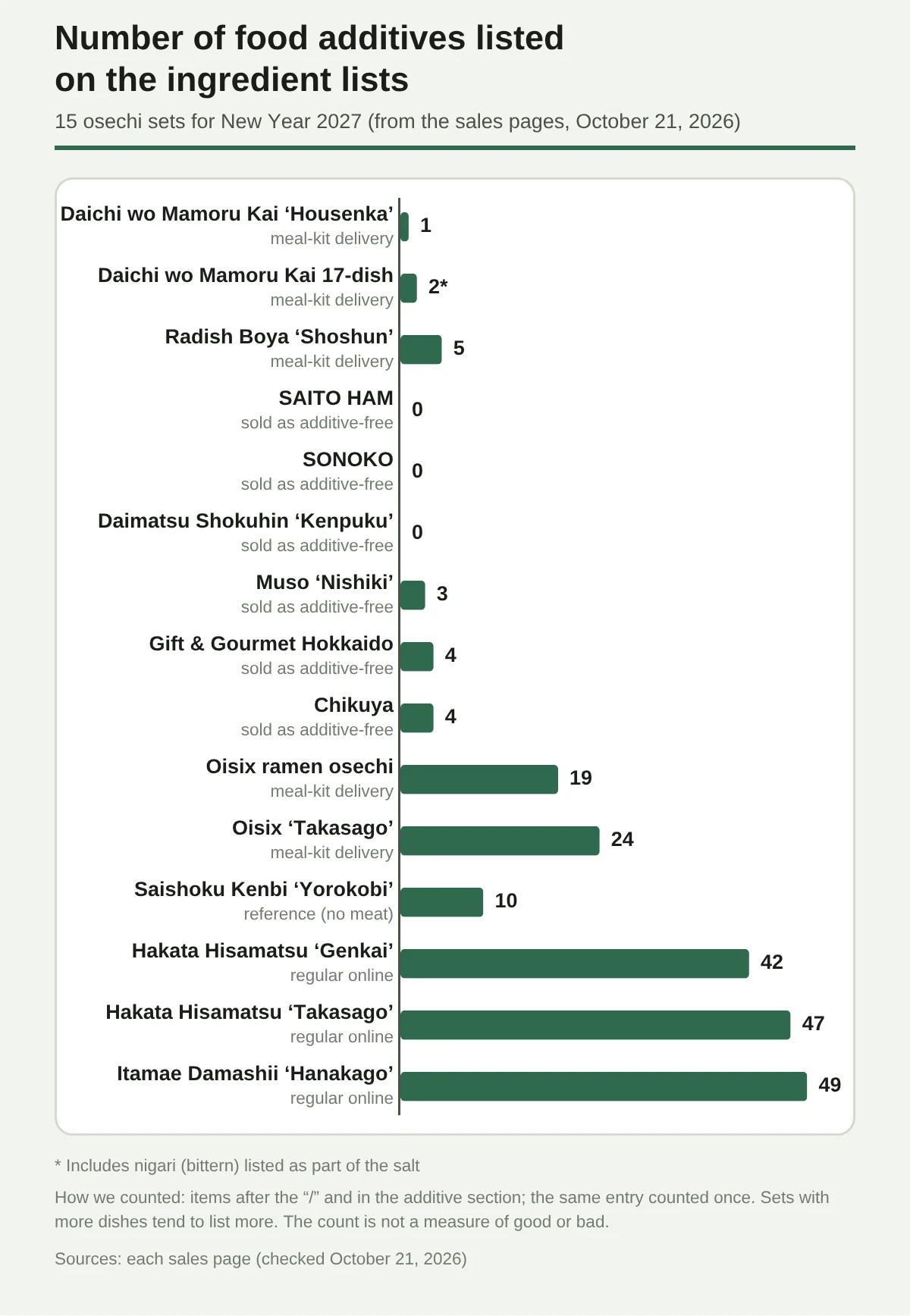
Keep in mind that the more dishes a set has, the more additive labels it tends to have. Regular mail-order osechi have many dishes (25–34) and are built from processed items such as ham, kamaboko, and kanroni (foods candied in syrup). Also, the number of labels does not show whether an osechi is good or bad. Food additives are used under usage standards set by the government.
Notes on reading the table
- Some food additives are not labeled. Additives used at the raw-material stage (carryover) and processing aids removed during production do not have to be labeled (our article on carryover)
- For SONOKO “和の重,” the ingredient list on the sales page covered only 15 of the 19 dishes (no listing for 鶏味噌松風 (chicken miso matsukaze), 蛸のポン酢餡かけ (octopus with ponzu sauce), 鯛真砂寄せ (sea bream roe terrine), or どんこ椎茸旨煮 (simmered donko shiitake))
- For Muso “錦,” one spot in the ingredient-table image (the 2nd line for 国産菜の花のお浸し, Japanese rapeseed greens ohitashi) ran outside its cell and could not be read
- Saishoku Kenbi “喜び” is a meat-free vegetarian osechi and does not carry a “mutenka” label. We include it for reference
What “mutenka” means differs from shop to shop
For the 7 osechi sold as “mutenka” or “no ○○ used” (including Daichi wo Mamoru Kai), we lined up the labels on the sales pages with the additives that appear in the ingredient lists.
| Osechi | “Mutenka” / “not used” claims on the sales page (as written) | Food additive labels in the ingredient list |
|---|---|---|
| Daichi wo Mamoru Kai “和風おせち17品セット” | “国産栗の無漂白栗きんとん” (unbleached kurikinton with Japanese chestnuts), “味付数の子(無漂白)” (seasoned kazunoko (unbleached)) | “トマト色素” (tomato color) (also “粗製海水塩化マグネシウム[にがり]” (crude seawater magnesium chloride [nigari]), listed as part of the salt) |
| SAITO HAM “国産 無添加 おせち 三段重” | “国産 無添加 おせち” (Japanese-made additive-free osechi), “厳選された国産食材のみを使用し、素材本来の味を大切に仕上げた” (made only with carefully selected Japanese ingredients, finished with care for their natural flavor) | None found |
| SONOKO “和の重” | “主原料国産で添加物不使用、ノンオイル調理の究極のおせち重。” (The ultimate osechi box: main ingredients from Japan, no additives used, cooked without oil.) | None found |
| Daimatsu Foods “無添加おせち料理 健福” | “調味料(アミノ酸等)、保存料、増粘剤、ph調整剤、酸化防止剤、乳化剤、酸味料不使用。” (No seasoning (amino acids, etc.), preservatives, thickeners, pH adjusters, antioxidants, emulsifiers, or acidulants used.), “各メニューの主たる原料は国産材料で取り揃え” (the main ingredients of each dish are sourced from Japan) | None found |
| Muso “和洋おせち 錦” | “調味料(アミノ酸)・タール系色素・香料・発色剤・リン酸塩不使用。” (No seasoning (amino acids), coal-tar dyes, flavorings, color fixatives, or phosphates used.), “不必要な添加物、遺伝子組み換え作物やゲノム編集食品を使用しないよう努めたおせちです。” (An osechi made while striving not to use unnecessary additives, genetically modified crops, or genome-edited foods.) | “着色料(ベニコウジ)” (coloring (red yeast rice)), “着色料(クチナシ)” (coloring (gardenia)), “重曹” (baking soda) |
| Gift & Gourmet Hokkaido “白木長手1段重 無添加おせち” | “主原料国産・天然・化学調味料不使用、合成着色料・合成保存料不使用の身体に優しい無添加おせちです。” (A body-friendly additive-free osechi: main ingredients from Japan, natural, no chemical seasonings, no synthetic colorings or synthetic preservatives used.) | “重炭酸ナトリウム” (sodium bicarbonate), “硫酸第一鉄” (ferrous sulfate), “紅麹色素” (red yeast rice color), “焼きミョウバン” (burnt alum) |
| Chikuya “手作り三段重おせち” | “調味料(アミノ酸等)、着色料、保存料、食肉製品にはリン酸塩、発色剤は使用しておりません。” (We do not use seasoning (amino acids, etc.), colorings, or preservatives, nor phosphates or color fixatives in meat products.) | “酒精” (ethyl alcohol), “重曹” (baking soda), “クチナシ” (gardenia), “水酸化Ca” (calcium hydroxide) |
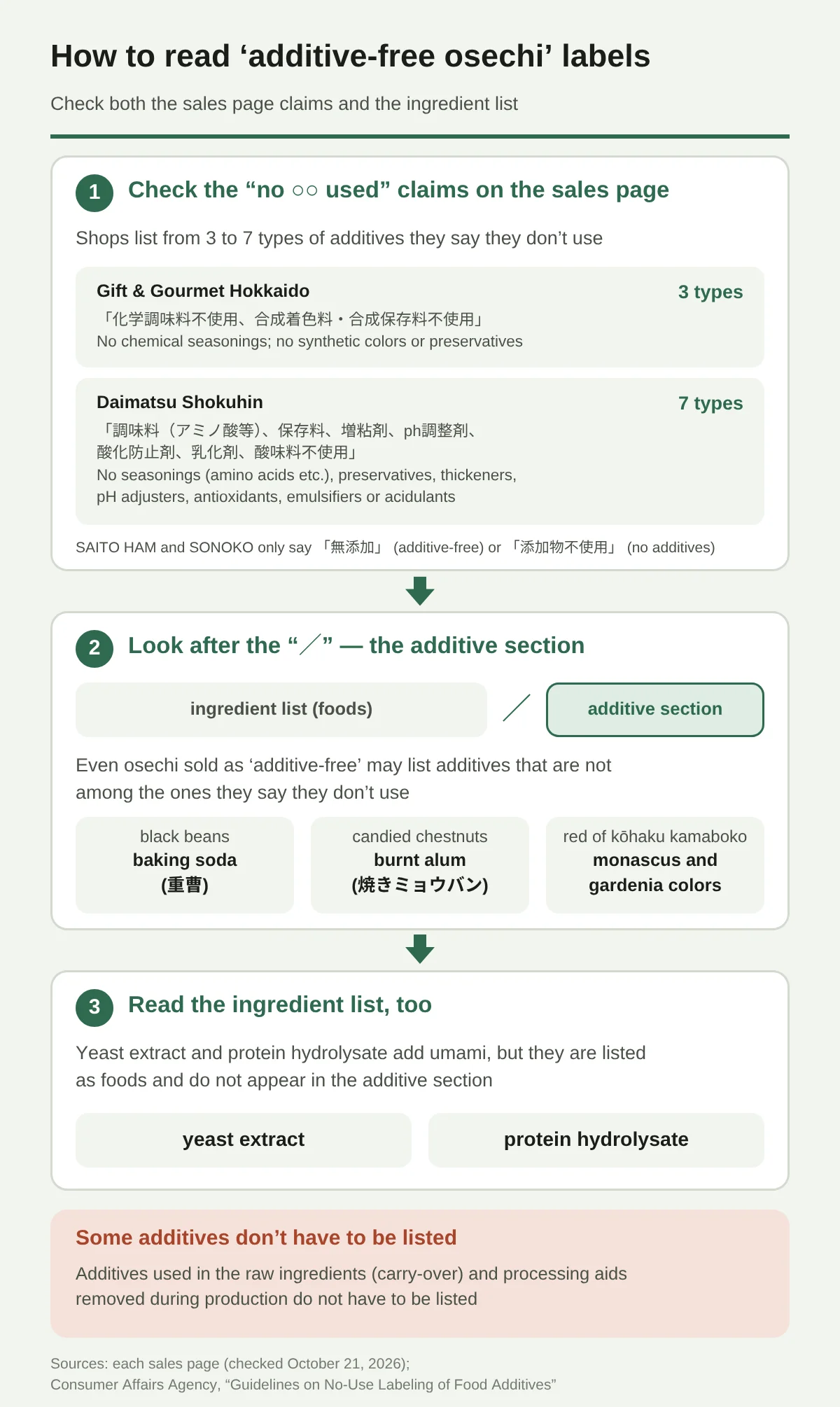
Lining them up shows the following:
- The additives that shops say they do not use range from 3 kinds (chemical seasonings, synthetic colorings, synthetic preservatives) to 7 kinds. SAITO HAM and SONOKO only write “mutenka” or “no additives used”
- Muso says it uses no “タール系色素” (coal-tar dyes), and Gift & Gourmet Hokkaido says no “合成着色料” (synthetic colorings), yet their ingredient lists include red yeast rice (ベニコウジ), gardenia (クチナシ), and red yeast rice color (紅麹色素). These are colorings taken from plants or microorganisms, and they are not among the targets the shops said they do not use
- Some osechi use additives that fall outside the targets they said they do not use, such as baking soda (sodium bicarbonate) in kuromame, burnt alum in candied chestnuts, and calcium hydroxide in konnyaku (konjac)
- The word “mutenka” alone does not mean no additives were used at all. The reliable way is to check both the details of the “no ○○ used” claim on the sales page and the ingredient list
Some osechi are made by the same company
Looking at the “製造者” (manufacturer) and “製造所” (production site) on the sales pages and ingredient tables, we found osechi that are made by the same company even though different shops sell them.
- 鹿祿 Co., Ltd. (Tokushima City): SONOKO “和の重,” Gift & Gourmet Hokkaido “白木長手1段重 無添加おせち,” and Radish Boya “Shoshun”
- Daimatsu Foods Co., Ltd. (Osaka City): 美食サークル “無添加おせち料理 健福” and Daichi wo Mamoru Kai “Housenka”
Even when the same company makes them, the combination of dishes and the ingredients differ from product to product. If you are concerned, check the ingredient list for each product.
Dish by dish
Kuromame: baking soda and iron
Some recipes for kuromame (sweet black soybeans) use baking soda (sodium hydrogen carbonate) to cook the beans soft and iron (such as ferrous sulfate) to keep them black.
| Osechi | Dish | Food additive labels |
|---|---|---|
| Daichi wo Mamoru Kai “Housenka” (宝泉華) | Simmered Japanese black soybeans | None |
| Daichi wo Mamoru Kai “和風おせち17品セット” | Plump kuromame cooked in a direct-fire kettle | None† |
| Radish Boya “Shoshun” (頌春) | Kuromame with gold leaf | “着色料(金箔)” (coloring (gold leaf)) |
| SAITO HAM “国産 無添加 おせち 三段重” | Tamba black soybeans | None |
| SONOKO “和の重” | Tamba black soybeans | None |
| Daimatsu Foods “無添加おせち料理 健福” | Simmered Tamba black soybeans | None |
| Muso “和洋おせち 錦” | Simmered black soybeans from Tamba-Sasayama | “重曹” (baking soda) |
| Gift & Gourmet Hokkaido “白木長手1段重 無添加おせち” | Kuromame | “重炭酸ナトリウム” (sodium bicarbonate), “硫酸第一鉄” (ferrous sulfate) |
| Chikuya “手作り三段重おせち” | Tamba black soybeans in syrup | “重曹” (baking soda) |
| Oisix “高砂” (Takasago) | Kuromame with gold leaf | “重曹” (baking soda), “硫酸第一鉄” (ferrous sulfate), “着色料(金箔)” (coloring (gold leaf)) |
| Saishoku Kenbi “喜び” (vegetarian) | Tamba black soybeans | “重曹” (baking soda) |
| Hakata Hisamatsu “玄海” (Genkai) | Kuromame in syrup | None |
| Hakata Hisamatsu “高砂” (Takasago) | Kuromame in syrup | None |
| Itamae Damashii “花籠” (Hanakago) | Kuromame | “重曹” (baking soda), “硫酸鉄” (iron sulfate) |
†Daichi wo Mamoru Kai lists “粗製海水塩化マグネシウム[にがり]” (crude seawater magnesium chloride [nigari]) as part of the salt.
Daichi wo Mamoru Kai explains on its sales page that the beans are “cooked without using baking soda.” For Hakata Hisamatsu’s kuromame in syrup, the additives column was empty.
Candied chestnuts and kinton: bleach, antioxidants, gardenia
In all 3 regular mail-order osechi, the candied chestnuts (kanroni) listed the same 3 items: bleach (sulfites), an antioxidant, and coloring (gardenia). Besides bleaching, sulfites prevent color changes and improve shelf life, and they are also used in kanpyo (dried gourd strips), amanatto (sugared beans), simmered beans, and more (Tokyo Metropolitan Government Bureau of Public Health, “食品衛生の窓” (Food Sanitation Window)).
| Osechi | Dish | Food additive labels |
|---|---|---|
| Daichi wo Mamoru Kai “Housenka” (宝泉華) | Kinton paste of Naruto Kintoki sweet potatoes from Tokushima | None |
| Daichi wo Mamoru Kai “Housenka” (宝泉華) | Candied Japanese chestnuts with inner skin | None |
| Daichi wo Mamoru Kai “和風おせち17品セット” | Unbleached kurikinton with Japanese chestnuts | None |
| Radish Boya “Shoshun” (頌春) | Kintoki sweet potato kinton | None |
| Radish Boya “Shoshun” (頌春) | Candied roasted chestnuts | None |
| SAITO HAM “国産 無添加 おせち 三段重” | Naruto sweet potato kinton | None |
| SONOKO “和の重” | Kintoki sweet potato kinton | None |
| SONOKO “和の重” | Candied chestnuts | None |
| Daimatsu Foods “無添加おせち料理 健福” | Candied Japanese chestnuts with inner skin | None |
| Daimatsu Foods “無添加おせち料理 健福” | Naruto Kintoki sweet potato paste | None |
| Muso “和洋おせち 錦” | Kinton | “着色料(クチナシ)” (coloring (gardenia)) |
| Muso “和洋おせち 錦” | Candied Japanese chestnuts (with inner skin) | None |
| Gift & Gourmet Hokkaido “白木長手1段重 無添加おせち” | Kinton | None |
| Gift & Gourmet Hokkaido “白木長手1段重 無添加おせち” | Candied chestnuts | “焼きミョウバン” (burnt alum) |
| Chikuya “手作り三段重おせち” | Kinton with Japanese chestnuts | “クチナシ” (gardenia) |
| Oisix “高砂” (Takasago) | Kurikinton | “トレハロース” (trehalose), “着色料(クチナシ)” (coloring (gardenia)) |
| Saishoku Kenbi “喜び” (vegetarian) | Roasted sweet potato kinton | “酸化防止剤” (antioxidant) |
| Hakata Hisamatsu “玄海” (Genkai) | Candied chestnuts | “漂白剤(亜硫酸塩)” (bleach (sulfites)), “酸化防止剤(V.C、EDTA-Ca・Na)” (antioxidants (vitamin C, calcium disodium EDTA)), “着色料(クチナシ)” (coloring (gardenia)) |
| Hakata Hisamatsu “玄海” (Genkai) | Kinton | “着色料(クチナシ)” (coloring (gardenia)) |
| Hakata Hisamatsu “高砂” (Takasago) | Candied chestnuts | “漂白剤(亜硫酸塩)” (bleach (sulfites)), “酸化防止剤(V.C、EDTA-Ca・Na)” (antioxidants (vitamin C, calcium disodium EDTA)), “着色料(クチナシ)” (coloring (gardenia)) |
| Hakata Hisamatsu “高砂” (Takasago) | Kinton | “着色料(クチナシ)” (coloring (gardenia)) |
| Itamae Damashii “花籠” (Hanakago) | Candied chestnuts | “酸化防止剤(V.C)” (antioxidant (vitamin C)), “着色料(クチナシ)” (coloring (gardenia)), “漂白剤(亜硫酸塩)” (bleach (sulfites)) |
| Itamae Damashii “花籠” (Hanakago) | Candied chestnuts with inner skin | None |
| Itamae Damashii “花籠” (Hanakago) | Kinton | “着色料(カロテノイド)” (coloring (carotenoid)) |
In osechi sold as “mutenka,” the chestnuts were mostly just chestnuts and sugar, while Gift & Gourmet Hokkaido used burnt alum. The yellow of kinton (sweet potato paste) splits into two groups: colored with gardenia, or made only from sweet potatoes and sugar. Daichi wo Mamoru Kai labels its dish “国産栗の無漂白栗きんとん” (unbleached kurikinton with Japanese chestnuts).
Kazunoko: seasoning (amino acids, etc.)
For seasoned kazunoko (herring roe), the regular mail-order osechi and Oisix “高砂” listed “調味料(アミノ酸等)” (seasoning (amino acids, etc.)).
| Osechi | Dish | Food additive labels |
|---|---|---|
| Daichi wo Mamoru Kai “Housenka” (宝泉華) | Seasoned kazunoko from Hokkaido herring | None |
| Daichi wo Mamoru Kai “和風おせち17品セット” | Seasoned kazunoko, unbleached | None† |
| Radish Boya “Shoshun” (頌春) | Kazunoko | None |
| Daimatsu Foods “無添加おせち料理 健福” | Seasoned kazunoko from Hokkaido herring | None |
| Muso “和洋おせち 錦” | Seasoned kazunoko from Hokkaido herring | None |
| Gift & Gourmet Hokkaido “白木長手1段重 無添加おせち” | Kazunoko | None |
| Chikuya “手作り三段重おせち” | Kazunoko marinated in Saikyo miso | “酒精” (ethyl alcohol) |
| Oisix “高砂” (Takasago) | Kazunoko in a savory marinade | “調味料(アミノ酸等)” (seasoning (amino acids, etc.)), “環状オリゴ糖” (cyclodextrin), “香料” (flavoring), “酸味料” (acidulant), “苦味料” (bittering agent) |
| Hakata Hisamatsu “玄海” (Genkai) | Seasoned kazunoko (small) | “調味料(アミノ酸等)” (seasoning (amino acids, etc.)), “トレハロース” (trehalose) |
| Hakata Hisamatsu “高砂” (Takasago) | Seasoned kazunoko | “調味料(アミノ酸等)” (seasoning (amino acids, etc.)), “トレハロース” (trehalose) |
| Itamae Damashii “花籠” (Hanakago) | Seasoned kazunoko | “調味料(アミノ酸等)” (seasoning (amino acids, etc.)) |
| Itamae Damashii “花籠” (Hanakago) | Kazunoko and edamame salad | “増粘剤(加工でん粉、増粘多糖類)” (thickener (modified starch, polysaccharide thickeners)), “酒精” (ethyl alcohol), “調味料(アミノ酸等)” (seasoning (amino acids, etc.)), “着色料(紅麹、クチナシ)” (coloring (red yeast rice, gardenia)), “香辛料抽出物” (spice extract) |
†Daichi wo Mamoru Kai lists “粗製海水塩化マグネシウム[にがり]” (crude seawater magnesium chloride [nigari]) as part of the salt.
Whether the kazunoko was bleached cannot be told from the ingredient list. Daichi wo Mamoru Kai writes “無漂白” (unbleached) in the dish name.
Red-and-white kamaboko: where the red color comes from
What gives the red in red-and-white kamaboko (fish cake) differed from product to product.
| Osechi | Dish | Food additive labels |
|---|---|---|
| Daichi wo Mamoru Kai “Housenka” (宝泉華) | Fluffy kamaboko | None |
| Daichi wo Mamoru Kai “和風おせち17品セット” | Red-and-white fish cake set (with the “寿” (kotobuki, celebration) design) | “トマト色素” (tomato color) |
| Radish Boya “Shoshun” (頌春) | Red-and-white kamaboko | “着色料(トマト色素)” (coloring (tomato color)) |
| Daimatsu Foods “無添加おせち料理 健福” | House-made kamaboko | None |
| Muso “和洋おせち 錦” | Odawara kamaboko, white | None |
| Muso “和洋おせち 錦” | Odawara kamaboko, red | “着色料(ベニコウジ)” (coloring (red yeast rice)) |
| Gift & Gourmet Hokkaido “白木長手1段重 無添加おせち” | Red-and-white shinjo (fish dumplings) | “紅麹色素” (red yeast rice color) |
| Oisix “飯田商店監修らぁ麺おせち” | Kotobuki naruto (fish cake with the “寿” design) | “調味料(アミノ酸等)” (seasoning (amino acids, etc.)), “着色料(ベニコウジ)” (coloring (red yeast rice)) |
| Oisix “高砂” (Takasago) | Checkered kamaboko | “着色料(クチナシ)” (coloring (gardenia)) |
| Itamae Damashii “花籠” (Hanakago) | Flower-shaped grilled kamaboko with cheese | “加工でん粉” (modified starch), “調味料(アミノ酸等)” (seasoning (amino acids, etc.)), “乳化剤” (emulsifier), “酸味料” (acidulant), “着色料(カロテノイド)” (coloring (carotenoid)) |
The sources of the red color split into tomato color, red yeast rice (red yeast rice color), gardenia, and carotenoids. The house-made kamaboko in Daimatsu Foods “健福” showed no label for a coloring source. For how Japanese and overseas rules on colorings differ, see our article on food colorings.
Umami sources: yeast extract and hydrolyzed protein count as “food”
Yeast extract and hydrolyzed protein (たん白加水分解物) are used to add umami, but they are treated as foods and are not written in the additives part of the label. Among the 15 sets, they appeared in SAITO HAM’s tazukuri (candied small sardines), in Daimatsu Foods “健福,” in Daichi wo Mamoru Kai’s simmered scallops, in the soy-marinated ikura (salmon roe) in Radish Boya “Shoshun,” and elsewhere.
If you want to avoid these umami sources, you need to look not only at the additives but at the whole ingredient list (our article on yeast extract, our article on umami seasonings).
Osechi from grocery delivery services
The grocery delivery services Oisix, Daichi wo Mamoru Kai, and Radish Boya make their osechi under the same in-house standards as their everyday foods.
In Daichi wo Mamoru Kai “和風おせち17品セット,” the only food additive label was the tomato color in the red-and-white kamaboko. The sales page explains the “unbleached” kurikinton and kazunoko, the kuromame “cooked without using baking soda,” and the kamaboko made “without starch or egg white as binders.” Frozen, chilled, and room-temperature items are delivered separately by temperature.
According to the ingredient PDF, the 3-tier “Housenka” (34 dishes, frozen) had only one food additive label: the coloring (beet red) in the tricolor habutae mochi (soft rice cakes). The sales page labels it “保存料不使用” (no preservatives used).
Radish Boya “Shoshun” (3 tiers, 51 dishes) is a chilled osechi that is never frozen, priced at ¥55,944 (tax incl., as shown on the sales page on October 21, 2026). It had 5 food additive labels: tomato color in the red-and-white kamaboko, gold leaf on the kuromame, caramel color in the bite-size kombu rolls, nigari (tofu coagulant) in the matsukaze and shinoda-maki, and calcium hydroxide in the konnyaku. The sales page explains that it is made “不要なものはなるべく使わず” (using as little of what is unnecessary as possible).
Oisix “高砂” is a 2-tier box of 25 Japanese and Western dishes, with 24 food additive labels. These include baking soda and ferrous sulfate (kuromame), gardenia (kurikinton, kamaboko), and seasoning (amino acids, etc.) (kazunoko). Oisix explains, “At Oisix, of course, we also check that our osechi meet the Oisix standards.”
Oisix “飯田商店監修らぁ麺おせち” leaves out classics such as kuromame and kazunoko and combines dishes supervised by a ramen shop with 3 servings of ramen (19 food additive labels).
For a comparison of the grocery delivery services themselves, see our grocery delivery comparison article.
Regular mail-order osechi
Hakata Hisamatsu and Itamae Damashii sell osechi with many dishes (25–34) starting at around ¥10,000. They have 42–49 food additive labels, including color fixatives (sodium nitrite, in ham and sausage), bleach (sulfites, in chestnuts), sweeteners (such as sorbitol and stevia), and pH adjusters. You can check which additive is used in which dish in the per-dish ingredient and additive tables on the sales pages.
They are not among the 15 sets in our table, but here are more mail-order osechi shops. Check the ingredients and additives on each sales page before you order.
For Japanese and overseas rules, see our article on color fixatives and our article on sweeteners.
Frozen vs. chilled osechi
Some osechi are delivered frozen and thawed before eating, while others are delivered chilled (fresh). Of the 15 sets, 11 were frozen, 3 were chilled, and 1 was delivered separately by temperature.
| Frozen osechi | Chilled (fresh) osechi | |
|---|---|---|
| After delivery | Store in the freezer and thaw before eating | Ready to eat as is |
| Thawing | Oisix “高砂” says “thawing takes 24 hours” | Not needed |
| Example of the use-by period | Daichi wo Mamoru Kai “和風おせち17品セット”: best-before “guaranteed for 14 days including the delivery day” (a mix of frozen, chilled, and room-temperature items) | Many are good only until around New Year’s Day |
*Thawing times and use-by periods differ by product. Follow the instructions that come with your order.
Some sellers explain that freezing keeps bacteria from growing at low temperatures, which makes it easier to produce osechi without preservatives. However, whether an osechi is frozen or chilled does not determine the number of additives. In our table, frozen osechi ranged widely, from 0 to 49 food additive labels.
Storage after delivery and food poisoning
Osechi are prepared dishes packed into tiered boxes ahead of time, so how you handle them after delivery matters. MHLW and MAFF give the following advice for preventing food poisoning at home:
- Avoid temperatures where bacteria grow easily: refrigerate at 10°C or below and freeze at −15°C or below
- Use clean serving chopsticks to take only what you will eat onto small plates, and put the rest back in the fridge right away
- Keep juices from raw meat and fish from dripping onto other foods
- When reheating prepared dishes, heat them thoroughly to the center
- Do not eat food that has been left out too long or that seems off
For simmered dishes made in large batches, such as nishime and chikuzenni (simmered vegetables and chicken), MAFF warns about Clostridium perfringens (ウェルシュ菌), which can survive cooking.
Osechi prices
According to a Teikoku Databank survey, the average price of osechi for the 2026 New Year (3-tier boxes or servings for 3–4 people, 110 companies) was ¥29,098 (tax incl.), up ¥1,054 (3.8%) from ¥28,044 the year before. About 60% of companies (65) raised prices, citing higher ikura (salmon roe) prices due to poor autumn salmon catches, higher prices for kazunoko, black soybeans, and eggs, and rising costs for materials such as the boxes and for delivery.
The 15 sets in this article ranged from ¥9,730 (Itamae Damashii “花籠,” early-bird price) to ¥55,944 (Radish Boya “Shoshun,” 3 tiers, 51 dishes). The osechi with 0–4 food additive labels cost ¥18,480–¥34,344.
FAQ
Does “mutenka osechi” mean no additives are used at all?
It depends on the product. Of the 7 sets sold as “mutenka” or “no ○○ used” in this article, 3 showed no food additive labels in their ingredient lists. The other 4 listed items such as tomato color, baking soda, gardenia, red yeast rice, and burnt alum. None of these are among the additives the sales pages said they do not use.
Does “no preservatives used” mean it won’t keep?
Instead of preservatives, some osechi are frozen or use ethyl alcohol (酒精). When your order arrives, check the use-by date and storage method for that product.
Are osechi with many food additive labels bad for you?
This article does not judge osechi as good or bad by the number of additives. Food additives are evaluated by the Food Safety Commission of Japan (FSCJ), and the government sets standards for how they may be used. If there is an additive you are concerned about, the reliable way is to check the ingredient list dish by dish when choosing. You can look up Japanese and overseas evaluations of each additive in our food additive database.
Also good to know
- The rules for “mutenka” and “not used” labels (the 10 types in the guidelines) → our article on the rules for “mutenka” labels
- Additives carried over from raw materials may not be labeled → our article on carryover
- How foods keep without preservatives → our article on preservatives
- How to compare grocery delivery services → our grocery delivery comparison article
Items featured in this article (summary)
Here is a recap of the items introduced in this article. The reasons and ingredients are in each section.
| Item | Where to buy |
|---|---|
| SAITO HAM “国産 無添加 おせち 三段重” | See on Rakuten (SAITO HAM) PR |
| SONOKO “和の重” (Wa no Ju) | See on Rakuten (SONOKO楽天市場店) PR |
| Daimatsu Foods “無添加おせち料理 健福” (Kenpuku) | See on Rakuten (美食サークル) PR |
| Muso “和洋おせち 錦” (Nishiki) | See on Rakuten (Utsuwa Marche) PR |
| Gift & Gourmet Hokkaido “白木長手1段重 無添加おせち” | See on Rakuten (ギフト&グルメ北海道) PR |
| Saishoku Kenbi “喜び” (Yorokobi, vegetarian) | See on Rakuten (菜食健美) PR |
| Hakata Hisamatsu “玄海” (Genkai) | See on Rakuten (博多久松) PR |
| Hakata Hisamatsu “高砂” (Takasago) | See on Rakuten (博多久松) PR |
| Itamae Damashii “花籠” (Hanakago) | See on Rakuten (板前魂) PR |
| Daichi wo Mamoru Kai osechi (2027) | 大地を守る会のおせち |
 PR |
|
| Radish Boya osechi (2027) | らでぃっしゅぼーやのおせち  PR |
| Oisix “高砂” (Takasago) (2027, frozen 2-tier box) | 【高砂】Oisixが総力を挙げて仕上げた決定版おせち 2027年  PR |
| Hakata Hisamatsu 2027 New Year osechi | 【博多久松2027年新春おせち特集】 |
 PR |
|
| Takumi Honpo (匠本舗) ryotei osechi (2027) | 匠本舗  PR |
| Gourmet Kineya (グルメ杵屋) osechi (2027) | お正月の食卓を華やかに彩るグルメ杵屋のおせち  PR |
Sources
- Ingredient lists, prices, and storage methods on each sales page (checked October 21, 2026): Oisix “飯田商店監修らぁ麺おせち” and “高砂”; Daichi wo Mamoru Kai “和風おせち17品セット” and “Housenka” (宝泉華) (ingredients from a PDF); Radish Boya “Shoshun” (頌春) (ingredients from a PDF); 健康惣菜 知久屋 (Chikuya) “手作り三段重おせち”; SAITO HAM “国産 無添加 おせち 三段重”; SONOKO “和の重”; 美食サークル “無添加おせち料理 健福”; Gift & Gourmet Hokkaido “白木長手1段重 無添加おせち”; Muso “和洋おせち 錦”; Saishoku Kenbi “喜び”; Itamae Damashii “花籠”; Hakata Hisamatsu “高砂” and “玄海”
- Consumer Affairs Agency, “食品添加物の不使用表示に関するガイドライン” (Guidelines on Labeling of Non-Use of Food Additives) (March 30, 2022)
- Tokyo Metropolitan Government Bureau of Public Health, “食品衛生の窓” (Food Sanitation Window), Main food additives by use: bleaching agents
- MHLW, “家庭でできる食中毒予防の6つのポイント” (6 points for preventing food poisoning at home)
- MAFF, “これで解決!食中毒予防のポイント” (Key points for preventing food poisoning) / “煮込み料理を楽しむために~ウェルシュ菌による食中毒にご注意を!!” (Enjoying stews safely: beware of food poisoning from Clostridium perfringens)
- Teikoku Databank, “2026年正月シーズン『おせち料理』価格調査” (Survey of osechi prices for the 2026 New Year season) (November 2025)
*This article does not make definitive claims about the safety or danger of any particular osechi or food additive. Ingredients, prices, and delivery dates may change. Before buying, check the latest information on the sales page. If you have food allergies, check each product’s allergen labeling.
Frequently asked questions
- What are the key findings on: What Is Additive-Free “Mutenka” Osechi? We Compared the Ingredient Lists of 15 New Year Osechi Sets (2027)?
- Osechi sold as additive-free (mutenka) listed 0-4 food additives, vs 42-49 for regular mail-order sets. Kuromame, chestnuts and kazunoko compared.
- What does the evidence show regarding: The rules for “mutenka” labels?
- “Mutenka” and “no ○○ used” labels on food are covered by the “Guidelines on Labeling of Non-Use of Food Additives” issued by the Consumer Affairs Agency in March 2022. Companies were asked to review their labels by the end of March 2024, and labels are now e…
- What does the evidence show regarding: We compared the ingredients of 15 osechi sets?
- On October 21, 2026, we copied the ingredient list for each dish from each sales page and counted the food additive labels.
- What “mutenka” means differs from shop to shop?
- For the 7 osechi sold as “mutenka” or “no ○○ used” (including Daichi wo Mamoru Kai), we lined up the labels on the sales pages with the additives that appear in the ingredient lists.
Related articles and databases
- Were “無添加” (Additive-Free) Labels Banned? Reading the Consumer Affairs Agency Guideline’s 10 Types from the Back Label
- What is carryover? How it differs from processing aids, and the additives that are not listed on labels even on “additive-free” foods
- Are preservatives bad for you? Types such as sorbic acid, what “preservative-free” hides, and how Japanese and overseas rules differ
- Are Food Colorings (Red No. 102, Yellow No. 4) Bad for You? Cancer Assessments and Whether They Are Banned Abroad, Checked Against Rules in Japan and Overseas
- Comparing 5 additive-conscious grocery delivery services: trial sets, ongoing costs, and additive standards (2026)
- Choosing Furusato Nozei Thank-You Gifts by Ingredients (2026): 12 Soy Sauce, Miso, Dashi, Ham, Soba and Mochi Compared
- Toshikoshi Soba and Ozoni Ingredients Compared (Year-End 2026): Buckwheat Share and What Is in Kirimochi