

Toshikoshi Soba and Ozoni Ingredients Compared (Year-End 2026): Buckwheat Share and What Is in Kirimochi

PR This article contains ads. “See on Rakuten” links are Rakuten affiliate links, and the Yukimura Soba button is an affiliate ad (A8.net). The “See on Amazon.co.jp” links are also affiliate links.
On New Year’s Eve we eat toshikoshi soba (New Year’s Eve soba), and at New Year we eat ozoni (New Year mochi soup). Many households buy bagged dried noodles or fresh soba for the first, and individually wrapped kirimochi (cut rice cakes) for the second.
But turn a soba package over, and the ingredient list (原材料名) starts with buckwheat flour on some products and with wheat flour on others. Some say “八割” (hachiwari, 80%) or “十割” (juwari, 100%), and some say nothing at all. Kirimochi is mostly just “水稲もち米” (glutinous rice), but not always.
Based on what the manufacturers published on their official sites as of November 2, 2026, this article compares in tables:
- The ingredients of 8 store-bought soba products (dried noodles, chilled boiled soba, and fresh soba), and the labeling rules for the share of buckwheat flour
- The ingredients of 6 kirimochi and marumochi (round rice cakes) for ozoni, and 2 white miso products used in Kansai-style ozoni
- The number of choking accidents involving mochi that rise at year-end and New Year, and how to prevent them
Bottom line: for soba, look at the first ingredient; for mochi, check whether it is glutinous rice only
- For soba, 30% buckwheat flour is enough to call it “soba”. For dried noodles (dried soba), the share must be written (“2割”, “1割未満”, etc.) only when buckwheat flour is under 30%. At 30% or more, the share does not have to be written
- Ingredients are listed in descending order by weight, so if “wheat flour” comes before “buckwheat flour,” buckwheat is under 50%. Among the 8 products here, 5 list buckwheat first and 3 list wheat flour first
- Only 2 products stated the buckwheat share officially: “十割そば” (Yamamoto Kajino) and “更科八割そば” (Obinata)
- Of the 5 dried noodle products, 4 listed no food additives. The 3 chilled boiled or fresh soba products listed 5 to 7 additive items
- Of the 6 kirimochi and marumochi, 4 contained nothing but glutinous rice (水稲もち米). The other 2 contained food additives for shelf life (pH adjuster and glycine), and one of them also used a Thai-made “glutinous rice flour preparation” and modified starch
- In the Tokyo Fire Department’s area, over the 5 years from 2020 to 2024 (Reiwa 2 to 6), 338 people were taken to hospital after choking on mochi and similar foods, and over 90% were aged 65 or older. January is the peak month
What is covered in this article
| For people who want to | What we cover | Where |
|---|---|---|
| Choose soba with more buckwheat flour | Dried noodles whose ingredient list starts with buckwheat flour, and juwari soba | Ingredients of 8 store-bought soba products |
| Compare fresh or boiled soba with dipping/soup sauce | 3 chilled soba products | Additives in chilled soba |
| Order toshikoshi soba by mail | Yukimura Soba (mail-order hand-cut fresh soba) | What the table shows |
| Choose mochi made only from glutinous rice | 6 kirimochi and marumochi products | Ingredients of 6 kirimochi and marumochi products |
| Make Kansai-style white miso ozoni | 2 white miso products | East and west ozoni |
Labeling rules for the share of buckwheat flour
How much buckwheat flour does a product need to be called “soba”? The rules differ for dried noodles and fresh noodles.
| Type | Rule | Buckwheat share | Share labeling |
|---|---|---|---|
| Dried noodles (dried soba) | Food Labeling Standards (Appended Table 19) | ― | Only when under 30%, write “2割” (20%), “20%”, etc. (under 10% is “1割未満”). At 30% or more, it need not be written |
| JAS for dried noodles (voluntary) | Japanese Agricultural Standard (JAS) for dried noodles | Standard grade 40% or more, premium grade 50% or more | The manufacturer chooses whether to put the JAS mark on the product |
| Fresh and boiled noodles | the Fair Competition Code for fresh noodle labeling | 30% or more (wheat flour 70% or less) to be called “soba” | ― |
* If the share is written near the product name in characters of 14 points or larger, it can be omitted from the labeling block.
The issue has even been raised in the Diet. A 2015 written inquiry in the House of Representatives pointed out that products listing “wheat flour” before “buckwheat flour” are thought to contain less than 50% buckwheat flour, yet are sold under names and slogans such as “Shinshu soba,” “Sarashina soba,” and “stone-ground.” The government’s written answer explained that dried soba with under 30% buckwheat flour must state the share under the Food Labeling Standards.
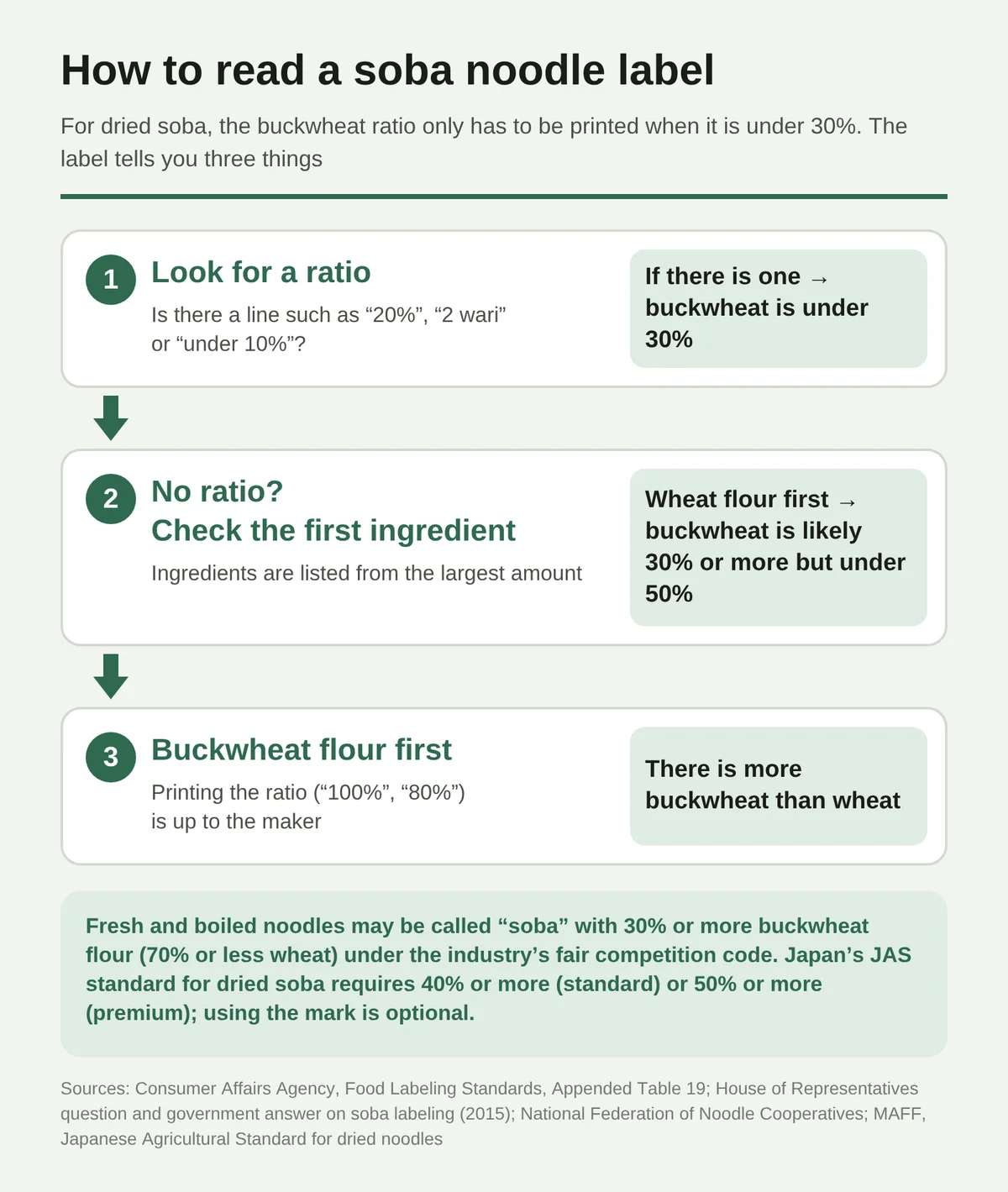
In summary, the label tells you the following three levels.
- “Buckwheat flour ○割” or “1割未満” is written → buckwheat flour is under 30%
- No share is written, and the first ingredient is wheat flour → buckwheat flour is thought to be 30% or more and under 50%
- No share is written, and the first ingredient is buckwheat flour → there is more buckwheat flour than wheat flour
Whether to write a share such as “十割” or “八割” is up to the manufacturer when it is 30% or more.
Ingredients of 8 store-bought soba products
The ingredient lists are the ones we checked on the manufacturers’ official sites on November 2, 2026.
| Product | Form | First ingredient | Official wording on buckwheat share | Additives listed | Salt equivalent (unit as shown on the label) |
|---|---|---|---|---|---|
| 山本かじの 元祖十割そば 200g (Yamamoto Kajino original juwari soba) See on Rakuten (Smile Spoon 楽天市場店) PR See on Amazon.co.jp PR |
Dried noodles | Buckwheat flour (the only ingredient) | “そば粉100%の十割そば” (juwari soba, 100% buckwheat flour) | 0 | Not shown on the official page (“食塩無添加”, no salt added) |
| おびなた 更科八割そば 240g (Obinata Sarashina hachiwari soba) See on Rakuten (Smile Spoon 楽天市場店) PR |
Dried noodles | Buckwheat flour, wheat flour, wheat protein, salt | “八割” (hachiwari, 80%) in the product name | 0 | 1.2 g (per serving, 80 g of noodles) |
| おびなた 蕎麦通のそば 240g (Obinata Sobatsu no Soba) See on Rakuten (Plus1マーケット楽天市場店) PR See on Amazon.co.jp PR |
Dried noodles | Buckwheat flour, wheat flour, salt | Not stated | 0 | 1.3 g (per serving, 80 g of noodles) |
| はくばく そば湯まで美味しい蕎麦 白 270g (Hakubaku Soba-yu made Oishii Soba, white) See on Rakuten (JET PRICE) PR |
Dried noodles | Buckwheat flour, wheat flour, wheat protein | Not stated | 0 | 0 to 0.04 g (90 g; no salt used) |
| はくばく 木曽路御岳そば 200g (Hakubaku Kisoji Ontake Soba) See on Rakuten (いいもん 楽天市場店) PR See on Amazon.co.jp PR |
Dried noodles | Wheat flour, buckwheat flour, salt, wheat protein | Not stated | 1 (modified starch) | 4.3 g (100 g) |
| シマダヤ「流水麺」国産そば粉使用 そば 2人前 (Shimadaya Ryusuimen soba with domestic buckwheat flour, 2 servings) | Chilled boiled soba | Buckwheat flour (domestic), wheat flour, wheat protein, dextrin, buckwheat leaf powder | Not stated | 5 | 0 to 0.4 g (per serving, 180 g) |
| マルちゃん そば 3食入 (Maruchan soba, 3 servings) | Chilled boiled soba | Wheat flour, buckwheat flour, wheat protein, egg white | Not stated | 5 | 0.0 g (per serving, 160 g) |
| マルちゃん 信州粗挽き生そば 2人前(つゆ付き) (Maruchan Shinshu coarse-ground fresh soba, 2 servings, with sauce) | Fresh soba | Noodles: wheat flour, buckwheat flour, fermented seasoning, wheat protein, salt, egg white | Not stated | 7 (noodles 3, sauce 4) | 7.1 g (per serving, 110 g of noodles and 1 sauce packet) |
* How we counted: each additive written after the “/” in the ingredient list is counted as one item. For Maruchan Shinshu coarse-ground fresh soba, the noodles and sauce are listed separately, so we added them (the acidulant appears in both the noodles and the sauce, so there are 6 types). Salt equivalents are in the units shown on the official pages (for dried noodles, the value is before boiling). Yamamoto Kajino’s official online shop page had no nutrition facts. The ingredients and nutrition facts for Shimadaya Ryusuimen were read from the package layout image on the official page.
What the table shows
- 5 products start with buckwheat flour (Yamamoto Kajino, 2 Obinata products, Hakubaku white, Shimadaya Ryusuimen), and 3 start with wheat flour (Hakubaku Kisoji Ontake, 2 Maruchan products)
- Some products, such as “蕎麦通のそば” and “そば湯まで美味しい蕎麦”, list buckwheat flour first but state no share. Because the share need not be written at 30% or more, the label only tells you that there is more buckwheat flour than wheat flour
- For Obinata’s “更科八割そば,” the product name says “八割” (80%) and the page heading says “SARASHINA 80%,” but the official page does not explain what the 80% is a share of
- The salt in dried noodles varies a lot by product. Hakubaku white and Yamamoto Kajino use no salt, while Hakubaku Kisoji Ontake has 4.3 g per 100 g. All are values before boiling; none of the official pages gave values after boiling
Besides dried noodles and chilled soba from the supermarket, you can also order fresh soba made by a soba restaurant by mail at year-end. Under the Fair Competition Code, fresh “soba” must contain at least 30% buckwheat flour. Check the buckwheat share and ingredients on the sales page.
Additives in chilled soba
Chilled boiled soba and fresh soba have a shorter shelf life than dried noodles, so they sometimes contain food additives to maintain quality.
| Product | Additives listed |
|---|---|
| Shimadaya Ryusuimen soba | Modified starch (加工澱粉), thickener (sodium alginate), pH adjuster, emulsifier, calcium phosphate |
| Maruchan soba, 3 servings | Glycine, thickener (alginic acid ester), acidulant, eggshell calcium, preservative (milt protein: derived from salmon) |
| Maruchan Shinshu coarse-ground fresh soba | Noodles: modified starch, sorbitol, acidulant / Sauce: seasoning (amino acids, etc.), alcohol (酒精), caramel color, acidulant |
- pH adjusters, acidulants, glycine, and alcohol (酒精) are food additives often used to extend the shelf life of foods (article on preservatives)
- Milt protein (shirako protein) is a preservative made from protein taken from the milt of herring or salmon. This product states “derived from salmon,” and “salmon” appears in its allergen labeling
- Thickeners, modified starch, and emulsifiers are used to keep the noodles’ texture and keep them from sticking together
- Seasoning (amino acids, etc.) in the sauce is a group name for umami food additives, and caramel color is a coloring (article on monosodium glutamate and article on caramel color)
Salt in the sauce
The official page for Maruchan Shinshu coarse-ground fresh soba gives a reference value: of the 7.1 g salt equivalent per serving, right after preparing kake soba (soba in hot broth) the standard way, 1.2 g is from the noodles and 4.0 g from the sauce. If you leave some of the soup, you take in correspondingly less.
For store-bought mentsuyu (noodle sauce), the salt in one bowl depends on the concentration ratio and how much you dilute it. The ingredients of mentsuyu also vary by product, such as with or without umami seasoning and alcohol (product pages for キッコーマン 濃いだし 本つゆ (Kikkoman Koidashi Hontsuyu), にんべん つゆの素ゴールド (Ninben Tsuyu no Moto Gold), ミツカン 追いがつおつゆ2倍 (Mizkan Oigatsuo Tsuyu, 2x), and 創味のつゆ (Somi no Tsuyu)). Japan’s target salt intake is under 7.5 g for men and under 6.5 g for women aged 18 and over (article on salt intake).
Buckwheat allergy
Buckwheat is one of the specified ingredients (特定原材料) whose labeling is mandatory under the Food Labeling Act. Medical institutions’ materials explain that buckwheat allergy often causes severe symptoms (anaphylaxis) even from a very small amount. All 8 products here had “そば” (buckwheat) in their allergen labeling.
Even products that do not use buckwheat, such as udon, may be made in the same factory as soba. If someone in your family has a buckwheat allergy, also check the “本品製造工場では〜” (made in a factory that also handles…) notice.
Ingredients of 6 kirimochi and marumochi products
| Product | Shape | Ingredients | Additives listed | Salt equivalent (unit as shown on the label) |
|---|---|---|---|---|
| サトウ食品 サトウの切り餅 パリッとスリット 700g (Sato Foods Sato no Kirimochi Paritto Slit) See on Rakuten (ドラッグWAKUWAKU) PR See on Amazon.co.jp PR |
Square | Glutinous rice (水稲もち米, 100% domestic) | 0 | 0 g (1 piece, 50 g) |
| 越後製菓 生一番 切り餅 1kg (Echigo Seika Namaichiban Kirimochi) See on Rakuten (マツモトキヨシ楽天市場店) PR See on Amazon.co.jp PR |
Square | Glutinous rice (水稲もち米, domestic) | 0 | 0.0 g (100 g) |
| 越後製菓 生一番 まる餅 1kg (Echigo Seika Namaichiban Marumochi) See on Rakuten (クイックファクトリー) PR See on Amazon.co.jp PR |
Round | Glutinous rice (水稲もち米, domestic) | 0 | 0 g (1 piece, 40 g) |
| たいまつ食品 杵つきもち おひとつパック まる 360g (Taimatsu Foods Kinetsuki Mochi Hitotsu Pack, round) | Round | Glutinous rice (水稲もち米, domestic) | 0 | 0.01 g (1 piece, 30 g) |
| 木村食品 国内産米生きり餅 ひと切れ包装 1kg (Kimura Foods domestic-rice fresh kirimochi, individually wrapped) | Square | Glutinous rice (水稲もち米, domestic) | 2 (pH adjuster, glycine) | Not shown on the official page |
| 木村食品 木村の切りもち 1kg (Kimura Foods Kimura no Kirimochi) | Square | Glutinous rice flour preparation (glutinous rice flour) (Thai-made), glutinous rice (Thai-made or Japan-made) | 3 (modified starch, pH adjuster, glycine) | Not shown on the official page |
* For Sato Foods, the values are those shown in the “商品仕様” (product specifications) section of the official page. The official product pages for the 2 Kimura Foods products had no nutrition facts.
- Of the 6 products, 4 contained nothing but glutinous rice (水稲もち米)
- The 2 Kimura Foods products contain pH adjuster and glycine for shelf life. The best-before periods on the official pages were 16 months after manufacture for the domestic-rice fresh kirimochi, and 7 months after manufacture for Kimura no Kirimochi
- The first ingredient of “木村の切りもち” is a glutinous rice flour preparation (もち米粉調製品). A “preparation” is glutinous rice flour mixed with something, but the label does not tell what was mixed in
Labeling rules for packaged mochi
- For mochi where glutinous rice is 50% or more of the ingredients, the origin of the glutinous rice (such as “domestic”) must be labeled (it is one of the 22 processed food categories with individual country-of-origin labeling rules). Even below 50%, the Rice Traceability Act requires passing on the origin of the rice used
- In 1993, the Japan Fair Trade Commission issued cease-and-desist orders to 4 manufacturers in the Kanto region (a violation of the Act against Unjustifiable Premiums and Misleading Representations) for packaged mochi that was mixed with waxy corn starch, not glutinous rice, but labeled “100% glutinous rice” and the like
How the shelf life works
Kirimochi made only from glutinous rice keeps for a long time because of how it is packaged, not because of food additives. For example, Echigo Seika’s official page describes a “double barrier package” with oxygen absorbers in both the individual wrapper and the outer bag. After opening, store it as the package instructs.
East and west ozoni
Ozoni varies greatly by region. The MAFF page puts the boundary for the shape of the mochi at around Sekigahara in Gifu Prefecture: square mochi is common in the east and round mochi in the west, and in Gifu, Ishikawa, Fukui, Mie, and Wakayama some places use both. For the soup, the basic style is clear soy sauce soup in Kanto and elsewhere, and white miso soup in Kansai, centered on Kyoto.
Here are the ingredients of 2 white miso products for Kansai-style white miso ozoni.
| Product | Ingredients | Additives listed | Salt equivalent (per 100 g) |
|---|---|---|---|
| ハナマルキ 京風白みそ 500g (Hanamaruki Kyoto-style white miso) See on Rakuten (食品のネットスーパー・さんきん) PR |
Rice, soybeans, salt, reduced starch syrup | Alcohol (酒精), vitamin B2 | 5.5 g (estimated) |
| マルコメ 料亭の味 白みそ 375g (Marukome Ryotei no Aji white miso) | Rice, soybeans, salt, reduced starch syrup | Alcohol (酒精) | 4.9 g (approximate) |
- Both products list “rice” first, meaning miso with a lot of rice koji (Hanamaruki’s official page describes it as “米こうじ22割,” 22-wari rice koji)
- Both have alcohol (酒精) after the “/”. Hanamaruki also has vitamin B2
- The salt equivalent was around 5 g per 100 g for both
The ingredients and salt of the instant dashi granules and dashi packs used in clear-soup ozoni and toshikoshi soba broth are compared in the article on dashi granules and dashi packs.
Watch out for choking on mochi
Accidents in which people choke on mochi increase at year-end and New Year.
- In the Tokyo Fire Department’s area, 338 people over the 5 years from 2020 to 2024 (Reiwa 2 to 6) were taken to hospital after choking on mochi and similar foods (including dango). Over 90% were aged 65 or older
- According to Tokyo Metropolitan Government materials, 453 people were taken to hospital over the 5 years from 2016 to 2020 (Heisei 28 to Reiwa 2), and 27 of them were confirmed dead at the first examination
- The Consumer Affairs Agency’s analysis shows that January accounts for about 30% of the year’s ambulance transports for mochi, the most of any month
The Tokyo Fire Department and the Consumer Affairs Agency recommend the following ways to prevent choking.
- Cut the mochi into small, easy-to-eat pieces
- Before eating mochi, drink tea or soup to moisten the throat
- Do not swallow in a hurry; chew well before swallowing
- When eating with infants or older adults, keep an eye on them
- Learn first aid (such as back blows) in advance for emergencies
Frequently asked questions
How much buckwheat flour must toshikoshi soba contain to be called “soba”?
For fresh and boiled noodles, the Fair Competition Code allows the name “soba” only for products with 30% or more buckwheat flour (70% or less wheat flour). Dried noodles can be sold as “soba” even with under 30% buckwheat flour, but then the share must be written, such as “2割” or “1割未満”.
If wheat flour comes first in the ingredients, is there little buckwheat?
Ingredients are listed in descending order by weight, so if wheat flour comes first, buckwheat flour is thought to be less than wheat flour (under 50%). If no share is stated, dried noodles are 30% or more.
Is there kirimochi made only from glutinous rice?
Of the 6 products here, 4 (Sato Foods, Echigo Seika’s kirimochi and marumochi, and Taimatsu Foods) contained nothing but glutinous rice (水稲もち米).
How can I avoid choking on mochi?
The Tokyo Fire Department recommends four things: cut it small, moisten your throat with tea or soup before eating, chew well before swallowing, and watch over older adults and infants when they eat.
Also worth knowing
- Nabe broth ingredients and salt per serving → article on nabe broth
- What “additive-free” means in osechi → article on additive-free osechi
- Target salt intake and how to reduce it → article on salt intake
- Food additives for shelf life → article on preservatives
- Labeling rules for “additive-free” and “not used” → article on “additive-free” labeling rules
Summary of products featured in this article
Here are the products featured in the article once more. The reasons and ingredients are in each section.
| Product featured | Where to buy |
|---|---|
| 山本かじの 元祖十割そば 200g (Yamamoto Kajino original juwari soba) | See on Rakuten (Smile Spoon 楽天市場店) PR See on Amazon.co.jp PR |
| おびなた 更科八割そば 240g (Obinata Sarashina hachiwari soba) | See on Rakuten (Smile Spoon 楽天市場店) PR |
| おびなた 蕎麦通のそば 240g (Obinata Sobatsu no Soba) | See on Rakuten (Plus1マーケット楽天市場店) PR See on Amazon.co.jp PR |
| はくばく そば湯まで美味しい蕎麦 白 270g (Hakubaku Soba-yu made Oishii Soba, white) | See on Rakuten (JET PRICE) PR |
| はくばく 木曽路御岳そば 200g (Hakubaku Kisoji Ontake Soba) | See on Rakuten (いいもん 楽天市場店) PR See on Amazon.co.jp PR |
| 雪村そば (Yukimura Soba; mail-order Shinshu hand-cut fresh soba) | 雪村そば  PR |
| サトウ食品 サトウの切り餅 パリッとスリット 700g (Sato Foods Sato no Kirimochi Paritto Slit) | See on Rakuten (ドラッグWAKUWAKU) PR See on Amazon.co.jp PR |
| 越後製菓 生一番 切り餅 1kg (Echigo Seika Namaichiban Kirimochi) | See on Rakuten (マツモトキヨシ楽天市場店) PR See on Amazon.co.jp PR |
| 越後製菓 生一番 まる餅 1kg (Echigo Seika Namaichiban Marumochi) | See on Rakuten (クイックファクトリー) PR See on Amazon.co.jp PR |
| ハナマルキ 京風白みそ 500g (Hanamaruki Kyoto-style white miso) | See on Rakuten (食品のネットスーパー・さんきん) PR |
Sources
- Product pages on each manufacturer’s official site (Hakubaku, Obinata, Yamamoto Kajino, Shimadaya, Toyo Suisan, Sato Foods, Echigo Seika, Taimatsu Foods, Kimura Foods, Hanamaruki, Marukome). Checked November 2, 2026
- Consumer Affairs Agency, Food Labeling Standards (Appended Table 19: buckwheat flour share in dried soba); National Consumer Affairs Center of Japan, “Consumer Trouble Explanations” (labeling of buckwheat flour share in dried soba)
- House of Representatives, “Written Inquiry on Quality Labeling of Japanese Soba” and the government’s written answer (2015)
- All-Japan Noodle Manufacturers Cooperative Association, “Types of Fresh Noodles” (definitions in the Fair Competition Code for fresh noodle labeling)
- MAFF, “Japanese Agricultural Standard for Dried Noodles” and “Mochi Shapes Differ by Region”
- Japan Fair Trade Commission cease-and-desist orders on packaged mochi (February 25, 1993; reported by Nihon Shokuryo Shimbun)
- Tokyo Fire Department, “Beware of Choking Accidents from Mochi and Other Foods!”; Tokyo Metropolitan Government Bureau of Citizens and Cultural Affairs, “Beware of Choking on Mochi!” (December 2021); Consumer Affairs Agency, “Please Beware: Choking Accidents among Older Adults!” (December 2018)
Shop in the US PR
Links to shops that deliver in the US. These are not recommendations of a specific product; check the label and certifications before you buy. Urayomi may earn a commission from purchases made through these links. As an Amazon Associate, Urayomi earns from qualifying purchases.
Products related to this article PR
Products whose labels Urayomi has read, picked because their ingredients or category relate to this article. This is not a recommendation or a safety rating. The shop buttons are affiliate links; prices are reference prices on the date we checked.
- キッコーマン 濃いだし 本つゆ 1LRead the label (in Japanese) →
- にんべん つゆの素ゴールド 500ml(3倍濃厚)Read the label (in Japanese) →
- 追いがつおつゆ2倍 500mlOigatsuo Tsuyu 2x (bonito-boosted noodle soup base, 2x concentrate), 500 mlRead the label →
- 越後製菓 生一番 切り餅 1kgRead the label (in Japanese) →
- 越後製菓 生一番 まる餅 1kgRead the label (in Japanese) →
- はくばく 木曽路御岳そば 200gRead the label (in Japanese) →
Frequently asked questions
- What are the key findings on: Toshikoshi Soba and Ozoni Ingredients Compared (Year-End 2026): Buckwheat Share and What Is in Kirimochi?
- Labels of 8 soba, 6 rice cakes and 2 white miso compared. Dried soba under 30% buckwheat must state the share; wheat flour listed first means under 50%.
- What does the evidence show regarding: Labeling rules for the share of buckwheat flour?
- How much buckwheat flour does a product need to be called “soba”? The rules differ for dried noodles and fresh noodles.
- What does the evidence show regarding: Ingredients of 8 store-bought soba products?
- The ingredient lists are the ones we checked on the manufacturers’ official sites on November 2, 2026.
- What does the evidence show regarding: Ingredients of 6 kirimochi and marumochi products?
- * For Sato Foods, the values are those shown in the “商品仕様” (product specifications) section of the official page. The official product pages for the 2 Kimura Foods products had no nutrition facts.
Related articles and databases
- Store-Bought Nabe Broths: Ingredients and Salt in 18 Products (Winter 2026)
- What Is Additive-Free “Mutenka” Osechi? We Compared the Ingredient Lists of 15 New Year Osechi Sets (2027)
- Where Does “Too Much Salt” Begin? Checking Japan’s Salt Intake Trend, Target Amounts, and the Links to High Blood Pressure and Stomach Cancer Against National Surveys and Studies
- Are preservatives bad for you? Types such as sorbic acid, what “preservative-free” hides, and how Japanese and overseas rules differ
- What Is Monosodium Glutamate (Umami Seasoning)? Checking the Claims About Petroleum, GMOs, Intake Limits, and a "Damaged Sense of Taste"
- Were “無添加” (Additive-Free) Labels Banned? Reading the Consumer Affairs Agency Guideline’s 10 Types from the Back Label
- Choosing Furusato Nozei Thank-You Gifts by Ingredients (2026): 12 Soy Sauce, Miso, Dashi, Ham, Soba and Mochi Compared
- Dashi Granules and Dashi Packs Compared (16 Products): Ingredients, Salt and What “Additive-Free” Means