

Dashi Granules and Dashi Packs Compared (16 Products): Ingredients, Salt and What “Additive-Free” Means

PR This article contains ads. “See on Rakuten” links are Rakuten affiliate links, and the Marutomo official online store button is an affiliate ad (A8.net). The “See on Amazon.co.jp” and “See on Yahoo! Shopping” links are also affiliate links.
Miso soup, simmered dishes, the clear soup for ozoni (New Year mochi soup), the broth for toshikoshi soba (New Year’s Eve noodles). Dashi (soup stock), which we use almost every day, comes in many forms: dashi granules that dissolve in hot water, dashi packs that are simmered like tea bags, and powdered dashi used as is.
Some people ask whether instant dashi granules are bad for you. But when you read the back of the package, the difference between dashi granules and dashi packs shows up in the order of the ingredients and in the salt.
Based on what the manufacturers publish on their official sites, this article covers:
- The ingredients and salt equivalent of 9 dashi granules and 7 dashi packs and powdered dashi
- The rules for “fuumi chomiryo” (flavor seasoning, the legal name for instant dashi), which most dashi granules fall under (the Japanese Agricultural Standard (JAS) and the Food Labeling Standards)
- How to read the labels “化学調味料無添加” (no chemical seasoning added) and “食塩無添加” (no salt added)
- What is known about histamine and benzo[a]pyrene in katsuobushi (dried bonito), and iodine in kombu (kelp)
Bottom line: you can compare dashi granules by the first ingredient and the salt per gram
- Of the 9 dashi granules, 3 list salt first in the ingredient list, 4 list glucose or sugars first, and 2 list flavor ingredients (風味原料, such as katsuobushi) first
- Salt equivalent per gram ranged from 0.03 to 0.42 g, a difference of more than 10 times. The lowest are the two “食塩無添加” (no salt added) Sozairyoku Dashi products; the highest are Hondashi, Hondashi Iriko Dashi and Yamaki’s yaki-ago (grilled flying fish) dashi
- 6 of the 9 use “調味料(アミノ酸等)” (seasoning (amino acids, etc.)) and 3 do not. Even those 3 contain umami sources such as yeast extract, as foods
- Dashi packs include products made only of ingredients such as fish flakes, niboshi (dried sardines) and kombu, and products flavored with salt, yeast extract and the like. The salt equivalent was 0.3 to 1.06 g per pack
- “化学調味料” (chemical seasoning) is not a term in the Food Labeling Standards. The Consumer Affairs Agency’s 2022 guidelines list “化学調味料無添加” as an example of a claim that needs caution
What is covered in this article
| For people who want to | What we cover | Where |
|---|---|---|
| Compare the salt in their usual dashi granules | 9 dashi granules (Hondashi, Shimaya, Riken Vitamin, Yamaki, Marutomo) | Ingredients and salt of 9 dashi granules |
| Choose a lower-salt dashi granule | No-salt-added and reduced-salt dashi granules | Salt equivalent per gram |
| Use dashi made only from ingredients | 7 dashi packs and powdered dashi | 7 dashi packs and powdered dashi |
| Choose katsuobushi or dashi packs from a specialty shop | Marutomo official online store | 7 dashi packs and powdered dashi |
Dashi granules are “fuumi chomiryo” (flavor seasoning)
Most granulated or powdered dashi bases sold in supermarkets have 風味調味料 (fuumi chomiryo, flavor seasoning) as their name on the label.
The Japanese Agricultural Standard (JAS) defines flavor seasoning as a product made by adding sugars, salt and the like to seasoning (amino acids, etc.) and flavor ingredients, then drying it into a powder or granules, used to add the aroma and taste of the flavor ingredients when cooking. Flavor ingredients (風味原料) are powders or extracts of katsuobushi and other dried fish, niboshi, kombu, scallop adductor muscle, dried shiitake and so on.
| Item | JAS standard |
|---|---|
| Sugar content | 40% or less |
| Salt content | 35% or less |
| Sugar and salt combined | 65% or less |
| Share of flavor ingredients | 8.3% or more |
| Starch and dextrin | 2% or less |
Under the Food Labeling Standards too, a product whose flavor ingredients make up 8.3% or more carries the type of flavor ingredient after the name, as in “風味調味料(かつお)” (flavor seasoning (bonito)). In a document submitted to a Consumer Affairs Agency study group in March 2025, the industry group (the flavor seasoning council) asked to keep this 8.3% line as “necessary for the quality of dashi”.
Put another way, the JAS upper limits for sugar and salt mean that even a flavor seasoning that meets the standard may be more than half sugar and salt by weight. This is why salt or sugars often come first in the ingredient list of dashi granules.
Ingredients and salt of 9 dashi granules
| Product | First item in ingredient list | Flavor ingredients | Seasoning (amino acids, etc.) | Salt equivalent (per labeled unit) |
|---|---|---|---|---|
| 味の素 ほんだし 40g (Ajinomoto Hondashi, 40 g) See on Rakuten (文具便 楽天市場店) PR See on Amazon.co.jp PR |
Salt, sugars (sugar, lactose) | katsuobushi powder, bonito extract | Yes | 0.40 g (1 g per bowl of miso soup) |
| 味の素 ほんだし いりこだし 8g×14本 (Ajinomoto Hondashi Iriko Dashi, 14 sticks of 8 g) See on Rakuten (ニシムタ 楽天市場店) PR See on Amazon.co.jp PR |
Salt, sugars (sugar, lactose) | niboshi (dried sardine) powder, niboshi sardine extract | Yes | 0.42 g (1 g per bowl of miso soup) |
| ヤマキ 長崎県産焼きあごだし 4g×10袋 (Yamaki Nagasaki Yaki-ago Dashi, 10 bags of 4 g) See on Rakuten (天満市場 楽天市場店) PR See on Amazon.co.jp PR |
Salt, glucose | grilled flying fish (ago) niboshi powder | Yes | 0.4 g (about 1 g per bowl of miso soup) |
| シマヤ だしの素(粉末)10g×20袋 (Shimaya Dashi no Moto, powder, 20 bags of 10 g) See on Rakuten (ゴダイ 楽天市場店) PR See on Amazon.co.jp PR |
Glucose, salt | katsuobushi powder, bonito extract powder | Yes | 3.7 g (1 bag, 10 g) |
| シマヤ 塩分55%カット だしの素(粉末)5g×20袋 (Shimaya 55% Reduced-Salt Dashi no Moto, powder, 20 bags of 5 g) See on Rakuten (MIKIYA) PR See on Amazon.co.jp PR |
Glucose, flavor ingredients, salt | katsuobushi powder | Yes | 0.73 g (1 bag, 5 g) |
| シマヤ 自然派思考だし 鰹とれたて加工(顆粒)6g×7本 (Shimaya Shizenha Shiko Dashi, fresh-processed bonito, granules, 7 sticks of 6 g) See on Rakuten (クスリのアオキ楽天市場店) PR |
Glucose, lactose, salt | katsuobushi powder, bonito extract powder | No (no additives listed) | 1.1 g (1 stick, 6 g) |
| マルトモ 減塩だしの素 50g×2袋 (Marutomo Reduced-Salt Dashi no Moto, 2 bags of 50 g) | Sugars (granulated sugar, lactose), salt | katsuobushi powder, soda-bonito (sodagatsuo) katsuobushi powder, bonito extract | Yes | 0.27 g (1 g per bowl of miso soup) |
| 理研ビタミン 素材力だし 本かつおだし 5g×12本 (Riken Vitamin Sozairyoku Dashi, Honkatsuo Dashi, 12 sticks of 5 g) See on Rakuten (名倉商事) PR See on Amazon.co.jp PR |
Flavor ingredients, starch hydrolysate | katsuobushi powder, katsuobushi extract powder, bonito extract powder, kombu powder | No | 0.03 g (1 g per bowl of miso soup) |
| 理研ビタミン 素材力だし こんぶだし 5g×12本 (Riken Vitamin Sozairyoku Dashi, Kombu Dashi, 12 sticks of 5 g) See on Rakuten (名倉商事) PR See on Amazon.co.jp PR |
Flavor ingredients, starch hydrolysate | kombu extract powder, kombu powder | No | 0.04 g (1 g per bowl of miso soup) |
※Ingredients and nutrition facts are as shown on the manufacturers’ official product pages (Hondashi checked on October 2, 2026; the others on November 2, 2026). Yeast extract and protein hydrolysate, the umami sources, are treated as foods, so they are omitted from the table (article on yeast extract).
Salt equivalent per gram
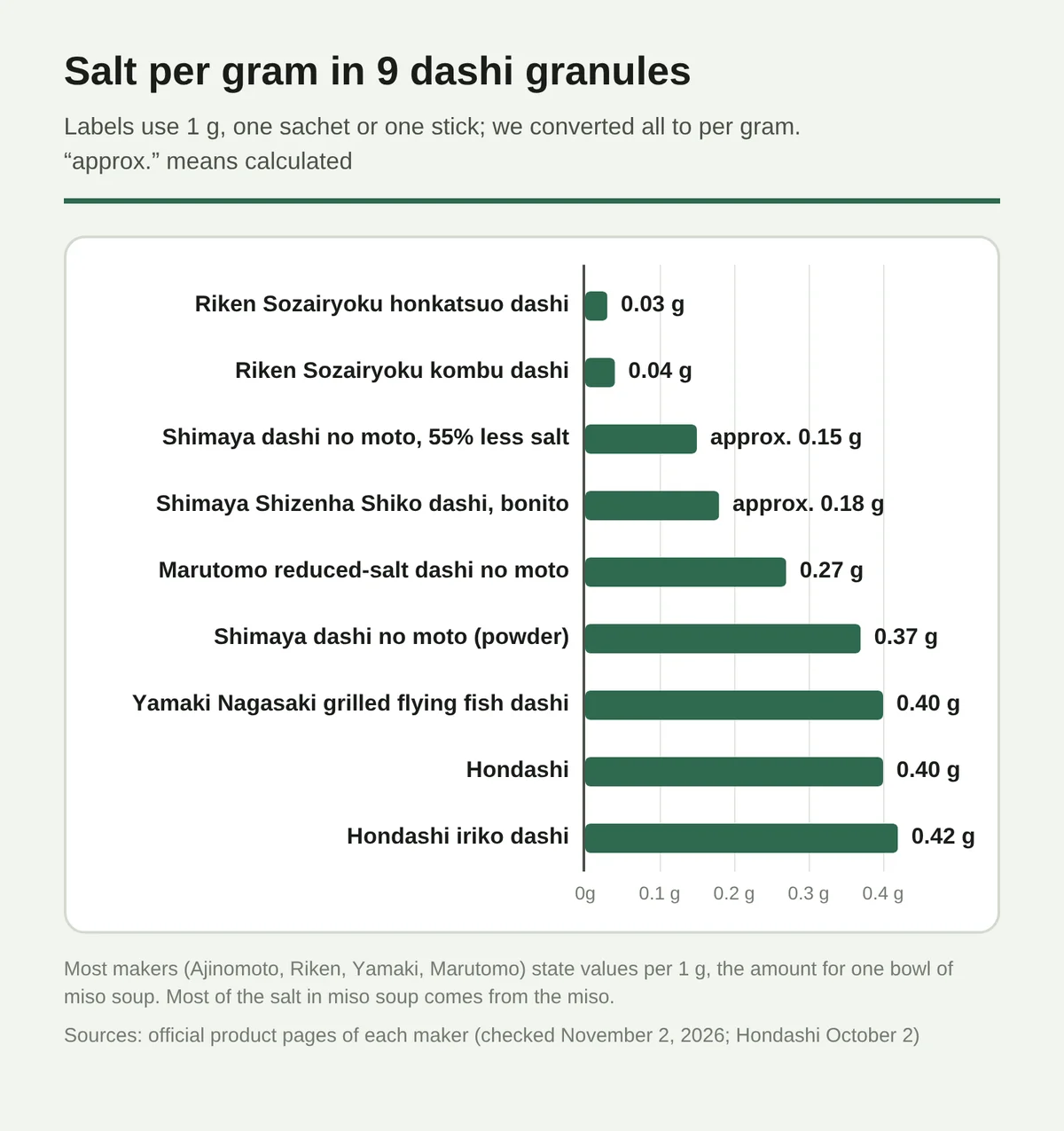
The labeled units differ (“1 g”, “1 bag of 10 g”, “1 stick of 6 g”), so the figures are lined up per gram.
| Product | Salt equivalent per gram | Basis of calculation |
|---|---|---|
| Sozairyoku Dashi Honkatsuo Dashi | 0.03 g | As labeled (per gram) |
| Sozairyoku Dashi Kombu Dashi | 0.04 g | As labeled (per gram) |
| Shimaya 55% Reduced-Salt Dashi no Moto | about 0.15 g | 0.73 g ÷ 5 g |
| Shimaya Shizenha Shiko Dashi, fresh-processed bonito | about 0.18 g | 1.1 g ÷ 6 g |
| Marutomo Reduced-Salt Dashi no Moto | 0.27 g | As labeled (per gram) |
| Shimaya Dashi no Moto (powder) | 0.37 g | 3.7 g ÷ 10 g |
| Yamaki Nagasaki Yaki-ago Dashi | 0.4 g | As labeled (per gram) |
| Hondashi | 0.40 g | As labeled (per gram) |
| Hondashi Iriko Dashi | 0.42 g | As labeled (per gram) |
- 4 of the 5 companies (Ajinomoto, Riken Vitamin, Yamaki and Marutomo) gave their nutrition facts per bowl of miso soup (1 g). Ajinomoto’s customer service page gives the guideline for Hondashi as 1 heaping teaspoon (4 g) per 600 mL of water (4 servings)
- If the amount used per bowl is the same, the lower the salt per gram of the dashi granules, the less of the salt in the miso soup comes from the dashi. But much of the salt in miso soup also comes from the miso and soy sauce
- “減塩” (reduced salt) and “塩分55%カット” (55% less salt) are comparisons with that maker’s regular product. Marutomo says “当社一般品よりも塩分を30%カット” (30% less salt than our regular product), and Shimaya says “塩分を55%カット” (55% less salt)
What the table shows
- 7 products list salt or sugars first in the ingredient list. Both are bulking ingredients within the JAS limits
- Products containing lactose (a sugar from milk) carry “乳成分” or “乳” (milk) in the allergen labeling (Hondashi, Iriko Dashi and Shizenha Shiko Dashi)
- Shimaya’s Shizenha Shiko Dashi has no slash (/) in its ingredient list and no additive entries. Its umami comes from foods such as protein hydrolysate and yeast extract
- The official pages of the two Sozairyoku Dashi products say “厳選素材・食塩無添加” (carefully selected ingredients, no salt added), and salt does not appear in their ingredient lists. Their name is “和風だしの素” (Japanese-style dashi base)
7 dashi packs and powdered dashi
A dashi pack is simmered like a tea bag to make dashi. Powdered dashi is ground ingredients that you dissolve and use as is.
| Product | Form | Ingredients | Additives listed | Salt equivalent (per labeled unit) |
|---|---|---|---|---|
| まえかわ だしパック 十二単 10g×20袋 (Maekawa Dashi Pack Junihitoe, 20 bags of 10 g) See on Rakuten (にっぽん津々浦々) PR See on Amazon.co.jp PR See on Yahoo! Shopping PR |
Dashi pack | sardine flakes, niboshi sardines, flying fish niboshi, katsuobushi, uruma sardine flakes, soda-bonito katsuobushi, kombu, dried shiitake, dried shrimp, mackerel scad (muroaji) flakes, tuna flakes | None | 0.3 g (1 bag, 10 g) |
| かね七 料亭仕込み 天然だしの素パック 8g×10袋×3 (Kane7 Ryotei Jikomi Natural Dashi Pack, 3 sets of 10 bags of 8 g) See on Rakuten (くすりのiQ・送料無料) PR See on Amazon.co.jp PR See on Yahoo! Shopping PR |
Dashi pack | katsuobushi, niboshi sardines, kombu, shiitake, niboshi horse mackerel | None | 0.3 g (1 bag, 8 g) |
| カネソ 匠味パック 京風まぐろだし 10g×8袋 (Kaneso Takumi Pack Kyoto-style Tuna Dashi, 8 bags of 10 g) | Dashi pack | tuna flakes, kombu | None | 0.1 g (per 100 mL of dashi broth) |
| 久原本家 茅乃舎だし 8g×30袋 (Kubara Honke Kayanoya Dashi, 30 bags of 8 g) See on Rakuten (久原本家公式) PR See on Amazon.co.jp PR See on Yahoo! Shopping PR |
Dashi pack (contents are powder) | flavor ingredients (katsuobushi, niboshi sardine extract powder, grilled flying fish, uruma sardine flakes, kombu), starch hydrolysate, yeast extract, salt, powdered soy sauce, fermented seasoning | None | 1.06 g (1 bag, 8 g) |
| オリッジ イブシギンのしぜんだし 粉末ボトル 80g (Orijji Ibushigin no Shizen Dashi, powder bottle, 80 g) See on Rakuten (ヒロセネットショップ) PR |
Powder | smoke-dried katsuobushi (arabushi), kombu powder | None | 1.09 g (whole 80 g bottle) |
| 自然の恵味だし 無添加プレミアム 300g (Shizen no Megumi Dashi, “Additive-Free” Premium, 300 g) | Powder | starch hydrolysate, sardine, kombu, bonito, shiitake, odorless garlic | None | 4.25 g (100 g) |
| 千年前の食品舎 だし&栄養スープ 500g (Sennen-mae no Shokuhinsha Dashi & Nutrition Soup, 500 g) See on Rakuten (正規取扱店と表示している店) PR |
Powder | starch hydrolysate, Japanese anchovy, bonito, kombu, log-grown shiitake, odorless garlic | None | Not shown on the official page |
※For Maekawa, Kane7, Kaneso and Ibushigin, Urayomi photographed the package and transcribed it (the others are from the official pages). Kaneso’s salt equivalent is per 100 mL of dashi broth, a different unit from the others.
- None of the 7 products listed any additives
- However, Kayanoya Dashi has powder inside and is a dashi pack flavored with salt, yeast extract, powdered soy sauce and the like. Its salt equivalent is 1.06 g per bag, about 3.5 times that of the ingredient-only dashi packs (0.3 g)
- Kubara Honke’s official page explains that “食品添加物であるうま味調味料は一切使用しておりません” (no umami seasoning, which is a food additive, is used at all)
- With ingredient-only dashi packs, you season with miso, soy sauce or salt after making the dashi. The salt level is up to you
Katsuobushi makers’ direct-sales sites let you compare shaved katsuobushi and dashi packs side by side, ingredient by ingredient. Marutomo, maker of the “Reduced-Salt Dashi no Moto” compared in this article, also runs an official online store.
The labels “化学調味料無添加” and “食塩無添加”
- “化学調味料” (chemical seasoning) is a term that does not appear in the Food Labeling Standards. The Consumer Affairs Agency’s “Guidelines on Claims That Food Additives Are Not Used,” issued in March 2022, gives “化学調味料無添加” (no chemical seasoning added) as an example of a claim using a term not in the Food Labeling Standards (type 2). The term to use instead is “うま味調味料” (umami seasoning), the word used on labels
- The Japan Umami Seasoning Association explains that “化学調味料” came into use in the 1950s because brand names could not be used on cooking shows, and that it has since been replaced by “うま味調味料” (article on umami seasoning)
- These guidelines concern claims that food additives are “not used.” A claim that a food such as salt is “無添加” (not added) falls under a different category. The “食塩無添加” (no salt added) on Sozairyoku Dashi matches the fact that salt is absent from its ingredient list
- Dashi granules labeled “うま味調味料不使用” (no umami seasoning used) can still contain yeast extract or protein hydrolysate, umami sources treated as foods (article on yeast extract)
What is known about the dashi ingredients
Histamine in katsuobushi
- When bacterial enzymes act on histidine, an amino acid abundant in red-fleshed fish such as bonito, histamine forms. Eating fish or processed fish products that have accumulated a lot of it can cause allergy-like food poisoning, with symptoms such as hives and headache
- The Food Safety Commission of Japan says that histamine, once formed, is not broken down by heating
- A Ministry of Health, Labour and Welfare (MHLW) guidebook names keeping the time between thawing the raw fish and boiling it short and at a low temperature as a critical control point in making katsuobushi
Benzo[a]pyrene in katsuobushi
- When bonito is smoke-dried (焙乾) to make katsuobushi, benzo[a]pyrene, a polycyclic aromatic hydrocarbon (PAH), forms. The International Agency for Research on Cancer (IARC) recognizes it as carcinogenic
- The EU sets limits for smoked meat, fish and the like of 2.0 μg/kg for benzo[a]pyrene and 30 μg/kg for the sum of four PAHs, and katsuobushi made the usual way is said to be hard to export to the EU as is (Shizuoka Prefecture fisheries technology material). Japan has no standard for benzo[a]pyrene in katsuobushi
- The Shizuoka material cites a report that, because PAHs dissolve easily in oil, the amount that came out into dashi made by simmering shaved katsuobushi for 20 minutes was 0.8 to 5% of the amount in the shavings. Industry group explanations also note that katsuobushi is eaten in far smaller quantities than ham or smoked fish
- The same material cites a report that much of the PAH in the Japanese diet comes from seasonings, and gives as the likely reason that powders of katsuobushi and mackerel flakes are widely used in seasonings as “dashi.” The PAH amount in each product cannot be known from the label
Iodine in kombu
- Iodine passes into the dashi just by soaking kombu in water. The MHLW’s “Dietary Reference Intakes for Japanese (2025)” sets the adult tolerable upper intake level for iodine at 3,000 μg per day (the recommended amount is 140 μg)
- Material from medical institutions says that habitually taking in too much iodine can disturb thyroid function, and advises people with thyroid disease, and people who are pregnant or breastfeeding, to lower the frequency, for example by alternating kombu dashi with katsuobushi or niboshi dashi rather than using kombu dashi every day
- Among the dashi granules in this article, Ajinomoto’s official customer service page gave the iodine in one bowl of Hondashi miso soup as “0 mg”
FAQ
Are dashi granules bad for you?
This article does not judge good or bad. Most dashi granules are “fuumi chomiryo” (flavor seasoning), and salt or sugars often come first in the ingredient list, so comparing salt by the salt equivalent per gram shows the differences. Domestic and international evaluations of the additive seasoning (amino acids, etc.) are summarized in the article on monosodium glutamate.
What is the difference between dashi granules and dashi packs?
Dashi granules are made by adding salt, sugars, umami seasoning and the like to powders or extracts of dashi ingredients and drying them; you dissolve them in hot water. Dashi packs are ingredients packed in a bag, and you simmer them. Some dashi packs are also flavored with salt or yeast extract.
Which dashi granules are lowest in salt?
Among the 9 products here, Riken Vitamin’s “食塩無添加” (no salt added) Sozairyoku Dashi had the least (Honkatsuo Dashi 0.03 g and Kombu Dashi 0.04 g, both per gram), followed by Shimaya’s 55% reduced-salt product (about 0.15 g).
What is not in a product labeled “化学調味料無添加”?
This label has been used to mean that no umami seasoning (seasoning (amino acids, etc.)) is used. The Consumer Affairs Agency’s 2022 guidelines list it as an example of a claim that needs caution. Umami sources treated as foods, such as yeast extract, may still be included.
Related reading
- “化学調味料” and “うま味調味料” → article on umami seasoning
- Why yeast extract is listed as a “food” → article on yeast extract
- Salt intake targets and how to reduce salt → article on salt intake
- Ingredients of nabe broths and salt per serving → article on nabe broth
- Ingredients of toshikoshi soba and kirimochi → article on toshikoshi soba and ozoni
Summary of products covered in this article
Here are the products from the article again. The reasons and ingredients are in each section.
| Product | Where to buy |
|---|---|
| 味の素 ほんだし 40g (Ajinomoto Hondashi, 40 g) | See on Rakuten (文具便 楽天市場店) PR See on Amazon.co.jp PR |
| 味の素 ほんだし いりこだし 8g×14本 (Ajinomoto Hondashi Iriko Dashi, 14 sticks of 8 g) | See on Rakuten (ニシムタ 楽天市場店) PR See on Amazon.co.jp PR |
| ヤマキ 長崎県産焼きあごだし 4g×10袋 (Yamaki Nagasaki Yaki-ago Dashi, 10 bags of 4 g) | See on Rakuten (天満市場 楽天市場店) PR See on Amazon.co.jp PR |
| シマヤ だしの素(粉末)10g×20袋 (Shimaya Dashi no Moto, powder, 20 bags of 10 g) | See on Rakuten (ゴダイ 楽天市場店) PR See on Amazon.co.jp PR |
| シマヤ 塩分55%カット だしの素(粉末)5g×20袋 (Shimaya 55% Reduced-Salt Dashi no Moto, powder, 20 bags of 5 g) | See on Rakuten (MIKIYA) PR See on Amazon.co.jp PR |
| シマヤ 自然派思考だし 鰹とれたて加工(顆粒)6g×7本 (Shimaya Shizenha Shiko Dashi, fresh-processed bonito, granules, 7 sticks of 6 g) | See on Rakuten (クスリのアオキ楽天市場店) PR |
| 理研ビタミン 素材力だし 本かつおだし 5g×12本 (Riken Vitamin Sozairyoku Dashi, Honkatsuo Dashi, 12 sticks of 5 g) | See on Rakuten (名倉商事) PR See on Amazon.co.jp PR |
| 理研ビタミン 素材力だし こんぶだし 5g×12本 (Riken Vitamin Sozairyoku Dashi, Kombu Dashi, 12 sticks of 5 g) | See on Rakuten (名倉商事) PR See on Amazon.co.jp PR |
| まえかわ だしパック 十二単 10g×20袋 (Maekawa Dashi Pack Junihitoe, 20 bags of 10 g) | See on Rakuten (にっぽん津々浦々) PR See on Amazon.co.jp PR See on Yahoo! Shopping PR |
| かね七 料亭仕込み 天然だしの素パック 8g×10袋×3 (Kane7 Ryotei Jikomi Natural Dashi Pack, 3 sets of 10 bags of 8 g) | See on Rakuten (くすりのiQ・送料無料) PR See on Amazon.co.jp PR See on Yahoo! Shopping PR |
| 久原本家 茅乃舎だし 8g×30袋 (Kubara Honke Kayanoya Dashi, 30 bags of 8 g) | See on Rakuten (久原本家公式) PR See on Amazon.co.jp PR See on Yahoo! Shopping PR |
| オリッジ イブシギンのしぜんだし 粉末ボトル 80g (Orijji Ibushigin no Shizen Dashi, powder bottle, 80 g) | See on Rakuten (ヒロセネットショップ) PR |
| 千年前の食品舎 だし&栄養スープ 500g (Sennen-mae no Shokuhinsha Dashi & Nutrition Soup, 500 g) | See on Rakuten (正規取扱店と表示している店) PR |
| Marutomo Official Online Store (katsuobushi and dashi packs) | かつお節・だしを楽しむ通販サイト【マルトモ公式直販】  PR |
Sources
- Product pages on each manufacturer’s official site (Ajinomoto, Shimaya, Riken Vitamin, Yamaki, Marutomo, Kubara Honke, Sennen-mae no Shokuhinsha, Shizen no Megumi Dashi). Checked November 2, 2026 (Hondashi on October 2). Ajinomoto “Customer Service Center” (guideline amount of Hondashi per use; iodine)
- MAFF, “Japanese Agricultural Standard for Flavor Seasoning”; Consumer Affairs Agency, “Food Labeling Standards” (Appended Table 4: names of flavor seasoning)
- Flavor Seasoning Council, “Report on the Review of Labeling Rules by Individual Flavor Seasoning Item” (March 2025, a document for a Consumer Affairs Agency study group)
- Consumer Affairs Agency, “Guidelines on Claims That Food Additives Are Not Used” (March 2022); Japan Umami Seasoning Association, commentary on the guidelines
- Food Safety Commission of Japan, histamine fact sheet; MHLW, “Guidebook for Hygiene Management Incorporating the HACCP Approach (Dried Fish Product Manufacturing)”; Kagoshima Prefectural Institute for Environmental Health, “On Risk Management of Histamine in Katsuobushi Production”
- Shizuoka Prefectural Research Institute of Fishery and Ocean Technology, “Atarashii Suisan Gijutsu” (reducing PAHs in katsuobushi and regulations by country)
- MHLW, “Dietary Reference Intakes for Japanese (2025)” (iodine)
Shop in the US PR
Links to shops that deliver in the US. These are not recommendations of a specific product; check the label and certifications before you buy. Urayomi may earn a commission from purchases made through these links. As an Amazon Associate, Urayomi earns from qualifying purchases.
Products related to this article PR
Products whose labels Urayomi has read, picked because their ingredients or category relate to this article. This is not a recommendation or a safety rating. The shop buttons are affiliate links; prices are reference prices on the date we checked.
- 千年前の食品舎 だし&栄養スープ・ペプチド 500gRead the label (in Japanese) →
- 茅乃舎 茅乃舎だし 8g×30袋Read the label (in Japanese) →
- イブシギンのしぜんだし 粉末ボトルRead the label (in Japanese) →
- 「ほんだし®」40g袋Bonito dashi granulesRead the label →
- 料亭仕込み 天然だしの素パックNatural dashi stock pack, ryotei (high-end restaurant) styleRead the label →
- だしパック 十二単(じゅうにひとえ)Dashi pack “Junihitoe” (twelve-layered robe)Read the label →
Frequently asked questions
- What are the key findings on: Dashi Granules and Dashi Packs Compared (16 Products): Ingredients, Salt and What “Additive-Free” Means?
- Labels of 9 dashi granules and 7 dashi packs compared. Many granules list salt or sugar first; salt runs 0.03–0.42 g per gram. Plus JAS flavor seasoning rules.
- What does the evidence show regarding: Dashi granules are “fuumi chomiryo” (flavor seasoning)?
- Most granulated or powdered dashi bases sold in supermarkets have 風味調味料 (fuumi chomiryo, flavor seasoning) as their name on the label.
- What does the evidence show regarding: Ingredients and salt of 9 dashi granules?
- ※Ingredients and nutrition facts are as shown on the manufacturers’ official product pages (Hondashi checked on October 2, 2026; the others on November 2, 2026). Yeast extract and protein hydrolysate, the umami sources, are treated as foods, so they are omit…
- What does the evidence show regarding: dashi packs and powdered dashi?
- A dashi pack is simmered like a tea bag to make dashi. Powdered dashi is ground ingredients that you dissolve and use as is.
Related articles and databases
- Why Did “No Chemical Seasoning” Disappear? Is Yeast Extract a Chemical Seasoning? How to Read Umami Seasonings and Hydrolyzed Protein
- What Is Monosodium Glutamate (Umami Seasoning)? Checking the Claims About Petroleum, GMOs, Intake Limits, and a "Damaged Sense of Taste"
- Is Yeast Extract Bad for You? Its History from Meat Extract, How It's Made, Glutamate Content, the “Hidden MSG” Claim, and Labeling Rules in Japan, the US and Germany
- Where Does “Too Much Salt” Begin? Checking Japan’s Salt Intake Trend, Target Amounts, and the Links to High Blood Pressure and Stomach Cancer Against National Surveys and Studies
- Store-Bought Nabe Broths: Ingredients and Salt in 18 Products (Winter 2026)
- Toshikoshi Soba and Ozoni Ingredients Compared (Year-End 2026): Buckwheat Share and What Is in Kirimochi
- Were “無添加” (Additive-Free) Labels Banned? Reading the Consumer Affairs Agency Guideline’s 10 Types from the Back Label
- Choosing Furusato Nozei Thank-You Gifts by Ingredients (2026): 12 Soy Sauce, Miso, Dashi, Ham, Soba and Mochi Compared