
What Is Monosodium Glutamate (Umami Seasoning)? Checking the Claims About Petroleum, GMOs, Intake Limits, and a "Damaged Sense of Taste"

PR This article contains affiliate links to Rakuten Ichiba and A8.net (“See on Rakuten”, etc.). What is written here is based on official sources and research papers, whether or not there are ads. The “See on Amazon.co.jp” and “See on Yahoo! Shopping” links are also affiliate links.
Monosodium glutamate sits at the center of the “調味料(アミノ酸等)” (“seasoning (amino acids, etc.)”) you see on the back of food packages. In Japanese households it is known by the brand name AJI-NO-MOTO® (味の素®), and in English it is called MSG (monosodium glutamate).
It is also a substance about which many stories circulate: “it’s made from petroleum,” “it’s made with genetically modified bacteria,” “too much of it ruins your sense of taste.”
In this article, we use official sources and research papers to check:
- What monosodium glutamate is, and how it came about
- How it has been made (and its links to petroleum and genetic modification)
- Since when it has been in use
- What happens in the body, and the international assessments of how much per day is acceptable
- What is known about its effects on the human body, and how far the claim that it “ruins your sense of taste” has been confirmed
- Its relation to salt reduction, and how to spot it on the label
For why “no chemical seasoning” labels disappeared, and how it differs from yeast extract, see our article on umami seasonings.
Conclusion
- Glutamic acid is an amino acid that occurs naturally in kombu (kelp), tomatoes, cheese, soy sauce, and more. In 1908, Kikunae Ikeda identified it as the source of the umami in kombu dashi (soup stock), and in 1909 it went on sale as a seasoning
- The way it is made has changed from “extraction” to “synthesis” to “fermentation.” Today, microorganisms ferment sugarcane molasses or starch to produce it
- There was a link to petroleum in the past. From 1962 to 1973, products were also made by chemical synthesis from acrylonitrile, a petrochemical (Ajinomoto Co. acknowledges this). The current method is fermentation
- The link to genetic modification exists today. For monosodium glutamate made with genetically modified microbes, Ajinomoto Co. went through Japan’s safety procedures 13 times between 2009 and 2023. However, because the product is so highly purified that no recombinant DNA or protein remains, it does not count as an “additive produced by applying recombinant DNA technology” under the system, and there is no labeling requirement. Which microbes are used for today’s household products has not been made public
- The assessment of “how much per day” differs by agency. The international body (JECFA, 1987) said “there is no need to set a numerical limit,” and the U.S. (FDA) says it is “generally recognized as safe.” The EU (EFSA, 2017), on the other hand, set an upper limit (ADI) of 30 mg per kg of body weight per day (as glutamic acid) and said that some groups, such as infants and children, may exceed it
- There are reports that some people get temporary symptoms such as headaches when they take 3 g or more at once on an empty stomach, while trials with food showed no difference. Studies disagree on the relationship with obesity
- The claim that it “ruins your sense of taste” has not been clearly confirmed. In a trial where people took it every day for 4 weeks, women perceived umami less strongly, but their ability to tell dilute concentrations apart did not change. There are no studies on long-term use
What is covered in this article
| Item | When it is useful | Where in the article |
|---|---|---|
| Rishiri kombu, dried shiitake, Parmigiano-Reggiano | When you want to get umami from the ingredients themselves | Getting umami from ingredients |
| Marutomo official online shop (bonito flakes, dashi) | When you want to make dashi combined with bonito flakes (inosinic acid) | Getting umami from ingredients |
| Muen.com (specialty online shop for reduced-salt foods) | When you want to look for reduced-salt foods before adding umami | Relation to salt reduction |
| AJI-NO-MOTO® | The umami seasoning itself, whose ingredients are only monosodium glutamate and nucleotides | How it is written on the label |
What is monosodium glutamate?
Glutamic acid is one of the 20 amino acids that make up proteins. It comes in a “bound form,” linked as part of a protein, and a “free form,” in which single molecules are separate. It is the free form that tastes of umami.
Monosodium glutamate is the salt of glutamic acid with sodium attached. It dissolves easily in water and is easy to handle as crystals.
The U.S. FDA explains that the glutamate produced when proteins are digested is chemically identical to the glutamate in monosodium glutamate.
How much is in food?
Free glutamate is abundant in kombu, cheese, soy sauce, miso, tomatoes, and more. It increases when proteins break down during aging or fermentation.
- Kombu has 200–3,400 mg per 100 g and cheese 180–2,220 mg, a wide range. The amount varies greatly with the variety and the length of aging
- The glutamate in the umami seasoning added to one serving of a dish (about 0.2 g) comes to about 150 mg by calculation. That is about the same as 100 g of tomato
- Breast milk also contains a lot of free glutamate. It is the most abundant of the free amino acids in breast milk, and the JECFA evaluation cites that breastfed infants take in about 36 mg of free glutamate per kg of body weight per day
Note: The FDA estimates that the average adult takes in about 13 g of glutamate per day from food protein and about 0.55 g per day from added monosodium glutamate (the protein figure includes the amount before it is digested into free form).
Origins: a seasoning born from kombu dashi
| Year | Event |
|---|---|
| 1866 | German chemist Ritthausen extracts an amino acid from wheat gluten and names it “glutamic acid” |
| 1907 | Kikunae Ikeda of Tokyo Imperial University begins studying the taste component of kombu dashi |
| 1908 | He identifies glutamic acid as the source of kombu’s umami and obtains a patent for “a method of producing a seasoning whose main component is glutamate” (July 25) |
| 1909 | In his paper “On a new seasoning,” Ikeda names a taste distinct from sweet, sour, salty, and bitter “umami.” AJI-NO-MOTO® goes on sale on May 20 |
| 1913 | Ikeda’s student Shintaro Kodama finds that the umami of bonito flakes is inosinic acid |
| 1957 | Akira Kuninaka of the Yamasa Shoyu research laboratory discovers the umami of guanylic acid (he later finds it is also the umami component of dried shiitake) |
| 2000–2002 | The receptors that sense umami are found in the taste cells of the tongue |
Note: Years are based on Ajinomoto Co.’s timeline and “The History of the Ajinomoto Group,” the English translation of Ikeda’s paper (Chemical Senses, 2002), a research report of the National Museum of Ethnology (Osawa 2019), and the receptor papers (Chaudhari 2000, Nelson 2002).
After Ikeda announced umami as a “fifth taste,” it took a long time for umami to be accepted internationally as an independent taste. Osawa (2019) describes the discovery of the receptors in the 2000s as the turning point at which umami became established with scientific backing.
How it is made: extraction, then synthesis, then fermentation
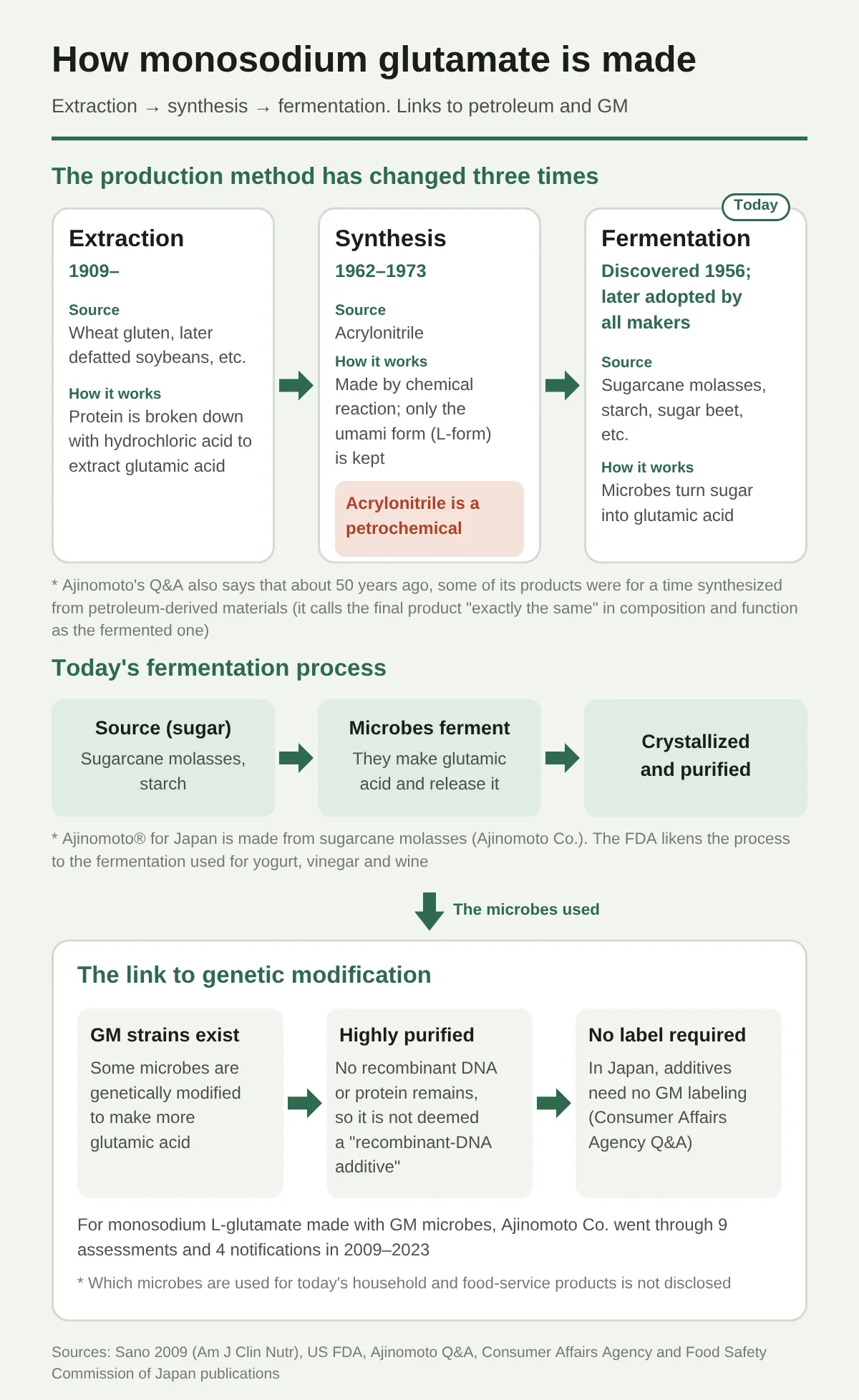
According to a paper by researchers at Ajinomoto Co. (Sano 2009, American Journal of Clinical Nutrition), the way monosodium glutamate is made has changed three times.
| Method | Period used | Raw material | How it works |
|---|---|---|---|
| Extraction | From 1909 | Wheat gluten, later plant proteins such as defatted soybeans | Proteins are broken down with hydrochloric acid, and glutamic acid is extracted and purified |
| Synthesis | 1962–1973 | Acrylonitrile (a petrochemical) | Glutamic acid is synthesized by chemical reactions, and only the form that tastes of umami (the L-form) is separated out |
| Fermentation (current) | Discovered in 1956; all manufacturers have since switched | Sugarcane molasses, cassava (tapioca) or corn starch, sugar beets, etc. | When microorganisms are fed sugar, they make glutamic acid and release it outside the cell. It is then crystallized and purified |
Fermentation began in 1956, when Shukuo Kinoshita, Shigezo Udaka, and colleagues at Kyowa Hakko Kogyo found a bacterium (later called Corynebacterium glutamicum) that produces large amounts of glutamic acid from sugar and ammonia. Sano (2009) writes that fermentation is advantageous in cost and environmental impact, and that all manufacturers switched to it. Ajinomoto Co. began fermentation production at its Kawasaki plant in December 1960.
The FDA also explains that monosodium glutamate is now made by fermenting starch, sugar beets, sugarcane, or molasses, a fermentation method similar to that used for yogurt, vinegar, and wine.
Where today’s AJI-NO-MOTO® is made
According to Ajinomoto Co.’s Q&A and product pages:
- The raw material for AJI-NO-MOTO® sold in Japan is sugarcane molasses (in other countries, it may be made from cassava or corn)
- Plants in Brazil and Indonesia carry out the process up to making monosodium glutamate, the final step of combining it with nucleotides is done at the Kyushu plant in Saga Prefecture, and the product is packed into jars and bags in Kawasaki
- The contents are 97.5% monosodium glutamate, 1.25% disodium inosinate, and 1.25% disodium guanylate
The link to petroleum
The claim that “AJI-NO-MOTO is made from petroleum” has some facts behind it.
- From 1962 to 1973, a method of chemical synthesis from acrylonitrile, a petrochemical, was used (Sano 2009). In its Q&A, Ajinomoto Co. also writes that “about 50 years ago, there was a period when some products were produced by synthesis from petroleum-derived raw materials.” It adds that the ingredients and function of the final product are “completely identical” to those made by fermentation
- In the 1960s and 70s, research was also reported on using acetic acid or n-paraffin (a component of petroleum) instead of sugar as the raw material for fermentation (the food for the microorganisms). A 1977 paper by the Central Customs Laboratory of the Ministry of Finance shows that products made by fermentation from acetic acid were actually on the market (the paper does not say whether that acetic acid was petroleum-derived)
- In 1972, the critic Atsutaka Gunji claimed in a book that it is “made from petroleum” (Sand 2005, Gastronomica)
Today, both Ajinomoto Co. and the FDA explain that the raw materials are plants such as sugarcane and starch, and that it is made by fermentation. As for why synthesis was abandoned, Ajinomoto Co.’s Q&A says in effect that “glutamic acid made by synthesis was not accepted by consumers” (we could not check the detailed account in the company history in the original source for this article).
The link to genetic modification
We consider the link to genetic modification in two parts: the “microbes” and the “raw-material crops.”
The microbes used for fermentation
Some of the microbes used for fermentation have been genetically modified to produce a lot of glutamic acid. From publications of the Consumer Affairs Agency and the Food Safety Commission of Japan (FSCJ), we can confirm that for L-monosodium glutamate made with genetically modified Corynebacterium and other microbes, Ajinomoto Co. went through 9 evaluations and 4 notifications between 2009 and 2023.
In its evaluation report (a 2010 example), the FSCJ judged that, for products made with the modified microbes:
- They meet the specifications for food additives (purity, etc.)
- Impurities have not increased to a degree that would pose a safety problem compared with conventional products
- They contain no new components suspected of being harmful
Products like this, where “the final product is so highly purified that no recombinant DNA or protein remains,” are called “highly purified products” and are regarded as not falling under “additives produced by applying recombinant DNA technology” under the system.
Which microbes are used to make today’s household and commercial products has not been made public. Ajinomoto Co.’s Q&A for the general public also contained no mention of genetically modified microbes.
The raw-material crops
In the U.S., most corn and sugar beets are genetically modified varieties (U.S. Department of Agriculture). The raw material for AJI-NO-MOTO® sold in Japan is sugarcane molasses, but whether the raw-material crops for products made overseas are modified varieties has not been disclosed by manufacturer.
Labeling rules
| Japan | EU | U.S. | |
|---|---|---|---|
| Additives made with modified microbes | Highly purified products are regarded as not being “additives produced by applying recombinant DNA technology” | Products made “using” modified microbes in which no modified material remains in the product are outside the GM food regulation | Exempt from labeling if records show that no modified genetic material can be detected |
| GM labeling for additives | Not required (Consumer Affairs Agency Q&A) | Outside the scope, as above | May be outside the scope, as above |
Note: For Japan, see the Consumer Affairs Agency’s “Food Labeling Standards Q&A (GM foods)” GM-3 and the list of items that passed the safety review. For the EU, see Regulation (EC) 1829/2003, recital (16). For the U.S., see 7 CFR §66.9.
The GM labeling system is also described in our article on high-fructose corn syrup.
Since when has it been used?
- It went on sale in 1909 as AJI-NO-MOTO®. Distributors were set up in Taiwan in the year of its launch, in Korea the next year, and in China in 1914, and an office was opened in New York in 1917 (Ajinomoto Co. timeline)
- In the U.S., from the mid-1930s to 1941, the U.S. was the biggest buyer other than Japan and Taiwan, mainly canned-soup and similar canned-food makers (Sand 2005). After World War II, the U.S. military also became interested, to improve the taste of soldiers’ meals
- Japan’s per-person consumption rose about 14-fold, from 52 g in 1955 to 745 g in 1968 (Ajinomoto Co.). Behind this were falling prices thanks to fermentation and the entry of other companies
- In the Household Survey, the annual purchase of monosodium glutamate seasoning per household went from 484 g in 1963 to 862 g in 1970 (the peak) to 120 g in 1999, so the amount bought for home use peaked in 1970 (Ministry of Internal Affairs and Communications Household Survey, as cited in Osawa 2019)
- Worldwide production by fermentation was estimated at about 2 million tons per year as of 2009 (Sano 2009)
From “chemical seasoning” to “umami seasoning”
“化学調味料” (“chemical seasoning”) is said to be a name that public broadcasting began using around the late 1950s (the Showa 30s) to avoid the brand name “味の素” (Ajinomoto) (Ajinomoto Co. Q&A, Osawa 2019). From around 1980, the industry pushed to rephrase it as “うま味調味料” (“umami seasoning”), and in 1986 the industry group was newly launched as the “Japan Umami Seasoning Association” (according to materials cited in Osawa 2019). It is now called “umami seasoning.” How “chemical seasoning” became a term with no legal basis is summarized in our article on umami seasonings.
What happens in the body?
- Most of the glutamate taken by mouth is used in the gut. In a trial in which healthy adults drank labeled glutamate, about 96% was taken up by the gut and liver before reaching the blood (Battezzati 1995). In a piglet trial it was also about 95%, and it was the most heavily used energy source for the gut (Reeds 2000)
- JECFA (1987) says that at ordinary amounts, blood glutamate barely rises, and that it rises temporarily when a large amount is taken on an empty stomach. When taken with a meal (especially with carbohydrate), the rise is smaller
- The brain has a mechanism called the “blood-brain barrier,” which limits the transfer of glutamate from the blood to the brain (according to reviews)
Acceptable intake (ADI): how much per day?
The ADI (acceptable daily intake) is the amount thought to cause no harmful health effects if taken every day for a lifetime. For monosodium glutamate, assessments differ by agency.
| Agency | Assessment |
|---|---|
| JECFA (FAO/WHO Joint Expert Committee on Food Additives) | In 1987, “ADI not specified” for glutamic acid and its salts together (there is no need to set a numerical upper limit for ordinary use). It also notes that it is better to spread it over several meals than to take a large amount at once, and that additives should be used in foods for infants with caution |
| EFSA (European Food Safety Authority) | In its 2017 re-evaluation, set a group ADI of 30 mg/kg body weight/day (as glutamic acid) for glutamic acid and its salts (E620–625). It said that high consumers and young children may exceed the ADI, and recommended reviewing the EU’s maximum levels of use |
| FDA (U.S. Food and Drug Administration) | Considers its addition to food “generally recognized as safe” (GRAS) |
| Japan | No usage standard for monosodium L-glutamate. The FSCJ, which evaluated the related substance ammonium L-glutamate in 2008, said “there is no need to specify an ADI” |
How EFSA arrived at 30 mg
EFSA took the highest amount that caused no harmful effect in a rat study of nervous system development (3,200 mg of monosodium glutamate per kg of body weight per day) and divided it by 100, which allows for differences between animals and humans and between individual people. That gave 27.8 mg as glutamic acid, rounded to 30 mg.
EFSA explains that although there are data on amounts at which effects were seen in humans, there were not enough data to determine a “no-effect amount,” so it used the animal study. EFSA says 30 mg is lower than the amounts at which symptoms were reported in humans (symptoms on an empty stomach: over 42.9 mg per kg of body weight; headache: 85.8 mg; rise in blood pressure: 150 mg; rise in insulin: over 143 mg; all as monosodium glutamate).
By body weight
| Body weight | ADI (as glutamic acid) | As monosodium glutamate (approx.) |
|---|---|---|
| 50 kg | 1.5 g per day | about 1.9 g |
| 20 kg | 0.6 g per day | about 0.76 g |
Note: Calculated from the ratio of monosodium glutamate monohydrate (molecular weight 187.13) to glutamic acid (147.13).
The nutrition facts on the AJI-NO-MOTO® product page are given “per 5 shakes (0.5 g) from the 70 g jar.” The Japan Umami Seasoning Association gives a guideline of 0.8 g for 4 servings of stir-fry or soup (5 to 8 shakes from the jar), which is about 0.2 g per serving. For a person weighing 50 kg, that is about one-tenth of the ADI.
How much do people take in the EU?
- In EFSA’s estimates, mean intake as an additive is 19–51 mg per kg of body weight for toddlers and 9–47 mg for children. In some surveyed countries, even the mean exceeds the ADI of 30 mg
- Among high consumers (95th percentile), there are countries where every age group exceeds the ADI
- The main sources were bakery products (fine bakery wares), soups and bouillons, sauces, meat products, and seasonings
- EFSA also writes that the estimates are uncertain and are likely to be overestimates overall
How much do people take in Japan?
In surveys cited in a 2008 report of the Ministry of Health, Labour and Welfare (MHLW) subcommittee:
- Intake of L-glutamates from food averaged 1,198 mg per person per day (as L-glutamic acid, 1998–1999 survey). The report says “it is thought to come mainly from intake as additives from processed foods”
- In a 2000 survey, L-glutamic acid from processed foods was 924 mg for ages 1–6 and 1,900 mg for ages 20–64
- Calculated from production for food use, it comes to about 1,290 mg (fiscal 2004; more than 99% of it the sodium salt)
Dividing the 1,900 mg for ages 20–64 by a body weight of 50 kg gives about 38 mg per kg of body weight, which exceeds EFSA’s ADI (30 mg) by calculation. However, this is a survey from more than 20 years ago, and Japan has not adopted EFSA’s ADI. For this article, we could not find a recent survey of intake in Japan.
Effects on the human body: what is known and what is not
| Topic | What is known | What is not known |
|---|---|---|
| Headaches, flushing, etc. (“Chinese restaurant syndrome”) | Some trials report more symptoms than placebo when a large amount is taken at once on an empty stomach. No difference with food | Whether “sensitive people” really exist, and how many there are |
| Newborn brain | Injection into newborn mice damages part of the brain | There is no evidence that it happens in humans at ordinary dietary amounts |
| Obesity | Studies in China and Thailand found an association; studies in China and Vietnam found none | Whether it is a cause. There are no randomized controlled trials or meta-analyses |
| Asthma | Not reproduced in double-blind trials | There are no studies in children |
| Sense of taste | In a 4-week trial, women perceived umami less strongly | What happens with long-term use |
“Chinese restaurant syndrome” and headaches
In 1968, a U.S. physician wrote in a letter to a medical journal that he got numbness in the neck and palpitations after eating Chinese food (Kwok 1968). This led to the suggestion that monosodium glutamate might be the cause.
- A multicenter, double-blind trial of 130 people who believed they reacted (Geha 2000): when they took 5 g without food, more symptoms were reported than with placebo. However, the reactions were inconsistent on repeat testing, and no one reproduced them to the end. There was no difference when it was taken with food
- A double-blind trial of 14 healthy people (Shimada 2013): when they took 150 mg per kg of body weight (7.5 g for a person weighing 50 kg) for 5 days, headaches occurred in 8 of 14 with monosodium glutamate and 2 with placebo. A temporary rise in blood pressure was also seen
- A systematic review of headaches (Obayashi 2016): in trials where it was taken with food, there was no difference except in the female group of one trial. Many trials used concentrated solutions that could be identified by taste (inadequate blinding), so the review says that further research is needed to judge causality
- The FDA cites a 1995 report by the Federation of American Societies for Experimental Biology (FASEB). The report says that when sensitive people take 3 g or more without food, temporary, mild symptoms such as headache, numbness, and flushing may occur. According to the FDA, one serving of food with added monosodium glutamate usually contains less than 0.5 g
Research funding Geha 2000 and Yang 1997, also a double-blind trial, received funding from the International Glutamate Technical Committee (IGTC), an industry group. The first author of Obayashi 2016 is an employee of a monosodium glutamate manufacturer. Shimada 2013 was funded by Danish public research funds and states that there is no conflict of interest.
The newborn mouse experiment (1969)
In 1969, the American researcher Olney reported that injecting monosodium glutamate under the skin of newborn mice killed nerve cells in parts of the brain such as the hypothalamus, and caused obesity and other effects after growth (Olney 1969, Science). In the same year, U.S. baby food makers stopped adding monosodium glutamate.
JECFA (1987) summarized that this brain damage occurs with injection or large forced doses, and that it has not been seen when it was mixed into feed or drinking water (except in dehydrated animals). Japan’s FSCJ (2008) also says it has not been confirmed in newborns of other animals, including monkeys, and that nerve damage in infants is unlikely.
In the EU, adding glutamates to foods for infants and young children is not permitted.
Obesity
| Study | Subjects | Result |
|---|---|---|
| He 2008 (INTERMAP) | 752 people in rural China, cross-sectional | More overweight among users |
| He 2011 (CHNS) | 10,095 people in China, followed for 5.5 years on average | In the highest-intake group, 1.33 times the risk of becoming overweight |
| Shi 2010 | 1,282 people in Jiangsu, China, followed for 5 years | No association with weight gain (the association disappeared after adjusting for rice intake and dietary pattern) |
| Thu Hien 2013 | 1,528 people in Vietnam, cross-sectional | No association with being overweight |
| Insawang 2012 | 349 people in rural Thailand, cross-sectional | For each 1 g increase, 1.14 times the metabolic syndrome and 1.16 times the overweight |
Human studies are observational only, and their results are split. We found no meta-analyses or randomized controlled trials in this search. The obesity caused by injecting newborn mice (Olney) is under different conditions from adults taking it by mouth.
Asthma
In a trial of 100 people, including people who “have had an asthma attack at a Chinese restaurant” (Woessner 1999), taking 2.5 g caused no attack or decline in lung function. A Cochrane review (2012) found only 2 trials meeting its criteria, in 24 adults, and concluded that “there is no evidence to support avoiding monosodium glutamate in adults with chronic asthma, although the data are limited.”
Does too much ruin your sense of taste?
There are claims that “if you use umami seasoning, you can’t taste things anymore” and “you can only taste strong flavors.” This is what has been confirmed in human studies.
Randomized controlled trial (Noel 2018, U.S.)
- 58 healthy young adults drank vegetable soup containing 3.8 g of monosodium glutamate every day for 4 weeks (the comparison group had soup matched for sodium)
- In women, the perceived intensity of umami weakened. There was no difference in men (a small number, 8 per group)
- The ability to tell dilute concentrations apart (discrimination) did not change
- At meals, the desire for and the amount of umami-rich food decreased
- It had no industry funding and states that there is no conflict of interest
Other findings
- A cross-sectional study found that obese women have a higher minimum concentration at which they can detect monosodium glutamate (they perceive it less easily) (Pepino 2010; funded by Ajinomoto). However, it is not known which is the cause
- Another study found that older adults needed on average 2.8 times the concentration of young people to detect umami in food (Schiffman 1994)
- In this search, we found no peer-reviewed study that directly examined whether long-term intake reduces or changes the taste buds or umami receptors on the tongue
Main causes of taste disorders
The MHLW’s “Manual for Handling Serious Adverse Drug Reactions by Disease (Drug-Induced Taste Disorder)” lists the causes of taste disorders as drugs (21.7%), unknown causes (15.0%), and zinc deficiency (14.5%), psychogenic causes (10.7%), and others. It says that many of the unknown causes are thought to be zinc deficiency from the diet, and that those in which zinc deficiency is directly or indirectly involved account for about 70% of the total. Umami seasoning does not appear in this manual’s list of causes.
In summary, there is only one trial showing that “after taking it every day for 4 weeks, women perceived umami as weaker,” and no study has shown that it “ruins your sense of taste (you can no longer taste).” On the other hand, since no study has examined what happens after years of use, we also cannot say that “there is no effect.”
Relation to salt reduction
Monosodium glutamate also contains sodium. However, the amount per weight is smaller than that of table salt.
| Sodium share | As salt equivalent | |
|---|---|---|
| Table salt (sodium chloride) | about 39.3% | about 1 g per 1 g |
| Monosodium glutamate | about 12.3% | about 0.31 g per 1 g |
| AJI-NO-MOTO® (product label) | ― | 0.15 g per 0.5 g (0.3 g per 1 g) |
Note: Percentages are calculated from molecular weights. AJI-NO-MOTO® figures are from the nutrition facts on Ajinomoto Co.’s product page. The idea of salt equivalent is explained in our article on salt intake.
Many studies show that adding umami makes food taste just as good even with less salt.
- A sensory test of 584 people in 19 regions of Japan (Hayabuchi 2020): adding monosodium glutamate to soup with 0.3% salt raised both saltiness and palatability
- A model calculation using National Health and Nutrition Survey data (Tanaka 2023): estimated that full use of umami could reduce salt intake by an average of 12.8–22.3%
However, most of these studies were funded by Ajinomoto Co. and similar companies, or have company employees as authors. In this search, we found no long-term trial that followed whether using umami seasoning actually lowers blood pressure or urinary sodium.
Also, the more umami seasoning you add, the more sodium you add along with it. If you want to cut salt itself, another option is to choose reduced-salt foods.
How it is written on the label
| Japan | EU | U.S. | |
|---|---|---|---|
| How it is written | May be grouped as “調味料(アミノ酸)” or “調味料(アミノ酸等)” (“seasoning (amino acids)” / “seasoning (amino acids, etc.)”) (group name) | Written as “monosodium glutamate” or “E621” | Written as “monosodium glutamate” |
| Labels such as “additive-free” | Consumer Affairs Agency guidelines give examples of labels that may be misleading | ― | Foods made with ingredients containing free glutamate, such as yeast extract, may not say “No MSG” or “No added MSG” |
On Japanese labels, if “調味料(アミノ酸等)” appears after the “/” in the ingredient list (the additives section), monosodium glutamate is often being used. Yeast extract and hydrolyzed protein, on the other hand, are treated as foods and are written before the “/”; even if they are rich in glutamic acid, they are not written as “調味料(アミノ酸等).” For details, see our article on umami seasonings and our article on the rules for “additive-free” labels, and for how each additive is treated in Japan and overseas, see the additive database.
The label of the umami seasoning itself, for example AJI-NO-MOTO®, lists just one line in the ingredient list, “調味料(アミノ酸等)”, and the contents are 97.5% monosodium glutamate and 2.5% nucleotides.
| Product | Ingredient list | Contents (as stated by the manufacturer) | Buy |
|---|---|---|---|
| AJI-NO-MOTO® Ajipanda® jar 70 g (Ajinomoto) | 調味料(アミノ酸等) | 97.5% monosodium glutamate, 1.25% disodium inosinate, 1.25% disodium guanylate | See on Rakuten (楽天24) PR See on Amazon.co.jp PR See on Yahoo! Shopping PR |
Note: Ingredients and contents are from Ajinomoto Co.’s product page (checked October 2, 2026). Ajinomoto’s official store on Rakuten Ichiba sells in units of 10, so the link goes to Rakuten 24, where you can buy a single jar.
Getting umami from ingredients
If you want to add umami without umami seasoning, you can combine kombu and cheese, which are rich in glutamic acid, dried shiitake, which is rich in guanylic acid, and bonito flakes, which are rich in inosinic acid. The Japan Umami Seasoning Association explains that combining glutamic acid with inosinic acid or guanylic acid makes umami taste stronger than each alone (a synergistic effect).
Kombu is also a food rich in iodine. We cover iodine in our article on thyroid cancer.
Summary
| Topic | What is known |
|---|---|
| Origins | Discovered by Kikunae Ikeda in 1908 as the umami of kombu, and put on sale in 1909 |
| How it is made | Extraction (from 1909), then synthesis (1962–1973), then fermentation (current; sugarcane molasses or starch as raw material) |
| Link to petroleum | There were synthetic products from a petrochemical (acrylonitrile) in 1962–1973. Today it is made by fermentation |
| Genetic modification | 13 procedures (2009–2023) for products made with modified microbes. Highly purified products, with no labeling requirement. The microbes used for current products are not disclosed |
| Since when | On sale since 1909. Japan’s consumption rose about 14-fold from 1955 to 1968. Household purchases peaked in 1970 |
| Acceptable intake | JECFA and Japan have set no numerical value. EFSA: 30 mg/kg body weight/day (as glutamic acid), or 1.5 g for 50 kg |
| Effects on the human body | Reports of temporary symptoms in some people at 3 g or more on an empty stomach. No difference with food. Results on obesity are split |
| Sense of taste | One trial in which women perceived umami less strongly after 4 weeks. No study has shown that it makes you unable to taste |
| Salt reduction | Sodium is about one-third that of table salt. Studies saying umami allows salt reduction are almost all industry-funded |
Items introduced in this article:
| Item | Ingredients | Buy |
|---|---|---|
| Rishiri kombu 150 g (尾道の昆布問屋) | 昆布(利尻産) (kombu from Rishiri) | See on Rakuten PR See on Amazon.co.jp PR See on Yahoo! Shopping PR |
| Dried shiitake Koshin 100 g (食べもんぢから。) | しいたけ(大分県産・原木栽培) (shiitake, log-grown, from Oita Prefecture) | See on Rakuten PR See on Yahoo! Shopping PR |
| Parmigiano-Reggiano aged 24 months (ハイ食材室) | Raw milk, salt | See on Rakuten PR See on Amazon.co.jp PR See on Yahoo! Shopping PR |
| Marutomo official online shop (bonito flakes, dashi) | Varies by product | かつお節・だしを楽しむ通販サイト【マルトモ公式直販】  PR PR |
| AJI-NO-MOTO® Ajipanda® jar 70 g (楽天24) | 調味料(アミノ酸等) | See on Rakuten PR See on Amazon.co.jp PR See on Yahoo! Shopping PR |
“See on Rakuten” and similar links are affiliate (PR) links. Prices and stock may change, so check the sales page before buying (checked October 2, 2026).
Sources
Public agencies
- U.S. FDA, “Questions and Answers on Monosodium glutamate (MSG)”
- JECFA, “Glutamic acid and its salts” (WHO Food Additives Series 22, 1987)
- EFSA ANS Panel, “Re-evaluation of glutamic acid (E 620), sodium glutamate (E 621)…” EFSA Journal 2017;15(7):4910
- MHLW Pharmaceutical Affairs and Food Sanitation Council, Food Additives Subcommittee, “Subcommittee report on the designation of ammonium L-glutamate as a food additive,” and the FSCJ evaluation report (2008)
- Consumer Affairs Agency, “List of items to which Article 3, paragraph 5 of the safety review procedure applies,” “List of notifications of highly purified additives,” and “Food Labeling Standards Q&A (GM foods)”
- FSCJ, “Evaluation report on GM foods: monosodium L-glutamate” (strains GLU-No.2 to 7)
- Ministry of Finance Central Customs Laboratory, “Trace components in sodium glutamate,” Bulletin of the Central Customs Laboratory No. 17 (1977)
- MHLW, “Manual for Handling Serious Adverse Drug Reactions by Disease: Drug-Induced Taste Disorder”
- Regulation (EC) No 1829/2003, U.S. 7 CFR §66.9
Papers
- Sano C. History of glutamate production. Am J Clin Nutr 2009 (a researcher at Ajinomoto Co.)
- Ikeda K. New seasonings. Chem Senses 2002 (English translation of the 1909 paper)
- Kinoshita S, et al. J Gen Appl Microbiol 1957
- Sand J. A Short History of MSG. Gastronomica 2005
- Osawa Y. “The perception and construction of umami in modern Japan,” Bulletin of the National Museum of Ethnology, 2019
- Battezzati A, et al. Am J Physiol 1995 / Reeds PJ, et al. J Nutr 2000
- Kwok RHM. N Engl J Med 1968 / Yang WH, et al. J Allergy Clin Immunol 1997 / Geha RS, et al. J Allergy Clin Immunol 2000 / Shimada A, et al. J Headache Pain 2013 / Obayashi Y, Nagamura Y. J Headache Pain 2016
- Olney JW. Science 1969
- He K, et al. Obesity 2008 / He K, et al. Am J Clin Nutr 2011 / Shi Z, et al. Br J Nutr 2010 / Thu Hien VT, et al. Public Health Nutr 2013 / Insawang T, et al. Nutr Metab 2012
- Woessner KM, et al. J Allergy Clin Immunol 1999 / Zhou Y, et al. Cochrane Database Syst Rev 2012
- Noel CA, et al. J Nutr 2018 / Pepino MY, et al. Obesity 2010 / Schiffman SS, et al. Physiol Behav 1994
- Hayabuchi H, et al. Hypertens Res 2020 / Tanaka S, et al. BMC Public Health 2023
Manufacturers and industry groups (used only to confirm facts)
- Ajinomoto Co., “AJI-NO-MOTO® Q&A,” product pages, timeline, and “Umami Seasoning Day”
- Japan Umami Seasoning Association, “The components of umami” and “Frequently asked questions”
Related articles and databases
- Why Did “No Chemical Seasoning” Disappear? Is Yeast Extract a Chemical Seasoning? How to Read Umami Seasonings and Hydrolyzed Protein
- Where Does “Too Much Salt” Begin? Checking Japan’s Salt Intake Trend, Target Amounts, and the Links to High Blood Pressure and Stomach Cancer Against National Surveys and Studies
- Were “無添加” (Additive-Free) Labels Banned? Reading the Consumer Affairs Agency Guideline’s 10 Types from the Back Label
- 添加物データベース