
Are Food Colorings (Red No. 102, Yellow No. 4) Bad for You? Cancer Assessments and Whether They Are Banned Abroad, Checked Against Rules in Japan and Overseas

PR This article contains advertising. The Shirai Seicha link is an affiliate ad through Moshimo Affiliate. What is written here is based on official sources from Japan and overseas and on published studies, whether or not there is an ad.
Red pickled ginger (beni shoga), cod roe (tarako), shaved-ice syrup, colorful candy. On the back label you will see entries like “着色料(赤102、黄4)” (colorant (Red 102, Yellow 4)).
You may have heard that “Japan’s food colorings are banned overseas.” In 2025 the topic drew attention again when the US revoked authorization for Red No. 3 and announced a plan to phase out other dyes as well.
This article, based on official sources from Japan and overseas, sorts out:
- How to read from the back label which colorants are used
- How the rules differ between Japan and other countries
- How studies and official bodies view the claims that colorings “affect children’s behavior” and “cause cancer”
Conclusion: Each Country Differs in Both the Dyes It Allows and Its Approach to the Rules
- Japan allows 12 tar dyes (dyes made chemically from petroleum and the like). Of these, the three dyes Red No. 104, 105, and 106 cannot be used in food in any of the US, EU, Canada, Australia, or South Korea
- The EU, following studies showing an effect on children’s behavior, requires a warning statement on foods containing certain dyes. The US has revoked authorization for Red No. 3 and is asking industry to stop using the remaining six dyes as well
- Japan’s government (the Consumer Affairs Agency), for its part, concluded in 2025 that there are no new findings that change the international assessments, and that Japanese intake is far below the acceptable level
- Under the labeling rules, colorants cannot be written as a group; the name of every dye used must be listed. By reading the back label, you can tell which dyes are used
Types of Colorants, and How to Tell Them Apart on the Back Label
Two broad types
| Type | Main examples | Example of how it appears on the back label |
|---|---|---|
| Tar dyes (designated additives) | 12 dyes: Red No. 2, 3, 40, 102, 104, 105, 106; Yellow No. 4, 5; Green No. 3; Blue No. 1, 2 | 着色料(赤102、黄4), 赤色3号, 青1 |
| Other colorants (mostly “existing additives” obtained from plants, insects, microbes, and so on) | Gardenia color, Monascus (benikoji) color, paprika color, caramel color, cochineal color, red cabbage color, and others | クチナシ色素, 着色料(カラメル、紅麹) |
| (White colorant) | Titanium dioxide (designated additive) | 着色料(二酸化チタン) |
The key to telling them apart is “color name + number.” If it is written as a combination of a color name and a number, such as “赤102” (Red 102), “黄4” (Yellow 4), or “青1” (Blue 1), it is a tar dye.
What to know about the labeling rules
- Colorants cannot be written as a group. Some additives may be written together under a collective name (group name, 一括名), such as “調味料(アミノ酸等)” (seasoning (amino acids, etc.)) and “香料” (flavoring), but colorants are not eligible. The name of each dye used is written one by one
- The word “着色料” (colorant) is sometimes omitted. When the name contains the character “色” (color), as in “赤色102号” (Red No. 102) or “クチナシ色素” (gardenia color), “着色料” does not have to be written. In the short form without “色,” such as “赤102” (Red 102), it is written as “着色料(赤102)” (colorant (Red 102))
- The words “natural” and “synthetic” cannot be used in additive labeling. Under national rules, chemically made and naturally derived substances are both treated as “additives” and labeled without distinction
- A colorant carried over from an ingredient is still labeled if its color remains. There is a system called “carryover” under which additives used in an ingredient need not be labeled if they are present in small amounts and have no effect. However, local governments explain that things whose effect is visible to the eye, such as colorants, are not covered by this system (example: melon ice cream topped with melon sauce made with a colorant) → our article on carryover
Japan’s Rules: Foods Where Use Is Prohibited Are Specified
In Japan, foods in which tar dyes must not be used are specified (Specifications and Standards for Foods and Food Additives).
Castella, kinako (excluding uguisu-ko), fish-meat pickles, whale meat pickles, kelp (kombu) products, soy sauce, meat, meat pickles, sponge cake, fresh fish and shellfish (including whale meat), tea, nori products, marmalade, beans, miso, noodles (including wonton), vegetables, and wakame products
The purpose of this rule is to prevent coloring raw meat, fish, vegetables, and the like to make them look fresher or of better quality than they are. Colorants other than tar dyes (such as gardenia color) also cannot be used in kelp products, meat, fresh fish and shellfish, tea, nori products, beans, vegetables, and wakame products.
On the other hand, Japan does not set a limit such as “up to X g per kg” for tar dyes. The EU and South Korea, introduced below, set limits by food. This is one of the big differences between Japan and other countries.
How much do people in Japan eat?
According to a Consumer Affairs Agency document (2025), the daily intake of tar dyes by people in Japan is estimated to be under 1% of the ADI (the amount considered not to affect health if eaten every day for a lifetime) for every dye.
- In a survey that buys actual foods and measures them (market basket method), many dyes came out as “0,” below the measurable amount
- Even in an estimate calculated from dye production volumes, the highest share of the ADI, for Red No. 3, was about 0.6%
Differences Between Japan and Other Countries
Can the 12 tar dyes be used in other countries?
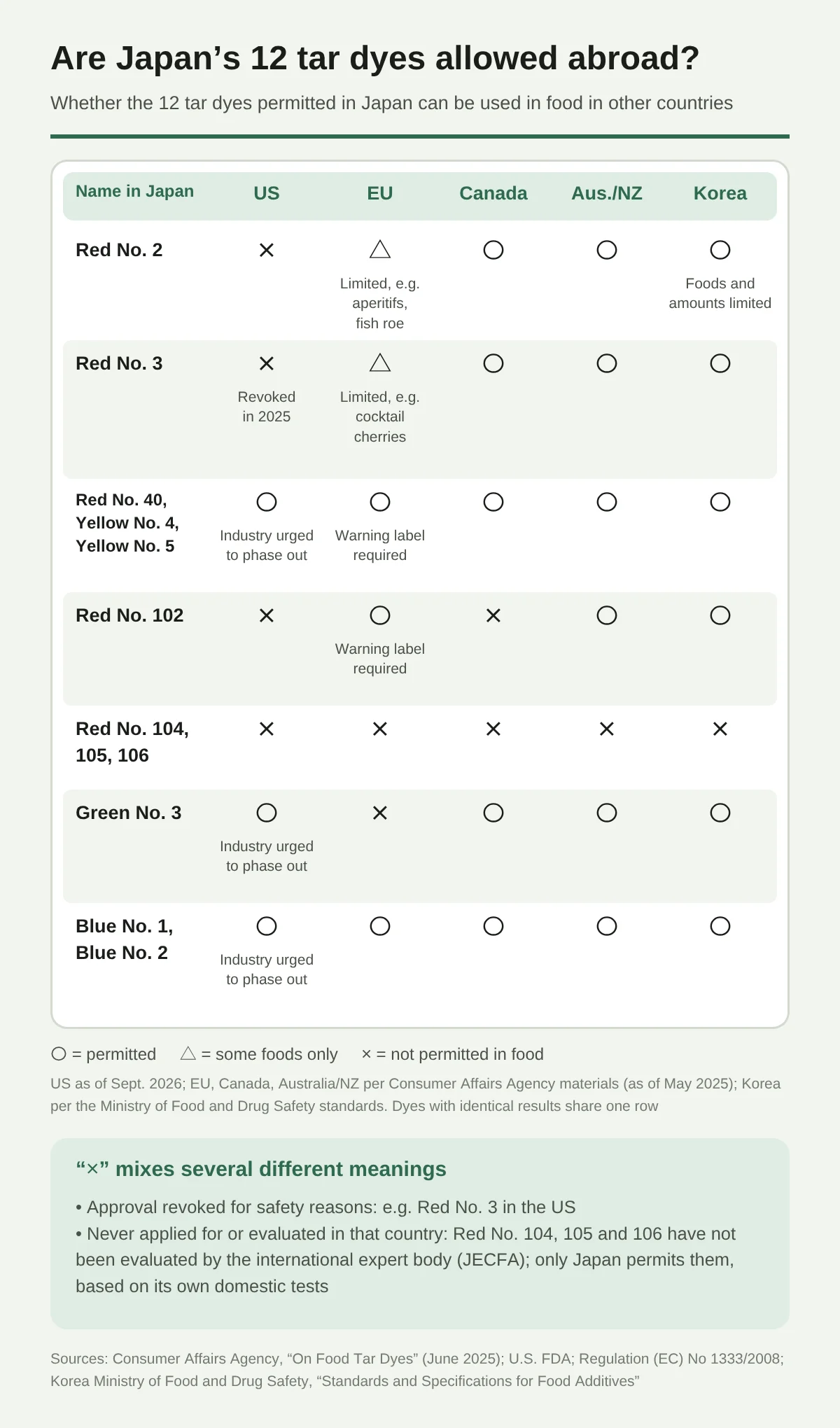
| Name in Japan | English name | US | EU | Canada | Australia/NZ | South Korea |
|---|---|---|---|---|---|---|
| Red No. 2 | Amaranth | ✕ | △ (only some foods, such as aperitifs and fish roe) | ○ | ○ | ○ (foods and amounts limited) |
| Red No. 3 | Erythrosine | ✕ (revoked in 2025) | △ (only some foods, such as cocktail cherries) | ○ | ○ | ○ |
| Red No. 40 | Allura Red AC | ○ (industry asked to phase out) | ○ (warning statement required) | ○ | ○ | ○ |
| Red No. 102 | Ponceau 4R | ✕ | ○ (warning statement required) | ✕ | ○ | ○ |
| Red No. 104 | Phloxine | ✕ | ✕ | ✕ | ✕ | ✕ |
| Red No. 105 | Rose Bengal | ✕ | ✕ | ✕ | ✕ | ✕ |
| Red No. 106 | Acid Red | ✕ | ✕ | ✕ | ✕ | ✕ |
| Yellow No. 4 | Tartrazine | ○ (industry asked to phase out) | ○ (warning statement required) | ○ | ○ | ○ |
| Yellow No. 5 | Sunset Yellow FCF | ○ (industry asked to phase out) | ○ (warning statement required) | ○ | ○ | ○ |
| Green No. 3 | Fast Green FCF | ○ (industry asked to phase out) | ✕ | ○ | ○ | ○ |
| Blue No. 1 | Brilliant Blue FCF | ○ (industry asked to phase out) | ○ | ○ | ○ | ○ |
| Blue No. 2 | Indigo Carmine | ○ (industry asked to phase out) | ○ | ○ | ○ | ○ |
○ = can be used △ = only some foods ✕ = cannot be used in food (US as of September 2026; EU, Canada, Australia, and NZ from a Consumer Affairs Agency document [as of May 2025]; South Korea according to the standards of the Ministry of Food and Drug Safety)
Some dyes are numbered differently from country to country The US “Yellow 5” is Japan’s Yellow No. 4 (tartrazine). The US “Yellow 6” is Japan’s Yellow No. 5. If a news story overseas mentions “Yellow 5,” checking the English name will keep you from confusing which Japanese dye is meant. Red No. 3 and 40, Blue No. 1 and 2, and Green No. 3 have the same numbers in Japan and the US.
What “banned overseas” means varies by country
The “✕” marks in the table cover several different meanings.
- Dyes whose authorization was revoked for safety reasons: such as Red No. 3 in the US
- Dyes for which no application was made in that country, or that have not been evaluated: Red No. 104, 105, and 106 have not been evaluated by the international evaluation body (JECFA), and only Japan allows them, based on domestic testing
- The reverse also happens: in the US, “Citrus Red No. 2,” used on orange peel, has long been permitted (revocation was proposed in 2026). It is a dye that cannot be used in Japan
The food standards agency of Australia and New Zealand also explains that many of the dyes “said to be banned in some country” simply have not had an application for approval in that country.
Rather than deciding one way or the other that “banned overseas = dangerous” or “allowed in Japan = safe,” it matters to look at which country decided what, and for what reason.
The US: Revocation of Red No. 3 and the Phase-out of Six Dyes
| When | What happened |
|---|---|
| January 2025 | The FDA (US Food and Drug Administration) revoked authorization for Red No. 3 in food. Food manufacturers must stop using it by January 15, 2027 |
| April 2025 | The FDA announced a plan to phase out Red No. 40, Yellow No. 4, Yellow No. 5, Green No. 3, Blue No. 1, and Blue No. 2 (all Japanese names) from food. This is not a legal ban; it asks industry to switch voluntarily |
| May and July 2025 | Newly approved replacement dyes included blue from algae, butterfly pea, calcium phosphate, and gardenia blue |
| February 2026 | Labeling policy changed so that foods using only naturally derived colors may be labeled “no artificial colors” |
| September 2026 | The FDA’s page gives the end of 2027 as the target for phasing out the six dyes (the end of 2026 when first announced) |
The revocation of Red No. 3 was based on test results showing an increase in thyroid cancer in male rats. US law has a provision (the Delaney Clause) that does not permit colorants that cause cancer in humans or animals, and the action followed it. At the same time, however, the FDA explained that “the mechanism by which cancer occurs in rats does not occur in humans” and “the amounts people normally consume are far smaller,” and said that, although the dye can no longer legally be used, the FDA itself considers Red No. 3 to meet the safety standard for color additives.
There are state laws too.
- California: From January 2027, manufacture and sale of foods containing Red No. 3 is prohibited (AB 418). From December 31, 2027, serving foods containing Red No. 40, Yellow No. 4, Yellow No. 5, Blue No. 1, Blue No. 2, or Green No. 3 (Japanese names) in public schools is prohibited (AB 2316)
- West Virginia and Texas have also enacted laws banning use or requiring warning labels, though some have been blocked by courts
Gardenia blue is a colorant that has long been used in Japan. The US approved it in 2025 as a replacement for synthetic dyes, so a reverse flow is also happening: a natural-type colorant that is commonplace in Japan is approved overseas later.
The EU and the UK: Warning Statements for Children
Since July 2010, the EU has required foods containing the following six dyes to carry the warning “may have an adverse effect on activity and attention in children” (EU Regulation 1333/2008, Annex V).
| Dyes requiring an EU warning statement | In Japan |
|---|---|
| Tartrazine (E102) | Yellow No. 4 |
| Sunset Yellow FCF (E110) | Yellow No. 5 |
| Allura Red AC (E129) | Red No. 40 |
| Ponceau 4R (E124) | Red No. 102 |
| Quinoline Yellow (E104) | Not allowed |
| Carmoisine (E122) | Not allowed |
The UK, after leaving the EU, has kept the same warning-statement rule. The EU allows Red No. 3 only in things like “cocktail and candied cherries” and Red No. 2 only in things like “aperitifs and fish roe,” and does not allow Green No. 3.
The white colorant titanium dioxide has also not been allowed in food in the EU since 2022 (explained below).
South Korea: Even the Amounts Allowed Are Set by Food
South Korea allows 9 tar dyes in food, and Japan’s Red No. 104, 105, and 106 cannot be used. It also sets, in a list, the foods in which each dye may be used and the maximum amount (since January 2022). For example, Red No. 2 is limited to traditional Korean confections, gum, rice cakes, sausages, pollock roe (mentaiko), and the like, and candy and ice cream are not on the list. In food for infants under 6 months, tar dyes “must not be detected.”
Australia and New Zealand: After Evaluation, No Warning Statement Is Required
Australia and New Zealand allow many dyes, including Japan’s Red No. 102. Because a survey of dye intake found that even heavy eaters and children were under 5% of the acceptable level, they do not require a warning statement like the EU’s.
Is “It Affects Children’s Behavior” True?
The UK study that started it
In 2007, a research team at the University of Southampton in the UK published a study in the medical journal The Lancet.
- 153 3-year-olds and 144 8- to 9-year-olds from the general population drank, without knowing which, either a drink containing a mix of colorants and a preservative (sodium benzoate) or a drink with no dyes
- There were two kinds of mixed drinks, each with four colorants (six in all across the two; the six dyes for which the EU later required a warning statement)
- When they drank the drink mixed with colorants and preservative, an indicator of hyperactivity (restlessness and inattention) rose slightly
This study led to the EU’s warning statement.
Official bodies’ views are split
| Body | View |
|---|---|
| EFSA (European Food Safety Authority), 2008 | Because the dyes and preservative were given mixed, it is not clear which dye had the effect. The effect was also small, and this study alone is not grounds for changing the ADI. Note: in 2009, however, it lowered the ADI of Yellow No. 5, Red No. 102, and others for a different reason |
| US FDA advisory committee, 2011 | Concluded that the data, including the Southampton study, do not support a causal link between colorants and hyperactivity |
| FSANZ (Australia and NZ) | The Southampton study is not grounds for changing the safety assessment of the dyes |
| Japan (conclusion of a past council as recorded in a Consumer Affairs Agency document) | There are many questions in assessing causality, and the study alone cannot be taken to show a serious effect on children. Intake in Japan is considerably lower than the amounts used in this experiment |
| California, US (OEHHA), 2021 | After reviewing 27 human trials and other evidence, concluded that synthetic dyes may affect behavior in some children, whether or not they have ADHD or similar conditions. It said the current US ADI was set from old tests done before neurological and behavioral effects were examined, and may not adequately protect children |
The reasons the conclusions differ are as follows.
- Many trials examine several dyes mixed together, making it hard to isolate the effect of a single dye
- Where there is an effect, it is in some children, and the strength of the response varies greatly from person to person
- There are no studies of long-term effects
There is no study that can say “colorants cause ADHD in children.” On the other hand, the view that “it may affect behavior in some children” also has official backing, as in the EU’s warning statement and California’s assessment. For now, this is a part that has not yet been settled.
Is “It Causes Cancer” True?
| Dye | Assessment |
|---|---|
| Red No. 3 | Thyroid cancer increased in male rats. The FDA, while saying “the same mechanism does not occur in humans,” revoked authorization in accordance with the text of the law. Japan has concluded that “there is no genotoxicity of concern in living organisms, and the amounts at which cancer appeared in rats are far higher than the amounts people consume,” and that it is not a safety concern for humans |
| Red No. 2 | In Japan in the 2000s, some mouse tests gave positive results, so retests were done; because the results were not reproduced, it was concluded that use would continue |
| Red No. 2, Yellow No. 5, Blue No. 1, Green No. 3 | IARC (International Agency for Research on Cancer) puts them in “Group 3” (not classifiable as to carcinogenicity to humans). Note: this does not mean it has been proven that they are “not carcinogenic” |
| Titanium dioxide | IARC puts it in “2B” (possibly carcinogenic). However, this is mainly an assessment of inhaling dust |
| Caramel color (III and IV) | A component formed during manufacture (4-MEI) is IARC “2B.” The US state of California requires warning labels on products over a certain amount. Japan sets an upper limit for 4-MEI in its specifications, and the Japan Food Additives Association says that the amount taken in from caramel color is not a cancer concern (4-MEI also forms when coffee beans are roasted and meat is cooked) |
Titanium Dioxide: Banned in the EU, Still Used in Japan, the US, the UK, and Elsewhere
This is a white colorant used in the white coating of white chocolate, gum, tablet candy, and the like.
- EU: In 2021, EFSA assessed that “a concern for genotoxicity (the property of damaging genes) cannot be ruled out” and that it “can no longer be considered safe,” and use in food has been prohibited since 2022
- Japan: The National Institute of Health Sciences ran a 90-day test feeding very small (nano-sized) titanium dioxide particles to rats and saw no effects. At an expert panel of the Food Safety Commission of Japan (November 2023), opinions were voiced that “EFSA’s view is very conservative” and that “there is no particular problem with the trace amounts used as an additive,” and the MHLW says there is no basis for changing the current rules
- The UK, Canada, Australia, and New Zealand: Each conducted its own assessment and does not support EFSA’s conclusion. The US has not changed its rules either (up to 1% of the weight of the food)
- JECFA (the international evaluation body): In its 2023 re-evaluation, it found the evidence for genotoxicity insufficient and did not change its conclusion that use may continue
- Even in the EU, it is still used in medicines (such as tablet coatings). This is because, even though more is used than in food, replacing it with other materials would affect the quality of the medicine
- Intake in Japan is estimated from production volume at about 0.11 mg per person per day (Food Safety Commission of Japan)
It is an example where, looking at the same data, conclusions split depending on whether the approach is “if doubt cannot be removed, stop” (EU) or “if the evidence is not clear, do not change the rules” (Japan, the US, and others).
Are Natural-Type Colorants Automatically Safe?
It cannot be said either that “avoiding tar dyes and choosing natural-type colorants is safe.”
- Cochineal color (a red colorant obtained from insects) can rarely cause acute allergic reactions (anaphylaxis), and the Consumer Affairs Agency issued a caution in 2012
- Caramel color comes in four types made by different methods, and the EU labels them separately, but Japanese labeling says only “カラメル色素” (caramel color), so you cannot tell which one it is
- Monascus (benikoji) color and gardenia color have long been used in Japan, but they are not approved as food additives in the EU
Be Careful with “合成着色料不使用” (No Synthetic Colorants) Labels
In stores you often see products labeled “合成着色料不使用” (no synthetic colorants) or “着色料無添加” (no colorants added).
The Consumer Affairs Agency’s “Guidelines on Labeling of Non-Use of Food Additives” (2022) lists the following kinds of labels as examples highly likely to mislead consumers.
- Labels that write “not used” together with the words “synthetic,” “artificial,” or “natural” (example: “人工甘味料不使用,” no artificial sweeteners). This is because the additive labeling rules originally make no distinction between “synthetic” and “natural”
- Labels that write “no ○○ colorants” even though a natural-type colorant (existing additive) is used
- Labels that write “no colorants” on a type of food that does not normally use colorants (example: products of the same type that ordinarily use no colorants and have the food’s natural color)
Rather than judging by the words “not used” alone, the reliable approach is to look at the ingredient list (原材料名) on the back label and check which colorants are, or are not, used. The full set of the guidelines’ 10 types is introduced in our article on “無添加” (additive-free) labeling rules.
Urayomi’s Approach
To sum up so far:
- According to national assessments, the 12 tar dyes allowed in Japan have no health effect when used within the set rules, and intake in Japan is estimated at under 1% of the acceptable level
- On the other hand, on effects on children’s behavior, studies and national judgments are split; the EU requires a warning statement and the US is moving toward phasing them out. This has not yet been settled
- What “banned overseas” means varies by country, and it mixes dyes banned because they were dangerous with dyes that were simply never applied for
- Colorants cannot be written as a group on labels, so by reading the back label you can tell which dyes are used
Urayomi does not write that tar dyes are uniformly “dangerous.” Instead, on product pages we list whether a colorant is used and, if so, which dye, exactly as shown on the back label. In particular, if you have small children and are concerned, you can choose products without a “color name + number” entry.
Back-Label Checklist
- Look after the “/” in the ingredient list (原材料名) (the additives section): additives are separated from the ingredients by a “/” or a line break
- Look for “color + number,” such as “赤102,” “黄4,” or “青1”: if it is there, it is a tar dye
- Don’t let your guard down if the word “着色料” is missing: when the name contains “色,” as in “赤色3号” or “クチナシ色素,” “着色料” is omitted
- “○○色素” and “着色料(カラメル)” are natural-type colorants: for cochineal (carminic acid), people with allergies should check especially carefully
- Don’t judge by a “合成着色料不使用” label alone: natural-type colorants may be used
An example of coloring with the ingredients’ own colors, with no colorant added
There is also a way to color food using the ingredients’ own colors, without adding a colorant. For example, Shirai Seicha of Gifu makes “Iroha,” green tea flavored teas that combine Mino Ibi tea with herbs and fruit and get the tea’s color from them (the maker labels them “無着色・無香料,” no coloring and no flavoring).
For example, the ingredient list of the blue “Asagi” is green tea (from Gifu Prefecture), lemon myrtle, butterfly pea, rosemary, spearmint, lemongrass, honeybush, and stevia. The blue color is that of the butterfly pea flower. Note that stevia, a sweetener, is included (“無着色・無香料” is a statement about colorants and flavorings).
Also Good to Know
- Rules for “無添加” (additive-free) and “不使用” (not used) labels (the guidelines’ 10 types) → our article on “無添加” labeling rules
- Additives carried over from ingredients may not be labeled: however, colorants must be labeled if their color remains → our article on carryover
- Overseas rules for each additive can also be checked in the additives database
Sources
- Consumer Affairs Agency, Food Sanitation Standards Examination Division, “On Edible Tar Dyes” (Food Sanitation Standards Council, Additives Subcommittee, Document 4, June 2025)
- Consumer Affairs Agency, “Response on the Food Additive Titanium Dioxide” (Food Sanitation Standards Council, Additives Subcommittee document, June 2024) / MHLW, “On the Food Additive Titanium Dioxide (Report)”
- Food Safety Commission of Japan, “Explaining Food Additives Used as Colorants, and Titanium Dioxide”
- MHLW, “Specifications and Standards for Foods and Food Additives” (MHW Notification No. 370 of 1959) / Japan Food Chemical Research Foundation, “Use Standards and Storage Standards for Each Additive” (November 2024)
- MHLW, “Analytical Methods for Food Additives in Food,” Edible Tar Dyes
- Consumer Affairs Agency, “On the Food Labeling Standards” (Annex: Additives) / Tokyo Metropolitan Bureau of Public Health, “Processed Foods (Additives)”
- Consumer Affairs Agency, “Guidelines on Labeling of Non-Use of Food Additives” (March 2022)
- Sapporo City Public Health Office, “Additives (General Processed Foods)” (the concept of carryover)
- U.S. FDA “FDA to Revoke Authorization for the Use of Red No. 3 in Food and Ingested Drugs” (January 2025)
- U.S. FDA “Tracking Food Industry Pledges to Remove Petroleum-Based Food Dyes” (updated September 15, 2026)
- U.S. FDA “Letter to the Food Industry on ‘No Artificial Colors’ Labeling Claims” (February 2026)
- U.S. FDA “Titanium Dioxide as a Color Additive in Foods”
- California AB 2316 (California School Food Safety Act) / AB 418 (California Food Safety Act)
- California OEHHA “Health Effects Assessment: Potential Neurobehavioral Effects of Synthetic Food Dyes in Children” (April 2021)
- Regulation (EC) No 1333/2008 Annex V (EU warning statement) / Commission Regulation (EU) 2022/63 (titanium dioxide)
- EFSA “EFSA evaluates Southampton study on food additives and child behaviour” (2008) / “EFSA updates safety advice on six food colours” (2009)
- Japan Food Additives Association, “Food Additives Q&A” (views of the US FDA advisory committee in 2011 and FSANZ; caramel color)
- Food Safety Commission of Japan, “Information on Cochineal Color” (May 11, 2012, caution issued by the Consumer Affairs Agency)
- McCann D, et al. Lancet 2007;370:1560–1567 (Southampton study)
- South Korea Ministry of Food and Drug Safety, “Standards and Specifications for Food Additives,” use standards by item / Suh HJ, Choi S. J Food Nutr Res 2012 (South Korean intake assessment)
- Food Standards Australia New Zealand “Colours and food additives reported as banned” / “Review of titanium dioxide as a food additive”
- IARC Monographs, List of Classifications (Vol. 8 and 16, Suppl. 7)
Note: This article does not assert the safety or danger of any particular food or additive. If you have a food allergy, or have concerns about your child’s diet, please consult a doctor.
Related articles and databases
- What is carryover? How it differs from processing aids, and the additives that are not listed on labels even on “additive-free” foods
- What Is “果糖ぶどう糖液糖” (High-Fructose Corn Syrup)? Is It Worse for You Than Sugar? How It Differs From Sugar, and Corn and Genetic Modification
- Does aluminum leach from aluminum pans and foil? How it is made, why it is used, what happens when it builds up in the body, and how to choose alternative pans
- Are Blueberries Good for Your Eyes? Antioxidant Differences by Variety, Ways of Eating Them for Better Absorption, Whether Frozen Is Better, and Studies of People Who Kept Eating Them
- Is Caramel Color Dangerous? The Carcinogen Claim About “4-MEI” and the Four Types, Checked Against Japan, EU, and US Assessments
- Were “無添加” (Additive-Free) Labels Banned? Reading the Consumer Affairs Agency Guideline’s 10 Types from the Back Label
- Are preservatives bad for you? Types such as sorbic acid, what “preservative-free” hides, and how Japanese and overseas rules differ
- Are Artificial Sweeteners Bad for You? Aspartame and Cancer, What “Zero Calorie” and “Zero Sugars” Really Mean, and Japanese vs. Overseas Rules
- Are Flavorings Bad for You? What “香料” (Flavoring) Contains, Why It Is Written as One Word, and Japanese vs. Overseas Rules
- 添加物データベース
- ポストハーベスト農薬と輸入食品