
Are Artificial Sweeteners Bad for You? Aspartame and Cancer, What “Zero Calorie” and “Zero Sugars” Really Mean, and Japanese vs. Overseas Rules

Zero-calorie soda, gum, low-carb sweets. On the back label you see entries such as “甘味料(スクラロース、アセスルファムK)” (sweetener (sucralose, acesulfame K)) or “エリスリトール” (erythritol).
In 2023, a WHO agency classified aspartame as “possibly carcinogenic to humans,” and in the same year the WHO issued guidance advising people not to use artificial sweeteners to control body weight.
This article uses materials from government and overseas public agencies to sort out:
- The types of sweeteners, and how to tell them apart on the back label
- What the “zero calorie,” “zero sugars,” and “no added sugars” labels actually mean
- How Japan and other countries differ in which sweeteners are allowed and how they must be labeled
- How research and public agencies view the claim that “sweeteners are bad for you”
Conclusion: “Zero” does not mean “nothing at all”
- “カロリーゼロ” (zero calorie) can be shown at less than 5 kcal per 100 mL, and “糖類ゼロ” (zero sugars) at less than 0.5 g per 100 mL. “Sugars” do not include sugar alcohols, oligosaccharides, or starch, so even a “zero sugars” product may contain them
- Among Japan’s sweeteners, some have set usage limits (acesulfame K, sucralose, saccharin, and others) and some do not (aspartame and others). Intake by Japanese people is estimated at under 1% of the acceptable level for all of them
- The 2023 classification of aspartame as “possibly carcinogenic” is a classification of the strength of the evidence, not of the size of the risk. At the same time, the international assessment body did not change the acceptable level
- However, on the effect of “switching to sweeteners to lose weight,” the WHO says that “no long-term benefit has been found.” It is a separate matter from safety, and worth knowing
Types of sweeteners and how to tell them apart
| Type | Main examples | Status in Japan | How it appears on the back label |
|---|---|---|---|
| Chemically made sweeteners (hundreds to tens of thousands of times sweeter than sugar) | Aspartame, acesulfame K, sucralose, saccharin, neotame, advantame | Designated food additives | 甘味料(スクラロース、アセスルファムK) |
| Plant-derived sweeteners | Stevia, monk fruit (羅漢果), licorice (glycyrrhizin) | Existing food additives (natural-origin additives used for a long time) | 甘味料(ステビア), 甘味料(甘草) |
| Sugar alcohols | Xylitol, D-sorbitol | Designated food additives | 甘味料(キシリトール) |
| Erythritol | Treated as a food (not an additive) | “エリスリトール” in the ingredient list (原材料名) |
What to look for on the back label
- Sweeteners must be written as “甘味料(〇〇)” (sweetener (name)). As with preservatives and colorants, the function name and the substance name are written side by side
- Aspartame is accompanied by “L-フェニルアラニン化合物” (L-phenylalanine compound). This is a rule for people with phenylketonuria (a condition in which the body cannot break down phenylalanine). Example: 甘味料(アスパルテーム・L-フェニルアラニン化合物)
- Erythritol is written in the ingredient list (原材料名), not in the additives section. This is because Japan treats it as a food. Look at the part before the “/” as well
What do “zero calorie” and “zero sugars” mean?
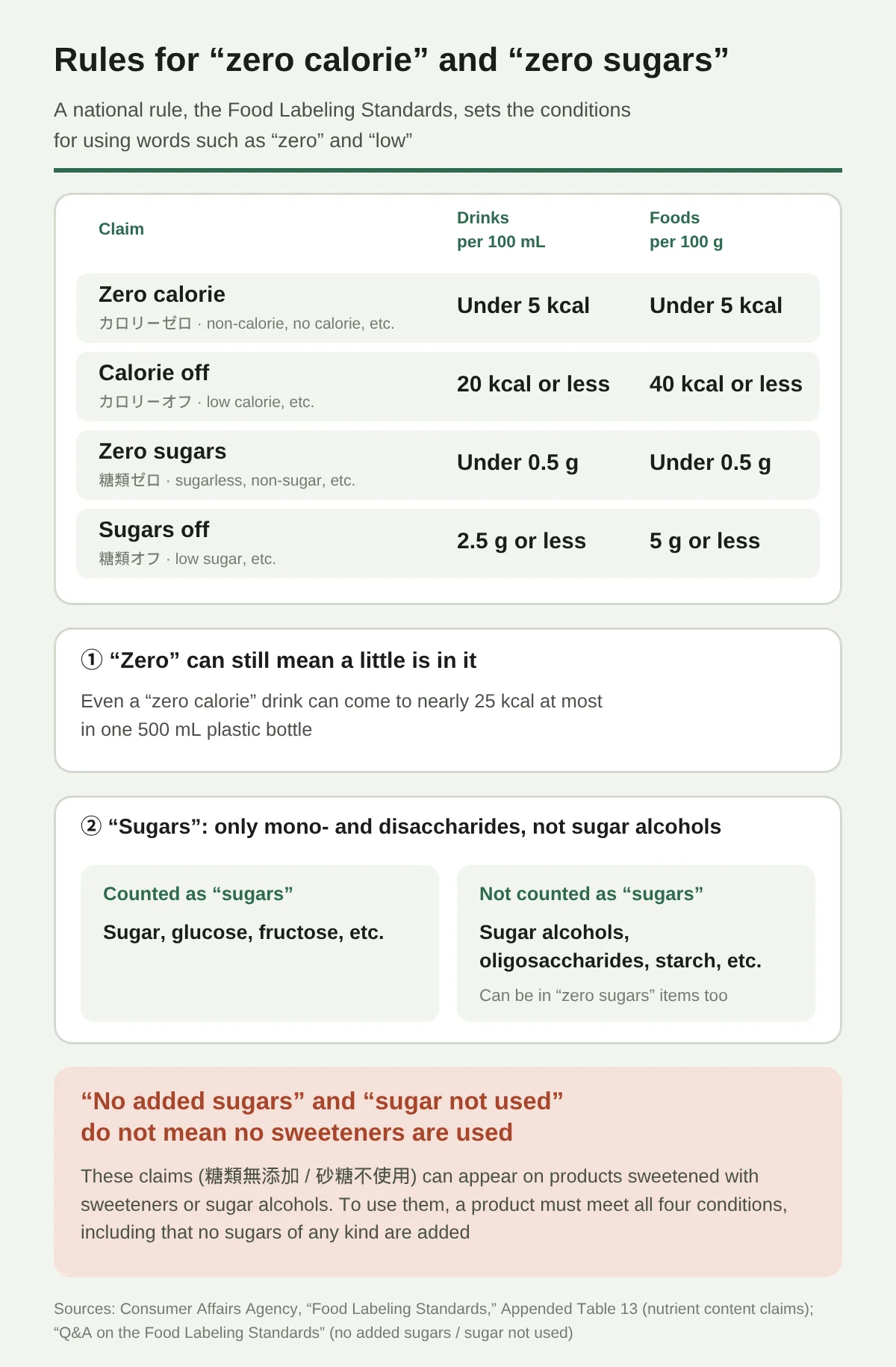
A national rule, the Food Labeling Standards, sets the conditions under which words such as “zero” and “low” may be used.
| Claim | Drinks (per 100 mL) | Foods (per 100 g) |
|---|---|---|
| “カロリーゼロ” (zero calorie) (non-calorie, no-calorie, etc.) | Under 5 kcal | Under 5 kcal |
| “カロリーオフ” (calorie off) (low calorie, etc.) | 20 kcal or less | 40 kcal or less |
| “糖類ゼロ” (zero sugars) (sugar-free, no sugar, etc.) | Under 0.5 g | Under 0.5 g |
| “糖類オフ” (sugars off) (low sugar, etc.) | 2.5 g or less | 5 g or less |
Two things are worth knowing here.
① Even “zero” may mean a little is present. A single 500 mL bottle of a “zero calorie” drink can have close to 25 kcal at most.
② “Sugars” are limited to things like sugar, glucose, and fructose. In the national rule, “sugars” means only monosaccharides and disaccharides (excluding sugar alcohols). So even a “zero sugars” product may still contain sugar alcohols, oligosaccharides, starch, and so on.
The four conditions for “no added sugars”
To label a product “糖類無添加” (no added sugars), all of the following must be met.
- No sugars of any kind have been added
- No ingredients (such as jam) or additives that substitute for sugars have been used
- Sugars have not been increased beyond the amount originally in the ingredients, for example by breaking them down with enzymes
- The amount of sugars is shown on the label
“砂糖不使用” (sugar not used) and “砂糖無添加” (no added sugar) can also be shown when these four conditions are met (Consumer Affairs Agency, Food Labeling Standards Q&A). In other words, it means not only sugar but also glucose, fructose, and so on have not been added, and the amount of sugars must also be shown. Note that sugars naturally present in the food, such as the fructose in fruit, may be present and the claim can still be shown.
However, “糖類無添加” and “砂糖不使用” do not mean no sweeteners are used. Some products are sweetened with sweeteners or sugar alcohols.
Japan’s rules: sweeteners with set amounts and those without
| Sweetener | Foods allowed and amounts (per kg) |
|---|---|
| Acesulfame K | Soft drinks, milk drinks, etc. 0.50 g; gum 5.0 g; confectionery, jam, pickles, and other foods 0.35 g, etc. |
| Saccharin sodium | Soft drinks, syrups, vinegar, etc. under 0.30 g; confectionery under 0.10 g, etc. |
| Saccharin (without sodium) | Gum only (0.050 g) |
| Sucralose | Upper limit set for each food |
| Disodium glycyrrhizinate (purified from licorice) | Soy sauce and miso only |
| Aspartame, neotame, advantame, xylitol, D-sorbitol | No usage standard |
| Licorice extract, stevia (existing food additives) | No usage standard (widely used in pickles, tsukudani (foods simmered in soy sauce), soft drinks, and more) |
(From the Japan Food Chemical Research Foundation, “Standards for Use and Preservation of Each Food Additive” (November 2024 edition), and the Tokyo Metropolitan Government Bureau of Public Health, “Main Food Additives by Use: Sweeteners.”)
How much do people in Japan consume?
| Sweetener | Estimated daily intake | Share of the ADI (acceptable daily intake) | Survey |
|---|---|---|---|
| Acesulfame K | 0.36 mg | 0.15% | Ages 1 to 6, fiscal 2022 |
| Sucralose | 0.87 mg | 0.35% | Ages 1 to 6, fiscal 2022 |
| Stevia | 0.37 mg | 0.56% | Ages 1 to 6, fiscal 2022 |
| Aspartame | 0.055 mg | 0.002% | All ages, fiscal 2019 |
| (For reference) aspartame | 6.58 mg | 0.3% | Estimated from production volume, 2020 |
(From the Consumer Affairs Agency and MHLW market basket surveys, and the Food Safety Commission of Japan (FSCJ) “Q&A on Aspartame.”)
Differences between Japan and overseas
Differences in allowed sweeteners and acceptable levels
| Sweetener | Japan | EU | US |
|---|---|---|---|
| Cyclamate (チクロ) | ✕ (banned in 1969) | ○ (E952) | ✕ |
| ADI for aspartame | 40 mg per kg of body weight per day | 40 mg | 50 mg |
| ADI for acesulfame K | 15 mg | 15 mg (raised from 9 mg in 2025) | ― |
| ADI for saccharin | ― | 9 mg (raised in 2024) | ― |
| ADI for sucralose | 15 mg | 15 mg (left unchanged in the 2026 re-evaluation) | ― |
| Erythritol | Treated as a food (JECFA: “ADI not specified”) | ADI 0.5 g per kg of body weight per day (newly set in 2023, based on its laxative effect) | GRAS (generally recognized as safe) |
| Stevia | Existing food additive (stevia extract, etc.) | ○ (E960) | Only highly purified forms (95% or more). Leaves and crude extracts are not permitted |
― = not checked for this article
There are also reverse cases like cyclamate, banned in Japan and the US but allowed in the EU. Cyclamate was banned in the US and then in Japan in 1969 after a rat experiment raised a suspicion of bladder cancer. In the EU, Canada, and elsewhere, it has continued to be used following the results of later tests.
Differences in labeling rules
In the EU, the following labeling about sweeteners is mandatory (EU Regulation 1169/2011, Annex III). Japan has no such rules.
| EU labeling requirement | Japan |
|---|---|
| Foods containing sweeteners must say “with sweetener(s)” near the product name | None (only “甘味料(〇〇)” in the ingredient list) |
| Foods containing more than 10% sugar alcohols must say “excessive consumption may produce laxative effects” | None |
| Confectionery and drinks containing a certain amount of licorice or more must say that people with high blood pressure should avoid excessive consumption | None |
| Aspartame must be labeled “contains a source of phenylalanine” | Yes (L-phenylalanine compound) |
Australia and New Zealand also require a warning about laxative effects on foods containing sugar alcohols.
Are “sweeteners bad for you”?
Aspartame as “possibly carcinogenic”
In July 2023, two WHO agencies announced their assessments of aspartame at the same time.
| Agency | Conclusion |
|---|---|
| IARC (International Agency for Research on Cancer) | Classified as “possibly carcinogenic to humans” (Group 2B), based on limited evidence for liver cancer in humans, among other things |
| JECFA (Joint FAO/WHO Expert Committee on Food Additives) | No sufficient reason to change the acceptable level (40 mg per kg of body weight per day). An adult weighing 70 kg would not exceed it unless drinking more than 9 to 14 cans of diet soda a day |
The FSCJ explains that the IARC classification shows “the strength of the evidence on whether it can cause cancer,” not the size of the chance of actually getting cancer. The US FDA does not agree with the classification, saying the studies IARC relied on have major flaws.
The WHO’s “do not use sweeteners for weight control”
In May 2023, the WHO issued guidance that “non-sugar sweeteners should not be used to control body weight or reduce the risk of lifestyle-related diseases.”
- It covers acesulfame K, aspartame, advantame, cyclamate, neotame, saccharin, sucralose, stevia, and others
- The reason is that no long-term effect of reducing body fat has been found. Observational studies also show more type 2 diabetes, cardiovascular disease, and deaths among long-term users, but they may not have removed the influence of people’s starting health and similar factors
- It is a “conditional” recommendation. Diet management for people who already have diabetes is outside the scope of this guidance’s evaluation (it means neither “must not use” nor “fine to use”). Sugar alcohols are also outside its scope
- Some short-term trials found that replacing sugar with sweeteners lowers weight a little. What the WHO is concerned about is the effect over the long term
- The guidance does not say that sweeteners themselves are toxic
Gut bacteria and blood sugar (2022 study)
In 2022, an Israeli research team published in the journal Cell a trial of 120 healthy adults.
- The 120 people were divided into groups taking one of saccharin, sucralose, aspartame, or stevia, and comparison groups (glucose only, or nothing), and took amounts below the acceptable level for two weeks (the sweeteners were taken together with glucose, as in commercial sachets)
- In the saccharin and sucralose groups, blood sugar rose more, along with changes in gut bacteria
- The changes varied greatly from person to person, and the team says “the clinical significance needs to be tested in future studies”
EFSA considered this study in its 2024 re-evaluation of saccharin. It noted that blood sugar rose more during the two weeks of saccharin intake but that the difference was gone at follow-up after the trial, and that four other small trials found no link with blood sugar or insulin, and said “the evidence is insufficient to judge, and there are no long-term trials.”
Erythritol and heart disease (2023 study)
In 2023, a research team at the Cleveland Clinic in the US reported in Nature Medicine that people with more erythritol in their blood had more heart attacks, strokes, and similar events within three years. It also showed experimental results that erythritol makes platelets clot more easily.
However, the US FDA reviewed the study and pointed out the following.
- It is an observational study, so it can show an association but cannot say it is the cause
- Erythritol is also made from glucose inside the body, and is known to increase when the body is under strain
- Blood from US patients was drawn in 2001 to 2007, before erythritol was widely used in foods, and while fasting. It is likely that the study is looking at what the body made, not at erythritol that was eaten
In its 2023 re-evaluation, EFSA also said that the current evidence does not show a causal relationship between foods containing erythritol and cardiovascular disease, and that it is uncertain whether blood levels in observational studies reflect erythritol eaten.
At the same time, in the same evaluation, EFSA set an acceptable level for erythritol for the first time (0.5 g per kg of body weight per day), based on the amount that caused no diarrhea in human trials. The value is also meant to prevent effects on the body from persistent diarrhea, not only immediate diarrhea. EFSA also said that intake estimates exceed this level in every age group, and heavy consumers may become unwell (EFSA says the estimates are on the high side). It is worth taking care not to eat or drink too many sweets and drinks high in sugar alcohols.
Sucralose impurities and heating
- In 2023, a study reported that a substance called “sucralose-6-acetate” damages DNA in cultured cells. It can be present as an impurity from making sucralose, and it is unclear whether it is formed from sucralose in the body. The FSCJ has not made it a subject of evaluation, saying very few related papers exist and no cases of harm to health have been confirmed in Japan or overseas. In the same paper, the bacterial mutagenicity test (Ames test) was negative
- In its February 2026 re-evaluation, EFSA concluded that there is no genotoxicity concern for sucralose and its impurities and left the acceptable level unchanged
- On the other hand, Germany’s Federal Institute for Risk Assessment (BfR) cautions that heating sucralose above 120°C may produce harmful chlorine compounds. EFSA also said there is no concern in current uses, but for an application to widen use to baked goods, it could not reach a safety conclusion because the effects of high-temperature heating are not sufficiently known. This is worth knowing when baking at home with a sucralose-containing sweetener
In summary
- The sweeteners usable in Japan are, in national assessments, considered to have no health effect when used within the set rules, and Japanese intake is far below the acceptable level
- On the other hand, the links with gut bacteria, blood sugar, and heart disease are still being researched and are not settled
- And the WHO’s current position is that you cannot say “switching to sweeteners will make you lose weight”
How Urayomi (ウラヨミ) approaches this
Urayomi does not write sweeteners off uniformly as “dangerous.” On the other hand, it puts weight on the point that the “zero” and “no additives” labels alone do not tell you what is in a product.
On product pages, we list, exactly as shown on the back label:
- The type of sweetener (aspartame, sucralose, acesulfame K, stevia, and so on)
- Sources of sweetness written in the ingredient list (原材料名), such as erythritol
- Whether claims such as “糖類ゼロ” or “糖類無添加” are shown
Where a manufacturer writes something like “砂糖不使用” (sugar not used), we quote it as is, and also show any sweeteners used.
Back-label checkpoints
- Look for “甘味料(〇〇)” in the additives section
- Look at the ingredient list (原材料名) too: erythritol, reduced starch syrup, oligosaccharides, and so on may be written there
- “糖類ゼロ” and “砂糖不使用” do not mean no sweeteners are included
- Check the amounts of “糖質” (carbohydrates) and “糖類” (sugars) in the nutrition facts: even a “zero sugars” product may contain 糖質 (carbohydrates minus dietary fiber)
- Be careful not to overeat sweets high in sugar alcohols: Japan has no mandatory warning
Related reading
- Sugars other than sugar (high-fructose corn syrup and others) → Article on isomerized sugar
- Rules for “no additives” and “not used” labels (the guideline’s 10 types) → Article on the rules for “無添加” labels
- Overseas rules for each additive → Additive database
Sources
- Consumer Affairs Agency, Food Labeling Standards, Article 7 and Appended Table 13 (nutrient content claims), Article 3 (labeling of aspartame)
- Consumer Affairs Agency, Food Labeling Standards Q&A (revised March 28, 2025), Processed Foods 230 and 231 (no added sugars and sugar not used)
- Consumer Affairs Agency, “Results of the Fiscal 2022 Market Basket Survey of Intake of Preservatives and Other Additives” (May 2024)
- FSCJ, “Q&A on Aspartame” / “Fiscal 2023 ‘Self-Initiated Evaluation’ Review Materials” (sucralose-6-acetate)
- Japan Food Chemical Research Foundation, “Standards for Use and Preservation of Each Food Additive” (November 2024)
- Tokyo Metropolitan Government Bureau of Public Health, “Main Food Additives by Use: Sweeteners”
- WHO “WHO advises not to use non-sugar sweeteners for weight control in newly released guideline” (May 2023)
- WHO “Aspartame hazard and risk assessment results released” (July 2023)
- U.S. FDA “High-Intensity Sweeteners” / “An evaluation of the article ‘The artificial sweetener erythritol and cardiovascular event risk’” (June 2023)
- EFSA, re-evaluation of acesulfame K (2025) / re-evaluation of saccharin (2024) / re-evaluation of sucralose (2026) / re-evaluation of erythritol (2023)
- BfR “Sucralose – Heating above 120°C can produce substances that are harmful to health”
- Regulation (EU) No 1169/2011 Annex III
- Food Standards Australia New Zealand “Warning and advisory statements”
- Suez J, et al. Cell 2022 (gut bacteria and blood sugar)
- Witkowski M, et al. Nat Med 2023;29:710-718 (erythritol)
- Schiffman SS, et al. J Toxicol Environ Health B 2023 (sucralose-6-acetate)
This article does not assert the safety or danger of any particular food or additive. If you manage your diet because of diabetes or similar conditions, or if you have phenylketonuria, please consult your doctor.
Related articles and databases
- Are preservatives bad for you? Types such as sorbic acid, what “preservative-free” hides, and how Japanese and overseas rules differ
- Are Food Colorings (Red No. 102, Yellow No. 4) Bad for You? Cancer Assessments and Whether They Are Banned Abroad, Checked Against Rules in Japan and Overseas
- What Is “果糖ぶどう糖液糖” (High-Fructose Corn Syrup)? Is It Worse for You Than Sugar? How It Differs From Sugar, and Corn and Genetic Modification
- What Is the Difference Between Mustard and Karashi? Seed Types, Why Mixing with Water Makes It Hot, and the Ingredients and Allergen Labeling of Dijon, Whole-Grain, and Japanese Karashi
- What Is Tomato Ketchup? The JAS “Special Grade,” How It Differs from Tomato Sauce, and Whether Lycopene Absorption Changes with Heat and Oil
- Does Fruit Fructose Make You Gain Weight? How It Differs from the Fructose in “果糖ぶどう糖液糖” (High-Fructose Corn Syrup), and a Comparison of Sugar and Fiber in 22 Fruits
- Were “無添加” (Additive-Free) Labels Banned? Reading the Consumer Affairs Agency Guideline’s 10 Types from the Back Label
- Why Did “No Chemical Seasoning” Disappear? Is Yeast Extract a Chemical Seasoning? How to Read Umami Seasonings and Hydrolyzed Protein
- Reading Oisix’s Trial Set and Subscription Down to the Back Label: Vegetable Pesticide Standards, the Trial Set, and How Cancellation Works
- What is carryover? How it differs from processing aids, and the additives that are not listed on labels even on “additive-free” foods
- Are Flavorings Bad for You? What “香料” (Flavoring) Contains, Why It Is Written as One Word, and Japanese vs. Overseas Rules
- 添加物データベース