
Are Blueberries Good for Your Eyes? Antioxidant Differences by Variety, Ways of Eating Them for Better Absorption, Whether Frozen Is Better, and Studies of People Who Kept Eating Them

PR This article contains ads. The “See on Rakuten” buttons are affiliate ads for Rakuten Ichiba, and the Tabechoku button is an affiliate ad for Moshimo Affiliate. What is written here is based on studies and national data, regardless of whether there are ads. The “See on Amazon.co.jp” links are also affiliate links.
“Blueberries are good for your eyes.” “Freezing them makes the nutrients easier to absorb.” “Eating them every day lowers blood pressure.” There are many good stories about blueberries.
How much of it is true? In this article, we check the following against studies and national data:
- How much do the antioxidant compounds (anthocyanins) differ by blueberry variety?
- Are there ways of eating that make anthocyanins easier for the body to take in?
- Is absorption better when they are frozen?
- In studies of people who kept eating them, what changes appeared over what periods?
- Does eating blueberries improve your eyesight?
- The safety of imported frozen berries, and how to read the back labels of dried blueberries and jam
Conclusions
- Anthocyanins are highest in the European wild species, bilberry (285 mg per 100 g raw), while the cultivated blueberries sold in supermarkets and the North American wild species (wild blueberries) are close to each other at 150 to 163 mg. Among 51 varieties grown in Japan there was a difference of up to 5.8 times, with the rabbiteye type higher
- In their original form, only about 1% of the anthocyanins eaten are absorbed, but counting the substances they are broken down into in the body, it is about 12%. No human trial can say “this way of eating gives the most absorption.” Heating, drying, and making jam reduce them
- The source of “freezing improves absorption” is a non-peer-reviewed undergraduate study, and what it measured was the amount that could be extracted from the berries. No study has compared absorption in people. Peer-reviewed research goes as far as showing that freezing does not reduce them
- Most trials of people who kept eating blueberries used powder and were funded by industry groups. Ease of blood vessel dilation tends to improve consistently from a few hours up to 6 months, but blood pressure and blood glucose results are split, and in the longest, 6-month trial, the main target measure (insulin sensitivity) did not change
- Most “good for the eyes” research is on bilberry extract. Night vision did not change in rigorous trials, while companies’ trials report improvements in eye fatigue and focusing with the extract. We found no trial that ate cultivated blueberry fruit and then examined the eyes. Among Foods with Function Claims, there are 0 notifications whose functional ingredient is “blueberry”
- Imported frozen berries have caused hepatitis A and norovirus food poisoning overseas, and Finland and Denmark recommend heating them. In Japan, no food poisoning caused by berries has been reported. Most dried blueberries contain sugar and oil, which is a different thing from the “dried” (unsweetened, no oil) entry in the Food Composition Tables
Products Featured in This Article
In the article, we introduce the following to match the points discussed (links to Rakuten Ichiba and Moshimo Affiliate).
| For someone who… | Product featured | Where |
|---|---|---|
| Wants to try the wild species, which has more anthocyanins | Frozen wild blueberries, organic JAS (from Canada) | Amount of anthocyanins: bilberry is higher, and the three cultivated types are close |
| Wants to use domestic berries outside the season | Frozen domestic blueberries (from Saitama or Chiba Prefecture) | Does freezing raise the absorption rate? |
| Wants to buy directly from the farmers who grew them | Domestic frozen blueberries on the farm-direct mail-order site Tabechoku (食べチョク) | Does freezing raise the absorption rate? |
| Wants dried berries with no sugar or oil | Dried blueberries whose only ingredient is “blueberries” | For dried blueberries, look at the ingredients |
Blueberry Varieties and Differences in Antioxidants
There Are Four Main Kinds of Blueberry
Things called “blueberries” are, botanically, different species in the same group (the genus Vaccinium).
| Kind | What it is | Main pigments (anthocyanins) |
|---|---|---|
| Highbush | Cultivated species. Common among the fresh blueberries in supermarkets. The “blueberries, raw” entry in the Food Composition Tables is also an analysis of this | Mostly malvidin type |
| Rabbiteye | Cultivated species. Higher than the highbush type in Japanese research (below) | Mostly malvidin type |
| Lowbush (wild blueberry) | North American wild species. Small berries. Sold in Japan frozen or dried | Mostly malvidin type |
| Bilberry | European wild species. Purple all the way through the flesh. A raw material for supplements | Mostly cyanidin and delphinidin types |
(Types of anthocyanins are from the USDA Flavonoid Database Release 3.3; Japanese varieties from Shibata 2021; bilberry flesh from Dare 2022.)
Amount of Anthocyanins: Bilberry Is Higher, and the Three Cultivated Types Are Close
- In the average values of the U.S. Department of Agriculture database, bilberry has 285 mg per 100 g, about 1.7 to 1.9 times the cultivated blueberries (highbush 163 mg, rabbiteye 149 mg) and wild lowbush (150 mg)
- However, these are averages of many studies, and note that the range within one kind is very wide. For example, delphinidin in highbush has been reported anywhere from a minimum of 3 mg to a maximum of 187 mg
- A Canadian study that compared them in the same laboratory with the same method (Kalt 2001) found that wild lowbush was consistently higher than cultivated highbush. In the database averages they are nearly the same, so the result changes with how you compare
- It is often said that “smaller berries have more anthocyanins,” but one study (Kalt 2001) found “no relationship” between berry size and amount, while another (Moyer 2002) found a relationship within highbush, so it is unclear
Among 51 Varieties Grown in Japan, a Difference of Up to 5.8 Times
A study that examined 51 varieties grown under the same conditions at an agricultural college in Chiba Prefecture (Shibata 2021) found anthocyanins ranging from 74 mg to 427 mg per 100 g, a difference of about 5.8 times. The rabbiteye type was higher than the highbush type. The highest was the rabbiteye variety “Suwannee,” and the lowest was the highbush variety “Berkeley.”
Even within the same variety, the amount changes with the number of days from when the berries turn blue until harvest. In two rabbiteye varieties, berries harvested 49 days after turning blue had 3.6 and 2.8 times the anthocyanins of those just after turning blue (Prior 1998; figures are from the paper’s abstract).
The Star of “Antioxidant” Is Not Vitamin C
The antioxidant capacity of blueberries (a figure measured in test tubes) closely matches the amount of polyphenols such as anthocyanins. Vitamin C is only about a quarter of that in strawberries and raspberries (Canadian analysis) and accounted for less than 10% of the antioxidant capacity (Kalt 1999).
| Per 100 g raw | Blueberries (raw) | Strawberries | Apples (with skin) | Kiwi (green) | Bananas |
|---|---|---|---|---|---|
| Energy | 48 kcal | 31 kcal | 56 kcal | 51 kcal | 93 kcal |
| Dietary fiber | 3.3 g | 1.4 g | 1.9 g | 2.6 g | 1.1 g |
| Vitamin C | 9 mg | 62 mg | 6 mg | 71 mg | 16 mg |
| Vitamin E (α-tocopherol) | 1.7 mg | 0.4 mg | 0.4 mg | 1.3 mg | 0.5 mg |
| Potassium | 70 mg | 170 mg | 120 mg | 300 mg | 360 mg |
(From MEXT, Standard Tables of Food Composition in Japan (2020 Edition (Eighth Revised)), 2023 Supplement. Anthocyanins are not an item in the tables.)
What Is the Best Way to Take In Antioxidants?
“1% Absorption” Changes Greatly Depending on What You Measure
- In the urine of 6 older women who ate 189 g of wild blueberries, anthocyanins in their original form were 0.004% of the amount eaten (Wu 2002)
- In a trial of 25 g of wild blueberry powder, the amount absorbed in its original form was 1.1% (Zhong 2017; funded by the Wild Blueberry Association of North America and others)
- In a trial in which 8 people drank 500 mg of anthocyanins labeled with a marker (carbon-13), counting the substances produced by breakdown in the body gave 12.38%. The breakdown products peaked in the blood about 10 hours after eating and remained for about 48 hours (Czank 2013)
Anthocyanins hardly enter the blood in their original form; they enter the body as substances broken down by gut bacteria and other processes (such as hippuric acid and ferulic acid). Both “the absorption rate is low, so it’s pointless” and “as much as 12% is absorbed” compare numbers that measured different things. What the breakdown products do in the body is still under study.
What About Eating Them With Milk?
- When 200 g of blueberries were eaten with water, a measure of antioxidant capacity in the blood rose, but it did not rise when eaten with 200 ml of whole milk. The peak of caffeic acid in the blood was about half (−49.7%) (Serafini 2009; 11 people, a single-dose trial)
- However, this trial did not measure the amount of anthocyanins themselves. In another study that imitated digestion in test tubes, mixing in milk did not change the “amount that could be absorbed from the gut” (Cebeci 2014)
We cannot go as far as saying “eating them with milk is bad.” If you are concerned, you can also choose to separate days when you mix them with yogurt or milk from days when you eat them plain.
Smoothies, Juice, and Whole Berries
- In a trial comparing blueberry juice and a smoothie, there was no difference in anthocyanin absorption (Kuntz 2015; 10 people)
- The claim that “making a smoothie with banana lowers absorption by 84%” comes from a trial of cocoa flavanols (a different polyphenol) and did not measure blueberry anthocyanins. Three people, including the lead author, are affiliated with Mars, which has a cocoa business (Ottaviani 2023)
- We found no human trial that directly compared absorption of whole berries and juice, or one that compared chewing well or not
On fruit juice, a large observational study in the United States found that people who drank more juice had more type 2 diabetes (Muraki 2013; introduced in a later section). For the sugar in fruit juice, see also the article on fructose in fruit.
Heating, Drying, and Jam Reduce Them
| Processing | Change in anthocyanins | Study |
|---|---|---|
| Freezing (−20°C, 3 months) | No clear decrease | Lohachoompol 2004 |
| Drying with hot air | −41% | Same |
| Soaking in sugar syrup, then drying | −49% | Same |
| Baking into baked goods | −42% | Rodriguez-Mateos 2014 |
| Making jam | Reduced by processing, and reduced much more after 6 months at room temperature. More remained when refrigerated (4°C) | Howard 2010 |
Amount and Timing
In a trial of ease of blood vessel dilation, the measure rose in proportion to the amount up to 766 mg of polyphenols in the drink, and leveled off above that (Rodriguez-Mateos 2013). The measure rose 1 to 2 hours and 6 hours after eating.
In a 28-day trial comparing eating in divided portions or all at once, drinking the day’s amount all at once gave a larger amount in the 24-hour urine. However, differences between individuals were 10-fold (Kalt 2017).
To sum up, no human trial can say “this way of eating gives the most absorption.” All we know is that heating, drying, and jam reduce them, that freezing does not, and that one small trial found some components in the blood were lower when taken with milk.
Does Freezing Raise the Absorption Rate?
Where the “Freezing Increases Them” Story Comes From
The story that “freezing increases anthocyanins” comes from a 2014 announcement by South Dakota State University in the United States.
- What it describes is an undergraduate capstone project (not peer-reviewed) (Plumb 2013)
- What it measured was the amount of anthocyanins that could be extracted from the berries in the lab using chemicals: 3.32 mg per gram raw and 8.89 mg after 133 days frozen. However, the frozen samples had large measurement variation (±3.56 mg)
- The university’s announcement explains that ice crystals broke the berry tissue, making the pigments easier to release
- The author’s own conclusion was modest: “freezing is fine as a storage method for up to about 2 months”
In Peer-Reviewed Research, the Finding Goes as Far as “They Do Not Decrease”
- A study that froze Australian highbush at −20°C for 1 month and 3 months found no clear decrease in anthocyanins (per gram dry weight: raw 7.2 mg, 1 month 8.1 mg, 3 months 7.9 mg) (Lohachoompol 2004)
- We found no trial that compared absorption between people who ate frozen blueberries and those who ate them raw (searched on PubMed, September 30, 2026)
“Easier to extract from the berries” and “easier for the human body to absorb” are different questions. We cannot say freezing raises absorption, but since freezing does not reduce them much, it is reasonable to use frozen berries outside the season.
There is a study finding more vitamin C in frozen berries than in berries kept a few days in the refrigerator (Bouzari 2015; funded by a frozen-food industry foundation). But blueberries do not have much vitamin C to begin with (see the table above).
You can also buy domestic blueberries directly from the farmers who grow them. On the farm-direct mail-order site Tabechoku (食べチョク), individual farmers list frozen blueberries. Fresh berries are available only from early summer through summer.
Studies of People Who Kept Eating Them: What Changed Over Each Period
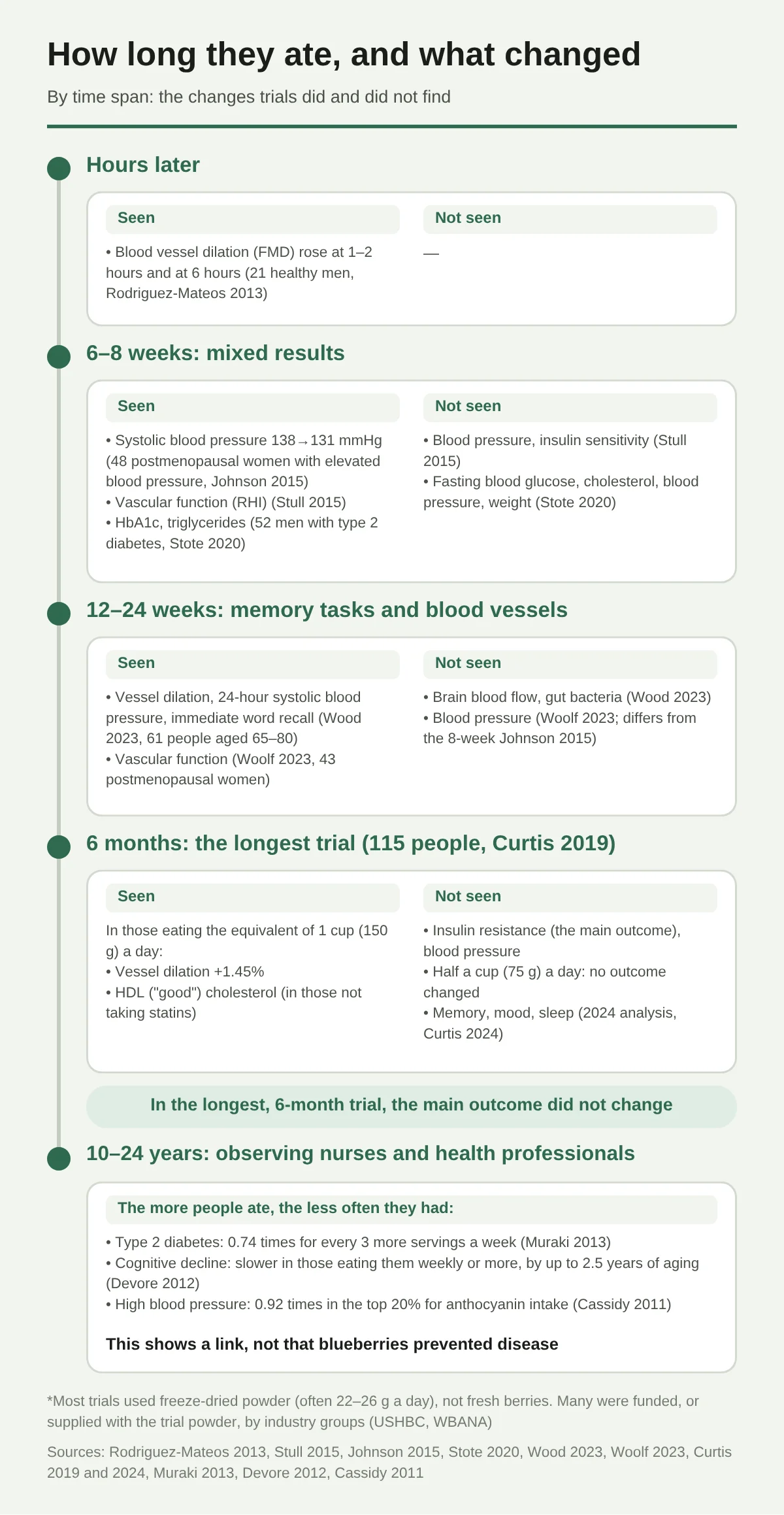
First, Keep in Mind: Most Trials Use “Powder” and “Industry Group Funding”
Most human trials use not raw blueberries but freeze-dried powder (often 22 to 26 g a day). By the papers’ own conversions, 26 g of powder equals about 178 g of fresh berries (Wood 2023), and 24 g equals about 1 cup of fresh berries (Miller 2018).
Also, many intervention trials were funded or supplied with trial powder by the U.S. Highbush Blueberry Council (USHBC) or the Wild Blueberry Association of North America (WBANA). The source of funding does not determine the result, but in this article we list the funders as stated in each paper.
A Few Hours Later: Ease of Blood Vessel Dilation Rises Temporarily
- In a trial of 21 healthy men, after drinking a blueberry drink, ease of blood vessel dilation (FMD, a measure of the function of the inner lining of blood vessels) rose 1 to 2 hours and 6 hours later. It rose in proportion to the amount up to 766 mg of polyphenols and leveled off above that (Rodriguez-Mateos 2013)
- In 21 children aged 7 to 10, scores on tasks such as remembering words improved about 1 to 3 hours after they drank freeze-dried wild blueberries (15 g and 30 g) (Whyte 2016)
6 to 8 Weeks: Results Split
| Trial | Participants | Amount and duration | What changed | What did not change | Funding |
|---|---|---|---|---|---|
| Stull 2010 | 32 people with obesity and poor insulin sensitivity | Smoothie with powder, twice a day, 6 weeks | Insulin sensitivity | Body fat, inflammation markers | A coauthor received research funds from USHBC |
| Stull 2015 | 44 people with metabolic syndrome | Same, 6 weeks | Vascular function (RHI) | Blood pressure, insulin sensitivity | USHBC, U.S. National Institutes of Health |
| Johnson 2015 | 48 postmenopausal women with slightly high blood pressure | 22 g powder/day, 8 weeks | Systolic blood pressure 138→131 mmHg, diastolic 80→75 mmHg, arterial stiffness | ― | USHBC and U.S. Department of Agriculture (per news reports; the paper’s statement not confirmed) |
| Stote 2020 | 52 men with type 2 diabetes | 22 g powder/day, 8 weeks | HbA1c (7.1% vs. 7.5%), triglycerides | Fasting blood glucose, cholesterol, blood pressure, body weight | USHBC |
12 to 24 Weeks: Memory Tasks and Blood Vessels
- In a trial in which 61 healthy people aged 65 to 80 took 26 g of freeze-dried wild blueberries (equal to 178 g of fresh berries) for 12 weeks, ease of blood vessel dilation (+0.86%), 24-hour systolic blood pressure (−3.59 mmHg), and a task of recalling words right away improved. Blood flow in the brain and gut bacteria did not change (Wood 2023; funded by WBANA)
- In a 12-week trial by the same research group in 43 postmenopausal women with slightly high blood pressure, vascular function improved but blood pressure did not fall (Woolf 2023). This differs from the 8-week trial (Johnson 2015)
- A trial in older adults whose memory had started to change (Krikorian 2010) had only 9 people and no control group compared at the same time
6 Months: In the Longest Trial, the Main Target Measure Did Not Change
The longest human trial to date followed 115 people with metabolic syndrome for 6 months (Curtis 2019).
- In people who took powder equal to 1 cup (150 g) a day, ease of blood vessel dilation rose by +1.45%, and HDL (“good”) cholesterol rose (in people not taking statins)
- The main target, insulin resistance (poor insulin sensitivity), did not change. Blood pressure did not change either
- In people at half a cup (75 g) a day, nothing changed in any measure
- In a 2024 analysis of the same trial, memory, mood, and sleep also did not change at 6 months (Curtis 2024)
- Funding was from USHBC and the UK research council (BBSRC)
In Analyses That Pool Studies (Meta-analyses)
| Item | Result | Study |
|---|---|---|
| Ease of blood vessel dilation (FMD) | Consistently in the direction of improvement (+1.11% in healthy people) | He 2026 (14 trials, 632 people) |
| Blood pressure | No difference in most of the pooled analyses. Only one found a decrease in diastolic blood pressure | Zhu 2017, Delpino 2024, He 2026 / Carvalho 2021 |
| Memory and judgment in healthy people | No difference | He 2026 |
| Memory in older adults worried about forgetfulness | Small improvement (standardized mean difference 0.34) | da Silva 2025 (9 trials, 513 people) |
Observational Studies That Followed People for Decades
In studies that followed nurses and health professionals in the United States for 10 to 24 years, people who ate more blueberries had less of the following diseases.
- Type 2 diabetes: for every 3 more servings of blueberries a week, the rate of developing it was 0.74 times. On the other hand, fruit juice was 1.08 times, with more cases among people who drank more (Muraki 2013)
- Cognitive decline: people who ate blueberries at least once a week declined more slowly, a difference of up to 2.5 years of age (Devore 2012; funding included the U.S. National Institutes of Health and the California Strawberry Commission)
- High blood pressure: 0.92 times in people with high anthocyanin intake (top 20%). In people over 60, there was no clear difference (Cassidy 2011)
These are associations in which “people who ate more had less,” and they do not show that blueberries prevented the diseases. People who eat a lot of fruit may also differ in other lifestyle habits.
Does Eating Blueberries Improve Your Eyesight?
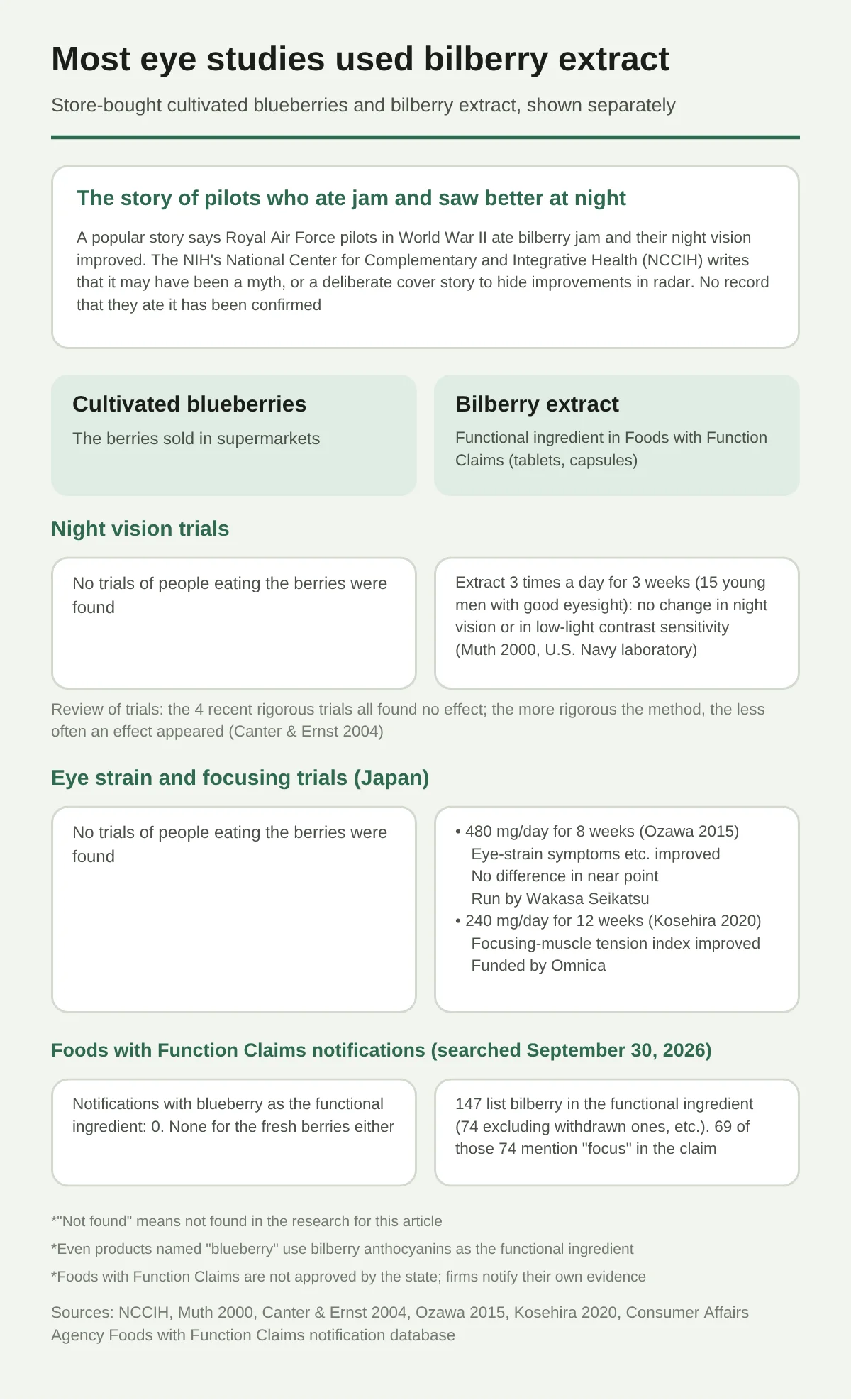
The Story of “Fighter Pilots Ate Jam and Could See Better at Night”
A story often told is that during World War II, Royal Air Force pilots ate bilberry jam and their night vision improved.
The U.S. National Institutes of Health’s National Center for Complementary and Integrative Health (NCCIH) writes that this story is “a myth or possibly a deliberate fabrication to hide improvements in radar.” No record that the pilots actually ate it has been confirmed.
Trials of Night Vision
- In a trial by a U.S. Navy laboratory in which 15 young men with good eyesight took bilberry extract three times a day for 3 weeks, neither night vision nor the ability to distinguish light and dark in dim places changed (Muth 2000)
- An analysis pooling trials on night vision found that all 4 recent rigorous trials showed no effect, and the more rigorous the method, the less likely an effect was seen (Canter & Ernst 2004)
Trials of Eye Fatigue and Focusing
In Japan, there are trials on eye fatigue and focusing from computer work, and they report improvement. However, both are trials of bilberry extract, not of eating the berries.
| Trial | Participants | Amount and duration | Result | Conducted by / funding |
|---|---|---|---|---|
| Ozawa 2015 (Keio University) | 88 people who work at computers | Bilberry extract 480 mg/day, 8 weeks | Smaller decline in flicker discrimination (CFF) and improved subjective symptoms of eye fatigue. No difference in near point (the distance at which they can see up close) | Conducted by Wakasa Seikatsu; 2 employees were coauthors |
| Kosehira 2020 | 109 people aged 20 to 60 | Bilberry extract 240 mg/day, 12 weeks | Improved a measure of tension in the focusing muscle | Funded by Omnica; 2 employees were authors |
In this survey, we found no human trial that had people eat the cultivated blueberries sold in supermarkets and then examined how the eyes worked.
Foods with Function Claims Are Almost All “Bilberry”
Searching the Consumer Affairs Agency’s database of Foods with Function Claims on September 30, 2026 gave the following.
- There are 147 notifications that include “bilberry” among the functional ingredients (74 excluding withdrawn ones and the like). Of those 74, 69 include “focus” in the claim
- Notifications whose functional ingredient is “blueberry” number 0. Even products with “blueberry” in the name have bilberry-derived anthocyanins as the functional ingredient
- All 74 are processed foods such as tablets and capsules, and there is no notification for blueberry fruit (a fresh food)
- An example of a daily amount: 43.2 mg of bilberry-derived anthocyanins (products by Taisho Pharmaceutical and Ajinomoto)
Foods with Function Claims are not reviewed or approved by the government; they are a system in which the company notifies its own evidence at its own responsibility.
Where Do the Blueberries in Japan Come From?
- The domestic harvest is 2,263.8 tons (2023 crop, 983.4 ha under cultivation). The largest are Tokyo (326 tons), Nagano (250 tons), Gunma (238 tons), and Ibaraki (205 tons) (MAFF, “Survey on Production Trends of Specialty Fruit Trees”)
- Fresh imports were 2,047 tons in 2025, with Mexico at 64.5%, the United States 25.3%, and Chile 6.7%
- Imports of frozen “berries (without added sugar)” were 33,697 tons in 2025, with Canada at 62.4% and Chile 18.8%. This category also includes berries other than blueberries, so the amount of blueberries alone is unknown
- For fresh blueberries, domestic and imported are about the same scale, but frozen imports are an order of magnitude larger
(Ministry of Finance, Trade Statistics. The statistics have no category for blueberries alone. Fresh is the total of cranberries, bilberries, and other fruits of the genus Vaccinium.)
Safety of Imported Frozen Berries
Pesticide Residue Violations and Inspections
MHLW’s “Violation cases of the Food Sanitation Act in imported foods” lists pesticide residue violations in blueberries. In 2023 to 2025, fungicides and insecticides above the standards were found in fresh and frozen blueberries from Chile, Mexico, and China.
- For tebuconazole (a fungicide) in blueberries from Chile, testing of every lot (an inspection order) began in August 2024, was lifted on July 13, 2026, and shifted to enhanced monitoring inspection
In the U.S. Department of Agriculture’s 2022 testing, no pesticides were detected in 16.0% of 482 samples of fresh blueberries and 11.8% of 51 samples of frozen. Most of what was detected was within U.S. standards, and 2 fresh samples exceeded the standard.
Radioactive Cesium Is Concentrated in “European Wild Bilberries”
The same violation list also has about 20 cases in which radioactive cesium exceeded Japan’s standard (100 becquerels per kg). Almost all were jam, dried products, frozen products, and supplement raw materials made with wild bilberries from Poland, Ukraine, Finland, Sweden, and elsewhere (up to 1,800 becquerels, a dried product in fiscal 2012). They need to be considered separately from North and South American blueberries.
Hepatitis A and Norovirus
Frozen berries have caused food poisoning overseas.
- In Europe in 2013–2014, there was an outbreak of hepatitis A from frozen mixed berries, with 1,589 people falling ill (Severi 2015). There were 32 events linked to frozen berries from 1983 to 2013, most commonly norovirus (Tavoschi 2015)
- In the Netherlands from November 2024 to February 2025, frozen blueberries sold in supermarkets caused hepatitis A in 24 people (Friesema 2026)
- The Finnish Food Authority recommends that foreign frozen berries eaten at home be boiled “at 90°C for at least 5 minutes, or for 2 minutes at a boil,” and the Danish Veterinary and Food Administration recommends boiling commercial frozen berries “for at least 1 minute”
In Japan, MAFF says that no hepatitis A food poisoning caused by berries has occurred domestically. Of 109 imported berry samples examined by the Tokyo Metropolitan Government, all were negative for hepatitis A virus. In this survey, we found no national notice recommending that consumers heat frozen berries. The Food Safety Commission of Japan (FSCJ) fact sheet says that heating at “85°C for at least 1 minute” is needed to inactivate hepatitis A virus.
If you are concerned, you can choose to heat them for use in jam, sauces, and the like. However, heating reduces anthocyanins (see the earlier section).
Back-Label Checkpoints
For Dried Blueberries, Look at the Ingredients
The “blueberries, dried” entry in the Food Composition Tables is the value for a product with no sugar or oil added (280 kcal and 17.6 g of dietary fiber per 100 g). However, the backs of many dried blueberries on sale are different.
| Ingredient list on the back (examples checked on Rakuten Ichiba product pages) | What is in it |
|---|---|
| Blueberries, sugar, vegetable oil (ブルーベリー、砂糖、植物油) | Sugar and oil |
| Blueberries (from the U.S.), sugar, sunflower oil (ブルーベリー(アメリカ産)、砂糖、ひまわりオイル) | Sugar and oil |
| Organic blueberries, organic sugar, organic sunflower oil (有機ブルーベリー、有機砂糖、有機ひまわり油) | Sugar and oil even though “organic” |
| Wild blueberries, high-fructose glucose syrup / acidulants (malic acid, tartaric acid), flavoring (ワイルドブルーベリー・果糖ブドウ糖液糖/酸味料(リンゴ酸、酒石酸)・香料) | Liquid sugar and flavoring even though “oil-free” |
| Blueberries (ブルーベリー) | Blueberries only |
- “Organic” and “oil-free” do not mean that no sugar is included. You can tell from the ingredient list (原材料名)
- Drying reduces anthocyanins by 40 to 50% (the table in the earlier section)
For Jam, Look at the Order of Ingredients and the “Sugar Content”
Ingredients (原材料名) are listed in descending order of weight.
| Example ingredient list | How to read it |
|---|---|
| Blueberries, sugar, concentrated lemon juice / gelling agent (pectin) (ブルーベリー、砂糖、濃縮レモン果汁/ゲル化剤(ペクチン)) | Blueberries are the largest |
| Sugar, blueberries / gelling agent (pectin) (砂糖、ブルーベリー/ゲル化剤(ペクチン)) | Sugar is the largest |
| Sugars (starch syrup, sugar, glucose, isomaltooligosaccharide), blueberries, … (糖類(水あめ、砂糖、ぶどう糖、イソマルトオリゴ糖)、ブルーベリー、…) | Sugars are the largest |
- Jam is fruit boiled with sugars and the like until it gels (Food Labeling Standards). Under JAS, jams have a sugar content (soluble solids) of 40% or more
- For jams, words indicating that the sugar content is lower than usual must not be used. The exception is for jam of 55 degrees or less, when numbers are written side by side, such as “sugar content 50 degrees” (Food Labeling Standards, Appended Table 22)
- Blueberry jam in the Food Composition Tables is 174 kcal per 100 g, of which 34.7 g is sucrose
“Blueberry Flavor” May Contain No Berries
- For soft drinks, milk drinks, ice cream, and the like, if the juice is less than 5%, “無果汁” (no fruit juice) or “果汁○%” (fruit juice ○%) must be written (the “no fruit juice” notice under the Act against Unjustifiable Premiums and Misleading Representations). Sweets and bread are not covered
- In a U.S. example, the ingredient list on the official website for a blueberry muffin mix (JIFFY) has no blueberries, and lists the colorings “BLUE 2 LAKE” and “RED 40 LAKE” and flavoring
Bilberry Extract in Supplements
- The American Botanical Council (ABC, an industry-affiliated nonprofit) reported in 2012 that some bilberry extract products were adulterated with anthocyanins from other fruits and from black rice and black beans, synthetic colorings, and so on. A paper also says adulteration is hard to detect with pharmacopoeia analysis methods alone (Govindaraghavan 2014)
- In Japan, there were 2 violations in 2023 in which a sweetener not permitted in Japan (cyclamate) was found in bilberry extract made in China (MHLW)
On colorings and sweeteners, see also the article on food colors and the article on sweeteners.
Who Should Be Careful
- People taking drugs that make blood harder to clot (anticoagulants and the like) or diabetes drugs: MHLW’s Information Site on Integrative Medicine (eJIM, a translation of NCCIH materials) says bilberry may interact with these drugs. This is not about the amount of berries eaten as food; if you use an extract supplement, consult a doctor or pharmacist
- Bilberry leaf: The U.S. NCCIH says that taking the leaf in high doses for a long time may be unsafe. It is different from the fruit
- People who are pregnant or breastfeeding: Little is known about safety for amounts beyond what is eaten as food (such as supplements) (NCCIH)
- People worried about food poisoning from frozen berries: There is the option of heating them (see the section above)
Summary of the Products Featured in This Article
| Organic frozen wild blueberries | Domestic frozen blueberries | Dried blueberries (no sugar or oil) | |
|---|---|---|---|
| For someone who… | Wants to try the wild species (lowbush) | Wants to use domestic berries outside the season | Wants something that keeps at room temperature |
| Ingredient list, etc. | Organic blueberries (from Canada), frozen | Blueberries (from Saitama or Chiba Prefecture), frozen | Blueberries (from the U.S.) only |
| Price (tax included) | 2 bags of 1 kg, ¥6,780 (free shipping) | 1 kg from ¥3,499 (free shipping) | 200 g from ¥2,280 (free shipping) |
| Buy | See on Rakuten PR | See on Rakuten PR | See on Rakuten PR See on Amazon.co.jp PR |
(Checked on Rakuten Ichiba sales pages on September 30, 2026. Prices and shipping may change.)
Urayomi’s Approach
- “Blueberries are good for your eyes” has not been confirmed for cultivated blueberry fruit. Most research is on bilberry extract; night vision did not change, and for eye fatigue and focusing, companies’ trials report improvement
- The antioxidant anthocyanin differs by several times depending on variety and ripeness. We do not know “which way of eating gives the most absorption,” but heating, drying, and jam reduce it, and freezing does not
- In trials of people who kept eating them, ease of blood vessel dilation is consistently in the direction of improvement, while blood pressure and blood glucose results are split. Many used powder, with industry group funding involved
- Imported frozen berries have had food poisoning cases overseas. For dried berries and jam, you can check for sugar, oil, and liquid sugar in the ingredient list on the back
Sources
- U.S. Department of Agriculture, USDA Database for the Flavonoid Content of Selected Foods, Release 3.3 (2018)
- Phenol-Explorer 3.6
- MEXT, “Standard Tables of Food Composition in Japan (2020 Edition (Eighth Revised)), 2023 Supplement” (updated March 27, 2026)
- MAFF, “Survey on Production Trends of Specialty Fruit Trees,” 2023 crop (e-Stat)
- Ministry of Finance, “Trade Statistics,” imports by commodity and country (2023–2025)
- MHLW, “Violation cases of the Food Sanitation Act in imported foods,” and the notices on the inspection order for blueberries from Chile (August 23, 2024) and its lifting (July 13, 2026)
- MAFF, materials on the hepatitis A virus survey of strawberries (fiscal 2025, survei r7-4)
- Tokyo Metropolitan Government, Food Safety Information Evaluation Committee materials (fiscal 2014, hepatitis A virus in imported berries)
- Food Safety Commission of Japan, fact sheet “Hepatitis A”
- Finnish Food Authority (Ruokavirasto), “Ulkomaiset pakastemarjat” / Danish Veterinary and Food Administration (Fødevarestyrelsen), “Frosne bær”
- US Department of Agriculture, Pesticide Data Program Annual Summary 2022
- Consumer Affairs Agency, search of notification information on Foods with Function Claims (searched September 30, 2026) / “Labeling of soft drinks and the like with no fruit juice”
- Food Labeling Standards (Cabinet Office Order No. 10 of 2015), Appended Tables 3 and 22 / Japanese Agricultural Standard for “Jams” (JAS 0524:2024)
- U.S. NCCIH, “Bilberry” (November 2024) / MHLW eJIM, “Bilberry”
- “JIFFY” Blueberry Muffin Mix official page (checked September 30, 2026)
- Foster S, Blumenthal M. HerbalGram. 2012;96:64-73 (ABC, adulteration of bilberry extract) / Govindaraghavan S. Fitoterapia. 2014
- Plumb ME. South Dakota State University Honors Capstone. 2013 (freezing and anthocyanins, not peer-reviewed)
- Kalt W, et al. J Agric Food Chem. 2001 / 1999 / Moyer RA, et al. J Agric Food Chem. 2002 / Prior RL, et al. J Agric Food Chem. 1998
- Shibata Y, et al. J Nutr Sci Vitaminol. 2021 (51 varieties grown in Japan) / Dare AP, et al. Food Chem. 2022
- Wu X, et al. J Nutr. 2002 / Zhong S, et al. Mol Nutr Food Res. 2017 / Czank C, et al. Am J Clin Nutr. 2013 / de Ferrars RM, et al. Br J Pharmacol. 2014 / Kalt W, et al. Food Funct. 2017
- Serafini M, et al. Free Radic Biol Med. 2009 / Cebeci F, et al. Int J Food Sci Nutr. 2014
- Kuntz S, et al. Br J Nutr. 2015 / Ottaviani JI, et al. Food Funct. 2023
- Lohachoompol V, et al. J Biomed Biotechnol. 2004 / Rodriguez-Mateos A, et al. Mol Nutr Food Res. 2014 / Howard LR, et al. J Agric Food Chem. 2010 / Bouzari A, et al. J Agric Food Chem. 2015
- Rodriguez-Mateos A, et al. Am J Clin Nutr. 2013 / Whyte AR, et al. Eur J Nutr. 2016
- Stull AJ, et al. J Nutr. 2010 / Nutrients. 2015 / Johnson SA, et al. J Acad Nutr Diet. 2015 / Stote KS, et al. Curr Dev Nutr. 2020
- Wood E, et al. Am J Clin Nutr. 2023 / Woolf EK, et al. Food Funct. 2023 / Krikorian R, et al. J Agric Food Chem. 2010
- Curtis PJ, et al. Am J Clin Nutr. 2019 / 2024
- Zhu Y, et al. J Hum Hypertens. 2017 / Carvalho MF, et al. Nutr Res. 2021 / Delpino FM, et al. Phytother Res. 2024 / da Silva ABN, et al. Biogerontology. 2025 / He Y, et al. Nutr Res. 2026
- Muraki I, et al. BMJ. 2013 / Devore EE, et al. Ann Neurol. 2012 / Cassidy A, et al. Am J Clin Nutr. 2011
- Muth ER, et al. Altern Med Rev. 2000 / Canter PH, Ernst E. Surv Ophthalmol. 2004
- Ozawa Y, et al. J Nutr Health Aging. 2015 / Kosehira M, et al. Nutrients. 2020
- Severi E, et al. Euro Surveill. 2015 / Tavoschi L, et al. Euro Surveill. 2015 / Friesema IHM, et al. Emerg Infect Dis. 2026
Related articles and databases
- Does Fruit Fructose Make You Gain Weight? How It Differs from the Fructose in “果糖ぶどう糖液糖” (High-Fructose Corn Syrup), and a Comparison of Sugar and Fiber in 22 Fruits
- Are Dairy Products Bad for Japanese People? The Effects of Eating Too Much, Differences from Foreigners, Dairy in Japan and Abroad, and Bulgaria, the “Land of Yogurt”
- Are Food Colorings (Red No. 102, Yellow No. 4) Bad for You? Cancer Assessments and Whether They Are Banned Abroad, Checked Against Rules in Japan and Overseas
- Is Benifuuki Green Tea Good for Hay Fever? Checking the Size and Funding of the Methylated Catechin Trials, What the Foods with Function Claims Notifications Say, and Caffeine and How to Brew, Against Papers and Government Documents