
Is Sesame Good for You? Checking Sesamin Research, Allergen Labeling, and Pesticide Residues in Imported Sesame Against Government Data and Studies

PR This article contains affiliate links to Rakuten Ichiba (“See on Rakuten”). What is written here is based on public agency data and published studies, regardless of whether there are ads. The “See on Amazon.co.jp” and “See on Yahoo! Shopping” links are also affiliate links.
Sesame is a food with many health claims: “rich in calcium,” “sesamin keeps you young,” “you have to grind it to absorb it,” and so on. On the other hand, sesame can cause food allergies, and almost all the sesame used in Japan is imported.
This article checks the following against government data and published studies.
- How do the nutrients differ among roasted sesame, ground sesame, sesame paste, and hulled sesame?
- What are sesamin and sesaminol? What is known from studies in people?
- How does sesame allergen labeling differ among Japan, the US, and the EU?
- Where does Japan buy its sesame, and what kinds of violations have been found at import inspection?
Conclusion
- Sesame has about 54 g of fat and 1,200 mg of calcium (roasted) per 100 g. However, hulled sesame (“mukigoma,” with the skin removed) has only 62 mg of calcium, and sesame paste has 590 mg (food composition table). A typical serving is around 10 g, so the amount you actually eat is one-tenth of those figures
- Meta-analyses (studies that statistically combine multiple studies) of human trials on sesame lignans such as sesamin often report lower blood pressure, cholesterol, and blood sugar. However, the results varied enormously from trial to trial, and some of the studies were rated “low” to “very low” in certainty of evidence
- In Japan, sesame allergen labeling is “recommended” (not mandatory). In the US, sesame became the ninth major allergen with mandatory labeling from January 2023, and the EU also makes labeling mandatory. In April 2026, Japan made cashew nuts mandatory and added pistachios as recommended, but sesame stays at “recommended”
- Japan imports about 190,000 tons of sesame seeds a year (2025). Nigeria is the largest source, and about 90% comes from African countries. Domestic harvest is about 27 tons (2024 crop), roughly 1/7,000 of the import volume
- In import inspections from April 2021 to September 2026, there were 63 Food Sanitation Act violations for sesame seeds: 41 for pesticide residues and 22 for mold toxin (aflatoxin). Violating shipments are destroyed, sent back, and so on, so they are designed not to reach the domestic market
What this article features
Within the article, we feature the following items to match each point (Rakuten Ichiba links, and a regular link to a maker’s official shop).
| For people who… | Item featured | Where |
|---|---|---|
| Want roasted sesame whose origin is known | Organic white roasted sesame (Kingoma Honpo; the official site says the raw material is organic sesame from Paraguay and Bolivia) | Choosing sesame with a disclosed origin |
| Want to compare roasted and ground sesame from the same maker | Katagi Foods organic roasted and ground sesame, choose-4-bags set | If you want to try roasted, ground, and paste |
| Want a sesame paste whose only ingredient is sesame | Katagi Foods organic white sesame paste | If you want to try roasted, ground, and paste |
| Want to grind sesame right before eating | Kyocera ceramic sesame mill | If you want to try roasted, ground, and paste |
Sesame nutrients: how roasted, ground, and paste differ
Comparing four types
The “Standard Tables of Food Composition in Japan (8th Revised Edition), 2023 Supplement” from MEXT lists four kinds of sesame. According to the tables’ explanations, they are as follows.
- Dry (乾): commercially sold “washed sesame” (black and white sesame)
- Roasted (いり): “dry” sesame that has been roasted
- Hulled (むき): white sesame soaked in water, with the seed coat (skin) removed, then rinsed and dried
- Paste (ねり): hulled white sesame, or sesame with the skin on, roasted and ground into a paste
| Per 100 g | Dry | Roasted | Hulled | Paste |
|---|---|---|---|---|
| Energy | 604 kcal | 605 kcal | 570 kcal | 646 kcal |
| Protein | 19.8 g | 20.3 g | 19.3 g | 19.0 g |
| Fat | 53.8 g | 54.2 g | 54.9 g | 61.0 g |
| Dietary fiber | 10.8 g | 12.6 g | 13.0 g | 11.2 g |
| Calcium | 1,200 mg | 1,200 mg | 62 mg | 590 mg |
| Iron | 9.6 mg | 9.9 mg | 6.0 mg | 5.8 mg |
| Magnesium | 370 mg | 360 mg | 340 mg | 340 mg |
| Vitamin B1 | 0.95 mg | 0.49 mg | 1.25 mg | 0.32 mg |
| Vitamin E (alpha-tocopherol) | 0.1 mg | 0.1 mg | 0.1 mg | 0.1 mg |
| Vitamin E (gamma-tocopherol) | 22.0 mg | 23.0 mg | 32.0 mg | 29.0 mg |
(Standard Tables of Food Composition in Japan (8th Revised Edition), 2023 Supplement. Food Nos. 05017, 05018, 05019, 05042)
Three things stand out in the table.
- Calcium drops sharply once the skin is removed. Dry and roasted sesame with the skin on have 1,200 mg, but hulled sesame has 62 mg. Sesame paste, which includes both hulled and unhulled types, has 590 mg
- Roasting reduces vitamin B1. The 0.95 mg in dry sesame becomes 0.49 mg in roasted sesame
- Most of the vitamin E in sesame is gamma-tocopherol. Alpha-tocopherol is only 0.1 mg
More than half of 100 g of sesame is fat, so the energy is also high. 10 g of roasted sesame (about 1 tablespoon; the table gives 65 g per 100 ml) is about 60 kcal. The label on the organic white roasted sesame (Kingoma Honpo) featured in this article states 66.6 kcal and 5.72 g of fat per 10 g. Values in the table and on products differ slightly depending on the raw material and how it is made.
Sesame oil is almost entirely fat per 100 g (890 kcal). It contains almost no calcium (1 mg). How oils compare with each other is covered in the article on vegetable oils and animal fats.
Ground sesame is not in the table
“Suri-goma” (ground sesame) is not listed in the food composition tables. The tables’ explanation says sesame is “used in cooking either roasted as is, or ground.” Ground sesame is roasted sesame that has been ground, so its nutrients per 100 g are thought to be about the same as roasted sesame (the table has no value, so this is Urayomi’s estimate).
You also often see the claim that “whole sesame seeds pass through undigested, so it is better to grind them before eating.” However, among the sources we checked, there was no study that fed people roasted sesame and ground sesame and compared nutrient absorption. A test-tube study that imitated digestion (Chen 2019) measured how much lignan (explained below) comes out of roasted sesame meal, but it did not confirm how much is absorbed in the human body.
If you want to try roasted, ground, and paste
We chose products whose ingredient list is only “organic sesame” (有機ごま).
What are sesamin and sesaminol?
Sesame contains a group of compounds called lignans. The best known are sesamin and sesamolin.
- According to a review (Wei 2022), the average amount in the seed is 2.48 mg of sesamin per gram (1.11 to 9.41 mg) and 1.72 mg of sesamolin (0.20 to 3.35 mg). Total lignans are higher in black sesame (3.56 to 12.76 mg per gram), and 2.83 to 5.66 mg is reported for white sesame
- Sesaminol and sesamol are present only in small amounts in raw seeds. They form from sesamin and sesamolin when sesame is pressed or heated. Under acidic conditions in particular (such as when sesame oil is bleached with acid clay), sesamolin is said to convert easily into sesaminol
- Sesame oil pressed with heat from roasted raw material is reported to contain more sesamol, sesamin, and total lignans than cold-pressed or refined oil
The amount of lignans varies widely with variety, origin, weather, and how the plant is grown. Product packages rarely state the sesamin content, so you cannot know exactly how much you are getting from ordinary sesame.
Is sesamin good for you? Studies in people
What the meta-analyses found
Many trials (randomized controlled trials and others) have had people eat sesame or sesamin. Here are the main meta-analyses that combine them.
| Study | Subjects | What was given | Result | Certainty of evidence |
|---|---|---|---|---|
| Khalesi 2016 | 10 controlled trials | Sesame (seeds, oil, etc.) | Triglycerides fell. Total cholesterol and LDL cholesterol showed no clear difference | Very large variation between trials (I²=84–96%) |
| Khosravi-Boroujeni 2017 | 8 trials, 843 people | Sesame | Systolic blood pressure fell 7.83 mmHg and diastolic 5.83 mmHg. In the 4 high-quality trials alone, systolic fell 3.23 mmHg and diastolic showed no clear difference | Very large variation (I²=98–99%) |
| Sun 2022 | 7 randomized controlled trials, 212 people | Sesamin supplements (28 to 60 days) | Total cholesterol fell 10.9 mg/dL, LDL cholesterol 8.4 mg/dL, and systolic blood pressure 3.7 mmHg. Diastolic blood pressure, triglycerides, and body weight showed no clear difference | Short duration, small numbers |
| Yargholi 2021 | 8 randomized controlled trials, 382 people (mainly with type 2 diabetes) | Sesame oil, sesame, sesamin (6 to 12 weeks) | Fasting blood glucose fell 28.2 mg/dL and HbA1c 1.00%. Insulin showed no clear difference | “Low” on GRADE (certainty rating) |
| Mardani 2025 | 6 trials, 465 people (people with somewhat high blood pressure or hypertension) | Sesame capsules, sesame oil (60 mg to 35 g per day) | Blood pressure, body weight, total cholesterol, and triglycerides fell. LDL cholesterol showed no clear difference | 5 of the 6 trials were rated “low” quality. All outcomes rated “very low” on GRADE |
There are also 5 more meta-analyses in people with diabetes that reported lower blood sugar and lipids with sesame or sesame oil (Sohouli 2022, Atefi 2022, Ramírez-Coronel 2023, Vajdi 2024, Jafari 2025).
Cautions when reading these results
Looking only at the results, it is tempting to say “sesame lowers blood pressure, cholesterol, and blood sugar,” but the following points need attention.
- The results varied enormously from trial to trial (many have I² above 90%). Even under the same label of “sesame,” the amount, form (seeds, oil, supplement), duration, and participants differed
- The most recent summary (Mardani 2025) rated the certainty of evidence as “very low.” The authors cite that many of the trials were small, included people taking blood pressure medication, or lacked blinding (a design so that people do not know which they are taking)
- Some trials used more than a normal diet provides, such as several tens of grams of sesame oil a day or sesamin supplements
- The subjects were mainly people with diabetes or high blood pressure. These are not studies of whether healthy people who keep eating sesame get fewer diseases
- In a trial that looked at how sesamin behaves in the body (Tomimori 2013, 48 healthy people, 50 mg a day of sesamin and episesamin for 28 days), no serious adverse events were reported. The authors of this paper are affiliated with the Suntory Wellness research laboratory, which sells sesamin supplements
How much sesame, how much sesamin
Using the average above (2.48 mg of sesamin per gram of seed), 10 g of sesame contains about 25 mg of sesamin (range about 11 to 94 mg; Urayomi’s calculation). Most of the supplement trials used less than 200 mg a day (4 of 7 in Sun 2022), so the amount of sesamin you get from cooking with sesame is likely lower than the amounts in the trials. There are also reports that white sesame is lower in lignans, so the amount varies further.
Sesamin in Foods with Function Claims
Japan has a system called Foods with Function Claims. According to the Consumer Affairs Agency, it lets businesses display a function claim if they notify the Commissioner of the Consumer Affairs Agency of the food’s safety and the scientific basis for its function before sale, and unlike FOSHU (Foods for Specified Health Uses), the government does not review it.
Searching the Consumer Affairs Agency’s notification database for “sesamin” (セサミン) found 8 notifications (October 1, 2026; 4 of them have stopped being sold). They come from 3 companies and fall into two types:
- Sesame oil (sesamin and sesamolin): claims about LDL cholesterol
- Tablets and capsules (sesamin-type compounds combined with other ingredients): claims about fatigue and sleep
The notified contents (including the supporting studies) can be viewed by anyone in the database. The Consumer Affairs Agency urges consumers not to take advertising at face value when it goes beyond the published notification.
Sesame allergen labeling: Japan, the US, and the EU
Japan: sesame labeling is “recommended”
Japanese food labeling divides allergy-causing foods into two groups (Consumer Affairs Agency, “Handbook on Food Allergy Labeling for Processed Foods,” April 2026 (fiscal 2026) edition).
| Category | Set by | Items | Labeling |
|---|---|---|---|
| Specified ingredients (9 items) | Food Labeling Standards (Cabinet Office Ordinance) | Shrimp, cashew nuts, crab, walnuts, wheat, buckwheat, eggs, milk, peanuts | Mandatory |
| Items equivalent to specified ingredients (20 items) | Notice from the Vice Commissioner of the Consumer Affairs Agency | Almonds, abalone, squid, salmon roe, oranges, kiwifruit, beef, sesame, salmon, mackerel, soybeans, chicken, bananas, pistachios, pork, macadamia nuts, peaches, yams, apples, gelatin | Recommended (voluntary) |
Sesame is an “item equivalent to specified ingredients.” This means it is not a violation to use sesame without labeling it. People with a sesame allergy need to check the ingredient list itself, not only the allergen labeling box.
The scope of “sesame” covered by labeling is as follows (same handbook).
- Plants of the genus Sesamum in the sesame family. White, black, and golden sesame are all covered
- Processed products such as sesame oil, sesame paste, ground sesame, cut sesame, and sesame butter are also covered
- Perilla (egoma) and castor bean (tōgoma) are not covered (different plants)
Also, even when sesame is not used as an ingredient, if it may be mixed in on the same factory’s production line, a cautionary statement is recommended, such as “This product is made in a factory that also produces products containing ○○.” On the other hand, vague statements such as “may contain” are not permitted. The package of the organic white roasted sesame (Kingoma Honpo) featured in this article also says, “This product is processed in a factory that also processes products containing wheat and peanuts.”
The April 2026 revision
The Consumer Affairs Agency reviews which items are covered, based on a nationwide survey conducted about every three years.
| When | What changed |
|---|---|
| March 2023 | Walnuts added as a specified ingredient (mandatory) |
| March 2024 | Macadamia nuts added as recommended; matsutake mushrooms removed from recommended |
| April 1, 2026 | Cashew nuts added as a specified ingredient (mandatory) (with a 2-year transition period). Pistachios added as recommended |
(Consumer Affairs Agency, information on food allergy labeling, administrative notice of April 1, 2026)
As of October 1, 2026, sesame is still “recommended.”
Number of sesame allergy cases in Japan
In a nationwide survey commissioned by the Consumer Affairs Agency (cases reported from January to December 2023; the fiscal 2024 report), out of 6,033 “immediate-type” food allergy cases (symptoms within 60 minutes of eating, seen at a hospital), 25 (0.4%) were caused by sesame. Of 586 cases with shock symptoms such as loss of consciousness, sesame caused 1 (0.2%).
| Cause | Immediate-type, 6,033 cases | Shock, 586 cases |
|---|---|---|
| Hen’s eggs | 1,609 (26.7%) | 136 (23.2%) |
| Walnuts | 916 (15.2%) | 86 (14.7%) |
| Cow’s milk | 807 (13.4%) | 95 (16.2%) |
| Cashew nuts | 279 (4.6%) | 37 (6.3%) |
| Sesame | 25 (0.4%) | 1 (0.2%) |
(Consumer Affairs Agency, “Fiscal 2024 Survey and Research Project on Food Labeling Related to Food Allergy, Report,” Table 7. Some items excerpted)
In Japanese surveys, sesame is a less common cause than the top items. These numbers are the background for why sesame remains only “recommended” in Japan.
The US: ninth major allergen since 2023
In the US, the FASTER Act (Food Allergy Safety, Treatment, Education, and Research Act) was signed into law on April 23, 2021, and sesame was added as the ninth major allergen to the previous eight (milk, eggs, fish, crustacean shellfish, tree nuts, peanuts, wheat, soybeans). For packaged foods and dietary supplements distributed on or after January 1, 2023, sesame labeling is mandatory.
The US Food and Drug Administration (FDA) explains that after the law took effect, some manufacturers changed their recipes, and some foods now contain small amounts of sesame that were not there before. Even for foods sold in the US, you need to recheck the labeling on products you previously ate without problems.
In a survey of about 79,000 people representing the US population (Warren 2019), 0.49% reported sesame allergy, and 0.23% were judged to have a convincing allergy based on symptoms and other criteria. About 1 in 3 (33.7%) of those with a convincing allergy said they had used an epinephrine (adrenaline) auto-injector.
The EU: labeling is mandatory
Under the EU food labeling regulation (Regulation (EU) No 1169/2011), Annex II lists 14 allergens that must be labeled, and number 11 is “sesame seeds and products thereof.”
- In the ingredient list, allergen names must be emphasized through font, style, background color, and so on
- Even for non-packaged food (sold loose or in restaurants), providing allergen information is mandatory
The Consumer Affairs Agency’s comparison table in its handbook shows that Canada, Australia and New Zealand, and Switzerland also make sesame labeling mandatory.
| Sesame labeling | Start and basis | |
|---|---|---|
| Japan | Recommended (voluntary) | Notice from the Vice Commissioner of the Consumer Affairs Agency, “items equivalent to specified ingredients” |
| US | Mandatory | FASTER Act (enacted 2021, from January 1, 2023) |
| EU | Mandatory | Regulation (EU) No 1169/2011, Annex II |
| Canada, Australia, NZ, Switzerland | Mandatory | Comparison table in the Consumer Affairs Agency handbook |
About 20 to 30% of people outgrow sesame allergy in childhood, and it often continues into adulthood (Adatia 2017). Many people also have peanut or tree nut allergies as well; in Warren 2019, 46.9% of people with a convincing sesame allergy also had a peanut allergy and 33.7% a tree nut allergy.
Self-sufficiency and where sesame is imported from
Almost all the sesame used in Japan is imported. We checked imports of sesame seeds (statistical item number 1207.40) in the Ministry of Finance trade statistics.
- Imports in 2025 were 186,483 tons (¥45.28 billion). They came from 30 countries (including countries with 0 tons)
- First is Nigeria (59,135 tons, 31.7%), second Tanzania, third Burkina Faso, and African countries together make up about 89%
- South America (Paraguay, Bolivia, Brazil, Argentina) totals 12,204 tons (6.5%), and 585 tons came from China
| Year | Imports | Nigeria | Tanzania | Burkina Faso | Paraguay | Bolivia |
|---|---|---|---|---|---|---|
| 2015 | 184,706 tons | 55,753 | 36,034 | 26,429 | 14,201 | 2,016 |
| 2020 | 204,864 tons | 76,208 | 18,296 | 25,925 | 15,019 | 2,087 |
| 2024 | 193,281 tons | 79,729 | 19,424 | 21,558 | 9,809 | 2,666 |
| 2025 | 186,483 tons | 59,135 | 31,905 | 26,390 | 7,994 | 3,331 |
(Ministry of Finance trade statistics, by country. Unit: tons)
Domestic production is very small. In a survey by the Japan Special Product Association (compiled with the cooperation of prefectures), the 2024 sesame harvest nationwide was about 27 tons (26,991.9 kg, 442 farms). Kagoshima Prefecture is the largest (9,349 kg; Kikai Town, Isen Town, and others).
We could not find an official sesame “self-sufficiency rate” in government data within the scope we checked. Using 2024 figures, the domestic harvest is about 1/7,000 (about 0.014%) of the import volume (Urayomi’s calculation). Some pages say “domestic sesame is 0.1%,” but by the figures in this survey it is even smaller than that.
Pesticide residues and mold toxin in imported sesame
How import inspection works
Imported food is inspected by quarantine stations under the Food Sanitation Act. The list of violation cases shows three types of inspection (from MHLW materials).
- Monitoring inspection: inspection carried out by the quarantine station
- Inspection order: for food where a violation was found and the same violation is judged highly likely, it obliges the importer to have every lot tested for each import notification
- Voluntary inspection: inspection carried out by the importer itself
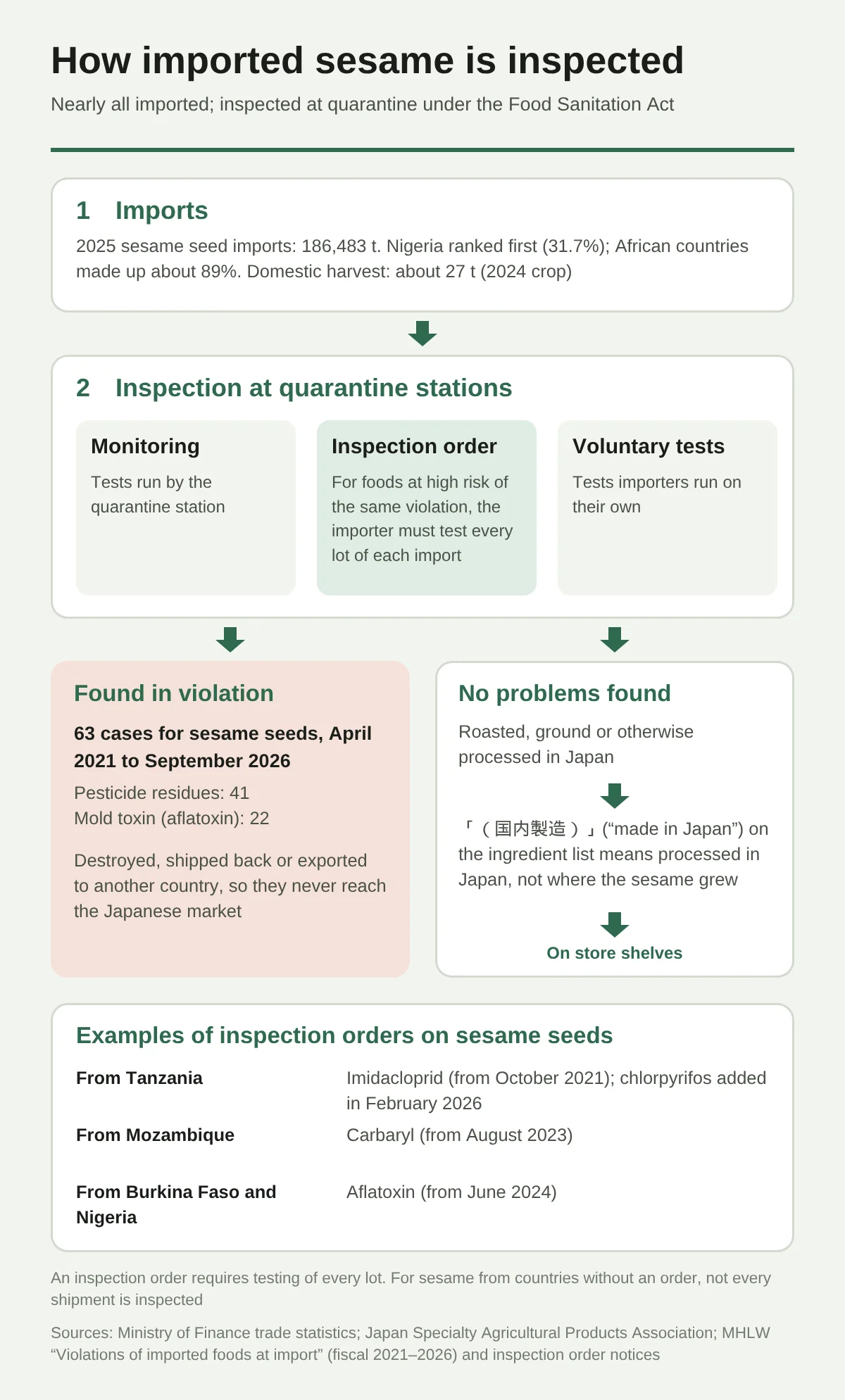
Number of violation cases
The Ministry of Health, Labour and Welfare (MHLW) publishes foods that violated the law at import as “Import Food Violation Cases at Import.” From the lists for fiscal 2021 through fiscal 2026 (to September), we counted the rows whose product name is “sesame seeds” (ごまの種子).
- Of the 63 cases in total, 41 were for pesticide residues and 22 for the mold toxin aflatoxin
- Pesticide residue cases are those where a pesticide exceeded the standard. Aflatoxin is a toxin produced by mold, and in Japan it is a violation if total aflatoxin exceeds 10 µg/kg (10 millionths of a gram per kg)
- Fiscal 2024 had many cases, 22, and about half of them were aflatoxin
Which countries, and what kinds of violations
| Country of production | Cases | Main details |
|---|---|---|
| Mozambique | 22 | Insecticides carbaryl and thiamethoxam |
| Tanzania | 17 | Insecticides imidacloprid and chlorpyrifos (plus 1 aflatoxin case) |
| Nigeria | 8 | 7 aflatoxin, 1 imidacloprid |
| Burkina Faso | 6 | Aflatoxin |
| Pakistan | 4 | 3 aflatoxin, 1 chlorpyrifos |
| Mali, Niger, Côte d’Ivoire, Togo, China | 1 each | Aflatoxin |
| Bolivia | 1 | Herbicide haloxyfop (presumed drift from a neighboring farm) |
| Paraguay | 0 | — |
(Tallied from MHLW, “Import Food Violation Cases at Import,” fiscal 2021–2026)
- The amounts found were, for example, 0.02 to 0.14 ppm for carbaryl (standard 0.01 ppm) and 0.06 to 0.29 ppm for imidacloprid (standard 0.05 ppm)
- The importers’ reports give causes of violations such as “drift from nearby farms,” “pesticide use by some farmers,” “uneven distribution of aflatoxin (concentrated in some grains),” and “insufficient drying”
- After the violations, inspection orders were placed on sesame seeds from Tanzania (imidacloprid, from October 2021; chlorpyrifos added in February 2026), Mozambique (carbaryl, from August 2023), and Burkina Faso and Nigeria (aflatoxin, from June 2024). Inspection orders may be lifted once conditions are met, and Nigerian sesame was again placed under an inspection order for aflatoxin in July 2026
Besides sesame seeds, there were violations in processed products such as sesame paste (from China, fiscal 2023, aflatoxin 13 µg/kg) and sesame-sauce-flavored instant noodles (from China, fiscal 2025, aflatoxin 96 µg/kg).
What happens to violating sesame
Violating shipments are subject to measures such as destruction, return to the shipping country (“tsumimodoshi”), and export to another country, so they do not reach the Japanese market. For the 63 cases we counted, the measures were “export to a third country,” “return,” and “instructed to destroy, return, etc. (entire quantity held).”
In its announcement of the August 2023 inspection order on Mozambican sesame, the MHLW explained that even if a 60 kg person ate 21.9 kg every day of sesame with 0.02 ppm of carbaryl remaining, the average lifetime intake would not exceed the acceptable daily intake (the amount that is considered not to affect health even if taken every day for life), and that there is “no effect on health.” This is because the standard is set well below the amount that would affect health.
However, since an inspection order is a system that requires “testing of every lot,” the flip side is that not every shipment of sesame from countries without an inspection order is tested. Zero violation cases does not mean there are no pesticide residues at all.
An overseas example: ethylene oxide in Indian sesame in the EU
In the EU, in September 2020, the substance ethylene oxide was found in sesame seeds from India at more than 1,000 times the EU limit (0.05 mg/kg). Ethylene oxide is not approved as a pesticide in the EU and is classified as a substance that damages genes and is carcinogenic and toxic to reproduction. By a regulation in October 2020 (Implementing Regulation (EU) 2020/1540), the EU raised the frequency of border pesticide residue checks on Indian sesame seeds to 50%.
Indian sesame is only a small part of Japan’s sesame imports (34 tons in 2025), but it is an example of sesame seeds being a target of international monitoring for residues. For how to think about pesticide residues in imported sesame, see also the post-harvest pesticide article and the vegetable and pesticide database.
Choosing sesame with a disclosed origin
The ingredient list on the back often does not tell you where the sesame comes from (explained in “How to read the label” below). If origin matters to you, you can choose products whose maker discloses the raw material’s origin or organic JAS products.
The organic JAS mark is attached to food “produced by the power of nature, without relying on chemicals such as pesticides and chemical fertilizers,” and only businesses certified through inspection by a registered certification body can use it. It is prohibited by law to label agricultural products or processed foods without the mark as “organic” (MAFF). However, even with organic farming, pesticides can get mixed in through drift from the next field, as in the violation cases above.
How to read the label
On the back of sesame and foods that use sesame, checking the following points tells you more.
| What to look at | What it tells you | Caution |
|---|---|---|
| Ingredient list “sesame” (ごま) or “organic sesame” (有機ごま) | What is in it | “White sesame,” “black sesame,” and “golden sesame” are all the same genus |
| Inside the parentheses in the ingredient list | The origin of the raw material, or the country where it was processed | “(国内製造)” (made in Japan) means it was processed, such as roasted, in Japan, and is not the origin of the sesame |
| Allergen labeling “(contains sesame as part of the ingredients)” (一部にごまを含む) | Whether sesame is used | In Japan labeling is recommended, so it may be missing. Check the ingredient list too |
| “This product’s factory…” (本品製造工場では…) | Other foods handled in the same factory | Not used as an ingredient, but may be mixed in |
| Organic JAS mark | Whether it was made to organic standards and certified | Not a guarantee of “zero” pesticides |
“(国内製造)” (made in Japan) comes from the rule for writing where processing took place when the largest ingredient is a processed product such as roasted sesame (country-of-origin labeling of ingredients under the Food Labeling Standards). The ingredient list of the organic white roasted sesame (Kingoma Honpo) also says “organic white sesame (国内製造),” while the sesame’s origin is Paraguay and Bolivia. For labeling that emphasizes not using additives, see the article on the rules for “additive-free” (無添加) labeling.
Summary
| Point | What we found | Learn more / if you want to buy |
|---|---|---|
| Nutrients | Roasted sesame has 54.2 g of fat and 1,200 mg of calcium per 100 g. Hulled sesame has 62 mg of calcium and sesame paste 590 mg. Roasting reduces vitamin B1 | If you want to try roasted, ground, and paste |
| Ground sesame | No value in the table; estimated to be about the same as roasted sesame. We found no study comparing absorption in people | Kyocera ceramic sesame mill |
| Sesamin research | Meta-analyses often show lower blood pressure, cholesterol, and blood sugar, but with large variation and certainty rated “low” to “very low” | Foods with Function Claims are notified on the business’s own responsibility |
| Allergen labeling | Recommended in Japan, mandatory in the US (from 2023) and the EU. Sesame is 0.4% of immediate-type cases in Japan | Check the ingredient list |
| Imports | 186,483 tons in 2025; Nigeria 31.7%; about 89% from Africa. Domestic about 27 tons | — |
| Pesticide residues and mold toxin | 63 cases for sesame seeds from April 2021 to September 2026 (41 pesticide, 22 aflatoxin). Violating goods do not reach the domestic market | Choosing sesame with a disclosed origin |
Sesame is a food that gives you fat and minerals in small amounts, but so far there is not enough solid evidence to say that “eating it lowers blood pressure and cholesterol.” For people with a sesame allergy, on the other hand, the key point is that Japan’s labeling is only “recommended.” If origin or how it is made matters to you, choosing products whose maker discloses the raw material’s origin, or organic JAS products, is the practical approach.
Sources
- MEXT, “Standard Tables of Food Composition in Japan (8th Revised Edition), 2023 Supplement” (main table Excel is the version updated March 27, 2026; food descriptions in Chapter 3). https://www.mext.go.jp/a_menu/syokuhinseibun/mext_00001.html
- Consumer Affairs Agency, “Information on food allergy labeling,” “Handbook on Food Allergy Labeling for Processed Foods (April 2026 edition),” “On allergy labeling (as of April 2026).” https://www.caa.go.jp/policies/policy/food_labeling/food_sanitation/allergy/
- Consumer Affairs Agency, Food Labeling Division, “On labeling of foods containing allergens” (administrative notice, April 1, 2026). https://www.caa.go.jp/policies/policy/food_labeling/food_sanitation/allergy/assets/food_labeling_cms204_260401_03.pdf
- Consumer Affairs Agency, “Fiscal 2024 Survey and Research Project on Food Labeling Related to Food Allergy, Report” (nationwide survey of health harm from immediate-type food allergy, September 2024). https://www.caa.go.jp/policies/policy/food_labeling/food_sanitation/allergy/assets/food_labeling_cms204_241031_1.pdf
- Consumer Affairs Agency, “On Foods with Function Claims,” notification information search (searched October 1, 2026). https://www.caa.go.jp/policies/policy/food_labeling/foods_with_function_claims/
- US Public Law 117-11, “Food Allergy Safety, Treatment, Education, and Research Act of 2021” (enacted April 23, 2021). https://www.govinfo.gov/app/details/PLAW-117publ11
- US Food and Drug Administration (FDA), “FASTER Act: Sesame is the Ninth Major Food Allergen” (updated April 12, 2024). https://www.fda.gov/food/food-allergies/faster-act-sesame-ninth-major-food-allergen
- Regulation (EU) No 1169/2011 on the provision of food information to consumers (Annex II, Articles 21 and 44). https://eur-lex.europa.eu/legal-content/EN/TXT/HTML/?uri=CELEX:02011R1169-20180101
- Commission Implementing Regulation (EU) 2020/1540 (sesame seeds from India). https://eur-lex.europa.eu/legal-content/EN/TXT/HTML/?uri=CELEX:32020R1540
- Ministry of Finance, “Trade Statistics,” by-country tables (imports, item no. 1207.40-000; 2015, 2020, 2024, 2025). https://www.customs.go.jp/toukei/srch/index.htm
- Japan Special Product Association, “Materials on regional specialty crops (industrial crops, medicinal crops, Japanese paper raw materials, etc.) (2024 crop)” (March 2026). http://www.jsapa.or.jp/pdf/Acrop_Jpaper/nousakumotuchousar6.pdf
- MHLW, “Import Food Violation Cases at Import” (fiscal 2021–2026). https://www.mhlw.go.jp/stf/seisakunitsuite/bunya/kenkou_iryou/shokuhin/yunyu_kanshi/ihan/index.html
- MHLW, “Implementation of inspection orders on imported food (sesame seeds from Mozambique and their processed products)” (August 30, 2023). https://www.mhlw.go.jp/stf/newpage_34858.html
- MHLW, “On implementation of inspection orders under Article 26, paragraph 3 of the Food Sanitation Act” (imidacloprid in Tanzanian sesame seeds, October 26, 2021; Burkina Faso, June 18, 2024; Nigeria, June 28, 2024 and July 13, 2026; chlorpyrifos in Tanzanian sesame, February 4, 2026). https://www.mhlw.go.jp/content/11135200/000847390.pdf and others
- MAFF, “Inspection and certification system for organic foods.” https://www.maff.go.jp/j/jas/jas_kikaku/yuuki.html
- Wei P et al. (2022) Sesame (Sesamum indicum L.): A Comprehensive Review of Nutritional Value, Phytochemical Composition, Health Benefits, Development of Food, and Industrial Applications. Nutrients. https://pubmed.ncbi.nlm.nih.gov/36235731/
- Khalesi S et al. (2016) Sesame fractions and lipid profiles: a systematic review and meta-analysis of controlled trials. Br J Nutr. https://pubmed.ncbi.nlm.nih.gov/26758593/
- Khosravi-Boroujeni H et al. (2017) Can sesame consumption improve blood pressure? A systematic review and meta-analysis of controlled trials. J Sci Food Agric. https://pubmed.ncbi.nlm.nih.gov/28387047/
- Sun Y et al. (2022) The Effects of Sesamin Supplementation on Obesity, Blood Pressure, and Lipid Profile: A Systematic Review and Meta-Analysis of Randomized Controlled Trials. Front Endocrinol. https://pubmed.ncbi.nlm.nih.gov/35311241/
- Yargholi A et al. (2021) The Effects of Sesame Consumption on Glycemic Control in Adults: A Systematic Review and Meta-Analysis of Randomized Clinical Trial. Evid Based Complement Alternat Med. https://pubmed.ncbi.nlm.nih.gov/34707665/
- Mardani H et al. (2025) Sesame and cardiovascular balance: a GRADE-assessed systematic review and meta-analysis. https://pubmed.ncbi.nlm.nih.gov/41089589/
- Sohouli MH et al. (2022) https://pubmed.ncbi.nlm.nih.gov/35043479/ , Atefi M et al. (2022) https://pubmed.ncbi.nlm.nih.gov/35673414/ , Ramírez-Coronel AA et al. (2023) https://pubmed.ncbi.nlm.nih.gov/37317803/ , Vajdi M et al. (2024) https://pubmed.ncbi.nlm.nih.gov/38316576/ , Jafari A et al. (2025) https://pubmed.ncbi.nlm.nih.gov/40644772/
- Tomimori N et al. (2013) Pharmacokinetics and safety of the sesame lignans, sesamin and episesamin, in healthy subjects. Biopharm Drug Dispos. https://pubmed.ncbi.nlm.nih.gov/24014208/
- Chen Y et al. (2019) Effects of thermal preparation and in vitro digestion on lignan profiles and antioxidant activity in defatted-sesame meal. Food Chem Toxicol. https://pubmed.ncbi.nlm.nih.gov/30946873/
- Warren CM et al. (2019) Prevalence and Severity of Sesame Allergy in the United States. JAMA Netw Open. https://pubmed.ncbi.nlm.nih.gov/31373655/
- Adatia A et al. (2017) Sesame allergy: current perspectives. J Asthma Allergy. https://pubmed.ncbi.nlm.nih.gov/28490893/
- Kingoma Honpo, “Organic white roasted sesame 70 g,” official online shop, “Product introduction” (checked October 1, 2026). https://kingoma.shop/?pid=107886742
Related articles and databases
- Are Lard and Butter Bad for You? 16 Plant Oils and Animal Fats (Beef Tallow, Fish Oil) Compared by Fatty Acids, and Which to Use Every Day
- What Is “植物油脂” (Vegetable Fat)? How True Is “Vegetable Oils Are Bad for You,” and What the Back Label Does and Does Not Tell You
- What is spelt wheat? Does gluten make holes in the gut? Checking “leaky gut” and pesticides in imported wheat against papers and national data
- Were “無添加” (Additive-Free) Labels Banned? Reading the Consumer Affairs Agency Guideline’s 10 Types from the Back Label