
What Is Organic (有機)? Organic JAS Standards, History, and How It Differs from “Pesticide-Free,” “Additive-Free,” and Shizen Saibai (Natural Farming), Explained with Official Sources

PR This article contains affiliate links to Rakuten Ichiba, Amazon, Yahoo! Shopping, and A8.net (“See on Rakuten,” etc.). What we write is based on materials from public agencies and on research papers, regardless of whether there is an ad. The “See on Amazon.co.jp” links are also affiliate links.
The words “organic” and “有機 (yuki)” are everywhere: in the produce aisle, on the seasoning shelf, on cosmetics, and on towels.
At the same time, many questions come up again and again.
- Are “organic” and “有機” the same thing? Does it have anything to do with “organic” in chemistry?
- If something is organic, does it contain zero pesticides?
- Is “pesticide-free” better than “organic”?
- Is shizen saibai (natural farming) a stricter method than organic?
- Are “organic” and “additive-free” the same?
- Do organic cosmetics and organic cotton have a national standard?
- Why is it expensive?
In a 2025 survey of 3,000 consumers by the Ministry of Agriculture, Forestry and Fisheries (MAFF), 93.5% knew the words “有機” and “organic.” But only 8.6% correctly knew both the growing methods and the labeling rules. The words are widely known, but what they mean is not.
In this article, we check the following against laws, MAFF materials, and papers:
- When, where, and against what did organic begin (the history in the world and in Japan)
- What the national rules for labeling something “organic” (organic JAS) do and do not decide
- How many pesticides and additives can still be used in organic
- How “pesticide-free,” specially cultivated produce, shizen saibai (natural farming), and “additive-free” differ
- What “organic” means for cosmetics, cotton, and wine
- What we see when we reread the “organic” labels on the foods Urayomi has featured
The organic series (3 articles)
- What is organic? (standards and history): this article. Standards, history, and how organic differs from other labels
- Organic food and health: nutrition, pesticide residues, cancer research, and where to start switching
- Organic in Japan and the world: market, area, and systems compared across the US, the EU, China, South Korea, and others
Conclusions
- Organic farming is a 20th-century movement that arose in reaction to chemical fertilizers and pesticides. The term “organic farming” first appeared in a book in 1940. The Japanese term “有機農業 (yuki nogyo)” was coined in 1971 by Teruo Ichiraku. That same year, the registrations of DDT and BHC, “organochlorine” pesticides, expired in Japan
- “Organic = old-fashioned farming” is only half right. Farming in old Japan used human waste (shimogoe) as fertilizer, and after the war about 60% of the population was infected with roundworm. Today’s organic JAS generally does not allow human waste or sewage sludge
- In Japan, “有機” and “organic” are legally protected names. Food without the organic JAS mark cannot be labeled “有機,” “organic,” or “organic” in English, and imported goods are the same. Anyone who fails to obey an order faces up to 1 year of imprisonment or a fine of up to ¥1 million
- Pesticides can be used in organic farming. The organic JAS standard lists 42 items of allowed pesticides (our count): copper preparations, sulfur, spinosad, and so on. In the EU’s 2024 testing, residues of some kind were found in about 20% of organic samples (0.9% exceeded the legal limit)
- Additives can be used in organic processed foods. There are 61 allowed additives (our count). But seasoning (amino acids, etc.), the preservative sorbic acid, synthetic colors, caramel color, and sweeteners are not in the table, so they cannot be used
- “Pesticide-free” and “reduced-pesticide” cannot be used on labels since 2003. At the time, more than 60% of consumers thought “pesticide-free” was better than organic. Shizen saibai (natural farming) and shizen noho (nature farming) have no legal definition
- Organic and additive-free are separate systems. Organic JAS is a system in which a third party certifies “how it was made.” “Additive-free” is covered only by Consumer Affairs Agency guidelines that give a rule of thumb for “how to word the label,” with no certification
- Cosmetics and cotton have no national “organic” standard. There are private standards (COSMOS, GOTS, etc.), and for cosmetics a product can be certified “organic” with an organic share of 20% of the whole product (10% for rinse-off products)
Items covered in this article
| Item | When it helps | Where in this article |
|---|---|---|
| Masanobu Fukuoka’s “わら一本の革命” (The One-Straw Revolution), Rachel Carson’s “沈黙の春” (Silent Spring), Sawako Ariyoshi’s “複合汚染” (Complex Pollution) | When you want to read the history of organic in the original sources | Books that trace the history |
| Home delivery from a co-op that carries a lot of organic (Co-op Shizenha) | When food with the organic JAS mark is hard to find in nearby stores | How to recognize the organic JAS mark and where to buy |
| Organic JAS wine | When you want to choose a drink with the “organic” label that applies from October 2025 | Organic alcohol from October 2025 |
How did organic begin?
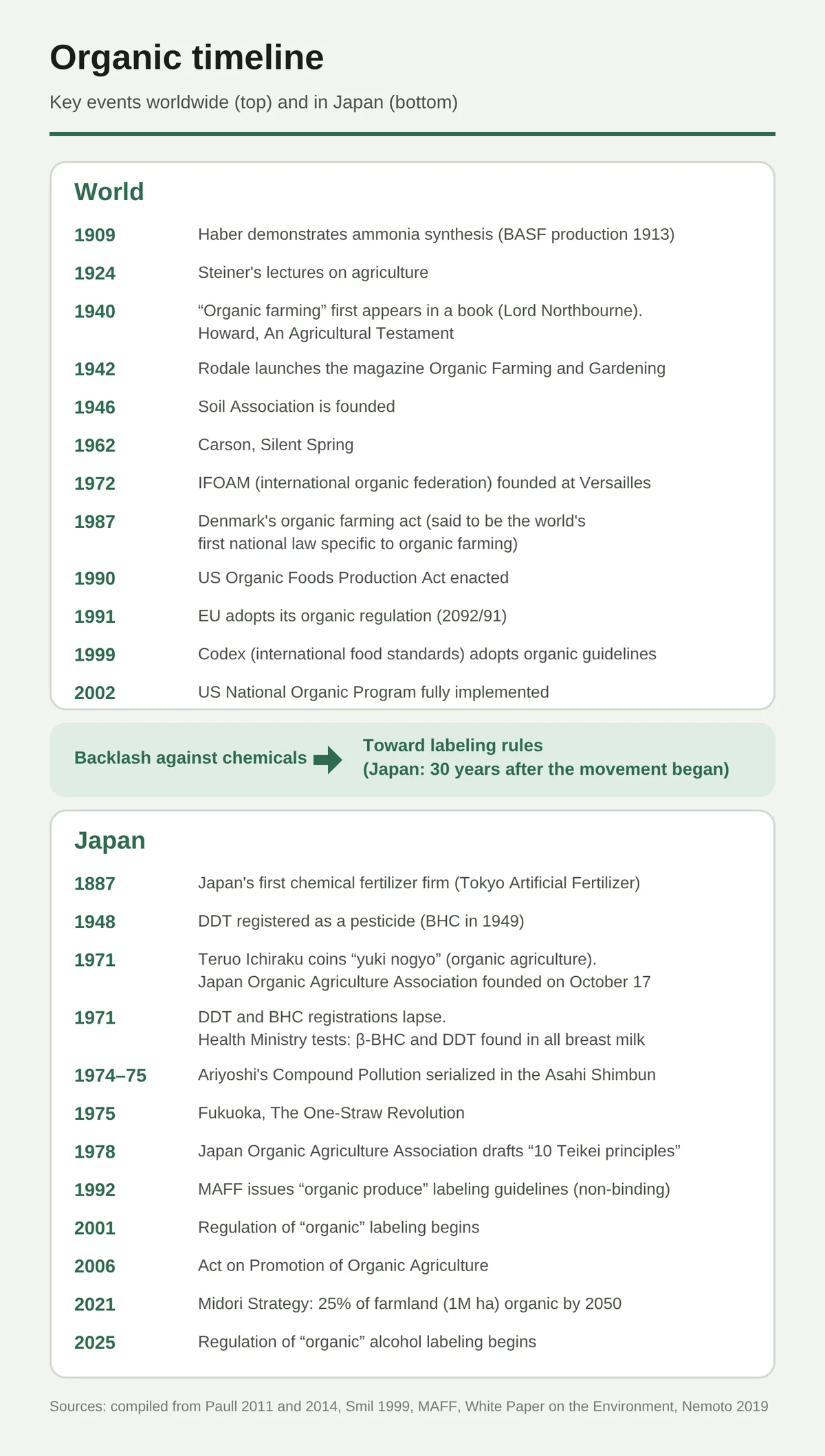
The history of organic is the flip side of the history of chemical fertilizer. The movement was born in reaction to the spread of chemical fertilizers and the start of pesticide use.
The start of the chemical fertilizer era
- In 1908, the German chemist Haber applied for a patent on a method of making ammonia from nitrogen in the air, and he demonstrated it in an experiment in 1909
- On September 9, 1913, the chemical company BASF began industrial production by this method (the Haber-Bosch process). At first it made fertilizer (ammonium sulfate), but when World War I began in 1914 it was also used to make raw materials for gunpowder
- The environmental scientist Smil writes that without this method, the world’s population would not have grown from 1.6 billion in 1900 to 6 billion (Nature, 1999)
Japan’s history of chemical fertilizer also began early. In 1887, Japan’s first chemical fertilizer company (Tokyo Jinzo Hiryo Kaisha) was founded. Its founders included Jokichi Takamine and Eiichi Shibusawa.
According to statistics from the Food and Agriculture Organization of the United Nations (FAO), the amount of nitrogen fertilizer per hectare of cropland in 1961 was 84 kg in Japan, 54 kg in the UK, and 13 kg in the US. Japan was early to use a lot of chemical fertilizer, and its peak was 116 kg in 1973. That the organic farming movement began in Japan in 1971 is thought to be partly because farming already used a lot of fertilizer and pesticides (this is not a causal relationship confirmed by research).
Steiner’s agriculture course (1924)
From June 7 to 16, 1924, the thinker Rudolf Steiner held an agriculture course in Koberwitz, in what is now Poland. 111 people from 6 countries attended the 8 lectures (Paull, 2011).
The course came about because the manager of a local estate asked for it eagerly. The researcher Paull writes that behind it was “farmers’ anxiety about the sudden changes that cheap synthetic nitrogen fertilizer was bringing to farming.” “Biodynamic farming” came out of this course.
The word “organic” was born in 1940
The term “organic farming” first appeared in a book in “Look to the Land,” published in May 1940 by Lord Northbourne of the UK (Paull, 2014).
- Lord Northbourne was the person who held the first biodynamic farming conference in the UK in July 1939
- The origin of “organic” was not the chemistry meaning of “containing carbon,” but the idea that “a farm is like a single living thing (organism)”
- Its opposite was also not “inorganic,” but “chemical farming”
Paull explains that in wartime Britain, the wording of Steiner, which had a strong German-thought flavor, was avoided and replaced with a neutral term.
Howard’s compost and Balfour’s Soil Association
In the same year, 1940, the British agronomist Albert Howard (1873–1947) published “An Agricultural Testament.” Howard, who had been director of a research institute in India, spread the “Indore method” of making compost from plant and animal waste, and criticized the way of thinking that looks only at the nitrogen, phosphorus, and potassium of fertilizer.
Howard is called “the father of organic farming,” but recent historical research has been revisiting the commonly told story.
- The reason the Howards at first did not recommend chemical fertilizer was not that it was “unnatural” but that it was “too expensive for Indian farmers” (Brown, 2025)
- The Indore method has been told as coming from “farmers’ age-old wisdom,” but in fact it is rooted in the couple’s rigorous scientific procedure (Barton, 2017)
In Britain, Eve Balfour and others started a farm in Suffolk in 1939 that compared three plots (organic, mixed, and without livestock), and summarized it in 1943 in “The Living Soil.” However, researchers assess this comparison as “by today’s standards, more a demonstration than an experiment, and unable to draw firm conclusions.” Balfour and others founded the Soil Association in 1946, began its first organic standards in 1967, and began its certification business in 1973 (the association’s own history).
Rodale and Silent Spring
In the US, the publisher J.I. Rodale launched the magazine “Organic Farming and Gardening” in 1942 and became the face of the organic movement. Howard wrote the foreword to his 1945 book “Pay Dirt.”
On September 27, 1962, the marine biologist Rachel Carson published “Silent Spring.” It is a book about the effects of insecticides such as DDT on birds, fish, and people, and it is a book about pesticides, not a book about organic farming. Even so, it spread anxiety about pesticides around the world and gave the organic movement a push. The Japanese edition is said to have first appeared in 1964 under the title “生と死の妙薬” (“Elixir of Life and Death”), and came out in 1974 as the Shinchosha paperback “沈黙の春.”
International bodies and national laws
| Year | Event |
|---|---|
| November 5, 1972 | The International Federation of Organic Agriculture Movements (IFOAM) is founded in Versailles, France. Five organizations (France’s Nature et Progrès, the UK’s Soil Association, the US’s Rodale Inc., and others) |
| 1987 | Denmark enacts its organic farming production law. It is said to be the world’s first national law specifically on organic farming |
| November 28, 1990 | The US Organic Foods Production Act is enacted |
| June 24, 1991 | The EU establishes its organic regulation (2092/91) (later replaced by 834/2007 and 2018/848) |
| 1999 | The international food standards body (Codex) adopts organic guidelines (for livestock, in 2001) |
| October 21, 2002 | The US National Organic Program is fully implemented |
| 2005 and 2008 | IFOAM sets the four principles of “health, ecology, fairness, and care” (2005) and a definition (2008) |
In the US, 275,000 comments were submitted on the draft rule published in 1997. Three things the draft had allowed, “genetic modification,” “irradiation,” and “sewage sludge as fertilizer,” were removed in 1998 (US Congressional Research Service).
The US final rule of 2000 then states that “certification is a process claim, not a product claim,” and says organic must not be taken to be safer than conventional (ordinary) farming. The Codex guidelines likewise say that “because the whole environment is contaminated, it cannot be guaranteed that organic products have no residues at all.” The movement had spoken of “health,” but the laws decided only “how it is made.” The research on health is checked in Organic food and health.
Japan: the term “yuki nogyo” was coined in 1971
The Japanese term “有機農業 (yuki nogyo, organic farming)” is said to have been coined in 1971 by Teruo Ichiraku (born 1906). Ichiraku had served as an executive at Norinchukin Bank and the Central Union of Agricultural Co-operatives, and he was the first in Japan to translate “organic” as “有機.” On October 17, 1971, he founded the Japan Organic Agriculture Association, and in 1974 he translated Rodale’s book as “有機農法.”
There are two explanations for where the translation “有機” came from.
- He learned from the name of Rodale’s magazine in the US, and took care that it would not be confused with the already existing “自然農法 (shizen noho, nature farming)” (explanation by researchers)
- It is also said that Ichiraku visited the dairy farmer Torizo Kurosawa, heard the phrase “天地有機 (tenchi yuki, heaven and earth have workings)” from him, and took the name from it. “機” means the workings of nature
1971 was also a turning point in the history of pesticides in Japan.
| Pesticide | Registered | Expired |
|---|---|---|
| DDT | 1948 | 1971 |
| BHC (lindane) | 1949 | 1971 |
| Chlordane | 1950 | 1971 |
| Heptachlor | 1957 | 1972 |
| Aldrin, dieldrin, endrin | 1954 | 1975 |
Source: MAFF’s list of “banned-for-sale pesticides.”
According to the White Paper on the Environment of the time, when the Ministry of Health and Welfare tested breast milk in 1971, β-BHC and DDT were found in all the breast milk tested. The BHC in cow’s milk came mainly from feeding cattle rice straw that had been sprayed with BHC. The organic farming movement was born against the background of such pesticide contamination and of pollution diseases such as Minamata disease.
Two streams of shizen noho (nature farming): Mokichi Okada and Masanobu Fukuoka
Apart from organic farming, Japan has a stream of “shizen noho (nature farming).”
- Mokichi Okada (1882–1955): In the mid-to-late 1930s he began researching and trial-growing crops without pesticides and chemical fertilizers (his chronology gives research in 1936 and trials in 1938; some sources say 1935), and from around 1940 he spoke out about the harm of pesticides
- Masanobu Fukuoka (1913–2008): He advocated a method of no tilling, no fertilizing, no pesticides, and no weeding. He published “自然農法 わら一本の革命” (shizen noho: The One-Straw Revolution) in 1975, and the English translation came out in 1978 from Rodale in the US. Japan’s shizen noho spread to the world through a publisher of the US organic movement
It is explained that Ichiraku chose the new name “yuki nogyo” partly in order to distinguish it from this shizen noho.
Teikei and Complex Pollution
What supported organic farming in Japan was “teikei (direct partnerships between farmers and consumers)”, in which farmers and consumers connect directly. In 1978, the Japan Organic Agriculture Association put together the “ten principles of teikei” (taking the whole harvest, prices decided through discussion, and so on). Many of its participants were urban housewives, and the number of groups is reported to have peaked at about 300 around 1991 (Kondo et al., 2024).
Daichi o Mamoru Kai (“the Association to Protect the Earth”), which began in 1975 as a citizens’ group, started Japan’s first door-to-door home delivery in 1985. It is one of the sources of today’s organic vegetable delivery, and it merged with Oisix in 2017 (for details, see the Oisix article).
The writer Sawako Ariyoshi serialized “複合汚染” (Complex Pollution) in the Asahi Shimbun from October 1974 to June 1975, writing about pollution in which pesticides, chemical fertilizers, synthetic detergents, and food additives overlap. In November 1974, Ariyoshi attended the IFOAM conference in Paris as a member of the Japan Organic Agriculture Association.
From guidelines to law
| Year | Event |
|---|---|
| 1988 | Aya Town, Miyazaki Prefecture, enacts the “Ordinance on Promoting Natural Ecosystem Agriculture” |
| October 1992 | MAFF creates labeling guidelines for “organic produce, etc.” (not binding) |
| July 1999 | The JAS Act is amended. Only certified products can be labeled “organic” |
| January 2000 | The Japanese Agricultural Standard (JAS) for organic produce is published |
| April 2001 | Regulation of “organic” labeling begins |
| December 15, 2006 | The Act on Promotion of Organic Agriculture (a bill introduced by members of the Diet) |
| July 2020 | Regulation of organic livestock product labeling begins |
| May 2021 | The Strategy for Sustainable Food Systems (Midori Strategy) (by 2050, organic farming to cover 25% of farmland, 1 million ha) |
| October 2025 | Regulation of organic alcohol labeling begins |
MAFF writes that the 1992 guidelines had no binding force, and that confusion arose, with cases such as products labeled “organically grown” just for using organic fertilizer. It took 30 years from 1971, when the movement began, to the regulation of labeling. How current area and targets are progressing is compared in Organic in Japan and the world.
“Organic = old-fashioned farming” is only half right
You often see the explanation that “organic is a return to the farming of the past, before chemical fertilizer.” When we check, we find it is only half right.
The right part: Before chemical fertilizer spread, Japanese farming was a recycling farming that used compost, oil cake, dried sardines, and also human waste (shimogoe). The US soil scientist King recorded that Japan used about 24 million tons of human waste as fertilizer in 1908 (“Farmers of Forty Centuries,” 1911). Divided by the population of the time, that is about 0.5 tons per person per year.
The wrong part: Shimogoe carries parasite eggs.
In a study that re-examined Ministry of Health and Welfare statistics (Okayama University, 1968), the share of people carrying roundworm eggs was 51.8% in fiscal 1945 and 62.9% in fiscal 1949, and fell to 5.3% in fiscal 1965. A report from a research group at the National Institute of Infectious Diseases sums it up this way: right after the war, the use of shimogoe was common, so about 60% of the population was infected with roundworm, and the infection then fell sharply with the spread of hygiene education, mass testing and deworming, sewage treatment facilities, and chemical fertilizer.
Today’s organic JAS generally does not allow human waste or sewage sludge. Moreover, Howard’s composting method also came out of a “scientific procedure.”
In other words, today’s organic farming is “farming that redoes part of the old wisdom to the standards of modern science and hygiene.” It is not “farming that simply goes back to the past.”
Books that trace the history
Among the books that appear in the history of organic, Masanobu Fukuoka’s “わら一本の革命,” Carson’s “沈黙の春,” and Sawako Ariyoshi’s “複合汚染” can still be read in paperback or new editions. You can check, in the authors’ own words, the concerns that were the starting point of the movement.
How organic JAS works: what is decided?
Japan’s “organic” labeling is set by the JAS Act (the Act on Japanese Agricultural Standards, etc.). Here, we look at what the law and the standards do and do not decide, based on their text.
“有機” and “organic” are legally protected names
- Article 63 of the JAS Act and Article 18 of its enforcement order make organic produce, organic livestock products, and processed foods made from them “designated agricultural and forestry products”
- For designated agricultural and forestry products, without the organic JAS mark (the grading label), neither the name “有機” nor any confusingly similar label may be used
- MAFF explains that “‘organic’ is the same as ‘有機.’” “Organic” in English, “有機栽培 (organically grown),” and the like are treated the same
- Imports are the same. An importer cannot sell, as is and without organic JAS grading, food labeled “Organic” in a foreign country (Article 63, paragraph 3)
Violations are handled in two stages.
| Violation | What happens |
|---|---|
| Writing “有機” without certification | First, the Minister of Agriculture, Forestry and Fisheries orders removal of the label or a halt to sales (Article 64). If the order is not obeyed, up to 1 year of imprisonment or a fine of up to ¥1 million (Article 78) |
| Attaching the organic JAS mark without certification | The same penalty applies without waiting for an order (Articles 37 and 78). For a company, a fine of up to ¥100 million (Article 83) |
Rules for organic produce: 2 years and 3 years
These are the main contents of the organic produce standard (JAS 1605:2024).
| What is decided | Contents |
|---|---|
| Basic idea | Cultivation that, as a basic principle, does not use chemically synthesized fertilizers and pesticides, and reduces the burden on the environment as much as possible |
| Conversion period | From at least 2 years before sowing or planting (for perennials such as fruit trees and tea, from at least 3 years before the first harvest), prohibited materials must not be used |
| During the conversion period | A field that has followed the rules for at least 1 year before the first harvest can be sold with the words “in conversion” written alongside |
| Seeds and seedlings | In principle, organic seeds and seedlings. Genetically modified seeds and seedlings cannot be used |
| Fertilizer | The principle is to maintain the strength of the soil with compost from the farm’s own residue and the work of living things around it. Only when that is not enough, designated materials (42 items) |
| Disease and pests | The principle is crop rotation, insect nets, natural enemies, and so on. Only when these cannot prevent it and serious damage is imminent, designated pesticides (42 items) |
| Radiation | Irradiation is prohibited |
| Neighboring fields | Measures to keep prohibited materials from drifting in |
The 2-year and 3-year conversion periods are the same as in the Codex guidelines. Producing both organic and conventional crops on the same farm (parallel production) is also allowed, but the farmer must prove with records that prohibited materials are not used in the organic fields.
And the important point is that MAFF itself explains that “organic JAS sets rules for cultivation and is not a standard for the quality of the finished produce.” The organic JAS mark is a sign that “it was made by this method,” not a sign of “more nutritious” or “higher safety.”
Can pesticides be used in organic?
“オーガニック 農薬使ってる” (“organic uses pesticides”) and “有機jas 農薬 一覧” (“organic JAS pesticide list”) often appear among Japanese search suggestions. The answer is “Yes, but the types and situations are limited.”
Table B.1 of the organic produce standard lists 42 items of pesticides that may be used (plus products made only by combining ingredients in the table). We could not find a number that MAFF publishes as “how many items,” so this is a count of the table.
| Type | Examples |
|---|---|
| Natural products and oils | Pyrethrum emulsion, rapeseed oil emulsion, machine oil emulsion, starch wettable powder |
| Inorganic ingredients | Copper wettable powder and Bordeaux mixture (copper sulfate), sulfur, lime sulfur, ferric phosphate granules, sodium bicarbonate (baking soda) |
| Ingredients made from microorganisms, etc. | Spinosad, milbemectin, kasugamycin |
| Living things and attractants | Biological pesticides such as natural enemies, sex pheromone products |
| Other | Metaldehyde (only for use inside traps), edible vinegar, hypochlorous acid water |
- Use is limited to “when there is imminent danger of serious damage to the crop that cannot be prevented by cultivation methods, physical methods, or the power of living things alone”
- The national notification assumes that the materials in this table also include some that are “chemically synthesized.” “Organic pesticides = natural ones only” is not the case
- With the 2024 revision, chlorella extract liquid, wax wettable powder, and diatomaceous earth powder were removed from the table (from January 2025)
Whether residues actually remain can be seen in official EU data. In the testing for 2024, published in 2026 by the European Food Safety Authority (EFSA), of 5,939 samples labeled organic, 80.4% had no quantifiable residue, 18.8% had residues detected at or below the legal limit, and 0.9% exceeded the limit. The most commonly found in organic was copper, which can be used in organic. A few pesticides not permitted in organic were also found, and EFSA lists possible drift from neighboring fields, contamination during distribution, and labeling errors.
Organic is not “zero pesticide,” but the fact is that detection is lower than in the EU’s samples as a whole (which include organic, with detections in about 40%). Japanese test figures and the amount of pesticide that enters the body are checked in Organic food and health, and the properties of each pesticide in the Pesticide Database.
Organic processed foods: 95% and 61 additives
To write “有機” on a processed food such as miso, soy sauce, or juice, the food must follow the organic processed food standard (JAS 1606:2024).
- Of the ingredients and additives, excluding water and salt, no more than 5% may be non-organic (that is, 95% or more organic)
- Non-organic ingredients can be used only when the organic version of the same kind cannot be obtained. Genetically modified or irradiated ingredients cannot be used
- Irradiation for preservation or pest control is also prohibited
- The US has a tier where “if 70% or more is organic, ‘made with organic ○○’ can be used,” but Japan has no 70% tier. A product that does not reach 95% cannot call itself “有機○○ (organic ○○),” and can only say something like “有機大豆使用 (made with organic soybeans)” for ingredients that carry the organic JAS mark
The additives that can be used are only those listed in Table A.1 of the standard. We counted 61 items.
| Category | Main examples |
|---|---|
| Acidity and pH adjustment | Citric acid, lactic acid, malic acid, tartaric acid, vitamin C (L-ascorbic acid) |
| Carbonates, etc. | Sodium carbonate and potassium carbonate (kansui, alkaline noodle water), sodium bicarbonate (leavening agent), calcium carbonate |
| Nigari and coagulants | Magnesium chloride, crude seawater magnesium chloride, calcium sulfate |
| Thickening and gelling | Pectin, carrageenan, guar gum, xanthan gum, sodium alginate |
| Emulsifying and antioxidant | Lecithin, mixed tocopherols (vitamin E) |
| Filtering and processing aids | Activated carbon, diatomaceous earth, bentonite, silicon dioxide |
| Other | Flavorings (those not chemically synthesized), enzymes, nitrogen, carbon dioxide |
Many have restrictions on use. For example, sodium hydroxide is limited to the processing of sugar, algae, edible oils, grains, and the like.
Conversely, anything not in the table cannot be used.
- Seasoning (amino acids, etc.) (“調味料(アミノ酸等)”; for details, see the MSG article)
- The preservatives sorbic acid and sodium benzoate (preservatives article)
- Synthetic colors and caramel color (food colors article, caramel color article)
- Sweeteners such as aspartame and sucralose (sweeteners article)
- The color fixative sodium nitrite (color fixatives article)
The additives usable in Japan are 476 designated additives and 357 existing additives (as of March 31, 2024). However, because the organic JAS table lumps some items into one row, such as “flavorings” and “enzymes,” a division like “61 ÷ 833” cannot be done. It is enough to remember that “organic ≠ zero additives, but the usable range is quite narrow.” Explanations of each additive are in the Additive Database.
Organic livestock products: feed, medicine, and space
Organic eggs, milk, and meat are covered by the organic livestock products standard (JAS 1608:2026).
| What is decided | Contents |
|---|---|
| Feed | Organic feed is the basic rule. Only when it cannot be obtained, non-organic feed up to 15% for cattle, sheep, and goats, and up to 20% for pigs and chickens (genetically modified or antibiotic-containing feed is not allowed) |
| Medicine | Veterinary drugs are not used to prevent disease. If antibiotics are used for treatment, the withdrawal period before shipment is twice the legal period |
| Prohibited | Growth-promoting substances, breeding using embryo transfer or hormones, genetic modification techniques |
| Outdoor access | Animals have free access to an outdoor area (grazing at least twice a week is also acceptable) |
| Minimum space | 0.15 m² per laying hen, 4.0 m² per dairy cow (1.8 m² for tie-stall housing), and 1.1 m² per fattening pig |
For livestock products, the “in conversion” label, as for produce, is not allowed.
Who checks? Certification and grading
The flow up to attaching the “organic” mark is as follows.
- The government makes private organizations and local governments that pass screening registered certification bodies (counting MAFF’s list, 50 in Japan and 22 abroad, as of October 3, 2026)
- A registered certification body inspects farmers and manufacturers through paperwork and on-site inspection and certifies them. It checks at least once a year after certification
- The certified farmers and manufacturers themselves check what they ship, perform grading (kakuzuke), and attach the organic JAS mark. The name of the certification body appears under the mark
- Organic food on store shelves is monitored on a routine basis by the Regional Agricultural Administration Offices and the Food and Agricultural Materials Inspection Center (FAMIC)
As of March 31, 2026, the certified producers and manufacturers (production process managers) numbered 4,939 in Japan and 3,133 abroad. Foreign farmers and manufacturers can also obtain Japan’s organic JAS directly.
Organic alcohol from October 2025
Alcohol was for a long time outside the scope of organic JAS, and “有機” was written under National Tax Agency standards. With the law amended in October 2022, alcohol also came under organic JAS, and after a 3-year transition period, from October 1, 2025, “有機” and “organic” cannot be labeled without the organic JAS mark. Imported wine is the same.
- Sulfites (sulfur dioxide, potassium metabisulfite), used as antioxidants, can be used in organic alcohol. These are additives not in the table for organic processed foods, and they are only in the table for alcohol (39 items)
- Alcohol graded under organic JAS in fiscal 2024 was 1,649 tons in Japan (fruit wine 932, beer 442, mirin 134, sake 92 tons, and so on) and 175,753 tons abroad. Abroad, almost all of it is wine, and 4,122 tons of that was for Japan
The difference between “natural wine” and “organic wine” is also often searched. Natural wine is not an organic JAS category, so as long as it does not write “有機” or “organic,” it can use that name without organic JAS certification. If you want to check whether a wine is organic, looking for the organic JAS mark on the label is the surest way.
Since October 2025, “organic” wines on store shelves have come to carry the organic JAS mark. The organic JAS mark and the certification body’s name on the label let you check whether it is organic under the system.
How to recognize the organic JAS mark and where to buy
“有機jas マーク” (“organic JAS mark”) appears in more than 10 kinds of Japanese search suggestions. Even so, in MAFF’s 2025 survey, among people who buy organic food, those who check the mark “always,” “almost always,” or “sometimes” totaled 34.2%. To begin with, few people know what the words mean.
There are three points for recognizing it.
- Is there the organic JAS mark, with the name of the certification body under it?
- If the words “in conversion” are nearby, it is from a field in the middle of switching to organic
- What is regulated is the sticker on the product, the container and packaging, the delivery slip, and the sign on the store display. Flyers, brochures, menus, banners, signboards, and online descriptions are outside the JAS Act (they can be subject to the Act against Unjustifiable Premiums and Misleading Representations). For online shopping, checking the mark in the product photo is the surest way
Repackaging also needs care. If a store without certification divides organic carrots into small portions and puts them in a bag, it cannot write “有機にんじん (organic carrots)” on that bag (it can indicate it with a sign at the sales area if there are measures to keep products from mixing).
Among people who buy organic food, where they buy was supermarkets 83.5%, farm stands 20.5%, co-ops 18.2%, drugstores 15.7%, and natural food stores 12.0% (MAFF, 2025). Meanwhile, the reason for not buying organic produce, after “the price is high” at 45.1%, was “it is not sold nearby” at 36.6% (Japan Finance Corporation, 2021). When you cannot find it nearby, home delivery is also an option. Some co-ops explain that much of the produce they carry is organic (check item by item whether it has the organic JAS mark).
Words that cannot be written without “有機”
MAFF’s Q&A (October 2025 edition) gives concrete examples of words that cannot be written and words that can.
| Cannot be written without the mark | Can be written without the mark |
|---|---|
| 有機, オーガニック, organic, 有機栽培, 有機農法 (organic, organic, organic, organically grown, organic farming) | 有機質肥料使用 (made with organic-matter fertilizer) |
| 完全有機, 準有機, 海外有機, 有機率○% (fully organic, quasi-organic, overseas organic, organic rate ○%) | 有機肥料を使用して栽培したトマト (tomatoes grown using organic fertilizer) |
| 有機移行栽培, 雨よけ有機栽培, 有機土栽培 (organic transition cultivation, rain-shelter organic cultivation, organic-soil cultivation) | (On processed food) “有機大豆使用” and “有機野菜○%使用” (made with organic soybeans, ○% organic vegetables) using organic JAS ingredients |
| 有機無農薬 (organic, pesticide-free), “外国(国名)有機認証品です” (“a certified organic product of a foreign country (name)”) |
“有機無農薬” cannot be written because “有機” can be used only by the method in the standard, and “無農薬” is a word prohibited by the guidelines. Writing “有機野菜ソース (organic vegetable sauce)” or “有機トマトケチャップ (organic tomato ketchup)” on a processed food is also impossible unless the whole product has organic processed food certification.
What happens if you violate it? An example of enforcement
On September 20, 2024, MAFF issued an order to remove labels from a company in Miyazaki Prefecture that, without certification, had put “有機 (organic)” and the organic JAS mark on “有機発芽玄米 (organic germinated brown rice)” (725 g packs) and had shipped 10,360 bags between March 2023 and April 2024. It was a case found by an on-site inspection by the Kyushu Regional Agricultural Administration Office.
According to press reports, there were 182 cases in which MAFF gave guidance for JAS Act violations between November 2011 and November 2013 (including false indications of place of origin as well as “organic” labels; from a freedom-of-information request by Kyodo News; we could not check MAFF’s original source).
There is also doubt on the consumer side. In a 2015 MAFF survey, 41.3% of people chose “it is doubtful whether labels such as ‘有機’ are true” as a reason for not wanting to buy organic food. If you think a label is wrong, you can send information to MAFF’s contact line (0120-714-110). Fraud cases are larger in the US than in Japan, and we cover them in Organic in Japan and the world.
Are “pesticide-free,” specially cultivated, shizen saibai (natural farming), and organic the same?
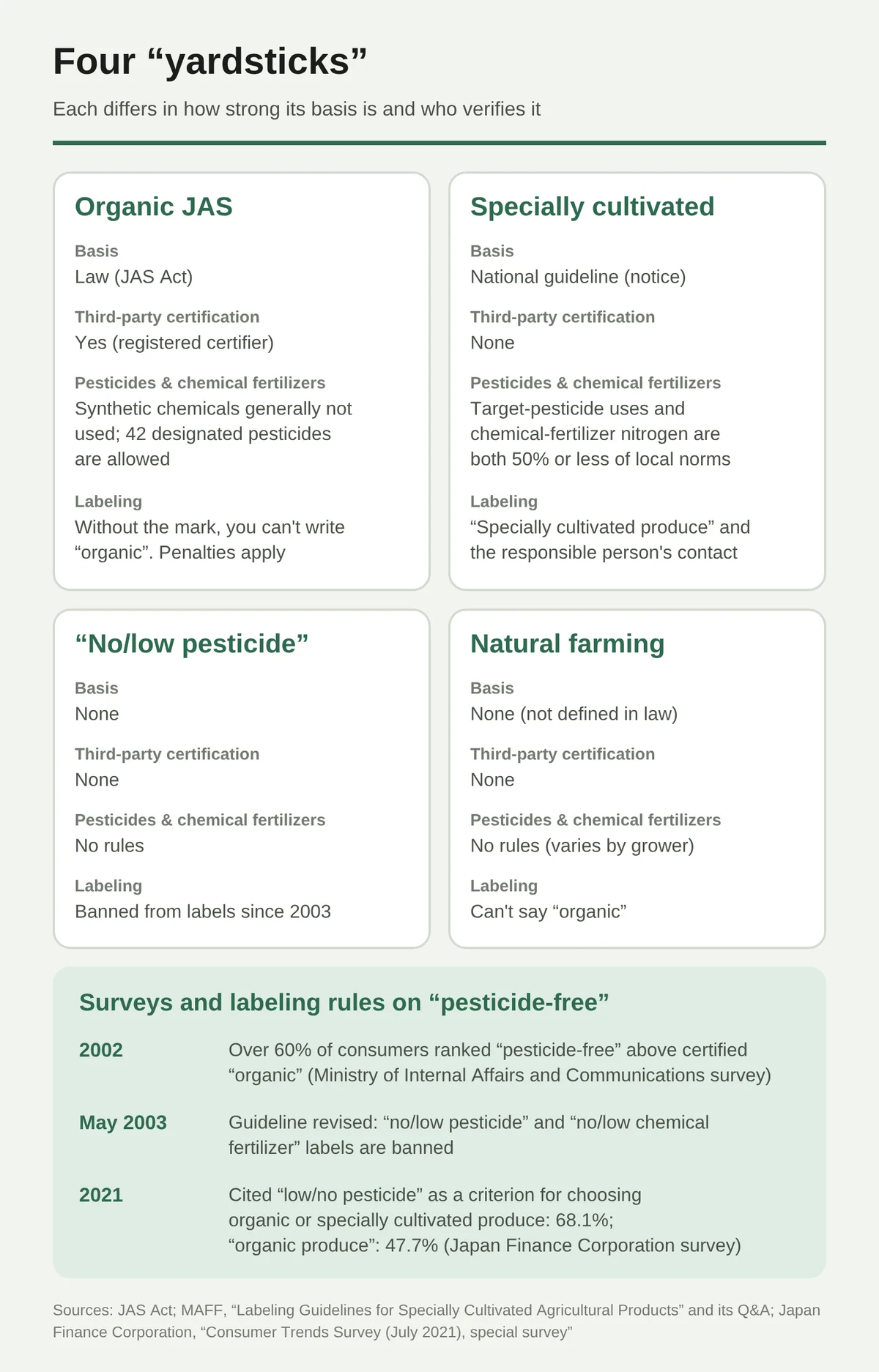
“有機栽培 無農薬 違い” (“organic cultivation, pesticide-free, difference”), “自然栽培 有機 違い” (“shizen saibai, organic, difference”), “特別栽培 有機栽培 違い” (“specially cultivated, organically grown, difference”). Search suggestions asking about the “difference” or “meaning” of words numbered 82 kinds in Japanese (Urayomi’s tally, October 3, 2026). The four are “yardsticks” that differ both in strength of basis and in who checks.
| Category | Basis | Third-party certification | Pesticides and chemical fertilizers | Labeling |
|---|---|---|---|---|
| Organic (organic JAS) | Law (JAS Act) | Yes (registered certification body) | Chemically synthesized ones are in principle not used. The designated 42 items of pesticides can be used | Cannot be labeled “有機” without the mark. Penalties apply |
| Specially cultivated | National guideline (notification) | No | 50% or less of the regional conventional level | “特別栽培農産物 (specially cultivated produce)” plus the responsible person’s name and contact |
| “Pesticide-free” and “reduced-pesticide” | None | No | No rules | Cannot be labeled since 2003 |
| Shizen saibai (natural farming) and shizen noho (nature farming) | None (no legal definition) | No | No rules (differs by grower) | Cannot be labeled “有機” |
Specially cultivated is a “50% or less” guideline
Specially cultivated produce is set by MAFF’s “labeling guidelines.” It is not a law, and it is not a third-party certification system either.
- Both the number of uses of “pesticides subject to reduction (節減対象農薬)” and the amount of nitrogen from chemical fertilizer must be 50% or less of the regional conventional level
- Pesticides that can be used under organic JAS are not included in “pesticides subject to reduction.” So even with “pesticides subject to reduction: not used during the growing period,” pesticides allowed under organic JAS may have been used
A detailed comparison of specially cultivated and organic JAS is in the Oisix article.
Why can “pesticide-free” no longer be labeled?
With the May 2003 revision of the guidelines, “無農薬 (pesticide-free),” “減農薬 (reduced pesticide),” “無化学肥料 (no chemical fertilizer),” and “減化学肥料 (reduced chemical fertilizer)” became prohibited labels (they are prohibited in the guidelines, with no legal penalty).
MAFF gives two reasons.
- Growers wrote it to mean “no pesticides were used during cultivation,” but buyers took it to mean “completely free of any pesticide, including pesticide remaining in the soil or drifting in from nearby”
- More than 60% of consumers thought “pesticide-free” was better than “organic,” which has third-party certification (2002 survey by the Ministry of Internal Affairs and Communications)
About 20 years later, the gap remains. In a 2021 Japan Finance Corporation survey, 68.1% of people named “reduced/no pesticide” as a criterion for choosing organic or specially cultivated produce, more than the 47.7% for “organic produce,” and only 18.5% knew what the organic JAS mark means. The most valued words are the words that cannot be used on labels.
Today the wording is like “pesticides: not used during the growing period.” The Japan-grown benifuuki powdered green tea that Urayomi featured said “節減対象農薬:栽培期間中不使用 (pesticides subject to reduction: not used during the growing period)” on its label. The product name on the sales page says “無農薬 (pesticide-free),” but that is a word that cannot be used under the guidelines’ thinking, and the label does not show whether pesticides allowed under organic JAS were used.
Shizen saibai (natural farming) and shizen noho (nature farming) have no legal definition
When we searched the text of the legal database (e-Gov) on October 3, 2026, “自然栽培 (shizen saibai)” and “自然農法 (shizen noho)” had 0 hits (some notifications and announcements are not in the database).
- The labeling guidelines for specially cultivated produce prohibit writing confusing words such as “天然栽培 (natural cultivation)” and “自然栽培 (shizen saibai)” together with a “specially cultivated produce” label
- MAFF explains that “‘有機○○’ cannot be labeled on shizen saibai (natural farming) produce”
- In other words, “shizen saibai (natural farming) = stricter than organic” cannot be said. Some growers use neither fertilizer nor pesticide and others do not, and there is no third party to check
“Organic-like farming” without certification seems to be quite large. The 2020 Census of Agriculture and Forestry asked “do you do organic farming?”, including shizen noho (nature farming) and organic farming without certification, and the total planted area was 115,269 ha. That is about 10 times the organic JAS fields (12,027 ha) in the same year. However, because it is total area and self-reported, the Policy Research Institute of MAFF points out “the effect of respondents widely regarding environmentally friendly farming methods as organic.” MAFF estimates the area of organic farming including uncertified at 39,800 ha at the end of fiscal 2024 (of which organic JAS is 26,400 ha).
The “Miracle Apple”: what can be done and what anyone can do are different
The best-known shizen saibai (natural farming) case is the apple orchard of Akinori Kimura in Aomori Prefecture. Here we separate anecdotes from books and films from what research has confirmed.
- What a paper confirmed: In an orchard of about 0.4 ha and about 50 trees in Hirosaki, with no chemical fertilizer, compost, pesticides, or herbicides for over 30 years, and with diluted vinegar sprayed, there is an economically viable yield. Disease appears considerably every year and is worse than in conventional orchards (Sugiyama et al., 2021)
- Public replication trials: NARO ran a trial at its research station in Morioka, Iwate Prefecture, for 7 years, 2009–2015, imitating the method of an orchard whose name was withheld. The share of flower buds formed was 32–55%, against almost 80% every year in the conventional plots, and yield, fruit size, and sugar content were all inferior to the conventional plots
That “it can be done” and “anyone can do it anywhere” are different is the result of the public trials.
Are organic and additive-free the same?
“オーガニック 無添加 違い” (“organic, additive-free, difference”) and “オーガニック 無添加 どっちがいい” (“organic or additive-free, which is better”) are also often searched. The two are separate systems, and having one does not mean having the other.
| Compared | Organic JAS (organic) | Additive-free (labeling of not using additives) |
|---|---|---|
| Basis | The JAS Act and the standards. The label is regulated by law | Consumer Affairs Agency guidelines (March 2022). The word “無添加 (additive-free)” is not defined in the Food Labeling Standards |
| What is decided | Methods of cultivation, raising, and processing | A rule of thumb for whether the label is misleading (10 types) |
| Third-party check | Inspected and certified by a registered certification body | No certification system |
| Additives | The designated 61 items can be used | It can be written if none are used, but there are limits on how to write it |
| Uniform ban? | “有機” without certification is prohibited | Not a uniform ban. A guide for checking yourself |
- Organic is not necessarily additive-free: sulfites can be used in organic alcohol, and citric acid and pectin can be used in organic processed foods
- Additive-free is not necessarily organic: even if no additives are used, if the ingredients are not organic JAS it cannot be labeled “有機”
The 10 types of “additive-free” are summarized in detail in the article on the rules for “additive-free” labeling.
How it differs from “non-GMO” and “natural”
- Organic JAS does not allow genetically modified seeds, seedlings, or ingredients. The label “遺伝子組換えでない (non-GMO)” is a separate label set by the Food Labeling Standards. Non-GMO soybeans are not necessarily organic
- For the words “ナチュラル (natural)” and “自然派 (shizen-ha, nature-oriented),” to the extent we checked, there is no national certification system like organic JAS
Are “organic” and “有機” the same? The relationship with “organic” in chemistry
The “有機” of food and the “有機 (organic compound)” of chemistry use the same characters but have different meanings. The origin of English “organic farming” was the idea that “a farm is a single living thing” (Lord Northbourne), and the Japanese “有機農業” is a 1971 translation.
Here there is an irony that is special to Japanese.
- The White Papers on the Environment of the 1970s call DDT, BHC, and aldrin “有機塩素剤 (organochlorines)” and parathion an “有機りん系 (organophosphorus)” pesticide
- The DDT and BHC whose registrations expired in 1971, the year Japan’s organic farming was born, were exactly “organochlorine” pesticides
- In other words, the representative pesticides that “有機” farming does not use were “有機○○” pesticides
“Organic” in chemistry means “a compound containing carbon,” so many chemically synthesized pesticides are “organic” in the chemical sense. Conversely, the pesticides usable under organic JAS include many “inorganic” ingredients such as copper and sulfur. The image of the words, “organic = natural and gentle on the body,” does not map directly onto what the system contains.
Is there a national standard for organic cosmetics and cotton?
In Japanese search suggestions, among the words combined with “オーガニック,” cosmetics and beauty accounted for 58 kinds and clothing, cloth, and sanitary napkins for 39 kinds. That is more than price (16 kinds) or the environment (10 kinds). Yet in this field there is no national “organic” standard.
- The scope of the JAS Act (agricultural and forestry products) excludes pharmaceuticals, quasi-drugs, and cosmetics in its text
- The Japan Organic & Natural Foods Association (JONA), which is also an organic JAS certification body, writes itself that “currently in Japan there is no legal system for organic labeling of cosmetics”
- Cotton for textiles is also outside the scope of the organic JAS standard
Private standards for organic cosmetics
In place of a national standard, there are private standards.
| Standard | Conditions for calling a product “organic” |
|---|---|
| COSMOS (a European private standard for cosmetics, v4.2) | At least 95% of physically processed agricultural ingredients are organic. The organic share of the whole product must be at least 20% (at least 10% for rinse-off products, etc.) |
| GOTS (a private standard for organic textiles) | “Organic” means at least 95% organic fiber; “Made with organic” means 70–94% |
| Organic JAS (food) | At least 95%, excluding water and salt |
Cosmetics contain a lot of water, so they cannot be compared with food on the same scale. Even so, it is good to know that an “organic cosmetic” can qualify with 20% of the product organic. Also, “organic” is a standard for how the ingredients were grown, and it does not mean less irritating to the skin or safe. Some people get a rash from plant ingredients. The way of thinking about cosmetic ingredients is summarized in the article on skin absorption and household products and the article on additive-free shampoo and body wash.
Why is it expensive?
“オーガニック 高い理由” (“why is organic expensive”) is often searched both in Japan and overseas, and in the 2025 survey, 79.2% of people who buy organic food felt “the price is high.” In short, the reasons are as follows.
- The price gap: In a MAFF survey comparing domestic products on the shelves of the same stores (2016), organic JAS vegetables were 1.43 to 1.87 times the price of ordinary domestic vegetables (from 143% for green onions to 187% for green peppers)
- Lower yields: In summaries of the research, organic yields are 5–34% lower than conventional (Seufert et al., 2012) and 19.2% lower on average (Ponisio et al., 2015)
- It takes 2–3 years to switch: During that time the produce cannot be sold as “有機” (“in conversion” can be written)
- Certification costs money and effort: Annual inspections and records are needed
Meanwhile, in the 2025 survey, when people who buy organic food were asked “how many percent more than usual would you still buy?”, “I would not buy if it were even slightly more expensive” was 30.0% and “up to 10% more” was 28.3%. Those who accept the actual gap (40–90% higher) were in the low teens of percent. Where switching is worth the cost is covered in Organic food and health, and world prices and markets in Organic in Japan and the world.
“Organic” in the foods Urayomi has featured
As of October 3, 2026, Urayomi has 71 foods and household products. “有機 (organic)” appears in the ingredient list of 9 of them, and the name on the label is “有機○○ (organic ○○)” for 5. Rereading them, the points of this article show up directly in the labels.
Of the 5 products named “有機○○,” 4 use overseas ingredients
| Food | Name on the label | Origin of the organic ingredient |
|---|---|---|
| 有機スパゲッティーニ(アルチェネロ) (organic spaghettini, Alce Nero) | “有機スパゲッティ” (organic spaghetti) | Italy (country of origin) |
| 老梅 有機純米酢(河原酢造) (Roubai organic pure rice vinegar, Kawara Vinegar Brewery) | “有機米酢” (organic rice vinegar) | Organically grown rice from Japan |
| 有機トウバンジャン(風と光) (organic doubanjiang, Kaze to Hikari) | “有機調味料” (organic seasoning) | Taiwan (country of origin) |
| 有機白ごまいりごま(金ごま本舗) (organic roasted white sesame, Kingoma Honpo) | “有機白ごまいりごま” (organic roasted white sesame) | Processed in Japan. The sesame is from Paraguay and Bolivia (official website) |
| 有機ガーリックペースト(メ・ド・プロヴァンス) (organic garlic paste) | “有機調味料” (organic seasoning) | France (country of origin) |
Only 1 product, the organic rice vinegar, used Japanese ingredients. Japan has mutual recognition (equivalence) with the US, the EU, Canada, Taiwan, the UK, and Switzerland, recognizing their organic systems as “at the same level,” and organic food from those countries can be sold as “有機” if the importer checks it and attaches the organic JAS mark. How much of Japan’s organic food comes from overseas is covered with figures in Organic in Japan and the world.
Another thing that stands out is that the largest ingredient in the organic doubanjiang was organic sugar. Organic is a standard for “how it is made,” so it does not mean that the amount of sugar or salt is small.
The difference between “made with 有機○○” and “有機○○”: the yakisoba sauce example
The yakisoba sauce made with domestic organic vegetables and fruit (Hikari Foods) has “有機” in its front-of-pack name, but the name on the label is “ウスターソース (Worcestershire sauce),” not an organic JAS “有機ソース (organic sauce)”.
- The largest ingredient, “vegetables and fruit” (8 kinds including onion, tomato, and carrot), is entirely organic
- On the other hand, of the sugars listed as “有機糖みつ、砂糖 (organic molasses, sugar),” the sugar is not marked “有機”
- The manufacturer’s official website also places it in a separate “sauce made with domestic organic vegetables and fruit” series, apart from the organic JAS “有機ソース”
MAFF’s Q&A allows labels such as “made with ○% organic vegetables” when organic JAS ingredients are used in a processed food, and says to state the share when not all the vegetables used are organic. In this sauce, all the vegetables and fruit are organic, so even though the whole product is not organic, it can say “made with organic vegetables and fruit.” “Made with 有機○○” means part of the ingredients are organic, and “有機○○” means the whole product is at least 95% organic and certified.
Foods where only some ingredients are organic
- 無添加万能焼肉のたれ(永野) (additive-free all-purpose yakiniku sauce, Nagano): of 12 ingredients, 3 are organic: sesame oil, sesame, and lemon juice
- 広島県産かきで造った オイスターソース(センナリ) (oyster sauce made with Hiroshima oysters, Sennari): only the rice vinegar is organic. Yeast extract is also included (see the yeast extract article)
- 植物素材の本格カレールウ(創健社) (authentic curry roux from plant ingredients, Sokensha): organic safflower oil among the vegetable fats
In every case, one “有機” in the ingredient list does not make the whole product organic. The shortcut is to check on the back whether the “名称 (name)” field says “有機○○”.
Salt does not become “有機”: Guérande salt
The package of Guérande salt (Aquamer) states certification by Nature et Progrès, a French organic farming organization. It is one of the five organizations that founded IFOAM in 1972. But salt is not grown in a field, so it does not fit the organic JAS “有機,” which is a rule about how things are grown. When counting the 95% for organic processed food, salt and water are also excluded.
Items featured in this article (summary)
Here we collect again the items we introduced in the article. The reasons and ingredients are written in each section.
| Item | Where to buy |
|---|---|
| Masanobu Fukuoka, “自然農法 わら一本の革命(新版)” (The One-Straw Revolution, new edition; Shunjusha) | See on Rakuten (楽天ブックス) PR See on Amazon.co.jp PR |
| Rachel Carson, “沈黙の春” (Silent Spring; Shinchosha paperback) | See on Rakuten (楽天ブックス) PR See on Amazon.co.jp PR See on Yahoo! Shopping PR |
| Sawako Ariyoshi, “複合汚染” (Complex Pollution; Shinchosha paperback) | See on Rakuten (楽天ブックス) PR See on Amazon.co.jp PR See on Yahoo! Shopping PR |
| Request materials for Co-op Shizenha home delivery | 取り扱い青果の60%以上がオーガニック!生協の宅配コープ自然派 PR PR |
| Luzon Organic 750 ml (Spain, red wine, organic JAS) | See on Rakuten (お酒の専門店 リカマン) PR See on Yahoo! Shopping PR |
Summary
| What you may wonder | What we found |
|---|---|
| When did organic begin? | A 20th-century movement born in reaction to chemical fertilizers and pesticides. “Organic farming” first appeared in 1940, and the Japanese “有機農業” in 1971 |
| Is it old-fashioned farming? | Only half. The shimogoe of the past caused roundworm, and today’s organic JAS generally does not allow human waste or sewage sludge |
| Are “organic” and “有機” the same? | The same (MAFF). The meaning differs from “organic” in chemistry, and the representative pesticides that Japan’s organic farming prohibited were “organochlorine” ones |
| What is needed to write “有機”? | Organic JAS certification and the mark. Imports are the same. Violations carry penalties |
| If it is organic, is there zero pesticide? | Not zero. 42 items of pesticides can be used, and in EU testing, residues were detected in about 20% of organic samples (0.9% over the limit) |
| What about additives? | 61 can be used. Seasoning (amino acids, etc.), sorbic acid, caramel color, sweeteners, and others cannot |
| Are pesticide-free and shizen saibai (natural farming) better than organic? | “Pesticide-free” has been banned as a label since 2003. Shizen saibai (natural farming) has neither a legal definition nor third-party checking |
| Is it the same as additive-free? | A separate system. Organic is certification of how it is made, and additive-free is a rule of thumb for how to write the label |
| What about cosmetics and cotton? | No national standard. Under private standards, a cosmetic is certified with an organic share of 20% or more of the whole product |
| Why is it expensive? | 1.43 to 1.87 times ordinary vegetables (2016). Yields are lower, and switching and certification take time and money |
Sources
Laws, standards, and national materials (standards and labeling)
- Act on Japanese Agricultural Standards, etc. (JAS Act) and its enforcement order (e-Gov Laws Search, checked October 3, 2026) https://laws.e-gov.go.jp/law/325AC0000000175
- MAFF, Japanese Agricultural Standard for Organic Plants (JAS 1605:2024), Japanese Agricultural Standard for Organic Processed Foods (JAS 1606:2024), and Japanese Agricultural Standard for Organic Livestock Products (JAS 1608:2026) https://www.maff.go.jp/j/jas/jas_kikaku/yuuki.html
- MAFF and the National Tax Agency, “Q&A on Organic JAS” (October 2025); MAFF, “On the organic food inspection and certification system” (April 2026); “Organic Produce Inspection and Certification System Handbook” (October 2024)
- MAFF, “List of registered organic certification bodies,” “Number of organic JAS certified operators” (as of March 31, 2026), and “Equivalence of organic certification systems” (as of April 1, 2026)
- MAFF, “Understand in 5 minutes! What is organic produce?” and “Organic JAS system: for wholesalers and retailers” (leaflet)
- MAFF, “Guidelines on Labeling of Specially Cultivated Agricultural Products” (revised March 23, 2007) and its Q&A (June 2008)
- MAFF press release, “Measures against improper labeling of the organic JAS mark” (September 20, 2024)
- MAFF and the National Tax Agency, “Outline of the JAS Act amendment for organic alcohol” (October 2023); MAFF, “Organic JAS mark for organic alcohol” (October 2022)
- Consumer Affairs Agency, “Guidelines on labeling of non-use of food additives” (March 30, 2022); MHLW and the Consumer Affairs Agency, “Ensuring the safety of food additives” (number of items as of March 31, 2024)
- Codex Alimentarius, “Guidelines for the Production, Processing, Labelling and Marketing of Organically Produced Foods” (CAC/GL 32-1999)
- IFOAM Organics International, “Definition of Organic Agriculture”; US 7 CFR 205.301
- COSMOS-standard v4.2 (September 1, 2025); GOTS, “Label grades”; Japan Organic & Natural Foods Association, “Cosmetics certification”
History
- Paull J. The Koberwitz Agriculture Course (2011); Paull J. Lord Northbourne, the man who invented organic farming (2014, Organic eprints)
- Smil V. Detonator of the population explosion. Nature 1999; BASF, “1913” company history
- Howard A. An Agricultural Testament (1940); Brown (2025, PMC7617516); Barton G. Itinerario 2017
- King FH. Farmers of Forty Centuries (1911)
- Soil Association, “Our history”; Rodale Institute, “1942”; Shinchosha bibliography of “Silent Spring”
- US Congressional Research Service RL31595 (2003); Federal Register 65 FR 80548 (December 21, 2000); 7 U.S.C. 6501
- Danish Environmental Protection Agency, Bichel Committee report (2001)
- Nemoto S. (根本志保子), “Teruo Ichiraku’s cooperative theory and organic farming,” Japan Society for the History of Economic Thought (2019); Furuta and Shimosato, Bulletin of Nagano University (2016); Yuko Kubota, Kokugakuin Economic Review, vol. 47, no. 3
- Kondo T, et al. Front Sustain Food Syst 2024 (teikei)
- MAFF, “Banned-for-sale pesticides”; White Paper on the Environment, 1972 and 1974 editions
- Kato (加藤尚司), “A re-examination of parasite egg-carrier rates,” Okayama Igakkai Zasshi (Journal of the Okayama Medical Association) 1968; MHLW Health and Labour Sciences Research reports, fiscal 2013 and fiscal 2015 (soil-transmitted parasitic diseases)
- Our World in Data, “Nitrogen fertilizer application per hectare of cropland” (FAOSTAT, retrieved October 3, 2026)
- Sugiyama A, et al. Microorganisms 2021 (PMC8540600); NARO Institute of Fruit Tree and Tea Science, Apple Research Station, collected results (2018)
Differences and consumer attitudes
- MAFF, “Survey on attitudes toward organic farming and organic food” (fiscal 2025), “Survey on attitudes toward environmentally friendly agricultural products, including organic farming” (fiscal 2015), “The situation surrounding organic farming” (April 2026), and “Area under organic farming in Japan” (June 2026)
- Japan Finance Corporation, “Consumer trends survey (July 2021) special survey” (2021)
- Policy Research Institute, MAFF, “Analysis of the status of organic farming” (Census of Agriculture and Forestry, February 2024)
- MAFF, “Fresh vegetable price trend survey” (2016)
- EFSA. The 2024 European Union report on pesticide residues in food. EFSA Journal 2026 (PMC13140735)
- Seufert V, et al. Nature 2012 (PMID 22535250); Ponisio LC, et al. Proc R Soc B 2015 (PMID 25621333)
- Google search suggestions (retrieved October 3, 2026; classified and tallied by Urayomi)
Related articles and databases
- Is organic food better for your health? Nutrition, pesticide residues and cancer studies checked against the papers — where to switch first, and what it costs
- Organic in Japan and the World: Why Is Japan’s Organic Share Only 0.9%? Markets, Farmland, Rules, and Fraud Compared with the US, EU, China, and South Korea
- Reading Oisix’s Trial Set and Subscription Down to the Back Label: Vegetable Pesticide Standards, the Trial Set, and How Cancellation Works
- Were “無添加” (Additive-Free) Labels Banned? Reading the Consumer Affairs Agency Guideline’s 10 Types from the Back Label
- Comparing 5 additive-conscious grocery delivery services: trial sets, ongoing costs, and additive standards (2026)