
How to Choose Additive-Free Shampoo and Body Soap: Soap-Based vs. Amino Acid-Based, and How to Read the Full Ingredient List

PR The comparison tables in this article contain links to Rakuten Ichiba affiliate ads (“See on Rakuten”). The products shown and their order are decided regardless of whether there are ads. The “See on Amazon.co.jp” and “See on Yahoo! Shopping” links are also affiliate links.
There are many shampoos and body soaps labeled “無添加” (“additive-free”). But even among those with the same “additive-free” label, the type of cleansing ingredient and what is left out differ from product to product.
In this article, based on government notices, industry guidelines, and the makers’ official pages, we sort out:
- The rules for the “full ingredient list” (全成分表示) on the back of shampoos and body soaps
- How to tell “soap-based” from “amino acid-based and other” cleansing ingredients
- Why a dedicated rinse is recommended with soap shampoo
- What “additive-free” refers to
- A comparison of the full ingredients of 5 shampoos and 5 body soaps that advertise being additive-free
This article does not judge which is “safe” or “gentle on skin.” It lays out the material for choosing.
Conclusion: Look at the first part of the “full ingredient list” and at “what is additive-free”
- Shampoos and body soaps (cosmetics) are legally required to carry a “full ingredient list” (全成分表示) that writes every ingredient blended in. The order is from largest amount to smallest
- Products labeled “薬用” (“medicated,” quasi-drugs) have different legal rules for ingredient labeling
- If “カリ石ケン素地” (potassium soap base), “脂肪酸カリウム” (potassium fatty acids), or “〇〇酸K” (potassium ○○ate) is near the front, it is soap-based; if it is “ラウロイルメチルアラニンNa” (sodium lauroyl methylalanine), “ココイルグリシンK” (potassium cocoyl glycinate), or the like, it is a synthetic cleansing ingredient such as the amino acid type
- Soap shampoo is alkaline, and makers recommend using it together with an acidic dedicated rinse
- What “additive-free” means differs by maker. Read what exactly is additive-free
- Fragrance can be written together as the two characters “香料” (“fragrance”). Trace ingredients that come with raw materials (carryover ingredients) need not be written
The rules for the “full ingredient list” on cosmetics
Most shampoos and body soaps are cosmetics. Since April 2001, under the Pharmaceuticals and Medical Devices Act, cosmetics have been required to list the name of every ingredient blended in.
The way of writing is set by the MHLW notice “On the Labeling Method for Full Ingredients of Cosmetics” (March 6, 2001), and in practice follows the guidelines of the Japan Cosmetic Industry Association.
| Rule | Content |
|---|---|
| Names | Written with Japanese names (using the Japan Cosmetic Industry Association’s “List of Labeling Names for Cosmetic Ingredients,” etc.) |
| Order | Written in descending order of amount in the product |
| Ingredients at 1% or less, and colorants | May be written in any order among themselves |
| Fragrance | Fragrance used for scenting may be written as “香料” |
| Carryover ingredients | Ingredients that come along with a raw material and are present in amounts that have no effect in the product (such as a preservative in a raw material) need not be written |
In other words, the nearer the front of the full ingredient list, the more of it is in the product. In shampoos and body soaps, the cleansing ingredient usually comes right after “水” (water).
How carryover works is covered in detail, using food examples, in our article on carryover.
The cleansing ingredient tells you the “type”
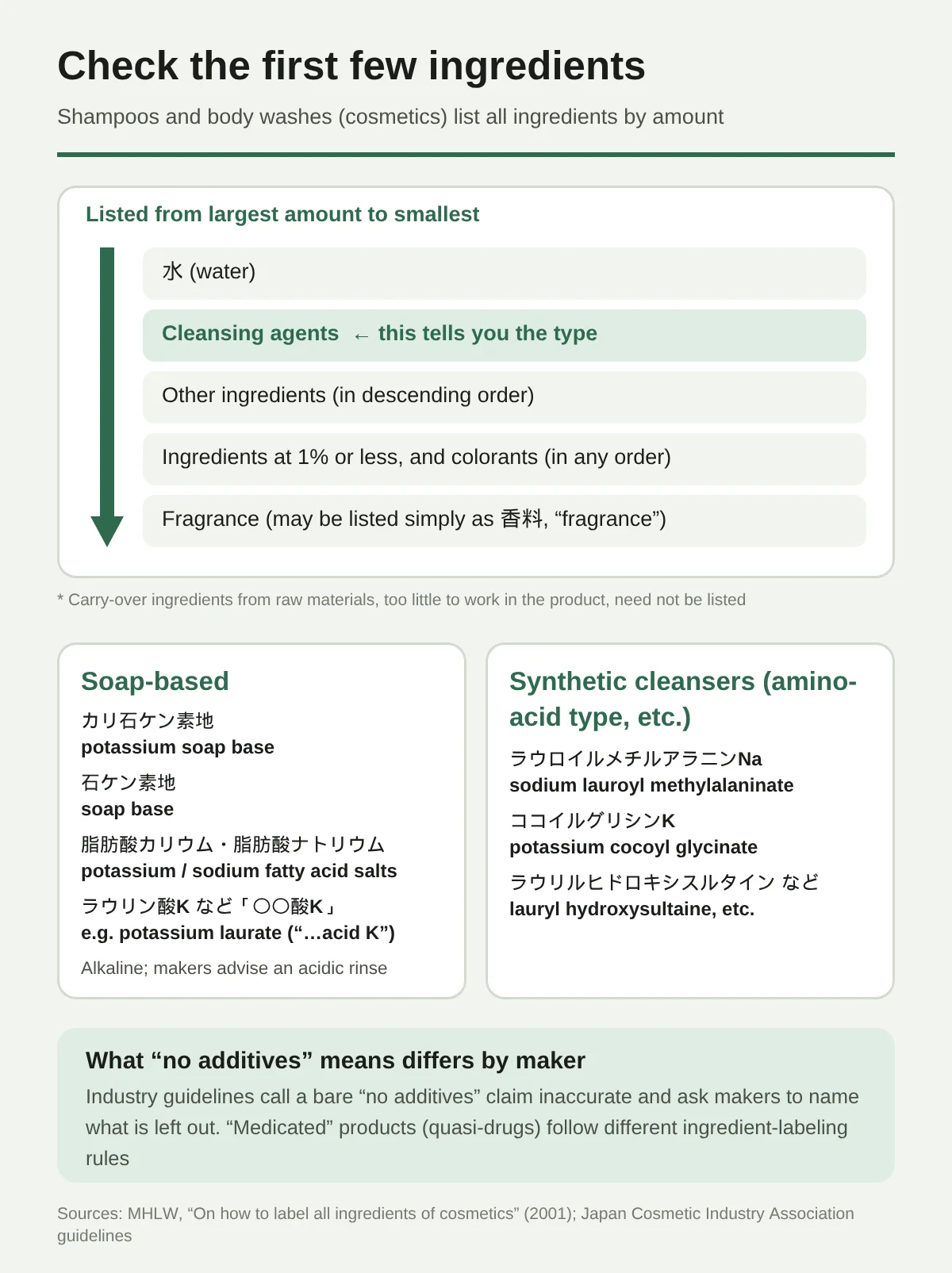
Looking at the cleansing ingredient near the front of the full ingredient list tells you the type.
| Type | Examples of how it is written in the full ingredient list | Products in this article |
|---|---|---|
| Soap-based | カリ石ケン素地 (potassium soap base), 石ケン素地 (soap base), 脂肪酸カリウム (potassium fatty acids), 脂肪酸ナトリウム (sodium fatty acids), and “〇〇酸K” such as ラウリン酸K (potassium laurate) and ミリスチン酸K (potassium myristate) | Shabondama, Miyoshi, Arau., PAX, Nebajuku |
| Mainly synthetic cleansing ingredients such as the amino acid type | ラウロイルメチルアラニンNa (sodium lauroyl methylalanine), ココイルグリシンK (potassium cocoyl glycinate), ラウリルヒドロキシスルタイン (lauryl hydroxysultaine), and the like | Cow Brand Additive-Free Foaming Body Soap |
“石ケン素地” (“soap base”) is a labeling name for the soap itself, made by reacting fats and oils with an alkali. “カリ石ケン素地” (“potassium soap base”) is potassium soap (potassium fatty acids); because it dissolves easily in water, it is often used as the main ingredient of liquid and foaming shampoos and body soaps.
- Even among soap-based products, makers write it differently: Shabondama Soap writes “カリ石ケン素地,” while Miyoshi Soap writes “ラウリン酸K、ミリスチン酸K…” (potassium laurate, potassium myristate…). Miyoshi Soap explains that it changed to a notation based on an international standard that makes even the origin of the raw materials clear, and that the contents are “soap” only, as before (potassium soap base = potassium laurate, potassium myristate, potassium palmitate, potassium stearate).
Soap shampoo and the dedicated rinse
Soap shampoo is alkaline. Makers recommend using it together with an acidic dedicated rinse (citric acid and the like).
- Miyoshi Soap: Washing with weakly alkaline soap opens the cuticle, which causes a squeaky, coarse feel, so it is neutralized with a dedicated weakly acidic citric acid rinse
- Shabondama Soap: Commercial synthetic rinses use the same ingredient as fabric softeners (a cationic surfactant) to coat the hair. A rinse dedicated to soap shampoo neutralizes, with acid, hair that has tilted alkaline, so the purpose of use is different
- Taiyo Yushi (PAX NATURON): When rinsing, a soap film formed by binding with the calcium and the like in tap water causes the squeakiness, and a weakly acidic rinse turns part of it into oil
When you try soap shampoo, thinking of the dedicated rinse as part of the set is the way of use in line with the makers’ guidance.
What “additive-free” means differs by maker
On cosmetics advertising, the Japan Cosmetic Industry Association’s “Guidelines for Proper Advertising of Cosmetics, etc.” provide as follows.
- Writing only “additive-free” is inaccurate because it is unclear what has not been added. If the ingredient not added is stated explicitly, the expression may be used
- Do not stress “additive-free” as if it were a catchphrase
- If the product contains that ingredient as a carryover ingredient, it cannot be expressed as “additive-free”
- Do not use expressions such as “contains no fragrances or colorants that tend to cause skin trouble”; stay with ones like “fragrance-free, colorant-free”
Among the 10 products in this article too, what the makers write as “additive-free” or “not used” differs from product to product: fragrances, colorants, preservatives, synthetic surfactants, and so on. Check the “Additive-free per maker’s labeling” column in the comparison tables.
Comparison tables: Labeling of shampoos and body soaps that advertise being additive-free
Ingredients, additive-free labeling, volume, and price are as shown on the makers’ official pages (official online shops) (checked September 28, 2026). “See on Rakuten” links are affiliate ads (PR). If the maker has an official store on Rakuten Ichiba, they lead to it; if not, to a seller that carries the single item (checked September 29, 2026). Prices on Rakuten may differ from the prices in the tables (the makers’ official prices).
Ingredient names below are given in English; the soap base labels are shown with their Japanese label wording, since that is what appears on the package.
Shampoos
| Product (maker) | Type | Full ingredients (as labeled) | Additive-free per maker’s labeling | Volume, official price (tax included) |
|---|---|---|---|---|
| 無添加せっけんシャンプー 泡タイプ (Additive-Free Soap Shampoo, foam type) (Shabondama Soap) See on Rakuten (シャボン玉石けん公式) PR See on Amazon.co.jp PR See on Yahoo! Shopping PR |
Soap | Water, カリ石ケン素地 (potassium soap base) | Silicone, synthetic polymers, fragrance, colorants, antioxidants, synthetic surfactants | 520 mL, 1,122 yen |
| せっけんシャンプー (Soap Shampoo) (Miyoshi Soap) See on Rakuten (サンドラッグ) PR See on Amazon.co.jp PR See on Yahoo! Shopping PR |
Soap, weakly alkaline | Water, potassium laurate, potassium myristate, potassium palmitate, potassium stearate | Fragrance, colorants, preservatives | 350 mL, 935 yen |
| アラウ.泡せっけんシャンプー (Arau. Foaming Soap Shampoo) (Saraya) See on Rakuten (サラヤ公式) PR See on Amazon.co.jp PR See on Yahoo! Shopping PR |
Soap | Water, カリ石けん素地 (potassium soap base), glycerin, citric acid, polyquaternium-10, lime oil, lavender oil, perilla leaf extract, chamomile extract, BG (butylene glycol) | Synthetic surfactants, synthetic fragrances, colorants, preservatives | 500 mL, ― |
| 泡状ポンプ式シャンプー (Foaming Pump Shampoo) (Taiyo Yushi PAX NATURON) See on Rakuten (ナチュリアス) PR See on Amazon.co.jp PR See on Yahoo! Shopping PR |
Soap | Water, カリ石ケン素地 (potassium soap base), glycerin, tocopherol, 香料 (fragrance), citric acid | (No list of what is additive-free. Labeled “100% natural-origin ingredients” [ISO 16128]) | 500 mL, 1,584 yen |
| しらかばシャンプーSS (Shirakaba Shampoo SS) (Nebajuku) See on Rakuten (楽天24 コスメ館) PR See on Amazon.co.jp PR See on Yahoo! Shopping PR |
Soap | Water, 脂肪酸カリウム (potassium fatty acids), glycerin | No fragrance, pigment, edetic acid, preservatives, or any other additives used | 400 mL, 627 yen |
- Polyquaternium-10 in Arau. is a positively charged polymer made by chemically processing cellulose. The maker explains: “plant-derived cellulose is blended as a conditioning ingredient to soften the squeaky feel”
- The fragrance in PAX NATURON, according to the maker, is made from essential oils such as rosemary, lavender, eucalyptus, and orange
- Arau. is shown as “―” because its official page gives no price
An example of a rinse to combine with soap shampoo:
| Product (maker) | Full ingredients (as labeled) | Volume, official price (tax included) |
|---|---|---|
| せっけん専用リンス (Rinse for Soap) (Miyoshi Soap) See on Rakuten (サンドラッグ) PR See on Amazon.co.jp PR See on Yahoo! Shopping PR |
Water, citric acid, sodium citrate | 350 mL, 935 yen |
Body soaps
| Product (maker) | Type | Full ingredients (as labeled) | Additive-free per maker’s labeling | Volume, official price (tax included) |
|---|---|---|---|---|
| 無添加ボディソープ たっぷり泡 (Additive-Free Body Soap, Plenty of Foam) (Shabondama Soap) See on Rakuten (シャボン玉石けん公式) PR See on Amazon.co.jp PR See on Yahoo! Shopping PR |
Soap | Water, カリ石ケン素地 (potassium soap base) | Fragrance, colorants, antioxidants, synthetic surfactants | 570 mL, 1,122 yen |
| 泡のボディソープ (Foaming Body Soap) (Miyoshi Soap) See on Rakuten (マツキヨ) PR See on Amazon.co.jp PR See on Yahoo! Shopping PR |
Soap | Water, potassium laurate, potassium myristate, potassium palmitate, potassium stearate | Fragrance, colorants, preservatives (also states “no synthetic surfactants used at all”) | 570 mL, 1,155 yen |
| ボディーソープ (Body Soap) (Taiyo Yushi PAX NATURON) See on Rakuten (楽天24 コスメ館, refill pack) PR See on Amazon.co.jp PR See on Yahoo! Shopping PR |
Soap | Water, カリ石ケン素地 (potassium soap base), glycerin, tocopherol, loquat leaf extract, ethanol, 香料 (fragrance), citric acid | (No list of what is additive-free) | 500 mL, 1,584 yen |
| カウブランド 無添加 泡のボディソープ (Cow Brand Additive-Free Foaming Body Soap) (Cow Brand Soap Kyoshinsha) See on Rakuten (楽天24) PR See on Amazon.co.jp PR See on Yahoo! Shopping PR |
Mainly amino acid type and the like (a small amount of soap ingredient too) | Water, DPG (dipropylene glycol), sodium lauroyl methylalanine, lauryl hydroxysultaine, potassium cocoyl glycinate, ceteareth-60 myristyl glycol, ceramide NG, sodium hyaluronate, glycine, betaine, potassium myristate, cocamide MEA, isostearic acid | Colorants, fragrance, preservatives, quality stabilizers, alcohol | 500 mL, suggested retail price 935 yen |
| 白雪の詩 (Shirayuki no Uta) (Nebajuku) See on Rakuten (ねば塾直営) PR See on Amazon.co.jp PR See on Yahoo! Shopping PR |
Soap (solid bar) | Sodium fatty acids 98% | No pigments, fragrance, or additives used at all | 180 g × 2, 495 yen |
- Cow Brand Additive-Free Foaming Body Soap has no “カリ石ケン素地” in its full ingredient list, and the core of its cleansing ingredients is synthetic cleansing ingredients such as the amino acid type. The soap ingredient (potassium myristate) is written 11th of 13 ingredients. The maker explains it as “blended with naturally derived soap ingredient and naturally derived amino acid-type cleansing ingredients.” The maker’s “additive-free” means colorants, fragrance, preservatives, quality stabilizers, and alcohol are not used
- PAX NATURON’s body soap contains fragrance (derived from essential oils) and ethanol
- Shirayuki no Uta is a solid soap, and we also introduce it as a kitchen soap in our article on additive-free detergents. The maker calls it “ideal as a kitchen soap too”
What is known about skin trouble
The Japanese Dermatological Association’s “Guidelines for the Management of Contact Dermatitis 2020” says the following.
- More than 90% of side effects from cosmetics are irritant dermatitis (a rash caused by irritation)
- Surfactants (mainly the anionic type) lower the skin’s barrier function and can cause redness, cracking, and the like on the hands and fingers
- Allergic contact dermatitis can occur even with a very small amount of the causative substance. Fragrances and isothiazolinone-type preservatives have drawn attention as causes
Soap too is a kind of anionic surfactant under the labeling rules. You cannot say “it won’t cause a rash because it’s soap” or “it will because it’s synthetic.” If you already know of fragrances, preservatives, or other ingredients that don’t agree with you, the surest way is to check the full ingredient list to see that those ingredients are not in it. If an abnormality appears on your skin, stop using it and consult a dermatologist.
On the claim of “transdermal toxins” (経皮毒), we examine it using materials from the government and academic societies in our article on transdermal toxins and daily goods.
Checkpoints when choosing
- Check whether it is “薬用” (medicated): Medicated products (quasi-drugs) have different labeling rules
- Look at the type of cleansing ingredient near the front of the full ingredient list: “カリ石ケン素地” or “〇〇酸K” means soap-based
- With soap shampoo, think of the dedicated rinse as part of the set
- Read what “additive-free” means: What is additive-free, such as fragrances, colorants, and preservatives, differs from product to product
- You can’t tell what is inside the two characters “香料”: Whether it is derived from essential oils can’t be known without the maker’s explanation
- If you know of ingredients that don’t agree with you, check the full ingredient list one by one
Urayomi’s approach
- Shampoos and body soaps are cosmetics, and the full ingredients are written on the back. They are products whose contents are easier to check than those of detergents
- On the other hand, some things can be written together, like “香料,” and some are not written at all, like carryover ingredients
- None of “additive-free,” “soap,” or “amino acid type” by itself decides whether a product will suit your skin
At Urayomi we do not write which products are “gentle on skin” or “safe.” We quote a maker’s “additive-free” as the maker’s labeling, and we value lining up the full ingredient lists so that people can use them as material for choosing.
Also worth knowing
- “Additive-free” laundry and kitchen detergents, and how to tell them by product name → Article on additive-free detergents
- Are “transdermal toxins” real? The labeling rules for daily goods → Article on transdermal toxins and daily goods
- Ingredients that come along with raw materials may not be labeled → Article on carryover
Sources
- Pharmaceuticals and Medical Devices Act (Act on Securing Quality, Efficacy and Safety of Products Including Pharmaceuticals and Medical Devices), Articles 59 and 61
- MHLW, “On the Labeling Method for Full Ingredients of Cosmetics” (March 6, 2001)
- Japan Cosmetic Industry Association, “Guidelines for Labeling the Full Ingredients of Cosmetics”
- Japan Cosmetic Industry Association, “Basic Policy of the Japan Cosmetic Industry Association on Ingredient Labeling of Quasi-Drugs” (March 10, 2006)
- Japan Cosmetic Industry Association, “Guidelines for Proper Advertising of Cosmetics, etc., 2020 Edition”
- Japanese Dermatological Association, “Guidelines for the Management of Contact Dermatitis 2020” (Japanese Journal of Dermatology 130(4), 2020)
- Official pages of each maker (Shabondama Soap, Miyoshi Soap, Saraya, Taiyo Yushi [PAX NATURON], Nebajuku, Cow Brand Soap Kyoshinsha). Checked September 28, 2026
This article explains labeling rules and the labeling of each product, and does not judge the safety or effect of any particular product or ingredient. Whether something suits your skin varies from person to person.
Related articles and databases
- Choosing an additive-free detergent: soap vs. synthetic detergent, and how to read the back label
- Are “transdermal toxins” (経皮毒) a myth or real? Do ingredients in shampoo and detergent enter through the skin, and what labels leave out
- What is carryover? How it differs from processing aids, and the additives that are not listed on labels even on “additive-free” foods
- What are surfactants? Types, history, rules in Japan and abroad, effects on the body, and what the “strength rankings” really are