

Is organic cotton gentle on skin? Why people call it a “lie”, and how to tell GOTS from OCS (menstrual pads, underwear, towels)

PR This article contains affiliate links to Rakuten Ichiba, Amazon, Yahoo! Shopping and A8.net (“See on Rakuten”, etc.). What is written here is based on public-agency materials and papers, whether or not ads are present. The “See on Amazon.co.jp” links are also affiliate links.
Menstrual pads, underwear, panties, pajamas, towels, baby clothes. Things labeled “organic cotton” turn up in all kinds of stores.
Here are some things you often hear.
- Organic cotton is gentle on skin. It is good for atopic dermatitis and sensitive skin
- Switching to organic cotton menstrual pads reduces rashes and period pain
- Cotton fields use 16% of the world’s insecticides
- Making one T-shirt takes 2,700 L of water
On the other hand, there are also voices saying “organic cotton is a lie” or “it means nothing”. There was also news that fake organic cotton was found in India.
In this article, we check the following against laws, materials from the Ministry of Health, Labour and Welfare (MHLW) and the Consumer Affairs Agency, the original text of private certification standards, and papers:
- What is organic cotton? Does Japan have a national standard?
- When a label says “organic cotton used”, what percentage of the cotton is organic?
- Is organic cotton really gentle on skin? Why do people call it a “lie”?
- Do organic cotton menstrual pads have any effect?
- Fraud in India, and GM cotton getting mixed in
- Are “16% of insecticides” and “2,700 L of water” true?
- Why is it expensive?
- Where on the label should you look when choosing?
Each company’s labeling was checked on its official pages on October 7, 2026.
The whole organic system is covered in What is organic? (standards and history), and research on organic food and health is in Organic and health.
Key conclusions
- For cotton, Japan has no national “organic” standard. The only things for which the law sets “organic” labeling are foods. The Consumer Affairs Agency says that writing “organic cotton 100%” in the composition label (the “cotton 100%” field, etc.) is “not appropriate”
- The share of organic cotton in “organic cotton used” ranges from 5% to 95% depending on the label. GOTS “Organic” is 95% or more, and OCS Blended is 5% or more. For uncertified “organic cotton used”, there is no rule
- For major brands’ pads, “organic cotton 100%” is mostly 100% of “the upper layer of the topsheet that touches the skin”. The makers themselves note this in small print. It does not mean the whole product is 100%
- No study has confirmed that organic cotton is “gentle on skin”. Organic or not, the fiber is the same cotton. We found no study comparing organic and ordinary cotton on skin symptoms. If a difference in skin does appear, it would be on the side of finishing, such as dyes and resins. Only GOTS also restricts finishing
- No study with a comparison group (control group) has shown that organic pads reduce “rashes, period pain or menstrual flow”. One view is that pad rash has more to do with humidity and friction than with the material
- Fraud really happened. In 2020, GOTS announced that it had found “20,000 tonnes of fake material” in India. About 60% of the world’s organic cotton is from India, and more than 96% of India’s cotton acreage is genetically modified cotton
- “16% of insecticides” is a figure from a 2007 environmental-group report, and (in what we checked) its source is not given. The 2024 figure from the international cotton body (ICAC) is 10.51%. However, that comes from pesticide-company data. “2,700 L of water” is a world average that does not distinguish organic from conventional, and about 40% of it is rainwater
- The reasons for the high price include small volume (2.9% of the world’s cotton), low yields, about 3 years to convert, and certification required for every company from field to sewing and sales. When choosing, check the certification’s name, grade and number, and the percentage
Items covered in this article
| Item featured | When it helps | Where in this article |
|---|---|---|
| ナトラケア ウルトラパッド (Natracare Ultra Pads)・ソフィ はだおもい オーガニックコットン (Sofy Hadaomoi Organic Cotton) | When you want to compare certification statements and which part is organic, to choose pads | What to check when choosing pads |
| People Tree オーガニックコットン ストレッチ・ショーツ (People Tree Organic Cotton Stretch Panties) | When you want underwear whose GOTS certification number you can check | Choosing underwear, panties and baby clothes |
| IKEUCHI ORGANIC オーガニック120 フェイスタオル (IKEUCHI ORGANIC Organic 120 face towel) | When you want a towel that is 100% organic cotton | Choosing towels |
What is organic cotton? Japan has no national standard
Organic cotton means “cotton grown to organic standards”, but Japan has no national standard that defines it. The standards are made by private organizations.
In law, “organic” applies only to food
In Japan, what sets “organic” labeling by law is the JAS Act (Act on Japanese Agricultural Standards, etc.). But the things that need certification to be called “organic” are limited by the enforcement order to food and beverages (agricultural and livestock products and their processed foods).
- Clothing, towels and fabrics are not covered
- Menstrual pads are quasi-drugs, and the JAS Act excludes “drugs, quasi-drugs and cosmetics” in its text
- The Japan Organic Cotton Association (JOCA) itself writes, “There is no national standard for organic textiles”
In short, there are no T-shirts or towels carrying the organic JAS mark. The organic JAS system for food is covered in What is organic? (standards and history).
The Consumer Affairs Agency says an “organic cotton 100%” composition label is “not appropriate”
Under the Household Goods Quality Labeling Act, clothing and towels must show their fiber composition (“cotton 100%”, etc.). The words allowed for cotton are “綿” (cotton), “コットン” and “COTTON”, and the word “organic” appears nowhere in the regulation.
The Consumer Affairs Agency’s FAQ says that writing “organic cotton 100%” in the composition field is “not appropriate”. Its explanation is that the use of organic cotton should be written separately as a voluntary label, in a way that makes clear it is voluntary (for example, indented or in parentheses).
“Cotton 100%” in the composition label means no fibers other than cotton are included. It has nothing to do with whether it is organic.
A draft national labeling rule that was nearly made in 2010
In fact, a national labeling rule was once nearly made. In February 2010, a report on a survey that the Organization for Small and Medium Enterprises and Regional Innovation, Japan (SMRJ) commissioned from Nomura Research Institute presented a final draft of an “organic cotton labeling guideline”, as a proposal to the Ministry of Economy, Trade and Industry.
| What the draft said | Content |
|---|---|
| What organic cotton is | Cotton certified or verified at the farming stage under each country’s organic standards |
| What to write | The share of organic cotton in the whole product. If parts are described separately, the share within that part (for a part, “organic cotton ○○% blend product”) |
| Minimum share | Not set (any percentage is fine as long as the share is stated) |
| Chemicals in finishing | A footnote: “This guideline does not take into account the use of chemicals in the processing stage” |
Under this draft, you could also state the share within a part, such as “the upper layer of the topsheet is 100% organic cotton”. The “only the upper layer is 100%” on pads, which we look at later, is this way of writing.
The report compares the pros and cons of using GOTS’s “70% or more” and OE’s “5% or more” as the standard. The committee also heard views in favor of a lower limit, but the final draft set none, saying “any share is fine if stated accurately”. However, we found no record of this draft becoming a national system or a public notice. The only national rule at present is the single sentence in the Consumer Affairs Agency’s FAQ above.
We also found no case, in what we checked, in which an order was issued over “organic cotton” labeling under the Act against Unjustifiable Premiums and Misleading Representations (the law that bans false or exaggerated labeling).
What about other countries?
| Country / region | How cotton “organic” is handled |
|---|---|
| Japan | No national standard. “Organic” in the JAS Act is for food only |
| EU | The organic regulation (EU 2018/848) covers cotton up to “uncarded cotton”. Yarn, fabric and clothing are outside the regulation |
| US | Raw fibers such as raw cotton are covered by the organic regulation (NOP). Products certified to GOTS can be sold as “organic”, but cannot carry the USDA organic seal (2011 policy memo) |
| India | Raw organic cotton is certified under a national system (NPOP, run by the government agency APEDA). Mainly for export |
In every country, once cotton becomes yarn or fabric, private standards (GOTS, OCS) mainly take over.
Almost all of Japan’s cotton is imported
According to JOCA, Japan’s cotton self-sufficiency is almost 0%. Cotton growing in Japan nearly disappeared in the 1960s. Almost all the raw material of organic cotton products sold in Japan is cotton grown in fields overseas.
What is “in-conversion” cotton?
Between starting organic farming and being allowed to call the crop “organic”, there is a waiting period. JOCA explains it as about 3 years (it varies a little by country and crop). Cotton harvested during this time is called “in-conversion cotton”.
- Both GOTS and OCS can treat in-conversion cotton as a grade separate from “organic”
- GOTS forbids mixing organic cotton and in-conversion cotton in one product
- Some industry groups recommend buying in-conversion cotton to support farmers on their way to organic (Textile Exchange)
What percentage is “organic cotton used”? A list by label
Even with “organic cotton used” on the label, the organic cotton can be 5% or 95% and over. You can only tell which from the label (the certification’s name and grade) or the percentage the maker writes.
| Label | Minimum share of organic cotton | Limits on finishing chemicals | Third-party certification |
|---|---|---|---|
| GOTS “Organic” | 95% | Yes | Yes |
| GOTS “Made with x% organic” | 70% | Yes | Yes |
| OCS 100 | 95% | No | Yes (tracking of volume and distribution) |
| OCS Blended | 5% | No | Yes (tracking of volume and distribution) |
| JOCA tag | No rule (the share must be stated accurately) | Not written in the rules | Yes (tracking of distribution) |
| JOCA family tag | No rule | Not written in the rules | Not required |
| Uncertified “organic cotton used” | No rule | No | No |
Sources: GOTS v8.0 (published March 2026), Textile Exchange “Organic Content Standard 3.0”, JOCA “member tags”.
GOTS: 95% and 70%, and it restricts finishing too
GOTS (Global Organic Textile Standard) is a private standard started by four organizations, and Japan’s JOCA is one of the founding bodies.
- The “Organic” grade requires 95% or more certified organic fiber. “Made with x% organic materials” requires 70% or more (as a share of the fibers, excluding accessories)
- Mixing ordinary cotton (conventionally grown cotton) into the remaining fibers is prohibited. Newly made polyester and acrylic cannot be used either
- Before cotton goes into the ginnery, it is tested for pesticide residues and genetic modification (GMO)
- Every company involved from the field onward, in spinning, weaving, dyeing, sewing and sales, must be certified
GOTS describes itself as “not a standard for organic cotton, but a standard for processing textile products made of organic fibers”. Organic certification of the field is obtained under a separate organic standard (such as each country’s organic regulation).
The version currently in force is 7.0 (since March 1, 2024). Version 8.0 was published in March 2026 and takes effect on March 1, 2027.
What GOTS sets for processing
| Item | GOTS rule |
|---|---|
| Bleaching | Oxygen-based only (peroxide, ozone). Chlorine-based bleaching cannot be used |
| Finishing | Synthetic antibacterial finishes, and water- and oil-repellent PFAS (organofluorine compounds), are prohibited |
| Dyes | Dyes with heavy metals in the molecule are prohibited. Residues of disperse dyes that can cause allergies are limited |
| Formaldehyde | Under 16 mg/kg for all products (it asks of adult products the same level that Japan’s law sets for infant products) |
| Pesticide residues | Under 0.1 mg/kg in total for natural fibers |
| Pads, diapers, absorbent cotton | All fibers totally chlorine free (TCF) bleached. Nonwovens and absorbent materials are 100% certified organic fiber |
Source: GOTS v8.0 (version 7.0 has rules to the same effect).
OCS: you can use the name from 5%, and it does not restrict finishing
OCS (Organic Content Standard) is a standard of the textile industry group Textile Exchange.
- OCS 100 requires 95% or more organic material, and OCS Blended requires 5% or more
- What OCS checks is “how much organic material is in the product, and how it is traced from the field to the product”. It does not restrict finishing chemicals such as bleaching and dyeing
- OCS also does GMO testing of organic cotton
- In-conversion cotton can also be accepted as OCS material if the farm-level standard allows it
Textile Exchange itself explains the difference: “GOTS has additional processing requirements, a minimum content of 70%, and limits on blends.” OCS is in the middle of moving to a new integrated standard made by Textile Exchange (the Materials Matter Standard). The new standard takes effect on December 31, 2026, and becomes mandatory from December 31, 2027.
In older materials and products you may see “OE 100” and “OE Blended”. These are OCS’s former names (from the Organic Exchange era).
JOCA tags and family tags
JOCA member companies attach two kinds of hang tags.
| Tag | Condition |
|---|---|
| JOCA tag | The share of organic cotton (%) must be stated accurately. Certification of distribution tracking by a third-party certification body is required |
| Family tag | Where “international certification is hard to obtain because of division of labor, etc.”, third-party certification is not required (self-management by members) |
For both, no minimum share is written in the rules. Instead, the condition is that the share be stated accurately.
JOCA explains that there are two ways of thinking about organic. One uses a certain share or more of organic fiber and also restricts processing (GOTS). The other allows using even a little (for example 5%) with conventional processing, and JOCA describes this one as “richer in expression and easier to sell”.
Where is “organic cotton 100%” 100%? 18 products checked on official pages
Even when “100%” is written, it is not always 100% of the whole product. For 18 products (menstrual pads, panty liners, panties, towels and baby underwear), we checked the share and part of organic cotton written on the maker’s official page, and any certification stated (checked October 7, 2026).
Notes on reading the tables:
- The “GOTS public database” column is the result of searching for the company name in the certified-entity search on the GOTS site (the content is Global Trace Base)
- Not being found in the database does not mean there is no certification. Searching with the country set to Japan returns only 81 companies, and some certifications may not be listed
- Wording that claims effects (such as “less likely to cause rashes”) is not included in the tables
Menstrual pads
| Product (category) | Organic share and part (as the official page words it) | Certification (as stated officially) | GOTS public database |
|---|---|---|---|
| ソフィ はだおもい オーガニックコットン (Sofy Hadaomoi Organic Cotton) (Unicharm, quasi-drug, made in Japan) | Only the upper layer of the topsheet is 100% organic cotton. The lower layer is cotton, polyethylene and polypropylene. No superabsorbent polymer used | Not stated | Not found |
| コットン・ラボ オーガニックコットンナプキン 21.5cm 羽つき (Cotton Labo Organic Cotton Pads 21.5 cm, with wings) (quasi-drug, made in Taiwan) | The topsheet is 100% organic cotton. Inside is fluff pulp | The Q&A says “GOTS since 2014”. No number or certification body stated. The “Pure Cotton Mark” indicates 100% cotton and is not an organic certification | Not found |
| ナトラケア ウルトラパッド (Natracare Ultra Pads) (a UK brand, made in Sweden. Labeled as a quasi-drug by the Japanese retailer) | “organic cotton cover” = the surface is organic cotton. Inside is wood pulp. “95% plant-based” is the share that is plant-derived, not the share that is organic | The GOTS license number (GOTS-11347) is published officially | Registered (Soil Association, until November 30, 2026). However, the scope shows only tampons and the like, and pads do not appear |
| Organyc (Italy. A regular Japanese import could not be confirmed) | The headline says “100% … inside and out”. The composition on the same page is 82% organic cotton (surface and absorbent core) | States GOTS certification | Registered (ICEA, pads and liners are within the scope) |
Panty liners
| Product (category) | Organic share and part (as the official page words it) | Certification (as stated officially) | GOTS public database |
|---|---|---|---|
| ナチュラムーン オーガニックコットン おりもの専用シート (Natural Moon Organic Cotton Panty Liners) (general goods, made in Korea) | The topsheet is organic cotton (unbleached). The text says “100% organic cotton nonwoven” | “Certified to OE Blended Standard” (OCS’s old name; Blended is the category for products with 5% or more organic). No number or certification body stated | Not found |
| ソフィ おりものシート オーガニックコットン (Sofy Panty Liners Organic Cotton) (general goods, made in Japan) | Only the upper layer of the topsheet is 100% organic cotton | Not stated | Not found |
| ロリエ きれいスタイル オーガニックコットン100% (Laurier Kirei Style Organic Cotton 100%) (Kao, made in Japan) | “100% organic cotton is used in the upper layer of the surface that touches the delicate area” | Not stated | Not found |
| コットン・ラボ オーガニックコットンライナー (Cotton Labo Organic Cotton Liners) (general product) | The topsheet is 100% organic cotton | Same as the pads | Not found |
Panties
| Product | Organic share and part (as the official page words it) | Certification (as stated officially) | GOTS public database |
|---|---|---|---|
| People Tree Organic Cotton Stretch Panties (made in India) | 95% organic cotton, 5% polyurethane | GOTS and WFTO (fair trade) labels | Registered (GOTS-11357, ECOCERT, underwear and sleepwear within scope, until March 30, 2027) |
| PRISTINE スタンダードショーツ (PRISTINE Standard Panties) (Avanti, made in Japan) | 92% organic cotton, 8% polyurethane | No product certification stated. The brand’s explanation says “the bales of raw cotton carry the GOTS certification mark” | Not found |
| ソフィ オーガニックコットン温活ショーツ (Sofy Organic Cotton Warming Sanitary Panties) (sanitary panties) | “92% organic cotton in the main body”. Materials other than the main body are not stated | Not stated | Not found |
Towels
| Product | Organic share and part (as the official page words it) | Certification (as stated officially) | GOTS public database |
|---|---|---|---|
| IKEUCHI ORGANIC オーガニック120 フェイスタオル (IKEUCHI ORGANIC Organic 120 face towel) (Imabari) | 100% organically grown cotton | The cotton is certified organic “based on EU standards” after review by the Swiss certification body bio.inspecta (type and number not stated). “Oeko-Tex Standard 100 Class 1” is a test for harmful substances, not an organic certification | Not found |
| PRISTINE スーパーソフト フェイスタオル (PRISTINE Super Soft face towel) (made in Japan) | 70% organic cotton, 30% ordinary cotton (the ordinary cotton is used in the base weave). The page title says “organic cotton” | No product certification stated | Not found |
| PRISTINE ワッフル フェイスタオル (PRISTINE Waffle face towel) | 100% organic cotton | No product certification stated | Not found |
| People Tree Hand-woven Waffle Face Towel | 100% organic cotton | WFTO label. No GOTS label | Towels are not within the scope of the company’s registration |
Baby underwear and baby clothes
| Product | Organic share and part (as the official page words it) | Certification (as stated officially) | GOTS public database |
|---|---|---|---|
| PRISTINE 22世紀ベビー短肌着 (PRISTINE 22nd Century Baby Short Undershirt) (made in Japan) | 100% organic cotton “down to the ties, name tag and sewing thread”. Undyed | No product certification stated | Not found |
| IKEUCHI ORGANIC オーガニックKB1 短肌着 (IKEUCHI ORGANIC Organic KB1 Short Undershirt) | 100% organically grown cotton | Same as the towels (bio.inspecta) | Not found |
| People Tree Baby T-shirt (made in India) | 100% organic cotton | GOTS label | Registered (GOTS-11357, baby clothes within scope) |
Sources: each company’s official page, GOTS public database (all checked October 7, 2026).
What the tables show
- Major brands’ pads and panty liners are “upper layer only”: for Sofy and Laurier, the upper layer of the topsheet that touches the skin is 100%, and the lower layer and absorbent core are different materials. “Organic cotton 100%” is written large and the scope is shown in small print (this is the “share within that part” way of writing in the 2010 national draft)
- Cases where the “100%” headline and the composition do not match: Organyc’s headline is “100% … inside and out”, but the composition is 82% (70% for the liner). The PRISTINE Super Soft face towel is 70%, which you cannot tell from the name
- Between official labeling and the GOTS public database, certification numbers could be confirmed for only three companies: Natracare, Organyc and People Tree. Only Natracare put the number on its official page. The official pages of the major domestic makers, Unicharm and Kao, had no certification statement (the maker of the material may hold certification, but it cannot be told from the official page)
- Similar names that are not organic: Natural Moon’s menstrual pad is “100% natural cotton”, and it is the same brand’s panty liner that is organic. Kao also sells “100% natural cotton” and “100% organic cotton” panty liners side by side
- “Oeko-Tex” is not an organic certification: it is a certification that a product passed tests for harmful substances, and it is separate from how the cotton was grown
Is organic cotton gentle on skin? Why people call it a “lie”
We found no study confirming that organic cotton is gentle on skin. As a fiber, organic and ordinary cotton are the same cotton. If a difference does appear in skin, it is on the side of finishing, not on how the cotton was grown.
The fiber is the same cotton. Analysis cannot tell them apart
Cotton fiber is mostly cellulose (a component of plant cell walls). Organic standards are about “how it was grown in the field”, and do not change the shape or composition of the fiber.
JOCA, an industry group, writes the following itself.
- Even ordinarily grown cotton has very little pesticide residue, so it is impossible to tell by a chemical test whether it is organic
- Compared with ordinary cotton, there is no difference big enough for pesticide or chemical-fertilizer components to be detected
Precisely because analysis cannot tell them apart, field certification and distribution tracking are needed, it explains. JOCA also writes that certified cotton is “not necessarily free of pesticides and chemical fertilizers”. Even organic fields can use designated pesticides (details in Pesticides allowed under organic JAS).
This is the main reason people say “organic cotton is a lie” or “it means nothing”. The value of organic lies on the side of the field (pesticides, farmers, soil), not directly in the skin of the person wearing it.
If skin differs, it is “finishing”
Between cotton and clothing come bleaching, dyeing, anti-wrinkle resin finishing, softening, antibacterial finishing and more.
- GOTS restricts this finishing too (table above)
- OCS, and uncertified “organic cotton used”, do not restrict finishing. The 2010 national draft guideline also wrote “does not take into account the use of chemicals in the processing stage”
The cause most often cited in research for rashes from clothing (contact dermatitis) is disperse dyes. Disperse dyes are dyes mainly used for synthetic fibers such as polyester.
| Study | What was found |
|---|---|
| Italian multicenter study (277 people, 2014) | Disperse dyes caused 79.8% of rashes from textiles. Formaldehyde-based resins matter for people who handle fabric at work |
| European multicenter study (2,907 consecutive people, 2014) | 3.7% of people reacted to the textile dye mix |
| German study (2007–2014) | People who reacted to their own clothing mostly had blue or black clothes that fit close to the skin |
Research on clothing and atopic dermatitis
There are several studies asking whether changing the material improves atopic dermatitis.
| Study | Type, number of people, duration | Result | Funding, etc. |
|---|---|---|---|
| CLOTHES trial (UK, 2017) | Randomized controlled trial (RCT). 300 children aged 1–15 with moderate to severe atopic dermatitis (282 analyzed), 6 months | Adding 100% silk clothing to standard treatment made no difference in symptom scores (ratio 0.95, 95% confidence interval 0.85–1.07). No difference in skin infections. Not cost-effective | UK public research funding (NIHR). Clothing provided free by the maker |
| ABC trial (Netherlands, 2024) | RCT. 159 people, 52 weeks | Silver or chitosan antibacterial clothing made no difference from standard therapeutic clothing | Public funding (the dermatology department received a grant from a clothing maker) |
| Merino wool trials (2017, 2019) | 39 and 50 people (completed), crossover of 6 weeks each | Reported improvement over usual cotton clothing | Both funded by a wool industry group |
| Systematic review (2013) | Summary of 13 studies | Evidence for recommending functional textiles is “weak”, and its quality is “low” | University |
| German trial (1990) | 55 people with atopic dermatitis + 31 healthy people | Cotton was the least irritating, compared with synthetic-fiber shirts | University (an old, small study) |
The “Atopic Dermatitis Clinical Practice Guidelines 2024” of the Japanese Dermatological Association and the Japanese Society of Allergology list “friction with clothing” as a cause of worsening, and say to avoid irritation from wool and rough materials. They do not recommend cotton or organic cotton.
We found no study comparing organic and ordinary cotton
Searching PubMed, the medical-paper database, for “organic cotton” combined with skin, dermatitis, eczema and irritation gave 7 results, and “organic cotton” alone gave 35 (October 7, 2026). The contents were about sports bra design, color loss in washing, pesticide exposure of cotton farmers and the like, and there was not a single clinical study that had people wear organic and ordinary cotton clothes and compared skin symptoms. Searching Japanese papers (J-STAGE) found none either.
There are two studies that compared amounts of substances (both in Spain).
| Study | What was found | How to read it |
|---|---|---|
| Formaldehyde in clothing for pregnant women and infants (2022) | “Eco” clothing averaged 10.4 mg/kg and ordinary clothing 8.23 mg/kg, so “eco” was somewhat higher (the difference was clear only for some item types). All were under the legal limit (75 mg/kg), and nothing was detected after washing | “Eco” does not necessarily mean low |
| Bisphenols in 120 new garments (2023) | For natural fibers, bisphenol S was higher in ordinary cotton than in organic cotton (1.24 and 0.76 ng/g) | Both compare amounts contained, not skin symptoms |
What current research can say is that what finishing was done, and whether you wash new clothes before wearing them, seem to matter more for the amount of chemicals touching the skin than whether it is organic. However, these are not studies that tested how skin symptoms change as a result.
Japan’s legal standards are common to all clothing
In Japan, the Act on the Control of Household Products Containing Harmful Substances sets upper limits for chemicals remaining in clothing. These are minimum standards that all clothing must meet, organic or not.
| Substance | Target | Limit |
|---|---|---|
| Formaldehyde | For infants up to 24 months old (diapers, underwear, sleepwear, outerwear, bedding, etc.) | 16 µg/g or less (or an absorbance difference of 0.05 or less by the prescribed test method) |
| Formaldehyde | Adult underwear, sleepwear, gloves, socks, tabi, etc. | 75 µg/g or less |
| Azo dyes | Underwear, sleepwear, outerwear, towels, bedding, etc. | 24 kinds of aromatic amines produced on decomposition, each 30 µg/g or less (since April 2016) |
| (Reference) GOTS | All GOTS products | Formaldehyde under 16 mg/kg (µg/g and mg/kg are the same unit) |
| (Reference) Menstrual pads | Approval standard for quasi-drugs | Formaldehyde 18 µg/g or less, etc. |
For baby clothes, even if not organic, the law sets a formaldehyde limit about 1/5 of that for adults. The difference is that GOTS asks of adult clothing the same level as that for infants.
What you can do if your skin is a concern
Turning what the research says into things you can do, we get the following.
- Wash new clothes and underwear once before wearing (formaldehyde was not detected after washing)
- People prone to rashes should be careful with dark-colored (blue, black) synthetic clothing that fits close to the skin (disperse dyes)
- If you want a product whose finishing is also restricted, look for the GOTS label, not “organic cotton used”
- Suspect detergent residue too. Among 148 Japanese atopic patients, in 115 who had dryness on the body, switching detergent for 2 weeks (from anionic to nonionic, with fewer additives) improved dryness in 87 (76%), according to a report (2003; a before-and-after comparison with no comparison group). Detergent ingredients are covered in Additive-free detergent and Surfactants
How much of a chemical enters through the skin, and the “transdermal toxin” (経皮毒) claim, are checked in Transdermal toxins and household goods.
Are organic cotton menstrual pads effective?
No study with a control group has shown that organic cotton pads reduce “rashes, period pain or menstrual flow”. However, how far the “organic” in a pad extends differs greatly between products.
Menstrual pads are quasi-drugs. The standard has no word “organic”
In Japan, menstrual pads have been quasi-drugs since 1961. The current standard is MHLW’s “Approval Standards for Manufacture and Sale of Menstrual Products” (notification of June 28, 2021, applied to applications from July 1).
| What the standard sets | Content |
|---|---|
| Quality | “Clean, with no irritation or other harmful effects”. Fluorescence (fluorescent whitening agent) test, formaldehyde 18 µg/g or less, etc. |
| Fragrance | If used, 0.1% or less of the product, and not in direct contact with skin or mucous membranes |
| Materials | 151 materials specified by part. For the topsheet that touches skin, cotton, rayon, polyethylene, polypropylene and others can be used |
| “Organic” | The words “organic” (オーガニック, 有機) appear 0 times anywhere in the standard, notifications or Q&A |
The topsheet is one of two kinds: a nonwoven of entangled fine fibers, or a perforated film (mesh) (Japan Hygiene Products Industry Association). Under it are an absorbent core of fluff pulp or superabsorbent polymer, and a film that prevents leaks.
“Organic” in pads is not a word whose content the state has defined. It is each company’s labeling.
How far does “organic” go in pads?
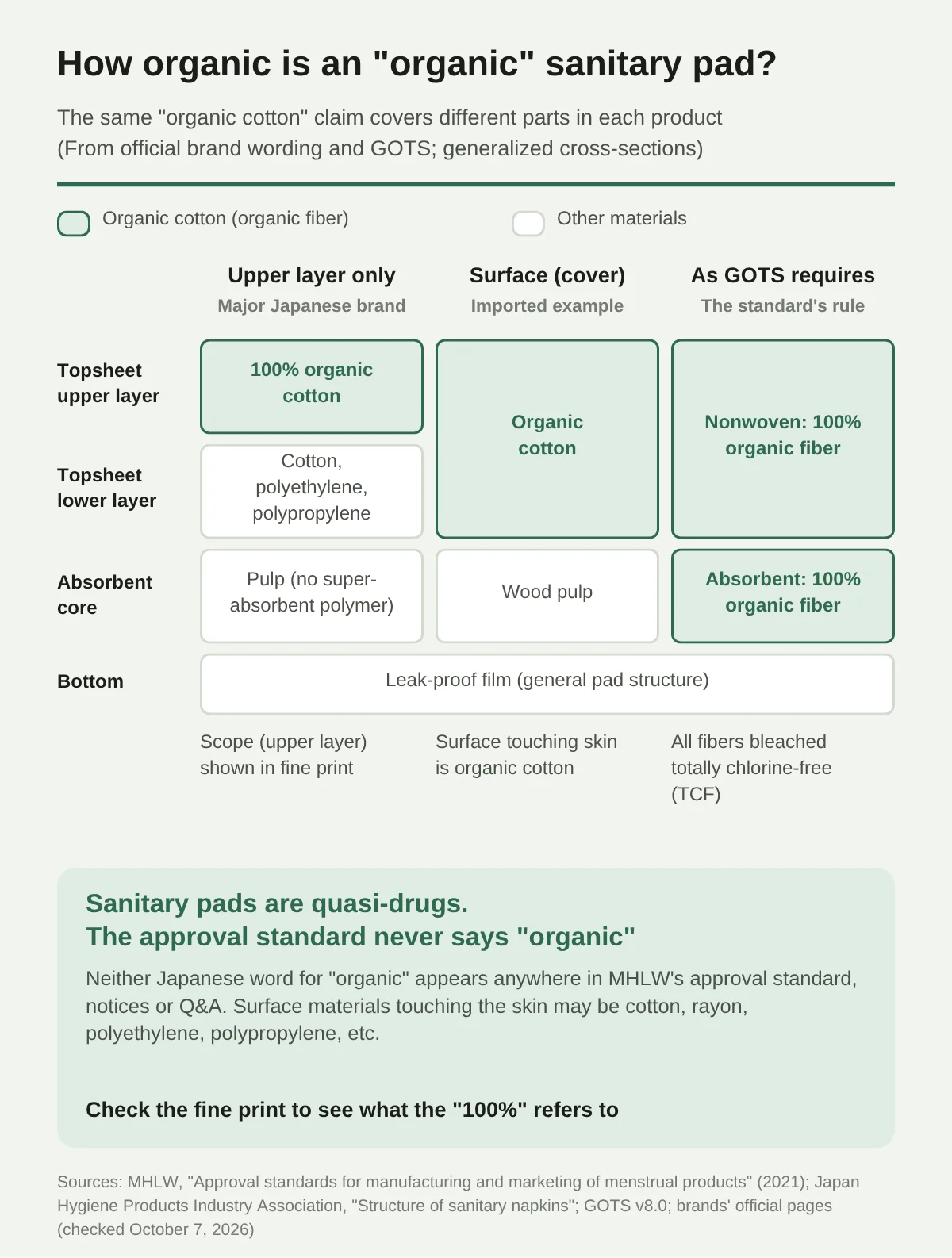
As the list above shows, the range of “organic cotton” in pads differs by product.
| Example product | Range of organic (as the official page words it) |
|---|---|
| ソフィ はだおもい オーガニックコットン (Sofy Hadaomoi Organic Cotton) | Only the upper layer of the topsheet. The lower layer is cotton, polyethylene and polypropylene, and the absorbent core is pulp (no superabsorbent polymer) |
| ナトラケア ウルトラパッド (Natracare Ultra Pads) | The surface (cover) is organic cotton. Inside is wood pulp |
| Organyc (a regular Japanese import could not be confirmed) | Surface and absorbent core. 82% organic cotton in the whole product |
| A pad made to the GOTS standard | All fibers are bleached totally chlorine free. Nonwoven and absorbent material are 100% organic fiber |
Only the surface touches the skin, so some people may think “organic on the surface is enough”. That depends on the person choosing. But from the big letters “organic cotton 100%” alone, you cannot tell how much of the product is organic.
Natracare officially writes “all the cotton we use is GOTS certified” and also publishes its license number. However, when we looked at the scope of its certification in the GOTS public database, only products that go inside the body, such as tampons, appeared, and pads did not (October 7, 2026). The database does not trace certification down to the raw-material stage, so this alone does not show there is no certification.
What is the evidence for “fewer rashes, less period pain, less menstrual flow”?
| Study | Type, number of people | Result | How to read it |
|---|---|---|---|
| Trial of organic cotton pads (Italy, 2018) | Number of people, control group and randomization are not stated in the abstract | Described as reducing the irritation that occurs with synthetic pads | Many of the authors belong to a contract testing company. We could not check the full text |
| “RCT, 1,002 people” of hemp and cotton pads (2022) | — | — | A paper retracted in September 2023. Sometimes cited online, but not valid evidence |
| Kao’s test of its own product (2007) | 16 women troubled by pad rash, before-and-after comparison | Redness, bumps and subjective symptoms decreased with its own product | Corporate research. A before-and-after comparison with no comparison group |
| Cloth pads (Japan, 2008, 2023) | 32 and 7 people, no controls | Period pain and menstrual symptoms improved | No comparison group. Not a comparison of organic or not |
We searched PubMed for trials comparing materials on period pain or menstrual flow and found 0. For the claim that organic cotton pads reduce menstrual flow or period pain, there is no evidence that can be checked.
The view that pad rash comes from “humidity” and “friction”
- In a case report of 6 people from a Japanese dermatology clinic (2007), in a test of sticking a piece of the person’s own pad on the arm, all were negative. Symptoms appeared with pads of any brand, and the cause is thought to be irritation from the humid environment and friction, not ingredients
- In tests by researchers at P&G and Kao, the difference in how nonwoven and film surfaces fit the skin was small (corporate research)
- Vulvar itching during periods is common, and a Japanese report says it occurs more easily in people with atopic dermatitis (joint research with Kao)
From this view, how to reduce humidity and friction seems to matter more than changing the material. However, no study has compared them. If symptoms continue, consult a dermatologist or gynecologist.
What about dioxins and chemicals?
You often see claims such as “bleaching pads creates dioxins” and “chemicals enter the body”.
| What is known | Source |
|---|---|
| The US FDA requires tampons to be free of dioxin (TCDD/TCDF) and pesticide residues, and requires the bleaching to be stated as elemental chlorine free (ECF) or totally chlorine free (TCF) | FDA guidance (2005) |
| Dioxin in tampons measured by an FDA laboratory was mostly below the detectable amount | Archer et al. 2005 |
| Dioxin in 7 Japanese-made pad products was 0.0044–0.076 pg TEQ/g. Even assuming 40 years of continuous use, about 1/1,666 to 1/29,166 of the tolerable daily intake | Ishii et al. 2014 (co-authored by Unicharm) |
| In South Korea in 2017, sanitary products became an issue and the national Ministry of Food and Drug Safety investigated (666 items, according to press reports). 50 of 74 volatile organic compounds were detected, but even assuming 100% absorption through the skin, it concluded there was no harmful health risk | Kim et al. 2019 (peer-reviewed paper). 666 items is from press reports |
| In 79 US products, even products labeled “organic” or “natural” did not necessarily have fewer volatile organic compounds | Lin et al. 2020 |
| In a test-tube test of 29 products, the 4 products that showed no cytotoxicity all had topsheets labeled organic cotton | Germolus et al. 2025 (a test-tube result, not human symptoms) |
| Measuring metals in 30 tampons, lead was higher in non-organic and arsenic was higher in organic. Absorption into the body was not studied | Shearston et al. 2024. An FDA study (2026, 11 products) concluded there was a safety margin even under stronger conditions |
It is neither “organic means zero chemicals” nor “ordinary pads are dangerous”. A pad made strictly to GOTS is totally chlorine free bleached, but even in ordinary pads, the dioxin measured in Japanese products was very small.
On “chemicals from pads accumulate in the uterus” and “transdermal toxins”, we found no study in humans. How to think about the amount of substances entering through skin is in Transdermal toxins and household goods. For scented products, see also Fragrances.
Panty liners are treated separately
For panty liners, the industry’s labeling guideline (2021) is separate, and says to write “use on days other than your period”. In the list above too, Sofy is labeled “general goods” (雑貨品) and Cotton Labo “general product” (一般品). They are products treated separately from quasi-drug menstrual pads, and are not made on the premise of absorbing menstrual blood.
What to check when choosing pads
| What to look at | What it tells you |
|---|---|
| The note on “organic cotton 100%” | Whether it is only the surface, only the upper layer, or up to the absorbent core |
| Certification name and number | Whether there is third-party certification such as GOTS. With a number, you can check the company and scope in the GOTS public database |
| Category | “Quasi-drug” means it meets the approval standard for menstrual pads. Panty liners are treated separately |
| Whether there is superabsorbent polymer | “Non-polymer” means no superabsorbent polymer is used. It is not a study comparing effects on skin |
| Fragrance | Whether it is scented |
For pads, you can choose by comparing where the organic part is and whether the certification can be confirmed officially. Here we set side by side Natracare (a UK brand that publishes its GOTS license number, GOTS-11347, on its official site, with an organic cotton topsheet; made in Sweden, labeled as a quasi-drug by the Japanese retailer) and Sofy from a major domestic maker (quasi-drug, made in Japan, no superabsorbent polymer), where only the upper layer of the topsheet is 100% organic cotton and the official page states no certification.
Organic cotton fraud: what happened in India?
About 60% of the world’s organic cotton comes from India, and fake transaction certificates have been found there. More than 96% of India’s cotton is genetically modified cotton, and testing to prevent mixing is also a challenge.
How much organic cotton is there in the world?
According to Textile Exchange’s estimates, organic cotton in 2023/24 was about 706,000 tonnes, 2.9% of the world’s cotton. The year before it was 2.3%, in 2020/21 it was 1.4%, and in 2008/09 it was about 1%. It is rising, but is about 3 out of every 100 units of cotton.
The largest is India, with 436,648 tonnes certified under India’s organic regulations, about 62% of the world (Urayomi’s calculation). Next is China (49,343 tonnes). By country share for 2020/21, it was India 38%, Turkey 24%, China 10%, Kyrgyzstan 9% and Tanzania 6%.
There is an important caution about these numbers.
- The original data for India does not distinguish organic cotton from in-conversion cotton. It is an estimate that Textile Exchange converted from past ratios
- The 2022 report itself writes that its confidence in India’s figure is “low”
- The 2025 report also calls the world figures “very rough estimates”
In 2020, GOTS announced “20,000 tonnes of fake material”
| When | What happened |
|---|---|
| October 30, 2020 | GOTS announced it had “obtained evidence of systematic fraud in Indian organic cotton”. Transaction certificates for raw cotton were found that imitated the format of India’s government agency (APEDA) and carried fake QR codes leading to a fake APEDA site. It firmly identified “20,000 tonnes of fake material” and banned 11 companies from certification. From then on, GOTS decided to verify itself the transaction certificates of all raw cotton entering GOTS |
| October 2021 (press report) | APEDA barred the Indian arm of the major certification body Control Union from registering new processors and exporters |
| February 13, 2022 | The US New York Times ran a major report on the problem in Indian organic cotton |
| April 2022 (press report) | Control Union notified customers that it would temporarily withdraw from certifying organic cotton in India |
| July 2022 (press report) | APEDA penalized three certification bodies. Reasons included certifying organic cotton where nothing was in the field |
| From December 2022 (press report) | GOTS and Textile Exchange strengthened inspections. A condition is that the data in transaction certificates can be traced back to the original farm |
| March 5, 2023 (press report) | The accreditation body IOAS suspended the accreditation of Control Union’s Indian arm |
Sources: GOTS press release (October 30, 2020). For 2021 onward, Indian press and trade journals (the original texts of APEDA and IOAS could not be checked).
“Half to four-fifths of India’s organic cotton is fake” is one person’s estimate
The New York Times article (2022) presented, as the estimate of one industry insider, that “half to four-fifths of organic cotton sold as Indian is not genuine”. It is not a figure from a public investigation.
The same article put the 20,000 tonnes GOTS found in 2020 at “one-sixth of India’s total production”, and also reported that the price of organic cotton rose from $1.70 to $3 per kg. One view is that demand rising suddenly and prices going up lay behind the fraud.
GM cotton (Bt cotton) getting mixed in
In August 2024, the Indian government told Parliament that Bt cotton (cotton genetically modified to resist insects) accounts for more than 96% of the cotton acreage. Bt cotton is the only genetically modified crop approved for commercial cultivation in India (approved in 2002).
- With fields all around being almost entirely GM, it is hard to get non-GM seed, and there is a lot of room for mixing
- That is why both GOTS and OCS require GMO testing at the ginning stage
- A Swiss consumer magazine also reported that genetic modification was found in GOTS-certified yarn from India (2017). However, the number of samples and the share of positives were not known
- We found no peer-reviewed paper that examined how much GM cotton is mixed into organic cotton products
The idea of genetically modified crops themselves is covered in GM foods and high-fructose corn syrup.
What is the impact on products in Japan?
Almost all of Japan’s cotton is imported, so raw cotton, yarn and products from India can also go into Japan’s “organic cotton”. However, we found no public case of organic cotton fraud being exposed in Japan.
Much of the fraud happened with paper certificates (transaction certificates). That is why GOTS has strengthened certificate checks, and makes it possible to check from a product’s certification number which company holds the certification, in a public database.
Is “cotton uses 16% of insecticides” true?
“Cotton uses 2.5% of the world’s farmland and 16% of insecticides” is a figure from a 2007 environmental-group report, and (in what we checked) its source is not given. The newer figure is 10.51% of insecticides.
| Figure | Origin | Status |
|---|---|---|
| 25% of insecticides | Said to come from a 1990s pesticide-market survey | Old. A trade journal has covered it as a “myth” |
| 16% of insecticides on 2.5% of farmland | Report by the Environmental Justice Foundation (EJF) and the UK pesticide watchdog PAN UK (2007) | (In what we checked) no source given |
| 2.3% of cropland, 4.0% of all pesticides, 10.51% of insecticides | ICAC (International Cotton Advisory Committee) feature in 2024. Average for 2018–2022 | Data source is the pesticide company Bayer Crop Science |
ICAC is an international body of governments of cotton-producing and cotton-consuming countries. The share of highly hazardous pesticides (HHP) among the pesticides used on cotton also differs greatly: 69.1% in EJF’s 2019 report and 13.04% for ICAC.
Both have their own positions. Environmental groups want to promote organic cotton, ICAC is on the side of the cotton industry, and its data come from a pesticide company. Still, at least it can be said that “16%” and “25%” are old figures with no source given (in what we checked).
On the other hand, even by ICAC’s figures, cotton uses about one-tenth of insecticides, and its use of insecticides that are highly hazardous pesticides is said to be the third largest among crops. That much insecticide is used in cotton fields holds true under either set of numbers. The difference on the field side is that organic cotton, in principle, does not use such chemically synthesized insecticides.
Is “2,700 L of water for one T-shirt” true?
The original figure is “2,720 L” in a 2006 paper. But it is a world average that does not distinguish organic from ordinary cotton, and about 40% is rainwater.
| Breakdown (for one 250 g T-shirt) | Amount |
|---|---|
| Irrigation water (drawn from rivers and groundwater) | 1,230 L |
| Rainwater (rain that fell on the field) | 1,110 L |
| Water needed to dilute pollution | 380 L |
| Total | 2,720 L |
Source: Chapagain et al. (2006, Ecological Economics). World average for 1997–2001.
This figure became widely known as “2,700 L” through campaigns such as WWF’s.
- In fields that grow on rainwater alone, no river or tap water is used
- It does not distinguish organic or not, so you cannot say “going organic cuts 2,700 L”
“Organic means 91% less water and 46% less CO2” is an industry-commissioned study
You often see the figure “organic cotton reduces water by 91% and CO2 by 46%”. This is a life cycle assessment (LCA) that Textile Exchange commissioned in 2014.
| Commissioned by Textile Exchange (2014) | Independent study (2026) | |
|---|---|---|
| Scope compared | Up to the cotton fiber | The whole way until the T-shirt is in the shop |
| Water | 91% less irrigation water | 23.8% less (98.7% less for the growing stage alone) |
| Global warming | 46% less | 26.9% less (82.5% less for the growing stage alone) |
| Funding and position | Companies and organizations that handle organic cotton, such as H&M, Nike, Inditex, Kering and GOTS | Declared no conflict of interest (a co-author is affiliated with a fair-trade organization) |
The 2014 report itself writes that the “comparability of the two studies it compared has not been verified by third-party review”. The 2026 study (a T-shirt grown in India and sold in Spain) concludes that even if the field’s burden falls greatly, the burden of yarn, fabric, dyeing and transport is not reduced by certification.
Why is organic cotton expensive?
Because the volume is small, yields are low, and every company from the field to the shop must be certified and managed separately.
| Reason | Basis |
|---|---|
| Small volume | 2.9% of the world’s cotton (2023/24) |
| Low yield | Textile Exchange’s estimate assumes organic yield is 80% of ordinary. The New York Times says “28% lower on average” |
| Burden of conversion | The conversion period (often about 3 years) cannot be sold as “organic” |
| Cost of certification | In GOTS, every company involved must be certified, through spinning, weaving, dyeing, sewing and sales |
| Segregation | Managed so it does not mix with ordinary cotton from raw cotton to product |
| Restrictions on processing | GOTS restricts bleaching, dyes and finishing agents |
| Price rises with demand | In 2020/21, organic cotton prices in China rose 30–40% on demand from overseas brands. The New York Times: $1.70 to $3 per kg |
We found no Japanese public survey comparing prices of organic and ordinary cotton products from the same brand. In the examples in the list above, face towels were 1,650–2,640 yen each and panties 1,760–4,400 yen (October 7, 2026, official tax-included prices).
Why organic food is expensive is covered in What is organic? (standards and history), and the world’s organic market in Organic in Japan and the world.
How to choose organic cotton: reading the label
Because there is no national standard, the surest way is to check for yourself the label’s “certification name, grade and number” and “what percentage”.
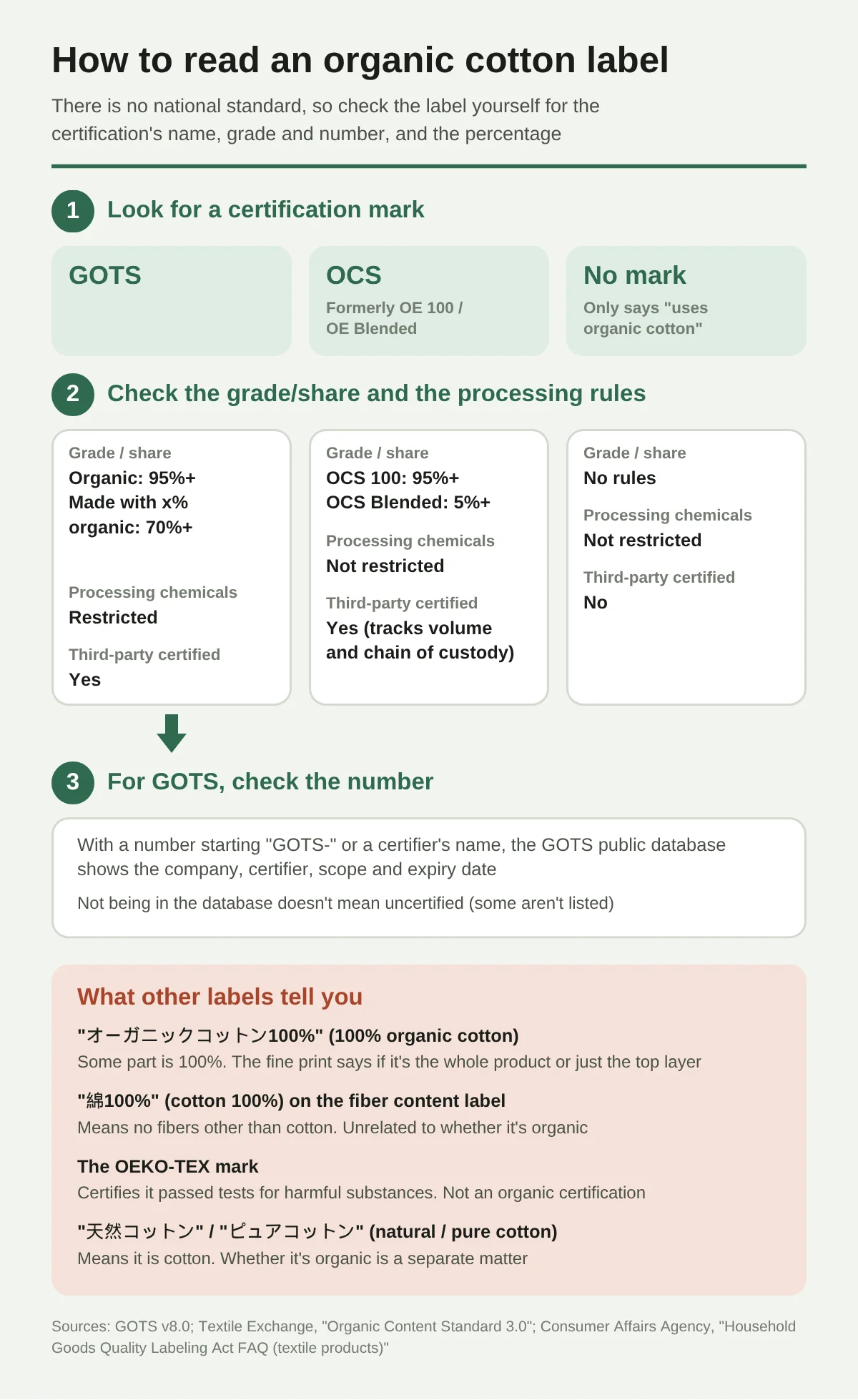
| What to look at | What it tells you | What it does not tell you |
|---|---|---|
| GOTS mark and grade (“Organic”, “Made with x% organic”) | Whether organic fiber is 95% or more, or 70% or more. Finishing chemicals are also restricted | The effect on skin when worn |
| GOTS number (a number starting with “GOTS-”, or the certification body’s name) | In the public database, you can check the company, certification body, scope and expiry date | Some certifications are not in the database |
| OCS mark (“OCS 100”, “OCS Blended”) | Whether organic material is 95% or more, or 5% or more. Distribution is tracked | Finishing chemicals (not restricted) |
| Only “organic cotton used” or “organic cotton blend” | The company says organic cotton is included | What percentage. Whether a third party verified it. The finishing |
| “Organic cotton 100%” | Some part is 100% | Whether it is the whole product or only the upper layer of the surface (check the note) |
| “Cotton 100%” in the composition label | No fibers other than cotton are included | Whether it is organic |
| “Oeko-Tex” mark | It passed tests for harmful substances | Whether it is organic (a separate certification) |
| “Natural cotton” (天然コットン), “pure cotton” (ピュアコットン) | That it is cotton | Whether it is organic (a different thing) |
The same goes for choosing baby clothes. For clothing for infants up to 24 months old, the law sets a strict formaldehyde limit (16 µg/g or less) whether or not it is organic. It is easier to understand if you think of the reason to choose organic as mainly whether you place weight on pesticides in the field and the environment of the farmers.
Choosing underwear, panties and baby clothes
Underwear touches the skin directly and is washed many times and used for a long time. If you want a product whose finishing is also restricted, one whose GOTS label and number you can check is the surest.
- Stretchy fabric may include polyurethane (an elastic fiber) (5–8% in the panties in the list above). Check the share of cotton too
- Wash new items once before wearing
- Some brands of baby underwear state whether even the ties, tags and sewing thread are cotton
For People Tree’s Organic Cotton Stretch Panties, the label says 95% organic cotton and 5% polyurethane, and in the GOTS public database we could confirm that the scope of the company’s certification (GOTS-11357, certification body ECOCERT, until March 30, 2027) includes underwear and sleepwear. It also carries the fair-trade WFTO label.
Choosing towels
For towels, even with “organic cotton” in the name, there are products where only the base weave is ordinary cotton (in the list above, the PRISTINE example is 70%). Check the share in the material field.
- “Oeko-Tex Standard 100” is a certification for tests of harmful substances, and is separate from organic certification
- If you are concerned about the ingredients of detergent and softener, see also Additive-free detergent
For the IKEUCHI ORGANIC Organic 120 face towel, the official page writes “100% organically grown cotton” and explains that the cotton received organic certification based on EU standards after review by the Swiss certification body bio.inspecta. The product has no GOTS label, and the official page does not state the type or number of the certification. It is made in Imabari, Ehime Prefecture.
Items featured in this article (summary)
Here are the items featured in the article, gathered again. The reasons and ingredients are in each section.
| Item featured | Where to buy |
|---|---|
| ナトラケア ウルトラパッド ノーマル(ふつうの日用・羽つき)12個 (Natracare Ultra Pads Regular, with wings, 12 pcs) ― GOTS certification number published officially | See on Rakuten (コスメキッチン) PR See on Amazon.co.jp PR |
| ソフィ はだおもい オーガニックコットン 特に多い昼用260 羽つき 22枚 (Sofy Hadaomoi Organic Cotton, extra-heavy day 260, with wings, 22 pcs) ― major domestic brand, upper layer of the surface is 100% | See on Rakuten (サンドラッグe-shop) PR See on Amazon.co.jp PR |
| People Tree オーガニックコットン ストレッチ・ショーツ (People Tree Organic Cotton Stretch Panties) (GOTS certification stated) | See on Rakuten (ハーモネイチャー) PR See on Amazon.co.jp PR |
| IKEUCHI ORGANIC オーガニック120 フェイスタオル 35×80cm (IKEUCHI ORGANIC Organic 120 face towel, 35×80 cm) | See on Rakuten (LuAstyle) PR |
Summary
| What you want to know | What we found |
|---|---|
| What is organic cotton? Is there a national standard? | Cotton grown to organic standards. Japan has no national standard, and “organic” in law is for food only. The Consumer Affairs Agency says an “organic cotton 100%” composition label is “not appropriate” |
| What percentage is “organic cotton used”? | GOTS is 95% and 70% or more, OCS 100 is 95% or more, and OCS Blended is 5% or more. For uncertified labeling, there is no rule |
| Is “100%” the whole product? | For major brands’ pads and panty liners it is 100% of “the upper layer of the topsheet”. Check the note |
| Gentle on skin? Why do people call it a “lie”? | The fiber is the same cotton and analysis cannot tell them apart. No study has compared organic and ordinary cotton on skin symptoms. Differences can arise in finishing, and only GOTS restricts finishing |
| Fewer rashes, period pain and menstrual flow with pads? | No study with a control group has shown it. Pads are quasi-drugs, but the standard has no word “organic”. One view is that humidity and friction contribute more to rashes |
| Fraud and GM cotton? | In 2020, GOTS announced 20,000 tonnes of fake material in India. About 60% of organic cotton is from India, and more than 96% of India’s cotton is GM. “Half to four-fifths is fake” is one person’s estimate |
| “16% of insecticides” and “2,700 L of water”? | 16% is a 2007 environmental-group figure, and in what we checked no source is given. ICAC 2024 says 10.51% (data from a pesticide company). 2,700 L is a world average that does not distinguish organic from conventional, and about 40% is rainwater |
| Why is it expensive? | 2.9% of the world’s cotton, low yields, about 3 years of conversion, and certification and segregation across all companies |
| How to choose? | Check the certification’s name, grade and number, and the percentage. Wash new underwear before wearing |
Sources
Japan’s systems
- Act on Japanese Agricultural Standards, etc., Article 2, and its Enforcement Order Articles 1 and 18 (e-Gov Law Search)
- Consumer Affairs Agency, “Household Goods Quality Labeling Act FAQ (textile products)” No. 32 https://www.caa.go.jp/policies/policy/representation/household_goods/faq/faq_02.html
- Consumer Affairs Agency, “Textile Products Quality Labeling Regulations” (last amended December 25, 2024)
- SMRJ, report on the “Survey on formulating organic cotton labeling guidelines” (February 2010, commissioned to Nomura Research Institute) https://joca.gr.jp/newwp/wp-content/uploads/2022/06/OC_display_guidline53102-2.pdf
- Act on the Control of Household Products Containing Harmful Substances, Enforcement Regulations Appended Table 1 (e-Gov); MHLW, “Outline of regulatory standards for household products containing harmful substances” (April 1, 2025)
- MHLW, “On approval standards for manufacture and sale of menstrual products” (June 28, 2021, Yakusei-hatsu 0628 No. 4) https://www.mhlw.go.jp/content/000797719.pdf
- Japan Hygiene Products Industry Association, “History of pads”, “Structure of pads”, “Guideline on labeling of panty liners” (June 1, 2021)
- Japanese Dermatological Association and Japanese Society of Allergology, “Atopic Dermatitis Clinical Practice Guidelines 2024”
Systems overseas
- Regulation (EU) 2018/848 Annex I https://www.legislation.gov.uk/eur/2018/848/annex/I
- USDA National Organic Program, “Policy Memo 11-14 Labeling of Textiles That Contain Organic Ingredients” (May 20, 2011)
- Press Information Bureau, Government of India (August 6, 2024, Bt cotton) https://pib.gov.in/PressReleseDetailm.aspx?PRID=2042234
Private standards and industry reports
- Global Organic Textile Standard v7.0 (Japanese version) and v8.0 (March 2026) https://global-standard.org/
- GOTS, “GOTS detects evidence of organic cotton fraud in India” (October 30, 2020)
- Textile Exchange, “Organic Content Standard 3.0”, “Organic Cotton Market Report 2022”, “Materials Market Report 2025”, and “The Life Cycle Assessment of Organic Cotton Fiber” (2014)
- Japan Organic Cotton Association, “What is organic cotton”, “Certification”, “Member tags” https://joca.gr.jp/
- ICAC, “The ICAC Recorder”, June 2024 issue
- EJF and PAN UK, “The Deadly Chemicals in Cotton” (2007)
Press reports
- The New York Times, “That Organic Cotton T-Shirt May Not Be as Organic as You Think” (February 13, 2022)
- Ecotextile News (April 14 and September 23, 2022), Krishi Jagran (APEDA’s penalties, IOAS’s suspension of accreditation)
Studies on skin and clothing
- Thomas KS, et al. PLoS Med 2017 (PMID 28399154) / Ragamin A, et al. Br J Dermatol 2024 (PMID 37936331) / Su JC, et al. Br J Dermatol 2017 (PMID 28182252) / Fowler JF, et al. Dermatitis 2019 (PMID 30864970) / Lopes C, et al. Pediatr Allergy Immunol 2013 (PMID 23980847) / Diepgen TL, et al. Z Hautkr 1990 (PMID 2291289)
- Lisi P, et al. Contact Dermatitis 2014 (PMID 24392992) / Ryberg K, et al. 2014 (PMID 24815318) / Heratizadeh A, et al. 2017 (PMID 28233329)
- Herrero M, et al. Toxics 2022 (PMID 35878266) / Herrero M, et al. Sci Total Environ 2023 (PMID 37001656) / Kiriyama T, et al. J Dermatol 2003 (PMID 14684951)
Studies on pads and menstrual products
- Mori A, et al. Minerva Ginecol 2018 (PMID 30465412) / Sun 2022 (PMID 36277007, retracted in 2023)
- Sato et al., Skin Science (皮膚の科学) 2007;6(3):300; Kobayashi M et al., Nishinihon Journal of Dermatology (西日本皮膚科) 2010;72(4):385; Kaimura et al., Journal of Women’s Psychosomatic Medicine (女性心身医学) 2008;13(3):143; Ito et al., Japan Journal of Physical Education, Health and Sport Sciences (体育学研究) 2023;68:263
- Wakashin K. J Dermatol 2007 (PMID 18078410) / Farage MA, et al. (PMID 17464747 and others) / Fujimura T, et al. 2011 (PMID 21425952)
- FDA, “Menstrual Tampons and Pads: Information for Premarket Notification Submissions” (2005) / Archer JC, et al. J Womens Health 2005 (PMID 15916504) / Ishii S, et al. Regul Toxicol Pharmacol 2014 (PMID 25078889)
- Korea Ministry of Food and Drug Safety, explanatory materials (May 18, 2018) / Kim HY, et al. 2019 (PMID 31328663) / Lin N, et al. Environ Int 2020 (PMID 32866732) / Germolus NP, et al. J Hazard Mater 2025 (PMID 40886531) / Shearston JA, et al. Environ Int 2024 (PMID 38963987) / Jin 2026 Toxicol Sci (PMID 42218823)
Environment and water
- Chapagain AK, et al. Ecological Economics 2006;60:186-203
- Barandiaran-Oliveras 2026 Sci Total Environ (PMID 42667802)
Each company’s official pages (checked October 7, 2026)
- Unicharm “Sofy Hadaomoi Organic Cotton”, “Sofy Panty Liners Organic Cotton”, “Sofy Organic Cotton Warming Panties”; Kao “Laurier Kirei Style”; Cotton Labo; Natracare; Organyc; G-Place “Natural Moon”; People Tree; PRISTINE (Avanti); IKEUCHI ORGANIC
- GOTS public database of certified entities (Global Trace Base)
Related articles and databases
- What Is Organic (有機)? Organic JAS Standards, History, and How It Differs from “Pesticide-Free,” “Additive-Free,” and Shizen Saibai (Natural Farming), Explained with Official Sources
- Is organic food better for your health? Nutrition, pesticide residues and cancer studies checked against the papers — where to switch first, and what it costs
- Organic in Japan and the World: Why Is Japan’s Organic Share Only 0.9%? Markets, Farmland, Rules, and Fraud Compared with the US, EU, China, and South Korea
- Pesticides Allowed Under Organic JAS: Full List of 42 Items (What Works on Aphids, Stink Bugs and Diseases? Any Herbicides? Antibiotics Too?)
- Where Are Organic School Lunches? Municipalities Serving Them and 168 Organic Villages, by Prefecture
- Are “transdermal toxins” (経皮毒) a myth or real? Do ingredients in shampoo and detergent enter through the skin, and what labels leave out
- How to Choose Additive-Free Shampoo and Body Soap: Soap-Based vs. Amino Acid-Based, and How to Read the Full Ingredient List