
Organic in Japan and the World: Why Is Japan’s Organic Share Only 0.9%? Markets, Farmland, Rules, and Fraud Compared with the US, EU, China, and South Korea

PR This article contains affiliate links to Rakuten Ichiba, Amazon, Yahoo! Shopping, and A8.net (“See on Rakuten” and similar). What we write is based on materials from public agencies and on research papers, regardless of whether there is an ad. The “See on Amazon.co.jp” links are also affiliate links.
“Europe is the leader in organic, and Japan is behind.” You hear this a lot. There are also questions such as:
- Is it true that organic farming covers less than 1% of Japan’s farmland?
- Which country has the most organic farmland in the world?
- Which country has the strictest organic standards?
- Can imported organic food, or organic food from China, be trusted?
- Does organic fraud really happen?
- What happened to Sri Lanka, which switched the whole country to organic?
- Is organic really good for the environment?
Many of these questions actually show up in search suggestions.
In this article, we:
- Compare organic sales, farmland, and per-person spending around the world using international statistics
- Compare the “organic” rules of Japan, the US, the EU, China, South Korea, India, Australia, and others
- Check why organic is small in Japan, and where it is growing (pasture in Hokkaido and school lunches)
- Find out how much of the organic JAS food sold in Japan was certified in other countries
- Line up fraud cases in the US, Europe, China, and Japan, and the measures taken afterward
- Compare, country by country, the reasons people do or do not buy organic
- Read the research on environmental impact, split into yield, biodiversity, and greenhouse gases
We check all of this against national statistics, laws, public agency materials, and research papers.
The organic series (3 articles)
- What is organic? (standards and history): the organic JAS standards, the conditions for writing “organic” (有機), the history, and how organic differs from “additive-free” and “natural farming”
- Organic food and health: research on nutrition, pesticide residues, and cancer, and where to start switching
- This article: Organic in Japan and the world
Conclusion
- Global organic food sales were 145 billion euros in 2024 (about ¥23.6 trillion). That is about 7.4 times the 2003 level. Four countries (the US, Germany, China, and France) account for about 70% of the world total
- Per-person spending is 481 euros a year in Switzerland, about 37 times Japan’s 13 euros (2022). Japan is below the world average (17.7 euros), and organic is 0.3% of food sales
- The country with the most organic farmland is Australia, with 53.6% of the world total. However, most of it is grazing land for cattle and sheep. Worldwide, 70% of organic farmland is grassland or pasture
- “Which country has the strictest standards” cannot be settled with a single yardstick. Japan is a country where you cannot write “organic” without the organic JAS mark. The US labels by tiers of “95% or more” and “70% or more.” Australia has no mandatory standard for organic sold domestically. South Korea is a country where the state certifies “pesticide-free” (in Japan, the term “pesticide-free” (無農薬) is banned by the labeling guidelines)
- Organic farming in Japan is 0.9% of cropland (end of fiscal 2024, 39,800 ha). International statistics show 0.4%, but that is a difference in how it is counted. Most of the recent growth is pasture in Hokkaido. Domestic organic is 0.12% of rice and 0.45% of vegetables. Only tea is relatively high, at 6.86%
- The volume of organic JAS produce graded abroad and shipped to Japan is about 60% of the volume graded in Japan. For fruit, soybeans, and coffee, far more is graded abroad. China is not among the six countries and regions with which Japan recognizes organic equivalence, so to sell Chinese-grown produce in Japan as “organic,” organic JAS certification is required
- Fraud does happen. In the US, there was a case in which more than 90% of the grain one farmer sold in 2010–2017 was falsely sold as “organic,” and new rules, including a mandatory import certificate, began in March 2024. In Japan too, the government issued an order in 2024 against a company that put the organic JAS mark on products without being certified
- On environmental impact, results differ by indicator. One analysis finds about 30% more biodiversity (variety of living things) with organic, but yields are about 20% lower, and greenhouse gas emissions per unit of output can be higher. Sri Lanka suddenly banned chemical fertilizers in 2021 and reversed the ban in less than eight months
Items featured in this article
| Item | When it helps | Where in the article |
|---|---|---|
| Organic miso made with domestic ingredients / organic miso made with imported ingredients | When you want to compare the country of origin on the label | Telling by the country of origin on the label |
| Organic JAS coffee beans / Italian organic olive oil | When choosing organic foods that are hardly produced in Japan | Items with a lot of imported organic |
| Co-op and farm-direct delivery services that handle a lot of organic (Coop Shizenha, Sakanotochu, Taberu Choku, and others) | When you want to connect with farmers and producing regions and buy organic vegetables | Teikei, born in Japan |
How big is organic worldwide?
First, the conclusion. Global organic food sales grew about sevenfold in a little over 20 years, but 70% of sales are concentrated in four countries. The figures come from the 2026 edition (2024 data, 183 countries) of “The World of Organic Agriculture,” the international statistics published every year by the Research Institute of Organic Agriculture (FiBL) in Switzerland and IFOAM – Organics International. Japan’s Ministry of Agriculture, Forestry and Fisheries (MAFF) also uses this report for international comparisons.
Sales grew about sevenfold in a little over 20 years
- Global retail sales of organic food were 145 billion euros in 2024 (up 6.9 billion euros from the previous year). MAFF converts this at 1 euro = ¥163, which gives about ¥23.6 trillion
- In 2003 the figure was 19.6 billion euros, so sales grew about 7.4 times in 21 years (calculated by Urayomi)
- Organic farmland (including “in conversion” land that is switching to organic) is 98.89 million ha, or 2.1% of the world’s agricultural land. In 2000 it was 14.9 million ha, or 0.3%
- There are about 4.84 million organic producers in the world. Of these, about 2.36 million (about 49%) are in India
Note that the survey years for sales differ by country. For example, Japan’s sales figure is for 2022. Also, US organic farmland grew 56% in 2024, but FiBL writes that this is “because new data were added, so it cannot be compared simply with the previous year.”
Four countries (the US, Germany, China, and France) make up about 70% of the world
| Rank | Country | Organic food retail sales (2024) |
|---|---|---|
| 1 | United States | 60.4 billion euros |
| 2 | Germany | 17.0 billion euros |
| 3 | China | 15.5 billion euros |
| 4 | France | 12.2 billion euros |
| 5 | Canada | 5.2 billion euros |
| 6 | Italy | 5.2 billion euros |
| 7 | Switzerland | 4.4 billion euros |
| 8 | United Kingdom | 4.1 billion euros |
| ― | Japan (2022) | 1.6 billion euros |
Source: FiBL & IFOAM, “The World of Organic Agriculture 2026,” country tables.
The top four countries total 105.1 billion euros, or about 72.5% of the world (calculated by Urayomi). Japan’s figure for 2022 is 1.62 billion euros. MAFF writes that Japan was “13th in the world and second in Asia after China as of 2022.” When Urayomi re-sorted the 2026 edition’s table, Japan came 14th (after Sweden and the Netherlands).
China is third in the world by sales, but because its population is so large, it comes to 11 euros per person, about the same as Japan (13 euros).
Per person, Switzerland spends about 37 times as much as Japan
Per person per year, organic food spending is 481 euros in Switzerland, 373 euros in Denmark, and 292 euros in Austria. Japan’s is 13 euros, about 1/37 of Switzerland’s (calculated by Urayomi). That is below the world average of 17.7 euros, and close to South Korea (11 euros) and China (11 euros).
For organic’s share of food sales (market share), it is 12.3% in Switzerland, 11.6% in Denmark, and 11.4% in Austria, versus 0.3% in Japan (2022). A note in the FiBL table says Japan’s figure also includes sales in restaurants and other eating out.
In yen, using 2022 figures converted by MAFF, Japan’s per-person amount was ¥1,794 a year, the world average was ¥2,346, the US ¥24,288, and Switzerland ¥60,306 (1 euro = ¥138).
What “Australia has the most organic farmland” really means
In the ranking of organic farmland area, first place is Australia, with 53.02 million ha. That is more than 13 times the area of second-place India (3.97 million ha). Australia alone accounts for 53.6% of the world’s organic farmland (calculated by Urayomi).
However, according to FiBL, about 99% of the organic farmland in Oceania, including Australia, is permanent grassland and pasture. In other words, it is vast grazing land for cattle and sheep. Australia has only 1,635 organic producers.
Worldwide too, 70.4% of organic farmland is grassland or pasture (69.61 million ha). Fields growing vegetables and grains are 16.55 million ha, and permanent crops such as fruit trees and tea are 6.85 million ha. Cropland and permanent crops together are only about a quarter of organic farmland.
If you read the “world organic farmland ranking” the way you would think about a supermarket produce aisle, it does not match reality. Excluding Australia, the world’s organic farmland is about 45.9 million ha, less than half.
Australia’s data are from 2022, and there were no new data for 2024. The sudden jump in world organic farmland in 2022 (76.2 million ha to 96.4 million ha) is probably largely due to the update of Australia’s data, but this could not be confirmed in FiBL’s text.
Countries with a high share of farmland
| Country / region | Share of farmland that is organic (2024) | Organic farmland |
|---|---|---|
| Liechtenstein | 43.5% | 1,574 ha |
| Austria | 27.2% | 699,000 ha |
| Uruguay | 23.1% | 3.25 million ha |
| Estonia | 22.5% | ― |
| Greece | 21.7% | ― |
| Italy | 19.2% | 2.51 million ha |
| Switzerland | 18.4% | 191,000 ha |
| Australia | 14.6% | 53.02 million ha |
| Germany | 11.5% | 1.91 million ha |
| EU as a whole | 11.1% | 18.08 million ha |
| France | 9.4% | 2.71 million ha |
| United Kingdom | 2.8% | 485,000 ha |
| South Korea | 2.4% | 38,000 ha |
| United States | 0.8% | 3.21 million ha |
| China | 0.7% | 3.59 million ha |
| Japan | 0.4% (0.9% in the government’s estimate) | 18,000 ha (39,800 ha in the same estimate) |
Source: FiBL & IFOAM, “The World of Organic Agriculture 2026.” We have not checked the ranking of small countries and islands against the original ranking table. The difference between Japan’s 0.4% and 0.9% is explained in 0.9% vs. 0.4%: why the same Japanese figure differs by a factor of two.
The US and China rank first and third in the world in sales, but organic is less than 1% of their farmland. According to FiBL, the EU and the US together imported 5.9 million tons of organic agricultural products, and the main exporting countries were Mexico, Ecuador, and Canada.
Which country has the strictest organic standards? Comparing the rules of major countries
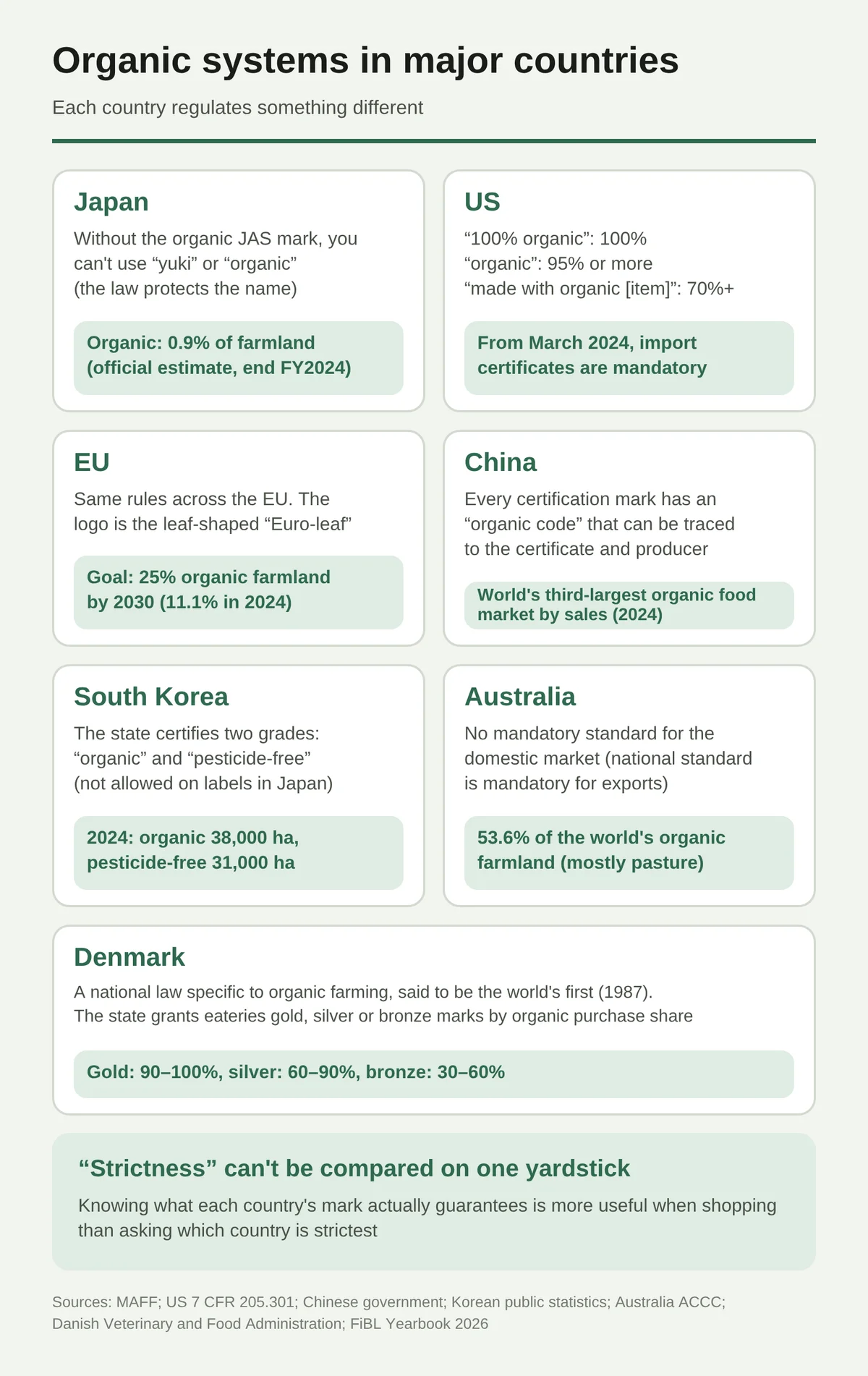
“Organic standards strict country,” “American organic standards,” and “EU organic mark” are phrases that actually appear in Japanese search suggestions. The conclusion first: because what each country regulates differs, strictness cannot be lined up in a single row.
The systems of 10 countries and regions
| Country / region | System / mark | Features of the labeling rules |
|---|---|---|
| Japan | Organic JAS (JAS Act). Certification bodies registered with the government certify, and the organic JAS mark is applied | Without the mark, you cannot write “organic” (有機), “オーガニック,” or “organic” (the law reserves the name). Only processed foods with 95% or more organic ingredients may be called “organic ○○” (有機○○). From October 2025, the mark is also required for organic alcoholic beverages |
| United States | USDA (Department of Agriculture) National Organic Program (NOP) | “100% organic” means 100%, “organic” means 95% or more, and “made with organic ○○” means 70% or more (excluding water and salt). Since March 2024, import certificates and certification of intermediaries are mandatory |
| EU | Regulation 2018/848 (applied from January 2022). The EU organic logo (the leaf-shaped “Euro-leaf”) | The same rules across the whole EU. A target of making 25% of farmland organic by 2030 |
| China | National standard GB/T 19630 and the “Measures for the Administration of Organic Product Certification” | Each certification mark carries its own “organic code,” so the product can be traced back to the certificate and the producer |
| South Korea | “Eco-friendly” agricultural product certification (National Agricultural Products Quality Management Service) | The state certifies two categories: “organic” and “pesticide-free” |
| India | Two tracks: the National Programme for Organic Production (NPOP) and the Participatory Guarantee System (PGS-India). Food labels use the “Jaivik Bharat” logo | PGS certification, in which producers and consumers check each other, covers about 25% of certified farmland (FiBL) |
| Australia | No mandatory standard for the domestic market (AS 6000-2015 is voluntary). For export, the national standard is mandatory | Domestically, the Australian Competition and Consumer Commission (ACCC) enforces consumer law against “organic claims that cannot be substantiated” |
| United Kingdom | After leaving the EU, it carried the organic regulations over into domestic law | Its organic equivalence with Japan continued after leaving the EU, and the scope widened to alcoholic beverages in October 2025 and further in April 2026 |
| Switzerland | The national organic ordinance, and the private Bio Suisse (the “bud” mark) | Highest in the world for both per-person spending and market share |
| Denmark | The state-run “Ø mark” | For restaurants, canteens, and similar places, the state issues, free of charge, a gold (90–100%), silver (60–90%), or bronze (30–60%) mark based on the share of organic in purchases |
Sources: MAFF, US federal regulation 7 CFR 205.301, US Federal Register (88 FR 3548), the Chinese government (gov.cn), public statistics from Gangwon Province (South Korea), FiBL yearbook 2026, the Australian ACCC, and the Danish Veterinary and Food Administration. We could not confirm the original text of the EU regulation (EUR-Lex) and rely on explanatory materials.
“Strictness” cannot be compared with a single yardstick
From the table above, we can see at least four different “yardsticks.”
- Does the law protect the name? In Japan, if you write “organic” on something that is not certified, the government can order you to remove the label, and ignoring the order is punishable by up to one year of imprisonment or a fine of up to ¥1 million (JAS Act, Articles 64 and 78). Australia has no mandatory standard for organic sold domestically. However, false organic claims are enforced against under consumer law
- Are tiers shown on the label? In the US, you can write “made with organic ○○” even at 70% or more. Japan has no 70% tier, and “organic ○○” is allowed only at 95% or more
- What counts as a relative of organic? South Korea has the state certify “pesticide-free.” Japan treats “pesticide-free” as a term that must not be used on labels
- How far can the product be traced? China numbers each mark so it can be traced, and since 2024 the US requires a certificate for each import shipment
Knowing “what a country’s mark guarantees” is more useful when shopping than knowing “which country is the strictest.” The organic JAS is explained in detail in What is organic? (standards and history).
The US has “95%” and “70%”; Japan has only “95%”
| Label | United States (7 CFR 205.301) | Japan (organic JAS) |
|---|---|---|
| 100% organic | 100% organic ingredients | No such tier |
| organic / 有機○○ | 95% or more | 95% or more (excluding salt and water) |
| made with organic ○○ | 70% or more | No such tier. When organic JAS ingredients are used, you may write “made with organic ○○” (有機○○使用) with the percentage |
| Less than 70% | “Organic” may be written only in the ingredient list | ― |
The US system began with the Organic Foods Production Act (November 1990), and the first proposed rule (1997) drew 275,000 comments. The parts of the proposal that would have allowed “genetic engineering,” “irradiation,” and “sewage sludge as fertilizer” were withdrawn in 1998. It was fully implemented in October 2002 (report of the US Congressional Research Service).
The final rule of 2000 states that “certification is a claim about the process, not a claim about the product” and that organic produce must not be interpreted as safer than non-organic produce. The international standard (the Codex guidelines) also says that because of environmental contamination, “it cannot be guaranteed that organic products are completely free of residues.” In every country, the organic mark is a “promise about how it is made.”
Japan and South Korea treat “pesticide-free” in opposite ways
In Japan, a May 2003 revision of MAFF’s guidelines made the labels “pesticide-free” (無農薬) and “reduced pesticide” (減農薬) prohibited. As the reason, MAFF cited that “more than 60% of consumers mistakenly thought pesticide-free was better than ‘organic,’ which has third-party certification” (2002 survey by the Ministry of Internal Affairs and Communications).
In South Korea, on the other hand, “pesticide-free agricultural products” remain a state certification category.
| Year | Organic (ha) | Pesticide-free (ha) | Total (ha) |
|---|---|---|---|
| 2014 | 18,306 | 65,061 | 83,367 |
| 2017 | 20,673 | 59,441 | 80,114 |
| 2020 | 38,540 | 43,286 | 81,826 |
| 2021 | 40,663 | 34,771 | 75,435 |
| 2024 | 37,617 | 30,548 | 68,165 |
Source: Statistics of South Korea’s National Agricultural Products Quality Management Service (public page of Gangwon Province).
- In 2024 in South Korea, organic was about 38,000 ha (24,287 farms) and pesticide-free about 31,000 ha (24,381 farms), nearly the same scale. Together they are about 4.5% of cropland (calculated by Urayomi)
- Over 10 years, pesticide-free fell by more than half, and organic roughly doubled. We could not confirm the breakdown of how many pesticide-free farmers moved to organic and how many gave up certification
Japanese consumers also care about “pesticide-free.” In a 2021 survey of 2,000 people by the Japan Finance Corporation, 68.1% named “reduced pesticide / pesticide-free” as a criterion for choosing agricultural products, more than the 47.7% who named “organic agricultural products.” The words consumers care about most are words that cannot be used on labels in Japan.
The order in which the systems were created
| Year | Event |
|---|---|
| 1987 | Denmark makes a national law on organic farming (said to be the world’s first national law specific to organic farming; the Ø mark follows in 1989) |
| 1990 | US Organic Foods Production Act |
| 1991 | EU Regulation 2092/91 (later replaced by 834/2007 and then 2018/848) |
| 1999 | The international standard (Codex organic guidelines) is adopted. Japan revises its JAS Act the same year |
| April 2001 | Regulation of “organic” labeling begins in Japan |
| October 2002 | The US National Organic Program is fully implemented |
| April 2014 | China’s “Measures for the Administration of Organic Product Certification” take effect |
| January 2022 | EU Regulation 2018/848 begins to apply (delayed one year because of COVID-19) |
| March 2024 | Compliance deadline for the US enforcement-strengthening rule (SOE) |
| October 2025 | In Japan, the organic JAS mark becomes mandatory for organic alcoholic beverages |
Sources: report of the Danish Environmental Protection Agency, the US Code, MAFF, the Chinese government, and the US Federal Register. How it took about 30 years in Japan from the movement (the Japan Organic Agriculture Association in 1971) to labeling regulation is summarized in What is organic? (standards and history).
Is it true that Japan’s organic share is 0.9%? Why hasn’t it spread?
The conclusion first. It is true. At the end of fiscal 2024, the area under organic farming was 39,800 ha, 0.9% of cropland. However, it has grown about 1.8 times in the past 10 years, and the growth has been uneven.
0.9% vs. 0.4%: why the same Japanese figure differs by a factor of two
The figures for Japan’s organic area differ depending on the source.
| Source | Area | Share | How it is counted |
|---|---|---|---|
| MAFF, “Area under organic farming” (end of fiscal 2024) | 39,800 ha | 0.9% | Organic JAS farmland (26,400 ha, measured) plus organic farming without JAS certification (13,400 ha, estimated from interviews with prefectures) |
| MAFF, organic JAS fields in Japan (March 31, 2025) | 26,400 ha | about 0.62% | Fields, paddies, pasture, and so on certified under organic JAS |
| FiBL (international statistics, 2024) | 18,100 ha | 0.4% | Organic JAS only (the source is noted as MAFF) |
When an international comparison table says “Japan 0.4%,” it counts organic JAS only. However, MAFF’s organic JAS area (26,400 ha) and FiBL’s 18,100 ha do not match either. It may be a difference in reference dates or in which land types are counted, but we could not confirm this. When reading an international comparison table, you need to check the source and how it is counted.
Separately, the 2020 Census of Agriculture and Forestry asked farmers whether they “practice organic farming,” including uncertified organic and natural farming, and the total planted area came to 115,000 ha. This differs greatly from the government’s estimate, possibly because the same field was counted several times and because respondents may have been thinking of “environmentally friendly farming” in a broad sense (Policy Research Institute, MAFF).
Most of the increase is pasture in Hokkaido
In 10 years, the area under organic farming grew from 21,600 ha (fiscal 2014) to 39,800 ha (fiscal 2024), about 1.8 times, and the organic JAS area grew from 10,000 ha to 26,400 ha, about 2.6 times. Over the last three years, the annual increase has been accelerating: 3,500 ha, then 4,400 ha, then 5,300 ha (calculated by Urayomi).
However, MAFF explains that “most of the increase in organic JAS area is pasture in Hokkaido.”
- Of the 26,400 ha of organic JAS fields in Japan, Hokkaido has 15,500 ha (about 59%)
- About 99% of the 10,400 ha of organic JAS pasture nationwide is in Hokkaido
- Since 2021, pasture for organic feed and livestock products has also been included in the reporting (the scope of the count widened)
As in the world as a whole, in Japan too the growth in “organic area” centers on pasture. Organic pasture connects to organic milk and beef. In fiscal 2024, the organic JAS-graded livestock products in Japan were 6,583 tons, of which raw milk was 6,213 tons.
By item: domestic organic is 0.12% for rice, and only tea is 6.86%
The share of domestically produced organic JAS produce in total domestic production (fiscal 2024, MAFF) is as follows.
| Item | Share that is domestic organic |
|---|---|
| Green tea (aracha, unrefined tea) | 6.86% |
| Soybeans | 0.61% |
| Vegetables (including sprouts) | 0.45% |
| Wheat and barley | 0.15% |
| Rice | 0.12% |
| Fruit | 0.12% |
The reason tea alone is so much higher was not written in the government materials we examined for this article.
Organic rice is declining. The organic JAS-graded volume of rice fell about 26%, from 12,338 tons in fiscal 2002 to 9,110 tons in fiscal 2024. Meanwhile sprouts (radish sprouts, pea shoots, and so on) rose to 14,289 tons and mushrooms to 6,653 tons, and all domestic organic JAS produce together rose about 2.2 times, from 43,759 tons in fiscal 2002 to 97,582 tons. The “growth” in domestic organic is in vegetables and mushrooms grown in facilities, more than in rice paddies.
The share of people who buy has stayed about the same for 8 years
The size of Japan’s organic food market, by MAFF’s estimate, is ¥224.0 billion in 2022 and ¥359.5 billion in 2025 (¥276.6 billion excluding the rise in prices). However, the estimation method differs from year to year (the 2025 figure was recalculated from a survey of 3,000 consumers), so it cannot be read as a year-on-year growth rate. The 2030 target is ¥328.0 billion.
Looking at the share of people who buy, a different picture appears.
| Survey | People who buy or use organic food “at least once a week” |
|---|---|
| MAFF fiscal 2017 (ages 16 and over, 4,530 people) | 17.5% |
| MAFF 2025 (ages 20–79; excluding people who heard the term for the first time, 2,805 people) | 17.4% |
| National target (2030) | 25% |
The ages surveyed and the way of counting differ, so they cannot be compared strictly, but MAFF lines up the two as the same indicator, and the level is about the same over 8 years. It cannot be said that “organic is spreading rapidly as a boom.”
The 2025 survey also found the following.
- 93.5% of people know the terms “yuki” (有機) and “organic” (オーガニック). But only 8.6% correctly knew both the farming methods and the labeling rules. 54.9% had heard the words but learned the substance for the first time in this survey
- 46.9% of households that buy organic food spend less than ¥5,000 a month
- For where they buy, supermarkets are 83.5%, farm stands 20.5%, co-ops 18.2%, drugstores 15.7%, and natural food stores 12.0%. Fewer than 1 in 10 buy directly from farmers
Why it does not spread: the producing side and the buying side
The reasons on the buying side are fairly clear from surveys.
| Survey | Reasons for not buying (top) |
|---|---|
| Japan Finance Corporation 2021 (people who do not buy) | Price is high 45.1%, not sold nearby 36.6%, not interested 28.0% |
| MAFF fiscal 2015 (155 people who do not want to buy; up to three answers) | Price is high (for the budget) 52.3%, suspicion that “organic” and similar labels are not true 41.3%, do not know where to buy 31.6% |
On price differences, in MAFF’s 2016 survey (items sold side by side in the same stores in major cities nationwide), organic JAS vegetables were 143–187% of the domestic standard product (8 items, from green onions at 143% to bell peppers at 187%). Meanwhile, in the 2025 survey, when people who buy organic food were asked “how many percent more than regular food would you still pay,” “I would not buy it if it is even a little more expensive” was 30.0% and “up to 10% more” was 28.3%. Those who would pay 30% or more totaled 14.1%. Only in the low teens of percent are people who can accept the actual price gap (40–90% higher). What makes up the price, and where to start switching, are covered in Organic food and health.
For the reasons on the producing side, government materials and research show the following.
- Yields fall: an analysis summarizing comparative studies around the world found organic yields were 19.2% lower than conventional on average (Ponisio et al. 2015, 115 studies), and 5–34% lower depending on conditions (Seufert et al. 2012)
- A conversion period of 2–3 years: organic JAS requires that prohibited materials not have been used for at least 2 years before sowing or planting (at least 3 years before harvest for perennial crops such as fruit trees). During that time the crop cannot be sold as “organic” (the label “in conversion” can be used)
- The number of farmers: the number of people practicing organic farming is estimated at about 12,600 (2023). Compared with the number of farm businesses, the number of people practicing organic farming corresponds to 0.67% (2009) → 1.36% (2023) (calculated by Urayomi; a rough guide, since it is a ratio of people to farm businesses). 26.4% of people who newly started farming practice organic (2024)
Can imported organic food, and “organic from China,” be trusted?
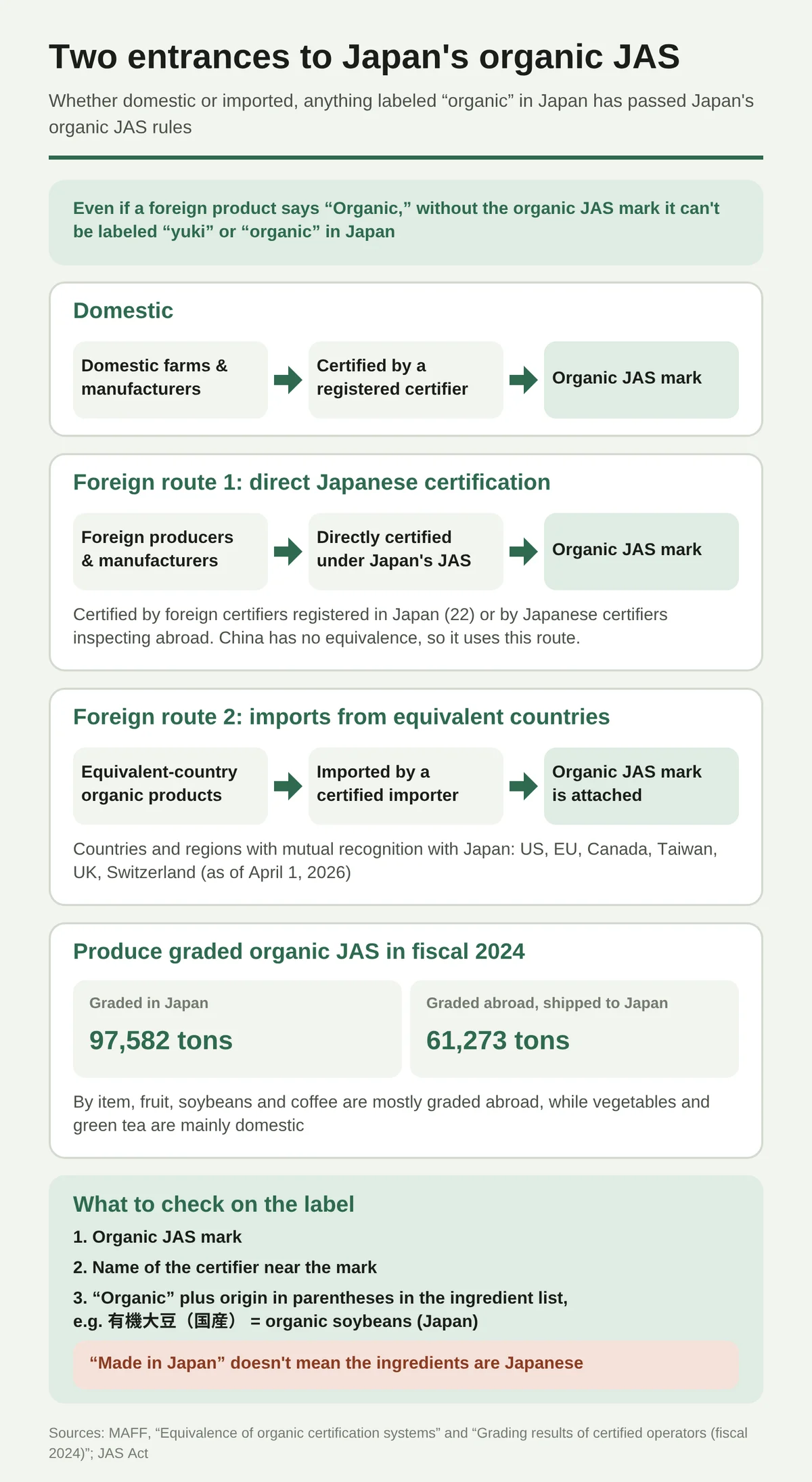
“Organic China safety” and “organic but made in China” appear in many forms in Japanese search suggestions (32 variations for origin and imports alone, counted by Urayomi on October 3, 2026). The conclusion first: anything labeled “organic” in Japan, domestic or foreign, has gone through Japan’s organic JAS rules. What differs is “which country’s, and which certification body, checked it.”
Equivalence: the conditions under which a foreign “organic” becomes Japanese “organic”
Even food labeled “Organic” abroad cannot be labeled “organic” (有機) or “organic” (オーガニック) when sold in Japan unless it carries the organic JAS mark. An importer also cannot sell it with the foreign “Organic” label as is (JAS Act, Article 63, paragraph 3).
There are two routes to labeling a product “organic” in Japan.
- A foreign producer or manufacturer is directly certified under Japan’s organic JAS. Certification is done by foreign certification bodies registered with MAFF (22 bodies, counted by Urayomi from MAFF’s list) or by Japanese certification bodies that inspect overseas
- Organic-certified products from a country recognized as “equivalent” to Japan are imported, and an importer certified in Japan applies the organic JAS mark
Under the second route, “equivalence,” the countries and regions that mutually recognize each other are six: the US, the EU, Canada, Taiwan, the UK, and Switzerland (as of April 1, 2026). The covered items differ by country: livestock products are excluded for Taiwan, and alcoholic beverages are excluded for Switzerland. With the EU, it was extended to organic alcoholic beverages and livestock products in May 2025, and with the UK it was extended to organic alcoholic beverages in October 2025.
MAFF’s grading materials list, as countries with equivalence for which grading for Japan is possible, Argentina, Australia, and New Zealand in addition to these six. China is in neither group.
About 4 in 10 of the organic produce for Japan is graded abroad
The produce graded under organic JAS in fiscal 2024 was:
- Graded in Japan: 97,582 tons
- Graded abroad and shipped to Japan: 61,273 tons
If the domestic volume is set to 100, the foreign volume for Japan is about 63. Foreign-graded volume is about 39% of the combined total, but because the domestically graded volume also includes what was exported, this is “an upper-bound estimate on the high side” (calculated by Urayomi). MAFF also makes a comparison along the lines of “a volume equal to about 70% of domestic grading comes from abroad,” using fiscal 2023 figures.
By item, the differences are clear.
- Fruit: 2,578 tons in Japan versus 29,160 tons of foreign fruit for Japan (about 11 times)
- Soybeans: 1,550 tons in Japan versus 14,839 tons of foreign soybeans for Japan (about 10 times)
- Green coffee beans and nuts: 0 tons in Japan. Foreign for Japan: 4,897 tons of coffee and 1,311 tons of nuts
- Vegetables: 47,085 tons in Japan versus 3,582 tons of foreign vegetables for Japan (mostly domestic)
- Green tea and sprouts: almost entirely domestic
For processed foods too, in fiscal 2024, against 127,447 tons graded in Japan, 63,909 tons were graded abroad and shipped to Japan. Organic alcoholic beverages graded abroad came to 175,753 tons (almost all fruit wines such as wine), of which only 4,122 tons (about 2%) were for Japan.
In other words, the soybeans in organic tofu, natto, miso, and soy sauce, and organic fruit, coffee, and wine, are items that are often foreign-made. Conversely, organic vegetables and tea are mainly domestic.
Organic from China: China’s system and Japan’s rules
China has its own organic system.
- National standard GB/T 19630 (2019 edition, said to have taken effect in 2020), and the “Measures for the Administration of Organic Product Certification” (in force since April 2014)
- Each organic certification mark carries its own “organic code”, so the product can be traced back to the certificate and the producer (Article 33 of the Measures)
- Sales of organic food in China were 15.5 billion euros in 2024, third in the world
On the other hand, Chinese news reports (Beijing Business Today, March 2026) say that 11 lots of organic products failed in a spot inspection by the authorities (March 2025), and that agents were selling fake certification marks. A paper summarizing research on Chinese consumers (2025) also concludes that “more than half of urban respondents are not confident in organic certification or trust it only partly” (we have not checked the original of each survey).
What matters in relation to Japan is the following.
- China has no organic equivalence with Japan, so a Chinese organic mark alone does not let a product be labeled “organic” in Japan
- To sell Chinese-grown products in Japan as “organic,” Japan’s organic JAS certification (by a certification body registered with MAFF) is required. The list of registered foreign certification bodies includes Chinese bodies
- Near the organic JAS mark, the name of the certifying body is written
Rather than deciding by origin alone, such as “it’s Chinese so it can’t be trusted” or “it’s domestic so it’s safe,” looking at the mark, the certification body’s name, and how the origin of the ingredients is written lets you confirm more. Post-harvest chemicals used on imported vegetables and fruit are summarized on the postharvest pesticides page.
Telling by the country of origin on the label
For organic processed foods, even when “made in Japan” (国内製造) is written, the ingredients are not necessarily domestic.
For example, the ingredient list of Organic White Roasted Sesame (Kingoma Honpo, 金ごま本舗), which is on Urayomi, reads “有機白ごまいりごま(国内製造)” (organic white roasted sesame (made in Japan)). This “made in Japan” means the roasting was done in Japan, and according to the manufacturer, the sesame was organically grown in Paraguay and Bolivia.
For the soybeans in organic miso, organic soy sauce, and organic tofu, as we saw above, the volume graded abroad is about 10 times the domestic volume. Whether domestic organic soybeans are used can be checked by:
- Parenthetical notes in the ingredient list (example: “有機大豆(国産)” (organic soybeans (domestic)))
- Front-of-pack claims such as “made with domestic organic soybeans” (国産有機大豆使用)
- The origin of ingredients explained on the manufacturer’s official site
Organic JAS processed foods follow a rule of writing “organic” (有機) before ingredients that are organic, so you can also read which ingredients carry “organic” and which do not.
Miso is one of the organic processed foods with a lot of domestic grading (3,719 tons in fiscal 2024, with 133 tons of foreign products for Japan). Even among products called “organic miso,” the labels show that some use domestic soybeans and some use imported ones, so we introduce them side by side.
Items with a lot of imported organic
For coffee, there is zero organic JAS grading in Japan, and all 4,897 tons of organic green coffee beans for Japan were graded abroad (fiscal 2024).
The graded volume of olive oil does not appear among the items in the statistics used for this article. But Italy, a main olive oil producer, is one of the countries with a high organic share, with 2.51 million ha of organic farmland, 19.2% of its farmland (2024), and the EU mutually recognizes organic systems with Japan.
Both are organic foods that are hardly produced in Japan, so we introduce ones that carry the organic JAS mark.
Does organic fraud really happen?
The conclusion first. It does. And after major cases, countries have changed their rules. English-language searches also bring up 24 suggestions such as “is organic fake” and “is organic legit” (Urayomi’s count).
The largest fraud in US history: 90% of the “organic” grain one farmer sold was fake
Randy Constant, a farmer in Missouri (with a broker in Iowa), sold at least $142.43 million worth of grain in 2010–2017, most of it fraudulent. According to an announcement by the US Department of Justice (August 2019, a copy published by the USDA Office of Inspector General):
- The grain sold was more than 11.5 million bushels, and more than 90% of it was fake organic
- The methods included passing off grain bought from others as coming from his own organic fields, selling grain from fields where prohibited materials had been applied, and mixing organic and non-organic grain
- His 2016 sales were equivalent to about 7% of US organic corn and about 8% of US organic soybeans
- Much of the grain became feed for chickens and cattle, and the meat, milk, and eggs from those animals were sold as “organic”
- In August 2019 he was sentenced to more than 10 years in prison. The forfeiture was $128.19 million. Three accomplice farmers were also convicted
The point of this case is that the fraud took place at the feed stage, even before the “organic” meat and milk that consumers pick up. You cannot spot it by looking at the label in the store.
Shiploads of “organic” grain from the Black Sea
The preamble to the US rule says that in 2017, three ships of corn and soybeans imported as “organic” (36 million to 46 million pounds per ship) turned out not to be organic.
- Tracing the transaction records showed that the source was uncertified producers in the Black Sea region, where it had originally been sold as cheap conventional grain
- One shipload of soybeans had been fumigated with a chemical prohibited in organic (aluminum phosphide)
- 21 million pounds had already entered circulation as feed for organic livestock
It also describes a case in which an individual in South Dakota sold $71 million worth of conventional grain as organic in 2012–2018 and kept going by creating a new brokerage company even after certification was revoked. This was because intermediaries were not required to be certified at the time.
The US answer: import certificates and certification of intermediaries (2024)
In response to such cases, the US published a rule strengthening organic enforcement (SOE) in January 2023 and began applying it in full from March 19, 2024.
- Imported organic food requires a national organic import certificate for each shipment
- Intermediaries and trading companies are also required to be certified
- Unannounced inspections
- Standardized certificate formats
- Record-keeping requirements for traceability
In Europe and China too
- Italy: In December 2011, Italian police exposed a case in which conventional grain and other products from Romania and Bulgaria were passed off as organic. Reports estimate it spanned 10 countries, with damages of 220 million euros, and that 700,000 tons were circulated as organic in 2007–2011 (a report by a British farming magazine; we have not checked the authorities’ original sources)
- China: As seen above, there are reports of failures in inspections by certification bodies and of the printing of fake marks
Cases caught in Japan, and the 41.3% who say “the labeling seems doubtful”
Labeling violations happen in Japan too.
- September 2024: MAFF ordered a company in Miyazaki Prefecture, under the JAS Act, to remove its labels after it put the organic JAS mark and the word “organic” on “organic germinated brown rice” without obtaining organic certification, and shipped 10,360 bags (7,511 kg) between March 2023 and April 2024. It was found through an on-site inspection by the Kyushu Regional Agricultural Administration Office
- It was reported that MAFF gave guidance for JAS Act violations in 182 cases between November 2011 and November 2013 (records Kyodo News obtained through a freedom-of-information request; they include cases of uncertified produce labeled “organic.” We have not checked MAFF’s original materials)
- In a flyer for retailers, MAFF warns that “many ‘self-proclaimed’ organic produce and organic processed foods have appeared” and lists a hotline for reporting violations (0120-714-110)
On the consumer side, in MAFF’s fiscal 2015 survey, 41.3% of people who do not want to buy organic food answered that “labels such as ‘organic’ seem doubtful.” In the 2025 survey, among people who buy organic food, 34.2% in total check the organic JAS mark “always, almost always, or sometimes.”
Some cases are also found through testing. In the European Food Safety Authority (EFSA) 2024 testing, 0.9% of organic samples exceeded pesticide residue limits, and for cases where pesticides not usable in organic were found, EFSA writes that the possible causes are “drift from neighboring fields, contamination in distribution, or mislabeling.” What is detected in organic foods, and how much, is covered in Organic food and health.
How readers can check
| What to look at | What it tells you |
|---|---|
| The organic JAS mark | The product was graded by a business certified in Japan. If “organic” (有機), “オーガニック,” or “organic” is written without the mark, it may violate the JAS Act |
| The name of the certification body near the mark | Which body checked it |
| “Organic” (有機) and parentheses in the ingredient list | Which ingredients are organic, and where they come from |
| “有機無農薬” (organic pesticide-free), “準有機” (quasi-organic), “有機率○%” (organic rate ○%) | All are words that must not be written under the organic JAS rules (MAFF Q&A) |
| Flyers, menus, banners, and online descriptions | Outside the scope of the JAS Act labeling rules (though they can fall under the Act against Unjustifiable Premiums and Misleading Representations). Check the label on the product itself |
What do people around the world care about in organic?
The conclusion first. In surveys, health stands out in Japan and the US, animal welfare in Germany, high prices across Europe and in Japan, and trust in China. People who buy for “the environment” are a minority in every country.
Questions that show up in search (Japanese and English)
On October 3, 2026, Urayomi collected and classified Google search suggestions. There were 664 suggestions in Japanese and 478 in English.
| Category of Japanese suggestions | Number | Category of English suggestions | Number |
|---|---|---|---|
| Differences in terms, meanings | 82 | Pesticides (including the Dirty Dozen and glyphosate) | 65 |
| Certification, marks, standards | 81 | Price, whether it is worth buying | 52 |
| Where to buy, online shopping | 80 | Labels, meaning, regulation | 50 |
| Pesticides | 73 | Non-food (cotton, cosmetics, and so on) | 34 |
| Cosmetics, beauty | 58 | Babies, pregnancy | 31 |
| Children, pregnancy, baby food | 50 | Health | 24 |
| School lunches, municipalities, policy | 44 | Trust, fraud | 24 |
| Origin, imports, Chinese-made | 32 | Environment, farming methods | 19 |
| Price | 16 | Wine | 12 |
| Environment | 10 | ― | ― |
Search suggestions are not the number of times something was searched, but the “continuations” people often type. The counts change with the choice of starting words, so please read them not as a ranking but as a guide to “questions that actually exist.”
In Japanese, school lunches and municipalities (44) and origin and Chinese-made (32) stand out, and in English, price and whether it is worth it and fraud and whether it is real stand out. The question “isn’t it bad for the environment?” appears in both Japanese and English.
Reasons to buy and not to buy, by country
| Country / region | Reasons to buy | Reasons not to buy or to hesitate | Survey |
|---|---|---|---|
| Japan | The reason for first trying organic food was “so that I or my family do not get sick” at 22.6% and “to protect the environment” at 7.6% (2019). When choosing, about 30% each prioritize taste, safety, peace of mind, and health (2025) | Price 45.1%, not sold nearby 36.6% (2021). Labeling seems doubtful 41.3% (2015). 60% of people do not know what it is | MAFF and Japan Finance Corporation |
| United States | Among people who bought organic food in the past month, 76% said “healthier food,” 33% the environment, 22% convenience | 72% say “price decides whether I buy” | Pew Research Center (2016) |
| Germany | 89% of buyers cite “animal welfare” and “natural food,” and 87% a healthy diet. The most important reason is animal welfare (33%), ahead of health (30%). 47% cite “meals for children and during pregnancy” | 15% do not buy, and 4 in 5 of them will not buy in the future either | “Öko-Barometer” of the Federal Ministry of Food and Agriculture (2024, about 1,000 people) |
| EU | 56% know the organic logo (27% in 2017) | 92% say “organic is more expensive than other food” (2022). More than 4 in 10 say it is “hard to find in nearby stores” | European Commission Eurobarometer |
| United Kingdom | Wanting to avoid artificial pesticides, high standards (including animal welfare), health | The rising cost of living. Organic’s market share of food and drink is 1.6% (2025, a market of 3.9 billion pounds) | Market report of the Soil Association, a UK organic advocacy group (2026) |
| China | Health awareness, concern for the environment | Distrust of certification (more than half are not confident or trust it only partly), price (30–60% higher than regular) | A paper summarizing research from 2014–2024 (2025) |
The result that animal welfare is the top reason in Germany shows that interest is focused on the rules for organic livestock (grazing and the amount of space for animals). The organic JAS rules for livestock in Japan are introduced in What is organic? (standards and history).
The UK’s Soil Association is a group that promotes organic, and Pew is a private research organization in the US. We have not checked the original of each survey for the Chinese figures, which rely on the paper’s summary.
Japan’s moves: the MIDORI Strategy, Organic Villages, and organic school lunches
The conclusion first. The national targets are big, while school lunches and municipal efforts are really increasing. But the gap between the target and the current pace is also big, so we check by doing the division.
Dividing up “25% by 2050”
In May 2021, MAFF adopted the MIDORI Strategy for Sustainable Food Systems (みどりの食料システム戦略), setting a goal of raising the area under organic farming to 25% of cropland (1 million ha) by 2050. As a midway target, there is 63,000 ha in 2030.
| Area | Pace required | |
|---|---|---|
| Actual at end of fiscal 2024 | 39,800 ha | ― |
| 2030 target | 63,000 ha | 3,900 ha a year |
| 2050 target | 1 million ha | 37,000 ha a year |
| Actual growth (last 1 year) | ― | 5,300 ha a year |
| Actual growth (10-year average) | ― | 1,800 ha a year |
Calculated by Urayomi:
- The 2030 target of 63,000 ha is a level that can be reached if the recent pace continues
- The 2050 target of 1 million ha requires continuing to grow at about 7 times the pace of the last year, and about 20 times the 10-year average
The EU also says “25%”: but the target year is 2030
The EU also set a target of making 25% of farmland organic by 2030 in its March 2021 action plan. It is the same 25% as Japan, but the target year is 20 years earlier than Japan’s, and the starting point is different.
- The EU’s organic farmland as a whole was 10.8% in 2023 (provisional), and 11.1% in FiBL’s 2024 figure
- In its September 2024 report, the European Court of Auditors wrote that “to reach the target, the annual growth rate has to double from 6% to nearly 11%,” and that “25% is a target that is not legally binding”
- Bulgaria, Ireland, Malta, the Netherlands, and Poland have not yet reached 5%
There are 154 Organic Villages
MAFF supports municipalities that take on organic farming as a whole community as “Organic Villages” (オーガニックビレッジ). According to a MAFF document (April 2026), 154 cities, wards, towns, and villages in 46 prefectures are taking part, exceeding the goal of “100 municipalities by 2025.” The next target is 200 municipalities by 2030.
There are also cases where local governments moved ahead of the national government. Aya Town in Miyazaki Prefecture made an “ordinance on promoting natural-ecosystem agriculture” in 1988, and in 2023 it also made an ordinance on organic school lunches.
Organic school lunches in 328 municipalities
The number of municipalities that use organic produce and other organic items in school lunches is increasing rapidly.
| Fiscal year | Municipalities that use organic food at least once a year |
|---|---|
| 2020 | 123 |
| 2021 | 137 |
| 2022 | 193 |
| 2023 | 278 |
| 2024 | 328 (about 19% of the country) |
Source: MAFF, Agricultural Environment Policy Division survey.
- The items used are vegetables (233 municipalities), cooked rice (164 municipalities), and seasonings and others (32 municipalities)
- About 30% of municipalities use it two or more times a month, and the other 70% use it less often than that
- Isumi City in Chiba Prefecture switched all the rice in the lunches of its municipal elementary and junior high schools to organic rice in October 2017, with the city covering the extra cost (Shokuiku white paper). Reports put the rice volume at about 42 tons
Questions such as “organic school lunch disadvantages” also appear in searches. But we could not find, for this article, a public nationwide tally comparing the costs and challenges of organic school lunches.
Teikei, born in Japan
In Japan there is a system called “teikei” (提携, direct partnerships between farmers and consumers), through which consumers connect directly with organic farmers, and it was born in Japan.
- In 1978, the Japan Organic Agriculture Association compiled the “Ten Principles of Teikei.” They include taking the entire harvest, setting prices through discussion, and doing the delivery themselves
- The main participants were often urban housewives, and it was often a case of consumer groups asking farmers to “switch to organic.” The number of groups peaked at about 300 around 1991, and the median size of a group was about 110 people (Kondo et al. 2024)
- Daichi o Mamoru Kai (大地を守る会), which started in 1975, began Japan’s first door-to-door delivery of organic vegetables in 1985. It is the forerunner of today’s Oisix Ra Daichi
- The paper places teikei as one of the sources of “CSA (community-supported agriculture),” in which farmers and consumers contract in advance
MAFF’s Q&A presents the view that “within a teikei arrangement, if information is properly disclosed, there is no particular problem even without organic JAS certification.” However, certification is required if you sell with the label “organic.”
In Japan today, fewer than 1 in 10 people buy organic food directly from farmers, and 18.2% buy from co-ops (2025). Co-op and farm-direct delivery services are one way of buying in which you know the producing region and the producer. How the standards and costs of each company compare is summarized in the comparison of food delivery services, and Oisix’s vegetable standards are summarized in the Oisix article. Here we introduce co-op and farm-direct delivery services that say they handle a lot of organic produce.
The “whole country organic” experiments: Sri Lanka and Bhutan
The conclusion first. Neither attempt to switch an entire country to organic quickly has gone as planned.
Sri Lanka: banned chemical fertilizers and reversed it in less than eight months
| When | What happened |
|---|---|
| April 2021 | Announced a total ban on chemical fertilizers and pesticides (going organic) |
| May 2021 | Effectively banned imports of chemical fertilizers and pesticides |
| November 2021 | Effectively withdrew the ban (in less than eight months) |
According to Sri Lanka’s national statistics (provisional), production of rice (paddy), the staple, was:
- Rainy-season crop (Maha season): 2020/21 3.06 million tons → 2021/22 1.93 million tons (down about 37%)
- Annual total: 2021 5.15 million tons → 2022 3.39 million tons (down about 34%)
- Yield per hectare in the rainy-season crop (Maha season): 2020/21 4,307 kg → 2021/22 2,853 kg
(percentages calculated by Urayomi).
A paper by researchers at the International Water Management Institute (IWMI) (2025) shows that the ban had a background of foreign-currency shortage and rising fertilizer prices, that the amount of nitrogen in the organic fertilizer available domestically was insufficient for crops such as rice and tea under every estimate, and it estimates that importing organic fertilizer would cost more foreign currency than chemical fertilizer.
However, 2022 was also a year in which a foreign-currency crisis and fuel shortages hit Sri Lanka at the same time. The whole drop in production cannot be blamed on going organic. What this example says is not that “organic is bad” but that “switching all at once without preparation leads to a shortage of fertilizer.”
Bhutan: “100% organic” has been postponed
Bhutan is said to have set a goal of “100% organic by 2020” at the 2012 United Nations conference (Rio+20), but reports say the target was postponed to 2035. According to a report contributed to the FiBL yearbook, the officially registered organic land is 3,358 ha (of which 1,621 ha is crops, and the rest is wild collection). About 70% of Bhutan’s land is forest, and the land used for agriculture is about 3%. In June 2025, the country’s first organic direct-sales market opened in the capital, Thimphu.
Is it true that organic is good for the environment?
The conclusion first. Results differ depending on the indicator. You cannot say in a word that organic is “good” or “bad” for the environment. English searches include “is organic farming bad for the environment,” and Japanese has a suggestion such as “organic environment bad” (オーガニック 環境 に 悪い).
| Study | What was compared | Result |
|---|---|---|
| Seufert et al. 2012 (Nature) | Yield (an analysis summarizing comparative studies worldwide) | Organic is lower than conventional, 5% to 34% lower depending on conditions. With good management and a crop and conditions that match, it is nearly the same as conventional |
| Ponisio et al. 2015 (Proceedings of the Royal Society B) | Yield (115 studies, more than 1,000 comparisons) | Organic is 19.2% lower. Combining crop rotation and multicropping narrows the gap to 8–9% |
| Tuck et al. 2014 (J Appl Ecol) | Biodiversity (94 studies, 184 comparisons) | Organic has about 30% more species of living things on average. The studies are concentrated in northern and western Europe and North America |
| Skinner et al. 2014 (Sci Total Environ) | Nitrous oxide from soil (a greenhouse gas) | Per area, organic is lower, but per unit of output, organic is higher. If the yield gap is under 17%, they are the same |
| Smith et al. 2019 (Nat Commun) | If all agriculture in England and Wales went organic | Domestic emissions would fall, but production would be short, and the estimate is that including the farmland that would increase overseas, emissions would rise |
| Muller et al. 2017 (Nat Commun) | If all the world’s food went organic | It would need more land than conventional, but nitrogen surplus and pesticides would decrease. If food loss and grain for livestock feed were reduced, it would need less land than the baseline scenario |
- Researchers from the Swiss Research Institute of Organic Agriculture (FiBL) took part in Skinner 2014 and Muller 2017. FiBL is also the publisher of the international statistics used in this article
- For Japan’s rice paddies, NARO announced in 2019 that “in paddies that are organic or have reduced pesticides, there are more endangered plants and more spiders, dragonflies, frogs, and waterbirds”
- A summary by the US researchers Reganold and Wachter (2016) states, “No single approach can feed the world. A combination of organic and other new methods is needed”
Many results favor organic for the abundance of living things, while organic tends to be at a disadvantage for yield and for emissions “per unit of output.” Which you weigh more heavily also depends on what you eat (the amount of meat) and how much you reduce food loss.
Where does the “organic” in foods on Urayomi come from?
Finally, from the foods featured on Urayomi, we collected those with “organic” (有機) in the ingredient list and checked the origin of those organic ingredients from the labels and the manufacturers’ explanations (checked October 3, 2026).
| Food | Organic ingredients | Origin of the ingredients (label and manufacturer’s explanation) |
|---|---|---|
| Organic spaghettini (Alce Nero) | Organic durum wheat semolina | Italy |
| Organic garlic paste (Me de Provence) | Organic garlic, organic sunflower oil, organic lemon juice | France (garlic) |
| Organic white roasted sesame (Kingoma Honpo) | Organic white sesame | Paraguay and Bolivia (processed in Japan) |
| Organic doubanjiang (Kaze to Hikari) | Organic sugar, organic chili, organic soybeans, and others | Made in Taiwan (origin of ingredients not confirmed) |
| Plant-based curry roux (Sokensha) | Organic safflower oil | United States |
| Yakisoba sauce with domestic organic vegetables and fruit (Hikari Shokuhin) | 8 items including organic onion and organic tomato, organic molasses | Vegetables and fruit are domestic; the organic molasses is from overseas |
| Roubai organic pure rice vinegar (Kawara Vinegar Brewery) | Organically grown rice | Domestic (Fukui, Ishikawa, Akita) |
| Additive-free all-purpose yakiniku sauce (Nagano) | Organic sesame oil, organic sesame, organic lemon juice | “Made in Japan” (origin of ingredients not confirmed) |
| Oyster sauce (Sennari) | Organic rice vinegar | Not confirmed |
Counting them up, of the 7 products whose ingredient origin or country of manufacture was known, 5 use foreign ingredients or were made abroad (ingredients from Italy, France, Paraguay and Bolivia, and the United States, and manufacture in Taiwan), only 1 uses only domestic organic ingredients (Kawara Vinegar Brewery’s rice vinegar), and 1 uses both domestic and foreign (Hikari Shokuhin). The numbers are small, so this cannot be called a general trend, but it does not contradict the picture in the statistics that “many organic ingredients are foreign.”
We noticed two things.
- Taiwan is one of the six countries and regions that mutually recognize organic systems with Japan (since 2020; alcoholic beverages were added in January 2024). Organic food made in Taiwan is sold as “organic” by one of two routes: it is directly certified under Japan’s organic JAS, or a Japanese importer applies the organic JAS mark based on Taiwan’s organic certification (we have not confirmed which applies to this organic doubanjiang)
- The package of Guérande salt on Urayomi carries the certification mark of France’s Nature et Progrès. This group is one of the five organizations that founded IFOAM (International Federation of Organic Agriculture Movements) in Versailles, France, in 1972. The ingredient list is only “seawater,” and “organic” is not written
For Hikari Shokuhin’s yakisoba sauce, the main ingredients, vegetables and fruit, are domestic organic, but the sugar is not organic, so the product as a whole is not an organic JAS “organic sauce.” The difference between the names “organic ○○” and “made with organic ○○” is explained in What is organic? (standards and history).
Items featured in this article (summary)
Here are the items featured in the article once more. The reasons and ingredients are written in the respective sections.
| Item featured | Where to buy |
|---|---|
| ヤマキ 有機JAS玄米みそ 消費者御用蔵 500g (Yamaki organic JAS brown-rice miso, 500 g) ― domestic ingredients | See on Rakuten (楽天24) PR See on Yahoo! Shopping PR |
| フンドーキン 生詰有機あわせみそ 500g (Fundokin organic blended miso, 500 g) ― the rice is imported | See on Rakuten (楽天24) PR See on Yahoo! Shopping PR |
| トーホー フェアトレード有機珈琲 豆 300g(有機JAS) (Toho fair-trade organic coffee beans, 300 g, organic JAS) | See on Rakuten (toho coffee) PR See on Yahoo! Shopping PR |
| アルチェネロ 有機エキストラ ヴァージン オリーブオイル ドルチェ 250ml(イタリア) (Alce Nero organic extra virgin olive oil Dolce, 250 ml, Italy) | See on Rakuten (酒類の総合専門店 フェリシティー) PR See on Amazon.co.jp PR See on Yahoo! Shopping PR |
| コープ自然派 宅配の資料請求 (Coop Shizenha: request delivery information) | 取り扱い青果の60%以上がオーガニック!生協の宅配コープ自然派 PR PR |
| 坂ノ途中 旬のお野菜セット(京都) (Sakanotochu seasonal vegetable set, Kyoto) | 坂ノ途中:お野菜・定期宅配 PR PR |
| 食べチョク(農家から直接買える産直通販) (Taberu Choku: a farm-direct online marketplace where you buy directly from farmers) | 食べチョクで生産者の野菜を見る |
Summary
| What you want to know | What we found |
|---|---|
| How big is organic worldwide? | Sales were 145 billion euros in 2024 (about 7.4 times 2003). The US, Germany, China, and France make up about 70%. Organic farmland is 2.1% of the world’s agricultural land |
| Is Japan behind? | Per-person spending is 13 euros, about 1/37 of Switzerland’s, and organic’s share is 0.3%. The area under organic farming is 0.9% of cropland (0.4% in international statistics, counting organic JAS only) |
| Who has the most organic farmland? | Australia (53.6% of the world). But most of it is pasture. 70% of the world’s organic farmland is grassland or pasture |
| Which country has the strictest standards? | They cannot be lined up in a single row. Japan protects the name by law, the US has 95% and 70% tiers, Australia has no mandatory standard domestically, South Korea also certifies “pesticide-free,” and China gives each mark an organic code |
| Why hasn’t organic spread in Japan? | Price (organic JAS vegetables are 143–187% of standard ones), where it is sold, doubts about labeling, and many people not knowing what it is. On the producing side, yield and the conversion period. The share of people buying at least once a week is about the same, 17.5% → 17.4% |
| Can imported and Chinese organic be trusted? | In Japan, only products that pass organic JAS can be labeled “organic.” China has no equivalence with Japan, so Japanese certification is required. The volume of organic produce for Japan is about 60% of the domestic volume, and much fruit, soybeans, and coffee is foreign |
| Does fraud happen? | US feed fraud (over 90% of the grain one farmer sold was fake organic), shiploads of Black Sea grain, cases in Italy and China, and cases caught in Japan. The US made import certificates mandatory in 2024 |
| What do people around the world care about? | Health in Japan and the US, animal welfare in Germany, price in the EU and Japan, trust in China. People who buy for the environment are a minority |
| Can Japan’s targets be reached? | The 2030 target of 63,000 ha is a level reachable at the current pace. The 2050 target of 1 million ha needs about 7 times the current speed. Organic school lunches are in 328 municipalities and there are 154 Organic Villages |
| Is it good for the environment? | Biodiversity is higher with organic (about 30%), yield is about 20% lower, and emissions per unit of output can be higher. Sri Lanka’s sudden switch to organic was reversed in less than eight months |
Sources
Global statistics
- FiBL & IFOAM – Organics International, “The World of Organic Agriculture. Statistics and Emerging Trends 2026” (February 2026) https://orgprints.org/id/eprint/56638/ , and its press materials (February 10, 2026)
- MAFF, “Circumstances Surrounding Organic Farming” (April 2026) https://www.maff.go.jp/j/seisan/kankyo/yuuki/index.html
Systems and equivalence in each country
- Act on Japanese Agricultural Standards (e-Gov); MAFF, “Inspection and certification system for organic food” and “Equivalence of organic certification systems” (as of April 1, 2026), “Organic JAS Q&A” (October 2025), and “List of registered organic certification bodies”
- MAFF press release, “Expansion of the scope of organic equivalence with the EU” (May 15, 2025)
- US federal regulation 7 CFR 205.301; US Federal Register 88 FR 3548 “Strengthening Organic Enforcement” (January 19, 2023) and 65 FR 80548 (December 21, 2000); US Congressional Research Service RL31595
- Council of the EU ST 7407/21 REV1 (organic action plan COM(2021)141); European Court of Auditors Special Report 19/2024; European Environment Agency, “Agricultural area used for organic farming”
- Chinese government, “Measures for the Administration of Organic Product Certification” (gov.cn); Beijing Business Today (March 16, 2026)
- Gangwon Province (South Korea), “Status of eco-friendly agricultural product certification” (statistics of the National Agricultural Products Quality Management Service)
- Australian Competition and Consumer Commission, “Organic claims”
- Danish Veterinary and Food Administration, “What is the Organic Cuisine Label”; Danish Environmental Protection Agency, Bichel Committee report (2001)
- Codex, “Guidelines for the production, processing, labelling and marketing of organically produced foods,” CAC/GL 32-1999
Japanese figures
- MAFF, “Area under organic farming in Japan” (June 2026), “Grading results of certified operators (fiscal 2024),” “Trends in graded volumes of organic agricultural products,” and “Area of organic JAS fields in Japan (as of March 31, 2025)”
- MAFF, “Survey of attitudes and intentions regarding organic farming and organic food” (fiscal 2025), “Survey on the organic food market” (fiscal 2017), “Survey of attitudes and intentions regarding environmentally conscious agricultural products, including organic farming” (fiscal 2015), and “Survey of intentions regarding consumption of organic food and similar products” (fiscal 2019)
- Japan Finance Corporation, “Consumer trend survey (July 2021), special survey”
- MAFF Statistics Department, “Fresh vegetable price trend survey report (2016)”
- Policy Research Institute, MAFF, 楠戸 (February 2024), “Analysis of the status of organic farming”
- MAFF, “MIDORI Strategy for Sustainable Food Systems,” “Basic policy on promoting organic agriculture” (April 2020), “Basic Plan for Food, Agriculture and Rural Areas” (April 2025), “Use of organic agricultural products and others in school lunches” (2025), and the Shokuiku white paper
- MAFF, “Efforts of Aya Town, Miyazaki Prefecture”; Ministry of the Environment
Fraud and misconduct
- US Department of Justice, Northern District of Iowa, announcement (August 2019; public version from the USDA Office of Inspector General)
- MAFF, “On measures against 株式会社コダマ (Kodama Co., Ltd.)” (September 20, 2024), and “Organic JAS system: for wholesalers and retailers”
- Ryukyu Shimpo editorial (based on a Kyodo News freedom-of-information request); Farmers Weekly (December 12, 2011)
- EFSA, “The 2024 European Union report on pesticide residues in food,” EFSA Journal 2026
Consumer interest
- Pew Research Center, “Americans’ views about and consumption of organic foods” (December 2016)
- European Commission, Special Eurobarometer (2020, 2022, and 2025)
- Bundesministerium für Ernährung und Landwirtschaft, “Öko-Barometer 2024”
- Soil Association, “Organic Market Report 2026”
- Frontiers in Sustainable Food Systems 2025 (a review of studies on consumers of organic food in China)
- Google search suggestions (October 3, 2026, collected and classified by Urayomi)
History and teikei
- Kondo C, et al. Front Sustain Food Syst 2024 (history of teikei)
- 根本志保子 (2019) (Japan Society for the History of Economic Thought)
Sri Lanka and Bhutan
- Drechsel P, et al. Food Security 2025;17(3):585-602 (IWMI)
- Sri Lanka Ministry of Finance, Weekly Economic Bulletin (paddy production from the Department of Census and Statistics)
- Bhutan report in the FiBL yearbook 2026; Heinrich Böll Stiftung (2022)
Environment
- Seufert V, et al. Nature 2012;485:229-32 (PMID 22535250)
- Ponisio LC, et al. Proc R Soc B 2015;282:20141396 (PMID 25621333)
- Tuck SL, et al. J Appl Ecol 2014;51:746-55 (PMID 25653457)
- Skinner C, et al. Sci Total Environ 2014;468-469:553-63 (PMID 24061052)
- Smith LG, et al. Nat Commun 2019;10:4641 (PMID 31641128)
- Muller A, et al. Nat Commun 2017 (PMID 29138387)
- Reganold JP, Wachter JM. Nat Plants 2016 (PMID 27249193)
- NARO, “Paddies with organic or reduced-pesticide cultivation have high biodiversity” (August 28, 2019)
Related articles and databases
- What Is Organic (有機)? Organic JAS Standards, History, and How It Differs from “Pesticide-Free,” “Additive-Free,” and Shizen Saibai (Natural Farming), Explained with Official Sources
- Is organic food better for your health? Nutrition, pesticide residues and cancer studies checked against the papers — where to switch first, and what it costs
- Comparing 5 additive-conscious grocery delivery services: trial sets, ongoing costs, and additive standards (2026)
- Reading Oisix’s Trial Set and Subscription Down to the Back Label: Vegetable Pesticide Standards, the Trial Set, and How Cancellation Works