

Pesticides Allowed Under Organic JAS: Full List of 42 Items (What Works on Aphids, Stink Bugs and Diseases? Any Herbicides? Antibiotics Too?)

PR This article contains affiliate links to Rakuten Ichiba, Amazon, Yahoo! Shopping and A8.net (“See on Rakuten”, etc.). What is written here is based on public-agency documents and papers, whether or not there are ads. The “See on Amazon.co.jp” links are also affiliate links.
“Do organic vegetables really use pesticides?” “Where is the list of pesticides allowed under organic JAS?” “Is there anything I can use for aphids or stink bugs in my home garden and still keep it organic?” These are questions about organic farming that come up often.
The short answer: pesticides can be used even under organic JAS. But only the 42 items in the national standard’s table (Annex B, Table B.1) are allowed, and only when the problem cannot be prevented by other methods.
This article covers:
- The full list of all 42 items of pesticides allowed under organic JAS (with purpose, origin, conditions, and the number of products currently registered)
- When pesticides may be used in organic farming
- Whether organic pesticides are “natural only,” or whether synthetic ones and antibiotics are included
- Whether any herbicide is allowed under organic JAS
- Whether baking soda and vinegar count as pesticides (specified pest-control materials)
- What is allowed for aphids, stink bugs, armyworms, powdery mildew and so on
- Home-garden products labeled “usable under organic JAS”
- Downsides of the pesticides allowed in organic farming (safety, effects on fish, copper building up in soil)
- How this differs from organic rules in the EU and US
- What the “organic JAS compatible-materials list” is
- The difference between “organic” and “pesticides: not used during the growing period”
We check these against the text of the standard, MAFF’s Q&A, the pesticide registration data of the Food and Agricultural Materials Inspection Center (FAMIC), and evaluations by the Food Safety Commission of Japan (FSCJ). Urayomi matched the registration data against Table B.1 one product at a time (checked October 8, 2026).
For the overall organic JAS system (the 2-year and 3-year rules, the mark, the history), see our article on what organic means (standards and history). For pesticide residues in organic food and the health research, see our article on organic food and health.
Conclusion
- The pesticides allowed under organic JAS are the 42 items in Table B.1, plus “other pesticides” made only of those ingredients. The current version is JAS 1605:2024 (amended July 1, 2024); since January 2025, three items (chlorella extract liquid, wax wettable powder, diatomaceous earth dust) have been removed. “Appendix Table 2” (別表2), as in searches for “organic jas pesticide appendix table 2,” is the old name of this table
- They may be used only when “there is an imminent danger of serious damage and it cannot be prevented by other methods”. First, growing methods such as variety choice and crop rotation, physical methods such as nets and mulch, and biological methods such as natural enemies are expected
- They are not “natural only.” The list also includes chemically synthesized metaldehyde (for slugs, only inside traps), industrially made copper compounds, spinosad and milbemectin (based on substances made by microbes), and the antibiotic kasugamycin. The national public notice itself assumes that some items in the table are “chemically synthesized”
- No item corresponds to a herbicide. Weeds are controlled by hand, machine, mulch and the like. We could not confirm whether commercial vinegar-based herbicides are usable under organic JAS
- Of the 3,741 pesticide products with a currently valid registration, 324 (8.7%) fall under Table B.1 (Urayomi’s matching). The largest group is the 113 products of “natural enemies and other biological pesticides,” which use natural enemies or microbes. For stink bugs in the field, only one product is registered: one spray for the hoozuki stink bug (hoozuki-kamemushi) on tomatoes
- “Natural origin” does not mean “safe.” Of the 324 products under Table B.1, 74 have a label caution about fish and crustaceans, and all 9 products with the “strong effect” caution contain copper. The EU treats copper as a “candidate for substitution” and limits it to 28 kg per hectare over 7 years even in organic farming, but organic JAS in Japan sets no upper limit on the amount
- Treatment of antibiotics differs by country. Japanese organic allows kasugamycin; US organic stopped allowing streptomycin and similar antibiotics in October 2014; and kasugamycin is not approved in the EU
- “Organic” does not mean “no pesticides used.” Under the Specially Cultivated Produce guidelines, only produce grown without any pesticide at all may be labeled “Pesticides: not used during the growing period”
Items featured in this article
| Item featured | When it is useful | Where in the article |
|---|---|---|
| KINCHO Engei Pai-Benica V Spray and Early Safe; Earth Chemical Yasaosu | When you want an insecticide or fungicide with ingredients allowed under organic JAS for a home garden | Commercial products labeled as usable under organic JAS for home gardens |
| Ikiteru Hiryo (a liquid fertilizer listed by the Organic JAS Material Evaluation Council) | When you want a fertilizer on the compatible-materials list for a home garden | What is the “organic JAS compatible-materials list”? |
| Direct-from-farm and home-delivery vegetables grown without pesticides | When you want to buy vegetables while checking the “Pesticides: not used during the growing period” label | How to buy vegetables grown without any pesticide |
List of Pesticides Allowed Under Organic JAS (All 42 Items in Table B.1)
Table B.1 of the standard lists 42 pesticide items plus one row for “other pesticides.” Here we give the item names and conditions as in the original text, with the Japanese item name in parentheses. Urayomi added the purpose and origin, and the number of products with a valid registration at FAMIC (as of September 30, 2026).
The version of the standard is as follows.
| Item | Details |
|---|---|
| Standard | Japanese Agricultural Standard for Organic Plants, JAS 1605:2024 |
| Amendment | July 1, 2024 (MAFF Public Notice No. 1280). Fully revised on October 27, 2005, and amended several times since |
| Removal of 3 items | Chlorella extract liquid, wax wettable powder, and diatomaceous earth dust were deleted from the table on January 1, 2025 |
| As of October 2026 | The file published by MAFF has not changed (Urayomi downloaded and checked it on October 3 and October 7) |
“Appendix Table 2” (別表2) is an old name. The earlier standard called it “Appendix Table 2” (別表2); after the way the standard is written changed, it became “Annex B, Table B.1.” The supplementary provisions of the public notice still use the term “別表2,” so people search under either name.
Three notes on reading the tables:
- The “Condition” column is the original wording. A dash (“-”) means no condition
- “Products” is the number of products with a valid registration in FAMIC’s pesticide registration data (3,741 products), counted by Urayomi by matching them with the item names and active ingredients of Table B.1. The final judgment on which product falls under Table B.1 is made by the registered certification body that certifies the farm, so treat the numbers as a guide
- As the note to the table says, every pesticide is limited to those “not manufactured using recombinant DNA technology”
Pesticides for insects and mites (16 items)
| Item (original wording) | Purpose | Origin | Condition (original wording) | Products |
|---|---|---|---|---|
| Pyrethrum emulsion (除虫菊乳剤) | Insecticide | Plant (extract of pyrethrum flowers) | Limited to those extracted from pyrethrum that do not contain piperonyl butoxide as a synergist. | 2 |
| Pyrethrin emulsion (ピレトリン乳剤) | Insecticide | Plant (extract of pyrethrum flowers) | Limited to those extracted from pyrethrum that do not contain piperonyl butoxide as a synergist. | 2 |
| Rapeseed oil emulsion (なたね油乳剤) | Insecticide | Plant (oil) | - | 2 |
| Blended oil emulsion (調合油乳剤) | Insecticide | Plant (safflower oil, cottonseed oil) | - | 2 |
| Machine oil aerosol (マシン油エアゾル) | Insecticide | Mineral (petroleum) | - | 1 |
| Machine oil emulsion (マシン油乳剤) | Insecticide | Mineral (petroleum) | - | 15 |
| Starch wettable powder (デンプン水和剤) | Insecticide | Plant (starch) | - | 1 |
| Metaldehyde granules (メタアルデヒド粒剤) | Insecticide (slugs, etc.) | Chemically synthesized | Limited to use in traps. | 11 |
| Metaldehyde product (メタアルデヒド剤) | Insecticide (slugs, etc.) | Chemically synthesized | Limited to use in traps. | 1 |
| Carbon dioxide fumigant (二酸化炭素くん蒸剤) | Insecticide (fumigation) | Inorganic (gas) | Limited to use in storage facilities. | 4 |
| Ferric phosphate granules (燐酸第二鉄粒剤) | Insecticide (slugs, golden apple snails) | Inorganic | - | 15 |
| Milbemectin emulsion (ミルベメクチン乳剤) | Insecticide / miticide | Microbial (said to be a substance made by actinomycetes) | - | 4 |
| Milbemectin wettable powder (ミルベメクチン水和剤) | Insecticide / miticide | Microbial (said to be a substance made by actinomycetes) | - | 2 |
| Spinosad wettable powder (スピノサド水和剤) | Insecticide | Microbial (substance made by the soil bacterium Saccharopolyspora spinosa) | - | 8 |
| Spinosad granules (スピノサド粒剤) | Insecticide | Microbial (substance made by the soil bacterium Saccharopolyspora spinosa) | - | 3 |
| Reduced starch hydrolysate liquid (還元澱粉糖化物液剤) | Insecticide (blocks insects’ spiracles) | Plant (processed starch) | - | 5 |
Pesticides for diseases (fungicides, 18 items)
| Item (original wording) | Purpose | Origin | Condition (original wording) | Products |
|---|---|---|---|---|
| Sulfur smoke (硫黄くん煙剤) | Fungicide | Mineral | - | 2 |
| Sulfur dust (硫黄粉剤) | Fungicide | Mineral | - | 3 |
| Wettable sulfur (水和硫黄剤) | Fungicide / miticide | Mineral | - | 8 |
| Shiitake mycelium extract liquid (シイタケ菌糸体抽出物液剤) | Fungicide (viral diseases) | Mushroom extract | - | 2 |
| Shiitake mycelium extract water-soluble powder (シイタケ菌糸体抽出物水溶剤) | Fungicide (viral diseases) | Mushroom extract | - | 2 |
| Sodium bicarbonate water-soluble powder (炭酸水素ナトリウム水溶剤) | Fungicide | Inorganic (industrial product) | - | 2 |
| Copper wettable powder (銅水和剤) | Fungicide | Inorganic (compounds such as basic copper chloride and cupric hydroxide) | - | 30 |
| Copper dust (銅粉剤) | Fungicide | Inorganic (copper compound) | - | 2 |
| Copper sulfate (硫酸銅) | Fungicide (used to make Bordeaux mixture) | Inorganic (copper compound) | Limited to use for preparing Bordeaux mixture. | 3 |
| Quicklime (生石灰) | Fungicide (used to make Bordeaux mixture) | Mineral (limestone, burned) | Limited to use for preparing Bordeaux mixture. | 16 |
| Potassium bicarbonate water-soluble powder (炭酸水素カリウム水溶剤) | Fungicide | Inorganic (industrial product) | - | 2 |
| Kasugamycin liquid (カスガマイシン液剤) | Fungicide | Microbial (said to be an antibiotic made by actinomycetes) | - | 2 |
| Kasugamycin dust (カスガマイシン粉剤) | Fungicide | Microbial (said to be an antibiotic made by actinomycetes) | - | 1 |
| Kasugamycin water-soluble powder (カスガマイシン水溶剤) | Fungicide | Microbial (said to be an antibiotic made by actinomycetes) | - | 1 |
| Kasugamycin granules (カスガマイシン粒剤) | Fungicide | Microbial (said to be an antibiotic made by actinomycetes) | - | 1 |
| Hypochlorous acid water (次亜塩素酸水) | Fungicide | Made by electrolysis | - | No registration required |
| Baking soda (重曹) | Fungicide | Inorganic | - | No registration required |
| Vinegar (食酢) | Fungicide | Fermentation (synthetic vinegar also allowed) | - | No registration required |
Pesticides for both insects and diseases (3 items)
| Item (original wording) | Purpose | Origin | Condition (original wording) | Products |
|---|---|---|---|---|
| Fatty acid glyceride emulsion (脂肪酸グリセリド乳剤) | Insecticide / fungicide (spider mites, aphids, powdery mildew) | Described by the maker as derived from plant oil (manufacturing process not confirmed) | - | 4 |
| Lime sulfur (石灰硫黄合剤) | Fungicide / insecticide | Mineral (made by boiling lime and sulfur) | - | 6 |
| Natural enemies and other biological pesticides (天敵等生物農薬) | Insecticide / fungicide | Natural-enemy insects and mites, and microbes themselves | - | 113 |
Others: attractants, growth regulation, spreaders, injury prevention (5 items)
| Item (original wording) | Purpose | Origin | Condition (original wording) | Products |
|---|---|---|---|---|
| Sex pheromone product (性フェロモン剤) | Lures insects / disrupts mating | Insect pheromone substances (registered under chemical names; manufacturing process not confirmed) | Limited to products whose active ingredient is a substance having the pheromone action of an insect that harms crops. | 27 |
| Mixed herbal extract liquid (混合生薬抽出物液剤) | Plant growth regulation | Plant extract | - | 1 |
| Spreader (展着剤) | Helps the spray liquid stick | Casein (milk), paraffin (petroleum) | Limited to products whose active ingredient is casein or paraffin. | 3 |
| Calcium carbonate wettable powder (炭酸カルシウム水和剤) | Prevents crop injury from copper | Mineral | Limited to use for preventing crop injury from copper wettable powder. | 4 |
| Ethylene (エチレン) | Plant growth regulation | Gas | Limited to use for inducing flowering of pineapple. | No registration required |
Other pesticides (combinations of ingredients)
| Item (original wording) | Contents | Condition (original wording) | Products |
|---|---|---|---|
| Other pesticides (その他の農薬) | Products containing only two or more of the ingredients in the tables above. The note to the standard gives examples: “sulfur-copper wettable powder, sodium bicarbonate-copper wettable powder, fatty acid glyceride-spinosad wettable powder, etc.” | Limited to products containing only two or more active ingredients contained in the other pesticides of this table. | 11 |
Source: MAFF, Japanese Agricultural Standard for Organic Plants, JAS 1605:2024, Annex B, Table B.1 (original text). Purpose and origin are Urayomi’s classification; the number of products is Urayomi’s matching against FAMIC pesticide registration information (as of September 30, 2026). Links go to ingredient pages in Urayomi’s pesticide database.
Counted by purpose: 18 fungicides, 16 insecticides, 0 herbicides
Of the 42 items, 18 are fungicides and 16 are insecticides/miticides; no item corresponds to a herbicide. Eleven items carry a condition (a limit on how they may be used).
The “42 items” counts different dosage forms of the same ingredient (powder, liquid, granules, etc.) separately. Kasugamycin has 4 items; spinosad, milbemectin and metaldehyde have 2 each; sulfur has 3 (plus lime sulfur). Counted by ingredient, there are about 30 kinds. We could not find a number of “how many items” announced by MAFF, so every number here is a count of the table.
Number of registered products: 324, and some items have only one
Of the 3,741 pesticide products with a valid registration, 324 (8.7%) fall under Table B.1.
- The largest group is the 113 products of natural enemies and other biological pesticides, about one-third of the total. This number includes 2 BT granule products (Benica BT Sakkin Ryuzai [ベニカBT殺菌粒剤] and Benica Natural Bait [ベニカナチュラルベイト]). We could not confirm from the national list whether granules fall under the natural-enemy and biological pesticides of Table B.1
- Next come 30 copper wettable powders, 27 sex pheromone products, 16 quicklime products for Bordeaux mixture, 15 machine oil emulsions, and 15 ferric phosphate granule products for slugs and golden apple snails
- On the other hand, there are 7 items with only one registered product (machine oil aerosol, starch wettable powder, metaldehyde product, mixed herbal extract liquid, and kasugamycin dust, water-soluble powder and granules). Even though the standard allows them, very few products can actually be bought
- Ethylene, hypochlorous acid water, baking soda and vinegar are “specified pest-control materials,” explained below, and have no pesticide registration
Counted by active ingredient, 69 of the 506 ingredients (13.6%) on FAMIC’s list of registered active ingredients have a mark (○, or a conditional ○) in the organic JAS column. However, FAMIC itself cautions that this column may not be up to date, and the spreader ingredient paraffin and the sex pheromones have no mark.
Can Organic Farms Use Pesticides? Checking the Wording of the Standard
Yes, they can. But the standard’s basic position is “do not use them.” The principle of the organic plants standard is to grow crops by making use of the soil’s power, with “avoiding” the use of chemically synthesized fertilizers and pesticides as the basis. It does not say “never use them at all.”
The definition of “organic agriculture” in the Act on Promotion of Organic Agriculture (2006) likewise takes “not using” chemically synthesized fertilizers and pesticides as its “basis.” Both contain the word “basis”: materials within a set range may be used.
Allowed only “when unavoidable”
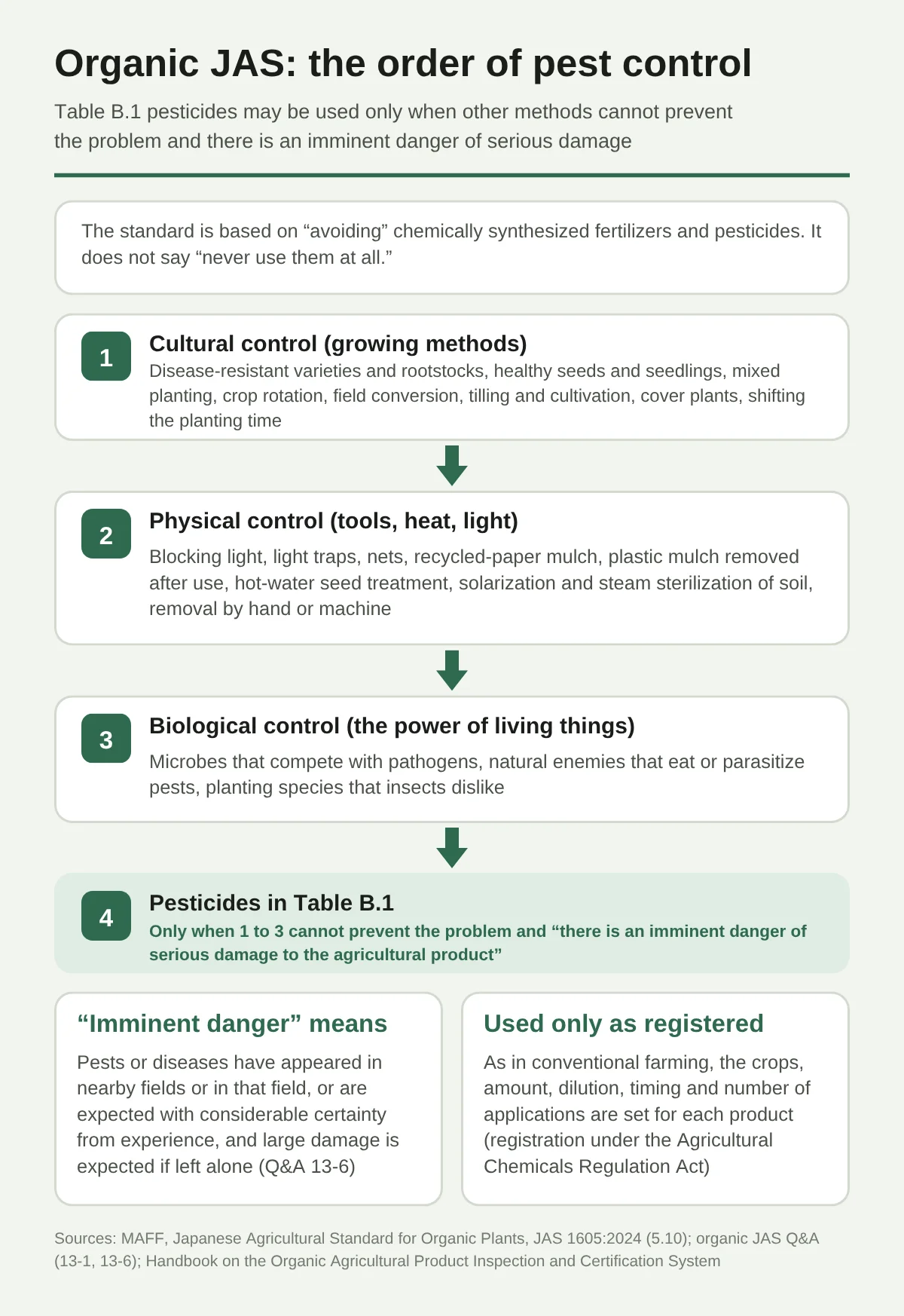
The pesticides in Table B.1 may be used only when other methods cannot prevent the problem and there is an imminent danger of serious damage. The standard (5.10) sets an order for controlling pests, diseases and weeds.
| Order | Method | Examples (standard and MAFF Q&A 13-1) |
|---|---|---|
| 1 | Cultural control (growing methods) | Disease-resistant varieties and rootstocks, healthy seeds and seedlings, mixed planting, crop rotation, field conversion, tilling and cultivation, cover plants, shifting the planting time |
| 2 | Physical control (tools, heat, light) | Blocking light, light traps, nets, recycled-paper mulch, plastic mulch removed after use, hot-water seed treatment, solarization and steam sterilization of soil, removal by hand or machine |
| 3 | Biological control (the power of living things) | Microbes that compete with pathogens, natural enemies that eat or parasitize pests, planting species that insects dislike |
| 4 | Pesticides in Table B.1 | Only when 1 to 3 cannot prevent the problem and “there is an imminent danger of serious damage to the agricultural product” |
On what “imminent danger” means, the Q&A (13-6) explains that it is when pests or diseases have appeared in nearby fields or in that field, or are expected with considerable certainty from experience, and large damage is expected if left alone.
There are other detailed rules.
- Pesticides in Table B.1 are also used according to the registration under the Agricultural Chemicals Regulation Act. As in conventional farming, the crops they may be used on, the amount, the dilution, the timing and the number of applications are set for each product (MAFF Handbook on the Organic Agricultural Product Inspection and Certification System)
- Placing pests weakened by a pesticide in the field to increase natural enemies is not allowed, because it is a use outside the registration (Q&A 13-5)
- A worker’s insect repellent spray may be used if it is applied in a way that does not get on the crop, for example before entering the field (Q&A 15-7)
What about seed and seedling disinfection?
The principle is to use organic seeds and seedlings. When they are not available, you may use seeds and seedlings that were not treated with prohibited materials, and if even that is not possible, ordinary seeds or the youngest seedlings possible (standard 5.4).
However, seeds and seedlings treated with chemically synthesized fertilizers or pesticides (those not in the table) that keep working in the field after planting cannot be used. The Q&A (10-5) says ordinary seed disinfection does not fall under this. Also, disinfecting organic seed with a pesticide in Table B.1 is allowed (14-2).
How were the pesticides in Table B.1 chosen?
Table B.1 is built on the organic guidelines of the international food standards (Codex). According to the Q&A (17-1), what goes in Table B.1 is, among pesticides registered or designated under Japan’s Agricultural Chemicals Regulation Act,
- those from the materials in Annex 2, Table 2 of the Codex organic guidelines that are needed considering how they are used in Japan
- or those added because they meet the “criteria for countries to draw up a list” in the same guidelines
In other words, both “registered as a pesticide in Japan” and “meets international organic criteria” are conditions. Meeting only one is not enough. The contents of the table are reviewed from time to time, as when three items were removed in the 2024 amendment.
For those searching “Appendix Table 2” (別表2)
“Organic jas pesticide appendix table 2” means today’s Table B.1. Sources count the contents differently, as “42” or “about 40,” depending on whether the “other pesticides” row is included and whether dosage forms are counted separately. Urayomi’s article on what organic means (standards and history) says 42 items and the article on organic food and health says “about 40 items”; both refer to the same table.
Are Organic Pesticides Only Natural? Synthetic Ones and Antibiotics Are Included
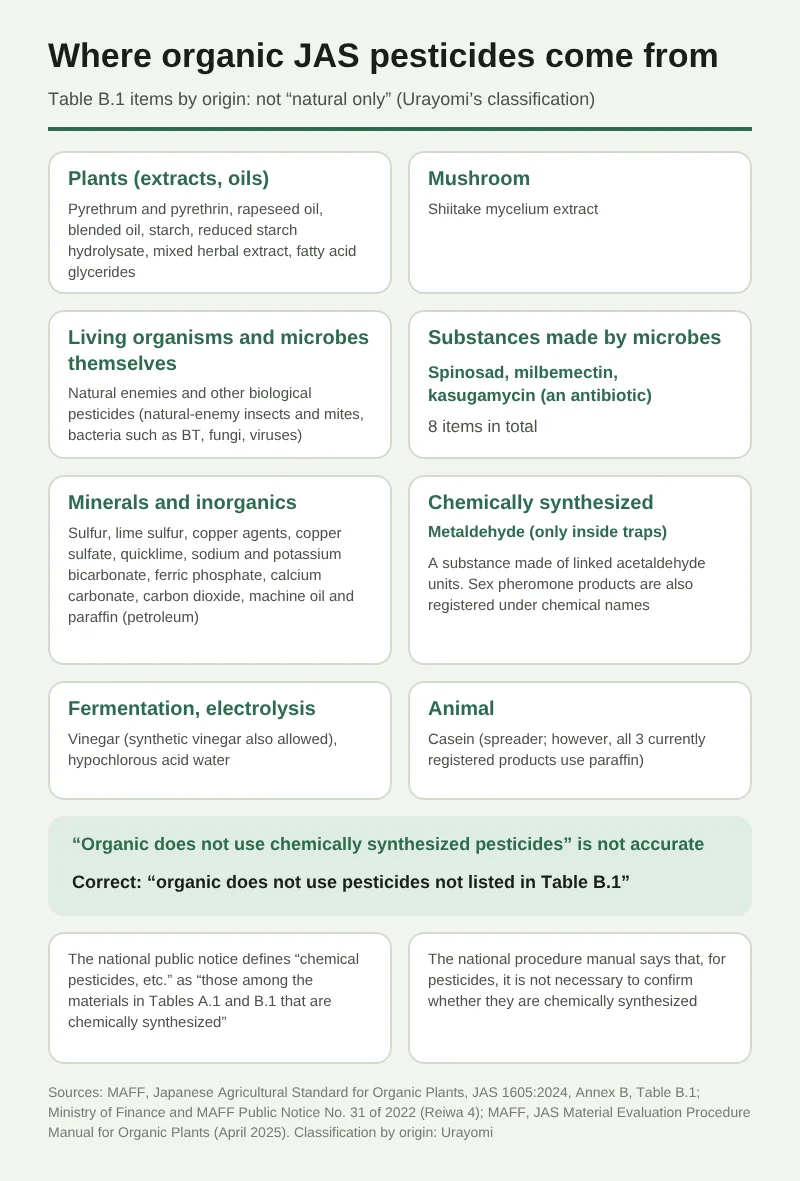
Organic pesticides are not “natural only.” Divided by origin, they look like this (Urayomi’s classification).
| Origin | Items in Table B.1 |
|---|---|
| Plants (extracts, oils) | Pyrethrum and pyrethrin, rapeseed oil, blended oil, starch, reduced starch hydrolysate, mixed herbal extract, fatty acid glycerides |
| Mushroom | Shiitake mycelium extract |
| Living organisms and microbes themselves | Natural enemies and other biological pesticides (natural-enemy insects and mites, bacteria such as BT, fungi, viruses. The national list also includes a nematode product, but we could not find a current registration) |
| Substances made by microbes | Spinosad, milbemectin, kasugamycin (an antibiotic). 8 items in total |
| Minerals and inorganic substances | Sulfur, lime sulfur, copper agents, copper sulfate, quicklime, sodium and potassium bicarbonate, ferric phosphate, calcium carbonate, carbon dioxide, machine oil and paraffin (petroleum) |
| Chemically synthesized | Metaldehyde (a substance made of linked acetaldehyde units). Sex pheromone products are also registered under chemical names |
| Fermentation, electrolysis | Vinegar (synthetic vinegar also allowed), hypochlorous acid water |
| Animal | Casein (spreader. However, all 3 current registered products use paraffin) |
The national public notice (Ministry of Finance and MAFF Public Notice No. 31 of Reiwa 4, i.e., 2022) defines “chemical pesticides, etc.” as “those among the materials in Tables A.1 and B.1 of the organic plants standard that are chemically synthesized.” The state assumes that Table B.1 contains chemically synthesized items.
MAFF’s “JAS Material Evaluation Procedure Manual for Organic Plants” (April 2025, Reiwa 7) also says that for pesticides it is enough to confirm two things: “is it in Table B.1 and does it meet the conditions” and “is recombinant DNA technology not used,” and it is not necessary to confirm whether it is chemically synthesized.
So the explanation “organic does not use chemically synthesized pesticides” is not accurate. The correct statement is: “organic does not use pesticides that are not listed in Table B.1.”
The antibiotic kasugamycin
Kasugamycin is regarded as an antibiotic based on a substance made by actinomycetes (a group of bacteria living in soil), and is a fungicide used for rice blast and other diseases. Table B.1 has four items (liquid, dust, water-soluble powder, granules), and 5 products are currently registered.
More than 30 products contain kasugamycin, but the only ones usable in organic farming are the single-ingredient products and combinations with copper (such as Kasumin Bordeaux). The others are mixed with chemically synthesized fungicides and cannot be used.
In its re-evaluation of May 13, 2026, the FSCJ set the ADI (acceptable daily intake: the amount estimated to cause no adverse health effects if taken every day for a lifetime) of kasugamycin at 0.094 mg per kg of body weight. Treatment of antibiotics differs by country: US organic stopped streptomycin and similar antibiotics in 2014, and kasugamycin itself is not approved in the EU (how does it compare with the EU and US?).
Spinosad and milbemectin: “substances made by microbes” are separate from natural enemies
Spinosad is an insecticide based on a substance made by the soil bacterium Saccharopolyspora spinosa, and milbemectin is an insecticide said to be based on a substance made by actinomycetes. They are listed in Table B.1 by ingredient name, as items separate from the “natural enemies and other biological pesticides” that use living microbes.
The Q&A (17-2) explains that only agents that use natural-enemy organisms or microbes themselves (living or dead cells) fall under natural enemies and other biological pesticides, and that purified or concentrated substances made by microbes do not. It gives the reason that they can include antibiotics and the like, which the international food standards (Codex) do not allow. The properties of spinosad are summarized on the Spinosad page.
Metaldehyde only inside traps
Metaldehyde, which kills slugs and snails, is a chemically synthesized ingredient; FAMIC classifies it as a deleterious substance (ordinary substance for formulations of 10% or less). Table B.1 allows it only when put inside a trap.
MAFF’s procedure manual specifically states that spreading metaldehyde granules on golden apple snails (sukumi-ringo-gai, called janbo-tanishi in Japan) in rice paddies is not allowed by the standard. Metaldehyde wettable powders (4 products) also cannot be used, because that dosage form is not in Table B.1 (the table has only “granules” and “agent”).
Is Any Herbicide Allowed Under Organic JAS?
Table B.1 has no item that corresponds to a herbicide. In organic fields, weeds are controlled in the following ways.
| Method | Treatment under organic JAS | Basis |
|---|---|---|
| Removing by hand or machine | Allowed (physical control) | Definition of terms in the standard |
| Paper mulch (with no added chemicals) | Allowed. Cornstarch used to mix charcoal into the paper is acceptable | Q&A 13-7 |
| Plastic mulch | Allowed if removed after use | Definition of terms in the standard, Q&A 13-7 |
| Biodegradable mulch (decomposes in the soil) | Not allowed | Q&A 13-7 |
| Spreading rice bran, scrap soybeans or okara on paddies | Allowed. It suppresses weeds by blocking light and reducing oxygen, a “combination of physical and biological control.” Okara made with chemically synthesized additives is not allowed | Q&A 13-4 |
| Releasing animals that eat weeds | Allowed (the definition of biological control includes “introduction of animals that prey on harmful animals and plants”). Animals such as ducks are not named in the standard | Definition of terms in the standard |
In US organic, biodegradable biomulch film is allowed under certain conditions. Organic JAS in Japan does not allow it; that is the difference.
Can a vinegar herbicide be used?
We could not confirm this. A herbicide with a pesticide registration whose active ingredient is brewed vinegar is Fumakilla’s “Vinegar Killer” (MAFF Registration No. 23863). Some retail sites write “can also be used under organic JAS,” but we could not find that statement in the body text of the manufacturer’s official page.
Table B.1 includes “vinegar,” but MAFF’s procedure manual says that “blended vinegar (awase-zu) mixed with things other than vinegar does not count as vinegar.” Whether a vinegar herbicide counts as “vinegar” in Table B.1 is best confirmed with the registered certification body that certifies your farm.
If you do not seek organic JAS certification for a home garden, you are not bound by the standard, but follow the usage (place, number of applications) on the label of any herbicide.
Are Baking Soda, Vinegar and Hypochlorous Acid Water Pesticides? What Are “Specified Pest-Control Materials”?
Baking soda, vinegar, hypochlorous acid water and ethylene are “specified pest-control materials (specified agricultural chemicals),” which need no pesticide registration. They are in Table B.1 too, but FAMIC’s registration data has no products for them.
Specified pest-control materials is a category created when the Agricultural Chemicals Regulation Act was amended in 2002 and the crackdown on unregistered pesticides became stricter. Requiring registration even for things that are clearly unlikely to harm crops, people, livestock or fish, judging from their raw materials, would be excessive, so they were made usable without registration (MAFF notice).
| Specified pest-control material | Treatment under organic JAS |
|---|---|
| Baking soda | Usable as “baking soda” in Table B.1 |
| Vinegar | Usable as “vinegar” in Table B.1. Synthetic vinegar is also allowed; blended vinegar (awase-zu) mixed with other things is not (procedure manual) |
| Hypochlorous acid water | Limited to that made by electrolysis of an aqueous solution of hydrochloric acid or potassium chloride |
| Ethylene | Only for inducing pineapple flowering. It cannot be used to prevent pests or diseases (procedure manual) |
| Natural enemies | Natural enemies native to the area (indigenous natural enemies) can be used as biological control |
A specified pest-control material is not automatically usable under organic JAS. Baking soda, vinegar and hypochlorous acid water were added to Table B.1 after being evaluated against the Codex guideline criteria once specified pest-control materials were established (MAFF Handbook).
As a reference for how vinegar is used, the state cites seed disinfection for bacterial grain rot and bakanae disease of rice (diluted to 0.1 to 0.25% acidity and soaked for 24 hours). The types and labeling of vinegar itself are summarized in our article on vinegar.
What Are Natural Enemies and Other Biological Pesticides? Inside the 113 Products
The group with the most products in Table B.1 is “natural enemies and other biological pesticides,” pesticides that use living organisms or microbes themselves.
- Insect natural enemies (29 products): the minute pirate bug (tairiku-hime-hana-kamemushi) that eats thrips, the parasitic wasp (onshitsu-tsuyakobachi) that attacks whiteflies, the lady beetle (nami-tentō) that eats aphids, and others
- Mite natural enemies (26 products): predatory mites that eat spider mites, such as chiri-kaburidani, miyako-kaburidani and the Swirski predatory mite (suwarusukī-kaburidani)
- BT (24 products): bacteria that make proteins effective on caterpillars of butterflies and moths. You can check their properties on Urayomi’s BT agents page. The 24 products include 2 BT granule products (Benica BT Sakkin Ryuzai and Benica Natural Bait). The national procedure manual list has “BT wettable powder,” and we could not confirm from the national list whether granules fall under natural enemies and other biological pesticides in Table B.1
- Fungi (18 products): Beauveria that attaches to insects, and Talaromyces and Trichoderma that compete with pathogens
- Bacteria other than BT (12 products): Bacillus subtilis, used for gray mold and other diseases
- Viruses and phages (4 products): granulosis virus, attenuated virus, and a bacteriophage that infects the bacterium causing bacterial wilt
The national list is out of date
The current Q&A (October 2025, Reiwa 7) does not list specific names of natural enemies and other biological pesticides, and tells readers to see FAMIC’s list. A list of specific names appears in MAFF’s material evaluation procedure manual (April 2025, Reiwa 7) as “49 agents as of September 2023 (Reiwa 5).”
Checking it against FAMIC’s registration data, Urayomi found that 4 agents registered since (2 bacteriophages that infect the bacterium causing bacterial wilt, non-pathogenic Rhizobium vitis, and the mite Yamauchi-ashiboso-togedani) are not on the list, while conversely 10 agents on the list no longer have a registered product that we could find. Because we matched by name, some of these may only have changed names.
Sex pheromone products: luring insects and disrupting mating
Sex pheromone products use the scent substances insects use to call their mates, either to lure insects into traps or to fill a field with the scent so that males and females cannot meet (mating disruption). The 27 products currently registered include “Yotokon,” for armyworms, and “Konagacon-Plus,” for the diamondback moth.
The examples in the procedure manual also include methyl eugenol products and cuelure liquid. Strictly speaking these are not sex pheromones but other substances that attract insects, though the manual lists them as examples of sex pheromone products.
What Organic Pesticides Work on Aphids, Stink Bugs and Powdery Mildew?
To let you look things up from the pest or disease side, we compiled the “application tables” (which pests on which crops a product can be used for) of the 324 products that fall under Table B.1. Using FAMIC’s registration data, we counted the products whose target pest or disease names include the pest or disease in question.
The crops, timing and number of applications differ by product. For example, even if a product is registered for aphids, it is not necessarily registered for the vegetable you are growing. Always check the crop name in the label’s “application table” before use.
Table by pest
| Pest | Items in Table B.1 (number of products) | Examples of product names |
|---|---|---|
| Aphids | natural enemies etc. 15, machine oil emulsion 12, reduced starch hydrolysate 5, fatty acid glyceride 4, pyrethrum 2, pyrethrin 2, milbemectin emulsion 2, starch 1, blended oil 1, carbon dioxide 1, combination 1 | あめんこ, ベニカマイルドスプレー, アーリーセーフ, パイベニカVスプレー, 粘着くん水和剤, ナミトップ |
| Stink bugs | pyrethrin emulsion 1 (hoozuki stink bug on tomatoes and cherry tomatoes). Otherwise carbon dioxide 1 (pre-treatment fumigation of imported pineapples) | パイベニカVスプレー |
| Armyworms and cutworms | natural enemies etc. (BT, etc.) 20, sex pheromone 6, spinosad wettable powder 3, combinations 3 | STゼンターリ顆粒水和剤, エスマルクDF, スピノエース顆粒水和剤, ヨトウコン-H |
| Cabbageworms (aomushi) | natural enemies etc. (BT, etc.) 20, spinosad wettable powder 3, pyrethrum 2, pyrethrin 2, combination 1 | ガーデントップ, パイベニカVスプレー, STゼンターリ顆粒水和剤 |
| Diamondback moth | natural enemies etc. (BT, etc.) 20, spinosad wettable powder 3, sex pheromone 2, pyrethrin 2, combination 1 | コナガコン-プラス, エスマルクDF |
| Spider mites | natural enemies etc. 23, machine oil emulsion 15, lime sulfur 6, reduced starch hydrolysate 5, milbemectin emulsion 4 and wettable powder 2, fatty acid glyceride 4, sulfur dust 3, etc. | スパイカルEX, コロマイト乳剤, アーリーセーフ, あめんこ |
| Whiteflies | natural enemies etc. 22, machine oil emulsion 7, reduced starch hydrolysate 5, combinations 3, rapeseed oil 2, etc. | エンストリップ, ベニカマイルドスプレー |
| Thrips | natural enemies etc. 29, spinosad wettable powder 4, combinations 3, etc. | オリスターA, スピノエース顆粒水和剤 |
| Leafminers | spinosad wettable powder 3 and granules 2, natural enemies etc. 3, combinations 2, milbemectin emulsion 1 | ゼロカウント粒剤 |
| Scale insects | machine oil emulsion 15, lime sulfur 6, carbon dioxide 2, etc. | ボルン (machine oil aerosol) |
| Caterpillars and other Lepidoptera | natural enemies etc. (BT, etc.) 22, spinosad wettable powder 3, sex pheromone 3, etc. | ニトルアー〈アメシロ〉 |
Source: FAMIC pesticide registration information (as of September 30, 2026); Urayomi tallied the application tables of the 324 products that fall under Table B.1. “Natural enemies etc.” means natural enemies and other biological pesticides, and “combination” means other pesticides.
Only one product is usable on stink bugs
The answer to “organic jas pesticide stink bug” is, more or less, “there is none.” Among the products that fall under Table B.1, the only one registered for stink bugs in the field is KINCHO Engei’s “Pai-Benica V Spray” (パイベニカVスプレー, a pyrethrin emulsion), for the hoozuki stink bug on tomatoes and cherry tomatoes.
We found no Table B.1 product usable on the spotted-rice stink bugs of rice or on stink bugs in orchards. For stink bugs, the approach centers on methods other than pesticides, such as blocking them physically with nets and managing the weeds around the field.
Slugs and golden apple snails
For slugs and snails, 10 ferric phosphate granule products (such as Slago), 6 metaldehyde granule products plus 1 metaldehyde product, and 10 copper wettable powder products are registered. Metaldehyde is allowed in organic farming only when put inside a trap. For golden apple snails in rice paddies, there are ferric phosphate products (such as Sukumin Bait).
Table by disease
| Disease | Items in Table B.1 (number of products) | Examples of product names |
|---|---|---|
| Powdery mildew | natural enemies etc. 15, combinations 8, wettable sulfur 7, lime sulfur 6, reduced starch hydrolysate 5, copper wettable powder 5, machine oil 4, fatty acid glyceride 4, sulfur dust 3, potassium bicarbonate 2, sodium bicarbonate 2, etc. | カリグリーン, ハーモメイト水溶剤, クムラス, アーリーセーフ |
| Downy mildew | copper wettable powder 21, quicklime (for Bordeaux mixture) 16, combinations 7, copper sulfate 3, etc. | Zボルドー, ICボルドー66D |
| Gray mold | natural enemies etc. 10, combinations 4, potassium bicarbonate 2, sodium bicarbonate 2 | バチスター水和剤, カリグリーン |
| Phytophthora blight (ekibyō) | copper wettable powder 26, quicklime 16, combinations 8, copper sulfate 3, copper dust 2 | Zボルドー |
| Scab (kuroboshi-byō) | quicklime 16, wettable sulfur 7, lime sulfur 6, combinations 6, natural enemies etc. 5, copper sulfate 3, copper wettable powder 3 | クムラス, ボトキラー水和剤 |
| Rust | quicklime 16, copper wettable powder 16, wettable sulfur 7, lime sulfur 6, etc. | クムラス |
| Bacterial soft rot | copper wettable powder 22, combinations 5, natural enemies etc. 2, kasugamycin liquid 1 | マスタピース水和剤 |
| Rice blast | natural enemies etc. 7, kasugamycin liquid, dust and water-soluble powder, 1 each | カスミン粉剤30 |
Source: same as above. “Natural enemies etc.” for powdery mildew and scab includes a BT granule product, Benica BT Sakkin Ryuzai (we cannot confirm from the national list whether granules fall under natural enemies and other biological pesticides in Table B.1).
For diseases, you can see that copper and Bordeaux mixture (made from copper sulfate and quicklime) are at the center. The downsides of copper are covered in What are the downsides of pesticides allowed in organic farming?.
Commercial Products Labeled as Usable Under Organic JAS for Home Gardens
Home-garden pesticides also include products with Table B.1 ingredients, and some makers officially state that they are “usable under organic JAS standards.” We checked the official websites of each company on October 7, 2026.
| Product (maker) | Active ingredient | Item in Table B.1 | Official wording |
|---|---|---|---|
| Pai-Benica V Spray (パイベニカVスプレー, KINCHO Engei) | Pyrethrin | Pyrethrin emulsion | “Usable under organic JAS standards (organic cultivation)” |
| Early Safe (アーリーセーフ, KINCHO Engei) | Fatty acid glyceride | Fatty acid glyceride emulsion | “Active ingredient derived from a natural product (coconut oil); usable under organic JAS standards (organic cultivation)” |
| ST Zenterli Granular Wettable Powder (STゼンターリ顆粒水和剤, KINCHO Engei) | BT | Natural enemies and other biological pesticides | “For organic crop cultivation (organic JAS)!” |
| Sun Bordeaux (サンボルドー, KINCHO Engei) | Basic copper chloride | Copper wettable powder | “Usable under organic JAS standards (organic cultivation)” |
| Karigreen (カリグリーン, KINCHO Engei’s home-garden line) | Potassium bicarbonate | Potassium bicarbonate water-soluble powder | “Usable under organic JAS standards (organic cultivation)” |
| Sankei Kumulus (サンケイ クムラス, listed on KINCHO Engei’s site) | Sulfur | Wettable sulfur | “Can also be used in organic cultivation” |
| Earth Garden Yasaosu (アースガーデン やさお酢, Earth Chemical) | Acetic acid (0.25% acidity) | Vinegar (specified pest-control material) | “A specified pest-control material usable to control and prevent diseases and pests” |
| Earth Garden Tomato Pest & Disease Control & Prevention (アースガーデン トマトの虫・病気 退治&予防, Earth Chemical) | Acetic acid (0.25% acidity) | Vinegar (specified pest-control material) | “Usable in organic cultivation” |
Source: official product information from KINCHO Engei and Earth Chemical (checked October 7, 2026). KINCHO Engei is the company that changed its name from Sumitomo Chemical Garden Products.
Yasaosu is a “synthetic vinegar” (the labeled name) with sweeteners and other things added. MAFF’s procedure manual says synthetic vinegar counts as vinegar but blended vinegar (awase-zu) does not, so farmers certified under organic JAS should check with their certification body.
Points to note when choosing:
- “Also for organic cultivation” and “usable under organic JAS” are not the same. KINCHO Engei’s “My Rose Benica BT Sakkin Ryuzai” (マイローズ ベニカBT殺菌粒剤, BT) says “Also for organic cultivation!” but does not say “organic JAS.” The national procedure manual’s list of natural enemies and other biological pesticides has “BT wettable powder,” and we could not confirm whether granules count (this article’s product counts include it among natural enemies and other biological pesticides)
- Some products whose ingredients seem to fall under Table B.1 are not described by the maker as “organic JAS.” For example, for “Benica Natural Spray” (ベニカナチュラルスプレー), which combines reduced starch hydrolysate, blended oil and BT, the official product information had no mention of “organic JAS.” Farmers certified under organic JAS should check with the certification body before use
- If you are not seeking certification for a home garden, you are not obliged to follow the standard. Still, if your goal is “to grow organic vegetables,” the ingredients in Table B.1 are a guide for choosing. For any product, follow the crops and usage in the label’s application table
- Contents and sales status may change
What to check on the label
Even for home-garden use, a pesticide may be used only on the crops and for the pests or diseases written in the label’s “application table.” For Pai-Benica V Spray, for example, the usable period is set for each crop, such as “until 7 days before harvest” for cabbageworms on cabbage and komatsuna. There are four things to look at.
| Label item | What to check |
|---|---|
| MAFF Registration No. ○○ | Whether it is registered as a pesticide (specified pest-control materials show “specified pest-control material”) |
| Active ingredient | Whether it is an ingredient in Table B.1 (pyrethrin, fatty acid glyceride, BT, copper, potassium bicarbonate, sulfur, etc.) |
| Crop name in the application table | Whether the name of the vegetable or flower you are growing is there |
| Timing and number of uses | Until how many days before harvest it can be used, and the total number of times |
You can check the properties of the ingredients on the pyrethrin, copper, sulfur, BT and bicarbonate pages of Urayomi’s pesticide database.
We chose products in home-garden quantities where the maker officially states organic JAS (or specified pest-control material) and the pesticide registration number can be confirmed (for vinegar, the specified pest-control material labeling). They are a pyrethrin spray registered for aphids and stink bugs (the hoozuki stink bug on tomatoes), a fatty acid glyceride registered for aphids, spider mites and powdery mildew, and a vinegar specified pest-control material.
What Are the Downsides of Pesticides Allowed in Organic Farming? Safety, Fish and Copper
It cannot be said flatly that “because it is allowed in organic farming it is safe” or “because it is of natural origin it is gentle on the environment.” Here is what is known from public evaluations and label cautions.
FSCJ ADIs
Among the ingredients in Table B.1, substances made by microbes and metaldehyde are evaluated by the FSCJ in the same way as ordinary pesticides, and ADIs (acceptable daily intakes) have been set.
| Ingredient | ADI (per kg of body weight per day) | Evaluation |
|---|---|---|
| Spinosad | 0.024 mg | June 15, 2021 |
| Milbemectin | 0.03 mg | April 22, 2014 |
| Metaldehyde | 0.022 mg (acute reference dose 0.3 mg) | October 12, 2022 |
| Kasugamycin | 0.094 mg | May 13, 2026 (re-evaluation) |
| Pyrethrin | No FSCJ evaluation found. The EU ADI is 0.04 mg | (EU evaluation of 2013) |
Source: FSCJ chemical substance toxicity evaluation database and evaluation reports; EU Pesticides Database.
The ADI is the amount estimated to cause no adverse health effects if taken every day for a lifetime. For a person weighing 50 kg, for example, the guide for spinosad is 1.2 mg per day. Having an ADI means not that “natural origin means no evaluation is needed,” but that the amount is managed with the same yardstick as other pesticides.
“Exempt substances” with no residue standard
On the other hand, there are also “exempt substances,” for which the state sets no residue standard because it is “clear that they pose no risk of harming human health even if they remain” (the public notice, updated version of February 19, 2026, lists 82 substances).
Among the ingredients in Table B.1, sulfur, copper, baking soda (sodium bicarbonate), shiitake mycelium extract, paraffin and machine oil are exempt substances. Spinosad, milbemectin, kasugamycin and metaldehyde are not.
For ferric phosphate, potassium bicarbonate and the like, the notice has substance names such as “iron” and “potassium,” but we could not confirm whether the compounds themselves count as exempt. Also, chlorella extract, diatomaceous earth and wax, removed from Table B.1 in 2025, remain on the list of exempt substances, because residue standards and the organic standard are separate systems.
Cautions about fish: 74 of 324 products, and all 9 with the “strong effect” caution contain copper
Pesticide labels carry cautions about water organisms such as fish and shrimp (aquatic organisms). We matched FAMIC’s product-by-product cautions against the 324 products that fall under Table B.1.
- 74 products (23%) had a caution
- Of these, the 9 products labeled “strong effect” all contain copper (6 copper wettable powders, 1 copper sulfate, 2 sulfur-copper combinations)
- “May have an effect” was on 65 products, including all 15 machine oil emulsion products, 15 copper wettable powders, 6 spinosad wettable powders and 6 lime sulfur products
- Most ferric phosphate, metaldehyde and quicklime products, and most natural-enemy products, were “not applicable”
By FAMIC’s classification, the 3 copper sulfate products are deleterious substances (the other 321 products are ordinary substances, or biological pesticides with no classification).
Effects on honeybees?
We have not checked the honeybee cautions on product labels this time. For reference, in the EU’s chemical classification, spinosad, pyrethrin and milbemectin carry the category “very toxic to aquatic life.” You can check the properties of each ingredient on the pages of the pesticide database.
Copper builds up in soil: the EU limits it to “28 kg in 7 years”
Copper is the central ingredient for preventing diseases in organic farming, but it has the property of building up in soil.
In Regulation 2018/1981 of 2018, the EU renewed the approval of copper compounds as a “candidate for substitution” (an ingredient to be replaced if something safer exists). The reasons are that it takes more than 120 days for it to halve in soil (it persists) and that its long-term toxicity to water organisms is high (long-term no-effect concentration below 0.01 mg/L). It then set a limit of 28 kg of copper per hectare over 7 years (4 kg per year on average).
The EU’s organic regulation (2021/1165) also states the same “maximum 28 kg/ha over 7 years” for copper hydroxide, copper oxychloride, copper oxide, Bordeaux mixture and tribasic copper sulfate. The approval of copper in the EU expires on June 30, 2029. US organic also limits fixed copper to use “that minimizes accumulation in the soil.”
Organic JAS in Japan has no upper limit on the amount of copper. The condition column for copper wettable powder and copper dust in Table B.1 is “-,” and the amount used is determined only by each product’s registration (number of applications, dilution). We could not confirm how much copper has accumulated in Japanese farmland soil.
Disproving “natural origin means safe”
Even natural ingredients are not necessarily low in toxicity.
- In the WHO classification of pesticides by hazard (2019 edition), both pyrethrin and copper compounds are “II (moderately hazardous)”
- US organic prohibits even natural ingredients such as rotenone, tobacco dust (nicotine sulfate), arsenic and strychnine
- The EU treats copper, a natural metal, as a “candidate for substitution” because of its persistence and toxicity
We found no public material that compares the toxicity of organic pesticides with that of conventional pesticides on the same yardstick. What can be said is that “usable in organic farming” means “listed in the standard’s table,” not “low in toxicity.”
Downside for growers: few tools to use
Another downside is that few products can be used. Those that fall under Table B.1 are 8.7% of all registrations, and for some pests, such as stink bugs, there is almost nothing to try. There were also 7 items with only one product.
On the other hand, we found no public survey of how much organic farmers actually use the pesticides in Table B.1. In MAFF’s Reiwa 7 (fiscal 2025) survey (1,068 operations engaged in organic farming), 31.8% answered “not certified under organic JAS, but no chemical fertilizers or chemical pesticides during the growing period,” and 16.8% answered “organic JAS certified.”
How Does It Compare With the EU and US? Antibiotics Are Treated Differently
The pesticides usable in organic farming differ by country. The biggest differences are antibiotics, the amount of copper, and the synthetic pyrethroids that the EU allows under conditions.
| Ingredient | Japan (Table B.1) | EU organic | US organic (NOP) |
|---|---|---|---|
| Kasugamycin (antibiotic) | ○ | × (not approved in the EU) | Not on the list |
| Streptomycin and tetracycline (antibiotics) | × (not in the table. Registered for conventional farming) | × (not approved) | × (allowed until October 21, 2014) |
| Polyoxin D (a fungicidal ingredient of microbial origin) | × | × | ○ (zinc salt) |
| Milbemectin | ○ | × (approved in the EU but not on the organic list) | × (not on the list) |
| Spinosad | ○ | ○ | ○ |
| Metaldehyde | ○ (traps only) | × | × |
| Ferric phosphate | ○ | ○ | ○ |
| Copper | ○ (no upper limit on amount) | ○ (up to 28 kg/ha in 7 years) | ○ (use that does not accumulate in soil) |
| Azadirachtin (neem) | × | ○ | Treated as usable as a natural substance (individual products not confirmed) |
| Synthetic pyrethroids | × | ○ deltamethrin and lambda-cyhalothrin only inside traps | × |
| Ingredients usable for weed control | No item | Basic substances, essential oils and fatty acids cannot be used for weed control | Soap-based herbicides (only on farm roads, ditches, around buildings, and ornamental crops) |
| Biodegradable mulch | × | (not confirmed) | ○ (biomulch film) |
| Ethylene | Only for pineapple flowering | Bananas and potatoes (citrus under conditions) | Pineapple flowering |
Source: JAS 1605:2024; EU Regulation 2021/1165 Annex I (consolidated version of January 1, 2026); US Code of Federal Regulations 7 CFR 205.601 and 205.602 (as of October 5, 2026); US Federal Register, December 14, 2015. Compiled by Urayomi.
The US stopped antibiotics in 2014
US organic (NOP) works on the principle that natural ingredients can in general be used (unless on the prohibited list), while synthetic ingredients are limited to those on the allowed list. The allowed list includes copper, sulfur, lime sulfur, horticultural oils, insecticidal soaps, pheromones, ferric phosphate and potassium bicarbonate.
The antibiotics streptomycin and tetracycline had been on the allowed list for fire blight of apples and pears, but they expired on October 21, 2014 and can no longer be used. They were also removed from the list in the Federal Register of December 14, 2015. Because the antibiotic kasugamycin can still be used under organic JAS in Japan, this is a big difference.
The EU: “all microbes” and “synthetic pyrethroids only inside traps”
The EU organic regulation (2021/1165 Annex I) is structured as follows.
- Basic substances: things that can also be food, such as vinegar, baking soda, sunflower oil, milk and mustard seed powder. They cannot be used as herbicides
- Low-risk substances: ferric phosphate, potassium bicarbonate, sex pheromones of butterflies and moths, and others
- Microorganisms: all microorganisms approved in the EU can be used (excluding those derived from genetic modification)
- Others: spinosad, pyrethrin, sulfur, paraffin oil, lime sulfur, azadirachtin (neem), kaolin, diatomaceous earth, essential oils such as orange oil, 5 kinds of copper (28 kg/ha in 7 years), and the synthetic pyrethroids deltamethrin and lambda-cyhalothrin (only inside traps for olive fruit fly and others)
Because there are broad categories that allow “all of such-and-such,” Urayomi’s view is that it is hard to state the number of active ingredients usable in EU organic farming as one figure. There are also differences such as diatomaceous earth, which Japan removed in 2025 but which can be used in organic farming in the EU.
The differences among organic systems around the world are summarized in our article on organic around the world.
What Is the “Organic JAS Compatible-Materials List”? Of 938 Entries, 11 Are Pesticides
The “organic JAS compatible-materials list” is a list of materials that private evaluation bodies have judged to “conform to organic JAS” and published; most of what it contains is fertilizer. For pesticides, what matters is not whether a product is on the list but whether it falls under Table B.1.
| Item | Details |
|---|---|
| What kind of list? | A list that evaluation bodies meeting certain requirements publish after judging materials to conform to organic JAS. Fertilizers and other materials on it can be used by organic JAS farmers without each of them evaluating the material (MAFF). Listing generally costs a fee |
| Evaluation bodies | MAFF introduces three: the Organic JAS Material Evaluation Council, the Japan Organic Agriculture Producers Association (Central Union), and ACCIS |
| Number of entries | Organic JAS Material Evaluation Council: 938 entries, of which 11 are Table B.1 (pesticides) (counted by Urayomi on October 7, 2026). ACCIS: 215 entries (updated September 24, 2026). The Japan Organic Agriculture Producers Association (Central Union) has a dozen or so; neither has any pesticides |
| The 11 pesticide entries | Natural enemies (Chilipack), Karigreen, Safoil emulsion ×2, a spreader (Abion-E), IC Bordeaux 412 and 66D, and 4 ferric phosphate products (Slago, Sukumin Bait ×3 and V, Sukumi-zan V) |
| Fertilizers vs. pesticides | For fertilizers, documents on raw materials and manufacturing confirm the absence of chemically synthesized substances and recombinant DNA. For pesticides, it is enough to confirm that the product falls under Table B.1 and does not use recombinant DNA; whether it is chemically synthesized need not be confirmed (procedure manual) |
| Who makes the final judgment | The registered certification body that certifies the farm. The Evaluation Council also writes that “there are materials that can be used even if not listed” |
A material labeled “organic JAS compatible” reflects an evaluation body’s judgment, not a national certification mark. ACCIS, a certification body, urges caution “so that certification is not revoked because of a misunderstanding about fertilizers or materials.” Also, for materials that claim to prevent diseases and pests but have no pesticide registration, MAFF collects information as “materials suspected to be unregistered pesticides.”
For a home garden, the quick way to choose a fertilizer that “conforms to organic JAS” is to check whether its name and registration number are on this list. For example, the following liquid fertilizer is on the Organic JAS Material Evaluation Council’s list with a registration number (it is a fertilizer, so it does not prevent diseases or pests).
Do Pesticides Remain on Organic Crops? What If They Drift From the Next Field?
Pesticides can remain on organic crops too. MAFF’s Q&A (15-9) itself says, “it is not possible to guarantee that there is no residue at all in organic agricultural products because of general environmental contamination.”
- When pesticides drift from the next field (drift): if it is confirmed that a pesticide other than those in Table B.1 drifted or flowed in, the produce of that field is no longer organic agricultural produce (Q&A 9-10). The standard requires necessary measures so that prohibited materials do not drift or flow in from surrounding areas (5.1.1)
- If you use a pesticide in Table B.1, its ingredient can remain. In the EFSA (European Food Safety Authority, published 2026) report on pesticide residues for 2024, of 5,939 samples labeled organic in official EU testing, 80.4% had no quantifiable residue, 18.8% had detections at or below the limit, and 0.9% exceeded the limit. The substance found most often in organic samples was copper. Details are in our article on organic food and health
- When preventing insects during post-harvest storage, physical methods are used first, and pesticides in Table B.1 and the like are used if those are not enough. Carbon dioxide fumigation involves only temporary contact, so it is not regarded as “contamination” (Q&A 15-4 and 18-1). Pesticides used after harvest are covered in our post-harvest article
Which pesticides are used on each vegetable and how much is found can be checked in the vegetable and pesticide database.
The Difference Between “Organic” and “Pesticides: Not Used During the Growing Period”
“Organic” and “pesticide-free” are different things. Even organic JAS produce may have been grown with pesticides in Table B.1.
| Label | Meaning | Rule |
|---|---|---|
| Organic (有機・オーガニック, organic JAS mark) | Conforms to the organic JAS standard. Pesticides in Table B.1 may have been used | JAS Act (without certification, “organic” cannot be labeled) |
| Pesticides: not used during the growing period (農薬:栽培期間中不使用) | No pesticides at all were used while the crop was grown | Labeling guidelines for specially cultivated produce |
| Pesticides subject to reduction: not used during the growing period (節減対象農薬:栽培期間中不使用) | “Pesticides subject to reduction” were not used. Pesticides in Table B.1 and others may have been used | Same as above |
| Pesticides subject to reduction: ○0% less than local practice (節減対象農薬:当地比○割減) | The number of applications of pesticides subject to reduction was cut to 50% or less of the local conventional practice | Same as above |
The “pesticides subject to reduction” in the specially cultivated produce guidelines are chemically synthesized pesticides excluding those in Table B.1 that can be used under organic JAS. So produce grown using only pesticides in Table B.1 is labeled “Pesticides subject to reduction: not used during the growing period,” and only produce grown without any pesticide is labeled “Pesticides: not used during the growing period” (MAFF Labeling Guidelines for Specially Cultivated Produce and Q&A).
The label “無農薬” (no pesticides) can no longer be used since the guidelines were amended in May 2003. The state’s explanation is that consumers easily take it to mean “no pesticide residue at all,” and more than 60% of people thought “no pesticides” was better than “organic.” For the detailed background, see our article on what organic means (standards and history).
Few people yet know the organic rules correctly. In MAFF’s fiscal 2025 (Reiwa 7) survey (3,000 people), 8.6% accurately knew the rules on how “organic” products are made and labeled. In the fiscal 2015 survey (893 people), the images that came to mind for “organic” were “safe and secure” for 76.4% and “good for health” for 63.4%. We found no public survey that directly asked whether people know that pesticides are used even in organic farming.
How to buy vegetables grown without any pesticide
If you want to choose vegetables grown with no pesticides at all, the organic JAS mark alone will not tell you. The reliable ways are to check the “Pesticides: not used during the growing period” label of specially cultivated produce, or to ask the grower about their growing methods.
Specially cultivated produce labels must carry the names and contact details of the person responsible for cultivation and the person responsible for confirmation, so you can also ask what pesticides were used and how much. With direct-from-farm and home-delivery services that publish each grower’s methods, you can check the label before buying. How to compare food-delivery services is covered in our food-delivery comparison article.
Items featured in this article (summary)
Here is a recap of what we introduced in the article. The reasons and ingredients are written in each section.
| Item featured | Where to buy |
|---|---|
| KINCHO Engei Pai-Benica V Spray 1000ml (pyrethrin) | See on Rakuten (サンドラッグe-shop) PR See on Amazon.co.jp PR |
| KINCHO Engei Early Safe 100ml (fatty acid glyceride) | See on Rakuten (コジマ楽天市場店) PR See on Amazon.co.jp PR |
| Earth Chemical Earth Garden Yasaosu 1000ml (vinegar = specified pest-control material) | See on Rakuten (サンドラッグe-shop) PR See on Amazon.co.jp PR |
| Sakanotochu Seasonal Vegetable Set (Kyoto) | 坂ノ途中:お野菜・定期宅配 PR PR |
| Tabechoku (direct-from-farmer online marketplace) | 食べチョクで生産者の野菜を見る |
| Ikiteru Hiryo (Kyoritsu Solutions Co., Ltd., organic liquid fertilizer) | 土の力を引き出す、菌根菌のチカラ【生きてる肥料】 PR PR |
Summary
| What you want to know | What we found |
|---|---|
| What is the list of pesticides allowed under organic JAS? | The 42 items in Table B.1 plus “other pesticides.” Fungicides 18, insecticides 16, both 3, growth regulation 2, attractant 1, spreader 1, injury prevention 1. About 30 by ingredient. “Appendix Table 2” is the old name |
| Can pesticides be used in organic farming? | Yes. But only when growing methods, physical methods and natural enemies cannot prevent the problem and serious damage is imminent. Use according to the registration as well |
| Are they natural only? | No. Chemically synthesized metaldehyde, copper compounds, spinosad and milbemectin made by microbes, and the antibiotic kasugamycin are included |
| Herbicides? | No item in Table B.1. Weeds are controlled by hand, machine, mulch, rice bran and so on. Biodegradable mulch is not allowed. Whether a vinegar herbicide is usable is unconfirmed |
| Baking soda and vinegar? | Specified pest-control materials that need no registration, and also in Table B.1. Synthetic vinegar is allowed; blended vinegar (awase-zu) is not |
| For aphids and stink bugs? | Many options for aphids, such as natural enemies, oils and reduced starch hydrolysate. For stink bugs, only one product, for the hoozuki stink bug on tomatoes |
| How many products are registered? | 324 of 3,741 (8.7%). Natural enemies and other biological pesticides are the largest group at 113. 7 items have only one product |
| Downsides? | 74 products carry a caution about fish; all 9 with the “strong effect” caution contain copper. The EU limits copper to 28 kg/ha in 7 years; Japan has no upper limit. Few usable products |
| Differences from other countries? | Antibiotics: Japan allows kasugamycin, the US stopped antibiotics in 2014, the EU has not approved it. The EU allows synthetic pyrethroids only inside traps |
| What is the compatible-materials list? | A list by private evaluation bodies, mostly fertilizers. Of the largest list’s 938 entries, 11 are pesticides. Pesticides are judged by Table B.1 |
| Organic vs. no pesticides? | Organic may use pesticides in Table B.1. “Pesticides: not used during the growing period” means no pesticide at all |
Sources
Standard, Q&A and procedure manual
- MAFF, Japanese Agricultural Standard for Organic Plants, JAS 1605:2024 (amended July 1, 2024, MAFF Public Notice No. 1280), Annex B, Table B.1 https://www.maff.go.jp/j/jas/jas_kikaku/attach/pdf/yuuki-437.pdf
- MAFF, “Inspection and certification system for organic foods” https://www.maff.go.jp/j/jas/jas_kikaku/yuuki.html
- National Tax Agency and MAFF, “Q&A on the JAS for organic plants, organic processed foods, organic livestock products and organic feed” (October 2025, Reiwa 7)
- MAFF, “JAS Material Evaluation Procedure Manual for Organic Plants” (April 2025, Reiwa 7) and “Handbook on the Organic Agricultural Product Inspection and Certification System” (October 2024, Reiwa 6)
- Ministry of Finance and MAFF Public Notice No. 31 of Reiwa 4 (2022) (definition of chemical pesticides, etc.)
- MAFF, “Organic JAS material evaluation” and “For those who produce and sell fertilizers” https://www.maff.go.jp/j/jas/jas_kikaku/yuuki_shizai.html
- Organic JAS Material Evaluation Council, “Organic JAS compatible-materials list” (retrieved October 7, 2026); ACCIS, “Organic JAS compatible-materials list” (updated September 24, 2026); Japan Organic Agriculture Producers Association (Central Union), “Registered products list” (June 25, 2026)
Specified pest-control materials and specially cultivated produce
- MAFF, “Specified pest-control materials (specified agricultural chemicals)” and “Points to note on designating specified agricultural chemicals (specified pest-control materials)” (March 28, 2014; amended November 25, 2014) https://www.maff.go.jp/j/nouyaku/n_tokutei/
- MAFF, “Labeling Guidelines for Specially Cultivated Produce,” its Q&A, and the summary of amendments https://www.maff.go.jp/j/jas/jas_kikaku/tokusai_a.html
- MAFF, “Fiscal 2025 (Reiwa 7) survey of awareness and intentions on organic farming and organic food” (published March 17, 2026, Reiwa 8)
Registration data (Urayomi’s matching)
- Food and Agricultural Materials Inspection Center (FAMIC), pesticide registration information download, overview of registered pesticides (as of September 30, 2026), list of registered active ingredients, and precautions on effects on aquatic organisms (September 30, 2026, Reiwa 8) https://www.acis.famic.go.jp/
Safety
- Food Safety Commission of Japan, chemical substance toxicity evaluation database; evaluation report on kasugamycin (May 13, 2026) https://www.fsc.go.jp/fsciis/evaluationDocument/show/kya20260501061
- Consumer Affairs Agency, public notice of “exempt substances” for which no residue standard is set (updated February 19, 2026, Reiwa 8)
- WHO, “Recommended Classification of Pesticides by Hazard” (2019 edition)
- EFSA (European Food Safety Authority), 2024 EU report on pesticide residues (published 2026)
Overseas
- Commission Implementing Regulation (EU) 2018/1981 (copper compounds, December 13, 2018) https://www.legislation.gov.uk/eur/2018/1981/contents
- Commission Implementing Regulation (EU) 2021/1165 Annex I (consolidated version of January 1, 2026) https://eur-lex.europa.eu/legal-content/EN/TXT/?uri=CELEX:02021R1165-20260101
- EU Pesticides Database (copper compounds, spinosad, pyrethrin, etc.)
- US Code of Federal Regulations 7 CFR 205.601 and 205.602 (eCFR, as of October 5, 2026)
- US Federal Register 80 FR (December 14, 2015, Docket 2015-31413)
Commercial products
- KINCHO Engei official website (Pai-Benica V Spray, Early Safe, ST Zenterli Granular Wettable Powder, Sun Bordeaux, Karigreen, Sankei Kumulus, My Rose Benica BT Sakkin Ryuzai) https://www.kincho-engei.co.jp/
- Earth Chemical, “Earth Garden Yasaosu” https://www.earth.jp/products/earth-garden-yasaosu-1000/index.html
- Fumakilla, “Kadan Joso-o series Vinegar Killer” https://fumakilla.jp/gardening/1874/
Related articles and databases
- What Is Organic (有機)? Organic JAS Standards, History, and How It Differs from “Pesticide-Free,” “Additive-Free,” and Shizen Saibai (Natural Farming), Explained with Official Sources
- Is organic food better for your health? Nutrition, pesticide residues and cancer studies checked against the papers — where to switch first, and what it costs
- Organic in Japan and the World: Why Is Japan’s Organic Share Only 0.9%? Markets, Farmland, Rules, and Fraud Compared with the US, EU, China, and South Korea
- Where Are Organic School Lunches? Municipalities Serving Them and 168 Organic Villages, by Prefecture
- Is organic cotton gentle on skin? Why people call it a “lie”, and how to tell GOTS from OCS (menstrual pads, underwear, towels)
- Is Vinegar Good for You? Rice, Pure Rice, Grain, Black, and Apple Cider Vinegar Compared, and the “Acetic Acid for Blood Pressure and Visceral Fat” Research Checked
- Comparing 5 additive-conscious grocery delivery services: trial sets, ongoing costs, and additive standards (2026)