
Are “transdermal toxins” (経皮毒) a myth or real? Do ingredients in shampoo and detergent enter through the skin, and what labels leave out

PR This article contains ads. The “See on Rakuten” and “See on Amazon” links are affiliate ads for Rakuten Ichiba and Amazon. What is written here is based on materials from the government and academic societies, regardless of whether an ad is attached. The “See on Amazon.co.jp” and “See on Yahoo! Shopping” links are also affiliate links.
“Chemicals in shampoo and detergent enter through the skin and build up in the body.” Have you heard this kind of claim along with the word “keihi-doku” (経皮毒, “transdermal toxins”)?
Meanwhile, things like hands getting rough from detergent, rashes from cosmetics, and feeling sick from the scent of fabric softener do actually happen.
This article sorts out the following, based on materials from the government, academic societies, and industry groups:
- What the “transdermal toxin” theory is, and how the government and academic societies have treated it
- How much of a substance actually enters through the skin
- What is actually worth being careful about with household products
- The labeling rules for shampoos and detergents, and what does not appear on labels
- How to read “additive-free”
Bottom line: watch for “rashes” and “labeling gaps,” not “toxins that build up”
- “Transdermal toxin” (経皮毒) is not an academic term. In 2008, the Ministry of Economy, Trade and Industry (METI) issued a business suspension order for “making false statements” to a multi-level marketing company whose salespeople used this word to explain that commercial detergents were harmful
- In toxicity tests to date, surfactants, the cleaning ingredients in detergents, have been evaluated as being absorbed through the skin only in small amounts and not accumulating in the body
- On the other hand, hand eczema (irritant contact dermatitis) and rashes (allergic contact dermatitis) do occur. The Japanese Dermatological Association’s guideline says that dermatitis from detergents is usually irritant, and that the main cause is anionic surfactants
- “Transdermal sensitization”, becoming allergic through the skin, has also been confirmed in cases such as the Cha-no-Shizuku soap incident. However, this is a different mechanism from the idea that “poison builds up”
- Cosmetics such as shampoo list all ingredients, but laundry and dish detergents list only their main ingredients. Blended ingredients in small amounts may not be written on the back label
- For “additive-free,” what matters is to look at what is not in it
What is the “transdermal toxin” theory?
“Transdermal toxins” (経皮毒) is the theory that chemicals in shampoo, detergent, cosmetics, and the like are absorbed through the skin, build up in the body, and cause harm. It is sometimes explained with numbers such as “harder to excrete than if taken by mouth” (as far as Urayomi could find, the research that those numbers come from was not located).
How the government and academic societies have treated it
METI’s business suspension order (2008)
On February 20, 2008, METI issued a business suspension order to a multi-level marketing company. One of the reasons given was that recruiters used the word “transdermal toxins” (経皮毒) to explain that commercial dish detergents contain poisons that pass through the skin and build up in the body, and told people that “this company’s products cure atopic dermatitis.” It was judged that they solicited people by making “false statements” about the quality and efficacy of the products.
Journal of Home Economics of Japan (2010)
After an article on “transdermal toxins” was published in the Journal of Home Economics of Japan (日本家政学会誌), the society’s editorial committee issued a statement saying that “the publication of the article was inappropriate.” In the same journal, a detergent researcher (Prof. Masaru Oya, Yokohama National University) explained that “transdermal toxin” is a coined word, not an academic term, and does not reflect the findings of research on “percutaneous toxicity,” which examines toxicity when a substance is administered through the skin.
Evaluation of surfactants
Surfactants, the main cleaning ingredients in detergents, have been through repeated toxicity tests by oral, skin, injection, and other routes.
- The European risk assessment (HERA) concluded that absorption through the skin is slight, they do not accumulate in the body, and no adverse effect on human health is expected
- In Japan, the Ministry of Health and Welfare (as it was then) compiled “Toxicity of Detergents and Its Evaluation” in 1983, which is said to have settled the earlier toxicity debate for the time being
- Tests using radioactive isotopes also examined whether they accumulate in the body, and accumulation was ruled out
(Based on the summary in Masaru Oya, “Issues in consumer information on safety and environmental problems,” Journal of Home Economics of Japan, 2010)
How much of a substance enters through the skin?
The stratum corneum (角層), the outermost layer of the skin, acts as a barrier against the entry of outside substances.
- The Japanese Dermatological Association’s guideline says that in normal skin, substances with a molecular weight of 1,000 or more are thought not to pass through the stratum corneum
- In dermatology research, the “500 Dalton rule” has also been proposed: to be absorbed through the skin, a substance needs to have a molecular weight under 500 daltons (Bos & Meinardi 2000). Put the other way, small molecules can pass through the skin
- The same guideline says that in today’s living environment the stratum corneum is often damaged, and that irritants touching the skin are thought to get in through damaged areas and cause inflammation
The reality is neither “nothing gets in through the skin at all” nor “everything gets in and builds up,” but that it varies with the size and properties of the substance and the condition of the skin.
What is actually worth being careful about with household products
Separate from the idea that “poison builds up,” skin problems caused by household products do actually occur.
Hand eczema (irritant contact dermatitis)
The Japanese Dermatological Association’s “Contact Dermatitis Clinical Practice Guidelines 2020” explain the following.
- Dermatitis from detergents and similar products is usually irritant contact dermatitis
- The main cause is mainly anionic surfactants. The skin’s barrier function falls, and redness, small blisters, peeling, and cracking appear on the fingers and palms; if prolonged, the skin becomes thick and hard
- More than 90% of adverse reactions to cosmetics are also irritant dermatitis
Unlike an allergy, this is a type of dermatitis caused by the irritation itself.
Rashes (allergic contact dermatitis)
Allergic contact dermatitis is the type in which, once a person has been “sensitized” to a substance, even a very small amount causes dermatitis. The same guideline gives the share of people who tested positive in patch tests (tests to find the cause) at dermatology clinics (fiscal 2016, Japanese standard allergens).
| Allergen tested | Positive rate | Main use |
|---|---|---|
| Fragrance mix | 5.3% | Fragrances in cosmetics and household products |
| Isothiazolinone mix | 4.3% | Preservatives in cosmetics, shampoo, conditioner, etc. |
| Paraben mix | 0.9% | Preservatives in cosmetics, medicines, foods, etc. |
(These are shares among people who had dermatitis and were tested, not shares of the general public)
The guideline says that the positive rate for isothiazolinone preservatives has risen, and they are allergens drawing attention in cosmetics and household products. There is no basis for calling fragrances or preservatives “poison,” but they can cause rashes.
You can become allergic through the skin (transdermal sensitization)
Hydrolyzed wheat (Glupearl 19S), contained in the face-washing soap “Cha-no-Shizuku Soap” (茶のしずく石鹸, the old product), caused many people to develop wheat allergy. As of April 20, 2014, 2,163 definite cases were reported. It is thought that as people kept using the soap, they became sensitized to wheat components through the skin and mucous membranes, and then developed allergic symptoms when they ate wheat.
This is a mechanism by which an allergy comes to occur through the skin, and it is different from the transdermal-toxin explanation that “poison accumulates in the body.”
Scent (so-called “kogai,” scent harm)
The Consumer Affairs Agency and others have made an awareness poster saying “Some people are troubled by that scent.” Consumer life centers and similar offices receive complaints of headache or nausea from the scent of fabric softeners and the like, and the poster calls for understanding that even a scent that is pleasant to you may trouble others.
If you want to limit scents, the surest way is to look for a “fragrance-free” (無香料) label (“no synthetic fragrance” may mean the product is scented with essential oils or similar). From among the products whose labels we checked in the article on additive-free detergents, these are the ones whose makers state that they do not use fragrance.
| Use | Product | Maker’s labeling | Purchase |
|---|---|---|---|
| Dish | Saraya Yashinomi Detergent (ヤシノミ洗剤) 500 mL | Fragrance-free, coloring-free (無香料・無着色) | See on Rakuten (サラヤ公式) PR See on Amazon.co.jp PR See on Yahoo! Shopping PR |
| Dish | Ecostore Dishwash Liquid, Fragrance-Free (ディッシュウォッシュ リキッド 無香料) 500 mL | Fragrance-free (free of synthetic fragrance and synthetic coloring) | See on Rakuten (エコストア公式) PR See on Amazon.co.jp PR See on Yahoo! Shopping PR |
| Fabric softener | Saraya Yashinomi Fabric Softener (ヤシノミ柔軟剤) 520 mL | Free of fragrance, coloring, and silicone (香料・着色料・シリコン無添加) | See on Rakuten (サラヤ公式) PR See on Amazon.co.jp PR See on Yahoo! Shopping PR |
(Even if a product is fragrance-free, it cannot be said that hand eczema or rashes will not occur from other ingredients)
Labeling rules differ by product
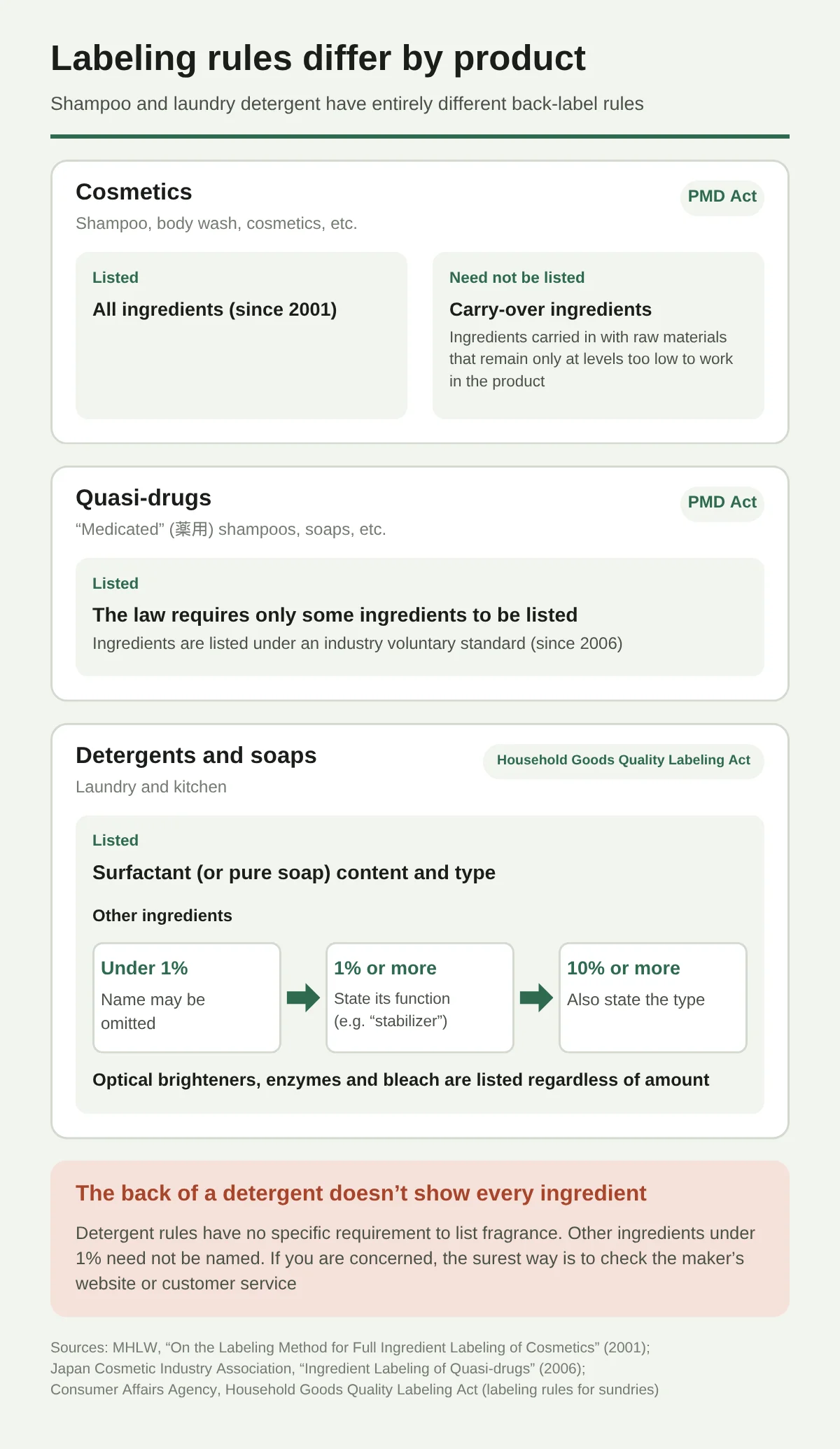
For shampoo and laundry detergent, the rules for what is written on the back label are completely different.
| Product | Underlying law | Ingredient labeling |
|---|---|---|
| Cosmetics (shampoo, body soap, cosmetics, etc.) | Pharmaceuticals and Medical Devices Act | All ingredients are listed (since 2001). However, ingredients contained in raw materials that remain in an amount with no effect in the product (carryover ingredients) need not be written |
| Quasi-drugs (“medicated” (薬用) shampoo, soap, etc.) | Pharmaceuticals and Medical Devices Act | The law requires labeling of only some ingredients. Ingredients are listed under an industry group’s voluntary standard (since 2006) |
| Laundry and dish detergents and soaps | Household Goods Quality Labeling Act | Centered on the content and type of surfactant (or pure soap content). For other blended ingredients, the “function name” (e.g., stabilizer) is written at 1% or more, and the type too at 10% or more. Fluorescent whitening agents, enzymes, and bleach are written regardless of amount |
(From MHLW notices, the Japan Cosmetic Industry Association, and Consumer Affairs Agency materials on the “Household Goods Quality Labeling Act”)
What does not appear on a detergent’s back label
Under the detergent rules of the Household Goods Quality Labeling Act, there is no rule requiring fragrance in particular to be written. Blended ingredients with a content under 1% need not be named. So even when you look at the back label of a laundry or dish detergent, you cannot tell every ingredient. When you are concerned, the surest way is to check on the maker’s website or with its customer service.
Even the “full ingredients” of cosmetics contain unlisted ingredients
Even in the full ingredient labeling of cosmetics, when antioxidants, preservatives, and the like that were added to raw materials remain only in an amount with no effect in the product, they need not be written (so-called carryover ingredients). Food additives have the same idea → Article on carryover
How to read “additive-free”
The cosmetics industry group (the Japan Cosmetic Industry Association)’s “Guidelines for Proper Advertising of Cosmetics” set out the following.
- Writing just “additive-free” is inaccurate because it does not say what has not been added. If the ingredient not added is clearly shown, the expression may be used
- Do not emphasize “additive-free” like a catchphrase
- If the product contains that ingredient as a carryover ingredient, it cannot be described as “additive-free”
- Wording such as “contains no fragrance or coloring, which tend to cause skin problems” could amount to disparaging other products, so stick to expressions such as “fragrance-free, coloring-free”
When something says “additive-free,” check what is not added, as in “fragrance-free” or “coloring-free”. “Additive-free” means “that ingredient has not been added”; it does not mean “gentle on skin” or “safe.”
Back-label checkpoints
- Do not take at face value claims that recommend a product on the grounds of “transdermal toxins”: there are cases the government has penalized as false statements
- For shampoo and body soap, look at the full ingredient list: if you have had a rash from a fragrance or preservative, you can check by ingredient name
- Laundry and dish detergents do not list every ingredient: to check fragrance and the like, ask the maker
- For “additive-free,” look at what is additive-free: “additive-free” alone does not mean irritation or allergy will not occur
- If hand eczema or rashes continue, see a dermatologist: there is a test called a patch test that looks for the cause
Urayomi’s approach
To sum up so far:
- The “transdermal toxin” theory has no scientific basis that we could find, and there is a case in which the government penalized solicitation that used the word
- On the other hand, hand eczema, rashes, transdermal sensitization, and scent problems do actually occur, and academic societies and the government have taken them up
- Under the labeling rules, not every ingredient of a detergent appears on the back label
Urayomi does not write that any specific ingredient or commercial product is a “poison” or “dangerous.” On product pages for household goods, we quote the maker’s “○○-free” labeling as the maker’s labeling, and also introduce the role of the ingredients.
Also worth knowing
- Comparison of the full ingredient lists of additive-free shampoos and body soaps → Article on additive-free shampoos and body soaps
- Comparison of the labels of additive-free laundry and dish detergents, and how to tell soap from synthetic detergent → Article on additive-free detergents
- Why additives and ingredients used in raw materials are not listed → Article on carryover
- The “flavoring” (香料) label on food is also one that can be written as a single word → Article on flavorings
- How to read “preservative-free” on food → Article on preservatives
Sources
- Masaru Oya, “Issues in consumer information on safety and environmental problems: Responding to misinformation in 2.5th-order information,” Journal of Home Economics of Japan 61(8) 511-516, 2010 (cites the content of METI’s business suspension order [February 20, 2008])
- Japanese Dermatological Association, “Contact Dermatitis Clinical Practice Guidelines 2020,” Jpn J Dermatol 130(4) 523-567, 2020
- Bos JD, Meinardi MM, “The 500 Dalton rule for the skin penetration of chemical compounds and drugs,” Exp Dermatol 2000
- Sakai N, et al., “Allergy caused by transdermal sensitization to hydrolyzed wheat,” Kagaku to Seibutsu 52(7) 431-437, 2014
- Consumer Affairs Agency et al., “Some people are troubled by that scent” poster (revised July 2023) / MHLW administrative notice (July 19, 2023)
- Ministry of Health, Labour and Welfare, “On the labeling method for full ingredient labeling of cosmetics” (March 6, 2001)
- Japan Cosmetic Industry Association, “Ingredient labeling of quasi-drugs” (voluntary standard implemented April 2006) / “Guidelines for Proper Advertising of Cosmetics, 2020 edition,” F5.8 and F5.9
- Consumer Affairs Agency, “Household Goods Quality Labeling Act,” Miscellaneous Industrial Goods Quality Labeling Regulations (synthetic detergents / soap for laundry or dishes)
This article explains labeling rules and materials from public bodies and academic societies, and does not judge the safety or danger of any particular product or ingredient. If skin symptoms continue, see a dermatologist.
Related articles and databases
- What is carryover? How it differs from processing aids, and the additives that are not listed on labels even on “additive-free” foods
- Are Flavorings Bad for You? What “香料” (Flavoring) Contains, Why It Is Written as One Word, and Japanese vs. Overseas Rules
- Are preservatives bad for you? Types such as sorbic acid, what “preservative-free” hides, and how Japanese and overseas rules differ
- What are surfactants? Types, history, rules in Japan and abroad, effects on the body, and what the “strength rankings” really are
- How to Choose Additive-Free Shampoo and Body Soap: Soap-Based vs. Amino Acid-Based, and How to Read the Full Ingredient List
- Choosing an additive-free detergent: soap vs. synthetic detergent, and how to read the back label