
What Is the Rice Polishing Ratio? How Sake Is Made, Flat Polishing, and Yeast: Reading the Words on the Label from Government Sources

PR This article contains affiliate links to Rakuten Ichiba and Moshimo Affiliate (“See on Rakuten” and the link to a sake mail-order shop). What is written here is based on materials from the National Tax Agency, the National Research Institute of Brewing, and prefectural research institutes, regardless of whether there are ads. Drinking is for those 20 and older. The “See on Amazon.co.jp” and “See on Yahoo! Shopping” links are also affiliate links.
Sake labels carry many words such as “junmai daiginjo,” “rice polishing ratio 50%,” “kimoto,” and “Kyokai No. 9.” Every one of them describes how the sake was made.
In this article, based on National Tax Agency rules and National Research Institute of Brewing materials, we sort out the following:
- How the law defines “sake (nihonshu),” “junmai,” and “ginjo”
- How sake is made, and why its alcohol content is high for a brewed beverage
- What the rice polishing ratio is, and whether the more you polish, the better it tastes
- How the new polishing method, “flat polishing,” differs
- How yeast changes the aroma
For ingredients and health effects, see our article on sake and health, and for its history and ties to Shinto, see our article on the history and culture of sake.
Conclusions
- Only seiishu (refined sake) made in Japan using only domestically grown rice can be called “日本酒” (nihonshu, Japanese sake). For the eight names such as “junmai” and “ginjo,” the National Tax Agency’s standards set the ingredients and the rice polishing ratio
- Sake is made by “multiple parallel fermentation,” in which koji turns the rice starch into sugar and yeast turns the sugar into alcohol at the same time in the same tank. As a result, undiluted sake reaches an alcohol content of around 20%, among the highest for a brewed beverage
- The rice polishing ratio is “the share of rice that remains.” Polishing more reduces off-flavors and lets aroma stand out, but brewers themselves write that “more polishing is not always better”
- Flat polishing is a way of grinding rice flat without making it round. In a Hiroshima Prefecture trial, flat polishing at 70% and ordinary polishing at 40% gave about the same amount of protein
- The stars of ginjo aroma are the apple-like aroma (ethyl caproate) and the banana-like aroma (isoamyl acetate) that yeast produces. They change greatly depending on which yeast is used
What is covered in this article
Within the article, we introduce the following in line with each point (they are Rakuten Ichiba and Moshimo Affiliate links).
| For people who | What we introduce | Where |
|---|---|---|
| Want to know about the most highly polished sake | Niizawa Brewery’s “Reikyo -Absolute 0-” (polishing ratio 0.85%) | How far can it be polished? |
| Want to try sake made with flat polishing | Daishichi “Minowamon” (ultra-flat polishing), two bottles of Taketsuru, flat polishing and spherical polishing | Sake made with flat polishing |
| Want to learn more about how it is made | Saishin Nihonshu no Kagaku (The Latest Science of Sake; Kodansha Blue Backs) | For those who want to know more |
The rules for “sake,” “junmai,” and “ginjo”
The legal definition
Under the Liquor Tax Act, a drink with an alcohol content under 22% that is made by fermenting rice, rice koji, and water and then filtering it is called “seishu” (refined sake).
Further, only seishu made in Japan using only domestically grown rice can be called “日本酒” (nihonshu, Japanese sake) (designated a geographical indication in 2015). Sake made with foreign rice or made overseas cannot be labeled “日本酒.”
The eight “tokutei meisho” (designated names)
The National Tax Agency’s “Labeling Standards for the Manufacturing Methods and Quality of Seishu” set eight names that only sake meeting the conditions may use.
| Name | Ingredients | Rice polishing ratio | In a word |
|---|---|---|---|
| Junmai daiginjo-shu | Rice, rice koji | 50% or less | Rice only, polished away by more than half and slowly fermented at low temperature |
| Junmai ginjo-shu | Rice, rice koji | 60% or less | Rice only, with a fruity ginjo aroma |
| Tokubetsu junmai-shu | Rice, rice koji | 60% or less, or a special method | The label explains the special reason |
| Junmai-shu | Rice, rice koji | No requirement | Made with rice only. The polishing ratio condition was dropped in 2004 |
| Daiginjo-shu | + brewer’s alcohol | 50% or less | A little alcohol is added to bring out the aroma |
| Ginjo-shu | + brewer’s alcohol | 60% or less | |
| Tokubetsu honjozo-shu | + brewer’s alcohol | 60% or less, or a special method | |
| Honjozo-shu | + brewer’s alcohol | 70% or less | Crisp and light |
- For all of them, the condition is that the rice made into koji is at least 15% of the total white rice. The raw-material rice must be grade 3 or better in the agricultural product inspection
- “Brewer’s alcohol” is alcohol made by fermenting and distilling starch or sugar. The amount allowed is up to 10% of the weight of the white rice (converted to 95% alcohol). It is used to bring out aroma and lighten the taste. Even in the Edo period there was a technique of adding shochu, called “hashira shochu”
- Anything that fits none of the eight is futsushu (regular sake). About 60% of the sake shipped in Japan (62.4% by taxed shipment volume in the Reiwa 5 brewing year, 2023) is futsushu
- When a designated name is used, the rice polishing ratio must be written on the label
- “Ginjo-zukuri” (ginjo brewing) has no detailed rules, but it refers to a method that takes well-polished rice and ferments it slowly at low temperature to bring out the ginjo aroma
How sake is made
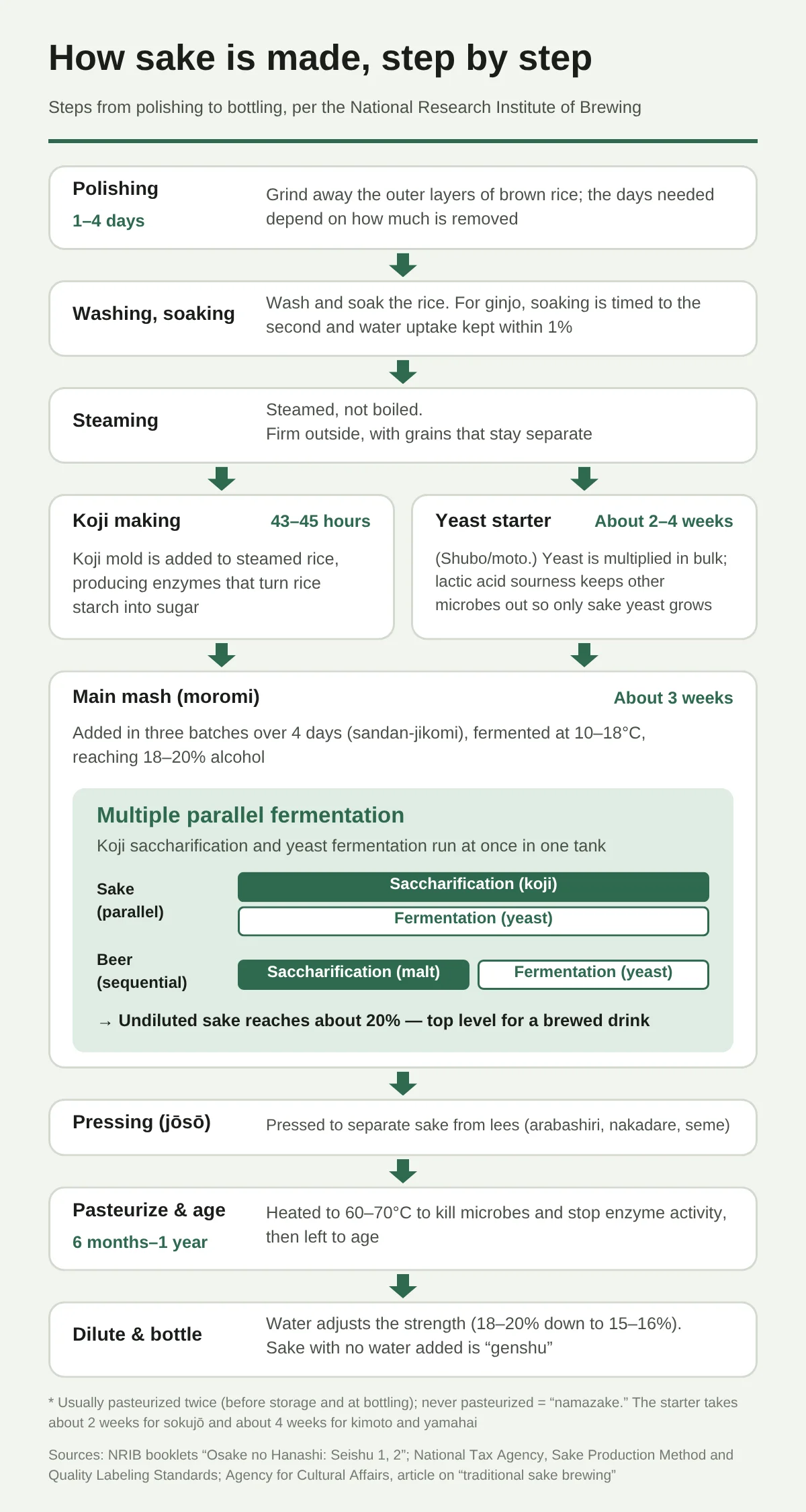
We go through the process step by step, based on National Research Institute of Brewing materials.
| Step | What is done | Key points |
|---|---|---|
| Polishing (seimai) | The outside of the brown rice is ground away | Takes 1–4 days depending on how much is polished |
| Washing and soaking | The rice is washed and made to absorb water | If it absorbs too much, the rice dissolves too much and the taste becomes heavy. In ginjo brewing, time is measured to the second and water absorption is controlled in 1% steps |
| Steaming | Steamed with steam | It is steamed, not cooked. Like glutinous rice, the outside is firm and the grains are separate, which is what you want |
| Koji making | Koji mold is applied to the steamed rice | 43–45 hours in the koji room (kōji-muro). Enzymes that turn rice starch into sugar are produced |
| Shubo (moto), the yeast starter | Yeast is multiplied in large numbers | Lactic acid makes it sour to keep out unwanted microbes, and only acid-resistant sake yeast is grown |
| Moromi (main mash) | The main brewing | Built in three additions and fermented for about 3 weeks at 10–18°C. Alcohol content reaches 18–20% |
| Joso (pressing) | Pressed to separate sake and sake lees | First comes the “arabashiri,” in the middle the “nakadare,” and last the “seme,” pressed under pressure |
| Hiire (pasteurization) | Heated to 60–70°C | Kills unwanted microbes and stops enzyme activity. Usually done twice |
| Storage and dilution | Aged, then adjusted with water | Aged for 6 months to 1 year, and 18–20% is brought down to 15–16%. Sake with no water added is “genshu” (undiluted sake) |
- About 80% of sake is water. Sake brewing needs about 10 times the weight of the rice used in water. The standard for iron in brewing water (0.02 ppm or less) is even stricter than for tap water (0.3 ppm or less)
- Yeast multiplies about 20,000-fold during brewing, reaching about 200 million cells per gram of moromi
Koji mold is the “national fungus”
The koji mold used for sake is yellow koji mold (scientific name Aspergillus oryzae). In 2006, the Brewing Society of Japan designated it the “national fungus” (kokkin). Black koji mold and white koji mold are used for shochu and awamori. Shochu koji and how shochu is made are covered in our article on types of shochu.
Yeast cannot turn rice starch directly into alcohol. So the koji enzymes turn the starch into glucose, and the yeast turns that into alcohol.
Three ways to make the yeast starter: kimoto, yamahai, sokujo
The purpose of making the yeast starter is to create a sour environment with lactic acid and multiply only sake yeast. There are three types, depending on how the lactic acid is provided.
| Method | How the lactic acid is made | Approximate duration | Features |
|---|---|---|---|
| Kimoto | Lactic acid bacteria living in the brewery make it naturally. Steamed rice is ground with paddles in a step called “yamaoroshi” | About 4 weeks | Established in the Edo period |
| Yamahai | Likewise natural lactic acid bacteria. Yamaoroshi is dropped, and koji enzymes dissolve the rice | About 4 weeks | Short for “yamaoroshi haishi moto” (yamaoroshi-abolished starter). Developed in 1909 at the national Brewing Experiment Station. Said to differ little in finished sake from kimoto |
| Sokujo | Brewing-grade lactic acid is added from the start | About 2 weeks | Also developed in 1909. Most of today’s sake is made this way |
In kimoto, it takes about 2 weeks for lactic acid bacteria to make lactic acid. In the meantime, the process depends on a relay of several microorganisms, such as nitrite made by nitrate-reducing bacteria holding back wild yeast.
Three-stage mashing and “multiple parallel fermentation”
The moromi is not built all at once; it is built in three additions over 4 days.
| Day | Name | Amount added |
|---|---|---|
| Day 1 | Soe | 1/6 of the total (plus all of the yeast starter) |
| Day 2 | Odori | Nothing is added; rest while the yeast multiplies |
| Day 3 | Naka | 1/3 of the total |
| Day 4 | Tome | 1/2 of the total |
This is because adding everything at once would dilute the yeast and the acid, slowing fermentation or letting unwanted microbes win.
And sake’s greatest feature is multiple parallel fermentation.
| Drink | How fermentation works |
|---|---|
| Wine | Yeast turns the grape sugar directly into alcohol (single fermentation) |
| Beer | Yeast ferments after saccharification with malt is finished (single-stage multiple fermentation) |
| Sake | Koji saccharification and yeast fermentation proceed at the same time in the same tank (multiple parallel fermentation) |
Thanks to this, undiluted sake reaches an alcohol content of around 20%. That is among the highest for a brewed beverage (the Agency for Cultural Affairs article says wine goes up to about 15%).
Researchers at the National Research Institute of Brewing give three reasons (Shimoi et al., 2013).
- Because saccharification and fermentation proceed together, the mash can be made thick without the yeast being weakened by concentrated sugar (without raising osmotic pressure)
- Koji helps yeast grow and ferment under low-oxygen conditions
- Sake yeast itself has strong fermentation power (in a Gekkeikan test, a laboratory yeast stopped fermenting at about half that level)
The difference between namazake, nama-zume, and nama-chozo
The name changes depending on when pasteurization (heat sterilization) is done.
| Name | Before storage | When bottling | Definition in the National Tax Agency standards |
|---|---|---|---|
| Ordinary sake | Pasteurized | Pasteurized | ― |
| Namazake | Not done | Not done | Yes (no heating at all) |
| Nama-chozo-shu | Not done | Pasteurized | Yes |
| Nama-zume | Pasteurized | Not done | No (an industry term) |
“Hiyaoroshi,” which appears in autumn, generally refers to sake that was pasteurized only once before storage, kept through the summer, and shipped in autumn without pasteurization (nama-zume). This too has no definition in the standards.
Pasteurization about 300 years before Pasteur A 1570 entry in the Tamonin Nikki, the diary of monks at Kofuku-ji in Nara, mentions “hiire,” heating sake to 63–65°C. Pasteur in France devised the pasteurization of wine in the 1860s, so this was about 300 years earlier.
Rice polishing ratio
The rice polishing ratio is “the share that remains”
The rice polishing ratio (seimai buai) is the share of white rice that remains after the brown rice is ground.
- A polishing ratio of 40% = 100 kg of brown rice ground down to 40 kg (60% ground away)
- The smaller the number, the more it has been polished (highly milled)
- The rice for everyday cooked rice is about 90% (about 10% of the outside is removed as bran)
Why polish?
| Part of the rice | Main components | Effect on the sake |
|---|---|---|
| Outside | Protein, fat, minerals | Protein is a source of umami, but too much causes off-flavors and heaviness. Fat makes it harder for ginjo aroma to emerge |
| Center (shinpaku) | Starch | Becomes sugar, the source of alcohol and sweetness |
The more a ginjo sake is meant to show aroma, the more it is polished.
How does sake rice differ from table rice?
| Sake rice (e.g., Yamada Nishiki) | Table rice (e.g., Nihonbare) | |
|---|---|---|
| Grain size | Large (1,000-grain weight about 26 g) | Ordinary (about 22 g) |
| Shinpaku | Most have a white shinpaku in the center | None |
| Protein | Low | Higher |
| When steamed | Grains stay separate | Sticky (Koshihikari tends to clump) |
- The shinpaku is the part with many gaps in the starch, where the hyphae of koji mold can easily enter
- The leading sake rice, “Yamada Nishiki,” was developed in Hyogo Prefecture in 1936 and makes up 38% of all sake rice (34,608 t in crop year Reiwa 5). About 55% of it is grown in Hyogo Prefecture
- Others include Gohyakumangoku (Niigata and Hokuriku), Miyama Nishiki (Nagano and Tohoku), and Omachi (Okayama)
How far can it be polished?
- Daiginjo is 50% or less. For competitions (kanpyōkai), it is sometimes polished down to 35%
- “Dassai Migaki Niwari Sanbu” by Asahi Shuzo in Yamaguchi is 23%
- According to press reports, there are also examples such as “Komyo” by Tatenokawa Shuzo in Yamagata at 1%
- Niizawa Brewery in Miyagi explains that in 2018 it spent 5,297 hours polishing rice down to a polishing ratio of 0.85% to make “Reikyo -Absolute 0-.” At the time, polishing ratios were labeled with the decimals cut off, so it was labeled “0%”; from July 2019 the rule changed so that anything under 1% is labeled “less than 1%” (according to the brewery)
“The more you polish, the better it tastes” is not always true
- Daishichi Sake Brewery in Fukushima writes that “it is not always the case that the more you polish, the better.” It says you choose according to the sake: high polishing for a showy daiginjo, and moderate polishing for a rich-flavored junmai drunk warm
- Aramasa Shuzo in Akita, on the contrary, makes “Nirugame” (Nirvana turtle), which is barely polished at all (polishing ratio 88–92%)
- The more you polish, the more rice you throw away. That is why attention has turned to the flat polishing described next
Flat polishing: less off-flavor at the same polishing ratio
The problem with ordinary polishing (spherical polishing)
A grain of rice is long and slender. In an ordinary rice polisher, the rice tumbles and is ground mostly along its length, becoming round. Then:
- The surface along the thickness direction, which is rich in protein, is left behind
- Conversely, the length direction, rich in the starch you want to keep, is ground too much
How flat polishing works
The polisher is turned slowly so that the rice rotates around its long axis, and the surface is ground away by the same thickness all around. The finished white rice has a flat shape close to the shape of the original rice.
| Source | Result |
|---|---|
| Hiroshima Prefecture Food Industry Technology Center (2021) | Flat polishing at 70% and spherical polishing at 40% give about the same amount of protein. Raw-material use goes up by about 30 points |
| The center’s trial brewing (polishing ratio 70%) | Crude protein: spherical 5.0% → flat 4.4%. The sake had fewer amino acids and was described as “clean-tasting” with a “crisp aftertaste.” The banana-like aroma (isoamyl acetate) increased, and off-odors from aging were less likely to appear |
| Daishichi Sake Brewery | The protein content of ultra-flat polishing at an apparent 70% is about the same as ordinary polishing at 58% |
On the other hand, with flat polishing the germ tends to remain, and fat and minerals also tend to be somewhat higher. The director of the Hiroshima center comments that “the elements of fullness and richness decrease. Preferences vary from person to person.”
How it developed
| Year | Event |
|---|---|
| 1993 | Tomio Saito, head of the Appraisal Office at the Tokyo Regional Taxation Bureau, presents the theory of flat polishing in the journal of the Brewing Society of Japan |
| 1994 | Daishichi Sake Brewery in Fukushima brews the first flat-polished junmai daiginjo in Japan. Rice polisher makers were negative, saying “the rice will crack,” so the brewery took it on itself |
| 1995 | Daishichi names it “ultra-flat polishing” (chō-henpei seimai) and releases “Minowamon.” In 1999, all its products switch to ultra-flat polishing |
| 2018 | Hiroshima rice polisher maker Satake releases a new polisher. Flat polishing, which had not spread because it took too long, can now be done in a practical time |
| FY2018–2020 | Hiroshima Prefecture and Satake do joint research. Ten breweries in the prefecture brew and commercialize it |
Satake has named flat-polished rice and sake “Shingin” and registered it as a trademark. Breweries can use it free of charge if they apply. Fukucho and Taketsuru (Hiroshima), Denshu (Aomori), Atago no Matsu (Miyagi), Fukunishiki (Hyogo), and others release Shingin sake.
The advantage of flat polishing is that it reduces off-flavors with less polishing, so it reduces the amount of rice thrown away, and the time and electricity needed for polishing.
Sake made with flat polishing
If you want to taste the difference flat polishing makes, here is sake you can try.
Taketsuru Shuzo in Hiroshima sells two bottles that use the same rice (Hattanso No. 35) and the same polishing ratio (65%) and differ only in the shape of the polishing. Drinking them side by side shows the difference the polishing shape makes (according to the retailer’s pages).
Yeast changes aroma and taste
Two compounds star in the aroma
| Compound | Aroma | Which sake has more |
|---|---|---|
| Ethyl caproate | Apple and pear-like aroma | Showy daiginjo |
| Isoamyl acetate | Banana and melon-like aroma | Ginjo sake in general |
Both are produced by yeast, and which yeast is used greatly changes the kind and amount of aroma.
Kyokai yeast (Brewing Society of Japan yeast)
“Kyokai yeast” is yeast from outstanding breweries that the Brewing Society of Japan cultures in pure form and distributes nationwide (since 1906). The numbers follow the order in which they were first distributed.
| No. | Brewery of origin | Year | Features (Brewing Society of Japan’s description) |
|---|---|---|---|
| No. 6 | Aramasa Shuzo (Akita) | 1930s | The oldest still distributed. Strong fermentation power, with a gentle, mellow aroma |
| No. 7 | Miyasaka Brewing “Masumi” (Nagano) | 1946 | Showy aroma. Usable for both ginjo and regular sake, and the most widely used |
| No. 9 | Kumamoto Prefecture Sake Research Institute “Koro” | About 1953 | Showy ginjo aroma. Became the mainstream for ginjo sake from about 1975 |
| No. 10 | Isolated from moromi in Tohoku (Meiri Ogawa yeast) | 1952 | Low acidity, with a high ginjo aroma |
| No. 14 | “Kanazawa yeast” from the Kanazawa Regional Taxation Bureau area | Distributed nationwide in 1995 | Low acidity, suited to designated-name sake |
| No. 1601 | A strain that produces a lot of aroma | 1990s | Low acidity. High in apple aroma (ethyl caproate) |
| No. 1801 | A strain the association bred | 2006 | High in both apple and banana aromas. Widely used for daiginjo in the National New Sake Appraisal |
- The apple aroma (ethyl caproate) of No. 1601 is said to be 3–4 times that of No. 7, and the aroma of No. 1801 is said to be a further 40–50% higher than No. 1601
- Such strongly aromatic yeasts were created in 1991 by a method of selecting strains resistant to a drug called “cerulenin.” This is said to have greatly changed the aroma of ginjo sake across Japan
- At actual breweries, it is said that they often mix a strongly aromatic yeast and a No. 9-line yeast at 7:3 to 5:5
- For No. 6, the year differs by source, 1930 (Aramasa Shuzo) or around 1935 (the start of distribution)
Non-foaming yeast
During fermentation, yeast raises foam thick enough to cover the surface of the tank. In 1971, a yeast that does not foam, “non-foaming yeast (No. 701),” began to be distributed. There is no foam to clean up, and 20–30% more can be brewed in the same tank, so now about 70% of the association’s yeasts are non-foaming types (the number ends in “01”).
Prefectural yeasts and flower yeasts
- Shizuoka yeast: Developed by prefectural researchers including Denbei Kawamura together with breweries in the prefecture. Its aroma recalls melon and banana, and it became the start of Shizuoka’s being called the “Ginjo Kingdom”
- Akita’s AK-1: Later adopted as “Kyokai No. 15”
- Flower yeast: Yeast isolated by Tokyo University of Agriculture from flowers such as dianthus. It tends to make sake with a lot of malic acid
- Many other prefectures, such as Gifu, Aichi, and Mie, have their own yeasts too
For those who want to know more
For those who want to learn more about how sake is made and how koji and yeast work, here is a book.
Please note Drinking is for those 20 and older. Drinking under 20 is prohibited by law. The products introduced here are not meant to show anything good for health. Prices and shipping may change (shipping varies by region and by refrigerated delivery).
Summary
- “日本酒” (nihonshu) is only seishu made in Japan with domestic rice. For names such as “junmai” and “ginjo,” the National Tax Agency’s standards set the ingredients and the rice polishing ratio
- Sake is made by “multiple parallel fermentation,” in which saccharification and fermentation proceed at the same time in the same tank, and it reaches the highest alcohol level among brewed beverages
- The rice polishing ratio is “the share that remains.” Polishing more reduces off-flavors, but more polishing does not always taste better
- Flat polishing is a way to cut protein with less polishing by grinding the rice flat. Daishichi Sake Brewery began it in 1994, and a new polisher in 2018 helped it spread
- Aroma changes greatly with yeast. The “Kyokai No. ○” on a label is a clue for reading the aroma
Sources
- National Tax Agency, “Labeling Standards for the Manufacturing Methods and Quality of Seishu” https://www.nta.go.jp/taxes/sake/hyoji/seishu/kokuji891122/03.htm
- National Tax Agency, “Manufacturing Status of Seishu (Reiwa 5 Brewing Year)” (February 2025) https://www.nta.go.jp/taxes/sake/shiori-gaikyo/seizojokyo/2023/pdf/001.pdf
- National Research Institute of Brewing, information magazine “The Story of Alcoholic Beverages: Seishu 1” https://www.nrib.go.jp/sake/story/pdf/SeishuNo01.pdf
- National Research Institute of Brewing, information magazine “The Story of Alcoholic Beverages: Seishu 2 (Fusion of Science and Technology)” https://www.nrib.go.jp/sake/story/pdf/SeishuNo02.pdf
- National Research Institute of Brewing, “Glossary of Sake Label Terms” https://www.nrib.go.jp/sake/pdf/nlziten_j.pdf
- Brewing Society of Japan, “Kyokai Yeast” https://www.jozo.or.jp/yeast/
- Hitoshi Shimoi et al. (2013) Seibutsu-Kogaku (Journal of Biotechnology) Vol. 91 No. 2 (why the alcohol concentration of seishu becomes high) https://sbj.or.jp/wp-content/uploads/file/sbj/9102/9102_ronbun_2.pdf
- Hiroko Tsutsumi (2011) Seibutsu-Kogaku Vol. 89 No. 12 (components of ginjo aroma and strongly aromatic yeasts) https://www.sbj.or.jp/wp-content/uploads/file/sbj/8912/8912_tokushu_1.pdf
- Masato Hirotsune (2014) Seibutsu-Kogaku Vol. 92 No. 4 (the progress of sake technology) https://sbj.or.jp/wp-content/uploads/file/sbj/9204/9204_yomoyama.pdf
- Hiroshima Prefecture Food Industry Technology Center, press release on flat polishing (2021) https://www.pref.hiroshima.lg.jp/uploaded/attachment/476503.pdf
- Hiroshima Prefecture Food Industry Technology Center, research presentation, “Flat and original-shape polishing with a new rice polisher” https://www.pref.hiroshima.lg.jp/uploaded/attachment/582356.pdf
- Daishichi Sake Brewery, “Ultra-flat polishing” https://www.daishichi.com/waza/henpei.html
- Satake, “Shingin” https://www.shingin.jp/
- Agency for Cultural Affairs, article introducing “traditional sake brewing” https://www.bunka.go.jp/prmagazine/rensai/news/news_005.html
Related articles and databases
- Is Sake Good for Your Health? Checking Ingredients, Calories, Weight Gain, and the Comparison with Shochu Against Public Data and Studies
- Why Is Sake Sacred? Its History, Shinto, Famous Regions, Premium Bottles, and Popularity Overseas, Read Through Government Sources
- Were “無添加” (Additive-Free) Labels Banned? Reading the Consumer Affairs Agency Guideline’s 10 Types from the Back Label
- Types of Shochu: Class A, Class B, Honkaku Shochu, and Awamori Explained, with a Popularity Ranking, Using National Tax Agency Materials