
Types of Shochu: Class A, Class B, Honkaku Shochu, and Awamori Explained, with a Popularity Ranking, Using National Tax Agency Materials

PR This article contains affiliate links to Rakuten Ichiba and A8.net (“See on Rakuten” and a link to a distillery’s online shop). What is written here is based on materials from the National Tax Agency, laws and regulations, and a market research firm, whether or not there is an ad. Alcohol is for people aged 20 and over. The “See on Amazon.co.jp” and “See on Yahoo! Shopping” links are also affiliate links.
Shochu labels carry many terms: “本格焼酎” (honkaku shochu), “焼酎甲類” (shochu Class A), “連続式蒸留焼酎” (continuous-still shochu), “泡盛” (awamori), “黒麹仕込み” (made with black koji), “減圧蒸留” (vacuum distillation), and more. Every one of them describes what it is made from and how it was made.
Using the law and National Tax Agency (NTA) materials, this article sorts out the following.
- What is the difference between “Class A (kou-rui),” “Class B (otsu-rui),” and “honkaku shochu”?
- Where, and how much, are sweet potato, barley, rice, buckwheat, brown sugar, and awamori shochu made?
- What changes with the koji (black, white, yellow) and with atmospheric vs vacuum distillation?
- Which shochu sells best (popularity ranking)?
For effects on the body, see the article on shochu and health. For why Kyushu became shochu country and for premium shochu, see the article on shochu history and Kyushu. For how sake is made, see the article on sake brewing.
Conclusion
- Under the law, shochu comes in two types: “continuous-still shochu (Class A),” made with a continuous still, and “single-distilled shochu (Class B),” made with any other still. Class A and Class B are not a ranking of quality
- “Honkaku shochu” can be used only for single-distilled shochu made only from grains, potatoes, sake lees, or brown sugar, plus koji and water (plus a small amount of 49 items designated by the national government), with nothing added other than water
- The raw materials of honkaku shochu are barley (43.5%) and sweet potato (42.8%), nearly 90% together (2024). Sweet potato is centered on Miyazaki, barley on Oita, rice on Kumamoto, and brown sugar on Kagoshima (Amami)
- There are no official statistics on sales by brand. In the ranking of companies by sales, Kirishima Shuzo (Miyazaki), maker of “Kuro Kirishima,” has been No. 1 for 14 years in a row (Teikoku Databank, 2025)
- Shochu has five geographical indications (GIs): Iki, Kuma, Ryukyu, Satsuma, and Tokyo Shimazake
Products featured in this article
The article introduces the following products where they fit the discussion (links to Rakuten Ichiba and A8.net).
| For people who… | Product featured | Where |
|---|---|---|
| Want to taste the differences between raw materials | One bottle each of sweet potato, barley, rice, brown sugar, and awamori (黒霧島 Kuro Kirishima, いいちこ Iichiko, 白岳 Hakutake, れんと Rento, 今帰仁城 Nakijinjo koshu) | Compare the raw materials yourself |
| Want to try honkaku shochu made outside Kyushu | Barley shochu made outside Kyushu (official shop of the Okukuji Hanawa Distillery in Fukushima Prefecture, A8.net link) | Sweet potato, barley, rice, buckwheat, brown sugar, awamori |
| Want to learn more about how koji, fermentation, and distillation work | 『焼酎の科学』 (The Science of Shochu; Kodansha Blue Backs) | For readers who want to know more |
Shochu comes in two types under the law
Continuous-still and single-distilled
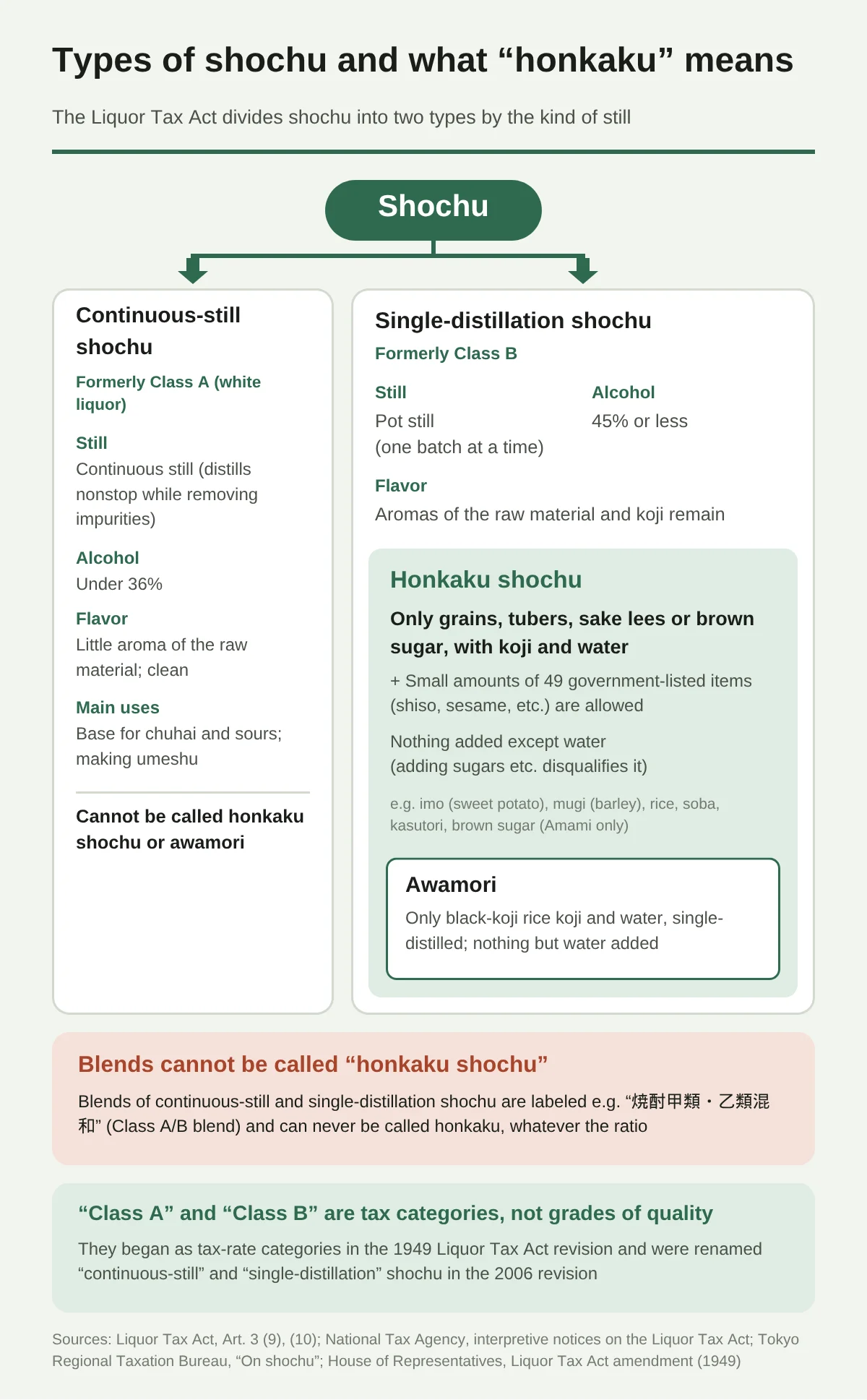
The Liquor Tax Act divides shochu into two kinds by type of still.
| Continuous-still shochu | Single-distilled shochu | |
|---|---|---|
| Former name | Shochu Class A (kou-rui; “white liquor”) | Shochu Class B (otsu-rui) |
| Still | Continuous still (distills continuously while removing impurities) | Any other (a single still that distills one batch at a time) |
| Alcohol content | Under 36% ABV | 45% ABV or less |
| Taste | The raw material’s aroma barely remains; clean and crisp | The aroma of the raw material and koji remains |
| Main uses | Base for chuhai and sours, making umeshu (plum liqueur) | Drunk with hot water, with cold water, on the rocks, and so on |
| Can it be called honkaku shochu or awamori? | No | Yes, if conditions are met |
- Products equivalent to whisky, brandy, vodka, rum, and gin are not counted as shochu
- The continuous still was developed in Ireland in 1830, and continuous-still shochu is said to have been made in Japan around 1900 (Tokyo Regional Taxation Bureau)
“Class A” and “Class B” are not a ranking of quality
The split into “Class A” (kou) and “Class B” (otsu) was created as tax brackets in the 1949 revision of the Liquor Tax Act. The 1953 Liquor Tax Act defined “continuous-still products are Class A, all others are Class B,” and the 2006 revision introduced the current names “continuous-still shochu” and “single-distilled shochu.”
“Kou” and “otsu” are names of tax categories and do not mean one is higher than the other. Even now, “焼酎甲類” (shochu Class A), “焼酎乙類” (shochu Class B), and “ホワイトリカー” (white liquor) may still be used as names on labels.
Conditions for calling something “honkaku shochu”
“Honkaku shochu” (literally “authentic shochu”) is a name allowed for single-distilled shochu made only from the following raw materials.
| Combination of raw materials | Example |
|---|---|
| Grains or potatoes, their koji, and water | Sweet potato, barley, rice, and buckwheat shochu |
| Grain koji and water only | Shochu made entirely with koji (zen-koji) |
| Sake lees (seishu kasu) (+ rice, rice koji, water) | Kasutori shochu |
| Brown sugar, rice koji, water | Brown sugar shochu (Amami Islands only) |
| Grains or potatoes, koji, and water, plus 49 items designated by the Commissioner of the National Tax Agency | Shiso, chestnut, sesame, green tea, milk, tomato, kombu, and so on |
- The 49 items may be used only in an amount that does not exceed the weight of the main raw materials (grains or potatoes, plus koji)
- A product with anything other than water (such as sugars) added after distillation cannot be called honkaku shochu
- Blends of continuous-still and single-distilled shochu are labeled “焼酎甲類乙類混和” (Class A–B blend) and the like, and cannot be called honkaku shochu regardless of the amount (if the minor component is less than 5% in pure alcohol, labeling only the larger component is also allowed)
Types by raw material
Sweet potato, barley, rice, buckwheat, brown sugar, awamori
| Type | Main raw material | Main production areas | Examples of representative brands |
|---|---|---|---|
| Sweet potato shochu (imo) | Sweet potato (+ rice koji, etc.) | Kagoshima, Miyazaki | Kuro Kirishima (Kirishima Shuzo), Satsuma Shiranami (Satsuma Shuzo), Kuro Isanishiki (Oguchi Shuzo) |
| Barley shochu (mugi) | Barley (+ barley koji or rice koji) | Oita, Nagasaki (Iki), Fukuoka, etc. | Iichiko (Sanwa Shurui), Nikaido and Kitchomu (Nikaido Shuzo) |
| Rice shochu (kome) | Rice, rice koji | Kumamoto (Kuma) | Hakutake (Takahashi Shuzo) |
| Buckwheat shochu (soba) | Buckwheat | Miyazaki (Takachiho, Gokase), Nagano, etc. | Unkai (Unkai Shuzo) |
| Brown sugar shochu (kokuto) | Brown sugar, rice koji | Only the Amami Islands of Kagoshima Prefecture | Rento (Amami Oshima Kaiun Shuzo), Sato no Akebono (Machida Shuzo) |
| Awamori | Rice koji (black koji) only | Okinawa | Zanpa (Higa Shuzo), Kumesen of Kumejima |
| Kasutori shochu | Sake lees from Japanese sake | Sake breweries nationwide (traditionally centered on Fukuoka) | − |
(The brands are those named as each company’s main brand in the Teikoku Databank ranking)
- Buckwheat shochu is a relatively new shochu, first made in 1973 in Gokase, Miyazaki Prefecture
- Barley shochu in Oita began to be made in earnest after barley controls ended in 1951, and barley koji is generally used. Iki barley shochu uses rice koji
Shochu is not made only in Kyushu. A distillery in Hanawa, Fukushima Prefecture, makes barley shochu from Fukushima-grown barley and barley koji.
Which raw materials are made, and how much?
- Barley and sweet potato together account for nearly 90%
- About two-thirds (65.5%) of sweet potato shochu is made in Miyazaki Prefecture, about 40% (43.3%) of barley shochu in Oita Prefecture, and more than half (53.1%) of rice shochu in Kumamoto Prefecture (calculated from the prefecture table in the same material)
- Brown sugar shochu is entirely made in Kagoshima Prefecture (the Amami Islands)
Sweet potato varieties
- The representative raw material for sweet potato shochu is “Koganesengan.” NARO (the National Agriculture and Food Research Organization) writes that it “is positioned as the optimal variety for shochu.” It accounts for about 20% (20.2%, 2023) of the sweet potato planting area nationwide
- In Miyazaki Prefecture, about 70% of sweet potatoes go to shochu, and in Kagoshima Prefecture about 60% (Ministry of Agriculture, Forestry and Fisheries (MAFF))
- Some shochu changes its aroma through variety, such as “Aka Kirishima” (released 2003), made from the purple sweet potato “Murasaki Masari”
- Since autumn 2018, “foot rot (motogusare-byo),” a disease that rots sweet potatoes, has spread in Kagoshima and Miyazaki, and in 2025 it limited production of some shochu
Why brown sugar shochu is made only in Amami
Brown sugar may be used as a shochu raw material only “when made within the jurisdiction of the Oshima Tax Office (Kagoshima Prefecture) and used together with rice koji,” under an NTA circular.
According to NTA materials, Amami lost its means of transport in the war and had a food shortage, and after the war, under US military occupation, brown sugar could not be shipped off the island, so brown sugar came to be used as a shochu raw material. Even after Amami was returned to Japan in 1953, special permission was given so that the islands could continue making shochu, it is explained (explanatory text of the Japan Tourism Agency).
Compare the raw materials yourself
For people who want to actually taste the differences between raw materials, we chose one bottle per raw material (brands from top-ranked companies and from geographical-indication areas).
How it is made
Primary moromi and secondary moromi
The process for making honkaku shochu (in the case of sweet potato shochu) roughly follows this flow (from the process chart in the NTA’s “Sake no Shiori”).
- Making koji: koji mold is applied to steamed rice (or barley)
- Primary moromi (fermenting mash): koji, water, and yeast are combined to multiply the yeast first. The citric acid produced by the koji keeps unwanted bacteria from growing
- Secondary moromi: the steamed main raw material (such as sweet potato) and water are added and fermented. The koji converting starch to sugar and the yeast converting sugar to alcohol proceed at the same time
- Distillation: the moromi is distilled once in a single still
- Storage, dilution, and bottling: in most cases the strength is adjusted with water and the product shipped within a year
The koji is made from rice, and if the main raw material is sweet potato, it is called “sweet potato shochu,” so shochu is named after its main raw material. This “secondary mashing” began to be used in Kagoshima around 1903 and became established for sweet potato shochu around 1912. Awamori uses “zen-koji” (all-koji) mashing, in which all the raw-material rice is made into koji, and has no secondary moromi.
Koji: black, white, and yellow
| Koji mold | Characteristics | History |
|---|---|---|
| Yellow koji mold | The koji mold of Japanese sake | Until the end of the Meiji era, shochu outside Okinawa also used yellow koji, and spoilage of the moromi (“fuzo”) is thought to have been frequent |
| Black koji mold | Produces a lot of citric acid, protecting the moromi from unwanted bacteria. The traditional koji of awamori | From around 1910, Genichiro Kawachi and others spread it to Kagoshima’s sweet potato shochu |
| White koji mold | A mutant strain of black koji mold. It does not blacken work clothes or the koji room. Said to make the taste softer | Found by Genichiro Kawachi in the Taisho era and spread around 1945 |
- In 2006, the Brewing Society of Japan designated yellow, black, and white koji molds as the “national fungus (kokkin)”
- After white koji spread, black koji has also made a comeback to diversify products (the “Kuro” in “Kuro Kirishima” and “Kuro Isanishiki” means made with black koji)
Atmospheric and vacuum distillation
| Atmospheric distillation | Vacuum distillation | |
|---|---|---|
| How it works | Distilled at normal pressure | Pressure is lowered and distillation takes place at a lower temperature |
| Aroma (from the NTA’s geographical indication standards) | Kuma: the aroma unique to rice, with a toasty note / Ryukyu: a toasty aroma | Kuma: a fruit-like aroma / Ryukyu: a fruity aroma like apple and banana |
| History | The traditional method | Introduced around 1972 |
- For barley shochu, a lighter-aroma type made with vacuum distillation and the like is the mainstream, while for sweet potato shochu, the richly aromatic, atmospherically distilled type is the mainstream (Tokyo Regional Taxation Bureau)
Awamori and koshu (kusu)
- Awamori is defined as made only from rice koji of black koji mold and water, fermented and single-distilled, with nothing other than water added
- Because its raw materials are “only grain koji and water,” awamori also meets the raw-material conditions for honkaku shochu under the law (the name “awamori” is used on the label)
- Awamori stored for 3 years or more is called “koshu (aged awamori, kusu).” Awamori keeps maturing even after bottling, and there is a culture of “shitsugi,” adding new awamori to old awamori at home
Shochu has five geographical indications (GIs)
A geographical indication (GI) is a system that lets the name of a place of origin be used only for liquor that meets set standards. Shochu (distilled liquor) has five GIs.
| Name | Place | Designated | Main standards |
|---|---|---|---|
| Iki | Iki City, Nagasaki Prefecture | 1995 | Barley and rice koji (roughly 2:1 by weight), water from within Iki City |
| Kuma | Kuma District and Hitoyoshi City, Kumamoto Prefecture | 1995 | Only domestically grown rice and rice koji, water from Kuma and Hitoyoshi |
| Ryukyu | Okinawa Prefecture | 1995 | Only rice koji of black koji mold and water (= awamori) |
| Satsuma | Kagoshima Prefecture (excluding Amami City and Oshima District) | 2005 | Sweet potatoes grown in Kagoshima Prefecture, water from within Kagoshima Prefecture |
| Tokyo Shimazake | 8 towns and villages of the Izu Islands | 2024 | Honkaku shochu using barley koji, water of the Izu Islands |
If a label says “Satsuma,” “Kuma,” “Iki,” or “Ryukyu,” the place of origin and raw materials meet these standards.
Why many shochu are “25%”
Many shochu products are sold at 25% ABV. Looking at the history of the law, from the 1950 revision the shochu tax rate was set with 25% as the dividing line, and under the 1953 Liquor Tax Act the system was “a fixed rate for 25% or below, with an addition for each degree above 25%.” However, we did not find any official document stating “that is why 25% became common.”
The current tax rate is ¥200,000 per kL for 21% and above, plus ¥10,000 for each degree above 20%. For a 25% isshobin bottle (1.8 L), the liquor tax is ¥450 (calculated with the rates from October 2026).
Popular shochu ranking
There are no official statistics by brand
NTA statistics go down to category, raw material, and prefecture, and there are no official statistics on sales or shipments by brand. Here we introduce the sales ranking of shochu makers compiled every year by the private research firm Teikoku Databank.
| Rank | Company (location) | Main brands | Main raw materials | Sales (2025) |
|---|---|---|---|---|
| 1 | Kirishima Shuzo (Miyakonojo, Miyazaki Prefecture) | Kuro Kirishima, Aka Kirishima | Sweet potato, barley | ¥52.54 billion |
| 2 | Sanwa Shurui (Usa, Oita Prefecture) | Iichiko | Barley | ¥25.52 billion |
| 3 | Nikaido Shuzo (Hiji, Oita Prefecture) | Oita Mugi Shochu Nikaido, Kitchomu | Barley | ¥16.3 billion |
| 4 | Hamada Shuzo (Ichikikushikino, Kagoshima Prefecture) | Kaido, Daiyame | Sweet potato, barley | ¥15.005 billion |
| 5 | Unkai Shuzo (Miyazaki, Miyazaki Prefecture) | Kobiki BLUE, Unkai | Sweet potato, buckwheat, barley | ¥12.564 billion |
| 6 | Miyazaki Honten (Yokkaichi, Mie Prefecture) | Kinmiya Shochu (Class A) | Barley | ¥9.876 billion |
| 7 | Wakamatsu Shuzo (Ichikikushikino, Kagoshima Prefecture) | Satsuma-ichi | Sweet potato, barley | ¥7.036 billion |
| 8 | Satsuma Shuzo (Makurazaki, Kagoshima Prefecture) | Satsuma Shiranami, Kami no Kawa | Sweet potato, barley | ¥6.6 billion |
| 9 | Hombo Shuzo (Kagoshima, Kagoshima Prefecture) | Arawaza Sakurajima | Sweet potato, barley | ¥6.178 billion |
| 10 | Takahashi Shuzo (Hitoyoshi, Kumamoto Prefecture) | Hakutake, Hakutake Shiro | Rice | ¥5.977 billion |
Some points to keep in mind when reading it.
- This ranking covers only companies with 50% or more of sales from shochu and awamori. Major companies such as Takara Shuzo (Takara Shochu) and Godo Shusei are not included because sales of other liquors are large
- It is a ranking of company sales, not of brands (we cannot say “Kuro Kirishima is the top-selling brand”)
- The combined sales of the top 50 companies were ¥221.3 billion, down about 30% from the 2008 peak (¥309.0 billion)
- By prefecture, Miyazaki (6 companies, ¥71.1 billion) has the highest combined sales, while Kagoshima (21 companies) has the most companies
How Kirishima Shuzo became No. 1
According to Kirishima Shuzo’s official timeline, it began making shochu in Miyakonojo in 1916, released the black-koji “Kuro Kirishima” in Miyazaki Prefecture only in 1998, and launched it nationwide in 1999. According to Teikoku Databank, it became the No. 1 shochu maker by sales for the first time in 2012, overtaking Sanwa Shurui (Iichiko), which had been No. 1 for nine years in a row until then. It has been No. 1 for 14 years in a row through 2025.
How Class A shochu is used
- Chuhai and sours: canned chuhai was launched by Takara Shuzo in 1984 as “Takara can Chuhai”
- Making umeshu: when making umeshu at home, the law requires using liquor of 20% ABV or higher. You must not sell the umeshu you make
- Chiba Prefecture makes the most continuous-still shochu (about 105,000 kL in fiscal 2024)
For readers who want to know more
For those who want to learn more about how koji, fermentation, and distillation work, there is the following book.
Note Alcohol is for people aged 20 and over. Drinking under 20 is prohibited by law. The products introduced here are not meant to show that anything is good for health. Prices and shipping fees may change (shipping varies by region).
Summary
- Shochu comes in two types: continuous-still (Class A) and single-distilled (Class B). Class A and Class B are names of tax categories, not a ranking of quality
- “Honkaku shochu” is single-distilled shochu made only from grains, potatoes, sake lees, or brown sugar, plus koji and water (+ 49 items), with nothing added other than water
- Barley and sweet potato make up nearly 90% of raw materials. Sweet potato is Miyazaki, barley is Oita, rice is Kumamoto, and brown sugar is Amami
- Black, white, and yellow koji and atmospheric vs vacuum distillation change the aroma. Awamori is made only from rice koji of black koji mold
- By company sales, Kirishima Shuzo has been No. 1 for 14 years in a row. But there are no official statistics by brand
Sources
- Liquor Tax Act, Article 3, items 9 and 10; Order for Enforcement of the Liquor Tax Act; Ordinance for Enforcement of the Liquor Tax Act; Ordinance for Enforcement of the Act on Liquor Business Associations, Article 11-5 (e-Gov Law Search) https://laws.e-gov.go.jp/law/328AC0000000006
- House of Representatives, “Act Partially Amending the Liquor Tax Act, etc.” (Act No. 43 of 1949), and the text of the Liquor Tax Act (Act No. 6 of 1953) as enacted https://www.shugiin.go.jp/internet/itdb_housei.nsf/html/houritsu/01519530228006.htm
- National Tax Agency, “Basic Circular on the Liquor Tax Act and Liquor Administration Laws and Regulations,” Article 3 (definition of shochu) https://www.nta.go.jp/law/tsutatsu/kihon/sake/2-02.htm / Article 86-5 (labeling) https://www.nta.go.jp/law/tsutatsu/kihon/sake/8-08.htm
- Tokyo Regional Taxation Bureau, “About Shochu” https://www.nta.go.jp/about/organization/tokyo/sake/abc/abc-shochu.htm
- National Tax Agency, “Sake no Shiori,” July 2026 (classification of liquors, manufacturing process, tax rates) https://www.nta.go.jp/taxes/sake/shiori-gaikyo/shiori/2026/index.htm
- National Tax Agency, “Overview of the Liquor Manufacturing and Liquor Wholesale Industries (fiscal 2025 survey)” https://www.nta.go.jp/taxes/sake/shiori-gaikyo/seizo_oroshiuri/r07/pdf/all.pdf
- National Tax Agency Statistics Annual Report, fiscal 2024, “Liquor Tax” https://www.nta.go.jp/publication/statistics/kokuzeicho/sake2024/xls/08_suryo.xlsx
- National Tax Agency, survey report “Sake Brewing with Traditional Japanese Koji Molds” (history of shochu and awamori) https://www.nta.go.jp/taxes/sake/koujikin/pdf/0021012-102_04.pdf
- National Tax Agency, “List of Geographical Indications for Liquor” https://www.nta.go.jp/taxes/sake/hyoji/chiri/ichiran.htm
- Japan Tourism Agency, Multilingual Explanatory Text Database for Regional Tourism Resources (Amami brown sugar shochu) https://www.mlit.go.jp/tagengo-db/common/001556968.pdf
- Ministry of Agriculture, Forestry and Fisheries, “On the Situation Surrounding Sweet Potatoes” (March 2026) https://www.maff.go.jp/j/seisan/tokusan/imo/attach/pdf/siryou-17.pdf
- NARO Kyushu Okinawa Agricultural Research Center, “Development of ‘Satsuma Masari,’ a new sweet potato variety for shochu” (2011) https://www.naro.go.jp/PUBLICITY_REPORT/PRESS/files/naro/konarc-press20110630-2.pdf
- Teikoku Databank, “Shochu Maker Sales Ranking (2025)” (September 3, 2026) https://www.tdb.co.jp/report/industry/20260903-syotyu-fukuoka/
- Kirishima Shuzo, “History” https://www.kirishima.co.jp/company/history/
- J-Net21, “Takara can Chuhai” (Organization for Small & Medium Enterprises and Regional Innovation, 2011) https://j-net21.smrj.go.jp/special/populardrinks/2011121601.html
Related articles and databases
- Is Shochu Good for Your Health? Checking “Zero Sugar,” “Zero Purines,” “Thin Blood,” Weight Gain, and Hangovers Against Food Composition Tables and Studies
- Why Is Kyushu Shochu Country? The History of Shochu, Premium Shochu (Moriizo, Maou, Murao), and Its Spread Overseas, Read Through Government Documents
- What Is the Rice Polishing Ratio? How Sake Is Made, Flat Polishing, and Yeast: Reading the Words on the Label from Government Sources
- Beer Types Explained: Beer vs. Happoshu vs. New Genre (After the 2026 Liquor Tax Unification), Lager vs. Ale vs. IPA and Other Beer Styles, How Beer Is Made, and How to Read the Label