
Why Is Kyushu Shochu Country? The History of Shochu, Premium Shochu (Moriizo, Maou, Murao), and Its Spread Overseas, Read Through Government Documents

PR This article contains affiliate links to Rakuten Ichiba (“See on Rakuten”). What is written here is based on materials from the National Tax Agency, prefectures, and research institutions, regardless of whether there are ads. Drinking is for those 20 and older. The “See on Amazon.co.jp” and “See on Yahoo! Shopping” links are also affiliate links.
When you think of shochu, you think of Kyushu, especially Kagoshima and Miyazaki. The oldest surviving writing of the word “shochu” in Japan is also graffiti that a carpenter wrote on a pillar of a shrine in Kagoshima.
In this article, we organize the following using national and prefectural documents:
- When and from where did shochu arrive, and how did it spread?
- Why did Kyushu (especially southern Kyushu) become shochu country?
- Which prefectures make how much, and drink how much?
- Why are “premium shochu” such as Moriizo, Maou, Murao, and Hyakunen no Kodoku hard to get?
- How much is it drunk overseas?
For the types of shochu and the popularity ranking, see the article on types of shochu; for its effects on the body, see the article on shochu and health. For the history of sake, see the article on the history and culture of sake.
Conclusion
- There are theories that the technique of distillation arrived by routes such as the Ryukyu Islands (Okinawa), the Korean Peninsula, and China, and it has not been settled on any one. Awamori is said to have begun to be made in the Ryukyus by the 15th century at the latest
- The oldest written “shochu” in Japan is graffiti by a carpenter at the Koriyama Hachiman Shrine in Isa City, Kagoshima Prefecture, in 1559. It says, in effect, “The head priest was stingy and never once let us drink shochu”
- According to national documents, southern Kyushu became shochu country because (1) with the yellow koji used for sake, the moromi (fermenting mash) spoiled easily, (2) the volcanic-ash Shirasu Plateau and typhoons made rice hard to grow, so sweet potatoes spread, and (3) spoilage-resistant methods were established with black koji and white koji, among other reasons. However, northern Kyushu (Fukuoka and others) is also sake country
- The prefecture that makes the most honkaku shochu (authentic single-distilled shochu) is Miyazaki, and the one that drinks the most per adult is Kagoshima (19.0 L a year, about 5.6 times the national average)
- Premium shochu is hard to get because the amounts made are small and the way it is sold is limited to lotteries and designated dealers. The brewery price of a 1.8-liter bottle (isshobin) of Moriizo is 3,630 yen (tax included), but it can be bought only through a telephone lottery
- Shochu exports were 1.96 billion yen in 2025, about 1/23 of sake (45.88 billion yen). In 2024, the making of shochu and awamori was also included in UNESCO’s Intangible Cultural Heritage listing “traditional sake-making”
Items introduced in this article
In the article, we introduce the following, matched to the points being discussed (these are Rakuten Ichiba links).
| For people who… | What is introduced | Where |
|---|---|---|
| Want to try shochu from the town where the word “shochu” survives | Sweet potato shochu from Isa City, the graffiti town (黒伊佐錦) | 1559: the oldest written “shochu” |
| Want to try the Kagoshima way of drinking at home | Kuro-joka (kuro-chiyoka) (Satsuma ware and Mino ware) | How to drink shochu and drinking vessels |
| Want to know more about the history of shochu | 『焼酎の履歴書』 (a book) | For those who want to know more |
The history of shochu
| Period | Event |
|---|---|
| 13th–14th century | The technique of distillation enters China (Yuan). One theory says it reached the Ryukyus directly from South China and Fujian, or by way of Siam (Thailand) |
| 1404 | Joseon Korea sends “shōshu” (distilled liquor) to the Sō clan of Tsushima as a return gift (Veritable Records of the Joseon Dynasty) |
| 15th century | Awamori is said to have begun to be made in the Kingdom of Ryukyu (by the second half of the 15th century at the latest) |
| 1534 | A Ming envoy records, “Ryukyuan liquor is clear and very strong. It seems to have originally come from Siam” |
| 1546 | Portuguese captain Jorge Álvares records that a “distilled liquor made from rice” is drunk at Yamakawa in Satsuma (now Ibusuki City). This is regarded as the oldest record of shochu (distilled liquor) |
| 1559 | At the Koriyama Hachiman Shrine in Isa City, Kagoshima Prefecture, a carpenter leaves graffiti reading “shochu.” The oldest record of the word “shochu” |
| 1671 | The name “awamori” appears among the gifts presented from the Ryukyus to the shogun |
| 1698 and 1705 | Sweet potatoes arrive from the Ryukyus at Tanegashima (1698) and at Yamakawa (1705) |
| 1795 | The Kinshoroku (『金薯録』), the oldest record describing how to make sweet potato shochu |
| 1899 | Home brewing for private use is banned entirely. In this year, liquor tax becomes the No. 1 source of national tax revenue |
| Around 1903–1912 | “Two-stage mashing” (nijishikomi) begins in Kagoshima and takes hold for sweet potato shochu |
| 1910s | Kawauchi Genichiro and others spread black koji to sweet potato shochu in Kagoshima. He later discovers white koji |
| Around 1972 | Vacuum distillation equipment is introduced, and light-tasting shochu comes to be made |
| 1973 | Nikaido Shuzo (Oita) begins making 100% barley shochu, and soba shochu begins to be made in Gokase, Miyazaki |
| 1979 | Sanwa Shurui (Oita) releases the barley shochu “Iichiko” |
| 1984 | Takara Shuzo releases “Takara Can Chuhai” |
| Fiscal 2003 | The taxed volume of shochu (Class A and honkaku shochu combined) exceeds sake for the first time |
| Fiscal 2007 | The taxed volume of honkaku shochu peaks (569,000 kL) |
| 2024 | Shochu and awamori making is included in the UNESCO Intangible Cultural Heritage listing “traditional sake-making” |
1559: The oldest written “shochu”
At the Koriyama Hachiman Shrine in Isa City, Kagoshima Prefecture, when the main hall was repaired in 1954–55, a carpenter’s graffiti was found behind a pillar decoration.
According to a National Tax Agency survey report, what was written was “其時座主ハ大キナこすてをちやりて一度も焼酎ヲ不被下候 何共めいわくな事哉.” It carries the date of the 11th day of the 8th month of Eiroku 2 (1559) and the names of two men, Sakujiro and Tsuruta Sukedaro.
The meaning is: “At that time the head priest (zasu, the monk of the temple that commissioned the work) was very stingy and never once let us drink shochu. What a nuisance.”
- It is a grudge-filled graffito from a carpenter who came to repair the shrine buildings and was not treated to shochu. It is not a record of offering shochu to the gods
- The National Tax Agency report says that, in Satsuma at that time, shochu was known even to ordinary people, but it was not so common that ordinary people could drink it all the time, and it is thought to have been a precious liquor
- This piece of wood was designated a tangible cultural property of Kagoshima Prefecture in 2015. It is not open to the public, for its protection
- Isa City promotes itself as the “birthplace of shochu,” but this means the place with the oldest written record of the word. As a record of distilled liquor, the 1546 record at Yamakawa is older
In Isa City, where the graffiti was found, there are still shochu breweries today.
Sweet potatoes and sweet potato shochu
Sweet potatoes arrived from the Ryukyus at Tanegashima in 1698 and at Yamakawa in 1705. It is said that Maeda Riemon, a sailor from Yamakawa, brought them back and spread them, and he is still enshrined at a shrine as “Karaimo Onjo” (Old Man Sweet Potato) (though, in the records, Tanegashima is earlier).
In the Edo period, sweet potato shochu had a low alcohol content and a distinctive smell, and was looked down on compared with rice shochu. The late-Edo lord Shimazu Nariakira ordered research into a good sweet potato shochu to replace rice shochu in Satsuma, which lacked rice.
The two shochu booms
- First boom (late 1970s to early 1980s): Light barley shochu and chuhai, in which shochu is mixed with soda, spread, and shochu came to be drunk outside Kyushu too. From fiscal 1980 to fiscal 1985, honkaku shochu grew about 2.4 times and Class A shochu about 2.6 times
- Second boom (early 2000s): Strongly aromatic honkaku shochu such as sweet potato shochu became popular. Honkaku shochu went from 394,000 kL in fiscal 2002 to a peak of 569,000 kL in fiscal 2007
- In fiscal 2003, shochu as a whole, Class A and honkaku shochu combined, exceeded sake for the first time. However, there has been no fiscal year in which honkaku shochu alone exceeded sake
- It has declined since, and honkaku shochu in fiscal 2024 was 353,000 kL, about 38% below the peak
Why is Kyushu shochu country?
What the national documents can tell us
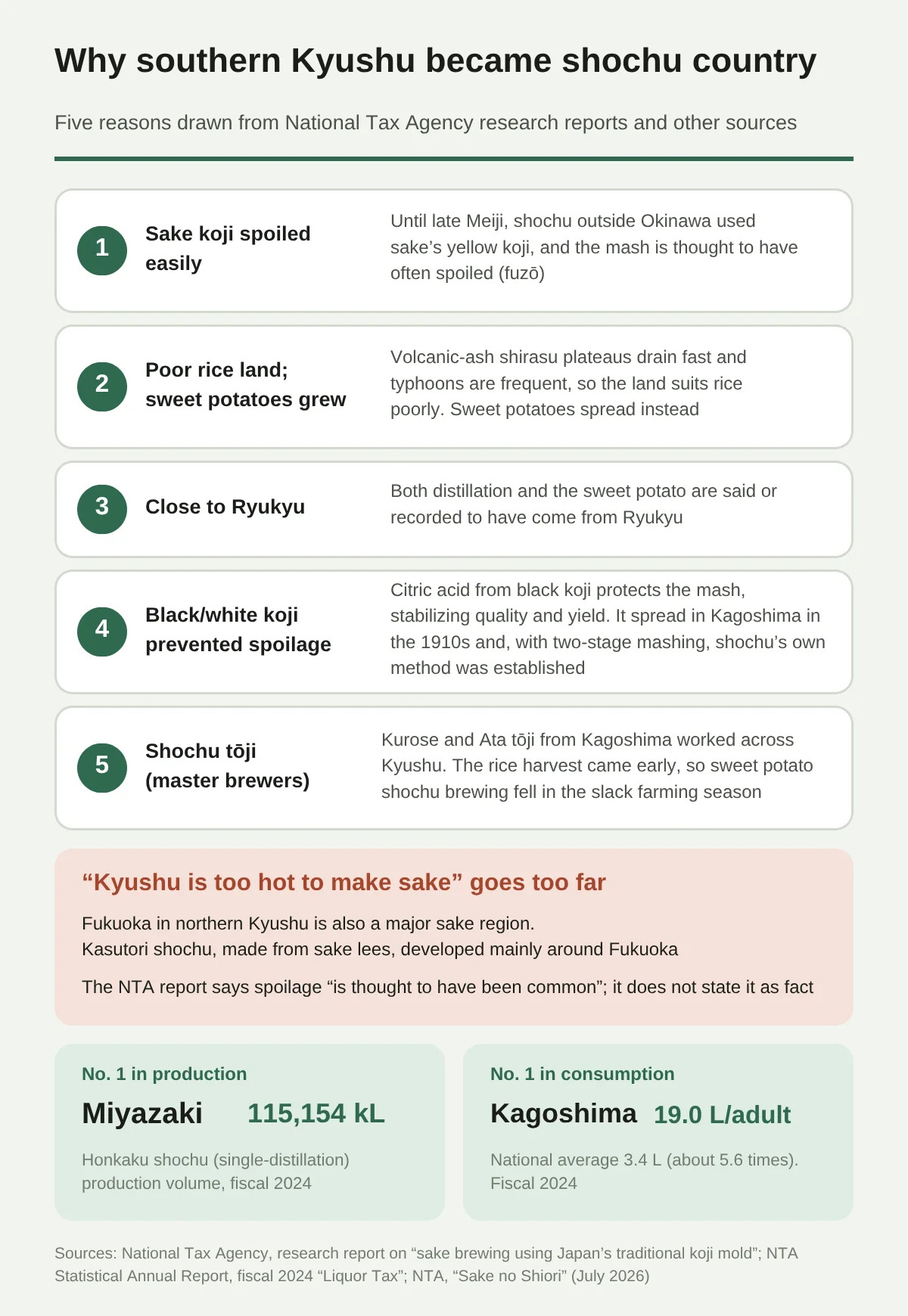
Summarizing the reasons southern Kyushu became shochu country from National Tax Agency survey reports and other sources, we get the following.
| Reason | Details |
|---|---|
| Sake koji spoiled easily | Until the end of the Meiji era, shochu outside Okinawa also used the same yellow koji as sake, and it is thought that spoilage of the moromi by bacteria (“fuzō”) was frequent. It is also explained that koji mold suits a warm climate |
| Rice was hard to grow, and sweet potatoes thrived | The Shirasu Plateau of volcanic ash drains well and typhoons are frequent, so it is not very suited to growing rice. Sweet potatoes spread instead. Satsuma lacked rice and bought it from other domains |
| It was close to the Ryukyus | There are theories and records that both the technique of distillation and the sweet potato came from the Ryukyus |
| Black koji and white koji made spoilage-resistant methods possible | The citric acid of black koji protects the moromi, stabilizing quality and quantity. It spread in Kagoshima in the 1910s, and together with two-stage mashing established the distinctive way of making shochu |
| There were shochu toji (master brewers) | The Kurose toji and Ata toji of Kagoshima worked all around Kyushu. Because rice was harvested early, in late July to early August, to avoid typhoons, the sweet potato shochu mashing fell in a slack period for farm work |
“Kyushu is too hot to make sake” is an overstatement
- The National Tax Agency report is worded as “spoilage is thought to have been frequent” and does not state it as fact
- Fukuoka in northern Kyushu is sake country. “Kasutori shochu,” made from sake lees, developed mainly in Fukuoka
- The areas that are shochu country are especially southern Kyushu (Kagoshima, Miyazaki), Oita (barley), Kumamoto’s Kuma region (rice), and Nagasaki’s Iki (barley)
- In Kagoshima, sake consumption per adult is 1.1 L a year, the lowest in Japan, but it has been reported that some breweries in Kagoshima have revived sake making
Kyushu in numbers
- The prefecture that makes the most honkaku shochu (single-distilled shochu) is Miyazaki, in first place, with Kagoshima second. The 4 prefectures of Kumamoto, Oita, Miyazaki, and Kagoshima account for about 84% of the national total
- Consumption per adult is highest in Kagoshima (19.0 L), about 5.6 times the national average (3.4 L)
- In the Ministry of Internal Affairs and Communications’ Family Income and Expenditure Survey (average of 2023–2025), the city with the highest spending on shochu is Miyazaki City (12,067 yen a year), and second is Kagoshima City (11,351 yen)
- Whether “Japan’s No. 1 in shochu consumption” is Kagoshima or Miyazaki depends on which figure is used for comparison
- Kagoshima has 110 honkaku shochu breweries, the most of any prefecture (Kagoshima Prefecture materials)
Premium shochu
Moriizo, Maou, and Murao (the “3M”)
The three sweet potato shochu Moriizo, Maou, and Murao are called the “3M” because their names begin with M in Roman letters, and during the shochu boom of the 2000s they were known as shochu that was hard to get (who started calling them this, and when, is not clear).
| Brand | Brewery (location) | Ingredient | Why it is hard to get and how it is sold |
|---|---|---|---|
| Moriizo | Moriizo Shuzo (Tarumizu City, Kagoshima) | Sweet potato | The isshobin is sold only by telephone lottery (applications from the 15th to the 25th of each month). The brewery says it does not sell over the internet. It is also handled by some department stores, and has been sold on Japan Airlines international flights since 1998 |
| Maou | Shiratama Shuzo (Kinko Town, Kagoshima) | Sweet potato | It is reported that the shops that handle it are limited |
| Murao | Murao Shuzo (Satsumasendai City, Kagoshima) | Sweet potato | It is reported that the amount made is limited |
- The brewery price of a bottle of Moriizo (1,800 ml) is 3,630 yen (tax included) (Moriizo Shuzo official site). On the other hand, it has been reported that on online auctions and the like it can fetch around 10 times that price
- The Moriizo official site states, “We firmly decline applications made for the purpose of resale”
Hyakunen no Kodoku
“Hyakunen no Kodoku” (One Hundred Years of Solitude) from Kuroki Honten in Takanabe, Miyazaki, is a 40% barley shochu made with barley and barley koji and aged for a long time in oak barrels (official site). It is introduced as being named after the novel by García Márquez. Kuroki Honten sells through “designated dealers.”
Why does something become “premium”?
As with premium sake (see the article on the history and culture of sake), what makes it hard to get is that the amount that can be made is small, yet the way it is sold is limited to lotteries and designated dealers. Most of what is sold at high prices is not the price the brewery set, but a resale price.
This site does not recommend buying by any means other than the way the brewery has set, so we do not include sales links for premium shochu.
How to drink shochu and drinking vessels
Oyuwari “rokuyon” (6:4)
The Japan Sake and Shochu Makers Association recommends, for 25% shochu, 6 parts shochu to 4 parts hot water (“rokuyon”). It explains that this gives about 15% alcohol and a temperature about like warmed sake (okan). The advice to “put the hot water in first” is often given, but it is not written on the Association’s official page.
Regional vessels
| Vessel | Region | How it is used |
|---|---|---|
| Kuro-joka (kuro-chiyoka) | Kagoshima | A Satsuma ware earthenware pot. Shochu is put in and slowly warmed over a fire |
| Gara and choku | Kuma-Hitoyoshi, Kumamoto | Vessels once used to warm and drink 35–40% shochu |
| Hato tokkuri | Miyazaki | A sake flask in the shape of a dove |
| Karakara | Okinawa | A vessel for serving awamori |
(Japan Sake and Shochu Makers Association, “Shochu and awamori vessels”)
- In Kagoshima, an evening drink is called “dareyame.” It means “stopping (yameru) the weariness (dare).” In Miyazaki it is called “dareyami”
The kuro-joka (kuro-chiyoka) is a vessel that has been used in Kagoshima to warm shochu.
Shochu overseas
Exports are about 1/23 of sake
(Amounts in Japanese sources are given in oku; 1 oku = 100 million yen. The text below converts them to billions of yen, and the chart keeps the oku figures.)
Shochu exports in 2025 were 1.96 billion yen (19.6 oku), up 13.9% from the previous year. That is about 1.3% of Japan’s total alcohol exports (149.48 billion yen) and about 1/23 of sake (45.88 billion yen).
| Rank | Export destination (2025) | Amount |
|---|---|---|
| 1 | China | 541 million yen |
| 2 | United States | 467 million yen |
| 3 | South Korea | 249 million yen |
| 4 | Taiwan | 138 million yen |
| 5 | Hong Kong | 98 million yen |
How it differs from Korean “soju”
According to a tally by a British trade magazine, the Korean soju brand “JINRO” has been the best-selling spirit in the world for 25 years in a row (per Korean newspaper reports). Mainstream soju is made by diluting high-proof alcohol with water, a type close to Japan’s Class A shochu.
California rules in the United States
From 2024 in California, imported shochu with 24% alcohol or less can be served even at restaurants with a license that lets them serve wine (the state’s Department of Alcoholic Beverage Control). It is not a system for the whole United States.
UNESCO Intangible Cultural Heritage “traditional sake-making”
In December 2024, Japan’s “traditional sake-making” using koji mold was inscribed on UNESCO’s Intangible Cultural Heritage list. The National Tax Agency explains that this technique has been passed down in making sake, shochu, awamori, and mirin, among others.
Shochu trivia
- November 1 is “Honkaku Shochu and Awamori Day”: Because new shochu can be drunk around November 1, it was decided in 1987 by an organization of honkaku shochu producers in Kyushu
- Okinawan awamori also has a place in prayer: The Japan Tourism Agency’s commentary says awamori is offered at sacred sites called utaki, before graves, and at household altars. In northern Kyushu, sake-lees shochu has been the celebration drink after rice planting (sanaburi shochu) (National Tax Agency report). However, what has been offered across Japan as omiki at shrines is mainly sake made from rice
- “Shitamachi no Napoleon” is “Iichiko”: It is often thought to be a catchphrase of Nikaido Shuzo, but it is the copy for Sanwa Shurui’s “Iichiko”
- Shochu tax: The liquor tax on a 1.8-liter bottle of 25% shochu is 450 yen (calculated at the rate from October 2026)
For those who want to know more
For those who want to know more about the history of shochu, there is the following book.
Note Alcohol is for those 20 and older. Drinking by those under 20 is prohibited by law. The products introduced here are not meant to show that they are good for health. Prices and shipping may change (shipping varies by region).
Summary
- The technique of distillation is said to have come from the Ryukyus, the Korean Peninsula, China, and elsewhere; a rice distilled liquor was recorded at Yamakawa in 1546, and the word “shochu” was recorded at a shrine in Isa in 1559
- Southern Kyushu became shochu country because yellow koji spoiled easily, the Shirasu Plateau and typhoons made rice hard to grow while sweet potatoes thrived, and methods were established with black and white koji, among other reasons. Northern Kyushu is also sake country
- Miyazaki is No. 1 in the amount made, and Kagoshima in the amount drunk
- Premium shochu is hard to get because the amount made is small and the way it is sold is limited. The brewery price of Moriizo is 3,630 yen per isshobin
- Exports are about 1/23 of sake. The making of shochu and awamori was also included in the UNESCO Intangible Cultural Heritage listing
Sources
- National Tax Agency, survey report “Sake making using Japan’s traditional koji mold” (history and chronology of shochu and awamori) https://www.nta.go.jp/taxes/sake/koujikin/pdf/0021012-102_04.pdf / https://www.nta.go.jp/taxes/sake/koujikin/pdf/0021012-102_09.pdf
- National Tax Agency, “Sake no Shiori” (Liquor Handbook), July 2026 (trends in taxed volume; consumption volume by prefecture) https://www.nta.go.jp/taxes/sake/shiori-gaikyo/shiori/2026/index.htm
- National Tax Agency Statistics Annual Report, fiscal 2024, “Liquor Tax” https://www.nta.go.jp/publication/statistics/kokuzeicho/sake2024/xls/08_suryo.xlsx
- National Tax Agency, “Recent trends in exports of Japanese alcoholic beverages” (February 2026) https://www.nta.go.jp/taxes/sake/shiori-gaikyo/shiori/2026/pdf/35.pdf / “Main export destinations by type of alcohol (2025)” https://www.nta.go.jp/taxes/sake/shiori-gaikyo/shiori/2026/pdf/37.pdf
- National Tax Agency, “UNESCO Intangible Cultural Heritage: Traditional Sake-making” https://www.nta.go.jp/traditional_sake_making/index.htm
- National Tax College, tax history materials, “Becoming No. 1 in national taxes” https://www.nta.go.jp/about/organization/ntc/sozei/tokubetsu/h21shiryoukan/03.htm
- Kagoshima Prefecture Gazette, April 17, 2015 (prefectural designation of the ink-inscribed wooden piece bearing the word “shochu,” held by Koriyama Hachiman Shrine) https://www.pref.kagoshima.jp/ab04/kensei/jourei/kouhou/1504/documents/45047_20150417160758-1.pdf
- Kagoshima Prefecture, “Nationally designated Important Cultural Property: Koriyama Hachiman Shrine” https://www.pref.kagoshima.jp/suisuinavi/25016.html / Isa City, “The ‘shochu’ ink inscription at Koriyama Hachiman Shrine” https://www.city.isa.kagoshima.jp/?p=60833
- Kagoshima Prefecture, “Top items in consumption spending ranking for Kagoshima City” (Ministry of Internal Affairs and Communications Family Income and Expenditure Survey) https://www.pref.kagoshima.jp/ac09/tokei/bunya/bukka/kakei/joirank.html
- Kagoshima Prefecture, “Outline of the local industry growth plan for honkaku shochu and others (liquor manufacturing)” https://www.pref.kagoshima.jp/ac11/kensei/keikaku/chihousousei/documents/130219_20260908134626-1.pdf
- Agriculture & Livestock Industries Corporation, “Changes in the starch industry” https://www.alic.go.jp/content/000073292.pdf
- Cabinet Office, Government Public Relations, “HIGHLIGHTING JAPAN,” March 2025 issue, “Shochu making in Kagoshima Prefecture” https://www.gov-online.go.jp/hlj/ja/march_2025/march_2025-05.html
- Japan Sake and Shochu Makers Association, “Honkaku shochu and awamori” (Q&A, how to drink shochu, vessels) https://www.honkakushochu-awamori.jp/
- Japan Tourism Agency, Multilingual Commentary Database of Regional Tourism Resources, “Sacred Liquor” (awamori) https://www.mlit.go.jp/tagengo-db/common/001554342.pdf
- Moriizo Shuzo official site https://www.moriizo.com/
- Kuroki Honten, “Shochu” https://www.kurokihonten.co.jp/shochu
- All About, “Premium Shochu 3M” (2022) https://allabout.co.jp/gm/gc/225339/
- California ABC “New Alcoholic Beverage Laws” https://www.abc.ca.gov/new-alcoholic-beverage-laws/
- Korea JoongAng Daily, “Jinro named world’s top-selling spirit for 25th straight year” (July 3, 2026) https://www.koreajoongangdaily.com/business/hite-jinros-jinro-brand-named-worlds-topselling-spirit-for-25th-straight-year-new-chamisul-fresh-soju-leads-domestic-spirit-trends/12753780
Related articles and databases
- Types of Shochu: Class A, Class B, Honkaku Shochu, and Awamori Explained, with a Popularity Ranking, Using National Tax Agency Materials
- Is Shochu Good for Your Health? Checking “Zero Sugar,” “Zero Purines,” “Thin Blood,” Weight Gain, and Hangovers Against Food Composition Tables and Studies
- Why Is Sake Sacred? Its History, Shinto, Famous Regions, Premium Bottles, and Popularity Overseas, Read Through Government Sources
- Where Did Beer Come From? 10,000 Years of History and the World Beer Consumption Ranking (China #1 in Total, Czechia #1 per Capita), and Where Japan Stands, Read Through Papers and Government Statistics