
Is Shochu Good for Your Health? Checking “Zero Sugar,” “Zero Purines,” “Thin Blood,” Weight Gain, and Hangovers Against Food Composition Tables and Studies

PR This article contains affiliate links to Rakuten Ichiba (“See on Rakuten”). What is written here is based on government materials, the food composition table, and studies, whether or not there are ads. Drink alcohol only after age 20. The “See on Yahoo! Shopping” and “See on Amazon.co.jp” links are also affiliate links.
“Shochu has zero sugar, so it won’t make you fat.” “It has zero purines, so it’s fine even with gout.” “Honkaku shochu dissolves blood clots.” “Distilled spirits don’t give you hangovers.” Shochu has an image as a gentle drink for the body.
In this article, we check the following against MEXT’s food composition table, MHLW materials, and studies.
- What is in shochu, and whether “zero sugar” and “zero purines” are true
- How much alcohol you take in with one drink
- How far claims such as “thin blood,” “good for gout,” “doesn’t raise blood sugar,” “won’t make you fat,” and “less likely to cause a hangover” have been verified
Shochu types and the popularity ranking are in our article on types of shochu. Why Kyushu became shochu country and premium shochu are in our article on shochu history and Kyushu. For nihonshu (sake), see our article on nihonshu and health.
Conclusion
- Shochu has almost zero sugar and almost zero purines (in the food composition table, carbohydrates are 0 g, and purines are 0.0 mg per 100 ml). However, it is not zero calories. One go (180 ml) of 25% shochu is about 250 kcal, more than one go of nihonshu (about 190 kcal).
- The pure alcohol in one go of 25% shochu is 36 g, about 1.7 times that of one go of nihonshu (about 22 g). Even when diluted, if the amount of shochu poured into the glass is the same, the amount of alcohol does not change.
- Human studies behind the story that “honkaku shochu dissolves blood clots” come from almost a single research group, with no detailed explanation of the study design, and no follow-up studies by other groups can be found. Some papers have co-authors who are employees of a manufacturer.
- Even without purines, drinking shochu raises uric acid levels (a survey of about 78,000 Japanese people). The rise is smaller than with beer, according to the results.
- “No sugar, so blood sugar is less likely to rise” comes from short trials with a handful of people, and there is no study showing that shochu is good for diabetes. For lean Japanese men, there is a report that drinking is a risk factor for diabetes.
- No study checking “less likely to cause a hangover” with shochu in people can be found. The biggest cause of a hangover is the amount of alcohol drunk.
What Is Featured in This Article
Within the article, the following are introduced to match the points being discussed (these are Rakuten Ichiba links).
| For people who… | What is introduced | Where |
|---|---|---|
| Want to know how much shochu goes into one drink | Hot-water glass with measurement marks, shochu-and-soda glass (with guide lines) | Tools for measuring amounts |
| Want to enjoy shochu’s aroma without alcohol | Non-alcoholic sweet potato shochu-flavored drink (Kozuru ZERO) | For days you don’t want alcohol |
What Is in Shochu?
Contents According to the Food Composition Table
MEXT’s “Standard Tables of Food Composition in Japan (Eighth Revised Edition), 2023 Supplement” lists three kinds of shochu. Values are per 100 g.
| Per 100 g | Single-distilled shochu (25%) | Continuous-distilled shochu (35%) | Awamori (35.4%) |
|---|---|---|---|
| Energy | 144 kcal | 203 kcal | 206 kcal |
| Water | 79.5 g | 71.0 g | 70.6 g |
| Alcohol | 20.5 g | 29.0 g | 29.3 g |
| Carbohydrate | 0 g | 0 g | 0 g |
| Protein and fat | 0 g | 0 g | Almost 0 (trace) |
- Single-distilled shochu is what is called honkaku shochu (sweet potato, barley, rice, and so on), and continuous-distilled shochu is what is called korui (Class A) shochu (the base for chuhai, etc.) (details in our article on types of shochu).
- Almost all of shochu’s energy comes from alcohol. The table calculates alcohol at 7 kcal per gram, so 20.5 g × 7 ≈ 144 kcal.
Is “Zero Sugar” True?
In the table, every shochu has 0 g of carbohydrate. This is because the sugars of the raw ingredients, such as sweet potato and barley, do not come over into the spirit during distillation. Kokuto shochu, made with brown sugar, also leaves no sugar in the distilled spirit.
However, under the law, “nothing can be added to shochu” is not the case.
- Under the Liquor Tax Act, korui shochu (continuous-distilled shochu) and some single-distilled shochu that have a little sugar, acid, or the like added (extract content under 2 degrees) are also counted as shochu.
- What can be labeled “honkaku shochu” is made only from designated ingredients such as grains, potatoes, and koji, with nothing but water added after distillation (details in our article on types of shochu).
If you want to confirm that no sugar has been added, look for the “honkaku shochu” label.
Is “Zero Purines” True?
According to measured values published by the Gout and Uric Acid Foundation of Japan (2006), the purines per 100 ml of alcohol are as follows.
| Drink | Purines (mg / 100 ml) |
|---|---|
| Shochu 25% | 0.0 |
| Whisky | 0.1 |
| Wine | 0.4 |
| Nihonshu | 1.2 |
| Beer | 3.3–6.9 |
| Shaoxing wine | 11.6 |
Shochu’s purines are almost zero in measurement. However, this does not mean it is “fine even with gout.” We explain why in a later section.
How Much Alcohol Is in One Drink?
Calculating Pure Alcohol
The MHLW’s “Guidelines on Alcohol Consumption with Health Considerations” (February 2024) recommend thinking about the amount of alcohol in grams of pure alcohol. The formula is as follows.
Amount drunk (ml) × alcohol content ÷ 100 × 0.8 = pure alcohol (g)
The same guidelines define 40 g or more of pure alcohol a day for men and 20 g or more for women as “amounts that raise the risk of lifestyle-related diseases” (with a note that this does not mean amounts below that are safe).
- Drinking 1 go (180 ml) of 25% shochu gives 36 g of pure alcohol. That is about 1.7 times one go of nihonshu, nearly the 40 g for men, and 1.8 times the 20 g for women.
- With 25% shochu, 100 ml gives 20 g.
Diluting It Doesn’t Change the Amount of Alcohol
Shochu is often drunk as oyuwari (with hot water), mizuwari (with cold water), or with soda. Diluting lowers the alcohol content and makes it easier to drink, but if the amount of shochu in the glass is the same, the pure alcohol does not change.
| How it is drunk | Contents of one drink | Pure alcohol |
|---|---|---|
| Oyuwari 6:4 (rokuyon) | 90 ml shochu + 60 ml hot water | 18.0 g |
| Mizuwari 5:5 | 90 ml shochu + 90 ml water | 18.0 g |
| 1 go of maewari (diluted 6:4 and left to rest) | Equivalent to 108 ml of shochu | 21.6 g |
| 1 go of 30% awamori on the rocks | 180 ml awamori | 43.2 g |
| 1 go of 43% aged awamori (kusu) on the rocks | 180 ml awamori | 61.9 g |
Three glasses of oyuwari is 270 ml of shochu alone, or 54 g of pure alcohol. One go of 43% aged awamori exceeds the “60 g or more at one time” that the guidelines say to avoid.
Tools for Measuring Amounts
The pure alcohol in shochu is determined by “the amount of shochu poured into the glass.” If you dilute by eye, the amount of shochu tends to creep up without your noticing. With a glass that has measurement marks, you can tell how much shochu went into one drink.
How Far Have the “Good for the Body” Claims Been Verified?
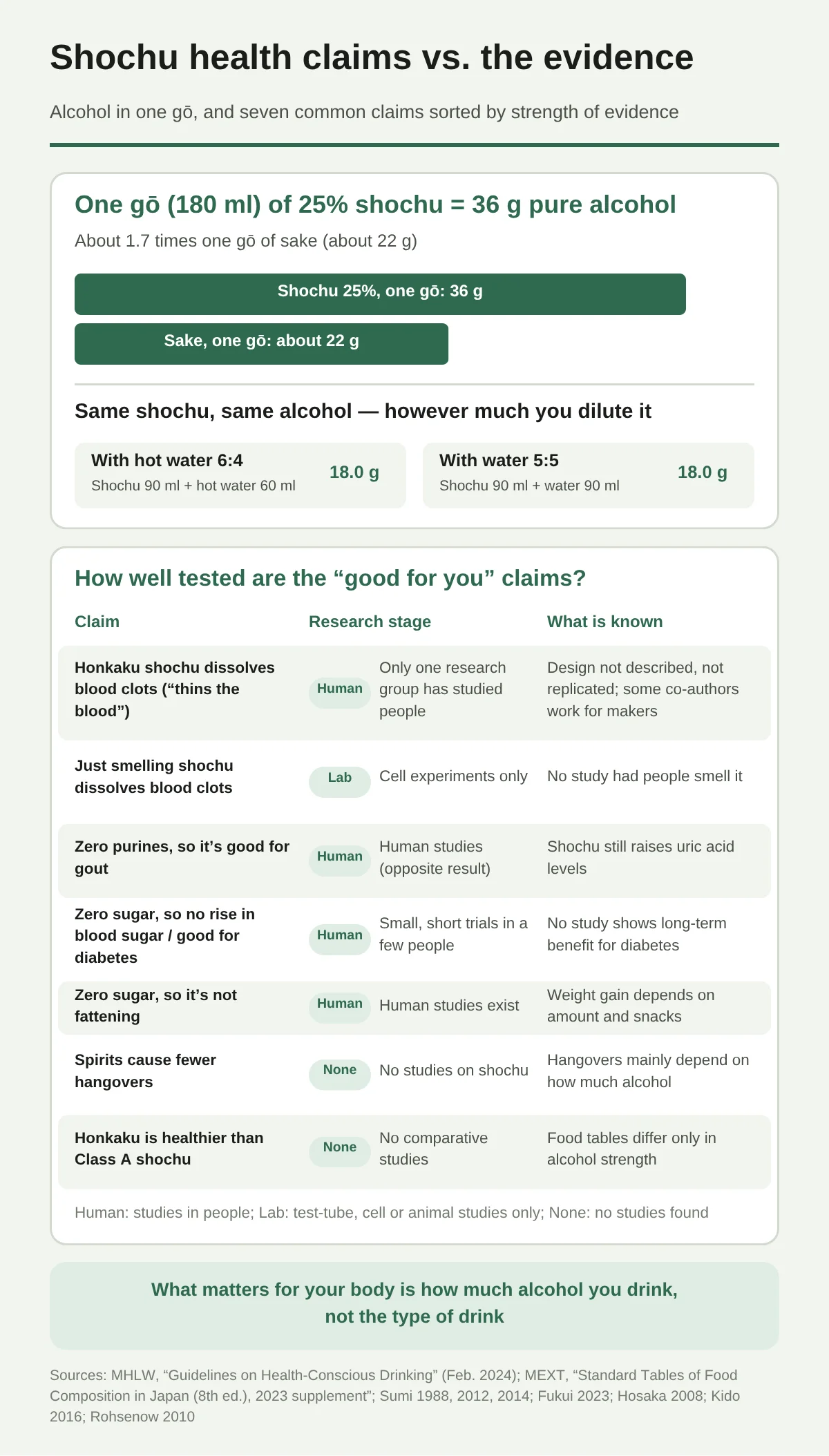
If we sort the health claims about shochu by the strength of the research, we get the figure below. After the figure, we look at them one by one.
“Thin Blood”: Honkaku Shochu and the Clot-Dissolving Enzyme
The source of the story that “drinking honkaku shochu increases the enzymes that dissolve blood clots (urokinase and t-PA)” is research by Hiroyuki Sumi (Miyazaki Medical College, later Kurashiki University of Science and the Arts) and colleagues.
- A 1988 paper reported that about 1 hour after drinking shochu, nihonshu, or beer, the blood’s “clot-dissolving power” rose, by about 2.1 times with shochu. However, the abstract has no explanation of the number of people or how comparisons were made.
- A 2014 review (a summary of research) presents a figure in which 62 people drank alcohol and the values 1 hour later were “no drink 478, beer 712, nihonshu 855, honkaku shochu 1160.” The commonly cited “about 2.4 times” is 1160 ÷ 478 from this figure. However, there is no explanation of whether the drinks were assigned by lottery or whether the same people were compared, and the figure’s labels and the text’s explanation do not agree.
In addition, the following points need attention.
- The human studies come from almost this one research group, and a PubMed search found no follow-up studies by other groups.
- The 2012 paper includes two researchers from a barley shochu maker (Sanwa Shurui) as co-authors (based on the affiliations listed in other papers by the same two people). In 2001, the group also received a commission from a prefectural industry support organization for “elucidating the functionality of shochu and developing new products.”
- It has been reported that alcohol itself can temporarily move an indicator of “clot-dissolving power” with drinks other than shochu as well. In a trial of 8 people in the Netherlands and in a study pooling 63 trials (2011), wine, beer, and spirits gave similar results.
There is currently no study that can say “only honkaku shochu dissolves blood clots in a special way.” On the other hand, the MHLW guidelines state that the amount at which the risk of cerebral infarction rises starts at about 40 g a day for men and 11 g a day for women.
“Just Smelling the Aroma” Comes from Cell Experiments
The story that “just smelling the aroma of shochu dissolves blood clots” is based on an experiment by the same research group in which an aroma component of shochu (β-phenethyl alcohol) was added to cultured cells. The review says that “the development of aromatherapy that raises t-PA just by smelling the aroma may one day become a reality,” but no study in which people smelled the aroma could be found.
Gout: Uric Acid Rises Even with Zero Purines
The MHLW’s health information site lists three ways that alcohol raises uric acid levels.
- When alcohol is broken down, purines increase in the body and become uric acid.
- Uric acid becomes harder to excrete from the body.
- You take in purines from the snacks.
In other words, even if the alcohol itself has no purines, alcohol raises uric acid levels. That is also what actual surveys show.
- In a survey of about 78,000 Japanese people (2023), for every additional 20 g of pure alcohol a day (100 ml for 25% shochu), uric acid was 0.08 mg/dL higher in men and 0.09 mg/dL higher in women even with shochu, a statistically clear difference.
- The rise is smaller than with beer, according to the results.
- In a study that followed about 47,000 American men for 12 years (2004), for each additional drink of spirits a day, the risk of developing gout was 1.15 times (1.49 times for beer).
There is no study saying “shochu is good for gout.” The MHLW’s health information site also says that “it is important to keep to an appropriate amount of drinking with any type of alcohol.”
Blood Sugar and Diabetes: “Less Likely to Rise” Comes from Trials of a Handful of People
- In a trial of 6 men with diabetes (2008), blood sugar rose after beer and nihonshu but not after shochu. The authors say that “the rise in blood sugar is due to the sugar in the alcohol.”
- In a trial of 6 healthy people (analysis of 5) (2016), shochu drunk with dinner also raised blood sugar less than beer. Most of the authors of this study are from the shochu and fermentation laboratory at Kagoshima University (the endowed course that the laboratory grew out of was created with donations from the prefecture and the shochu industry).
Because shochu has no sugar, not raising blood sugar through the alcohol’s sugar is a natural result judging from its composition. As for the longer-term risk of diabetes, however, there are the following reports.
- In a study pooling 38 studies and 1.9 million people (2015), the association of fewer diabetes cases with light drinking was seen in women only and was not seen in Asian people.
- In a study that followed about 29,000 Japanese people for 10 years (JPHC Study, 2005), among lean men with a BMI of 22 or less, people who drank 23 g or more a day developed diabetes more often.
It cannot be said that “shochu is good for diabetes.”
Does It Make You Fat? Zero Sugar but Not Zero Calories
| One drink | Energy (approx.) |
|---|---|
| 1 go (180 ml) of 25% shochu | About 250 kcal |
| 1 go of nihonshu | About 190 kcal |
| Beer, medium bottle (500 ml) | About 200 kcal |
| 100 ml of 25% shochu (20 g pure alcohol) | About 140 kcal |
(Calculated from the per-100 g values in the Food Composition Table, Eighth Revised, 2023 Supplement.)
- When pure alcohol is matched (per 20 g), shochu has less energy than beer or nihonshu. But comparing one go to one go, shochu has more.
- It is sometimes said that “alcohol calories are empty calories, so they don’t make you fat,” but empty calories means “calories without nutrients such as vitamins,” and does not mean they don’t enter the body.
- In a trial of 8 healthy men (1992), when they took alcohol, the body’s fat was burned less during that time.
- In a study pooling 127 studies (2022), heavy drinking above 28 g a day was associated with more overweight and obesity.
As with nihonshu, whether you gain weight depends on how much you drink and what you eat with it (our article on nihonshu and health).
Hangovers: No Studies with Shochu
There is a theory that “distilled spirits have few impurities, so they are less likely to cause a hangover.”
- In an American trial (2010, 95 people), bourbon, which has many aroma components (congeners), left people feeling slightly worse the next morning than vodka, which has almost none. However, there was no difference in next-day attention or reaction speed.
- Summaries of the research say that the biggest cause of a hangover is alcohol itself, and the effect of aroma components is far smaller.
- Applying this idea to shochu, korui (continuous-distilled) shochu is made in a still that removes impurities, so it is close to vodka, while honkaku shochu, if anything, has more aroma components.
- A PubMed search found no human study that compared hangovers from shochu with other alcohol.
Korui or Honkaku Shochu: Which Is Better for You?
No human study directly comparing the health effects of korui and honkaku shochu could be found. The only difference in the composition table is the alcohol content; both have zero sugar, fat, and protein.
Amount Matters More Than Type of Alcohol
- The International Agency for Research on Cancer (IARC) classifies ethanol (alcohol) itself in alcoholic drinks as Group 1, “carcinogenic to humans.”
- The World Cancer Research Fund (WCRF) says that “all types of alcoholic drinks affect cancer risk in the same way.”
Details are in our article on types of alcohol and cancer.
Canned Chuhai and Strong-Type Drinks
Shochu (mainly korui) is also the base for canned chuhai and sours.
| Can | Pure alcohol | Notes |
|---|---|---|
| 7%, 350 ml | 19.6 g | Canned chuhai (lemon flavor) in the food composition table has 2.9 g of carbohydrate per 100 g |
| 9% (strong type), 350 ml | 25.2 g | Over 20 g for women from this one can |
| 9% (strong type), 500 ml | 36.0 g | Same as 1 go of 25% shochu |
- In a survey of about 28,000 people nationwide (2023), people who drank strong-type drinks were more likely to have hazardous drinking patterns (AUDIT score of 8 or more). In a survey that followed people for 3 years (2026), people who started drinking them were more likely to become hazardous drinkers the next year.
- In February 2024, Asahi Breweries and Sapporo Breweries announced a policy of not releasing new products with an alcohol content of 8% or more (sales of existing products are said to continue).
- If you mix with green tea, oolong tea, sparkling water, or hot water, sugar barely increases. Sweet canned chuhai contains both alcohol and sugar.
What You Can Do If You Drink
- Count by the amount of shochu: With 25%, 100 ml is 20 g of pure alcohol. For oyuwari, what matters is not “how many glasses” but “how many ml of shochu went in.”
- Less of high-proof drinks: Awamori and aged awamori are 30–43%. One go comes to 40–60 g.
- Water alongside: The MHLW guidelines give mixing in water to lower the alcohol content and choosing drinks without alcohol as examples of consideration.
For Days You Don’t Want Alcohol
For days when you like the aroma of shochu but don’t want alcohol, there are non-alcoholic “sweet potato shochu-flavored drinks.”
Note Drink alcohol only after age 20. Drinking under 20 is prohibited by law. The products introduced here do not indicate any health benefit. Prices and shipping fees may change (shipping varies by region).
Summary
- Shochu has almost zero sugar and purines. But it does have calories, about 250 kcal for 1 go of 25%.
- The pure alcohol in 1 go of 25% shochu is 36 g, about 1.7 times that of 1 go of nihonshu. Even when diluted, the alcohol is the same if the amount of shochu is the same.
- “Honkaku shochu dissolves blood clots” rests only on studies from almost a single research group, with insufficient explanation of design. There are no follow-up studies, and there are ties to manufacturers.
- Even without purines, shochu raises uric acid levels. There is also no study showing that it is good for diabetes or less likely to cause a hangover.
- What determines the effect on the body is the amount of alcohol drunk, more than the type of alcohol.
Sources
- MEXT, “Standard Tables of Food Composition in Japan (Eighth Revised Edition), 2023 Supplement,” Food Composition Database (16014 continuous-distilled shochu, 16015 single-distilled shochu, 16060 awamori) (in Japanese) https://fooddb.mext.go.jp/
- MHLW, “Guidelines on Alcohol Consumption with Health Considerations” (February 2024) (in Japanese) https://www.mhlw.go.jp/stf/newpage_38541.html
- MHLW, Health Information Site, “Alcohol and Hyperuricemia/Gout” (in Japanese) https://kennet.mhlw.go.jp/information/information/alcohol/a-01-012.html
- Gout and Uric Acid Foundation of Japan, “Purine Content in Alcoholic Beverages” (in Japanese) https://www.tufu.or.jp/gout/gout4/73
- Liquor Tax Act, Article 3, items 9 and 10 (e-Gov Law Search) https://laws.e-gov.go.jp/law/328AC0000000006 / Tokyo Regional Taxation Bureau, “About Shochu” https://www.nta.go.jp/about/organization/tokyo/sake/abc/abc-shochu.htm (in Japanese)
- Sumi H, et al. Urokinase-like plasminogen activator increased in plasma after alcohol drinking. Alcohol Alcohol. 1988;23(1):33-43. PMID: 3128990
- Sumi H. “Novel functions of the aroma components of shochu: release of t-PA and inhibition of platelet aggregation.” J Brew Soc Japan 109(3):137-146, 2014 (in Japanese). DOI: 10.6013/jbrewsocjapan.109.137
- Sumi H, et al. Shochu aroma increases t-PA activity, and decreases platelet aggregation activity. Nihon Arukoru Yakubutsu Igakkai Zasshi (Japanese Journal of Alcohol Studies & Drug Dependence) 2012;47(2):75-81. PMID: 22746039
- Hendriks HF, et al. Effect of moderate dose of alcohol with evening meal on fibrinolytic factors. BMJ. 1994;308:1003-6. PMID: 8167511
- Brien SE, et al. Effect of alcohol consumption on biological markers associated with risk of coronary heart disease. BMJ. 2011;342:d636. PMID: 21343206
- Fukui S, et al. Differences in the Association Between Alcoholic Beverage Type and Serum Urate Levels Using Standardized Ethanol Content. JAMA Netw Open. 2023;6(3):e233398. PMID: 36930152
- Choi HK, et al. Alcohol intake and risk of incident gout in men: a prospective study. Lancet. 2004;363:1277-81. PMID: 15094272
- Hosaka S, et al. The short-term effect of alcoholic beverage-intake on blood glucose levels in type 2 diabetic patients. Diabetes Res Clin Pract. 2008;79(2):183-4. PMID: 17897751
- Kido M, et al. Acute effects of traditional Japanese alcohol beverages on blood glucose and polysomnography levels in healthy subjects. PeerJ. 2016;4:e1853. PMID: 27069795
- Knott C, et al. Alcohol Consumption and the Risk of Type 2 Diabetes. Diabetes Care. 2015;38(9):1804-12. PMID: 26294775
- Waki K, et al. Alcohol consumption and other risk factors for self-reported diabetes among middle-aged Japanese (JPHC). Diabet Med. 2005;22(3):323-31. PMID: 15717882
- Suter PM, et al. The effect of ethanol on fat storage in healthy subjects. N Engl J Med. 1992;326(15):983-7. PMID: 1545851
- Golzarand M, et al. Association between alcohol intake and overweight and obesity. Crit Rev Food Sci Nutr. 2022;62(29):8078-8098. PMID: 33998940
- Rohsenow DJ, et al. Intoxication with bourbon versus vodka. Alcohol Clin Exp Res. 2010;34(3):509-18. PMID: 20028364 / Rohsenow DJ, Howland J. The role of beverage congeners in hangover. Curr Drug Abuse Rev. 2010;3(2):76-9. PMID: 20712591
- Yoshioka T, et al. Strong chū-hai and hazardous alcohol use. Alcohol Clin Exp Res. 2023;47(2):285-295. PMID: 36478596
- IARC Monographs Volume 100E (2012) / World Cancer Research Fund, “Limit alcohol consumption” https://www.wcrf.org/research-policy/evidence-for-our-recommendations/limit-alcohol-consumption/
- Business Insider Japan, “Asahi and Sapporo Will Not Release New Products with an Alcohol Content of 8% or More” (February 14, 2024) (in Japanese) https://www.businessinsider.jp/post-282558
Related articles and databases
- Types of Shochu: Class A, Class B, Honkaku Shochu, and Awamori Explained, with a Popularity Ranking, Using National Tax Agency Materials
- Why Is Kyushu Shochu Country? The History of Shochu, Premium Shochu (Moriizo, Maou, Murao), and Its Spread Overseas, Read Through Government Documents
- Is Sake Good for Your Health? Checking Ingredients, Calories, Weight Gain, and the Comparison with Shochu Against Public Data and Studies
- Is Beer Bad for You? Gluten in Barley, Purines, "Zero Carbs," Brewer's Yeast and Virility, and "Beer Belly," Checked Against Food Tables and Studies