
Is Beer Bad for You? Gluten in Barley, Purines, "Zero Carbs," Brewer's Yeast and Virility, and "Beer Belly," Checked Against Food Tables and Studies

PR This article contains affiliate links to Rakuten Ichiba, Amazon, Yahoo! Shopping, A8.net and Moshimo Affiliate. What is written here is based on government documents, food composition tables, laws and studies, whether or not there is advertising. Alcohol is for people aged 20 and over. The “See on Amazon.co.jp” links are also affiliate links.
“Beer is made from grain. But if it’s barley, there’s no gluten, right?” “Does drinking brewer’s yeast boost virility?” “If it’s purine-free, is it okay with gout?” “Is a beer belly real?” There are many stories about beer and the body.
This article checks the following against the Standard Tables of Food Composition in Japan (MEXT), documents from MHLW and the Consumer Affairs Agency, the laws of several countries, and published studies.
- What is in beer. What do “rich in B vitamins” and “zero carbs” actually mean?
- Whether barley beer contains gluten, and how the labeling rules differ in Japan, the EU and the US
- Whether brewer’s yeast boosts virility
- Purines, gout, beer belly, hangovers, and the claims that beer is “good for you”: how far have they been confirmed?
For beer styles, how beer is made, and how to read the label, see the article on beer types. For the history of beer and world consumption, see the article on beer history and the world.
Summary
- Barley also has a gluten-family protein (hordein), and it remains in beer. In a study by an Australian research institute that tested 60 brands, hordein was found in every beer made from barley. In Japan, barley falls outside the “wheat” allergen labeling, and alcoholic drinks have no allergen-labeling obligation at all
- I found no human trial testing whether brewer’s yeast raises virility (0 trials). The effects listed for the brewer’s yeast tablet “Ebios tablets” are stomach and gut complaints and nutritional supplementation. On the other hand, a pooled analysis of more than 10,000 people found that long-term drinking lowers male hormone (testosterone)
- About two-thirds of the energy in beer comes from alcohol. Vitamin B1 is zero
- The pure alcohol in 500 ml of 5% beer is 20 g. One can reaches the amount that the MHLW guidelines call “the amount that raises the risk of lifestyle-related diseases” for women
- The purines in 350 ml of beer are 3 to 6% of the daily guideline (400 mg). What affects gout is alcohol itself more than purines, and uric acid can rise even with purine-free beer
- Claims that beer is “good for bones,” “helps you sleep,” “feminizes,” or “is good for the heart” all fall into one of these: observational studies only, trials of a dozen or so people, industry funding, or amounts off by orders of magnitude. There is no research that gives a reason to drink beer
- “Beer belly” is not specific to beer; it was the result of overall weight gain. “Wine after beer makes you sicker” also showed no difference in a randomized trial
What this article introduces
Within the article, the following are introduced to match the points being made.
| For people who | What is introduced | Where |
|---|---|---|
| Want to know whether they hold alcohol well or poorly (constitution) | A mail-in test kit for alcohol constitution (EBS) | The flushing constitution |
| Want to avoid gluten but still enjoy the taste of beer | 100% rice gluten-free beer (ORYVIA) / beer made from barley and treated with enzymes (Daura Damm) | Beer for people who want to avoid gluten |
| Want to know what a brewer’s yeast tablet is | Ebios tablets (dried yeast tablets) | Brewer’s yeast tablets |
| Want the taste of beer without alcohol | Non-alcoholic beer whose only ingredients are malt and hops (Ryoma 1865) | For days when you don’t want alcohol |
What is in beer?
What the food composition table shows
The Ministry of Education, Culture, Sports, Science and Technology (MEXT)’s “Standard Tables of Food Composition in Japan (8th Revised Edition), 2023 Supplement” lists three beers and happoshu (low-malt beer). Values are per 100 g.
| Per 100 g | Beer, pale | Beer, dark | Stout | Happoshu |
|---|---|---|---|---|
| Energy | 39 kcal | 45 kcal | 62 kcal | 44 kcal |
| Alcohol | 3.7 g | 4.2 g | 5.9 g | 4.2 g |
| Carbohydrate | 3.1 g | 3.6 g | 4.9 g | 3.6 g |
| Protein | 0.3 g | 0.4 g | 0.5 g | 0.1 g |
| Fat | 0 | trace | trace | 0 |
| Potassium | 34 mg | 55 mg | 65 mg | 13 mg |
| Vitamin B1 | 0 | 0 | 0 | 0 |
| ABV (vol%) | 4.6% | 5.3% | 7.6% | 5.3% |
- “Pale” means ordinary golden beer (this includes nama (unpasteurized) beer)
- Carbohydrate (sugar) in 350 ml is about 11 g (pale)
Two-thirds of the energy is alcohol
The composition table calculates alcohol at 7 kcal per gram. The 3.7 g of alcohol in 100 g of pale beer is about 26 kcal, so about two-thirds (66%) of the 39 kcal comes from alcohol.
| Per 350 ml | Energy | Carbohydrate | Pure alcohol |
|---|---|---|---|
| Beer, pale | about 138 kcal | about 10.9 g | 12.9 g |
| Beer, dark | about 159 kcal | about 12.7 g | 14.8 g |
| Stout | about 221 kcal | about 17.5 g | 21.3 g |
| Happoshu | about 155 kcal | about 12.7 g | 14.8 g |
| Non-alcoholic beer | about 18 kcal | about 4.2 g | 0 |
(Calculated from the composition table values. Pure alcohol is calculated from the ABV in the table)
Is “beer is rich in B vitamins” true?
Beer contains small amounts of niacin, vitamin B6 and folate. However, vitamin B1 is zero. The amounts in 350 ml of pale beer, compared with the “nutrient reference values” used in food labeling (a guide to daily requirements), are as follows (calculated).
| Amount in 350 ml of pale beer | % of reference value |
|---|---|
| Niacin 2.8 mg | 22% |
| Vitamin B6 0.18 mg | 14% |
| Folate 24.7 μg | 10% |
| Vitamin B12 0.35 μg | 9% |
| Vitamin B2 0.07 mg | 5% |
| Potassium 120 mg | 4% |
| Vitamin B1 0 | 0% |
It is not “rich in B vitamins” by any stretch, and B1 is not present at all.
What does “zero carbs” mean?
- Alcoholic drinks have no obligation to show nutrition information (Food Labeling Standards). But when a nutrition claim such as “zero carbs” is made, the rules of the Food Labeling Standards apply
- In the Food Labeling Standards, “carbs” (糖質, tōshitsu) is the weight of the food minus protein, fat, dietary fiber, ash and water. And if there is less than 0.5 g per 100 ml, it can be labeled “0.” In other words, “zero carbs” means “less than 0.5 g of carbs per 100 ml”
- The table of numerical criteria for “free” and “low” claims lists “sugars” (糖類, tōrui), not “carbs” (糖質). The words look alike, but they are different things
- Even with zero carbs, the energy from alcohol remains. At 5% and 350 ml, that is 14 g of pure alcohol, about 98 kcal (calculated)
- Even with zero carbs, if dietary fiber (such as indigestible dextrin) is included, carbohydrate does not become 0
Ingredients and additives on the label
Under the Food Labeling Standards, alcoholic drinks do not have to list ingredients (原材料名). For beer, however, the industry’s “Fair Competition Code on Beer Labeling” requires ingredients to be listed (this code covers only “beer”; happoshu and the like are outside it).
- The ingredients of beer are listed not in descending order by weight but in the order written in the law (the Liquor Tax Act). The order “malt, hops, rice, corn, starch” does not reflect quantity
- When I checked the ingredients on the four major brewers’ official pages on October 2, 2026, none of the products classified as “beer” used additives (except one product with added “carbonic acid”). Adjuncts were limited to rice, corn, starch and sugars
- The additives were mostly in happoshu, former “new genre” drinks and non-alcoholic drinks, which have “zero” carbs or purines
| Product (category) | Additives among the ingredients |
|---|---|
| Asahi Super Dry (beer) | None |
| Sapporo Goku ZERO (極ZERO) (happoshu) | Carbonic acid (炭酸), flavoring (香料), bittering agent (苦味料), calcium chloride (塩化カルシウム), caramel color (カラメル色素), acidulant (酸味料), stabilizer (alginic acid ester) (安定剤(アルギン酸エステル)) |
| Suntory Jokki Nama (ジョッキ生) (happoshu) | Flavoring (香料), acidulant (酸味料), caramel color (カラメル色素), potassium citrate (クエン酸K), sweetener (acesulfame K) (甘味料(アセスルファムK)) |
| Suntory All-Free (オールフリー) (beer-taste beverage) | Carbonic acid (炭酸), flavoring (香料), acidulant (酸味料), caramel color (カラメル色素), vitamin C (ビタミンC), bittering agent (苦味料), sweetener (acesulfame K) (甘味料(アセスルファムK)) |
(From each company’s ingredient and nutrition list pages, checked October 2, 2026)
For each individual additive, see the caramel color article, the sweeteners article, the flavorings article and the food additive database.
How much alcohol are you taking in with one drink?
Calculating pure alcohol
MHLW’s “Guidelines on Drinking with Consideration for Health” (February 2024) recommend thinking of the amount of alcohol in grams of pure alcohol.
Amount drunk (ml) × ABV ÷ 100 × 0.8 = pure alcohol (g)
The guidelines themselves give the example “500 ml of 5% beer is 20 g.”
| 5% beer | Pure alcohol |
|---|---|
| 350 ml can | 14.0 g |
| 500 ml can / medium bottle | 20.0 g |
| 633 ml large bottle | 25.3 g |
| 7%, 350 ml can | 19.6 g |
- The same guidelines define 40 g or more for men and 20 g or more for women of pure alcohol per day as “the amount that raises the risk of lifestyle-related diseases.” With 5% beer, that is 1,000 ml for men (about 2.9 350 ml cans) and 500 ml for women (about 1.4 cans)
- The “heavy episodic drinking” to be avoided (60 g or more at one time) is 1,500 ml of 5% beer (about 4.3 350 ml cans)
- A 500 ml can of strong-type canned chuhai (9%) is 36 g, about 2.6 times a 350 ml can of 5% beer (calculated)
- The alcohol industry associations have agreed to show the pure alcohol content (g) on cans and bottles (for example, a 350 ml can shows “14 g per can”). Kirin began showing it in stages from May 2022
The amount at which the risk of each disease rises
The guidelines have a table, based on research on Japanese people, of “the amount from which risk rises” (pure alcohol per day).
| Disease | Men | Women |
|---|---|---|
| High blood pressure | Any amount | Any amount |
| Esophageal cancer | Any amount | No data |
| Stomach cancer | Any amount | 20 g |
| Cerebral infarction | 40 g | 11 g |
| Cerebral hemorrhage | 20 g | Any amount |
| Colorectal cancer | 20 g | 20 g |
| Prostate cancer (advanced) | 20 g | No data |
| Breast cancer | No data | 14 g |
| Liver cancer | 60 g | 20 g |
(MHLW guidelines, Table 1. “Any amount” is “more than 0 g” in the table. Weekly amounts converted to daily amounts)
A 350 ml can of 5% beer is 14 g. For women, cerebral infarction (11 g) is less than one can, and breast cancer (14 g) is exactly one can (calculated).
- WHO staff wrote in 2023 that “no safe level of drinking for cancer and health can be set” (Lancet Public Health)
- The International Agency for Research on Cancer (IARC) classifies ethanol in alcoholic drinks, and acetaldehyde formed by drinking, in Group 1, “carcinogenic to humans”
For alcohol types and cancer, see the article on alcohol types and cancer; for pancreatic cancer, see the article on alcohol and pancreatic cancer.
The guidelines list drinking under age 20, drunk driving, and drinking during pregnancy or breastfeeding (risk of fetal alcohol syndrome and the like) as things that must not be done. Beer cans also carry a warning about drinking during pregnancy and lactation, under the industry’s voluntary standards.
The flushing constitution
According to the guidelines, people who get a flushed face or palpitations after a little alcohol (the “flushing reaction”) make up about 41% in Japan. The guidelines caution that people whose constitution cannot tolerate alcohol should not drink. For the link between this constitution and cancer, see the article on alcohol types and cancer.
You can also find out which constitution you have with a mail-in test kit that checks the enzyme that breaks down alcohol (ALDH2).
Does barley beer contain gluten?
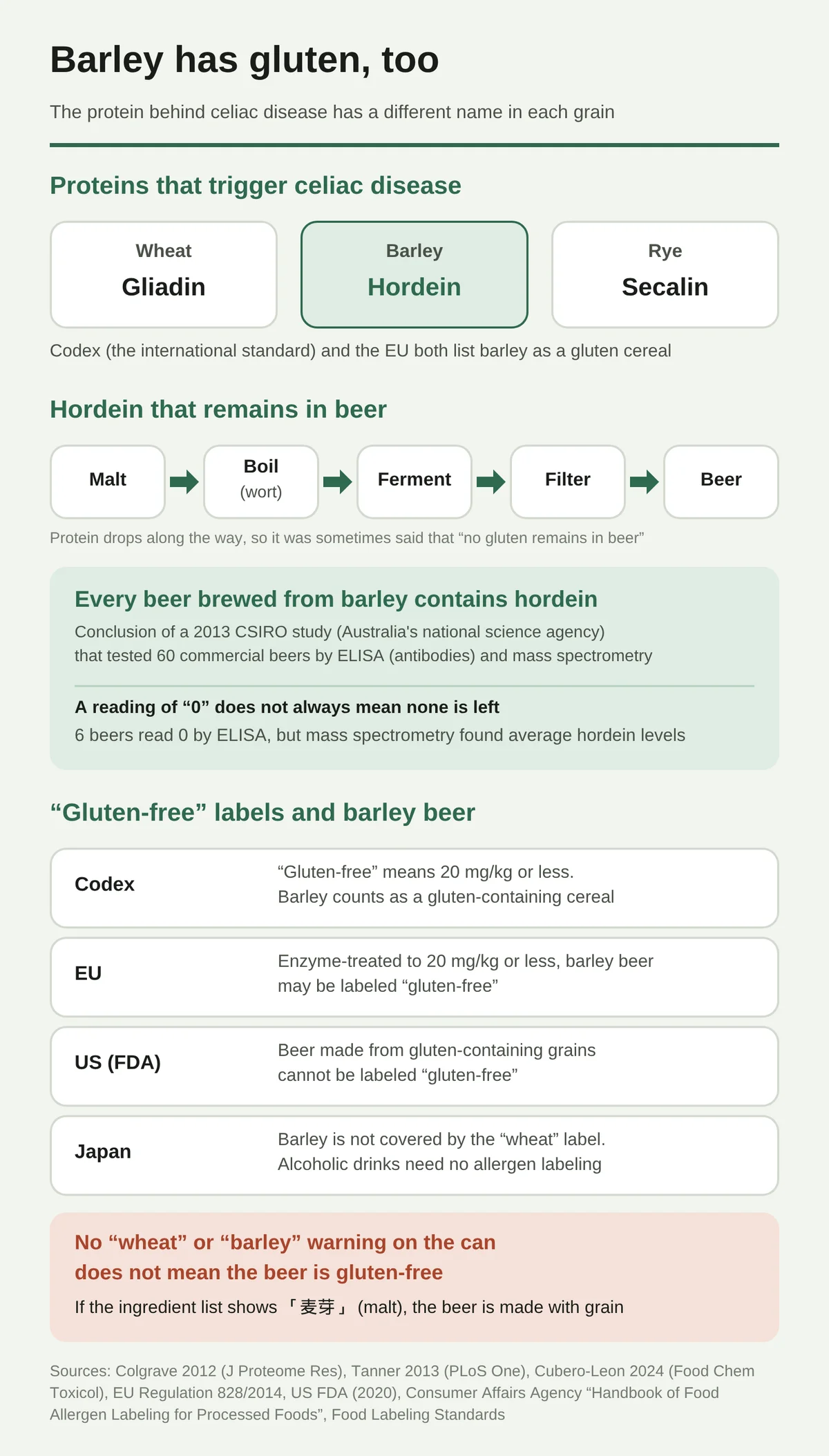
Barley gluten, “hordein”
To put the conclusion first: yes, it does.
Gluten is a group of proteins in grains. What causes celiac disease (a disease in which gluten triggers inflammation of the small intestine) is a set of similar proteins that have different names depending on the grain.
| Grain | Protein that causes celiac disease |
|---|---|
| Wheat | Gliadin (and glutenin) |
| Barley | Hordein |
| Rye | Secalin |
(According to the review by Cubero-Leon 2024)
Both the international food standard (Codex) and the EU include barley among “cereals containing gluten.” For more on gluten and wheat, see the article on gluten and spelt.
Hordein that remains in beer
Beer is made by boiling malt, fermenting it and filtering it. Because protein decreases along the way, it was sometimes said that “no gluten remains in beer.” A group at Australia’s national research agency (CSIRO) tested this.
- A 2012 study found, in beer and wort, the same kinds of hordein as in barley flour. The paper states, “contrary to some speculation, hordein is definitely present in beer.” On the other hand, gluten-free beer made without barley had no hordein
- A 2013 study measured 60 commercial brands with two methods (ELISA, which uses antibodies, and mass spectrometry, which measures protein fragments directly). The conclusion was “all beers made from barley contain hordein”
The two authors of this study are inventors on a patent application for low-hordein barley (the rights were assigned to research institutions and others, and the paper states there is no personal financial gain).
Even when it measures “0,” some may remain
The same 2013 study also found differences depending on the measurement method.
- Half of the commercial gluten-free beers had no hordein by either method
- On the other hand, six brands showed 0 by ELISA but an average amount of hordein by mass spectrometry
- About 20% of commercial beers were under 1 ppm (parts per million) by ELISA but at an average level by mass spectrometry
- Another paper showed that ELISA values change by 100 to 1,000 times depending on the choice of reference substance
Other studies point the same way.
- A 2017 study found gluten fragments by mass spectrometry in beers marketed as “gluten removed” by treatment with a gluten-degrading enzyme, even when the industry-standard ELISA (R5 method) showed under 20 mg/kg. Some products had incomplete enzyme treatment
- A 2023 study found fragments containing regions known to trigger an immune reaction in several beers that claim to be gluten-free
- In 2024, a review by researchers at the European Commission’s Joint Research Centre said that fragments of proteins that could be harmful to people with celiac disease may remain in barley beer treated with enzymes, and that evaluation in the human body is needed
The US Food and Drug Administration (FDA) also wrote in its 2020 rule that it knows of no scientifically valid method to accurately measure gluten in fermented or hydrolyzed foods.
Rules in Japan, the EU and the US
| Country / body | “Gluten-free” label | Barley beer? |
|---|---|---|
| Codex (international standard) | 20 mg/kg or less | Barley is a “cereal containing gluten” |
| EU | 20 mg/kg or less at the time of sale. 100 mg/kg or less is “very low gluten” | May be labeled “gluten-free” if treated with enzymes to 20 mg/kg or less. Barley is subject to allergen labeling |
| US FDA | Judged by whether the ingredients before fermentation are gluten-free (in force from October 2020) | Beer made from gluten-containing grains cannot be labeled “gluten-free” |
| Japan | Not defined in the Food Labeling Standards | Barley is outside the scope of the “wheat” label. No allergen-labeling obligation for alcoholic drinks |
- The US agency in charge of labeling ordinary beer (TTB) has, since 2014, allowed beer made from gluten-containing grains and then treated to use a fixed statement meaning “made to remove gluten, but the gluten content cannot be verified and it may contain gluten”
- In the EU, drinks over 1.2% alcohol do not need an ingredient list, but allergens such as barley must be written with “contains”
How to read Japanese can labels
- The foods for which allergen labeling is mandatory in Japan (specified ingredients) became 9 items from April 2026 with the addition of cashew nuts. Even together with the 20 items for which labeling is recommended, barley is not included
- The Consumer Affairs Agency’s handbook states, on the scope of the wheat label, that “barley, rye and the like are not covered”
- Furthermore, alcoholic drinks are outside allergen labeling. The reason given is that it is extremely difficult to tell whether symptoms such as flushing and palpitations are caused by allergy or by the action of alcohol
- Under the Food Labeling Standards too, alcoholic drinks do not need to show “ingredients,” “allergens” or “country of origin”
In other words, a can with no “wheat” or “barley” warning does not mean there is no gluten in it. If “malt” (麦芽) appears in the ingredient column, grain is used. Beers made with wheat malt are sometimes labeled “wheat malt” (小麦麦芽) and the like. The Consumer Affairs Agency’s handbook also cautions that the Western “gluten-free” label and Japan’s allergen labeling have different standards.
There are two kinds of gluten-free beer
| Type | How it’s made | Hordein | Label treatment |
|---|---|---|---|
| Made without grain | Made from sorghum, rice or millet | Not found (2012 study) | Can be labeled “gluten-free” even in the US. Because it uses no malt, it falls in a category other than “beer” under Japan’s Liquor Tax Act |
| Barley treated with enzymes | Made from barley and treated with an enzyme that breaks down gluten | Fragments remain in some products (2017 and 2023 studies) | In the EU, can be labeled “gluten-free” at 20 mg/kg or less. In the US, cannot be labeled |
Beer for people who want to avoid gluten
As the table above shows, the two types differ in how they are made and how each country treats them. Here is one of each: one made from rice without grain, and a Spanish beer made from barley and treated with enzymes.
Purines and gout
How many purines are in beer?
These are measurements published by the Japan Gout and Uric Acid Foundation (measured in July 2006 by Kiyoko Kaneko of Teikyo University and colleagues).
- Beer (7 brands) was 3.3 to 6.9 mg per 100 ml, jibiru (13 brands) 5.8 to 16.6 mg, happoshu 2.8 to 3.9 mg, and purine-cut happoshu 0.1 mg
- Sake is 1.2 mg, wine 0.4 mg and shochu 0.0 mg
- These were measured in 2006 and are not values for current products
For 350 ml of beer, that is 11.6 to 24.2 mg. Japanese society guidelines recommend keeping purines from food to under 400 mg per day to prevent gout and hyperuricemia (per Kaneko 2014). 350 ml of beer is 3 to 6% of that (calculated).
Uric acid rises even with zero purines
MHLW’s health information site lists three ways alcohol raises uric acid.
- When alcohol is broken down, purines increase in the body and become uric acid
- Uric acid becomes harder to excrete from the body
- You take in purines from the snacks
There are also studies that confirmed this in people.
- In a trial of 6 gout patients (1982), taking alcohol for 8 days raised blood uric acid from 8.4 to 10.1 mg/dL. Alcohol sped up the processes that produce uric acid
- In a trial of 5 people with gout and 5 healthy people (1984), drinking beer raised uric acid, while the juice drink (squash) taken for comparison did not. The authors attribute this to both the purines and the alcohol in beer
- In a 2023 survey of about 78,000 Japanese people, for each additional 20 g of pure alcohol per day, uric acid was 0.12 mg/dL higher for men and 0.21 for women with beer, and 0.08 for men and 0.09 mg/dL for women even with shochu (0.0 mg purines)
Beer with the purines removed still contains alcohol. I found no trial in people that measured uric acid with purine-free beer. MHLW’s health information site says “it is important to keep to an appropriate amount of drinking, whatever kind of alcohol.”
Beer and gout risk
- A study that followed 47,150 US men for 12 years (2004) found 730 cases of gout
- The gout risk for each additional drink per day was 1.49 times for beer, 1.15 times for spirits and 1.04 times for wine (no statistically significant difference)
- There were differences by amount too: compared with non-drinkers, those drinking 50 g or more per day had 2.53 times the risk
- Because this is an observational study, it cannot be said that beer itself is the cause. Funding included US public funds
Is beer belly real?
Two studies have examined the “beer belly,” the idea that “drinking beer makes only your belly stick out.”
- In a Czech study (2003, a cross-sectional study of 1,141 men and 1,212 women), the association between men’s beer intake and waist-to-hip ratio became unclear once other factors were matched. The paper says “it is unlikely that beer greatly increases waist circumference or BMI”
- In a German study (2009, 7,876 men and 12,749 women followed for 8.5 years), men who drank 1,000 ml per day had a 17% higher risk of increased waist circumference than very light drinkers. But when the overall weight gain was matched, most of the association was explained. The authors say “beer can make you gain weight, but a special effect that adds fat only to the belly is not supported”
- In a trial of 8 healthy men (1992), while they were taking alcohol, body fat was burned less
The conclusion of the research is that the “beer belly” is not specific to beer; if you drink a lot, your waist grows along with your weight.
Hangovers and trips to the toilet
“Wine after beer makes you sicker”
In a randomized trial of 90 people (aged 19 to 40) (2019), beer then wine, wine then beer, beer only and wine only were compared. Neither the type of drink nor the order made a difference in how bad the hangover was. What predicted the hangover was how drunk people felt, and whether they vomited.
Does beer make you need the toilet more?
- In a randomized trial of 12 men (2010), comparing 1 L of 4% beer with 1 L of non-alcoholic beer, when the body was well hydrated, urine volume was 1279 ml versus 1121 ml, more with the alcoholic drink. When the body was dehydrated, there was no clear difference
- In a trial of older men (2017), with 30 g of alcohol, wine and spirits increased urine over 4 hours, but there was no difference with beer and non-alcoholic beer. Over 24 hours, there was no difference among any of the drinks. The three authors of this paper are staff of a Dutch beer-industry research institute
A little beer does not cause a large loss of water, but with high-ABV drinks or when you drink a lot, urine increases.
Does brewer’s yeast boost virility?
Human trials: 0
I searched the paper database PubMed (October 2, 2026) for human trials in which people took brewer’s yeast (dried brewer’s yeast) and sexual function, libido, male hormones or sperm were measured.
- Searching “brewer’s yeast” with “sex,” “libido,” “testosterone,” “sperm,” “erection” and the like gave 8 results. All were studies of yeast genetics or studies of insects and honeybees
- Restricting “brewer’s yeast” to human clinical trials gave 21 results. The topics were chromium-containing yeast and blood sugar, a yeast component (beta-glucan) and colds, folate absorption, and cookies during breastfeeding (no effect on milk volume), among others, and there were 0 trials of sexual function
“Brewer’s yeast raises virility” is a claim that has not been confirmed.
Effects listed for Ebios tablets
“Ebios tablets” (Asahi Group Foods), a well-known brewer’s yeast tablet in Japan, are a quasi-drug (designated). The effects written in the package insert (revised January 2016) are as follows.
- Stomach heaviness, indigestion, a bloated feeling in the stomach and abdomen
- Overeating, overdrinking, heartburn, nausea (including nausea from hangover or drinking too much), vomiting
- Weak stomach, loss of appetite
- Nutritional supplementation, nutritional disorders, nutritional supplementation for pregnant and nursing women and people with weak constitutions
There is no effect listed for sexual function.
Some of the contents of the daily dose (30 tablets for ages 15 and over, 7,125 mg of dried yeast), compared with the nutrient reference values, are as follows (the comparison with reference values is calculated).
| Per 30 Ebios tablets | Amount | Compared with the guide |
|---|---|---|
| Vitamin B1 | 0.72 mg | 72% of reference value |
| Zinc | 0.43 mg | 5% of reference value |
| Selenium | 4.6 μg | 16% of reference value |
| Purines | 113.3 mg | 28% of 400 mg per day |
The zinc and selenium studies are about people who are deficient
Zinc and selenium are sometimes given as the reason brewer’s yeast is said to be good for virility. The surrounding research is as follows.
- Zinc: In a survey of 40 men (1996), body zinc was associated with male hormone. In the same paper, 9 older men who were mildly zinc-deficient took zinc (about 30 mg/day) for 3 to 6 months, and their male hormone rose. This is not about people who have enough. The 0.43 mg of zinc in 30 Ebios tablets is about 1/70 of the amount in this trial (calculated)
- Selenium: In a randomized trial of 69 men with poor sperm motility at an infertility clinic (1998, Scotland), those who took selenium had improved sperm motility. Sperm count did not change. The result was in people from an area with low selenium
Neither is a trial of brewer’s yeast itself, and the amounts are off by orders of magnitude.
Alcohol, if anything, lowers male hormone
- A pooled analysis (2024) of 21 studies (30 trials, 10,199 people) found that men who drink had lower male hormone (total testosterone) and higher female hormone (estradiol). What was clear was the case of healthy men who keep drinking over a long period
- English has the slang term “brewer’s droop.” An English slang dictionary defines it as “temporary erectile dysfunction caused by alcohol,” and it originated as an Australian expression
On the other hand, there are also pooled studies showing that for erectile dysfunction (ED), “people who drink a little have less.”
- A pooled analysis (2018) of 24 studies and 154,295 people found that people drinking fewer than 21 drinks a week had less ED than non-drinkers (no difference for those above 21 drinks a week)
- A pooled analysis (2021) of 46 studies and 216,461 people showed the same J-shaped pattern
However, both are mainly point-in-time surveys (cross-sectional studies). As in studies of heart disease, people who quit drinking because of illness get mixed into the “non-drinkers,” which may make the non-drinkers’ results look worse, and the ED studies do not adjust for this. It cannot be said that “drinking reduces ED.”
What to know before taking brewer’s yeast tablets
- High in purines: dried brewer’s yeast has 2,995.7 mg of purines per 100 g, about 500 times that of beer. 10 g comes to about 300 mg, three-quarters of the daily guideline of 400 mg (calculated). The researchers who measured it wrote that people with gout or hyperuricemia “should avoid” supplements such as brewer’s yeast
- People taking MAO inhibitors: people taking MAO inhibitors are said to need to be careful with foods high in a compound called tyramine. The “foods to avoid” list in a 1996 paper includes concentrated yeast extract (Marmite) and draft beer poured from the keg. In a measurement of 98 beer samples, all bottles and cans were low in tyramine (10 mg per liter or less), and all 4 samples that were high were lagers that had undergone secondary fermentation in the keg (nama, unpasteurized). I found no measured tyramine values for dried brewer’s yeast tablets (yeast extract and dried yeast are different things). The MAO inhibitors used in Japan include selegiline, rasagiline and safinamide for Parkinson’s disease
- People with Crohn’s disease: antibodies to the same kind of yeast as brewer’s yeast (ASCA) are used as a marker in blood tests for Crohn’s disease. In a randomized trial of 19 people with stable Crohn’s disease (1992), disease activity scores were slightly higher during the period they took baker’s yeast capsules
The Ebios tablet package insert also says to consult a doctor before taking them if you are under medical treatment.
Brewer’s yeast tablets
The contents and effects of brewer’s yeast tablets are as described above. They have no effect listed for sexual function and they contain purines. With that understood, they are introduced here for people who want to know about them for stomach and gut purposes or nutritional supplementation.
A list of the claims that beer is “good for you” or “bad for you”
Here are the health claims about beer, set out by type and number of studies and what was found.
| The claim | Type and number of studies | What was found | Verdict |
|---|---|---|---|
| A little makes you live longer / is good for the heart | Pooled observational studies (107 studies, about 4.84 million people), genetic study (about 260,000 people) | After correcting for bias, even a little drinking does not lower mortality | Not supported |
| Silicon strengthens bones | Absorption trial (9 people), cross-sectional study (about 2,700 people) | Higher bone density in men having 1 to 2 drinks a day. Causation unknown | Association only |
| A hop component (xanthohumol) prevents disease | In humans, only safety trials (30 people, 20 people) | The amount in 350 ml of beer is about 1/400 of the trial amount | No basis at beer amounts |
| A hop component (8-PN) feminizes | A single-dose trial in 24 postmenopausal women | The amount in 350 ml of beer is about 1/70,000 of the amount that had an effect | Cannot be confirmed |
| Hops help you sleep | 17 nurses, no randomization, no comparison drink | Fell asleep faster. Industry-association funding | Weak |
| Non-alcoholic beer is good after exercise | Randomized trial (277 runners), hydration trials (7 people, 12 people) | Fewer colds. Water was retained better with low-alcohol beer with salt added | Partly (about non-alcoholic beer) |
| Fewer kidney stones | Observational studies (about 27,000 and about 194,000 people) | An association with fewer stones in heavier drinkers | Association only |
| More likely to get gout | Observational study (about 47,000 people, 12 years) | 1.49 times for each drink a day | Risk goes up |
| Lowers male hormone | Pooled analysis (21 studies, 10,199 people) | Lower in men who keep drinking over a long time | Goes down |
| Raises blood pressure | Study of Japanese people (guidelines), pooled reduction trials (36 trials, 2,865 people) | Risk at any amount. Cutting down lowers it in people who drink more than 2 drinks a day | Goes up |
| Cancer | Assessment by international bodies | No safe amount can be set | Risk goes up |
| Beer belly | Observational study (about 20,000 people, 8.5 years) | The result of overall weight gain | Not specific to beer |
From here, we look at the top 7 rows of the table (the claims that beer is good for you) one by one. The downsides are covered in the sections above.
“A little makes you live longer”: the J-curve disappears after correction
The graph showing that “people who drink a little live longer than those who don’t drink at all” looks like the letter J, so it is called the “J-curve.”
- In a pooled analysis of 87 studies and about 4 million people (2016), without correction, the mortality risk for light drinkers was 0.86 times. But after correcting for the bias of mixing people who quit drinking because of illness and the like into the “non-drinkers” and other factors, it was 0.97 times, no difference
- A pooled analysis of 107 studies and about 4.84 million people (2023) also found that after correction, the drop in mortality risk with light drinking (1.3 to 24 g per day) was unclear, and risk was 1.19 times at 45 to 64 g per day and 1.35 times at 65 g or more. One author of this study has received payment, separate from this study, from Finland’s state-owned alcohol retailer
- In a genetic study (2014, about 260,000 people), people who carry a gene that makes them drink less from birth had less coronary artery disease (0.90 times). This shows that even for light drinkers, cutting back is better for the heart
I found no study that showed a heart-protective effect specific to beer alone.
Silicon and bones
- A study of 76 beer brands (2004) found silicon averaged 19.2 mg per liter. When 9 healthy people drank 0.6 L of beer, about 55% of the silicon was absorbed
- Another study (2010) found a wide range of 6.4 to 56.5 mg per liter in commercial beers, with beers made from husked barley higher than wheat beers
- In a US cross-sectional study (2009, 1,182 men, 1,289 postmenopausal women and 248 premenopausal women), men who drank 1 to 2 drinks a day had hip bone density 3.4 to 4.5% higher than non-drinking men. When silicon intake was matched, the difference disappeared, so the authors say “silicon seems to be involved”
- In the same study, men who drank more than 2 drinks a day of spirits had 3.0 to 5.2% lower bone density than men who drank 1 to 2
Because it is a point-in-time survey, it cannot be said that beer strengthens bones.
Xanthohumol (a hop component)
- Xanthohumol, found in hops, has been studied in test tubes and animal experiments for effects against cancer and inflammation
- A measurement of 45 beers (2020) found xanthohumol averaged 0.17 mg per liter. In 350 ml, that is about 0.06 mg (calculated)
- The human trials are one in which 30 healthy people took 24 mg of xanthohumol for 8 weeks to check safety (2021), and one in 20 people with Crohn’s disease (2026, mainly for safety; the authors have previously received research support from Metagenics)
- 24 mg is about 400 cans of 350 ml beer (calculated)
There is no study in people showing an effect at beer amounts.
8-PN and the “beer feminizes” claim
- In 1999, 8-prenylnaringenin (8-PN), a strong phytoestrogen (a plant compound with an action like female hormone), was found in hops. The paper that discovered it itself wrote that it is also found in beer but “the amount is small and no cause for concern”
- In a trial of 24 postmenopausal women (2006), a single 750 mg dose of 8-PN lowered the hormone (LH) by 16.7%
- The 8-PN in 350 ml of beer is about 10.5 μg. 750 mg is about 70,000 cans, and even the lowest dose in the trial, 50 mg, is about 4,800 cans (calculated)
- Gut bacteria convert another component of beer (isoxanthohumol) into 8-PN. The ability to convert varies greatly between people; in stool from 51 women, there were 8 high, 11 moderate and 32 low converters (2006). A 2026 computational modeling study found that high converters are exposed to about twice as much 8-PN as low converters, but “below the amount of concern for endocrine disruption”
I found no study showing that people were feminized by drinking beer.
Hops and sleep
- In a study of 17 shift-working nurses (2012), drinking 333 ml of non-alcoholic beer (0.0%) with dinner for 14 days shortened the time to fall asleep compared with the week without it (12.0 and 20.5 minutes)
- However, it was neither randomized nor blinded, and there was no comparison drink. Funding included Spain’s beer-industry “Beer and Health Information Center” (the paper’s conflict-of-interest section says “none”)
- The study reporting that a hop extract reduced nighttime activity was an experiment in quail
Non-alcoholic beer and exercise
- In a randomized trial of 277 male marathon runners (2012, blinded to both participants and researchers), drinking 1 to 1.5 L of non-alcoholic beer per day for 3 weeks before and 2 weeks after the race resulted in a smaller rise in inflammation markers right after the race, and colds and the like in the 2 weeks after the race were 3.25 times fewer. The comparison was a drink that was the same except that it contained no polyphenols. The trial drink was non-alcoholic wheat beer from Germany’s Erdinger
- What this trial measured was inflammation and colds, not hydration
- The hydration trials were in 7 men (2013) and 12 men (2015). When salt (sodium) was added to 2.3% low-alcohol beer, more water stayed in the body than with ordinary beer (4.8%). The authors say “electrolytes (such as salt) matter more than a small difference in alcohol”
There is no data from people showing that ordinary beer is suitable for rehydration after exercise.
Kidney stones
- In a study that followed 27,001 Finnish men who smoke (aged 50 to 69) for 5 years (1999), for each additional bottle of beer per day, the risk of stones was 40% lower
- In three US studies with 194,095 people (2013), those who drank the most beer also had 41% fewer stones, wine 31 to 33% and coffee 26% fewer. Sugar-sweetened cola was associated with 23% more
These are observational studies, and the results are consistent. However, they cannot be separated from the effect of drinking more fluid, and no public body recommends alcohol to prevent stones.
What gets mixed into beer: NDMA, glyphosate and mycotoxins
NDMA: greatly reduced in the 1980s
- In 1979, a group at the German Cancer Research Center reported that tiny amounts of N-nitrosodimethylamine (NDMA), a type of N-nitroso compound, were mixed into beer
- A study of more than 3,000 foods in West Germany (1980) found that 64% of the NDMA men took in came from beer. NDMA was formed in the process of drying malt. The paper reported that improved methods can remove it
- The industry then took measures. In 514 samples from one German state (1987), 302 had none detected and the average was 0.16 μg per kg. In 194 brands in the US and Canada (1991), the average was 0.074 μg/kg, down to 1 to 5% of about 10 years earlier
- In 2023, a Czech brewing and malting research institute (industry-affiliated) reported that volatile nitrosamines are well controlled, but that 22 kinds of non-volatile, nitrite-related compounds were found in malt and about 200 beer samples. Their health effects have not yet been evaluated
Glyphosate (herbicide)
- In 2019, a US consumer group (PIRG) tested 20 products (13 beers, 5 wines and 2 ciders) and detected the herbicide glyphosate in 19. Among beers, Tsingtao had the highest value, 49.7 μg (ppb) per liter
- It is not a peer-reviewed paper, and the report itself says “20 samples is not a complete scientific study.” The report also says that the detected values are below the US Environmental Protection Agency’s allowable level for drinks
- A 350 ml serving of 49.7 μg/L beer is 17.4 μg. The Food Safety Commission of Japan’s daily allowance is 1 mg per kg of body weight, which is 60 mg for a 60 kg person, so one can is about 0.03% (calculated)
- Glyphosate was classified by the International Agency for Research on Cancer (IARC) in 2015 as Group 2A (probably carcinogenic). On the other hand, the Food Safety Commission of Japan says carcinogenicity through food is not recognized
Mycotoxins
- A study (2017) in which a Dutch food safety institute tested 1,000 beer samples from 47 countries (60% craft beer) found the grain mycotoxin deoxynivalenol (DON) and its relatives at 10 to 475 μg per liter in 406 samples. Of these, 73% were craft beer
- 29% of imperial stouts (high-ABV dark beers) exceeded 100 μg/L, and the paper says that DON and its relatives in 27 craft beers were “at or above the tolerable daily intake (TDI)”
- One of the authors is an employee of a test-kit company
Non-alcoholic beer
0.00% and “slightly alcoholic”
- Under the Liquor Tax Act, an alcoholic drink is “a drink with an alcohol content of 1 degree or more.” Under 1% is not alcohol in the eyes of the law
- On the other hand, the voluntary standards of the beer industry and others (last revised July 1, 2026) define a “non-alcoholic drink” as “0.00% ABV, with a taste similar to alcoholic drinks, intended to be drunk by people aged 20 and over”
- In other words, “slightly alcoholic” and “low-alcohol” products at around 0.5% are not alcohol under the law, but they do not count as “non-alcoholic” in the industry’s terms. 350 ml of a 0.5% product contains 1.4 g of pure alcohol (calculated)
- The same voluntary standards say not to advertise to people who are abstaining for health reasons or who are pregnant. They do not say “it’s fine to drink during pregnancy”
What is in non-alcoholic beer
- The food composition table’s “beer-flavored carbonated beverage (non-alcoholic beer)” has 5 kcal per 100 g, 1.2 g of carbohydrate and 8 mg of vitamin C. In 350 ml that is about 18 kcal (calculated)
- For purines, in the 2006 measurement, a beer-taste beverage (1 brand) had 1.3 mg per 100 ml
- Ingredients differ by product, and as in the table above, some use additives such as flavoring, acidulant, caramel color and sweeteners. You can check whether anything other than malt and hops is used in the ingredient column of the can
MHLW’s guidelines list choosing drinks that contain no alcohol as one way to cut down on how much you drink.
For days when you don’t want alcohol
Here is a non-alcoholic beer at 0.00% whose only ingredients are malt and hops.
What you can do if you drink
- Count in grams of pure alcohol: for 5% beer, 14 g for a 350 ml can and 20 g for a 500 ml can. Some products show the pure alcohol amount on the can
- Watch out for large bottles, mugs and high-ABV beer: a 633 ml large bottle is 25.3 g. The stout in the composition table is 7.6%, which is 21.3 g per 350 ml
- Drink water alongside: the guidelines list drinking water and choosing drinks without alcohol as examples of consideration
- People with gout should watch the alcohol even with zero purines: alcohol itself also raises uric acid
- People avoiding gluten should not judge by the can label alone: in Japan there is no allergen-labeling obligation for alcoholic drinks
What was introduced in this article (summary)
Here are the items introduced in the article, gathered once more. The reasons and ingredients are given in each section.
| Item introduced | Where to buy |
|---|---|
| Alcohol sensitivity gene test (mail-in kit) | 『アルコール感受性遺伝子分析キット』 PR PR |
| ORYVIA(オリビア)雅・爽・凛 6 × 330 ml ― 100% rice beer made without grain | See on Rakuten (RICE HACK BREWERY) PR See on Yahoo! Shopping PR |
| ダウラ ダム (Daura Damm) 6 × 330 ml bottles (Spain) ― beer made from barley and treated with enzymes | See on Rakuten (お酒の専門店 リカマン) PR See on Amazon.co.jp PR See on Yahoo! Shopping PR |
| エビオス錠 (Ebios tablets) 600 tablets (Asahi Group Foods, quasi-drug) | See on Rakuten (クスリのさくら健康プラザ) PR See on Amazon.co.jp PR See on Yahoo! Shopping PR |
| 日本ビール 龍馬1865 (Nippon Beer Ryoma 1865) 24 × 350 ml (non-alcoholic, 0.00%) | See on Rakuten (楽天24 ドリンク館) PR See on Amazon.co.jp PR See on Yahoo! Shopping PR |
Please note Alcohol is for people aged 20 and over. Drinking under age 20 is prohibited by law. Do not drink during pregnancy or breastfeeding, and do not drink and drive. Nothing introduced here is meant to show that it is good for your health. Prices and shipping costs may change (shipping varies by region).
Wrap-up
- Barley also has gluten (hordein), and it remains in barley beer. Depending on the measurement method, it can show “0” and still be present. In Japan there is no allergen-labeling obligation for alcoholic drinks, and barley is outside the scope of the “wheat” label
- There are 0 human trials testing whether brewer’s yeast raises virility. The effects of Ebios tablets are for the stomach and gut and nutritional supplementation, and the daily dose contains 113.3 mg of purines. Drinking over a long period actually lowers male hormone
- About two-thirds of the energy in beer is alcohol. Vitamin B1 is zero. Even with “zero carbs,” the calories from alcohol remain
- 500 ml of 5% beer is 20 g of pure alcohol. For women, the risk of cerebral infarction rises from 11 g per day and breast cancer from 14 g
- Even with zero purines, alcohol raises uric acid. One study found the risk of gout is 1.49 times for each beer a day
- “Good for the heart,” “good for bones,” “helps you sleep” and “feminizes” each come down to one of these: disappears after correction, observational studies only, trials of a dozen or so people, or amounts off by orders of magnitude. What determines the effect on the body is the amount of alcohol you drank
Sources
- MEXT, “Standard Tables of Food Composition in Japan (8th Revised Edition), 2023 Supplement” (16006 Beer, pale; 16007 Beer, dark; 16008 Stout; 16009 Happoshu; 16058 Beer-flavored carbonated beverage) https://www.mext.go.jp/a_menu/syokuhinseibun/mext_00001.html
- MHLW, “Guidelines on Drinking with Consideration for Health” (February 2024) https://www.mhlw.go.jp/stf/newpage_38541.html
- MHLW Health Information Site, “Alcohol and hyperuricemia / gout” https://kennet.mhlw.go.jp/information/information/alcohol/a-01-012.html
- Food Labeling Standards (Cabinet Office Order No. 10 of 2015), e-Gov https://laws.e-gov.go.jp/law/427M60000002010
- Consumer Affairs Agency, “Handbook on Food Allergy Labeling of Processed Foods (for businesses),” April 2026 (Reiwa 8) https://www.caa.go.jp/policies/policy/food_labeling/food_sanitation/allergy/assets/food_labeling_cms204_260401_02.pdf
- Liquor Tax Act (e-Gov Laws Search) https://laws.e-gov.go.jp/law/328AC0000000006
- Fair Competition Code on Beer Labeling and its Enforcement Rules (implemented by the Brewers Association of Japan)
- Liaison Council on Drinking, “Voluntary Standards on Advertising and Promotion of Alcoholic Beverages and Labeling of Alcoholic Beverage Containers” (last revised July 1, 2026 (Reiwa 8)) https://www.brewers.or.jp/contents/self-pdf/Self-Regulatory_jap.pdf
- Brewers Association of Japan, “Explanatory materials for the Alcohol-Related Health Problems Countermeasures Council” (September 22, 2025) https://www.mhlw.go.jp/content/10601000/001566490.pdf
- Ingredient and nutrition lists of Asahi Breweries, Kirin Brewery, Sapporo Breweries and Suntory (checked October 2, 2026)
- Japan Gout and Uric Acid Foundation, “Purine content in alcoholic beverages” https://www.tufu.or.jp/gout/gout4/73
- Ebios tablets package insert (Asahi Group Foods, revised January 2016) https://www.info.pmda.go.jp/downfiles/otc/PDF/J0601002018_05_A.pdf
- Commission Implementing Regulation (EU) No 828/2014 https://www.legislation.gov.uk/eur/2014/828/annex/adopted /Regulation (EU) No 1169/2011 Annex II https://www.legislation.gov.uk/eur/2011/1169/annex/II/adopted
- U.S. FDA. Food Labeling; Gluten-Free Labeling of Fermented or Hydrolyzed Foods. Federal Register 2020;85:49240 https://www.federalregister.gov/documents/2020/08/13/2020-17088/food-labeling-gluten-free-labeling-of-fermented-or-hydrolyzed-foods
- Colgrave ML, et al. What is in a beer? Proteomic characterization and relative quantification of hordein (gluten) in beer. J Proteome Res. 2012;11(1):386-96. PMID: 21999962
- Tanner GJ, et al. Measuring hordein (gluten) in beer–a comparison of ELISA and mass spectrometry. PLoS One. 2013;8(2):e56452. PMID: 23509606
- Tanner GJ, et al. Quantification of Hordeins by ELISA: the correct standard makes a magnitude of difference. PLoS One. 2013;8(2):e56456. PMID: 23509607
- Colgrave ML, et al. Liquid Chromatography-Mass Spectrometry Analysis Reveals Hydrolyzed Gluten in Beers Crafted To Remove Gluten. J Agric Food Chem. 2017;65(44):9715-9725. PMID: 29047268
- Nye-Wood MG, et al. Low Gluten Beers Contain Variable Gluten and Immunogenic Epitope Content. Foods. 2023;12(17):3252. PMID: 37685187
- Cubero-Leon E, et al. Barley based gluten free beer - A blessing or an uncontrollable risk? Food Chem Toxicol. 2024;193:115019. PMID: 39307344
- Kaneko K, et al. Total purine and purine base content of common foodstuffs for facilitating nutritional therapy for gout and hyperuricemia. Biol Pharm Bull. 2014;37(5):709-21. PMID: 24553148
- Faller J, Fox IH. Ethanol-induced hyperuricemia. N Engl J Med. 1982;307(26):1598-602. PMID: 7144847
- Gibson T, et al. Beer drinking and its effect on uric acid. Br J Rheumatol. 1984;23(3):203-9. PMID: 6743968
- Choi HK, et al. Alcohol intake and risk of incident gout in men: a prospective study. Lancet. 2004;363:1277-81. PMID: 15094272
- Fukui S, et al. Differences in the Association Between Alcoholic Beverage Type and Serum Urate Levels Using Standardized Ethanol Content. JAMA Netw Open. 2023;6(3):e233398. PMID: 36930152
- Anderson BO, et al. Health and cancer risks associated with low levels of alcohol consumption. Lancet Public Health. 2023;8(1):e6-e7. PMID: 36603913
- IARC Monographs Volume 100E(2012)
- Roerecke M, et al. The effect of a reduction in alcohol consumption on blood pressure. Lancet Public Health. 2017;2(2):e108-e120. PMID: 29253389
- Bobak M, et al. Beer and obesity: a cross-sectional study. Eur J Clin Nutr. 2003;57(10):1250-3. PMID: 14506485
- Schütze M, et al. Beer consumption and the ‘beer belly’: scientific basis or common belief? Eur J Clin Nutr. 2009;63(9):1143-9. PMID: 19550430
- Suter PM, et al. The effect of ethanol on fat storage in healthy subjects. N Engl J Med. 1992;326(15):983-7. PMID: 1545851
- Köchling J, et al. Grape or grain but never the twain? A randomized controlled multiarm matched-triplet crossover trial of beer and wine. Am J Clin Nutr. 2019;109(2):345-352. PMID: 30753321
- Hobson RM, Maughan RJ. Hydration status and the diuretic action of a small dose of alcohol. Alcohol Alcohol. 2010;45(4):366-73. PMID: 20497950
- Polhuis KCMM, et al. The Diuretic Action of Weak and Strong Alcoholic Beverages in Elderly Men. Nutrients. 2017;9(7):660. PMID: 28657601
- Prasad AS, et al. Zinc status and serum testosterone levels of healthy adults. Nutrition. 1996;12(5):344-8. PMID: 8875519
- Scott R, et al. The effect of oral selenium supplementation on human sperm motility. Br J Urol. 1998;82(1):76-80. PMID: 9698665
- Santi D, et al. The chronic alcohol consumption influences the gonadal axis in men: Results from a meta-analysis. Andrology. 2024;12(4):768-780. PMID: 37705506
- Wang XM, et al. Alcohol intake and risk of erectile dysfunction: a dose-response meta-analysis of observational studies. Int J Impot Res. 2018;30(6):342-351. PMID: 30232467
- Li S, et al. A Meta-Analysis of Erectile Dysfunction and Alcohol Consumption. Urol Int. 2021;105:969-985. PMID: 34521090
- Green’s Dictionary of Slang “brewer’s droop” https://greensdictofslang.com/entry/oueadsi
- Gardner DM, et al. The making of a user friendly MAOI diet. J Clin Psychiatry. 1996;57(3):99-104. PMID: 8617704
- Tailor SA, et al. J Clin Psychopharmacol. 1994;14(1):5-14. PMID: 8151003
- Barclay GR, et al. The effect of dietary yeast on the activity of stable chronic Crohn’s disease. Scand J Gastroenterol. 1992;27(3):196-200. PMID: 1502481
- Stockwell T, et al. J Stud Alcohol Drugs. 2016;77(2):185-98. PMID: 26997174
- Zhao J, et al. JAMA Netw Open. 2023;6(3):e236185. PMID: 37000449
- Holmes MV, et al. BMJ. 2014;349:g4164. PMID: 25011450
- Sripanyakorn S, et al. The silicon content of beer and its bioavailability in healthy volunteers. Br J Nutr. 2004;91(3):403-9. PMID: 15005826
- Casey TR, Bamforth CW. Silicon in beer and brewing. J Sci Food Agric. 2010;90(5):784-8. PMID: 20355113
- Tucker KL, et al. Effects of beer, wine, and liquor intakes on bone mineral density in older men and women. Am J Clin Nutr. 2009;89(4):1188-96. PMID: 19244365
- Boronat A, et al. Beer Phenolic Composition of Simple Phenols, Prenylated Flavonoids and Alkylresorcinols. Molecules. 2020. PMID: 32498371
- Langley BO, et al. Mol Nutr Food Res. 2021;65(8):e2001170. PMID: 33629812 / Bradley R, et al. Mol Nutr Food Res. 2026;70(6):e70438. PMID: 41834265
- Milligan SR, et al. Identification of a potent phytoestrogen in hops (Humulus lupulus L.) and beer. J Clin Endocrinol Metab. 1999;84(6):2249-52. PMID: 10372741
- Rad M, et al. Br J Clin Pharmacol. 2006;62(3):288-96. PMID: 16934044
- Possemiers S, et al. J Nutr. 2006;136(7):1862-7. PMID: 16772450
- Stevanoska M, et al. Arch Toxicol. 2026;100(6):2397-2409. PMID: 41807782
- Franco L, et al. The sedative effect of non-alcoholic beer in healthy female nurses. PLoS One. 2012;7(7):e37290. PMID: 22815680
- Scherr J, et al. Nonalcoholic beer reduces inflammation and incidence of respiratory tract illness. Med Sci Sports Exerc. 2012;44(1):18-26. PMID: 21659904
- Desbrow B, et al. Beer as a sports drink? Int J Sport Nutr Exerc Metab. 2013;23(6):593-600. PMID: 23690556 / Desbrow B, et al. Int J Sport Nutr Exerc Metab. 2015;25(3):262-70. PMID: 25588064
- Hirvonen T, et al. Nutrient intake and use of beverages and the risk of kidney stones among male smokers. Am J Epidemiol. 1999;150(2):187-94. PMID: 10412964
- Ferraro PM, et al. Soda and other beverages and the risk of kidney stones. Clin J Am Soc Nephrol. 2013;8(8):1389-95. PMID: 23676355
- Spiegelhalder B, et al. Contamination of beer with trace quantities of N-nitrosodimethylamine. Food Cosmet Toxicol. 1979;17(1):29-31. PMID: 437609 / IARC Sci Publ. 1980;(31):467-79. PMID: 7228273
- Frommberger R. N-nitrosodimethylamine in German beer. Food Chem Toxicol. 1989;27(1):27-9. PMID: 2703190
- Scanlan RA, Barbour JF. N-nitrosodimethylamine content of US and Canadian beers. IARC Sci Publ. 1991;(105):242-3. PMID: 1855861
- Malečková M, et al. J Agric Food Chem. 2023. PMID: 37924290
- Cook K. Glyphosate in Beer and Wine. CalPIRG Education Fund, February 2019
- Food Safety Commission of Japan, evaluation of glyphosate (2016) https://www.fsc.go.jp/iken-bosyu/iken-kekka/kekka.data/kekka_no_glyphosate_280406.pdf
- Peters J, et al. Mycotoxin profiling of 1000 beer samples with a special focus on craft beer. PLoS One. 2017;12(10):e0185887. PMID: 28982162
Related articles and databases
- Beer Types Explained: Beer vs. Happoshu vs. New Genre (After the 2026 Liquor Tax Unification), Lager vs. Ale vs. IPA and Other Beer Styles, How Beer Is Made, and How to Read the Label
- Where Did Beer Come From? 10,000 Years of History and the World Beer Consumption Ranking (China #1 in Total, Czechia #1 per Capita), and Where Japan Stands, Read Through Papers and Government Statistics
- Is Shochu Good for Your Health? Checking “Zero Sugar,” “Zero Purines,” “Thin Blood,” Weight Gain, and Hangovers Against Food Composition Tables and Studies
- Is Sake Good for Your Health? Checking Ingredients, Calories, Weight Gain, and the Comparison with Shochu Against Public Data and Studies
- Does the Type of Alcohol Change Cancer Risk? Which Cancers Rise, Which Show Lower Numbers, and Whether Drinking Has Benefits, Checked Against International Assessments and Studies