
Beer Types Explained: Beer vs. Happoshu vs. New Genre (After the 2026 Liquor Tax Unification), Lager vs. Ale vs. IPA and Other Beer Styles, How Beer Is Made, and How to Read the Label

PR This article contains affiliate links to Rakuten Ichiba, Amazon, Yahoo! Shopping, A8.net and Moshimo Affiliate. What is written here is based on laws, the National Tax Agency, industry bodies, the BJCP (the U.S.-based organization that sets beer style guidelines), research papers and each company’s official pages, regardless of any ads. Drinking is for those 20 and over. The “See on Amazon.co.jp” links are also affiliate links.
“Beer” covers a lot of ground. On a can you will see “beer,” “happoshu” and “happoshu ②” written separately, and in a bar there are many more names: “Pilsner,” “IPA,” “Hefeweizen,” “Stout,” and so on.
These two sets of names are different yardsticks.
- “Beer” and “happoshu” are categories in Japanese law (the Liquor Tax Act). They exist to decide how much tax is charged
- “Pilsner,” “IPA” and the like are beer styles. They are names for taste types, sorted by birthplace, ingredients, how they are fermented, color and bitterness
This article goes through the following in order.
- What “beer,” “happoshu” and “new genre” mean in Japanese law, and what changed with the liquor tax unification on October 1, 2026
- How beer is made, and the differences between top-fermenting, bottom-fermenting and spontaneous fermentation
- The world’s beer styles, with figures from the standard (BJCP 2021 edition)
- How to read the label on a can, and the ingredients and additives of 23 major brands
- Germany’s “Reinheitsgebot” (beer purity law) and Japanese craft beer
- Facts about drinking beer well: temperature, foam, light-struck flavor and best-before dates
For the effects on the body (calories, purines, gluten, brewer’s yeast), see the article on beer and health. For the origins of beer and world consumption, see the article on beer history and the world.
Conclusion
- To be called “beer” under Japanese law, malt must make up at least 50% of the weight of the ingredients other than water and hops (lowered from 67% in April 2018). The “up to 5%” limit applies only to flavorings such as fruit and herbs, not to rice, corn, starch or sugars
- “New genre (third beer)” drinks were merged into the “happoshu” category in October 2023. The “happoshu ②” on a can is the mark of that
- On October 1, 2026, the liquor tax on beer, happoshu and the former new genre was unified at ¥54.25 per 350 ml. Beer went down from ¥77 (until 2020), and new genre went up from ¥28. Kinmugi, Mugi to Hop, GOLD STAR and Clear Asahi are changing to “beer” in October, and Kirin’s Hon-Kirin from the batch released on November 4
- The big difference in how beer is made is fermentation. Lager (bottom-fermenting) uses yeast that settles at low temperatures, ale (top-fermenting) uses yeast that rises at higher temperatures, and spontaneous fermentation leaves it to yeast and microbes in the air. Lager yeast is a hybrid of ale yeast and a wild yeast found in Patagonia, South America
- The BJCP 2021 edition, the style standard, has 34 categories and 107 styles. Most major Japanese beers are Pilsner-type lagers, and Asahi Super Dry is listed by the BJCP as an example of International Pale Lager
- Under the Food Labeling Standards, alcoholic drinks do not have to list ingredients. The ingredient list on beer comes from an industry fair competition code, and the order follows the order in the law, not weight. “Nama” means not heat-treated, and “Pilsner” and “premium” have no definition
- Among the 23 major brands checked, products classed as “beer” had no additives. Caramel color, flavorings, acidulants, sweeteners and the like were found in happoshu and new genre, especially the “zero” types
Items featured in this article
Within the article, the following items are introduced where they fit the point being made (links to Rakuten Ichiba, Amazon, Yahoo! Shopping, A8.net and Moshimo Affiliate).
| For people who | Item featured | Where |
|---|---|---|
| Want to try the original Pilsner | A beer that carries the name of the original Pilsner (Pilsner Urquell) | Lager styles |
| Want to compare German and Belgian wheat beers | German white beer (Weihenstephaner / ヴァイエンシュテファン), Belgian white (Hoegaarden / ヒューガルデン) | Wheat beer styles |
| Want to try Pale Ale, IPA and Stout | Pale Ale (Yona Yona Ale / よなよなエール), IPA (India no Aooni / インドの青鬼), Stout (Guinness / ギネス) | Ale styles |
| Want to learn about Trappist and spontaneously fermented beers | Trappist (Chimay / シメイ), Lambic (Lindemans / リンデマンス) | Spontaneous fermentation and sours |
| Want to choose Japanese craft beer by type | A mail-order shop that sorts Nagano craft beers by type (NAGANOSAKE.JP) | Japanese craft beer |
| Want to drink beer at the right temperature without overchilling | Stainless steel cooling cubes that chill beer without diluting it with ice (Beer Cube / ビアキューブ) | Temperature, pouring and glasses |
| Want to learn more about styles and brewing | A book covering the basics of beer (Official Textbook for the Japan Beer Certification) | For those who want to know more |
Beer Types in Japanese Law
Where Beer Fits Among Alcoholic Drinks
Under the Liquor Tax Act, “alcoholic beverages” are drinks with an alcohol content of 1 degree (1%) or more. Alcoholic beverages are divided into four groups: “sparkling liquors,” “brewed liquors,” “distilled liquors” and “mixed liquors.” Beer belongs to sparkling liquors.
| Category within sparkling liquors | What it is |
|---|---|
| Beer | Made mainly from malt, hops and water, and meeting conditions such as the malt ratio (Article 3, item 12) |
| Happoshu (low-malt beer) | Uses malt or barley but does not meet the conditions for beer, and similar cases (Article 3, item 18) |
| Other sparkling liquors | Anything else with foam (chuhai and the like). Alcohol content under 11 degrees (changed from “under 10 degrees” on October 1, 2026) |
- Non-alcoholic and beer-taste drinks with an alcohol content under 1% are not alcoholic beverages in law
The Definition of Beer (Original Text of the Liquor Tax Act)
Article 3, item 12 of the Liquor Tax Act defines beer as follows (the current text on the e-Gov law search).
- Beer: any of the following alcoholic beverages with an alcohol content of less than 20 degrees. (a) A beverage fermented from malt, hops and water (b) A beverage fermented from malt, hops, water and barley or other items specified by Cabinet Order (limited to those where the weight of malt among the ingredients is at least 50/100 of the total weight of ingredients other than hops and water, and where the total weight of the items specified by Cabinet Order among the ingredients does not exceed 5/100 of the weight of the malt) (c) A beverage made by adding hops or items specified by Cabinet Order to an alcoholic beverage listed in (a) or (b) and fermenting it (the same two conditions as (b))
In other words, beer is any of these three.
| Item | Contents | Example |
|---|---|---|
| (a) | Only malt, hops and water | Beer whose ingredients are “malt, hops” |
| (b) | Malt, hops and water, plus specified adjuncts | Beer with “malt, hops, rice, corn, starch” |
| (c) | Beer of type (a) or (b) with hops or flavorings added and fermented once more | A method approved in 2018 |
Adjuncts and the “5%” Rule
You sometimes hear it explained as “ingredients other than malt are limited to 5%,” but that is not accurate. Article 6 of the Order for Enforcement of the Liquor Tax Act divides adjuncts into two groups.
| Group | What can be used | Quantity condition |
|---|---|---|
| Item 1 | Barley, rice, corn, sorghum, potatoes, starch, sugars, bittering agents, colorants (caramel), etc. | Malt must be at least 50% of the “ingredients other than water and hops” (that is, these can be used up to the same weight as the malt) |
| Item 2 | Fruit, and flavorings such as coriander | In addition to the condition above, up to 5% of the weight of the malt in total |
The flavorings in item 2 are specified in Article 4 of the Ordinance for Enforcement of the Liquor Tax Act as follows.
- Coriander and its seeds
- Spices such as pepper, cinnamon, cloves and sansho (Japanese pepper)
- Herbs such as chamomile, sage, basil and lemongrass
- Vegetables such as sweet potato and pumpkin
- Buckwheat and sesame
- Things containing sugar such as honey, salt, and miso
- Flowers, tea, coffee and cocoa
- Oysters, kelp, wakame seaweed and katsuobushi (dried bonito)
The colorant is specified in Article 4, paragraph 1 of the Ordinance as “caramel.”
The National Tax Agency (NTA) explains its reason for setting the 5% cap: “a product made with large amounts would be considered an alcoholic beverage that deviates greatly from the original form of beer” (Q&A on the revision of the definition of beer).
The 2018 Revision of the Definition
On April 1, 2018, the definition of beer was widened (fiscal 2017 tax reform). According to the NTA Q&A, three things changed.
- Malt ratio: “It used to have to be 67% or more, and this was lowered to 50% or more”
- Range of adjuncts: Fruit and flavorings became usable within 5% of the weight of the malt
- Method of making: Adding hops or adjuncts to finished beer and fermenting it once more (item (c)) was approved
There are also detailed rules (same Q&A).
- Katsuobushi can be used, but other dried fish such as iwashi-bushi (dried sardine) cannot
- Fruit peel and seeds count as “fruit.” However, sugar-coated peel cannot be used
- If concentrated fruit juice is mixed in and then water is added before fermenting, it becomes happoshu, not beer
The Definition of Happoshu
Happoshu is, under Article 3, item 18 of the Liquor Tax Act, a sparkling alcoholic beverage (alcohol content under 20 degrees) that falls under any of the following.
| Item | Contents |
|---|---|
| (a) | Made with malt or barley as part of the ingredients (excluding those with a barley-based distilled spirit added) |
| (b) | Not covered by (a), made with hops or specified bittering agents as part of the ingredients |
| (c) | Not covered by (a) or (b), with an aroma, taste and color similar to beer (bitterness value of 5 or more and color value of 4 or more) |
- (b) and (c) were added in the revision of October 1, 2023
- The “bitterness value” is measured as the absorbance of light at a wavelength of 275 nm × 50, which gauges the amount of the hop bittering compounds (iso-alpha acids) (Article 4-2 of the Ordinance for Enforcement of the Liquor Tax Act). It has the same form as the bitterness unit used for beer around the world
- What matters to small breweries is the minimum production quantity. The amount that must be brewed in a year is 60 kL for beer and 6 kL for happoshu (Article 7, paragraph 2 of the Liquor Tax Act)
New Genre (Third Beer) and “Happoshu ②”
“New genre” and “third beer” were never the names of legal categories. They were the name of a tax-rate category from October 2020 to September 2023. According to the definitions in the NTA’s “Sake no Shiori” (Guide to Liquor), there are roughly two kinds.
| Kind | Contents | Example |
|---|---|---|
| Made without malt | Fermented from sugars, hops, water and specified items (decomposed soy or pea protein, yeast extract, corn, dietary fiber, caramel, etc.) | Kirin Nodogoshi <Nama> (ingredients: hops, sugars, soy protein, yeast extract) |
| Happoshu with a barley spirit added | A happoshu with a malt ratio under 50%, with a spirit made from barley or wheat added | Kirin Hon-Kirin (ingredients: happoshu (malt, hops, barley, corn, sugars), barley spirit) |
- According to the Brewers Association of Japan, the low-malt happoshu “Suntory Hops <Nama>” went on sale in 1994 (Heisei 6), and Sapporo “Draft One,” which uses neither malt nor barley and is made from pea protein, went on sale in Heisei 15 (2003)
- In October 2023, the definition of happoshu was widened, and new genre was merged into the “happoshu” category. The “happoshu ②” on a can is the mark of this former new genre
- From October 2026, it became acceptable to write just “happoshu” without the “②” (keeping it is also allowed)
Liquor Tax Unification (October 1, 2026)
How the Tax per 350 ml Changed
The Ministry of Finance explains: “The tax rate on beer-type drinks was unified in October 2026 (Reiwa 8) at ¥155,000 per kL (¥54.25 per 350 ml) (implemented in three stages from October 2020 (Reiwa 2)).” The stated reason is “from the standpoint of correcting the situation where gaps in tax rates among similar alcoholic beverages affect product development and sales volume, and restoring fairness of the tax burden among alcoholic beverages, under revenue neutrality.”
| Liquor tax per 350 ml | Until Sep 2020 | From Oct 2020 | From Oct 2023 | From Oct 2026 |
|---|---|---|---|---|
| Beer | ¥77.00 | ¥70.00 | ¥63.35 | ¥54.25 |
| Happoshu (malt under 25%) | ¥46.99 | ¥46.99 | ¥46.99 | ¥54.25 |
| Happoshu (malt 25% to under 50%) | ¥62.34 | ¥58.49 | ¥54.25 | ¥54.25 |
| New genre (happoshu ② since Oct 2023) | ¥28.00 | ¥37.80 | ¥46.99 | ¥54.25 |
| (For reference) Chuhai and the like | ¥28 | ¥28 | ¥28 | ¥35 |
- In the single step of October 2026, beer went down ¥9.10 (¥63.35 to ¥54.25), while happoshu (malt under 25%) and the former new genre went up ¥7.26 (¥46.99 to ¥54.25)
- Compared with before September 2020, beer went down ¥22.75 and new genre went up ¥26.25
- As of December 2025, before the unification, liquor tax and consumption tax on a 350 ml beer priced at ¥230 made up 36.6% of the price (Sake no Shiori)
- Brewed liquors such as sake and fruit wine were already unified in October 2023 at ¥100,000 per kL
Brands Switching from New Genre to Beer
As the tax gap narrows, staple new-genre (happoshu ②) products are switching one after another to “beer.” The Brewers Association of Japan writes, “The trend of returning to beer is advancing.”
| Announced | Company | Contents (each company’s announcement) |
|---|---|---|
| May 29, 2026 | Asahi | Renewing the contents of Super Dry for “the second time since its launch in 1987,” with a “higher malt ratio” (for product made from early August onward) |
| June 17, 2026 | Sapporo | Changing “GOLD STAR” and “Mugi to Hop” from happoshu ② to beer, planned for release on October 20 (Mugi to Hop raises its malt ratio) |
| July 16, 2026 | Suntory | Changing “Kinmugi” and “Kinmugi <75% Sugar Off>” to “beer-making methods,” planned for release on October 6 (Kinmugi will be 5.5% alcohol) |
| September 18, 2026 | Asahi | Changing “Clear Asahi” to beer, planned for release on October 27 as “Clear Asahi <Nama>” (5%) |
| May 20, 2026 | Kirin | Price revision for product delivered from October 1. As of October, “Hon-Kirin” and “Nodogoshi” are in the happoshu ② (tax-increase) category |
| May 27, 2026 | Kirin | Changing “Hon-Kirin” from happoshu ② to “beer”, with the renewed product released on November 4 (alcohol 6% → 5%) |
- Suntory writes that even after unification, it “expects a certain price gap to remain”
- On Suntory’s official ingredient list, the existing “Kinmugi” (happoshu ②) is marked “production has ended” (checked October 2, 2026)
- Check the category on the can itself
Labeling Changes from the Unification
- The “malt ratio XX%” statement on happoshu has been optional since October 2026 (keeping it is also allowed)
- Kirin’s official page lists the category for Nodogoshi <Nama> as “October Reiwa 5 to September Reiwa 8: happoshu ②; from October Reiwa 8: happoshu” (checked October 2, 2026)
How Beer Is Made
Ingredients
| Ingredient | Contents (explanation by the Brewers Association of Japan) |
|---|---|
| Malt | Mainly two-row barley (brewing barley), germinated and dried. “Most of the malt now used is imported from Canada, Australia, European countries and elsewhere” |
| Hops | The unpollinated flowers (cones) of the female plant. Harvested in August and September. “Most are imported from overseas, such as Germany and Czechia” |
| Water | Soft water low in calcium and magnesium is said to suit pale beer (ordinary Japanese beer), and hard water suits dark beer |
| Adjuncts | Rice, corn, starch, sugars and so on. “They help adjust the taste of the beer and give it good balance” |
- One large bottle (633 ml) uses “two handfuls of barley (about 90 g), 10 hop cones (about 1 g) and adjuncts” (Brewers Association of Japan)
From Malting to Packaging
Based on the process chart in the NTA’s “Sake no Shiori” and the explanation of the Brewers Association of Japan, the making of pale beer goes as follows.
- Malting: Barley is soaked in water to germinate, then dried with hot air (kilning). “This is when it acquires the components beer needs, its distinctive color and its fragrant aroma”
- Mashing (saccharification): Crushed malt and adjuncts such as rice are mixed with warm water. Enzymes in the malt turn the starch into sugar
- Filtering and boiling: The sugary liquid (wort) is strained, and hops are added and boiled
- Fermentation: The wort is cooled to about 5°C and yeast is added. In 7 to 8 days, most of the sugar becomes alcohol and carbon dioxide (young beer)
- Lagering (maturation): Rested for several tens of days at a low temperature of about 0°C
- Filtering and packaging: The yeast is filtered out, and the beer is packed into bottles, cans and kegs. “About 2 to 3 months” from brewing
- The carbon dioxide in the foam is not injected afterward; it is produced naturally by fermentation (Kirin)
Top-Fermenting, Bottom-Fermenting and Spontaneous Fermentation
What mainly sets beer’s character apart is which yeast is used, and at what temperature it ferments.
| Fermentation | Yeast | Temperature | Resulting beer |
|---|---|---|---|
| Top-fermenting | Saccharomyces cerevisiae. At the end of fermentation it rises to the top of the liquid together with carbon dioxide | Relatively warm (around 20°C [paper], 20–25°C [Suntory]) | Ale (Pale Ale, IPA, Stout, Weizen, etc.) |
| Bottom-fermenting | Saccharomyces pastorianus. At the end of fermentation it clumps and settles to the bottom of the tank | Cold (around 10°C [paper], 6–15°C [Suntory]), taking more time | Lager (Pilsner, Helles, Bock, etc.) |
| Spontaneous fermentation | No cultured yeast is used; it is left to yeast and bacteria in the air | − | Lambic. Fermented for 1 to 2 years or more (Brewers Association of Japan) |
(The paper is by Mayu Omuro, a researcher at Asahi Breweries, “The Small Stars of Brewing Beer,” Journal of the Society for Biotechnology, Japan, 2016.)
- According to Suntory, bottom fermentation “spread rapidly from the 15th century and, in the 19th century when refrigerating machines developed, … is now the world mainstream”
- “Most of today’s Japanese beer is lager-type beer made with bottom-fermenting yeast” (Omuro 2016)
- “Lager” comes from the German word lagern (to store). The Brewers Association of Japan explains that “most Japanese beer is lager beer”
Lager Yeast Is a Hybrid
The yeast used for lager (Saccharomyces pastorianus) is a hybrid of two kinds of yeast crossed together.
- One parent is the ale yeast (Saccharomyces cerevisiae)
- The other was unknown for a long time, but in 2011 a wild yeast found in southern beech forests in Patagonia, South America was reported to be that parent. It was named Saccharomyces eubayanus, and a draft of its genome (genetic information) matched the “non-cerevisiae part” of lager yeast at 99.5% (Libkind et al., PNAS, 2011)
- In 2014 it was also reported that a population found on the Tibetan Plateau is even closer (Bing et al., Current Biology, 2014). That means relatives of the wild parent have been found in both South America and Asia
- Libkind et al. say lager was first brewed in the 15th century. In 1553 a Bavarian territorial ordinance limited the brewing period to September 29 (St. Michael’s Day) through April 23 (St. George’s Day)
- The world’s first purely cultured lager yeast was the one Hansen isolated in 1883 at the Carlsberg Laboratory in Denmark, and its genome was examined in 2014 (Walther et al., G3, 2014)
The Role of Hops
The Brewers Association of Japan sums up the work of hops in four points.
- They give a distinctive aroma and a refreshing bitterness
- They settle out excess protein in the wort and clear the beer
- “They suppress the growth of bacteria and prevent the beer from spoiling”
- They improve foam retention
What research has shown:
- The source of hop bitterness is “alpha acids (humulones),” which turn into iso-alpha acids during boiling, and these become the bitterness of beer. If boiled too long, the iso-alpha acids also break down (Malowicki and Shellhammer, J Agric Food Chem, 2005; an experiment measuring reaction speed at 90–130°C)
- Iso-alpha acids suppress the growth of a type of bacteria called Gram-positive bacteria (Sakamoto and Konings, Int J Food Microbiol, 2003)
“Nama” and Heat Treatment
- Beer that has finished maturing becomes a product either by filtering out the yeast or by stopping the yeast’s action with heat treatment (Sapporo)
- Only beer that has not been heat-treated (pasteurized) may call itself “nama” (raw, unpasteurized) or “draft” (Fair Competition Code; explained later in “How to Read the Label”)
- The NTA’s process chart also separates keg-filled nama beer from beer that is “heat-treated (hi-ire)” after bottling and sold in the market. The Brewers Association of Japan explains that “most bottled and canned beer is nama beer”
- The best-known heat-treated beer is Sapporo Lager Beer (Akaboshi, “red star”). It is “the oldest surviving beer brand in Japan, released in Meiji 10 (1877)” (Sapporo)
- “Lager” and “nama” are different axes. The Brewers Association of Japan writes, “Lager beer comes in beer that is not heat-treated and beer that is heat-treated (pasteurized)”
Units of Color and Bitterness (EBC, SRM, IBU)
How to read the numbers that appear in descriptions of beer styles.
| Unit | What the number shows | How to read it |
|---|---|---|
| SRM | Color (method of the American Society of Brewing Chemists, ASBC) | The larger the number, the darker the color |
| EBC | Color (European method) | According to the BJCP, about twice the SRM value |
| IBU | Bitterness (International Bittering Units) | The larger the number, the more bitter |
| ABV | Alcohol content (% by volume) | The same as the “alcohol content” on the can |
- The 2026 guidelines of the Brewers Association, the U.S. brewers’ organization, give SRM and EBC side by side (example: 3–6 SRM = 6–12 EBC)
An Overview of Beer Styles
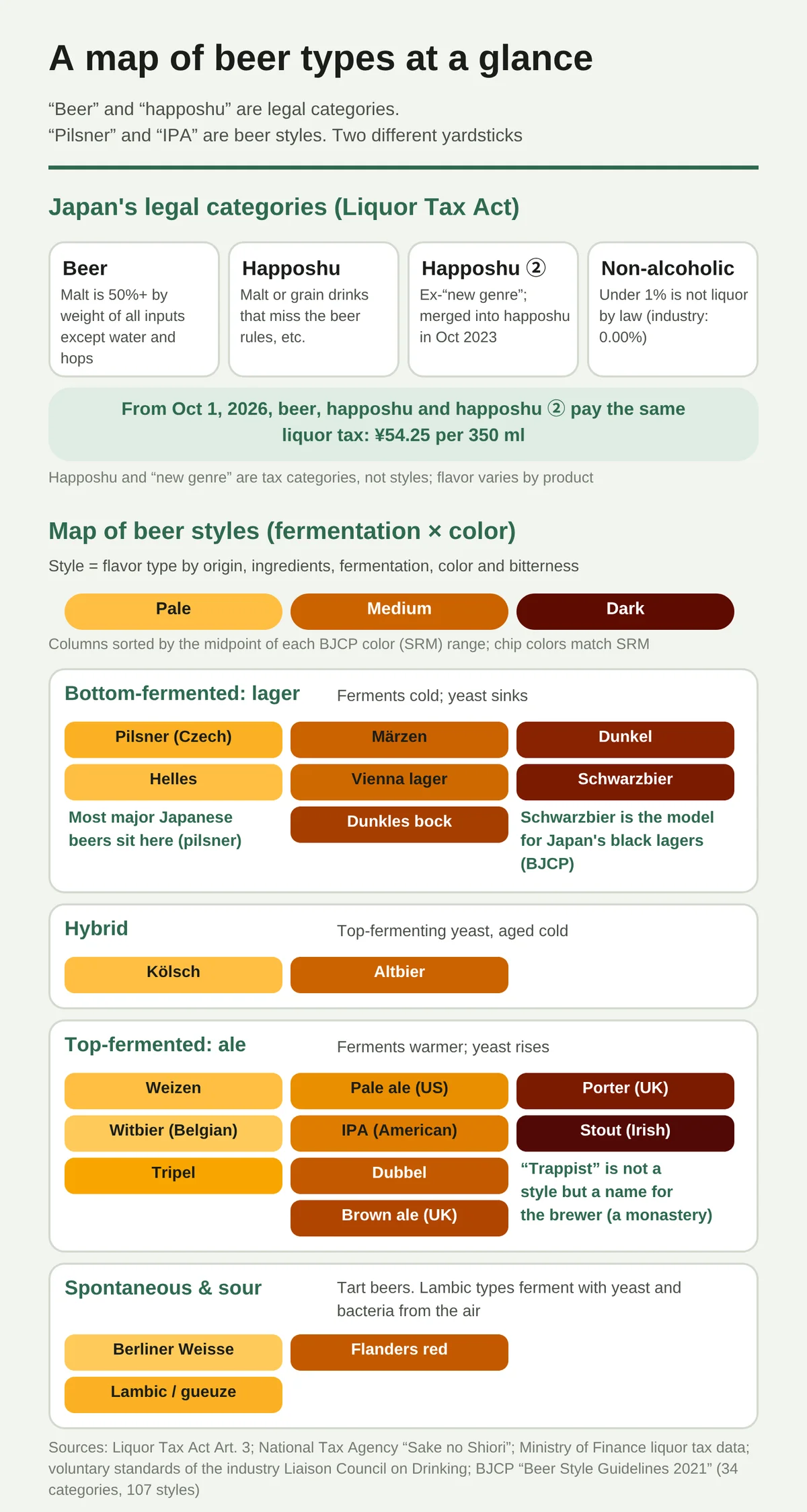
The Style Standards: BJCP and the Brewers Association
There are two widely used standards for the world’s beer styles.
| Standard | Edition | Contents |
|---|---|---|
| BJCP Beer Style Guidelines (the U.S. certification body for beer judges) | 2021 edition (current) | 34 categories and 107 styles (numbered). In addition, category 27 has 9 historical styles (counted by Urayomi) |
| Brewers Association Beer Style Guidelines (the U.S. brewers’ organization) | 2026 edition | The 2026 edition adds “Rice Lager” (using 15% or more rice) |
All the numbers in this article’s tables (color, alcohol content, bitterness) were taken from the BJCP 2021 edition “Vital Statistics.” Origins and history also follow the BJCP’s descriptions. The numbers (such as 3B) are BJCP style numbers. Color is in SRM, and strength is alcohol content (%).
The 34 categories of BJCP 2021 are as follows.
| Number | Category |
|---|---|
| 1–9 | Standard American Beer / International Lager / Czech Lager / Pale Malty European Lager / Pale Bitter European Beer / Amber Malty European Lager / Amber Bitter European Beer / Dark European Lager / Strong European Beer |
| 10–17 | German Wheat Beer / British Bitter / Pale Commonwealth Beer / British Brown Beer / Scottish Ale / Irish Beer / Dark British Beer / Strong British Ale |
| 18–22 | American Pale Ale / American Amber and Brown Beer / American Porter and Stout / IPA / Strong American Ale |
| 23–26 | European Sour Ale / Belgian Ale / Strong Belgian Ale / Monastic Ale |
| 27–34 | Historical Beer / American Wild Ale / Fruit Beer / Spiced Beer / Alternative Fermentables Beer / Smoked Beer / Wood Beer / Specialty Beer |
Lager Styles
These are bottom-fermenting beers matured at low temperatures. Most major Japanese beers fall here.
| Style (origin) | Color SRM | ABV % | Bitterness IBU | Notes (BJCP) |
|---|---|---|---|---|
| Czech Premium Pale Lager = Bohemian Pilsner (Plzeň, Czechia) | 3.5–6 | 4.2–5.8 | 30–45 | 3B. The original is Pilsner Urquell (1842, brewer Josef Groll). In Czechia, only Pilsner Urquell and Gambrinus are called “Pilsner” |
| German Pils (Germany) | 2–4 | 4.4–5.2 | 22–40 | 5D. The Czech Pilsner adapted to German water and hops. Early 1870s |
| Munich Helles (Munich) | 3–5 | 4.7–5.4 | 16–22 | 4A. Born in 1894 to compete with Pilsner. Said to have started at the Spaten brewery |
| German Helles Exportbier = Dortmunder (Dortmund) | 4–6 | 5.0–6.0 | 20–30 | 5C. Dortmund in the 1870s. In the Brewers Association of Japan’s classification it is “Dortmunder” |
| Festbier (Munich) | 4–6 | 5.8–6.3 | 18–25 | 4B. Since 1990, most beer served at Munich’s Oktoberfest has been this style. “Oktoberfestbier” is a protected name that only Munich breweries may use |
| Märzen (Germany) | 8–17 | 5.6–6.3 | 18–24 | 6A. The “March beer,” brewed in March and stored in caves over the summer. Spaten, 1841 |
| Vienna Lager (Vienna) | 9–15 | 4.7–5.5 | 18–30 | 7A. Anton Dreher, 1841. It traveled to Mexico |
| Rauchbier (Bamberg) | 12–22 | 4.8–6.0 | 20–30 | 6B. Uses malt smoked over beechwood. Märzen is the base |
| Munich Dunkel (Munich) | 17–28 | 4.5–5.6 | 18–28 | 8A. Spaten brewed it in the 1830s, after Munich malt became available |
| Schwarzbier (Thuringia, Saxony, Franconia) | 19–30 | 4.4–5.4 | 20–35 | 8B. Means “black beer.” The BJCP writes that it “served as the model for black lagers brewed in Japan” |
| Dunkles Bock (Einbeck) | 14–22 | 6.3–7.2 | 20–27 | 6C. Originated in Einbeck in the Hanseatic League era. Recreated in Munich from the 17th century |
| Helles Bock / Maibock (Germany) | 6–9 | 6.3–7.4 | 23–35 | 4C. Newer among the Bocks. A seasonal beer for spring, in May |
| Doppelbock (Munich) | 6–25 | 7.0–10.0 | 16–26 | 9A. First brewed by monks of the Order of St. Francis of Paola by the 1700s |
| Eisbock (Kulmbach) | 17–30 | 9.0–14.0 | 25–35 | 9B. Late 1800s. Concentrated by freezing and matured for a long time |
| American Light Lager (U.S.) | 2–3 | 2.8–4.2 | 8–12 | 1A. Brewed by Rheingold in 1967 and spread by Miller from 1973 |
| American Lager (U.S.) | 2–3.5 | 4.2–5.3 | 8–18 | 1B. Changed from the pre-Prohibition lager after Prohibition and World War II |
| International Pale Lager (worldwide) | 2–6 | 4.5–6.0 | 18–25 | 2A. A commercial example is Asahi Super Dry. The BJCP notes it is often confusingly labeled “Pilsner” |
| California Common (U.S. West Coast) | 9–14 | 4.5–5.5 | 30–45 | 19B. The “steam beer” of the Gold Rush era. Anchor Steam is the prototype. Bottom-fermenting in the BJCP classification |
- The Brewers Association of Japan explains of Pilsner that “this type of beer is the most widespread in the world, and Japanese pale beer also belongs to this type” (it gives the alcohol content as 4.0–5.0%)
- According to Pilsner Urquell’s official history, the first brew was on October 5, 1842, and the trademark was registered in 1898
For those who want to compare the original Czech Pilsner with Japanese pale beer: it is sold under the name from 1842.
Wheat Beer Styles
These are top-fermenting beers that use malted wheat. The Brewers Association of Japan explains German Weizen as using “wheat … malt at 50% or more.”
| Style (origin) | Color SRM | ABV % | Bitterness IBU | Notes (BJCP) |
|---|---|---|---|---|
| Weissbier = Hefeweizen (Bavaria) | 2–6 | 4.3–5.6 | 8–15 | 10A. Also called “Hefeweizen” or “Weizenbier.” Aromas of banana and clove. The present form dates from the Schneider brewery in 1872 |
| Dunkles Weissbier (Germany) | 14–23 | 4.3–5.6 | 10–18 | 10B. A dark wheat beer |
| Weizenbock (Germany) | 6–25 | 6.5–9.0 | 15–30 | 10C. Schneider’s “Aventinus,” 1907 |
| Belgian White = Witbier (around Leuven, Belgium) | 2–4 | 4.5–5.5 | 8–20 | 24A. Uses spices such as coriander. It died out in 1957 and was revived in 1966 by Pierre Celis as Hoegaarden |
- In the history of the Reinheitsgebot, brewing with wheat was in principle forbidden, but privileges were granted to nobles (for example the Degenberg family in 1548; Historical Lexicon of Bavaria)
- Both wheat and barley contain proteins in the gluten family. For details, see the article on beer and health and the article on gluten and spelt
One German Hefeweizen and one Belgian white beer. Even among wheat beers, as the table above shows, the source of the aroma and the birthplace differ.
Ale Styles
These are top-fermenting beers. British, Irish and American styles are arranged from palest color to darkest.
British Pale Ale, Bitter and IPA
| Style (origin) | Color SRM | ABV % | Bitterness IBU | Notes (BJCP) |
|---|---|---|---|---|
| Ordinary Bitter (Britain) | 8–14 | 3.2–3.8 | 25–35 | 11A |
| Best Bitter (Britain) | 8–16 | 3.8–4.6 | 25–40 | 11B |
| Strong Bitter (Britain) | 8–18 | 4.6–6.2 | 30–50 | 11C |
| English IPA (London, Britain) | 6–14 | 5.0–7.5 | 40–60 | 12C. From the pale, long-maturing ales sent to India in the late 1700s |
American Pale Ale and IPA
| Style (origin) | Color SRM | ABV % | Bitterness IBU | Notes (BJCP) |
|---|---|---|---|---|
| American Pale Ale (U.S.) | 5–10 | 4.5–6.2 | 30–50 | 18B. Popularized by Sierra Nevada Pale Ale in 1980 |
| American IPA (U.S.) | 6–14 | 5.5–7.5 | 40–70 | 21A. From Anchor Liberty Ale in 1975. A dry beer with a sharp, clean bitterness is called “West Coast IPA,” but it is only a kind of American IPA, says the BJCP |
| Hazy IPA (New England, U.S.) | 3–7 | 6.0–9.0 | 25–60 | 21C. Also called “New England IPA” or “NEIPA.” The prototype is said to be “Heady Topper” from The Alchemist brewery |
| Double IPA (U.S.) | 6–14 | 7.5–10.0 | 60–100 | 22A. From the mid-to-late 1990s |
- BJCP 21B “Specialty IPA” contains seven substyles: Belgian IPA, Black IPA, Brown IPA, Red IPA, Rye IPA, White IPA and Brut IPA
Brown Ale, Porter and Stout
| Style (origin) | Color SRM | ABV % | Bitterness IBU | Notes (BJCP) |
|---|---|---|---|---|
| British Brown Ale (Britain) | 12–22 | 4.2–5.9 | 20–30 | 13B |
| American Brown Ale (U.S.) | 18–35 | 4.3–6.2 | 20–30 | 19C. Pete’s Wicked Ale (1986) |
| English Porter (London, Britain) | 20–30 | 4.0–5.4 | 18–35 | 13C. London in the early 1700s |
| Irish Stout (Ireland) | 25–40 | 3.8–5.0 | 25–45 | 15B. In 1799 Guinness brewed only porter, and around 1810 it brewed a “stouter (stronger) porter” |
| Sweet Stout = Milk Stout (Britain) | 30–40 | 4.0–6.0 | 20–40 | 16A. “Milk” refers to the use of milk sugar (lactose). In Britain it can no longer be labeled “milk,” says the BJCP |
| Oatmeal Stout (Britain) | 22–40 | 4.2–5.9 | 25–40 | 16B. From around 1900 |
| Imperial Stout (Britain → U.S.) | 30–40 | 8.0–12.0 | 50–90 | 20C. A legend says it was exported to the Russian court. Also called “Russian Imperial Stout” |
Strong Ales
| Style (origin) | Color SRM | ABV % | Bitterness IBU | Notes (BJCP) |
|---|---|---|---|---|
| English Barleywine (Britain) | 8–22 | 8.0–12.0 | 35–70 | 17D. Bass No. 1 in 1872 was the first to be called “barleywine” |
| American Barleywine (U.S.) | 9–18 | 8.0–12.0 | 50–100 | 22C |
| Wee Heavy (Scotland) | 14–25 | 6.5–10.0 | 17–35 | 17C. Also called “Strong Scotch Ale” |
Checking some well-known stories against papers in a specialist journal on beer history gives the following.
- “IPA was a new style made specially strong to survive the long trip to India” is an exaggeration. What the records show is that Hodgson’s brewery in Bow, London, supplied East India Company ship captains with an already existing “October beer” (strong, pale and heavily hopped), which matured during the voyage and became popular. In 1801 a Calcutta newspaper carried an advertisement for “Hodgson’s beer,” and in 1809 “Hodgson’s select Pale Ale” appears. Allsopp of Burton was invited into the trade in 1822 and made its first shipment in 1823, and in 1832–33 the market shares were Bass 43% and Hodgson 28% (Cornell, Brewery History, 2003)
- “Porter was invented by Harwood in 1722” is also an exaggeration. Porter came about around 1720 as an improvement of London brown beer (Anderson, Brewery History, 2004). The Brewers Association of Japan, however, explains it as “1722, London”
For those who want to try Pale Ale, IPA and Stout that are easy to get in Japan: one each that corresponds to the American Pale Ale, IPA and Irish Stout in the tables above.
Hybrid Styles
These are beers that use top-fermenting yeast but are matured at low temperatures like a lager.
| Style (origin) | Color SRM | ABV % | Bitterness IBU | Notes (BJCP) |
|---|---|---|---|---|
| Kölsch (Cologne) | 3.5–5 | 4.4–5.2 | 18–30 | 5B. Top-fermenting with cold maturation. A name protected by the “Kölsch Convention” (1986). Bottom fermentation was banned in Cologne |
| Altbier (Düsseldorf) | 9–17 | 4.3–5.5 | 25–50 | 7B. Brewed top-fermenting in the late 19th century using lager techniques |
Belgian Ales and Trappist
| Style (origin) | Color SRM | ABV % | Bitterness IBU | Notes (BJCP) |
|---|---|---|---|---|
| Saison (Wallonia, Belgium) | 5–14 (pale) / 15–22 (dark) | 3.5–5.0 (table) / 5.0–7.0 (standard) / 7.0–9.5 (super) | 20–35 | 25B. An ale for farm workers |
| Belgian Golden Strong Ale (Belgium) | 3–6 | 7.5–10.5 | 22–35 | 25C. Developed after World War I by the Moortgat brewery (Duvel) |
| Dubbel (Belgium) | 10–17 | 6.0–7.6 | 15–25 | 26B. Westmalle, 1922 |
| Tripel (Belgium) | 4.5–7 | 7.5–9.5 | 20–40 | 26C. Westmalle, 1931 |
| Belgian Dark Strong Ale (Belgium) | 12–22 | 8.0–12.0 | 20–35 | 26D. Outside Belgium it is also called “Quad.” “Quadrupel” is the name of a particular brand, says the BJCP |
- Watch the names: “Duvel” is the name of a brand (its style is 25C), while “Dubbel” is the name of a style (26B)
Trappist is not a style
- In its description of category 26, “Monastic Ale,” the BJCP writes that names such as Trappist are “often protected names that indicate where the beer comes from, not a style.” Trappist is a name that indicates the maker (a monastery)
- The International Trappist Association’s products page says that “10 member abbeys brew and sell their own beer.” The brands on the same association’s beer list are 10: La Trappe, Chimay, Rochefort, Westmalle, Westvleteren, Mont des Cats, Cardeña, Mount St. Bernard, Orval and Tre Fontane (checked October 2, 2026)
- However, the numbers differ from page to page on the association’s site (the ATP label page lists 8 sites for Trappist beer, and the beer page says “11 abbeys,” for instance). Read the number as something that can change
- The “Authentic Trappist Product (ATP)” label requires, among other things, that the beer be brewed close to the monastery under the supervision of monks or nuns and that the profits go to the community, solidarity and charity. The license lasts 5 years
Spontaneous Fermentation and Sours
These are beers with a sour taste. Lambic and its relatives are fermented by yeast and bacteria in the air.
| Style (origin) | Color SRM | ABV % | Bitterness IBU | Notes (BJCP) |
|---|---|---|---|---|
| Lambic (around Brussels, Belgium) | 3–6 | 5.0–6.5 | 0–10 | 23D. A spontaneously fermented “wild” ale. A tradition of farms in the Senne Valley and the Pajottenland. Not blended; taken from the cask young (6 months) |
| Gueuze (same) | 5–6 | 5.0–8.0 | 0–10 | 23E. A blend of young and aged lambic. Strongly sparkling |
| Fruit Lambic (same) | 3–7 | 5.0–7.0 | 0–10 | 23F. Fruit is added partway through maturation. Kriek uses cherries |
| Flanders Red Ale (West Flanders, Belgium) | 10–17 | 4.6–6.5 | 10–25 | 23B. Represented by the Rodenbach brewery (founded 1821). Matured up to 2 years in large wooden casks |
| Berliner Weisse (Berlin, Germany) | 2–3 | 2.8–3.8 | 3–8 | 23A. In 1809 Napoleon’s troops called it the “Champagne of the North” |
| Gose (Goslar → Leipzig, Germany) | 3–4 | 4.2–4.8 | 5–12 | 23G. Uses salt and coriander. Today’s versions are made by adding lactic acid bacteria |
- American beers made with wild yeast and bacteria are in a separate BJCP category, 28 “American Wild Ale”
For those who want to try a leading Trappist and a spontaneously fermented lambic: Chimay is a brand on the association’s list above, and Lindemans is a lambic brewery.
Other Categories and Historical Styles
- Categories 29–34 are fruit (fruit beer), spice, non-barley fermentables, smoked, wood-aged and other specialty beers
- Category 27, “Historical Beer,” has 9 styles: Kellerbier, Kentucky Common, Lichtenhainer, London Brown Ale, Piwo Grodziskie, Pre-Prohibition Lager, Pre-Prohibition Porter, Roggenbier (rye beer) and Sahti
- Radler has no entry as a style in BJCP 2021
Japan-Specific Categories (Happoshu, New Genre, Non-Alcoholic, Dry)
| Category | What it is | Source |
|---|---|---|
| Happoshu and new genre (happoshu ②) | Categories in Japan’s Liquor Tax Act, not styles. The taste type differs by product | Liquor Tax Act |
| Non-alcoholic and beer-taste drinks | With an alcohol content under 1%, a drink is not alcohol in law. Under the industry’s voluntary standard, only 0.00% drinks count as “non-alcoholic drinks.” The BJCP writes that low-alcohol and non-alcoholic Weissbier is popular in Germany | Liquor Tax Act Article 2, voluntary standard of the Liaison Council on Drinking, BJCP 10A |
| Dry | Asahi Super Dry went on sale on March 17, 1987. Asahi writes that it “created a new concept of ‘karakuchi (dry)’ in beer.” In the BJCP it is an example of 2A International Pale Lager | Asahi, BJCP |
| Japanese pale beer | The Brewers Association of Japan and Suntory explain that it belongs to the “Pilsner” type. The alcohol content of domestic beer is “mostly 4.5–5.5%” | Brewers Association of Japan, Suntory |
| Japanese black lager | The BJCP writes that German Schwarzbier “served as the model for black lagers brewed in Japan” | BJCP 8B |
| Rice Lager | A style newly established in the 2026 edition by the U.S. Brewers Association. Uses 15% or more rice | Brewers Association 2026 |
- According to the Brewers Association of Japan, in the Showa 60s (1985–89) companies released dry beers and the like, and in Heisei 6 (1994) production hit a record high of 7.135 million kL
How to Read the Label
Alcoholic Drinks Are Not Required to List Ingredients
Ordinary processed foods must list their ingredients and allergens under the Food Labeling Standards. But alcoholic drinks are an exception.
| Rule | How it applies to alcohol (beer) |
|---|---|
| Food Labeling Standards, Article 5 | “When selling alcoholic beverages,” the ingredient list, allergens and country of origin need not be shown |
| Food Labeling Standards, Article 3, paragraph 3 | For alcohol, storage method, best-before date, nutrient content and calories can also be omitted |
| Liquor Business Association Act, Article 86-5 | The item category of the alcohol and so on must be shown in an easy-to-see place on the container |
| Fair Competition Code on Beer Labeling | A voluntary industry rule (implemented by the Brewers Association of Japan). Requires showing that it is beer, the ingredient list, best-before date, storage method, volume, alcohol content, business name, place of manufacture, country or place of origin of ingredients, and so on |
| Labeling Standards on Preventing Underage Drinking | Statements such as “Drinking by persons under 20 is prohibited by law.” The type size must be 6 points or more (5.5 points or more for 360 ml or smaller) |
- The ingredients written on a beer can are there because of the Fair Competition Code, not the Food Labeling Standards. According to Kirin, this code was established in 1979
- The code applies to “beer” under the Liquor Tax Act that is packed into containers in Japan. Happoshu and new genre are not covered by this code
- Country-of-origin labeling for ingredients (example: “malt (foreign-made or domestic (under 5%))”) became required for product made from April 2022
- On why allergen labeling is not required for alcohol, the Consumer Affairs Agency explains that it is “extremely difficult to judge whether symptoms such as a flushed face or palpitations come from the antigenicity of specified ingredients or from the action of the alcohol.” So the absence of an allergen label does not mean “not contained” (Kirin voluntarily labels “soybean” on Nodogoshi <Nama>)
The Ingredient List Follows “the Order in the Law”
Article 2 of the code’s enforcement rules says that the ingredients of beer are to be written as follows.
The ingredients used (excluding water) shall be shown under the item names set in the Liquor Tax Act, its Enforcement Order and its Enforcement Ordinance, in that order. However, corn may be shown as “corn” (コーン) and starch (でんぷん) as “starch” (スターチ).
- In other words, the “malt, hops, rice, corn, starch” of a beer is in the order written in the law, not from most to least (the order of Article 6 of the Enforcement Order: barley, rice, corn, sorghum, potatoes, starch, sugars…)
- Even if “rice” comes before “corn,” there is not necessarily more rice
- The ingredient list of an ordinary processed food is in order of weight, so note that it is read differently
The Definitions of “Nama,” “Lager,” “Black Beer” and “Stout”
Article 4 of the code and Article 3 of its enforcement rules set how these words may be used.
| Word | Condition for use (gist of the original) |
|---|---|
| Nama beer / Draft beer | May not be shown “unless it is beer that has not been treated with heat (pasteurization).” The container must also state that it is “not heat-treated” |
| Lager beer | May not be shown “unless it is beer matured in the storage (lagering) process” |
| Black beer / Dark beer | “A dark-colored beer using dark malt as part of the ingredients” |
| Stout | “A beer using dark malt as part of the ingredients, dark in color and particularly strong in aroma and taste” |
| Tokusei (special) | When at least one of the ingredients, manufacturing process or manufacturing equipment has a “significant difference” from the industry norm and this can be explained objectively. The reason must also be stated |
| Ginjo | When all of the conditions are met, such as an extract content of the malt of 80.5% or more, aroma hops at 80% or more, and use of first wort only |
| High concentration | Original wort extract of 13% or more |
| High alcohol | Alcohol content of 6% or more |
| Words that cannot be used | “Honjozo,” “Honzukuri,” “Honjikomi” |
The code treats the following kinds of labeling as “improper labeling” (Article 4 of the enforcement rules).
- Writing “○○ beer,” “○○ ale,” “○○ stout” and the like on a drink that is not beer
- Claiming a medicine-like effect
- Superlatives such as “the best,” “finest” or “best”
- “Oldest,” “No. 1 in Japan” or “number one” without grounds, or “fresh” without grounds
- Stressing the quality of nama beer because it is “not heat-treated,” without factual backing
- Labeling that suggests you will not get drunk
“Pilsner” and “Premium” Have No Definition
- The code and its enforcement rules have no definition of “Pilsner” or “premium” (the full text was checked)
- “Premium” is a word each company uses freely within a range that does not amount to a superlative like “the best”
- The BJCP writes that the world’s mass-produced lagers (International Pale Lager) are often confusingly labeled “Pilsner.” “Pilsner” on a can can be a guide to the style, but there is no fixed standard behind it
Alcohol Content, Pure Alcohol and the Age-20 Notice
- Alcohol content is shown either as “○○% or more but under ○○%” (a range of 1 degree) or in a form such as “5%” (Article 2 of the code’s enforcement rules)
- Showing pure alcohol (g): Industry groups for alcoholic beverages have agreed to write grams on the container as either “per 100 ml,” “per can/bottle” or “per drink” (example: “14 g per can” for a 350 ml can of beer). The start date is “promptly, taking into account the timing of label changes” (Brewers Association of Japan, materials for the Ministry of Health, Labour and Welfare (MHLW) meeting of September 22, 2025). Kirin has been introducing it gradually since May 2022
- The formula is “volume (ml) × alcohol content (%) ÷ 100 × 0.8” (Sapporo). For 5% and 350 ml, that is 14 g
- The notice on preventing underage drinking is not satisfied by “This is alcohol” or “Drink slowly and in moderation” alone (NTA circular)
Ingredients and Additives of 23 Major Brands
I checked each company’s official pages on October 2, 2026. Items written after the “/” in the ingredient list are food additives. The category is the one on each company’s page.
Category “beer”
| Brand | ABV | Ingredients | Additives |
|---|---|---|---|
| Asahi Super Dry | 5% | Malt, hops, rice, corn, starch | None |
| Asahi Nama Beer Kuronama | 5% | Malt, hops, rice, corn, starch | None |
| Asahi Stout | 8% | Malt, hops, sugars | None |
| Kirin Ichiban Shibori Nama Beer | 5% | Malt, hops | None |
| Kirin Ichiban Shibori Sugar Zero | 5% | Malt, hops, sugars | None |
| Sapporo Nama Beer Black Label | 5% | Malt, hops, rice, corn, starch | None |
| Sapporo Lager Beer (Akaboshi, heat-treated) | 5% | Malt, hops, rice, corn, starch | None |
| Yebisu Beer | 5% | Malt, hops | None |
| The Premium Malt’s | 5.5% | Malt, hops | None |
| Suntory Nama Beer | 5% | Malt, hops, corn, sugars | None |
| Perfect Suntory Beer | 5.5% | Malt, hops, sugars | None |
(The way malt origin is written has been omitted.)
Category “happoshu”
| Brand | ABV | Ingredients | Additives |
|---|---|---|---|
| Kirin Tanrei Green Label | 4.5% | Malt, hops, barley, corn, sugars | None |
| Asahi Style Free <Nama> | 4% | Malt, malt extract, hops, barley, rice, corn, starch, sugars, yeast extract, dietary fiber, soy protein | None |
| Asahi Style Free Triple Zero | 6% | Happoshu (malt extract, hops, rice, corn, starch, sugars, soy protein), spirits (alcohol, hops) | Flavoring, seasoning (amino acids), caramel color |
| Sapporo Gokuzero | 5% | Malt, hops, barley, sugars, spirits, water-soluble dietary fiber | Carbonic acid, flavoring, bittering agent, calcium chloride, caramel color, acidulant, stabilizer (alginate ester) |
| Suntory Jokki Nama | 5% | Hops, corn, sugars, brewer’s alcohol, dietary fiber, yeast extract, corn protein hydrolysate | Flavoring, acidulant, caramel color, potassium citrate, sweetener (acesulfame K) |
| Asahi Orion Zero Life | 4% | Happoshu (malt, hops, wheat, barley, sugars, dietary fiber, soy peptide, yeast extract), spirits (barley) | Caramel color, sweetener (acesulfame K) |
Former new genre (happoshu ②)
| Brand | ABV | Ingredients | Additives |
|---|---|---|---|
| Kirin Hon-Kirin | 6% | Happoshu (malt, hops, barley, corn, sugars), barley spirits | None |
| Kirin Nodogoshi <Nama> | 5% | Hops, sugars, soy protein, yeast extract (no malt or barley) | None |
| Kirin Nodogoshi ZERO | 4% | Happoshu (malt extract, hops, sugars, dietary fiber, soy protein), barley spirits | Emulsifier |
| Sapporo Draft One | 5% | Hops, sugars, pea protein | Caramel color |
| Sapporo Whiteberg | 5% | Happoshu (barley malt, wheat malt, hops, barley, coriander seed, orange peel), spirits (barley) | None |
| Suntory Kinmugi (the happoshu ② up to now) | 5% | Happoshu (malt, hops, sugars), spirits (wheat) | None |
(For reference, non-alcoholic) Suntory All-Free (0%): ingredients are malt and hops / additives are carbonic acid, flavoring, acidulant, caramel color, vitamin C, bittering agent and sweetener (acesulfame K).
What can be read from this:
- The 11 brands in the “beer” category had no additives. The adjuncts went no further than rice, corn, starch and sugars (separately, Asahi Super Dry Sokai Karakuchi carries a “/ carbonic acid” label)
- Soy protein, pea protein, corn protein hydrolysate, yeast extract and dietary fiber are written on the ingredient side, not as additives. These are the same as the “specified items” in the definition of new genre
- The sweetener sucralose was not found in the beer-type drinks checked this time (beer, happoshu, new genre and non-alcoholic)
- Suntory’s Kinmugi will become a “beer” category product with the new Kinmugi planned for release on October 6, 2026. Kirin’s Hon-Kirin will also become “beer” (5%) from the batch released on November 4, 2026. The table above shows Kinmugi and Hon-Kirin as they have been up to now
Additives in Sugar-Zero and Purine-Zero Types
Additives appeared only in happoshu, new genre and non-alcoholic drinks, and were most common in brands with “ZERO” in the name.
| Additive | Brands where it appeared (within the scope of this check) | Details |
|---|---|---|
| Caramel color | Triple Zero, Gokuzero, Jokki Nama, Orion Zero Life, Draft One, All-Free | Article on caramel color |
| Flavoring | Triple Zero, Gokuzero, Jokki Nama, All-Free | Article on flavorings |
| Sweetener (acesulfame K) | Jokki Nama, Orion Zero Life, All-Free | Article on sweeteners |
| Acidulant | Gokuzero, Jokki Nama, All-Free | Food additive database |
| Bittering agent | Gokuzero, All-Free | Food additive database |
| Others | Seasoning (amino acids), emulsifier, stabilizer (alginate ester), calcium chloride, potassium citrate, carbonic acid, vitamin C | Food additive database |
It also helps to know the rules for “sugar zero” labeling when reading labels (Food Labeling Standards).
- Nutrition labeling is not required for alcohol. But when a nutrition claim such as “sugar zero” is made, the Food Labeling Standards rules apply
- “Sugar content (糖質, toshitsu)” can be shown as “0” if it is under 0.5 g per 100 ml. In other words, “sugar zero” (糖質ゼロ) means “under 0.5 g of toshitsu per 100 ml”
- What the standards table for “free of” and “low” claims (Appended Table 13) lists is “sugars (糖類, tōrui),” and “toshitsu” is not in it. I could not find numerical standards in the Food Labeling Standards for “sugar off” (糖質オフ) or “○% sugar cut” (糖質○%カット)
- Even at zero sugar, the calories from alcohol remain (7 kcal per gram of alcohol). At 5% and 350 ml, that is 14 g of pure alcohol and about 98 kcal
- Kirin Ichiban Shibori Sugar Zero, in the “beer” category, has the ingredients malt, hops and sugars, and had no additives
For purines, calories and gluten, see the article on beer and health. For the rules on when you may write “additive-free” (mutenka), see the article on the rules for “additive-free” labeling.
Germany’s Beer Purity Law
The 1516 Original Text Says “Barley, Hops, Water”
In 1516, part of the “territorial ordinance” decided by the Bavarian Diet (at Ingolstadt) and issued by Wilhelm IV and Ludwig X is what is called the “Beer Purity Law.”
- The original text says nothing other than “barley (Gersten), hops and water” may be used in beer (Historical Lexicon of Bavaria, the scholarly encyclopedia of the Bavarian State Library)
- Yeast is not included. The German Brewers’ Federation explains that yeast was explicitly added later because “its role in brewing was not understood at the time”
- The Federation paraphrases the original’s “barley” as “malt (Malz)”
- The date differs by source. The German Brewers’ Federation gives April 23 (in Germany, “German Beer Day”), while the Bavarian scholarly encyclopedia says it was “dated April 24, finally discussed and printed in July”
- According to the Federation, there were three purposes: (1) protect people from excessively high beer prices, (2) keep wheat for bread from being used in beer, and (3) prevent harmful additions such as henbane, thorn apple and soot
- Earlier, similar rules existed in Munich in 1487 and Bamberg in 1489 (malt, hops, water, yeast), among others
- The Federation explains that it spread across Germany with Baden in 1896, Württemberg in 1900 and then the Reich law of 1906, and has continued across the whole of Germany since. The Federation describes the Purity Law as “the world’s oldest consumer protection law still in force” (this is the Federation’s own wording)
The 1987 Ruling of the European Court of Justice
On March 12, 1987, the European Court of Justice gave its judgment in the case in which the European Commission sued Germany (Case 178/84).
- The legal basis at the time was Articles 9 and 10 of the “Beer Tax Act” (1952). Article 9 set how beer is made, and Article 10 set the rules on use of the name “beer.” Rice, corn and sorghum were held not to count as “grain” for beer ingredients
- The judgment held that barring the sale of beer lawfully made and sold in another member state because it does not conform to these rules violates Article 30 of the EEC Treaty
- As reasons, it cited that “beer” is a generic name in other member states that includes both beer made only of barley malt and beer with rice or corn added, that information for consumers can be provided by labeling, and that banning all additives would be disproportionate
- The German Brewers’ Federation explains that since 1987 foreign beers that do not follow the Purity Law have been sold in Germany too, but German breweries are still expected to brew according to the Purity Law
Germany’s Law Today
- The German Brewers’ Federation explains that the legal basis of today’s purity requirement is the “Provisional Beer Act (Vorläufiges Biergesetz)”
- Article 9 of the Provisional Beer Act says that bottom-fermented beer uses only barley malt, hops, yeast and water, while top-fermented beer may also use other malts (wheat malt and so on) and sugars (text checked on a private legal-information site)
- Article 1 of the Beer Ordinance (1990) says that beer made abroad that can be sold as “beer” in that country may call itself “Bier” even if it does not meet these conditions
- According to the Federation, beer made according to the Purity Law is treated as a “traditional food” under the EU additives regulation
Relation to Japanese Beer
- In Japan, the Liquor Tax Act allows rice, corn, starch, sugars and so on to be used in beer. The Brewers Association of Japan explains that, of these, rice, corn and starch are “widely used in the United States and European countries (except Germany) as well”
- Among the 23 brands in the table, the beers whose ingredients are only “malt, hops” were three: Kirin Ichiban Shibori Nama Beer, Yebisu Beer and The Premium Malt’s
Japanese Craft Beer
Born from the 1994 Deregulation
- In April 1994 (Heisei 6), the Liquor Tax Act was amended, and the minimum annual production needed for a beer brewing license dropped from 2,000 kL to 60 kL. The Brewers Association of Japan explains that “small breweries such as microbreweries and pub breweries appeared in Japan too”
- The minimum production is still 60 kL for beer and 6 kL for happoshu (Article 7, paragraph 2 of the Liquor Tax Act)
- In an NTA survey (as of January 1, 2025, 622 respondents), producers with “beer only” numbered 48, “happoshu only” 324, and “beer and happoshu” 250. That is, the largest group holds only a happoshu license
- When the definition of beer was widened in 2018, those who had held a happoshu license were treated as having received a beer license (NTA Q&A)
For the change in the number of producers, see the graph in the article on beer history and the world.
14 Large Companies Account for 95.3%
Looking at domestic beer sales volume for 2024 in the NTA’s “Overview of the Liquor Manufacturing and Wholesale Industries (Reiwa 7 survey),” it is as follows (a total of the respondents, not the whole population).
| Category | Number of companies | Domestic beer sales volume | Share (Urayomi’s calculation) |
|---|---|---|---|
| Large companies | 14 | 2,520,339 kL | 95.3% |
| Small and medium enterprises | 518 | 124,965 kL | 4.7% (small and medium plus individuals combined) |
| Sole proprietors | 90 | 156 kL | (included above) |
| Total | 622 | 2,645,460 kL | 100% |
- For happoshu, the share of small and medium businesses and individuals was 3.2%, and for beer and happoshu combined it was 4.2%
- In the same material’s prefecture breakdown, Nagano Prefecture’s domestic beer sales volume was 9,527 kL (2024)
- In the last survey under the name “Overview of the Jibiru (Local Craft Beer) Manufacturing Industry” (fiscal 2018 data, excluding the 5 large companies), beer from outside the 5 large companies was 1.1% of production volume, and 83.2% of the 303 respondents were makers producing under 100 kL a year
Definitions of “Jibiru” and “Craft Beer”
- The Liquor Tax Act, its Enforcement Order and its Enforcement Ordinance do not contain the words “jibiru (local craft beer)” or “craft” (searching the current text gave 0 hits). The only legal categories are beer and happoshu
- Industry groups do have definitions. The definition of the National Jibiru Brewers Council, introduced in a 2020 news report (Mynavi News), has three points: (1) independent of the large-capital mass-produced beer from before April 1994, (2) a single brew (wort volume) of 20 kL or less, and (3) traditional methods or local specialties are used and the brewer is rooted in the region. However, the council’s original site is now a different site, and I could not confirm the original text
- The National Jibiru Brewers Council has 154 member companies (as of the MHLW meeting materials of September 2025)
- In the United States, the Brewers Association defines craft brewers as “small and independent.” Small means up to 6 million barrels a year, and independent means less than 25% owned or controlled by an alcohol-industry member that is not itself a craft brewer
For those who want to choose domestic craft beer by type, such as ale, lager, Pilsner, white and black: a mail-order shop for Nagano local sake carries beer from six Nagano breweries, including Yo-Ho Brewing, sorted by type.
Facts About Enjoying Beer
Temperature, Pouring and Glasses
- Temperature: Kirin says “6°C to 8°C is a guide … slightly lower in summer, slightly higher in winter,” and writes that “if it is too cold, you cannot tell the beer’s original taste and the foam does not form well”
- The three-step pour (Kirin): (1) pour slowly at first, then with more force partway; (2) when the beer and foam are about 1:1, top it up until the foam rises 1 cm; (3) when the foam settles, pour slowly so as to push the foam up
- Weizen (Kirin): tilt the glass nearly horizontal and pour gently, and when it is three-quarters full, stand the glass up and make 6 to 7 cm of foam. Without a dedicated glass, make the ratio of beer to foam “6:4”
- Glasses (Kirin): foam sticking to the inside of a glass is a sign of dirt, with the carbonation coming apart. Wash with a dedicated sponge and let it air-dry without wiping with a cloth
Ice in beer melts and dilutes it. There are also tools for keeping the beer in the glass cold without ice.
The Role of Foam
- Foam is “made of carbon dioxide bubbles with proteins, carbohydrates, hop resin and so on in the beer sticking to them” (Kirin)
- Foam acts as “a lid that keeps carbon dioxide from escaping and keeps the beer from losing flavor through contact with air” (Kirin)
- Components of hop resin improve foaming and foam retention (Kirin, Brewers Association of Japan)
Light-Struck Flavor and Brown Bottles
- When sunlight hits beer, an unpleasant smell called “light-struck flavor” (nikkōshū) appears. The substance responsible is 3-methyl-2-butene-1-thiol
- The mechanism is that light-activated vitamin B2 (riboflavin) breaks down the hop bittering compounds (iso-alpha acids), and this substance forms from the breakdown products (Huvaere et al., J Agric Food Chem, 2005). It is produced by light in the ultraviolet range (Pratap-Singh et al., Foods, 2023)
- Suntory writes, “When direct sunlight hits beer its flavor declines, so brown bottles are used to prevent this. Even brown, however, the blocking effect on sunlight is not 100%”
- The BJCP treats light-struck flavor not as a style characteristic but as a “handling flaw”
Best-Before Dates and Storage
| Company | Shelf life of domestic beer (checked in official lists) |
|---|---|
| Asahi | 9 months (Asahi Stout: 12 months) |
| Kirin | 9 months (“beer-type drinks are 9 months from production”) |
| Suntory | 9 months |
| Sapporo | 12 months |
- Under the code, the best-before date is written as year, month and day, but for products over 3 months it may be year and month. Kirin explains that a “20●●/●” notation means “until the end of the month shown”
- The Brewers Association of Japan explains that the best-before date is “set with ample margin based on the results of storage tests”
- An example of the storage statement is “Store in a cool place out of direct sunlight” (the code’s enforcement rules). Kirin also says to avoid sunlight and temperatures that are too high or too low
- For bottles, an example caution is set: “Avoid impact to the bottle and freezing it, and do not leave it in the sun for a long time”
- There are about 6 bottle sizes in all, including the large bottle at 633 ml, the medium at 500 ml and the small at 334 ml. The large bottle’s 633 ml matches 3.51 gō (633.168 ml), the smallest of the factories’ large bottles when the Liquor Tax Act of Showa 15 (1940) required capacities to be standardized, and it was fixed in Showa 19 (Brewers Association of Japan)
For Those Who Want to Know More
For those who want to learn more about beer styles and brewing, with diagrams and photos.
Items Featured in This Article (Summary)
Here are the items introduced in the article once more. The reasons and ingredients are in each section.
| Item featured | Where to buy |
|---|---|
| Pilsner Urquell 330 ml bottles × 6 (Czechia) | See on Rakuten (酒宝庫 MASHIMO) PR See on Amazon.co.jp PR See on Yahoo! Shopping PR |
| Weihenstephaner Hefeweissbier 330 ml × 6 (Germany) (ヴァイエンシュテファン ヘーフェヴァイス) | See on Rakuten (津田SAKE店) PR See on Amazon.co.jp PR See on Yahoo! Shopping PR |
| Hoegaarden White 330 ml bottles × 6 (Belgian white beer) (ヒューガルデン ホワイト) | See on Rakuten (ワインと地酒の店 かたやま) PR See on Amazon.co.jp PR See on Yahoo! Shopping PR |
| Yona Yona Ale 350 ml cans × 12 / 24 (American Pale Ale) (よなよなエール) | See on Rakuten (よなよなの里(ヤッホーブルーイング直営)) PR See on Amazon.co.jp PR See on Yahoo! Shopping PR |
| India no Aooni 350 ml cans × 12 / 24 (IPA) (インドの青鬼) | See on Rakuten (よなよなの里(ヤッホーブルーイング直営)) PR See on Amazon.co.jp PR See on Yahoo! Shopping PR |
| Draught Guinness 330 ml cans × 8, with a dedicated pint glass (Ireland) (ドラフトギネス) | See on Rakuten (酒のビッグボス) PR See on Amazon.co.jp PR See on Yahoo! Shopping PR |
| Chimay Blue 330 ml bottles × 6 (Trappist) (シメイ ブルー) | See on Rakuten (世界のビール専門店 BEER THE WORLD) PR See on Amazon.co.jp PR See on Yahoo! Shopping PR |
| Lindemans Selection Set 250 ml × 4, with glass (Lambic) (リンデマンス セレクションセット) | See on Rakuten (にっぽん津々浦々) PR See on Amazon.co.jp PR See on Yahoo! Shopping PR |
| Choose craft beer at NAGANOSAKE.JP (mail order for Nagano local sake) | NAGANOSAKE.JP で長野のクラフトビールを見る |
| Beer Cube (stainless steel cooling cubes) (ビアキューブ) | ビアキューブ直販ストアで見る |
| Japan Beer Culture Society, “The World of Beer Opens Up, 2nd Edition: Official Textbook for the Japan Beer Certification, 2026–2027 Edition” (日本ビール文化研究会『知って広がるビールの世界 第2版 日本ビール検定公式テキスト 2026-2027年版』) | See on Rakuten (楽天ブックス) PR See on Amazon.co.jp PR See on Yahoo! Shopping PR |
Notice Drinking is for those 20 and over. Drinking by persons under 20 is prohibited by law. Do not drink during pregnancy or while breastfeeding, and never drink and drive. Nothing introduced here is meant to show that it is good for your health. Prices and shipping may change (shipping varies by region).
Summary
- Under Japanese law, “beer” is at least 50% malt among the ingredients (other than water and hops). The “up to 5%” limit applies only to fruit and flavorings, not to rice, corn, starch or sugars
- New genre was merged into happoshu in October 2023 (happoshu ②). On October 1, 2026, the liquor tax on beer, happoshu and the former new genre was unified at ¥54.25 per 350 ml, and Kinmugi, Mugi to Hop, GOLD STAR and Clear Asahi, and in November Hon-Kirin, move to beer
- The big difference in brewing is fermentation: lager (bottom), ale (top) and spontaneous. Lager yeast is a hybrid of ale yeast and a wild yeast from Patagonia
- BJCP 2021 has 34 categories and 107 styles. Most major Japanese beers are Pilsner-type lagers, and “happoshu” and “new genre” are tax categories, not styles
- The ingredient list on beer comes from the Fair Competition Code, and its order is the order in the law. “Nama” means not heat-treated. “Pilsner” and “premium” have no definition
- Among the 23 brands checked, the “beer” category had no additives, and additives were in happoshu, new genre and non-alcoholic drinks, especially the “zero” types
- The Purity Law’s original text was barley, hops and water, with no yeast. After the 1987 ruling, foreign beer could be sold in Germany too
Sources
- Liquor Tax Act, Articles 2, 3 (items 12 and 18), 7 and 23; Order for Enforcement of the Liquor Tax Act, Articles 6 and 7-2; Ordinance for Enforcement of the Liquor Tax Act, Articles 4 and 4-2 (e-Gov law search) https://laws.e-gov.go.jp/law/328AC0000000006
- NTA, “Q&A on the Revision of the Definition of Beer under the Fiscal 2017 Tax Reform” (March 2018, revised September 2019) https://www.nta.go.jp/publication/pamph/pdf/0018004-031_01.pdf
- NTA, “Guide to Labeling Items and Tax Rate Categories for the Phased Tax Rate Changes of Sparkling Liquors” (August 2023) https://www.nta.go.jp/taxes/sake/pdf/0023008-027.pdf
- NTA, “Sake no Shiori” (July 2026): liquor tax rate table, beer manufacturing process chart, appendix https://www.nta.go.jp/taxes/sake/shiori-gaikyo/shiori/2026/index.htm
- Ministry of Finance, “Materials on Liquor Tax” https://www.mof.go.jp/tax_policy/summary/consumption/d07_0.pdf
- NTA, “Overview of the Liquor Manufacturing and Wholesale Industries (Reiwa 7 survey),” Tables 55–57 https://www.nta.go.jp/taxes/sake/shiori-gaikyo/seizo_oroshiuri/r07/pdf/all.pdf
- NTA Liquor Tax Division, “Overview of the Jibiru (Local Craft Beer) Manufacturing Industry (fiscal 2018 survey)” https://www.nta.go.jp/taxes/sake/shiori-gaikyo/seizogaikyo/beer/pdf/h30/h30beer_01.pdf
- NTA, Liquor Tax Act and Liquor Administration Related Laws Interpretation Circular, Article 86-6 (labeling to prevent underage drinking) https://www.nta.go.jp/law/tsutatsu/kihon/sake/8-09c.htm
- NTA Notice, “Labeling Standards on Preventing Underage Drinking” (revised Reiwa 1) https://www.nta.go.jp/law/kokuji/190614/03.htm
- Food Labeling Standards (Cabinet Office Order No. 10 of 2015), Articles 3 and 5, Appended Tables 9 and 13 (e-Gov) https://laws.e-gov.go.jp/law/427M60000002010
- Liquor Business Association Act, Article 86-5 (e-Gov) https://laws.e-gov.go.jp/law/328AC0000000007
- Consumer Affairs Agency, “Handbook on Food Allergy Labeling for Processed Foods” (April 2026) https://www.caa.go.jp/policies/policy/food_labeling/food_sanitation/allergy/assets/food_labeling_cms204_260401_02.pdf
- Fair Competition Code on Beer Labeling and its enforcement rules (implementing body: Brewers Association of Japan; checked in the PDF posted by the All Japan Federation of Fair Trade Councils, via the April 26, 2025 Web Archive version)
- Brewers Association of Japan, “How Beer Is Made” https://www.brewers.or.jp/tips/production.html / “Major Beers of the World” https://www.brewers.or.jp/tips/type.html / “History of Beer” https://www.brewers.or.jp/tips/histry.html / Q&A on everything
- Brewers Association of Japan, “Explanatory Materials for the Alcohol-Related Health Problems Countermeasures Council” (September 22, 2025, posted by MHLW) https://www.mhlw.go.jp/content/10601000/001566490.pdf
- Liaison Council on Drinking, “Voluntary Standards on Advertising and Promotion of Alcoholic Beverages and Labeling of Alcoholic Beverage Containers” (last revised July 1, 2026) https://www.brewers.or.jp/contents/self-pdf/Self-Regulatory_jap.pdf
- BJCP, “Beer Style Guidelines 2021 Edition” https://www.bjcp.org/bjcp-style-guidelines/
- Brewers Association, “Beer Style Guidelines,” 2026 edition https://www.brewersassociation.org/edu/brewers-association-beer-style-guidelines/
- International Trappist Association https://www.trappist.be/en/products/ / https://www.trappist.be/en/products/beers/ / https://www.trappist.be/en/about-ita/atp-label/
- Historisches Lexikon Bayerns, “Purity Law, 1516” https://www.historisches-lexikon-bayerns.de/Lexikon/EN:Purity_Law,_1516
- Deutscher Brauer-Bund (German Brewers’ Federation), “Entstehung” https://brauer-bund.de/reinheitsgebot/entstehung/ / “Fragen und Antworten” https://brauer-bund.de/reinheitsgebot/fragen-und-antworten/
- European Court of Justice, Case 178/84, Commission v Germany (March 12, 1987, ECLI:EU:C:1987:126) https://eur-lex.europa.eu/legal-content/EN/TXT/?uri=CELEX:61984CJ0178
- Vorläufiges Biergesetz §9 https://lxgesetze.de/vorlbierg/9 / Bierverordnung §1 https://www.gesetze-im-internet.de/bierv/__1.html
- Libkind D, et al. Microbe domestication and the identification of the wild genetic stock of lager-brewing yeast. PNAS. 2011;108(35):14539-44. PMID: 21873232
- Bing J, et al. Evidence for a Far East Asian origin of lager beer yeast. Curr Biol. 2014;24(10):R380-1. PMID: 24845661
- Walther A, et al. Genome sequence of Saccharomyces carlsbergensis, the world’s first pure culture lager yeast. G3. 2014;4(5):783-93
- Omuro M. “The Small Stars of Brewing Beer,” Journal of the Society for Biotechnology, Japan, vol. 94, no. 9 (2016)
- Malowicki MG, Shellhammer TH. J Agric Food Chem. 2005;53:4434. PMID: 15913306
- Sakamoto K, Konings WN. Int J Food Microbiol. 2003;89:105-124. PMID: 14623377
- Huvaere K, et al. J Agric Food Chem. 2005;53:1489. PMID: 15740029
- Pratap-Singh A, et al. Foods. 2023;12:684. PMC9955924
- Cornell M. Brewery History. 2003;111:63-68 (history of IPA)
- Anderson R. Brewery History. 2004;113:27-30 (history of porter)
- Asahi Breweries, “Ingredient and Nutrition Table” https://www.asahibeer.co.jp/products/ing_beer.html / news releases of May 29, 2026 https://www.asahibeer.co.jp/news/2026/0529_3.html and September 18, 2026 https://www.asahibeer.co.jp/news/2026/0918_2.html
- Kirin Brewery product pages https://www.kirin.co.jp/alcohol/beer/ichiban/ and others / Customer Service FAQ (id 50053, 50094, 50096, 50098, 50807) / Kirin Holdings news releases of January 15 and May 20, 2026 / Kirin Journal (October 31, 2024)
- Sapporo Breweries, “Nutrition Facts List” https://www.sapporobeer.jp/product/nutrition/ / FAQ https://www.sapporobeer.jp/support/customer/faq/0000000277/ / news release of June 17, 2026 https://www.sapporobeer.jp/news_release/0000018638/
- Suntory, “Nutrition Facts List, Beer-Type Drinks” https://products.suntory.co.jp/beer/ingredient.html / news release of July 16, 2026 https://www.suntory.co.jp/news/article/2026/15085.html / Customer Center FAQ (001704, 005520, 005799)
- Pilsner Urquell, “History” https://www.prazdroj.cz/en/about-us/history
- Brewers Association, “Craft Brewer Definition”
- Mynavi News (August 21, 2020, introducing the definition of the National Jibiru Brewers Council)
Related articles and databases
- Is Beer Bad for You? Gluten in Barley, Purines, "Zero Carbs," Brewer's Yeast and Virility, and "Beer Belly," Checked Against Food Tables and Studies
- Where Did Beer Come From? 10,000 Years of History and the World Beer Consumption Ranking (China #1 in Total, Czechia #1 per Capita), and Where Japan Stands, Read Through Papers and Government Statistics
- Types of Shochu: Class A, Class B, Honkaku Shochu, and Awamori Explained, with a Popularity Ranking, Using National Tax Agency Materials