
Where Did Beer Come From? 10,000 Years of History and the World Beer Consumption Ranking (China #1 in Total, Czechia #1 per Capita), and Where Japan Stands, Read Through Papers and Government Statistics

PR This article contains affiliate links to Rakuten Ichiba, Amazon, Yahoo! Shopping, A8.net, and Moshimo Affiliate. What is written here is based on papers, museums, government statistics, and official company materials, regardless of any ads. You must be 20 or older to drink alcohol in Japan. The “See on Amazon.co.jp” links are also affiliate links.
“Where was beer born?” “Which country drinks the most beer in the world?” “Where does Japan rank?”
These are common questions, but the answers you find online mix in old numbers and stories with unclear sources. For example, “Germans drink the most beer,” “Japan is 7th in the world in beer consumption,” and “Under the Code of Hammurabi, a tavern keeper who watered down the beer was thrown into the river” do not match current sources.
This article checks the following against papers, museum materials, government statistics, and official company materials.
- Where beer originated, and why no single place can be named as “the birthplace”
- How beer spread, from ancient Mesopotamia and Egypt through medieval monasteries to modern lager and Pilsner
- When and where beer began in Japan
- Which country consumes the most beer, and where Japan ranks
- How much the Japanese beer market has shrunk
- How much of the commonly told beer history is actually true
Beer types (lager, ale, IPA, and so on) and how beer is made are covered in the article on beer types. Health effects, gluten, and purines are covered in the article on beer and health. For the history of sake and shochu, see the article on the history and culture of sake and the article on the history of shochu and Kyushu.
Conclusion
- The “birthplace” of beer cannot be pinned to one place. The oldest evidence is spread across a stone mortar in an Israeli cave (about 13,000 years ago, disputed), a brewing vat in Egypt, residue in a jar in Iran, brewing tools in China, a clay tablet in Mesopotamia, and more, and each kind of evidence differs (residue, tools, writing)
- The oldest beer recorded in writing is on a Mesopotamian clay tablet from about 3100–3000 BCE, where it appears as a “ration” for workers. What the Code of Hammurabi set for beer taverns was a penalty for cheating on the price, not a penalty for “watering it down”
- The shape of today’s beer was largely complete with hops (Middle Ages), lager yeast (said to have started in 15th-century Bavaria), the Pilsner of 1842, and the 19th-century pure yeast culture and refrigeration machine
- In Japan, a beer brewery opened in Yokohama in 1869–1870, and the government-run Kaitakushi Brewery opened in Sapporo in 1876. On October 1, 2026, the liquor taxes on beer, happoshu (low-malt beer), and the new genre (third beer) were unified
- The top country in total consumption is China (2024, 20.9% of the world, 22 years in a row). The top in per-capita consumption is Czechia (148.8 L, 32 years in a row). Germany is 10th per capita
- Japan is 11th in total consumption and 56th per capita (33.7 L). It was 7th in total for 14 years through 2020, but has been slipping
- The peak of taxed volume of beer-type drinks in Japan was fiscal 1994. By an industry group’s estimate, the fiscal 2025 market is about half of the peak
Products Featured in This Article
Following the points in the article, these items are introduced (links to Rakuten Ichiba, Amazon, Yahoo! Shopping, and others).
| For people who… | What is featured | Where |
|---|---|---|
| Want to try beer from the European breweries that appear in history | Beer from breweries in history (Pilsner Urquell, Guinness, Weihenstephan, Westmalle) | Beer from breweries in history |
| Want to try beers named in the history of Japanese beer | Beer with names from Japanese beer history (Spring Valley, Yebisu, Sapporo Lager, Orion) | Japanese beers with names from history |
| Want to learn more about the history of beer | A book that reads through the history of beer (A History of Beer) | For those who want to know more |
Beer History on a Timeline
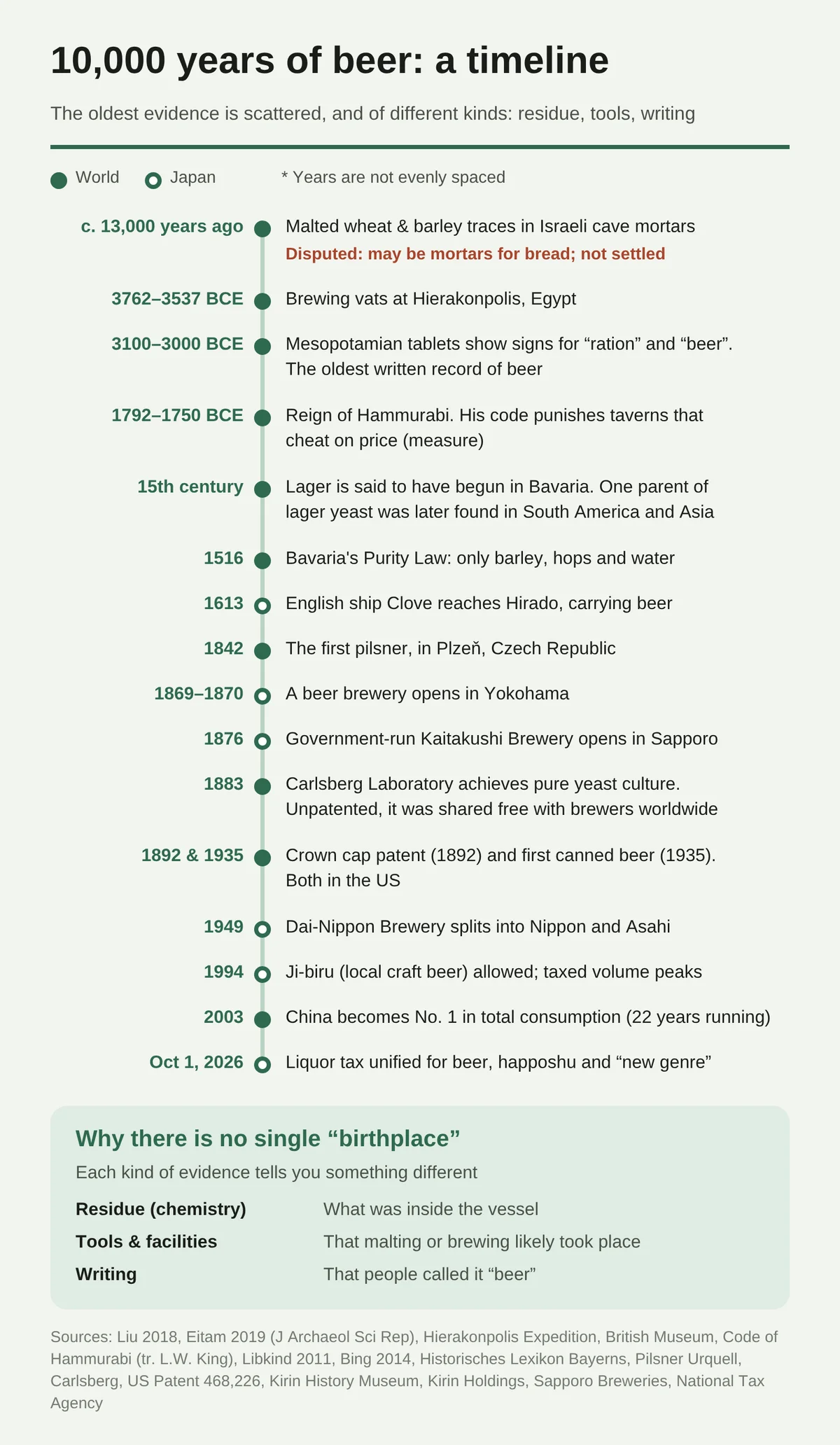
| Date | Event |
|---|---|
| About 13,700–11,700 years ago | Stone mortars in Raqefet Cave, Israel, carry traces of malted wheat and barley (one paper says for brewing; a rebuttal says for bread) |
| 3762–3537 BCE | A brewing vat at Hierakonpolis, Egypt |
| Late 4th millennium BCE | Beer residue (beerstone) in jars at Godin Tepe, Iran |
| 3400–2900 BCE | Brewing tools at Mijiaya (米家崖), China |
| 3100–3000 BCE | A clay tablet from Uruk, Mesopotamia, with the words “ration” and “beer” |
| 1792–1750 BCE | The reign of King Hammurabi. His code sets rules for the tavern keeper |
| April 1516 | In Bavaria, a rule limits beer ingredients to barley, hops, and water (the Purity Law) |
| 1553 | In Bavaria, brewing is limited to the period from September 29 to April 23 |
| 1759 | Arthur Guinness leases a Dublin brewery for 9,000 years |
| 1842 | The first Pilsner is brewed in Plzeň, Czechia |
| 1876 | Pasteur publishes Studies on Beer. In Japan, the Kaitakushi Brewery opens in Sapporo |
| 1883 | Pure yeast culture succeeds at the Carlsberg Laboratory in Denmark |
| 1892 | A US patent for the crown cap (the metal cap for bottles) |
| 1920–1933 | Prohibition in the US |
| 1935 | The world’s first canned beer, in the US |
| 1994 | Making jibiru (local craft beer) becomes possible in Japan. Taxed volume of beer-type drinks in Japan peaks |
| 2003 | China passes the US to become the world’s top in total beer consumption (22 years in a row since) |
| October 1, 2026 | Liquor taxes on beer, happoshu, and the new genre are unified in Japan |
Where Did Beer Originate?
The Oldest Evidence in Order of Date
Many sites around the world are named as “the oldest beer.” Sorted by the kind of thing found, they look like this.
| Date | Place | What was found | Kind of evidence |
|---|---|---|---|
| About 13,700–11,700 years ago | Raqefet Cave (Israel) | Traces of at least 7 kinds of plants, including malted wheat and barley, on 3 stone mortars in a Natufian burial site | Wear marks on tools, and the shapes of starch grains and plant cells (alcohol was not detected chemically) |
| About 9,000 years ago | Qiaotou (southern China) | A possible fermented drink reported (2021 paper) | — |
| 7th millennium BCE | Jiahu (賈湖, China) | A fermented drink mixing rice, honey, and fruit (hawthorn or grape) | Chemical analysis of pottery residue (no barley malt used) |
| 3762–3537 BCE | Hierakonpolis (Egypt) | A brewing vat. Residue inside shows malted wheat and barley, and flavorings such as date palm | The facility, and chemical analysis of residue |
| Late 4th millennium BCE | Godin Tepe (Iran) | Calcium oxalate (beerstone) collected in grooves on the inside of a jar | Chemical analysis of residue |
| 3400–2900 BCE | Mijiaya (米家崖, China) | A funnel, jars, and a stove. Beer mixing millet, barley, Job’s tears, tubers, and more | Tools, and residue |
| 3100–3000 BCE | Uruk (Mesopotamia) | A clay tablet with pictographs and numbers for “ration” and “beer” | Writing |
- Raqefet Cave: A 2018 paper (Stanford University and others) called it “the oldest evidence of making beer from grains,” and the university’s announcement described it as “the world’s oldest record of alcohol made by humans.” But in 2019, a rebuttal saying “it is not beer, but a mortar for threshing and milling barley to make bread” was published in the same journal, and the original authors replied. It is still unsettled
- The fermented drink at Jiahu mixed rice, honey, and fruit, and did not use barley malt. Whether to call this “beer” depends on the definition, and “one of the oldest fermented drinks containing grain” is the accurate way to put it
- The excavation team at Hierakonpolis writes that it “may be the world’s oldest brewery.” A 2019 analysis found that the residue contained a lot of phosphate, which may have served as a preservative
- The Mijiaya paper also points out that the reason barley came into China may have been beer making
- The Göbekli Tepe site is also sometimes presented as “the oldest beer.” The abstract of a 2012 paper said they “almost certainly drank beer,” but a 2019 analysis of tools could not confirm it chemically. It is treated as not yet certain
Why There Is No Single “Birthplace”
As the table shows, there are three kinds of evidence.
| Kind of evidence | What it tells us | Weak point |
|---|---|---|
| Residue (chemical analysis) | What was in the vessel | Whether a grain-based fermented drink counts as the same thing as today’s “beer” depends on the definition (the Jiahu case) |
| Tools and facilities | That people seem to have been malting or brewing | The same tools can be used for bread or porridge (this is the Raqefet Cave rebuttal) |
| Writing | That people called it “beer” | Nothing is known about the time before written records |
So it is not possible to settle on “beer began in Mesopotamia” or “in Egypt.” What can be said is the following.
- Drinks made by fermenting grain were made in many places, including West Asia, Egypt, and China, from early times
- The oldest record that lets us confirm in writing the drink called “beer” is the Mesopotamian clay tablet
- If we include the “possibility of brewing,” the oldest candidate is the Israeli cave of about 13,000 years ago (though disputed)
Beer in Ancient Times
Mesopotamia: The Ration Tablet, the Hymn to Ninkasi, and the Code of Hammurabi
The ration tablet: A clay tablet from Uruk of about 3100–3000 BCE held by the British Museum (museum number 1989,0130.4) bears pictographs and numbers for “ration” and “beer.” The museum explains it as a record of a temple giving workers barley beer every day. In news reports it is sometimes called “the world’s oldest pay stub.”
The Hymn to Ninkasi: A song praising Ninkasi, the goddess of beer, with copies surviving from the Old Babylonian period (around the 18th century BCE). According to the English translation in the Oxford database of Sumerian literature (ETCSL), it sings of the steps of brewing: baking bread for beer in a big oven, soaking malt in a jar, spreading it on a reed mat, and putting sweet wort into a fermentation vat.
The Code of Hammurabi: The code of King Hammurabi (reigned 1792–1750 BCE) was carved on a basalt stele, found at Susa (in present-day Iran), and is held at the Louvre. The articles on taverns are 108–111 (the English translation is L. W. King’s, on Yale’s Avalon Project).
| Article | Content |
|---|---|
| Article 108 | If a tavern keeper refuses a customer who tries to pay in grain, takes silver, and gives less drink (beer) than the grain’s value would buy, she is thrown into the water |
| Article 109 | If conspirators gather in a tavern and the tavern keeper does not seize them and hand them over, she is put to death |
| Article 110 | If a woman devoted to a god opens a tavern or enters a tavern to drink, she is burned |
| Article 111 | If she gives drink (beer) on credit, 60 ka (a unit of volume), she receives 50 ka of grain at harvest |
The story that “a tavern keeper who watered down the beer was thrown into the water” is often repeated, but what the article says is cheating on the price (the amount). It does not say “watered down.”
Ancient Egypt: The Pyramid Workers and Beer
The story that “the pay of the workers who built the pyramids was beer” is only half right.
- AERA, the research group excavating the workers’ town at the Giza pyramids (Heit el-Ghurab; Mark Lehner and others), found a bakery in 1991, and says that ancient documents support the existence of bread and beer rations
- At the same time, AERA writes in its own reports that decisive evidence of brewing beer in this town has not yet been found (it does report buildings that may have been used for brewing)
- The oldest surviving papyri, from near the end of the reign of Khufu (the journal of a man named Merer, found at Wadi al-Jarf), record items such as bread supplied to a crew of about 40 people. The published excerpts show no record of beer rations
- At the New Kingdom village of Deir el-Medina, more than a thousand years after Giza, the monthly supply is described as 4 khar of wheat and 1.5 khar of barley, that is, grain
- The often-repeated “4–5 L of beer a day” cannot be traced to a source
All that can be said is that “wages were paid in kind, as grain, bread, beer, and so on.”
Beer as Roman Writers Saw It (Tacitus and Pliny)
Roman writers recorded beer as the drink of people from other lands.
- The Roman historian Tacitus writes in Germania, chapter 23, that the Germanic peoples make a drink from barley and other grain, fermented to resemble wine
- Pliny, in Natural History (book 14, section 149), writes that grain drinks also exist in Gaul, Hispania, and Egypt, and remarks wryly that “people have found a way to get drunk even on water”
The Middle Ages: Monasteries, Gruit, and Hops
Monasteries and Beer
- The Abbey of St. Gall has a record from 754 of tribute paid in beer
- The “Plan of St. Gall” (819, or around 827–830), a monastery blueprint showing 52 buildings, is often described as “showing three breweries,” but the holding library’s explanation says nothing about breweries, and this could not be confirmed here
- Weihenstephan in Germany claims to be the world’s oldest brewery, saying it “received permission to brew and sell in 1040.” However, the basis for that year is questionable (the verdict on common beliefs)
- Paulaner in Munich cites as its founding basis a record from February 24, 1634, in which the town’s brewers complained to the city that it was “selling monastery beer”
From Gruit to Hops
Before hops spread, in parts of Europe beer was given aroma and bitterness with a herbal mix called gruit.
- Its contents were herbs such as bog myrtle (Myrica gale), with the recipe kept secret and said to vary by region
- Archaeobotanical studies show bog myrtle was used in brewing at the mouth of the Rhine (now northern Netherlands) from around the start of the Common Era
- The right to sell gruit became a source of revenue for lords and the Church
- Gruit was used mainly in the Low Countries, the lower Rhine, and Westphalia. The explanation that “it was used all over Europe” is a misreading of a 1908 source describing the region where bog myrtle grows, according to beer historian Roel Mulder
On hops, the nun Hildegard writes in Physica that “bitterness makes beer less likely to spoil.” From the 13th century, Hanseatic cities such as Hamburg and Bremen exported hopped beer in large quantities, and it spread across northern Europe. Taxes also shifted from a gruit tax to a hop tax, and later to a tax on beer itself.
In England, from the 15th century, the hopped drink that came from the Low Countries was called “beer” and the unhopped one “ale.” In the 18th century both came to be hopped, and today the usual dividing line is the type of yeast (top-fermenting or bottom-fermenting) (see the article on beer types).
The Purity Law of 1516 and the Summer Brewing Ban of 1553
In April 1516, Wilhelm IV and Ludwig X of Bavaria issued a territorial ordinance at Ingolstadt that contains rules on beer. This later came to be called the “Beer Purity Law (Reinheitsgebot).”
- It first sets maximum prices for winter and summer beer, and then goes on to say that “nothing other than barley, hops, and water may be used” (Historical Lexicon of Bavaria)
- Yeast is not mentioned. The German Brewers’ Federation explains that people knew beer would not be made without adding yeast, but did not yet understand what it did
- Wheat was left out to keep it for bread. Later, however, nobles used privileges to brew wheat beer, and from 1602 Duke Maximilian I of Bavaria monopolized wheat beer and made it a state enterprise
- On the date, the German Brewers’ Federation gives April 23 (it has made this day “German Beer Day” since 1994), while the Historical Lexicon of Bavaria says “dated April 24,” so sources differ
- Where the word “Reinheitsgebot” was first used differs by source: the Historical Lexicon of Bavaria says the Reichstag in 1909, while the German Brewers’ Federation says the Bavarian state parliament in 1918
- Today’s German legal basis is the 1993 Provisional Beer Act, in which yeast is among the ingredients, and other malts such as wheat, and sugars, are allowed for top-fermented beer
- In 1987 the European Court of Justice ruled that it was contrary to the European treaties for Germany to refuse, citing the Purity Law, to sell beer lawfully made in another member state
Then in 1553, the Bavarian territorial ordinance limited the brewing period to September 29 (St. Michael’s Day) through April 23 (St. George’s Day). Beer could no longer be made in summer, and brewing became something done in the cold season.
The Modern Age: Lager, Pilsner, and Science
Where Did Lager Yeast Come From?
“Lager” is said to have been first brewed in 15th-century Bavaria. About that lager yeast, something surprising was learned in the 21st century.
- Lager yeast is a hybrid of ale yeast and another, cold-tolerant species of yeast
- The wild yeast that is the “other parent” (Saccharomyces eubayanus) was found in 2011 in southern beech forests in Patagonia, South America. It matched the non-ale side of lager yeast’s genes at 99.5%
- In 2014, it was reported that a population found on the Tibetan Plateau is even closer
That means one parent of European beer yeast was found in South America and Asia.
1842: The Birth of Pilsner
At a brewery in the Czech town of Plzeň (Pilsen in German), brewer Josef Groll brewed the first Pilsner on October 5, 1842. It was served at U Pinkasů in Prague in April 1843, and the trademark “Pilsner Urquell (the original Pilsner)” was registered in 1898 (the brewery’s official history).
The Brewers Association of Japan’s explanation calls Pilsner the type that is “most widespread in the world,” and says Japan’s pale beer is of this type too.
You may also see stories online such as “it was first served on November 11” and “it began when townspeople dumped 36 barrels of beer in 1838,” but the brewery’s official history does not mention them.
Porter and IPA
- Porter: A beer that arose around 1720 in London as an improvement on brown beer. The explanation that the name comes from its popularity with porters (carriers) is generally considered about right, but the story that “a man named Harwood invented it in 1722” is considered an exaggeration
- IPA (India Pale Ale): It is often said to have been “newly made stronger and more heavily hopped to survive the long voyage to India.” According to a 2003 paper by beer historian Martyn Cornell, Hodgson’s brewery in Bow, London, sold East India Company captains the strong, pale “October beer” that it already made as a matter of course, and it matured on the voyage and became popular. That was the beginning. Cornell concludes there is no evidence of making it specially stronger for India. In 1823, Allsopp of Burton also began shipping to India
Science and Refrigeration: Pasteur, Hansen, and Linde
In the late 19th century, scientific research entered beer making.
| Year | Person | What they did |
|---|---|---|
| 1873, 1877 | Carl von Linde (Germany) | Patented a compression refrigerating machine (a method using ammonia, in 1877). Sedlmayr of the Spaten brewery in Munich provided funding. Founded a company in 1879 |
| 1875 | J.C. Jacobsen (Denmark) | The founder of the beer company Carlsberg set up the Carlsberg Laboratory |
| 1876 | Louis Pasteur (France) | Published Studies on Beer |
| 1883 | Hansen (Denmark) | At the Carlsberg Laboratory, established a method of “pure culture,” growing yeast from a single cell. Used it in actual brewing in November of the same year |
| 1909 | Sørensen (Denmark) | At the same laboratory, devised the pH scale for the degree of acidity or alkalinity |
- According to Carlsberg’s official website, Jacobsen did not patent the pure culture method and gave it free to brewers around the world
- The first pure-cultured lager yeast in the world is called “Saccharomyces carlsbergensis,” and its whole genome was read in 2014
The Crown Cap, the Can, and Prohibition
- The crown cap: On February 2, 1892, William Painter of Baltimore, US, patented a bottle closure combining a metal cap and a thin cork (US Patent No. 468,226). The same year he founded the company that became today’s Crown Holdings. The first beer in Japan to use a crown cap was Tokyo Beer in July 1900
- Canned beer: The first is said to be the one sold on January 24, 1935, in Richmond, Virginia, by the Krueger brewery working with the American Can Company. In Japan, Asahi Beer released the first canned beer on September 15, 1958
- US Prohibition: On January 17, 1920, the making and sale of alcohol was banned nationwide, and it was repealed on December 5, 1933, by the 21st Amendment. Beer up to 3.2% alcohol by weight (about 4% by volume) had been allowed to be sold earlier, from April 7, 1933
Guinness and the Trappists
Guinness (Ireland): According to Guinness’s official website, its history is as follows.
- On December 31, 1759, Arthur Guinness (then 34) leased an unused brewery at St. James’s Gate, Dublin, on a 9,000-year lease at 45 pounds a year
- He began brewing porter in the 1770s, brewed ale for the last time in 1799, and concentrated on porter
- In 1801 he made “West India Porter,” which in 1849 took the name “Foreign Extra Stout.” Guinness explains that it had more hops and alcohol to survive long voyages (a voyage-related explanation, as with IPA)
- The harp on the label has been used since 1862 and was trademarked in 1876. When the Irish Free State made the same harp its national emblem in 1922, Guinness reversed its direction to avoid a clash with the trademark
- In 1959 it released a nitrogen-gas beer, and in 1988 a draft beer in cans
- On the year of the first export, the official site says “the first confirmed export was in 1796, to England.” However, many sources give “1769,” so sources differ
Trappist (Belgium and elsewhere): Beer brewed at Trappist monasteries. Only beer that meets the conditions of the International Trappist Association (brewed close to the monastery, under the supervision of monks or nuns, with the profits used for the community’s living costs and charity) may use the “Trappist” label, and the license is renewed every 5 years. On the association’s label page, 8 sites are listed as making labeled Trappist beer (Chimay, La Trappe, Orval, Rochefort, Tre Fontane, Tynt Meadow, Westmalle, Westvleteren). Meanwhile, the site’s products page says “10 abbeys” and its beer page says “11 abbeys” brew beer, so the numbers do not match.
Beer from Breweries in History
Many of the breweries that have appeared so far still make beer today. Here are the beers of Pilsner Urquell (1842), Guinness (1759), Weihenstephan (claiming permission in 1040), and the Trappist Westmalle.
The History of Beer in Japan
Timeline
| Year | Event |
|---|---|
| 1613 | The English ship Clove enters Hirado. Beer is among the cargo (the Kirin History Museum presents this as a question, “possibly the oldest record?”) |
| 1724 | A Dutch interpreter writes in Oranda Mondo that beer is “殊の外悪敷物にて何のあぢはひも無御座候” (an exceedingly bad thing with no taste at all) |
| 1812 | Doeff, the head of the Dutch trading post at Dejima, Nagasaki, tries to make beer in Japan for the first time |
| Around 1853 | The Dutch-studies scholar Kawamoto Kōmin is said to have tried brewing beer (explained below) |
| 1860 | Tamamushi Sadayū, of the Japanese embassy to the US, writes that beer is “苦味ナレドモ口ヲ湿スニ足ル” (bitter, but enough to moisten the mouth) |
| 1869 | “Japan Yokohama Brewery” at 46 Yamate, Yokohama. Japan’s first beer brewery |
| 1870 | William Copeland, a Norwegian-born American, opens “Spring Valley Brewery” at 123 Yamate, Yokohama |
| 1875 | Japan’s first beer garden, at Spring Valley |
| September 23, 1876 | The Hokkaido Development Commission (Kaitakushi) opens the “Kaitakushi Brewery” in Sapporo. In September 1877 it puts “Sapporo Beer” on sale |
| 1885 | “Japan Brewery Company” is established, taking over the Spring Valley site. “Kirin Beer” goes on sale in May 1888 |
| 1889 | Osaka Beer Company is established, and “Asahi Beer” goes on sale in May 1892 |
| February 25, 1890 | “Yebisu Beer” goes on sale. The Yebisu Beer Hall opens on August 4, 1899 |
| 1900 | At the Paris Exposition, Asahi and Yebisu each win awards. In July, Tokyo Beer makes Japan’s first crown-capped beer |
| 1901 | The beer tax is introduced |
| 1906 | Osaka Beer, Japan Beer, and Sapporo Beer merge into “Dai-Nippon Beer” |
| 1907 | Kirin Brewery Co., Ltd. |
| 1949 | Dai-Nippon Beer is split by the Law for the Elimination of Excessive Concentrations of Economic Power into “Nippon Beer” and “Asahi Beer” |
| 1957, 1959 | In Okinawa, Okinawa Beer (later Orion Beer) is founded in 1957 and goes on sale in 1959 |
| 1958 | Asahi Beer makes Japan’s first canned beer |
| 1963 | Suntory releases beer (in 1930 Kotobukiya had released “Oraga Beer”) |
| 1987 | “Asahi Super Dry” goes on sale. In 1988, dry beer reaches one third of all beer |
| 1994 | A Liquor Tax Act revision lowers the minimum production for a beer-making license from 2,000 kL a year to 60 kL, making jibiru (local craft beer) possible. In October Suntory’s “Hops (nama)” appears and the happoshu market begins |
| 2003, 2004 | Sapporo “Draft One” (the start of the “new genre,” which uses neither malt nor barley). Kirin’s chronology says 2003, Sapporo’s says 2004 |
| April 2018 | The definition of beer changes: the malt share goes from 67% or more to 50% or more. Fruit, herbs, and the like become usable up to 5% of the malt weight |
| October 1, 2026 | Liquor taxes on beer, happoshu, and the new genre are unified |
The Edo Period: Dutch Ships and Dutch-Studies Scholars
Records of beer in the Edo period are tied to English and Dutch ships and trading posts. The Dutch interpreter’s impression in 1724 was “an exceedingly bad thing with no taste at all.”
The story is often told that the Dutch-studies scholar Kawamoto Kōmin tried brewing beer at his home in Edo around 1853. The Brewers Association of Japan writes that he “is said to have made a trial brew,” but the Kirin History Museum states that “no surviving document records that Kawamoto Kōmin brewed beer.” It is also sometimes said that he “made a trial brew after seeing the Kagaku Shinsho,” but the Kagaku Shinsho was produced in 1861, so the years do not match.
The Meiji Era: It Began in Yokohama and Sapporo
The first beer breweries opened in Yokohama.
- “Japan Yokohama Brewery” of 1869 was Japan’s first beer brewery
- In 1870, William Copeland, a Norwegian-born American, opened “Spring Valley Brewery.” Japan Brewery Company, which took over this site, put out “Kirin Beer” in 1888, and later became Kirin Brewery (1907)
- In 1876, the Hokkaido Development Commission opened the government-run “Kaitakushi Brewery” in Sapporo. Murahashi Hisanari is credited with leading its opening, and Nakagawa Seibei with the center of the brewing. Sapporo Breweries counts this year as its start
- In Osaka, the Osaka Beer Company was founded in 1889 and released “Asahi Beer” in 1892
- In 1890, “Yebisu Beer” went on sale, and in 1899 the Yebisu beer hall opened
The Great Merger and the Split (1906–1949)
In 1906, three companies, Osaka Beer, Japan Beer, and Sapporo Beer, merged to form “Dai-Nippon Beer.”
On September 1, 1949, after the war, Dai-Nippon Beer was split into “Nippon Beer” and “Asahi Beer” under the Law for the Elimination of Excessive Concentrations of Economic Power (Nippon Beer changed its name to Sapporo Breweries in 1964). Beer halls returned the same year, and the Brewers Association of Japan notes that a 500 ml mug in Tokyo was 130 yen.
Postwar: Cans, Dry, Jibiru, and Happoshu
- Orion: “Okinawa Beer” was founded in Okinawa on May 18, 1957, went on sale on May 17, 1959, and changed its company name to “Orion Beer” that June
- Canned beer: On September 15, 1958, Asahi Beer released Japan’s first canned beer
- Suntory: It released “Suntory Beer” on April 27, 1963, and entered the beer business in earnest
- Super Dry: Released on March 17, 1987. Asahi calls it the “world’s first dry beer.” According to Kirin’s chronology, dry beer made up one third of all beer the next year, 1988
- Jibiru (local craft beer): The April 1994 Liquor Tax Act revision cut the minimum production for a beer-making license sharply, from 2,000 kL to 60 kL a year, so small breweries could make beer. Kirin’s chronology calls Uehara Shuzo’s “Echigo Beer” of 1995 the “first jibiru in Japan,” but other breweries are also called “No. 1”
- Happoshu and the new genre: On October 20, 1994, Suntory released the low-malt happoshu “Hops (nama),” and the happoshu market began. After happoshu was taxed more in May 2003, Sapporo’s “Draft One,” a “new genre” drink using neither malt nor barley, appeared (Kirin’s chronology says September 17, 2003, and Sapporo’s says 2004)
- The change in the definition of beer: In April 2018, the malt share needed to call a drink beer fell from 67% or more to 50% or more, and aroma ingredients such as fruit and coriander became usable up to 5% of the malt weight (details in the article on beer types)
October 1, 2026: Liquor Taxes on Beer-Type Drinks Unified
On October 1, 2026, the liquor tax on beer, happoshu, and the new genre (happoshu ②) was brought to the same 155,000 yen per kL (54.25 yen per 350 ml). This is the last stage of a review carried out in three steps since October 2020 (Ministry of Finance).
| Liquor tax per 350 ml | Until September 2020 | From October 2026 |
|---|---|---|
| Beer | 77 yen | 54.25 yen |
| Happoshu (malt share under 25%) | 46.99 yen | 54.25 yen |
| New genre | 28 yen | 54.25 yen |
- Compared with the rates just before, in October 2023, beer fell 9.1 yen per 350 ml, and happoshu and happoshu ② rose about 7.26 yen (National Tax Agency leaflet)
- In step with this, Suntory has announced that it will change “Kinmugi,” and Kirin “Hon-Kirin” (from November 4), to be made in the way beer is made
A detailed table of the tax rate stages is in the article on beer types.
Japanese Beer Companies and Overseas
From the late 1990s, Japanese beer companies have invested in and acquired overseas beer companies. Pilsner Urquell of 1842 is also part of the central and eastern European beer business that Asahi bought in 2017.
| Company | When | What was bought | Amount |
|---|---|---|---|
| Asahi | October 2016 | Peroni, Grolsch, Meantime, and others | 2.55 billion euros (about 294.5 billion yen) |
| Asahi | March 2017 | Beer business in 5 central and eastern European countries (Pilsner Urquell and others) | 7.3 billion euros (about 873.7 billion yen) |
| Asahi | June 2020 | CUB in Australia | 16 billion Australian dollars (about 1.1416 trillion yen) |
| Kirin | October 2009 | Made Lion Nathan a wholly owned subsidiary (took a stake in 1998) | 3.3 billion Australian dollars |
| Kirin | 2011 | Schincariol in Brazil (transferred to Heineken in 2017 for 86.4 billion yen) | About 303.8 billion yen in total |
| Sapporo | 2006, 2022 | Sleeman in Canada, Stone Brewing in the US | — |
(Asahi: timely disclosures to the Tokyo Stock Exchange. Kirin also invested in San Miguel in 2002 and 2009, and in Myanmar Brewery in 2015)
Japanese Beers with Names from History
The names that appear in the history of Japanese beer remain as product names today: Spring Valley of 1870, Yebisu of 1890, Sapporo going back to the Kaitakushi of 1876, and Orion of 1959.
The World Beer Consumption Ranking
From here on, these are country-by-country figures for the world. The main source is the latest edition of Kirin Holdings’ yearly “Beer Consumption by Country” report (2024 figures, announced December 22, 2025). It tallies 170 countries and regions, based on a survey of national beer associations, the annual report of the German hop merchant BarthHaas, and data from the research firm GlobalData. The 2025 figures are expected to be announced around December 2026 (checked October 2, 2026).
The World’s Top Consumer Is China (22 Years in a Row)
- World beer consumption in 2024 was about 194.12 million kL (up 0.5% from the previous year). In large bottles (633 ml), that is about 306.7 billion bottles
- The top country is China, at 40.534 million kL, 20.9% of the world. It has been first for 22 years in a row since passing the US in 2003. It fell 3.7% from the previous year, though
- Second is the US (22.34 million kL), third Brazil, fourth Mexico, fifth Russia, sixth Germany
- Japan is 11th (4.135 million kL, 2.1% of the world)
- Among the top 25 countries, the biggest gain was in India (up 14.6% from the previous year). Russia (up 9.0%) and Thailand (up 5.8%) also grew
The Top Per Capita Is Czechia (32 Years in a Row)
| Rank | Country | Per capita (L) | In large bottles |
|---|---|---|---|
| 1 | Czechia | 148.8 | 235 |
| 2 | Lithuania | 110.6 | 175 |
| 3 | Austria | 104.6 | 165 |
| 4 | Ireland | 99.0 | 156 |
| 5 | Croatia | 95.1 | 150 |
| 7 | Spain | 91.8 | 145 |
| 10 | Germany | 86.9 | 137 |
| 48 | South Korea | 44.6 | — |
| 56 | Japan | 33.7 | 53 |
- The top per capita is Czechia, at 148.8 L. It has been first for 32 years in a row since 1993, about 4.4 times Japan
- Germany is 10th, down from 8th the previous year. “Germans drink the most beer” does not match today’s figures
- Of the top 20 countries, all except Panama and Mexico (Latin America) and Gabon and South Africa (Africa) are in Europe (especially central and eastern Europe)
- The UK is 24th (66.3 L), the US is 29th (65.4 L), and Belgium is 33rd (57.4 L)
Cautions When Reading the Numbers
There are some things to know when reading Kirin’s tables.
- A correction on the day of release: In the 2024 edition, on the same day as the release, the year-on-year change in the world total was corrected from “2.9%” to “0.5%”
- The original has what look like typos: In table 3, Czechia’s “change from the previous year (in large bottles)” is printed as 94.8 bottles, but since it fell from 152.1 L the year before to 148.8 L, the actual decrease should be about 5 bottles
- Figures for earlier years are revised every year: For example, the 2023 world total, 187.93 million kL when announced, was revised to 193.23 million kL in the next year’s edition. It is safer to avoid linking figures from editions of different years and saying “it grew by X%”
- Old figures are in circulation: “Czechs drink 190 L a year” is a figure from the 2018 edition (191.8 L) or the 2022 edition (188.5 L). Czechia’s figure changed sharply, from 188.5 L in 2022 to 152.1 L in 2023, because of a change in the data source
- What is inside Japan’s figure: Japan’s 4.135 million kL is not beer alone but the combined amount of beer, happoshu, and happoshu ② (the former new genre), and from 2020 on it is an estimate by an industry paper (Jozo Sangyo Shimbun). The per-capita 33.7 L is divided by the total population, so the denominator differs from the National Tax Agency’s “per adult” figure
By Region: Asia Has One Third
| Region | Share of the world (2024) |
|---|---|
| Asia | 32.6% |
| Europe | 25.4% |
| Latin America | 19.4% |
| North America | 12.4% |
| Africa | 8.3% |
| Oceania | 1.1% |
| Middle East | 0.8% |
Asia has been first among regions for 17 years in a row. The smallest is the Middle East (0.8%). In Islam, alcohol (khamr) is prohibited (Qur’an 5:90).
The World’s Big Beer Companies
According to the annual report of the German hop merchant BarthHaas (for members only, so the original could not be obtained; confirmed through a table reproduced in an industry magazine), the top producers in 2024 were as follows.
| Rank | Company (headquarters) | Production (2024) |
|---|---|---|
| 1 | AB InBev (Belgium) | 495.49 million hL |
| 2 | Heineken (Netherlands) | 240.7 million hL |
| 3 | China Resources Snow Breweries (China) | 108.8 million hL |
| 4 | Carlsberg (Denmark) | 101.2 million hL |
| 5 | Molson Coors (US/Canada) | 79.62 million hL |
| 6 | Tsingtao (China) | 75.38 million hL |
| 7 | Asahi Group (Japan) | 65 million hL |
- Among Japanese companies, Asahi is 7th, Kirin 14th (22.9 million hL), Suntory 26th (8.41 million hL), and Sapporo 27th (8.16 million hL) (1 hL = 100 L)
- In the 2025 annual report too, AB InBev accounts for about a quarter (25.5%) of world production and is first
World Production
According to press coverage of the BarthHaas annual report, world beer production in 2025 was about 1.896 billion hL, down 0.7% from the previous year. The US (down 5.2%) and Germany (down 5.6%) fell, and Africa (up 2.6%) was the only region that grew. This report also revises the previous year’s figures every year, so linking figures from different years’ editions for comparison is avoided.
Where Japan Stands
Japan in the World: 11th in Total, 56th Per Capita
- Japan’s rank in total consumption was 7th for 14 years through 2020, then 8th in 2021, 10th in 2022, and 11th in 2023 and 2024
- Per capita, it fell from 46.9 L in 2009 to 33.7 L in 2024, down about 30% in 15 years
- In the 2012 edition, Japan’s per capita was described as “the highest in Asia,” but from 2013 on, South Korea’s is higher (in 2024, South Korea 44.6 L, Japan 33.7 L)
- The per-capita rank moves a lot when the set of countries or the data company changes (40th in 2012, 50th in 2013). Looking at the change in volume is more reliable than looking at rank
Domestic Beer-Type Drinks Peaked in Fiscal 1994
According to National Tax Agency materials, the peak of taxed volume (the volume on which tax was levied) for beer, happoshu, and the new genre combined was 7.44 million kL in fiscal 1994, and for beer alone the peak was 7.41 million kL in the same fiscal year.
- Happoshu peaked at 2.65 million kL in fiscal 2002. For the new genre, in National Tax Agency materials through fiscal 2017, the peak was 2.27 million kL in fiscal 2013
- The Brewers Association of Japan says the beer-type market has “fallen by nearly 30% in the last 10 years, to about half of the peak in 1994”
- The peak taxed volume for all alcoholic beverages was 10.17 million kL in fiscal 1999, and in fiscal 2024 it was 8.12 million kL (about 80% of the peak). The peak of liquor tax revenue was 2.12 trillion yen in fiscal 1994, and in fiscal 2024 it was 1.18 trillion yen (National Tax Agency)
| Fiscal year | Taxed volume of beer-type drinks | All alcoholic beverages | Share of beer-type drinks |
|---|---|---|---|
| 1994 | 7.44 million kL | 10.07 million kL | About 74% |
| 2017 | 5.34 million kL | 8.75 million kL | About 61% |
| 2024 | About 4.39 million kL | 8.12 million kL | About 54% |
(Calculated from National Tax Agency materials. The fiscal 2024 figure is beer and happoshu combined, since from October 2023 the new genre is counted as happoshu)
Of the alcohol drunk in Japan, beer-type drinks still account for a little over half. But that share has fallen from about 74% in fiscal 1994 to about 54% in fiscal 2024. Of fiscal 2024 liquor tax revenue, beer was about 445.6 billion yen, or 37.5%.
In Fiscal 2020, the New Genre Passed Beer
By the Brewers Association of Japan’s estimate, in fiscal 2020 the new genre (about 2.02 million kL) passed beer (about 1.77 million kL). That year, the COVID-19 pandemic coincided with the first stage of the October 2020 liquor tax review (a tax cut for beer and a tax increase for the new genre).
After that, by the association’s estimate, beer grew through fiscal 2024 (and fell in fiscal 2025), while the new genre has fallen every year. In National Tax Agency taxed volume too, beer recovered from 1.828 million kL in fiscal 2020 to 2.465 million kL in fiscal 2024. In Ministry of Finance materials, beer in fiscal 2025 is 2.315 million kL, 30.4% of all alcoholic beverages.
Per Adult
The National Tax Agency’s “per adult” figures (excluding Okinawa Prefecture) are as follows.
| Fiscal year | All alcohol | Beer | Happoshu |
|---|---|---|---|
| 1992 | 101.8 L (peak) | — | — |
| 2014 | 80.3 L | 25.0 L | 7.4 L |
| 2019 | 78.1 L | 21.6 L | 5.5 L |
| 2022 | 75.4 L | 20.2 L | 5.5 L |
| 2024 | 74.8 L | 22.5 L | 9.4 L |
- The amount of alcohol one adult drinks in a year has fallen by about 27 L from the fiscal 1992 peak
- Happoshu is up in fiscal 2024 because, from October 2023, the new genre is counted as “happoshu”
Jibiru (Local Craft Beer)
- The number of jibiru makers grew from 6 in fiscal 1994 to 242 in fiscal 1999, then fell to 173 in fiscal 2013
- The count doubled to 368 in fiscal 2018, but this was not a boom. It was because under the revised definition of beer, breweries that held happoshu licenses were deemed to have received beer licenses
- In fiscal 2024 there were 394 makers (430 breweries)
- Even so, the volume is small. In the National Tax Agency’s fiscal 2018 survey, beer-type production by companies other than the big five (Asahi, Kirin, Sapporo, Suntory, and Orion) was about 1.0% of the total. Of the 303 makers that responded, 98.3% were small and medium-sized businesses, and 83.2% made under 100 kL a year
- The word “craft” does not appear in the Liquor Tax Act (the table name in the National Tax Agency statistics is “jibiru”)
Japanese craft beer styles and how to choose are covered in the article on beer types.
How Drinkers Feel
A survey announced by the Brewers Association of Japan on September 1, 2025 (1,200 people who drink beer-type drinks at least once a month) found the following.
- 59.5% drink beer-type drinks at home
- The top reason for drinking is “because it tastes good” (81.8%)
- 60.2% answered that the tax burden on beer after unification (about 33% of the retail price) is “high”
Company-by-Company Volumes Are No Longer Published
“Which beer company sells the most in Japan?” can no longer be compared with official figures.
- In January 2019, the Brewers Association of Japan stopped publishing its “Market Trend Report,” which compiled the volumes of the five companies (because it “could not accurately convey the trend of the beer-type market as a whole”). The last one covered 2018
- Asahi stopped publishing beer-type volumes in 2020 and gives only the year-on-year change in sales value
- For 2025 results too, the formats vary: Kirin gives year-on-year change in sales value, Sapporo gives year-on-year change in beer sales volume, and Suntory gives year-on-year change by brand
As of October 2, 2026, there are no official figures that let you line up the five companies’ shares side by side.
Beer Culture Around the World
Oktoberfest (Munich, Germany)
- It began in October 1810 as a festival celebrating the wedding of Crown Prince Ludwig of Bavaria (later Ludwig I) and Princess Therese. It ended with a horse race on October 17, and the grounds, the “Theresienwiese,” are named for the bride (City of Munich)
- In 2025 there were about 6.5 million visitors and about 6.5 million Maß of beer (1 Maß = 1 L). The visitor record is about 7.2 million in 2023
- 2026 is the 191st, and beer costs 14.80–15.90 euros per Maß
Belgium: Beer Culture on the UNESCO Intangible Cultural Heritage List
In 2016, “Beer culture in Belgium” was inscribed on UNESCO’s Intangible Cultural Heritage list. UNESCO’s description notes that Belgium has about 1,500 kinds of beer, that beer is also used in cooking, and that Trappist monasteries have contributed brewing knowledge and put profits toward charity.
American Craft Beer
According to the Brewers Association in the US (an organization of brewers), in 2025 there were 9,578 craft breweries in the US (9,724 breweries in all), and craft beer made up 13.4% by volume and 24.8% by value. The whole US beer market was 113 billion dollars, with volume down 5.7%.
In the US, “craft” has a definition from the association: a small brewery making 6 million barrels a year or less, with less than 25% owned by a non-craft alcohol company.
Trivia from Around the World
- The origin of the word “beer”: The leading theory is that monasteries around the 6th century borrowed the Latin biber (a drink), but another theory says it comes from a Germanic word for “barley.” It has not been settled
- The drink at King Midas’s funeral: Traces of a drink mixing wine, barley beer, and mead were found in vessels from the “Midas Mound” at Gordion in Turkey (around 700 BCE) (1999 paper). The American craft brewery Dogfish Head has recreated it
- Beer from a 170-year-old shipwreck: Analysis of two bottles of beer found in a shipwreck off the Åland Islands in the Baltic Sea showed two kinds with different amounts of hops, and the aroma compounds made by the yeast were close to those in beer today (2015 paper)
- Washington’s beer recipe: In 1757, George Washington, then a colonel in the Virginia militia, wrote down a recipe for “small beer” in a notebook. It uses bran, hops, molasses, and yeast (as introduced by Smithsonian Magazine and others)
Verdicts on Common Beliefs
The history of beer is full of stories that are often heard but do not match the sources. Here is a summary of what I found.
| Common claim | Verdict | What the sources show |
|---|---|---|
| The pyramid workers’ pay was beer | Half right | Pay was in kind: grain, bread, beer, and so on. There is still no decisive evidence of brewing in the Giza workers’ town. “4–5 L a day” cannot be verified |
| The world’s oldest pay stub is a beer ration record | Mostly right | The Uruk clay tablet of about 3100–3000 BCE has “ration” and “beer” (British Museum). “Pay stub” is how the press puts it |
| Under the Code of Hammurabi, a tavern keeper who watered down the beer was thrown into the river | The content differs | The penalty is “thrown into the water,” but the offense is cheating on the price (amount). It does not say “watered down” |
| The Beer Purity Law (1516) is the world’s oldest food law and is still in force | Exaggerated | There are older rules (Augsburg 1156, Nuremberg 1302–05, Munich 1487). Today’s basis is a 1993 law, which also admits yeast and wheat malt |
| The Purity Law has no yeast because yeast was not known | Mostly right | People knew yeast was there, but did not understand what it did |
| Weihenstephan is the world’s oldest brewery, founded in 1040 | Weak basis | Until the 1950s it claimed 1146. Both years rest on the same document, which a German historian pointed out in 1979 to be a forgery made by an abbot in the 17th century (according to a summary of the paper) |
| Lager was born in Bavaria, a European yeast beer | Partly right | It is said to have begun in 15th-century Bavaria, but one parent of lager yeast was found in South America and Asia |
| IPA was newly made for the long voyage to India | Exaggerated | A strong pale beer that was already being made matured on the voyage and became popular |
| Porter was invented by Harwood in 1722 | Exaggerated | It arose around 1720 in London as an improvement on brown beer |
| People in the Middle Ages drank beer because the water was too dirty to drink | Wrong | In the English Colloquy of Ælfric of around 1000, there is an exchange, “ale if I have it, water if not.” An English history tells of a king who had cups placed at springs for travelers. London brought drinking water from springs in 1237–45. Beer was liked, but that is no evidence they avoided water |
| “Honeymoon” comes from the custom of drinking mead for the first month of marriage | Wrong | The first English example is from 1546. It is said to compare the love of newlyweds to the moon, which begins to wane as soon as it is full |
| Vikings drank from the skulls of their enemies | Wrong | The “curved branches of the skull” in the Old Norse poem Krákumál is a figure of speech for drinking horns. In 1651 the scholar Ole Worm mistranslated it as “drinking from the skulls of slain enemies” |
| The Pilgrims on the Mayflower landed at Plymouth because they ran out of beer | Partly right | A 1622 record says “our victuals were much spent, especially our beere.” But it also gives open land, traces of fields, and drinking water as reasons |
| Monks got through fasting periods on strong beer alone | Cannot be verified | There are records that Paulaner Monastery brewed strong beer, but no source was found showing they “lived on beer alone” |
| Guinness’s 9,000-year lease is still running | Wrong | The lease is from 1759, as the official site says. The brewery is said to have bought the land afterward, and the official site says nothing like “still in force” |
| Germans drink the most beer | Wrong | Germany is 10th per capita, and Czechia is 1st (2024) |
| Japan is 7th in the world in beer consumption | Outdated | 7th was until 2020. In 2023 and 2024 it is 11th |
For Those Who Want to Know More
For people who want to read the history of beer straight through, from ancient times to the present.
What This Article Featured (Summary)
Here are the items featured in the article, gathered once more. The reasons and ingredients are written in each section.
Please note You must be 20 or older to drink alcohol. Drinking under 20 is prohibited by law. Do not drink during pregnancy or while breastfeeding, and do not drink and drive. The items featured here are not presented as showing anything good for health. Prices and shipping costs can change (shipping varies by region).
Summary
- The birthplace of beer cannot be pinned to one place. The “oldest” differs by kind of evidence (residue, tools, writing), and even the oldest candidate (the Israeli cave of about 13,000 years ago) is disputed
- The oldest beer recorded in writing is the ration for workers in Mesopotamia. What the Code of Hammurabi punished was not watering down but cheating on the price
- Hops, 15th-century lager, the Pilsner of 1842, and 19th-century pure yeast culture and refrigeration gave beer its present form. One parent of lager yeast was found in South America and Asia
- Beer in Japan began in Yokohama in 1869–1870 and in Sapporo in 1876, and on October 1, 2026, liquor taxes were unified
- The world’s top consumer is China (22 years in a row), and per capita it is Czechia (32 years in a row). Japan is 11th in total and 56th per capita
- Domestic beer-type drinks peaked in fiscal 1994 and are now about half of that. In fiscal 2020 the new genre passed beer, but beer has since recovered
Sources
Oldest evidence and ancient times
- Liu L, et al. Fermented beverage and food storage in 13,000 y-old stone mortars at Raqefet Cave, Israel. J Archaeol Sci Rep. 2018;21:783-793. https://doi.org/10.1016/j.jasrep.2018.08.008 / Rebuttal: Eitam D. J Archaeol Sci Rep. 2019;28:101913. https://doi.org/10.1016/j.jasrep.2019.101913 / Reply: Liu L, et al. same journal, 101914 https://doi.org/10.1016/j.jasrep.2019.101914
- Wang J, Jiang L, Sun H. PLoS One. 2021;16(8):e0255833 (Qiaotou site)
- McGovern PE, et al. Fermented beverages of pre- and proto-historic China. PNAS. 2004;101(51):17593-8. PMID: 15590771
- Hierakonpolis Expedition “HK11 Wadi Breweries” https://hierakonpolis-online.org/index.php/explore-the-predynastic-settlement/breweries/hk11-wadi-breweries / Farag MA, et al. Sci Rep. 2019;9:16199. PMID: 31700104 / Wang J, Friedman R, Baba M. J Anthropol Archaeol. 2021;64:101347. https://doi.org/10.1016/j.jaa.2021.101347
- Michel RH, McGovern PE, Badler VR. Chemical evidence for ancient beer. Nature. 1992;360:24. https://doi.org/10.1038/360024b0
- Wang J, et al. Revealing a 5,000-y-old beer recipe in China. PNAS. 2016;113(23):6444-8. PMID: 27217567
- Dietrich O, et al. Antiquity. 2012;86:674-695 / Dietrich L, et al. PLoS One. 2019;14(5):e0215214. PMID: 31042741 (Göbekli Tepe)
- British Museum collection 1989,0130.4 https://www.britishmuseum.org/collection/object/W_1989-0130-4
- ETCSL “A hymn to Ninkasi” c.4.23.1 https://etcsl.orinst.ox.ac.uk/section4/tr4231.htm (Civil M. 1964)
- The Code of Hammurabi (translated by L.W. King) Avalon Project, Yale Law School https://avalon.law.yale.edu/ancient/hamcode.asp / Louvre Museum Sb 8 https://collections.louvre.fr/en/ark:/53355/cl010174436
- AERA “Feeding Pyramid Workers” https://aeraweb.org/feeding-pyramid-workers/ / AERAGRAM 15(1-2), 16(2)
- Tallet P. 2017 (Wadi al-Jarf papyri)
- Tacitus, Germania, chapter 23; Pliny, Natural History, book 14, section 149
- McGovern PE, et al. A funerary feast fit for King Midas. Nature. 1999;402:863-864. https://doi.org/10.1038/47217
The Middle Ages and the modern age
- Behre KE. The history of beer additives in Europe — a review. Veget Hist Archaeobot. 1999;8:35-48. https://doi.org/10.1007/BF02042841
- Roel Mulder “Fact check: where did gruit occur?” Lost Beers https://lostbeers.com/fact-check-where-did-gruit-occur/
- Historical Lexicon of Bavaria “Purity Law, 1516” (Klaus Rupprecht) http://www.historisches-lexikon-bayerns.de/Lexikon/EN:Purity_Law,_1516
- German Brewers’ Federation “Reinheitsgebot” https://brauer-bund.de/reinheitsgebot/entstehung/ / Q&A https://brauer-bund.de/reinheitsgebot/fragen-und-antworten/
- European Court of Justice Case 178/84 Commission v Germany (March 12, 1987)
- Gattinger (2022), Bavarian brewing regulations (the 1553 territorial ordinance, the 754 record at St. Gall)
- Weihenstephan “History” https://www.weihenstephaner.de/en/our-brewery/history/ / Uhl B. Sammelblatt des Historischen Vereins Freising 29 (1979) 9-48 (confirmed through a summary on the German-language Wikipedia)
- Paulaner “History” https://www.paulaner.com/en/brewery/history
- Libkind D, et al. PNAS. 2011;108(35):14539-44. PMID: 21873232 / Bing J, et al. Curr Biol. 2014;24(10):R380-1. PMID: 24845661 / Walther A, et al. G3. 2014;4(5):783-93
- Plzeňský Prazdroj “History” https://www.prazdroj.cz/en/about-us/history
- Cornell M. Hodgson’s brewery, Bow and the birth of IPA. Brewery History. 2003;111:63-68. https://breweryhistory.com/journal/archive/111/bh-111-063.html / Anderson R. Brewery History. 2004;113:27-30
- Pasteur L. Études sur la bière. Paris: Gauthier-Villars, 1876
- Carlsberg Group “Purifying yeast” https://www.carlsberggroup.com/pursuit-of-better/scientific-discoveries/purifying-yeast/
- Neue Deutsche Biographie “Linde, Carl von”
- US Patent 468,226 (William Painter, 1892) https://patents.google.com/patent/US468226A/en / Crown Holdings “History” https://crowncork.com/about/history
- History.com and Smithsonian Magazine (the 1935 canned beer)
- Library of Congress “Prohibition” https://guides.loc.gov/this-month-in-business-history/january/prohibition / “18th Amendment” https://guides.loc.gov/18th-amendment
- Guinness Storehouse “Story of Guinness” https://www.guinness-storehouse.com/en/discover/story-of-guinness
- International Trappist Association “ATP label” https://www.trappist.be/en/about-ita/atp-label/
- Londesborough J, et al. J Agric Food Chem. 2015;63(9):2525-36. PMID: 25664918 (shipwreck beer)
Verdicts on common beliefs
- Bede, Ecclesiastical History of the English People, book 2, chapter 16 https://ccel.org/ccel/bede/history.v.ii.xvi.html
- Anatoly Liberman “Honeymoon” OUP Blog (2008) https://blog.oup.com/2008/03/honeymoon/
- World Tree Project “Drinking from skulls” https://www.worldtreeproject.org/exhibits/show/miscon/drinkingskulls
- History News Network (quotation from Mourt’s Relation, 1622) https://www.historynewsnetwork.org/article/133996
- Online Etymology Dictionary “beer,” “ale”
The history in Japan
- Kirin History Museum “Chronology” https://museum.kirinholdings.com/history/nenpyo/bn_01.html / “Kawamoto Kōmin” https://museum.kirinholdings.com/history/column/bd005_1853.html
- Brewers Association of Japan “The History of Beer” https://www.brewers.or.jp/tips/histry.html
- Kirin Holdings “Corporate History” https://www.kirinholdings.com/jp/company/history/1885_1949/
- Sapporo Breweries “History” https://www.sapporobreweries.com/who-we-are/history/
- Asahi Group Holdings “History” https://www.asahigroup-holdings.com/company/history/
- Suntory “History” https://www.suntory.co.jp/company/history/timeline/
- Orion Beer “History” https://www.orionbeer.co.jp/company/history2.html
- National Tax College, Ronso No. 110 (Mōri Yasuhiro) https://www.nta.go.jp/about/organization/ntc/kenkyu/ronsou/110/03/index.htm
- National Tax Agency “Q&A on the revision of the definition of beer” https://www.nta.go.jp/publication/pamph/pdf/0018004-031_01.pdf
- Ministry of Finance “Materials on liquor tax” https://www.mof.go.jp/tax_policy/summary/consumption/d07_0.pdf / National Tax Agency leaflet on taxation of stock on hand (September, Reiwa 8) https://www.nta.go.jp/taxes/sake/annai/pdf/0026007-082-01.pdf
- Suntory news release (Kinmugi, 2026) https://www.suntory.co.jp/news/article/2026/14968.html
- Tokyo Stock Exchange timely disclosures (Asahi Group Holdings acquisitions)
Figures for the world and Japan
- Kirin Holdings “Beer Consumption by Country, 2024 Edition” (December 22, 2025) https://www.kirinholdings.com/jp/newsroom/release/2025/1222_01.pdf / editions of each year (announced 2008–2024)
- BarthHaas Report 2024/2025 and 2025/2026 (reproduced and reported in BRAUWELT, August 7, 2025 https://brauwelt.com/en/topics/raw-materials/648375-barthhaas-report-world-hop-and-beer-market-2024-2025 , VinePair, June 26, 2025 https://vinepair.com/booze-news/40-biggest-beer-producers-2025/ , and CAMRA What’s Brewing, July 27, 2026 https://wb.camra.org.uk/2026/07/27/global-beer-production-declines )
- National Tax Agency “Sake no Shiori” (Liquor Guide), Reiwa 8 edition https://www.nta.go.jp/taxes/sake/shiori-gaikyo/shiori/2026/index.htm / “Sake Report,” July, Reiwa 8 https://www.nta.go.jp/taxes/sake/shiori-gaikyo/shiori/2026/pdf/00-1.pdf
- National Tax Agency “Recent Initiatives in Liquor Administration” (Liquor Subcommittee, Document 2, March 13, 2019) https://www.nta.go.jp/about/council/sake-bunkakai/190331/pdf/002.pdf
- National Tax Agency “Overview of the Jibiru and Similar Manufacturing Industry (Fiscal 2018 survey)” https://www.nta.go.jp/taxes/sake/shiori-gaikyo/seizogaikyo/beer/pdf/h30/h30beer_all.pdf
- Ministry of Finance “Liquor Tax Collection Results (Fiscal 2025)” https://www.mof.go.jp/tax_policy/summary/consumption/d08.htm
- Brewers Association of Japan and the Association for Considering Happoshu Taxation, “Petition on Liquor Tax for Beer and Happoshu” (2026) https://www.brewers.or.jp/contents/pdf/26beer.pdf
- Brewers Association of Japan “On the announcement of market trend reports from 2019 onward” https://www.brewers.or.jp/data/doko-pdf/about.pdf / “Survey on Drinking Trends” (September 1, 2025) https://brewers.or.jp/pdf/20250901_research_release.pdf
- City of Munich “Wiesn Zahlen & Rekorde” https://www.muenchen.de/veranstaltungen/oktoberfest/wiesn-zahlen-rekorde / oktoberfest.de “Die Wiesn 2025” https://www.oktoberfest.de/magazin/oktoberfest-news/die-wiesn-2025
- UNESCO “Beer culture in Belgium” https://ich.unesco.org/en/RL/beer-culture-in-belgium-01062
- Brewers Association “National Beer Sales & Production Data” https://www.brewersassociation.org/statistics-and-data/national-beer-stats/
- Qur’an 5:90 https://quran.com/5/90
Related articles and databases
- Beer Types Explained: Beer vs. Happoshu vs. New Genre (After the 2026 Liquor Tax Unification), Lager vs. Ale vs. IPA and Other Beer Styles, How Beer Is Made, and How to Read the Label
- Is Beer Bad for You? Gluten in Barley, Purines, "Zero Carbs," Brewer's Yeast and Virility, and "Beer Belly," Checked Against Food Tables and Studies
- Why Is Sake Sacred? Its History, Shinto, Famous Regions, Premium Bottles, and Popularity Overseas, Read Through Government Sources
- Why Is Kyushu Shochu Country? The History of Shochu, Premium Shochu (Moriizo, Maou, Murao), and Its Spread Overseas, Read Through Government Documents