
Why Is Sake Sacred? Its History, Shinto, Famous Regions, Premium Bottles, and Popularity Overseas, Read Through Government Sources

PR This article contains affiliate links to Rakuten Ichiba, Amazon, A8.net, and Moshimo Affiliate (“See on Rakuten”, “See on Amazon”, and links to sake mail-order and subscription services). What is written here is based on materials from the National Tax Agency, shrines, and research institutes, regardless of whether there are ads. Drinking is for those 20 and older. The “See on Amazon.co.jp” and “See on Yahoo! Shopping” links are also affiliate links.
Sake is offered to the gods at shrines, shared in cups at weddings, and served at celebrations by breaking open a barrel. In the Meiji era it supported the nation’s tax revenue, and today it is exported to more than 80 countries and regions.
In this article, we sort out the following using government materials and the official information of shrines:
- When and how did sake come into being, and how has it changed?
- How are sake and Shinto connected? Why was sake considered sacred?
- Where is it made in large quantities? Why does water change the taste?
- Why are “premium sake” such as Juyondai, Aramasa, and Dassai so hard to get?
- How much is it drunk overseas, and how well is it known?
For ingredients and health effects, see our article on sake and health; for how it is made, the rice polishing ratio, and yeast, see our article on how sake is made.
Conclusions
- The oldest record of alcohol in Japan is the 3rd-century Gishi Wajinden (the “Records of Wei” section on the people of Wa). In the Nara period there are records of sake made with koji, and in the temple sake of the Muromachi period, the basics of present-day brewing (hiire pasteurization, dan-jikomi stepwise brewing, and moro-haku made only with polished white rice) were all in place.
- The reasons sake came to be considered sacred can be summed up in four: it is a blessing of the rice god; the invisible work of fermentation was thought to be the work of the gods; the prayer that something offered to the gods must not spoil; and the connection with the gods made by drinking the same sake as they do.
- Hyogo (Nada), Kyoto (Fushimi), and Niigata produce the most, and these three prefectures make about half of the national total. Niigata has the most breweries.
- Premium sake is hard to get because only small amounts can be made, and the brewery sells only through specialty dealers it has chosen.
- Exports have grown about threefold in 10 years (2025: 45.9 billion yen, 81 countries and regions). In Europe and the US, however, 60–70% know the name, but only 1–2% name sake when asked “what comes to mind for alcohol”.
Products featured in this article
Within the article, we introduce the following in line with each point (they are Rakuten Ichiba, A8.net, and Moshimo Affiliate links).
| For people who | What we introduce | Where |
|---|---|---|
| Want to try sake brewed the way Muromachi-period temples made it | Sake made with bodaimoto (Gozenshu in Okayama, 嬉長 in Nara) | Bodaimoto sake still made today |
| Want to compare regional sake a little at a time, or order from local shops | SAKEPOST, a subscription that delivers 100 ml pours of sake from breweries across Japan; CHIBASAKE.com, mail-order for Chiba local sake; NAGANOSAKE.JP, mail-order for Nagano local sake (Moshimo Affiliate links) | Comparing sake from different regions |
| Want to choose sake from breweries across Japan at a specialty mail-order shop | Ginten, a sake specialty mail-order shop (A8.net link) | Why does it become “premium”? |
| Want to know more about the history of sake | Nihon-shi no Naka no Sake (Yoshikawa Kobunkan), Kinichiro Sakaguchi, Nihon no Sake (Iwanami Bunko) | For those who want to know more |
The history of sake
| Period | Events |
|---|---|
| 3rd century | The Gishi Wajinden says the people of Wa “are naturally fond of sake.” The oldest record of alcohol in Japan |
| Nara period | The imperial court has a brewing office, the “Miki-no-tsukasa.” The Harima no Kuni Fudoki gives the first record of sake brewed with mold (koji) |
| Heian period | The Engishiki lists 13 kinds of sake made at the court |
| Muromachi period | 342 sake shops in Kyoto (1425). Temple sake (sobo-shu) with hiire, dan-jikomi, and moro-haku |
| Edo period | Brewing concentrated in the winter-only “kan-zukuri” (1673). Nada’s Miyamizu, and “kudari-zake” shipped to Edo on tarukaisen barrel ships |
| Meiji | Liquor tax becomes the No. 1 source of national tax revenue (1899) |
| Postwar | Sanbai zojo-shu, triple-volume sake (from 1949). Shipments peak in fiscal 1973 at 1.76 million kL |
| Heisei to Reiwa | Popularity of regional sake and ginjo-shu, expanding exports. Listed as UNESCO Intangible Cultural Heritage in 2024 |
The beginning: mouth-chewed sake and mold sake
- The oldest record about sake in Japan is the 3rd-century Chinese history Gishi Wajinden. It says the people of Wa were “naturally fond of sake.”
- A lost fragment of the Osumi no Kuni Fudoki (eastern Kagoshima Prefecture) mentions “kuchikami-zake,” made by villagers, men and women, chewing raw rice, spitting it out, and letting it ferment. It turns starch into sugar with enzymes in saliva, and there are records of it being made in Okinawa and Hokkaido until modern times.
- The Nara-period Harima no Kuni Fudoki has a story of rice offered to the gods getting wet and growing mold, and sake being brewed from it. The National Tax Agency’s chronology treats this as the first mention of sake brewing using koji (mold).
- In mythology, the Kojiki says that when Susanoo slew the Yamata no Orochi, he got it drunk with a strong sake brewed repeatedly, “Yashiori no Sake.”
From the sake of the court to the sake of temples
- In the Nara period the court had a brewing office, the Miki-no-tsukasa, and the “sake-be” who actually brewed numbered 60.
- The Heian-period Engishiki records how sake was made at the court. At that time there were 13 kinds of sake, most of them for the emperor and the court.
- In the Muromachi period Kyoto had 342 sake shops (1425), and “Yanagi-zake” (Willow sake) was famous.
- Around the same time, “sobo-shu” made at temples, such as Shoryakuji in Nara, became well known. Temple records already show hiire (heat pasteurization), dan-jikomi (stepwise brewing), and moro-haku (white rice used for both the koji rice and the steamed rice), which lead to today’s brewing.
- Shoryakuji’s “bodaimoto” is a method of making sake after first fermenting lactic acid, and is regarded as the prototype of today’s shubo (yeast starter).
- For the “birthplace of seishu (refined sake),” there are two theories: Shoryakuji in Nara, and Konoike in Itami, Hyogo (1600).
Bodaimoto sake still made today
To revive bodaimoto, which had once died out, volunteer brewers in Nara Prefecture formed a study group in 1996. Even now, Shoryakuji holds a “Bodaimoto Seishu Festival” every January, when the shubo is prepared. Sake made with bodaimoto comes from breweries in other regions as well as Nara.
Edo: Nada’s sake goes down to Edo
- In 1673 the shogunate banned brewing outside winter. This established kan-zukuri (winter brewing) and gave rise to the toji system, groups of craftsmen who came from farming villages to work in winter.
- Around 1840, Nada brewers worked out that the well water of Nishinomiya, Miyamizu, was well suited to brewing (some say 1837).
- Sake from Nada and Itami was carried to Edo by ship and called “kudari-zake.” More than 70% of the sake drunk in Edo was kudari-zake, and in peak years it reached 1 million barrels. In the 1790 race to bring new sake, the first ship reached Edo in only 5 days.
- One theory holds that the word “kudaranai” (worthless) comes from “not kudari-zake = not of high quality” (regarded as a folk etymology).
Meiji to postwar: the sake that supported the nation, and then was diluted
- In 1899 (Meiji 32), liquor tax made up 35.5% of national tax revenue and overtook the land tax to become No. 1. It stayed nearly at No. 1 until income tax passed it in 1918 (National Tax College). Today it is about 1.5% of national tax revenue.
- During the war, rice ran short and “goldfish sake,” diluted with water, circulated.
- Adding alcohol began in 1943, and in 1949 sanbai zojo-shu (triple-volume sake), which tripled the volume with brewer’s alcohol, sugars, acidulants, and so on, appeared. This method was removed from “seishu” in the 2006 revision of the Liquor Tax Act.
- Sake shipments peaked at 1.76 million kL in fiscal 1973. In fiscal 2024 they were about 376,000 kL, about 20% of the peak.
- As volume fell, from the 1970s and 80s small and medium breweries began to compete on individuality with junmai-shu, ginjo-shu, and regional sake (jizake), which led to today’s diverse sake.
Sake and Shinto: why is it sacred?
“Omiki,” essential to the gods
- The basic foods offered to the gods at shrines (shinsen) are rice, sake, salt, and water. Kokugakuin University’s Encyclopedia of Shinto describes omiki as indispensable among shinsen and explains that drinking it together with the gods deepens communion with them.
- The “ki” in “miki” is an old word for sake. In a song in the Kojiki sake is also called “kushi,” and one theory links it to “kusuri” (medicine).
- Theories on the origin of the word “sake” include “sakae” (prosperity) and “saku” (to avoid cold or evil spirits), and nothing is settled.
“Naorai,” where gods and people receive the same thing
When a festival ends, everyone shares the omiki and food offered to the gods. This is called naorai. The Kokugakuin University encyclopedia explains that the center of the Daijosai is a meal that people and gods share, and that this communal eating (naorai) is important in Shinto.
- At the imperial court’s Niinamesai and Daijosai, shiroki and kuroki, brewed from new rice, are used. Kuroki is shiroki mixed with ash from a plant (kusagi), and the Engishiki also describes how it is made.
- The san-san-kudo of a wedding is likewise a ritual of exchanging cups to pledge a bond. It was adopted into weddings within the etiquette of the Muromachi-period warrior class (National Diet Library).
- The celebratory kagami-biraki is breaking the lid (kagami, “mirror”) of a sake barrel and serving the sake. It is said “hiraku” (to open) to avoid “waru” (to break).
Why was sake considered sacred?
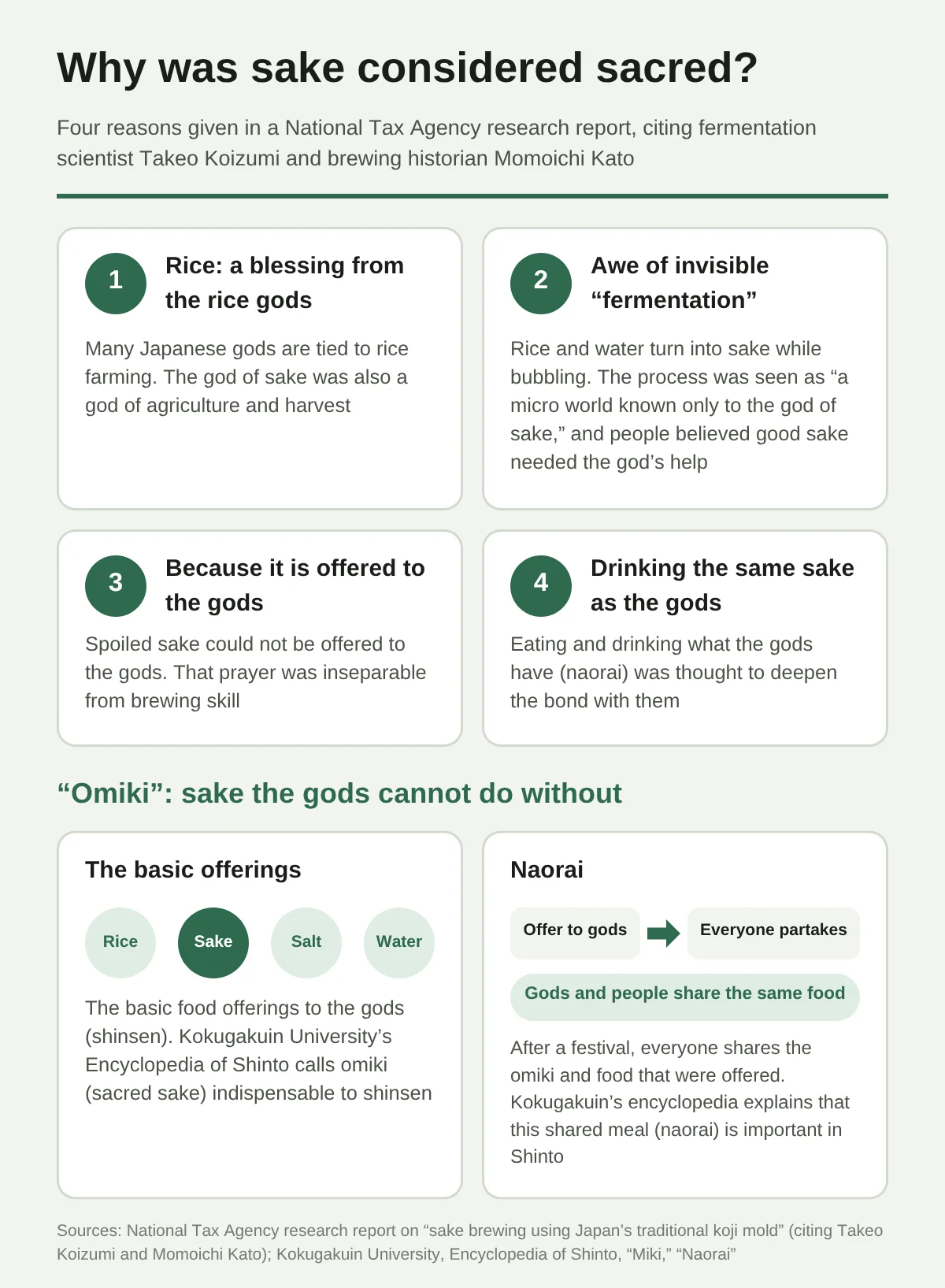
The National Tax Agency’s survey report explains the link between sake and the gods, citing explanations by fermentation scientist Takeo Koizumi and brewing historian Hyakuichi Kato. In sum, there are four reasons:
| Reason | Details |
|---|---|
| 1. Rice = a blessing of the rice god | Many Japanese gods are tied to rice farming. The god of sake was, as it were, also the god of agriculture and harvest |
| 2. Awe of invisible “fermentation” | Rice and water turn into sake, bubbling as they go. The mechanism was thought of as “a microscopic world known only to the god of sake,” and people believed good sake could not be made without the help of the gods |
| 3. Because it is offered to the gods | Spoiled sake cannot be offered to the gods. That prayer and the skill of brewing could not be separated |
| 4. Drinking the same sake as the gods | Eating and drinking the same things as the gods (naorai) was thought to deepen the connection with them |
Even now, it is said there are more than 50 shrines that pass down sake brewing as a Shinto ritual.
The gods of sake and the sugidama
- Omiwa Shrine (Mt. Miwa, Nara): The enshrined deity, Omononushi-no-Okami, is regarded as a god of sake brewing. Takahashi Ikuhi-no-mikoto, who appears in the Nihon Shoki, is said to have brewed fine sake in a single night, and he is enshrined as the ancestor of the toji at Ikuhi Shrine within the grounds. From the sacred cedar tree, the custom arose of hanging a sugidama (sakabayashi), a ball of cedar, under the eaves of sake shops, and even now a “sign sugidama” is granted to breweries across Japan. Each year, the day before the “Sake Festival (Brewing Safety Prayer Ceremony)” on November 14, the large sugidama at the worship hall is replaced.
- Matsunoo Taisha (Kyoto): A shrine enshrined by the Hata clan, for whom sake brewing was a specialty. Since the end of the Muromachi period it has been regarded as the “foremost god of sake brewing in Japan.” Breweries mix water from the shrine’s “Kame-no-i” spring into their brewing water.
- The color of a sugidama: When new sake is ready, a fresh green sugidama is hung. As it gradually turns brown, it is taken as a guide to the sake’s aging.
Famous sake regions
- Three prefectures, Hyogo, Kyoto, and Niigata, make about half of Japan’s total. Hyogo’s Nada-Gogo (the five sake-brewing districts of Nada) and Kyoto’s Fushimi are regions where large breweries gather.
- For the number of breweries, Niigata (77) is No. 1, followed by Nagano (67), Hyogo (56), Fukushima (54), and Yamagata (44).
- What is interesting is Yamaguchi Prefecture. Its average rice polishing ratio is 34.1% (national average 61.2%), polishing away far more rice than anywhere else in Japan.
Water decides the character of sake
- Nada (Hyogo): Miyamizu is rich in phosphorus, potassium, and calcium, and has almost no iron. Fermentation proceeds firmly, and the result is called “Nada no otoko-zake (Nada’s masculine sake).”
- Fushimi (Kyoto): Water with lower hardness than Miyamizu gives a smooth, fine-grained “Fushimi no onna-zake (Fushimi’s feminine sake).”
- Saijo (Hiroshima): Soft water ferments less readily and was considered hard to brew with. In the Meiji era Senzaburo Miura developed a method that works even with soft water, and at the first sake competition in 1907, Hiroshima’s sake placed near the top.
By world standards, most Japanese water is soft. “Hard” and “soft” are comparisons within Japan.
Geographical Indications (GI)
For sake, 23 designations have been made under rules for using a place name (Geographical Indications) (up to those designated on October 1, 2025). “Nihonshu” (Japanese sake) itself is also a GI.
Hakusan, Yamagata, Nada-Gogo, Harima, Mie, Tonenumata, Hagi, Yamanashi, Saga, Nagano, Niigata, Shiga, Shinano-Omachi, Iwate, Shizuoka, Minami-Aizu, Itami, Kitakata, Aomori, Kyoto, Tottori, and Fukuoka, and the number grows year by year.
Comparing sake from different regions
Even within the same prefecture, water, rice, and yeast differ by brewery, and so does the taste. You can compare regional sake a little at a time, or order from local specialty shops.
There is also a mail-order shop that handles sake from Nagano Prefecture, which has the most sake breweries after Niigata.
Premium sake: Juyondai, Aramasa, and Dassai
Juyondai (Takagi Shuzo, Yamagata Prefecture)
- It is a brand launched in 1994 by the then 25-year-old heir, Akitsuna Takagi (who took the name of the 15th generation, “Tatsugoro Takagi,” in 2023).
- It took off with a “hojun umakuchi” style (rich in aroma and flavor), with a fruit-like aroma and deep umami, the opposite of the light, dry style that was mainstream at the time.
- It uses sake rice the brewery grows itself: “Sakemirai,” “Ryu no Otoshigo,” and “Ushu Homare.”
- It has no official website and does no direct sales. It is often sold through a limited number of specialty dealers by lottery or reservation.
Aramasa (Aramasa Shuzo, Akita City)
- Founded in 1852. The 8th-generation head, Yusuke Sato, graduated from the Faculty of Letters at the University of Tokyo and worked as a writer and editor, but returned to the brewery in 2007 and overhauled the brewing.
- The brewery’s policy (official site):
- Use only rice grown in Akita Prefecture
- All shubo is made the traditional kimoto way
- The only yeast is Kyokai No. 6 alone, collected at this brewery in Showa 5 (1930)
- No additives that need not be labeled (such as brewing acids and enzyme preparations)
- Everything is labeled “junmai-shu” regardless of the rice polishing ratio
- It also works on brewing in wooden vats, going as far as making the wooden vats itself.
- It does no direct sales and has a system that introduces specialty dealers.
Dassai (Asahi Shuzo, Iwakuni, Yamaguchi Prefecture)
- The flagship is “Migaki Niwari Sanbu” (Polished 23%). It is a junmai daiginjo with 77% of the rice polished away and only 23% left.
- With no toji, it turned brewing thoroughly into data and has employees brew, achieving both mass production and quality.
- In 2023 it opened a brewery, “DASSAI BLUE,” in New York State in the United States.
Why does it become “premium”?
- Only small amounts can be made: The brewing takes great effort, and production cannot be increased.
- It is supplied only to specialty dealers: The brewery supplies only liquor shops it trusts, to protect quality such as temperature control.
- It is distributed by lottery or reservation: Because it does not line the shelves, people who cannot get it buy it online at high prices.
Reselling may require a license According to the National Tax Agency, even on flea-market apps and online auctions, if you repeatedly list and sell alcohol, an “alcoholic beverage retail license” (酒類販売業免許) is required. If you are only putting up alcohol that you no longer drink at home, you do not need one.
Besides going through specialty dealers, you can also choose from specialty mail-order shops that handle sake from breweries across Japan.
The sake boom overseas
Exports have grown about threefold in 10 years
- In 2025, the destinations were 81 countries and regions, the most ever.
- The unit price per liter rose from 789 yen in 2016 to 1,368 yen in 2025. More expensive sake has come to sell.
- Among Japan’s alcohol exports in 2025, sake is No. 2 after whisky (49.0 billion yen).
Which countries are buying? (2025)
| Rank | Country/region | Amount | Change from previous year |
|---|---|---|---|
| 1 | China | 13.3 billion yen | +14.0% |
| 2 | United States | 11.0 billion yen | −3.5% |
| 3 | Hong Kong | 4.8 billion yen | −5.7% |
| 4 | South Korea | 4.4 billion yen | +17.4% |
| 5 | Taiwan | 2.7 billion yen | +1.1% |
- By volume, the United States is No. 1 (about 7,720 kL). By value, China, which buys expensive sake, is No. 1.
- High unit prices per liter are seen in Macau (3,058 yen), Hong Kong (2,376 yen), and Singapore (2,190 yen).
Sake made overseas
- Brazil: “Azuma Kirin” (東麒麟) has been made since 1935 (JETRO report).
- United States: Dassai’s “DASSAI BLUE” (New York State, 2023) and others.
- France: The Japanese venture WAKAZE began brewing in the suburbs of Paris in 2019.
Under the Geographical Indication rules, “SAKE” made overseas cannot be called “nihonshu” (Japanese sake).
Listed as UNESCO Intangible Cultural Heritage
In December 2024 (December 5, Japan time), “traditional sake brewing” was inscribed on UNESCO’s Intangible Cultural Heritage list. It covers not only sake but also shochu, awamori, and mirin, that is, the whole of Japan’s brewing techniques that use koji mold. What was recognized was the skill handed down by toji and kurabito (brewery workers), and the culture in which sake is indispensable at festivals, weddings, and the like. The history of shochu and awamori is covered in our article on the history of shochu and Kyushu.
How sake is known around the world
These are the results of a 2025 survey in eight markets by JFOODO, the Japanese government’s agency for promoting food exports. The subjects are people who drink alcohol two or three times a month or more (not figures for the general public).
| Market | Know the name | Named sake unprompted when asked “what comes to mind for alcohol” | Drank in the past year |
|---|---|---|---|
| United States (NY, LA, SF) | 61% | 2% | 25% |
| China | 63% | 13% | 36% |
| Hong Kong | 61% | 9% | 38% |
| Singapore | 66% | 6% | 37% |
| United Kingdom | 65% | 1% | 16% |
| France | 71% | 1% | 21% |
- People who “know it when they see the name” are 60–70%.
- But the share who name sake on their own is only 1–2% in Europe and the US.
- The name is known, but it has not yet become an “everyday drink.”
- The English word “sake” has been recorded in dictionaries since the 1680s.
Sake trivia
- October 1 is “Nihonshu no Hi” (Sake Day): Decided in 1978 by the Japan Sake and Shochu Makers Association. It comes from the fact that October 1 was the start of the brewing year until 1965, and that the 10th of the twelve zodiac signs, “tori” (rooster), was originally the character for a sake jar.
- Why people who love drinking are called “satō” (left party): One theory is a pun: carpenters hold the chisel (“nomi”) in the left hand, and “nomi-te” (chisel hand) sounds like “nomi-te” (drinker) (regarded as a folk etymology).
- Edo-period sake was very sweet: Calculated from the brewing recipe, its nihonshu-do (sake meter value) was about −50 (the lower the negative number, the sweeter).
- It goes with dried squid (surume): Because sake contains almost no sulfites or iron, it is said to be less likely to bring out a fishy smell when paired with surume (National Research Institute of Brewing).
For those who want to know more
For those who want to learn more about the history and culture of sake, there are the following books.
Notice Drinking is for those 20 and older. Drinking under 20 is prohibited by law. The products introduced here do not indicate anything good for your health. Prices and shipping may change (shipping varies by region and by refrigerated delivery).
Summary
- Records of sake in Japan go back to the 3rd century, and in the temple sake of the Muromachi period, the basics of today’s brewing were all in place.
- Sake has been regarded as sacred as a blessing of the rice god, as the work of the gods in invisible fermentation, and as something that connects people with the gods through drinking the same sake.
- The regions with the largest volume are Hyogo, Kyoto, and Niigata. Differences in water have shaped the character of “otoko-zake” and “onna-zake.”
- Premium sake is hard to get because only small amounts can be made and it is sold only through specialty dealers.
- Exports have grown about threefold in 10 years, and in 2024 the brewing techniques were listed as UNESCO Intangible Cultural Heritage. In Europe and the US, however, only a minority have made it their “usual drink.”
Sources
- National Tax Agency, survey report “Sake Brewing Using Japan’s Traditional Koji Mold” (Introduction, History of Sake, Chronology) https://www.nta.go.jp/taxes/sake/koujikin/01.htm
- National Tax Agency, “UNESCO Intangible Cultural Heritage: Traditional Sake Brewing” https://www.nta.go.jp/taxes/sake/koujikin/index.htm
- National Tax Agency, “Sake no Shiori,” July 2026 (Recent Trends in Sake Exports) https://www.nta.go.jp/taxes/sake/shiori-gaikyo/shiori/2026/pdf/36.pdf
- National Tax Agency, “Status of Sake Production, etc. (Brewing Year 2024)” https://www.nta.go.jp/taxes/sake/shiori-gaikyo/seizojokyo/2024/pdf/001.pdf
- National Tax Agency, “List of Geographical Indications for Alcoholic Beverages” https://www.nta.go.jp/taxes/sake/hyoji/chiri/ichiran.htm
- National Tax Agency, Q&A on alcohol (retail license, flea markets and auctions) https://www.nta.go.jp/taxes/sake/qa/03b/05.htm
- National Tax College, “Becoming No. 1 in National Taxes” https://www.nta.go.jp/about/organization/ntc/sozei/tokubetsu/h21shiryoukan/03.htm
- Japan Sake and Shochu Makers Association materials (peak of taxed shipment volume of seishu, 2016) https://www.maff.go.jp/j/seisan/keikaku/kome_torihiki/seisyu/attach/pdf/160322-3.pdf
- National Research Institute of Brewing, information magazine “Osake no Hanashi: Seishu 2” https://www.nrib.go.jp/sake/story/pdf/SeishuNo02.pdf
- Omiwa Shrine, “Tales of the Gods of Mt. Miwa” https://oomiwa.or.jp/jinja/kamigatari/
- Matsunoo Taisha, “History and Origins” https://www.matsunoo.or.jp/about01
- Kokugakuin University, Encyclopedia of Shinto, “Miki” https://d-museum.kokugakuin.ac.jp/eos/detail/?id=9623 / “Naorai” https://d-museum.kokugakuin.ac.jp/eos/detail/?id=9042
- National Diet Library, “Kaleidoscope of Books,” No. 38 (Weddings) https://www.ndl.go.jp/kaleido/38/1
- Aramasa Shuzo, “Policy” https://www.aramasa.jp/policy/
- Asahi Shuzo, “DASSAI BLUE” https://dassai.com/us/news/info/005468.html
- JETRO, “The Sake Market in Brazil” (March 2022) https://www.jetro.go.jp/ext_images/_Reports/02/2022/df15c982caeefa0f/sake_br2203.pdf
- JETRO / JFOODO, “Sake Usage & Attitude Survey” (published March 2026) https://www.jetro.go.jp/ext_images/jfoodo/archive/usage_attitude/4-1.pdf
- UNESCO, “Traditional knowledge and skills of sake-making with koji mold in Japan” https://ich.unesco.org/en/RL/traditional-knowledge-and-skills-of-sake-making-with-koji-mold-in-japan-01977
- Japan Sake and Shochu Makers Association, “Happy Sake Day, October 1st” https://japansake.or.jp/sake/en/topic/events/happy-sake-day-october-1st/
Related articles and databases
- What Is the Rice Polishing Ratio? How Sake Is Made, Flat Polishing, and Yeast: Reading the Words on the Label from Government Sources
- Is Sake Good for Your Health? Checking Ingredients, Calories, Weight Gain, and the Comparison with Shochu Against Public Data and Studies
- Does the Type of Alcohol Change Cancer Risk? Which Cancers Rise, Which Show Lower Numbers, and Whether Drinking Has Benefits, Checked Against International Assessments and Studies
- Where Did Beer Come From? 10,000 Years of History and the World Beer Consumption Ranking (China #1 in Total, Czechia #1 per Capita), and Where Japan Stands, Read Through Papers and Government Statistics
- Why Is Kyushu Shochu Country? The History of Shochu, Premium Shochu (Moriizo, Maou, Murao), and Its Spread Overseas, Read Through Government Documents