
Is Sake Good for Your Health? Checking Ingredients, Calories, Weight Gain, and the Comparison with Shochu Against Public Data and Studies

PR This article contains affiliate links to Rakuten Ichiba (“See on Rakuten”). What is written here is based on government documents, the food composition tables, and studies, regardless of whether there are ads. Drinking is for those 20 and older. The “See on Amazon.co.jp” and “See on Yahoo! Shopping” links are also affiliate links.
“Sake is good for you because it has a lot of amino acids.” “Sake has a lot of carbohydrates and makes you fat.” “If you are going to drink anyway, shochu is better.” There are many theories about sake and health.
In this article, we check the following four points against government documents, the food composition tables, and studies:
- What is in sake
- How far have the ingredients said to be “good for the body” been confirmed? What is bad for the body?
- Does sake make you fat?
- Which is better, sake or shochu?
How sake is made, the rice polishing ratio, and yeast are covered in our article on how sake is made, and its history, its ties to Shinto, and its popularity overseas are covered in our article on the history and culture of sake.
Conclusions
- Most of what is in sake is water and alcohol. Its distinguishing feature is that amino acids (glutamic acid), the source of umami, are in orders of magnitude greater amounts than in wine or beer. It contains almost no vitamins or minerals
- The research on the ingredients said to be “good for the body” is mostly test-tube and animal experiments. For health effects confirmed in people drinking sake, we found none, or only very small studies
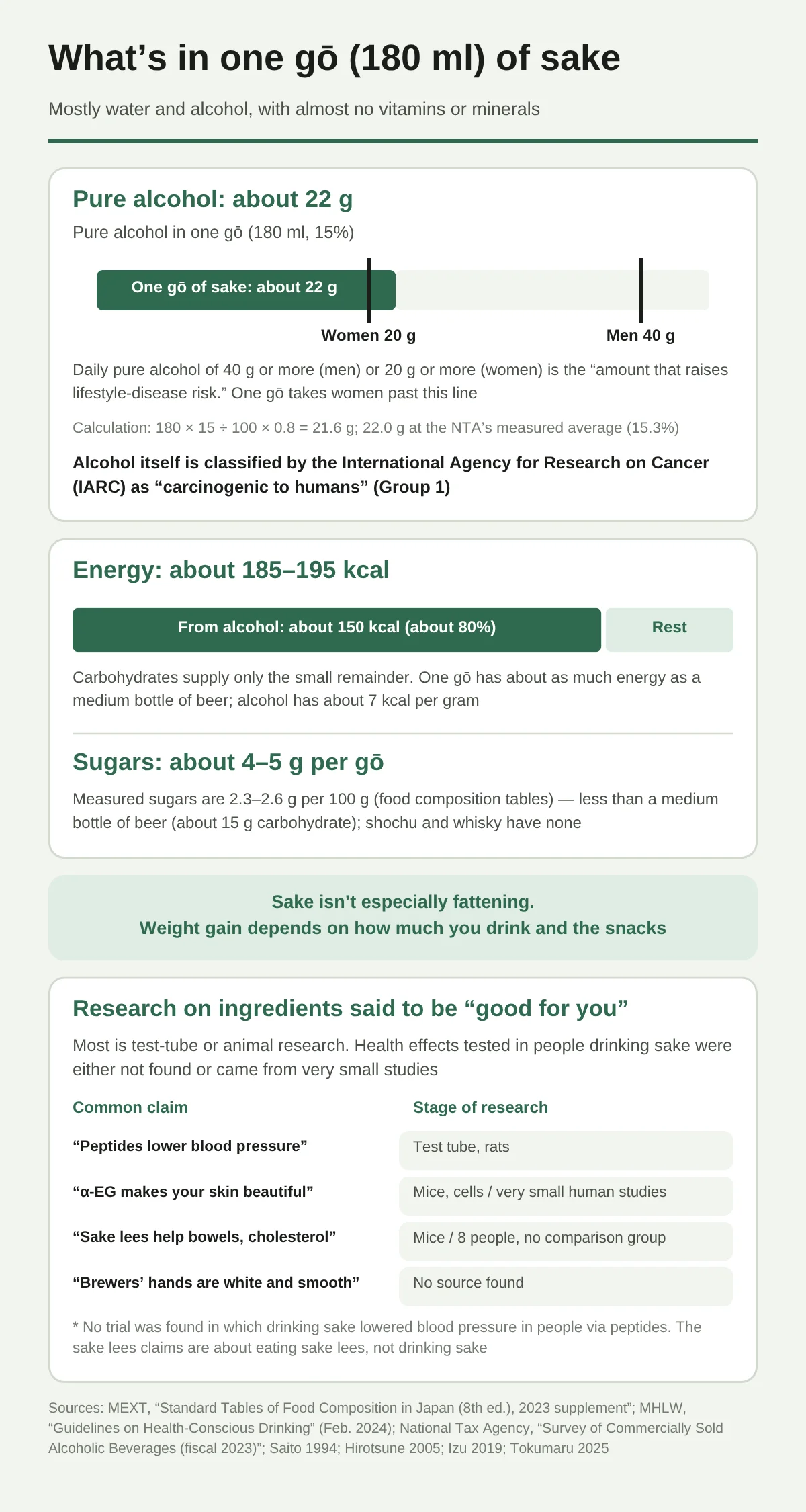
- On the other hand, alcohol itself is classified by the International Agency for Research on Cancer (IARC) as “carcinogenic to humans.” The pure alcohol in one gō (180 ml) of sake is about 22 g, and one gō exceeds the amount that “raises the risk of lifestyle-related diseases” for women (20 g a day)
- The energy in one gō of sake is about 185–195 kcal, almost the same as a medium bottle of beer. It is not the case that sake in particular makes you fat. Whether you gain weight is decided by the amount and the snacks
- Shochu has almost zero carbohydrates and purines. However, most of the harm to the body comes from alcohol, so if you match the amount of pure alcohol, there is no big difference
Products featured in this article
Within the article, we introduce the following in line with each point (they are Rakuten Ichiba links).
| For people who | What we introduce | Where |
|---|---|---|
| Want to know exactly how much they drank, not in “gō” | Ichigo masu (domestic hinoki cypress, 1-gō measuring box), HARIO glass 1-gō tokkuri (sake flask) | Tools for measuring amounts |
| Like sake but want to cut alcohol | Low-alcohol sake (Ichinokura Suzune 5%, Shirataki Jozen 8–9%), non-alcoholic sake-taste drink | When you want to reduce alcohol |
What is in sake?
Most of it is water and alcohol
Let us look at what is in 100 g of sake in the Ministry of Education, Culture, Sports, Science and Technology (MEXT) food composition table (Standard Tables of Food Composition in Japan, 2020 Edition (Eighth Revised), 2023 Supplement).
| Type | Energy | Alcohol | Carbohydrate | Of which actual sugar |
|---|---|---|---|---|
| Futsushu (regular sake) | 107 kcal | 12.3 g | 4.9 g | 2.5 g |
| Junmai-shu (pure rice sake) | 102 kcal | 12.3 g | 3.6 g | 2.3 g |
| Honjozo-shu (naturally brewed sake) | 106 kcal | 12.3 g | 4.5 g | 2.6 g |
| Ginjo-shu | 103 kcal | 12.5 g | 3.6 g | 2.4 g |
| Junmai ginjo-shu | 102 kcal | 12.0 g | 4.1 g | 2.5 g |
- “Carbohydrate” is a value obtained by subtracting the other components. The sugar actually measured was 2.3–2.6 g per 100 g
- In the National Tax Agency’s survey measuring 331 commercial sake products (published February 2025), the average alcohol content was 15.0–15.5%, and glucose was 1.4–2.1 g per 100 ml
- It contains almost no vitamins or minerals. There is a little vitamin B6, and vitamin C, folate, and niacin are zero
Ingredients that give sake its character
| Ingredient | What it does | Amount (guide) |
|---|---|---|
| Amino acids (especially glutamic acid) | Umami and richness | Sake has about 150–390 mg per liter. Wine has about 85 mg or less, and beer almost none (National Research Institute of Brewing materials) |
| Organic acids (lactic, succinic, malic) | Sourness and crispness | Acidity 1.2–1.5. Far milder than wine |
| Aroma compounds (ethyl caproate, isoamyl acetate) | Ginjo aroma like apples and bananas | Varies greatly with the type of yeast (our article on how sake is made) |
| α-Ethyl glucoside (α-EG) | Faint sweetness and bitterness | About 0.5% in ordinary sake. Said to be the next most abundant after alcohol and glucose |
| Peptides | Thickness of flavor | Rice protein that has been broken down |
| Purines | Source of uric acid | 1.2–1.5 mg per 100 ml. Less than beer (3.3–8.4 mg) |
We could not find a source for “sake contains over 700 ingredients” It is a number you often see, but we found it in no paper or public agency document. It is safest to take it as something like “contains several hundred ingredients.”
How far have the ingredients said to be “good for the body” been confirmed?
To give the conclusion first, the research on the “healthy ingredients” of sake is mostly test-tube and animal experiments. Much of the research comes from the laboratories of sake breweries, and what has been confirmed in people is either nonexistent or very small.
| Common claim | Stage of research | What is actually known |
|---|---|---|
| Peptides lower blood pressure | Test tube, rats | Nine kinds of peptides that interfere with the action of the enzyme that raises blood pressure (ACE) were found in sake and sake lees. Giving them to hypertensive rats lowered blood pressure (Gekkeikan Research Institute, 1994). We found no trial in which drinking sake lowered blood pressure in people |
| α-EG makes skin beautiful | Mice and cells / very small studies in people | In mice, it reduced skin damage from ultraviolet light (Ozeki et al.). The human study was only a conference presentation, and what was drunk was a special sake with increased α-EG. There were 5–11 people per group, and it is not even clear whether there was a comparison group |
| Sake lees are good for bowel movements and cholesterol | Mice / 8 people, no comparison group | Sake lees contain a hard-to-digest protein (resistant protein). This is about “eating sake lees,” not about drinking sake |
| The hands of toji (master brewers) are white and beautiful | No source found | A story told as the origin of research on kojic acid (a whitening ingredient made by koji mold). We found no primary source recording it. Besides, it is about what touches the hands, not about drinking |
On the contrary, the guideline of the Ministry of Health, Labour and Welfare (MHLW) says that for high blood pressure, the risk rises with even a little drinking. The peptide claim goes only as far as “this effect was seen in rats and test tubes,” and it cannot be said that “drinking sake lowers blood pressure.”
What is bad for the body is clear
| Ingredient | Assessment |
|---|---|
| Ethanol (alcohol) and acetaldehyde | Classified by the International Agency for Research on Cancer (IARC) as Group 1 (carcinogenic to humans). A relationship with cancers of the mouth, throat, esophagus, liver, colon, and breast has been recognized |
| Ethyl carbamate | IARC Group 2A (probably carcinogenic). The average in sake is 0.10 mg per liter (National Tax Agency fiscal 2023 survey, 48 samples). Japan has no standard value, and this is about half of Canada’s upper limit for sake (200 ppb). Efforts are advancing to reduce it through yeast improvement and low-temperature storage after pasteurization |
| Carbohydrates | About 4–5 g per gō. Less than a medium bottle of beer (about 15 g carbohydrate), but shochu and whisky have none |
How much drinking raises the risk?
The MHLW’s “Guidelines on Drinking with Consideration for Health” (February 2024) say the following:
- The amount that raises the risk of lifestyle-related diseases is, in pure alcohol per day, 40 g or more for men and 20 g or more for women
- The pure alcohol in one gō of sake (180 ml, 15%) is about 22 g. That is, women exceed this line with one gō
- Drinking 60 g or more at one time (about 3 gō of sake) should be avoided
- For high blood pressure and for esophageal cancer in men, the risk rises with even a little drinking
- About 40% of Japanese people have a constitution in which the face turns red when drinking alcohol. Even those who have grown used to drinking and feel fine have a very high risk of cancers of the mouth and esophagus
Formula for pure alcohol Amount drunk (ml) × alcohol content (%) ÷ 100 × 0.8 = pure alcohol (g) One gō of sake: 180 × 15 ÷ 100 × 0.8 = 21.6 g. Using the National Tax Agency’s measured average (15.3%), it is 22.0 g
The relationship between types of alcohol and cancer is examined in more detail in our article on types of alcohol and cancer.
For those concerned about gout
Sake is a drink low in purines. However, alcohol itself raises uric acid in the body. In a study that followed 3,310 Japanese men for 6 years, for both beer and sake, the more people drank, the more people had high uric acid levels (Nakamura et al., 2012). You cannot say “it is low in purines, so it is fine to drink a lot.”
Does sake make you fat?
Calories are “about the same as a medium bottle of beer”
Of the energy in one gō of sake, about 80% (about 150 kcal) comes from alcohol. What comes from carbohydrates is only a small remainder.
Is “alcohol is empty calories, so it does not make you fat” true?
This is a misunderstanding.
- “Empty” means “not accompanied by nutrients such as vitamins,” and does not mean zero calories. Alcohol has about 7 kcal per gram
- The body processes alcohol first. During that time, burning fat is put off. In a study of 8 healthy men, on days when alcohol was added, daily fat burning fell by 31–36% (Suter et al., 1992)
- Drinking increases appetite, and you tend to eat more snacks
What does the research say?
- In a review that pooled 31 studies (Sayon-Orea et al., 2011), the relationship between light drinking and weight gain was unclear, while people who drink a lot tended to gain weight
- We found no weight study limited to sake alone
It is not the case that sake in particular makes you fat. What decides whether you gain weight is how much you drink and what you eat with it.
Sake or shochu: which is better?
| What we compare | Sake | Honkaku shochu |
|---|---|---|
| Carbohydrates | About 4–5 g per gō | Zero (distillation leaves no sugar) |
| Purines | Low (1.2–1.5 mg per 100 ml) | Almost zero |
| Energy (per 20 g of pure alcohol) | About 175 kcal | About 140 kcal |
| Risk to cancer, blood pressure, and liver | Determined by the amount of pure alcohol | Same |
| Uric acid | Rises when you drink | Rises when you drink |
| Character of taste | Umami (amino acids) and aroma | Clean. Changes freely with how it is mixed |
The most important point is that most of the harm to the body comes from alcohol itself. If you match the amount of pure alcohol, there is no big difference whichever you choose.
- If you care about carbohydrates and purines, shochu has the advantage
- However, shochu has a high alcohol content, so if you make it strong, pure alcohol rises quickly. One gō of shochu (180 ml, 25%) is 36 g of pure alcohol, 1.6 times one gō of sake
- Claims about shochu such as “zero carbohydrates, zero purines,” “makes blood flow smoothly,” and “less likely to cause a hangover” are checked in detail in our article on shochu and health
“Shochu dissolves blood clots” is an overstatement A 1988 study reported that one hour after drinking, the activity that dissolves blood clots rose about 2.1-fold with shochu, about 1.7-fold even with sake, and about 1.5-fold with beer (Sumi et al.). However, this was a temporary change in blood values, not a result showing that thrombosis or myocardial infarction decreased. Since it also rose with sake, it is not a feature of shochu alone.
It is also said that “brewed alcohols (sake and wine) have many minor components and so are more likely to cause a hangover.” In a trial of 95 people, bourbon, with more minor components, caused worse subjective hangover symptoms than vodka (Rohsenow et al., 2010). However, we found no study directly comparing sake and shochu. The biggest cause of a hangover is the amount of alcohol drunk.
What you can do if you drink
| What to do | Why |
|---|---|
| Think in “grams,” not “gō” | One gō of sake is about 22 g. The national guideline is not to exceed 40 g a day for men and 20 g for women |
| Decide the amount and measure with a vessel | Tokkuri (sake flasks) and glasses vary in size, making it hard to tell how much you drank |
| Drink yawaragi-mizu (chaser water) alongside | The national guideline recommends alternating with non-alcoholic drinks |
| Do not drink a lot at one time | 60 g or more (about 3 gō) at one time is “heavy episodic drinking” and should be avoided |
| Make days in the week when you do not drink | You can reduce the amount for the week |
| If your face turns red, drink less | The risk of esophageal and mouth cancers is especially high |
Tools for measuring amounts
Sake you drink at home is hard to keep track of in gō, because glasses and tokkuri vary in size. If you use a vessel in which one gō (180 ml) is clear, it becomes easier to count the pure alcohol (about 22 g per gō).
When you want to reduce alcohol
Even if you like the taste of sake, when you want to reduce alcohol, one option is to choose sake with a lower alcohol content. Pure alcohol is determined by “amount × alcohol content,” so for the same amount, the lower the alcohol content, the less there is.
On days when you do not want any alcohol at all, there are also non-alcoholic “sake-taste drinks.” However, they are not sake with the alcohol removed. The ingredients of Gekkeikan “Special Free” are yuzu extract, seasoning (amino acids, inorganic salts), acidulant, flavoring, sweetener (stevia), and spices, and no rice or rice koji is used.
Note Drinking is for those 20 and older. Drinking by those under 20 is prohibited by law. The products introduced here are not meant to show that they are good for health. Prices and shipping may change (shipping varies by region and for chilled delivery).
Summary
- Most of what is in sake is water and alcohol. Its umami amino acids are in orders of magnitude greater amounts than in wine or beer, but it has almost no vitamins or minerals
- The research on “ingredients good for the body” is almost all at the test-tube and animal stage. We found no health effect confirmed in people drinking sake
- Alcohol itself is a carcinogen. One gō of sake has about 22 g of pure alcohol. Women exceed the national guideline (20 g) with one gō
- The energy in one gō is almost the same as a medium bottle of beer. Whether you gain weight is decided by the amount and the snacks
- Even compared with shochu, what matters is the amount, more than the type. If you enjoy drinking, think in “grams,” not “gō”
Sources
- Ministry of Health, Labour and Welfare, “Guidelines on Drinking with Consideration for Health” (February 2024) https://www.mhlw.go.jp/content/12200000/001211974.pdf
- Ministry of Education, Culture, Sports, Science and Technology, “Standard Tables of Food Composition in Japan (Eighth Revised), 2023 Supplement,” Food Composition Database (sake, futsushu) https://fooddb.mext.go.jp/details/details.pl?ITEM_NO=16_16001_7
- National Tax Agency, “Results of the Nationwide Survey of Commercial Alcoholic Beverages (fiscal 2023 survey)” (February 2025) https://www.nta.go.jp/taxes/sake/shiori-gaikyo/seibun/2024/pdf/001.pdf
- National Tax Agency, “On Methods for Reducing Ethyl Carbamate in Sake” https://www.nta.go.jp/taxes/sake/anzen/pdf/01_2_2.pdf
- National Research Institute of Brewing, Nami Goto, “The Deliciousness of Sake” (materials for the National Tax Agency expert council, 2019) https://www.nta.go.jp/about/council/sake3/191101/shiryo/pdf/05.pdf
- Kyoto Municipal Institute of Industrial Technology and Culture, research report (purines in alcoholic beverages, fiscal 2023) https://tc-kyoto.or.jp/app/uploads/2024/01/outcome2022_08.pdf
- Health Canada, “Ethyl carbamate” https://www.canada.ca/en/health-canada/services/food-nutrition/food-safety/chemical-contaminants/food-processing-induced-chemicals/ethyl-carbamate.html
- Saito Y et al. (1994) Biosci Biotechnol Biochem (ACE-inhibitory peptides in sake and sake lees). https://pubmed.ncbi.nlm.nih.gov/7765503/
- Hirotsune M et al. (2005) J Agric Food Chem (components of sake and the skin barrier against ultraviolet light, mice). https://pubmed.ncbi.nlm.nih.gov/15713003/
- Izu H et al. (2019) Biosci Biotechnol Biochem (resistant protein in sake lees). https://pubmed.ncbi.nlm.nih.gov/30582422/
- Tokumaru O et al. (2025) PLoS One (sake lees and constipation, 8 people, no comparison group). https://pubmed.ncbi.nlm.nih.gov/40460378/
- Nakamura K et al. (2012) Nutr Metab Cardiovasc Dis (drinking and hyperuricemia in Japanese men). https://pubmed.ncbi.nlm.nih.gov/21421297/
- Suter PM et al. (1992) N Engl J Med (alcohol and fat burning). https://pubmed.ncbi.nlm.nih.gov/1545851/
- Sayon-Orea C et al. (2011) Nutr Rev (systematic review of drinking and body weight). https://pubmed.ncbi.nlm.nih.gov/21790610/
- Sumi H et al. (1988) Alcohol Alcohol (fibrinolytic activity after drinking). https://pubmed.ncbi.nlm.nih.gov/3128990/
- Rohsenow DJ et al. (2010) Alcohol Clin Exp Res (minor components and hangover). https://pubmed.ncbi.nlm.nih.gov/20028364/
Related articles and databases
- What Is the Rice Polishing Ratio? How Sake Is Made, Flat Polishing, and Yeast: Reading the Words on the Label from Government Sources
- Why Is Sake Sacred? Its History, Shinto, Famous Regions, Premium Bottles, and Popularity Overseas, Read Through Government Sources
- Is Shochu Good for Your Health? Checking “Zero Sugar,” “Zero Purines,” “Thin Blood,” Weight Gain, and Hangovers Against Food Composition Tables and Studies
- Does the Type of Alcohol Change Cancer Risk? Which Cancers Rise, Which Show Lower Numbers, and Whether Drinking Has Benefits, Checked Against International Assessments and Studies
- Is Beer Bad for You? Gluten in Barley, Purines, "Zero Carbs," Brewer's Yeast and Virility, and "Beer Belly," Checked Against Food Tables and Studies