
Acidulants and pH Adjusters: The History of Citric Acid, What Group Names Hide, Phosphates and the Kidneys, “Preservative-Free” Claims, and How Japan and the EU Label Them

PR This article contains affiliate links to Rakuten Ichiba, Amazon, Yahoo! Shopping and A8.net (“See on Rakuten”, etc.). What we write is based on public documents and studies, whether or not an ad is present. The “See on Amazon.co.jp” links are also affiliate links.
Curry roux, ponzu, bouillon cubes, Chinese soup base, convenience-store bento. Look at the ingredient list (原材料名) on the back and, in the additive section after the slash (/), you will often find “酸味料” (acidulant) and “pH調整剤” (pH adjuster).
But these two words do not tell you what is actually in the food. Common questions and claims include the following.
- What is in an “acidulant”? How is it different from vinegar or lemon juice?
- “pH adjusters are dangerous” and “they kill gut bacteria”
- Why does a “preservative-free” bento contain a pH adjuster?
- Are phosphates bad for the kidneys? Do they dissolve bones?
- How do other countries label the same thing?
This article uses government notices, minutes of study groups, statistics and papers to check:
- When and how acidulants such as citric acid came to be made
- When and why the “acidulant” / “pH adjuster” style of labeling (group names) was created
- What is inside the group names, and where they overlap
- How labeling differs in Japan, Codex (the international food standards body), the EU and the US
- Effects on the body: what research shows about phosphates and the kidneys and bones, and about citric acid and inflammation, fatigue and teeth
- How a government study group discussed the relationship between “preservative-free” and pH adjusters
- How acidulants and pH adjusters are written on the 71 products listed on Urayomi
Preservatives themselves are covered in the preservatives article, the rules for “additive-free” and “not used” claims in the article on the rules for “additive-free” labeling, and acetic acid in vinegar in the vinegar article.
Conclusion
- “Acidulant” and “pH adjuster” are “group names” (一括名): the name of the actual substance does not have to be written. Whichever and however many of the 24 designated additives (acidulant) or 35 designated additives (pH adjuster) are used (plus phytic acid, an existing additive, for both), the label can simply say “acidulant” or “pH adjuster”
- All 24 acidulant substances are also pH adjusters. The substances only in the pH adjuster list are 11, such as baking soda (sodium bicarbonate) and other alkaline substances, and sodium and potassium salts of phosphoric acid. The same glucono-delta-lactone is labeled under four different names depending on purpose: “acidulant”, “tofu coagulant”, “pH adjuster” and “leavening agent”
- Citric acid was isolated from lemon juice in 1784 and is now made by fermentation with a black-mold species. Japan began domestic production in 1953 in Kagoshima from sweet potato starch residue, but today imports dominate: 88.4% of the 57,210 tonnes imported in 2025 came from China
- The group-name system began in 1988, and “acidulant” and “pH adjuster” were among the first 11 names. In 2019-2020 a government study group even drafted Codex-style labels for comparison and concluded “keep the status quo”. Only 12.0% of consumers know that additives can be written together under a group name
- Codex, the EU and the US do not allow “pH adjuster” alone. The EU requires “category plus substance name or E number”, and the US requires the substance name. For the same Coca-Cola, the US official site lists “PHOSPHORIC ACID” while the Japanese official site lists only “酸味料” (acidulant)
- For citric, lactic and acetic acids, international evaluations say “ADI not limited” (ADI = acceptable daily intake). The source of “citric acid causes inflammation” was just four case reports. We could not find research behind “pH adjusters are dangerous” or “they kill gut bacteria”. What deserves attention is dental erosion from sipping acidic drinks for a long time
- Phosphates are a different story. Behind the group names are 6 phosphates under pH adjuster, 13 under kansui (alkaline agents for Chinese noodles) and 15 under leavening agent, but the label does not show them. The Japanese Society of Nephrology puts the absorption rate of inorganic phosphorus used in food processing at 90% or more. The information most needed by kidney patients who restrict phosphorus is the information group names hide most. On the other hand, for healthy people the link to heart disease or fractures is unclear
- Using a pH adjuster to extend shelf life while claiming “preservative-free” is listed in the government guidelines as an “example highly likely to mislead” (Type 4). In the study group, a convenience-store member said, based on what he heard from people in the industry, “Because preservatives have a bad image, [they are] switching to pH adjusters and glycine (…)”. In a small test of rice cooked at factories, no clear suppression of bacteria by pH adjusters was seen
What we introduce in this article
| What we introduce | When it helps | Where in the article |
|---|---|---|
| 河原酢造 老梅 有機純米酢 (Kawara Shuzo Roubai organic pure rice vinegar) | When you want to add sourness with vinegar | How are vinegar and lemon juice different from acidulants? |
| Meal delivery for people with kidney disease | When looking for meals with adjusted phosphorus and protein (under the guidance of a doctor or registered dietitian) | People with kidney disease cannot tell what is inside from group names |
| FIT FOOD HOME (frozen prepared-meal delivery) | When you want to choose side dishes by their ingredients | What to check when choosing prepared foods and bento |
History of acidulants: from lemons to black mold, and then to imports
Today’s main acidulant is citric acid. After an era of extracting it from lemons and an era of making it with molds, Japan has gone around a full circle: “import, then domestic production, then import again”.
1784: citric acid is extracted from lemon juice
In 1784 the Swedish chemist Scheele extracted citric acid as crystals from lemon juice, and it was named after the lemon (citrus) (Ciriminna et al. 2017, a peer-reviewed review). Scheele also discovered lactic acid in sour milk in 1780. Industrial fermentation of lactic acid is said to have begun in 1881, but sources disagree on who started it (a French researcher or an American entrepreneur).
The lemon industry of Sicily
In the 19th century, citric acid was made from the lemon juice of Sicily, Italy. Lime was added to concentrated lemon juice to precipitate “calcium citrate”, which was then converted back with dilute sulfuric acid. Lemon-based production peaked at 17,500 tonnes in 1915-1916, and in 1930 Europe’s largest citric acid plant was in Palermo, Sicily (Ciriminna 2017).
1917: making citric acid with black mold
What changed the course was fermentation with molds.
| Year | Event | Source |
|---|---|---|
| 1893 | The German Wehmer notices that a Penicillium-type mold makes citric acid | Książek 2023 (review) |
| 1917 | The American food chemist Currie reports that growing a black-mold species (Aspergillus niger) in sugar solution produces large amounts of citric acid | Currie 1917 (J Biol Chem), Cairns et al. 2018 |
| 1919 | Commercial production begins in Belgium with another mold (Citromyces, now Penicillium) | Ciriminna 2017 |
| 1919-1923 | Currie’s method is industrialized in the US. “A pilot plant by Pfizer two years after the discovery” (Cairns 2018) and “commercial production in New York in 1923” (Ciriminna 2017, no company named): the sources word it differently | Both papers |
We could not confirm Pfizer’s official company history. Here we only say that “within a few years of Currie’s discovery, Pfizer industrialized it”.
As fermentation spread, production from lemons declined. World citric acid production (including citrates) reached about 500,000 tonnes in 1989 and over 2 million tonnes in 2015, and in 2015 China accounted for 59% of world production and 74% of exports (Ciriminna 2017).
Japan’s citric acid: from Belgian imports to sweet potato residue in Kagoshima
Until the early 1950s, Japan’s citric acid was made mainly from imported Belgian citrate of lime (calcium citrate).
In 1953 (Showa 28), Uemura Chemical Industry in Kagoshima Prefecture completed a plant with an annual capacity of 160 tonnes that made citrate of lime by solid-state fermentation, using the sweet potato residue left after extracting starch (starch pulp) as the raw material. By 1962 four companies together made 2,000 tonnes a year, and demand for sourness in soft drinks and powdered juices was expected to be “well over 4,000 tonnes” (Matsumura 1963, Journal of the Japanese Society of Starch Science).
We could not confirm whether any company in Japan now makes citric acid by fermentation. What the statistics show is that imports keep growing, and most of them come from China.
| Year | Citric acid imports | Of which from China | China’s share |
|---|---|---|---|
| 2000 | 32,361 tonnes | 19,375 tonnes | 59.9% |
| 2010 | 40,158 tonnes | 36,232 tonnes | 90.2% |
| 2021 | 55,392 tonnes | 53,117 tonnes | 95.9% (peak) |
| 2025 | 57,210 tonnes | 50,598 tonnes | 88.4% |
Over 25 years imports grew about 1.8 times. The main non-China sources in 2025 were Austria and Thailand. These numbers include detergent and industrial uses and exclude salts such as sodium citrate. The 2025 value is the UN annual figure and has not been checked against the Ministry of Finance’s final data.
When substances were approved as additives in Japan
Many of the substances used as acidulants and pH adjusters were approved soon after the Food Sanitation Act was established (from the Japan Food Research Laboratories Foundation’s “History of designation and deletion”).
| Year | Substance |
|---|---|
| July 1948 | Acetic acid (the first designation under the Food Sanitation Act. It was dropped once in 1950, re-designated in 1957, and renamed “glacial acetic acid” in 1959) |
| July 1957 | Lactic acid, fumaric acid, DL-malic acid, phosphoric acid, trisodium citrate, succinic acid, gluconic acid, etc. |
| December 1959 | Citric acid, DL-tartaric acid, L-tartaric acid |
| 1962 | Glucono-delta-lactone (also used as a tofu coagulant) |
| 1983 | Adipic acid |
| 2013 | Potassium lactate |
The first edition of the Japanese Standards of Food Additives (198 items), issued in March 1960, already listed citric acid, lactic acid, fumaric acid, tartaric acid, malic acid, phosphoric acid and acetic acid. The current edition is the 10th (2024).
1988: “group names” are created
The “acidulant” and “pH adjuster” style of labeling was born in the 1988 system revision, and both were among the first 11 names.
| Year | Event |
|---|---|
| 1984 | The Ministry of Health and Welfare sets up the “Food Additive Labeling Study Group” |
| September 1987 | Final report of the study group. It says that “food additives that are also commonly present in food, such as organic acids and amino acids” and similar may be labeled by names that group them by function |
| Autumn 1987 | The report is translated into English and notified to other countries through GATT (the General Agreement on Tariffs and Trade). South Korea asked that glycerin in chewing gum be included under the group name “softener” and this was accepted; the US argued that “making only synthetic additives labeled while exempting natural ones is a new non-tariff barrier”, and the EC and Australia agreed |
| July 1988 | By ministerial ordinance, group names become 11 names: yeast food, gum base, kansui, flavoring, acidulant, seasoning, pH adjuster, tofu coagulant, emulsifier, leavening agent and chewing gum softener |
| November 1989 | Natural additives also become subject to labeling. Enzyme, glazing agent and bittering agent are added to the group names, making 14 names |
| July 1991 | The transitional period (until June 30, 1991) ends, and the system of labeling, in principle, all additives starts in earnest. In a 1988 explanatory article the grace period was planned to last until the end of 1990 |
(From explanatory articles in Journal of the Brewing Society of Japan 1988 and Seikatsu Eisei 1990, and Consumer Affairs Agency study group materials. We could not confirm the original text of the 1988 notice itself.)
A 1990 explanatory article describes pH adjusters as “substances added to adjust the acidity of food, such as acetic acid, citric acid and baking soda”, and acidulants as “organic acids and their salts used to give sourness”. The group names took shape in trade negotiations, as an exception allowing “labeling together”, at the same time as the labeling system was expanding toward “write every additive”.
How are acidulants and pH adjusters different?
“Acidulant” is a group name for making food sour, and “pH adjuster” is a group name for keeping the degree of acidity or alkalinity. But many of the substances inside are the same.
What is pH?
pH is a number that shows how acidic or alkaline something is. 7 is neutral; lower numbers are more acidic and higher numbers are more alkaline. Lemon juice and vinegar are acidic, and water with baking soda dissolved in it is mildly alkaline.
Official definitions and scope
| Acidulant (酸味料) | pH adjuster (pH調整剤, hydrogen ion concentration adjuster) | |
|---|---|---|
| Definition | An additive used to give or strengthen sourness and improve taste | An additive used to keep food in a suitable pH range (excluding the purpose of “kansui” for Chinese noodles) |
| Substances that may be written | 24 designated additives + phytic acid | 35 designated additives + phytic acid |
| Main ones | Citric acid, lactic acid, malic acid, tartaric acid, fumaric acid, sodium acetate, glacial acetic acid, gluconic acid, phosphoric acid, etc. | All 24 acidulant substances + sodium bicarbonate (baking soda), sodium carbonate, potassium carbonate, sodium and potassium salts of phosphoric acid, etc. |
Source: Consumer Affairs Agency, “About the Food Labeling Standards”, Annex Additives 1-4 (April 1, 2026 version)
All 24 acidulant substances are also on the pH adjuster list
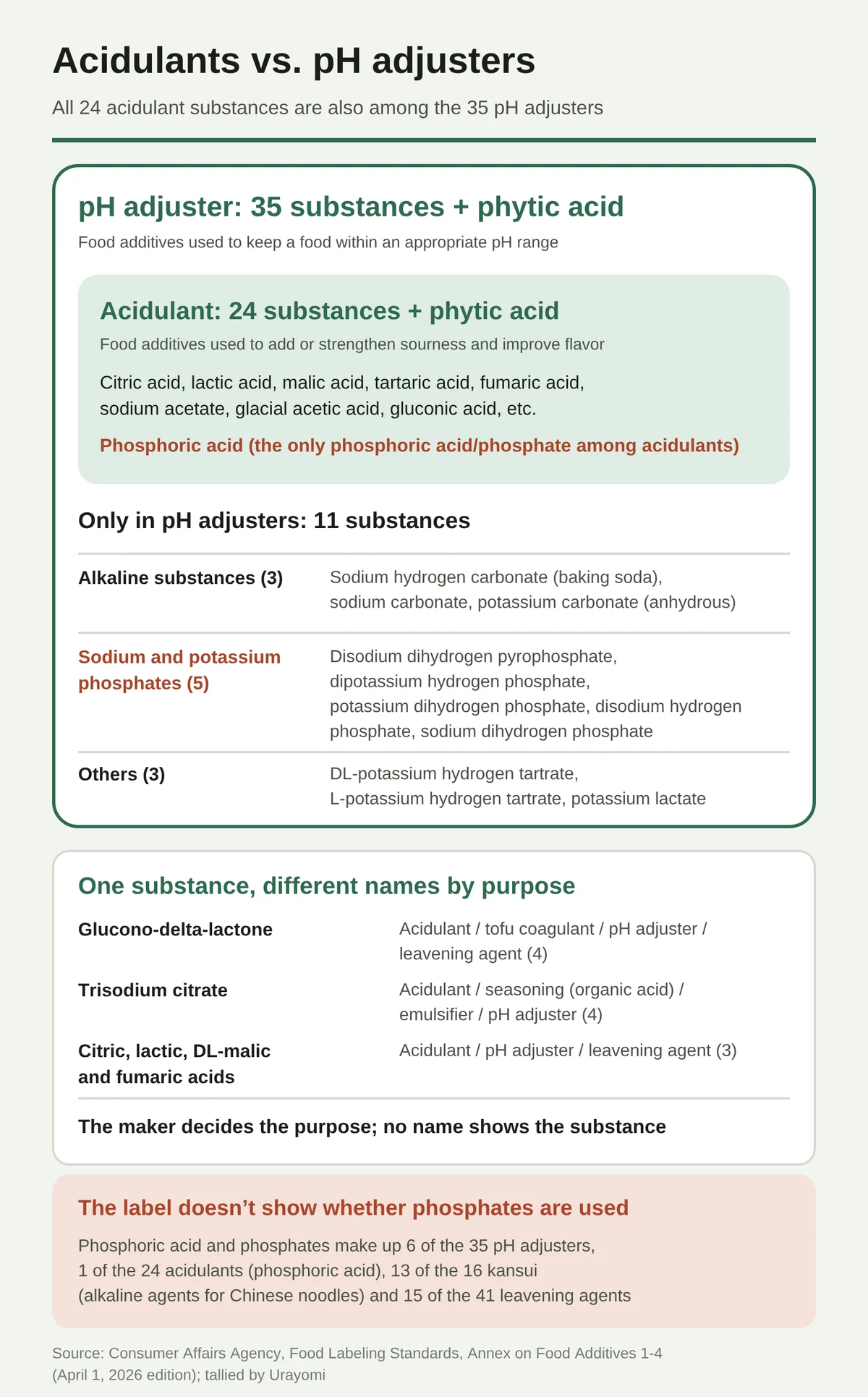
Cross-checking the government’s notice list, every one of the 24 acidulant substances is also among the 35 pH adjusters. The substances only in the pH adjuster list are these 11.
| Type | Substances |
|---|---|
| Alkaline substances | Sodium bicarbonate (baking soda), sodium carbonate, potassium carbonate (anhydrous) |
| Sodium and potassium salts of phosphoric acid | Disodium dihydrogen pyrophosphate, dipotassium hydrogen phosphate, potassium dihydrogen phosphate, disodium hydrogen phosphate, sodium dihydrogen phosphate |
| Others | Potassium DL-hydrogen tartrate, potassium L-hydrogen tartrate, potassium lactate |
In other words, “pH adjuster” is a group name that does not only make things sour but may also move food toward the alkaline side. A respondent to the Consumer Affairs Agency study group’s survey also wrote, “I have never seen the contents of pH adjusters or leavening agents written, and it would be easier to understand if we could tell whether they adjust toward acidic or basic.”
Compared with a 1996 notice, the scope of pH adjusters has grown from 34 to 35 substances. The only addition is potassium lactate, designated in 2013.
The same substance goes by many names
Group names are decided by “purpose of use”, not by “substance”. So the same substance can be written differently on the label depending on its purpose. It is the manufacturer that decides the purpose.
| Substance | Group names it falls under |
|---|---|
| Glucono-delta-lactone | Acidulant / tofu coagulant / pH adjuster / leavening agent (4 names) |
| Trisodium citrate | Acidulant / seasoning (organic acids) / emulsifier (for processed cheese, etc.) / pH adjuster (4 names) |
| Citric acid, lactic acid, DL-malic acid, fumaric acid | Acidulant / pH adjuster / leavening agent (3 names) |
| Sodium acetate, sodium lactate | Acidulant / seasoning (organic acids) / pH adjuster (3 names) |
| Phosphoric acid | Acidulant / pH adjuster |
Source: Urayomi’s tally from Consumer Affairs Agency Annex Additives 1-4
The same citric acid could be written “acidulant” in a juice, “pH adjuster” in a bento and “leavening agent” in pancake mix. With any of these, the name of the substance does not appear.
How are vinegar and lemon juice different from acidulants?
Even when the source of sourness is the same kind of acid, vinegar and lemon juice are treated as “food” and acidulants as “additives”.
| Vinegar / lemon juice | Acidulant | |
|---|---|---|
| Treated as | Food | Additive |
| Place on the back label | Before the “/” in the ingredient list | After the “/” |
| Main acid | Acetic acid for vinegar, citric acid for lemon | Highly purified substances such as citric acid, lactic acid, malic acid and glacial acetic acid |
| How it is written | “Brewed vinegar”, “apple vinegar”, “lemon juice”, etc. | May be written simply as “acidulant” (酸味料) |
Vinegar itself is a food, but “glacial acetic acid”, which is purified acetic acid, and “sodium acetate” are additives and fall under acidulant and pH adjuster.
Counting the 71 products listed on Urayomi, 20 products use vinegar such as brewed vinegar for sourness and 9 use juice such as lemon or yuzu. Some products, like Ajipon (味ぽん), use both “brewed vinegar” and “citrus juice” and also an “acidulant”.
Kawara Shuzo’s Roubai Organic Pure Rice Vinegar (老梅 有機純米酢) is a rice vinegar whose ingredient list has only one item: “organically grown rice (domestic)”. The label says that the “梅” (ume) in the trademark “老梅” means a traditional sour seasoning (no ume is among the ingredients). We introduce it for people who want to add sourness to cooking with vinegar rather than additives. The types of vinegar and the conditions for writing “pure rice vinegar” (純米酢) are covered in the vinegar article.
Labeling rules: Japan, Codex, the EU and the US
In Japan it is enough to write “acidulant” or “pH adjuster”, while the main overseas systems require a substance name or a number.
Japan: additives written by purpose, and additives that may be grouped
Additive labeling in Japan is, in principle, by substance name. In addition:
- For 8 purposes (sweetener, colorant, preservative, thickener etc., antioxidant, color fixer, bleaching agent and antifungal agent), there is an obligation to write the purpose and the substance name side by side, as in “preservative (potassium sorbate)”
- For 14 group names such as acidulant, pH adjuster, emulsifier, flavoring and seasoning, it is allowed to write only the group name instead of the substance name (it is not an obligation)
The Q&A on the Food Labeling Standards also allows adding the contents after the group name, as in “acidulant (citric acid, etc.)”. The conditions are that the substances are within the scope, are in order of weight, and that when several are used it is not written as if there were only one.
When an acidulant used at the raw-material stage is not present in an amount that works in the finished food, it may not be labeled at all. See the carry-over article for details.
12.0% know about group names
In a Consumer Affairs Agency survey of 10,000 people (fiscal 2017),
| What people know | Share |
|---|---|
| Some additives are labeled together under a group name | 12.0% |
| Additives are labeled separately from ingredients | 11.7% |
| Additives are also written in order of weight | 35.8% |
This means only about one in ten people knows that “acidulant” is not the name of a single substance.
The Consumer Affairs Agency advises people who want to know what is in an additive written under a group name to contact the manufacturer or seller named on the label.
The government study group chose to “keep the status quo”
The Consumer Affairs Agency’s “Study Group on the Food Additive Labeling System” (2019-2020) discussed whether to review group names. In the study group’s materials, the label of the same bento is compared in three ways.
| Style | Example |
|---|---|
| Japan today | pH adjuster, glycine |
| Codex style (substance names) | pH adjuster (citric acid, trisodium citrate), shelf-life extender (glycine) |
| Codex style (numbers) | pH adjuster (330, 331(iii)), shelf-life extender (640) |
(Labeling examples from the Consumer Affairs Agency study group materials. The bento is a hypothetical example.)
The conclusion was that “keeping the status quo is appropriate”. The reasons were that group names have been used for more than 30 years, that labels would get longer, and that international numbers (INS numbers) are unfamiliar to consumers. In exchange, businesses are expected to respond politely to inquiries and to provide information on websites.
However, a 2019 survey found that the only group names for which websites listed the substance names were tofu coagulant and bittering agent.
Labeling in Codex, the EU and the US
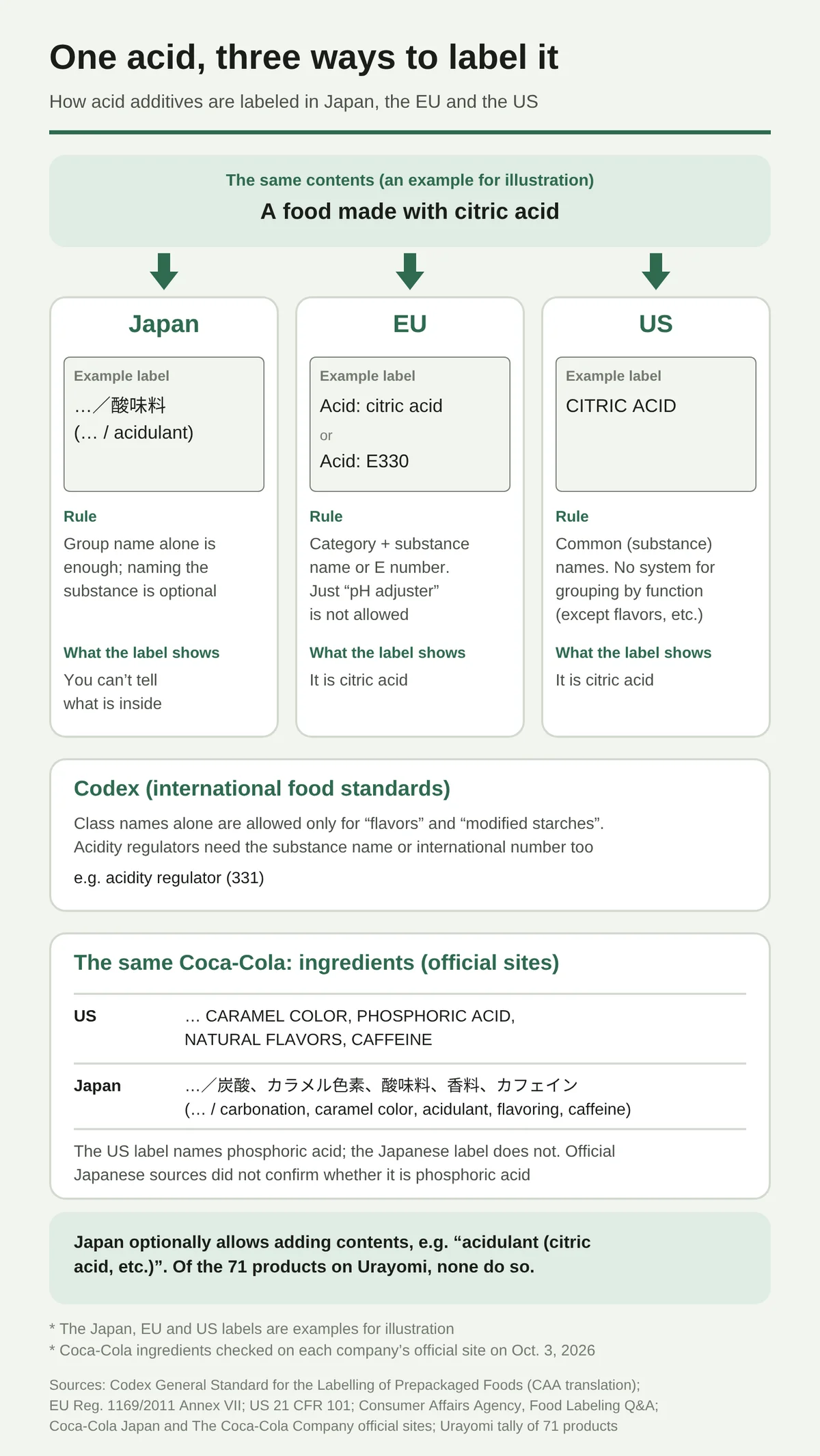
| How acid additives are written | Examples | |
|---|---|---|
| Japan | The group name alone is enough | Acidulant, pH adjuster |
| Codex | Only “flavoring” and “modified starch” may be written by category alone. Functional classes including pH adjuster (acidity regulator) must be accompanied by a substance name or international number. This list of functional classes has nothing that corresponds to the EU’s “Acid” | acidity regulator (sodium citrates), acidity regulator (331) |
| EU | Category names such as “Acid” and “Acidity regulator” + substance name or E number | Acid: citric acid, Acid: E330 |
| US | Ingredients are written by their common (substance) name. There is no system of grouping by function (except for flavorings, etc.) | CITRIC ACID, PHOSPHORIC ACID |
Source: Codex General Standard for the Labelling of Prepackaged Foods (provisional translation by the Consumer Affairs Agency), EU Regulation 1169/2011 Annex VII, US Code of Federal Regulations 21 CFR 101
The main EU numbers are E330 citric acid, E270 lactic acid, E296 malic acid, E297 fumaric acid, E260 acetic acid, E338 phosphoric acid, E339-E341 sodium, potassium and calcium salts of phosphoric acid, E450-E452 di-, tri- and polyphosphates, and E575 glucono-delta-lactone. In the EU it is not possible to write just “pH adjuster”.
The same cola is “PHOSPHORIC ACID” in the US and “acidulant” in Japan
The difference between systems is easy to see in the drinks of the same brand (checked October 3, 2026).
| Ingredient label | |
|---|---|
| Coca-Cola in the US (official site) | CARBONATED WATER, HIGH FRUCTOSE CORN SYRUP, CARAMEL COLOR, PHOSPHORIC ACID, NATURAL FLAVORS, CAFFEINE |
| Coca-Cola in Japan (official site) | Sugars (high-fructose glucose syrup, sugar) / carbonation (炭酸, i.e., carbon dioxide), caramel color, acidulant (酸味料), flavoring, caffeine |
In the US it is written “phosphoric acid”. In Japan it is written only “acidulant”, and even the FAQ page of Coca-Cola Japan explains it only as “acidulant”. We could not confirm from official Japanese materials whether the acidulant in cola sold in Japan is phosphoric acid. What we can say is that “for drinks with the same name, the US label shows phosphoric acid, and the Japanese label does not”. Caramel color is covered in the caramel color article.
Are acidulants and pH adjusters bad for you?
Citric, lactic and acetic acids, the core of acidulants, are substances for which international evaluations found no need to set an upper limit. Phosphates, on the other hand, are a different matter for people whose kidney function has declined.
Evaluations by international bodies
| Substance | JECFA (FAO/WHO Joint Expert Committee on Food Additives) | EFSA (European Food Safety Authority) |
|---|---|---|
| Citric acid and its salts | ADI “not limited” | No re-evaluation as a food additive found |
| Lactic acid and its salts | ADI “not limited” | Same |
| Acetic acid and its salts | ADI “not limited” | Same |
| Glucono-delta-lactone, gluconates | ADI “not specified” | Same |
| Malates | ADI “not specified” | Same |
| Tartaric acid and salts | ADI 30 mg/kg body weight | Raised to 240 mg/kg in 2020 |
| Phosphoric acid, phosphates | Maximum tolerable daily intake 70 mg/kg (as phosphorus, 1982) | ADI 40 mg/kg (as phosphorus) in 2019 |
ADI (acceptable daily intake) is the amount thought to cause no harm to health even if taken every day for a lifetime. Sources: notes in the 12th report of the MHLW-funded research on production statistics; EFSA 2019, 2020
What does “ADI not limited” mean?
“Not limited” and “not specified” mean that toxicity is very low and, at the amounts needed to achieve the intended effect, there is no health concern, so there is no need to set a numerical ADI (the definition in EFSA guidance). It does not mean “any amount is fine”; it assumes “use only the amount that is needed”.
Re-evaluations can move standards in a stricter direction or a looser one. For phosphates, the standard went from JECFA’s 70 to EFSA’s 40, which is stricter, and for tartaric acid it rose eightfold from 30 to 240 (because humans absorb tartaric acid less readily than rats do). “Re-evaluated” does not mean “a danger was found”.
How much do we take in as additives?
This is an estimate by a government research group, which gathered shipment volumes for food use from a survey of manufacturers and importers and divided them into per-person, per-day amounts (fiscal 2016).
- Citric acid is 483 mg per person per day, about 2.1 times the figure from the survey of the late 1980s (230.8 mg)
- Next are sodium acetate at 190 mg, trisodium citrate at 173 mg, sodium bicarbonate at 158 mg and lactic acid at 90 mg
- These are amounts per substance, so you cannot tell whether they were used as an acidulant, pH adjuster, seasoning or leavening agent. Amounts naturally present in fruit and the like are not included
The research work was commissioned to an industry group (the Japan Food Additives Association), and the data are the manufacturers’ own reports.
Phosphates: EFSA set an ADI in 2019
Phosphates (phosphoric acid, sodium phosphates, pyrophosphates, polyphosphates, etc.) are used in acidulants and pH adjusters, in kansui and leavening agents, and as binders in ham and sausage. Phosphorus is also a mineral the body needs.
In 2019 EFSA re-evaluated phosphates and set a group ADI of “40 mg per kg of body weight as phosphorus”. For a 70 kg adult that is 2,800 mg a day.
- The basis is the amount at which no effects such as calcium deposits in the kidneys were seen in long-term rat studies, multiplied by an additional safety factor
- This ADI applies to the total phosphorus from the whole diet, not only the additive portion
- EFSA states that it “does not apply to people with moderately to severely reduced kidney function” and writes that about 10% of the general population may have chronic kidney disease (CKD)
- By EFSA’s calculation, on average infants, toddlers and children in Europe, and high consumers among adolescents, exceeded the ADI. Still, the conclusion was that “healthy adults are protected”, and EFSA recommended that its own Scientific Committee review how reference values are set for substances that are also nutrients
- It also writes that “total phosphorus content is not required on food labels”
The European phosphate industry association also submitted data for the evaluation.
How much phosphorus do Japanese people take in?
| Item | Value | Source |
|---|---|---|
| Average intake | 986 mg/day (median 956 mg) | 2023 National Health and Nutrition Survey |
| Adequate intake (adults) | Men 1,000 mg/day, women 800 mg/day | Dietary Reference Intakes for Japanese 2025 |
| Tolerable upper intake level (adults) | 3,000 mg/day (not set for children) | Same |
What stands out is that the MHLW itself writes in the Dietary Reference Intakes 2025 that “the values in the National Health and Nutrition Survey do not take into account the amount of phosphorus added to processed foods”. For that reason, actual intake may be higher, and the adult adequate intake is taken from the lowest of the medians across age groups. The contribution of additives is described as “unknown”.
How many mg of phosphorus come from additives? Estimates differ greatly by method
| Estimation method | Additive-derived phosphorus (per day) | Source |
|---|---|---|
| Measure both processed food and additive-free raw materials and take the difference (1988 and 1989) | 36 mg | Cited in FSCJ 2023 |
| Divide from production volume (fiscal 2016) | 53.4 mg | FSCJ 2023 |
| Measure whole processed foods (fiscal 2021, orthophosphate + condensed phosphate) | 248 mg (includes natural phosphorus) | MHLW market basket study |
The Food Safety Commission of Japan judges that additive-derived phosphorus is “about 50 mg/day”, which raises the roughly 1,000 mg in the National Health and Nutrition Survey by only a few percent on average. The 248 mg figure also includes phosphorus naturally present in processed foods, so it is not the additive amount alone.
The same report also introduces a study of 16 types of convenience-store bento in which the calculated phosphorus per meal averaged 259 mg and the measured amount averaged 320 mg, so that the measured value was about 60 mg (61 mg) higher (Tanizaki et al. 2017, Micronutrient Research; we could not confirm the original paper). Cooking usually reduces phosphorus, so the measured value should be lower, which suggests there is phosphorus that the calculation does not include.
Absorption: inorganic phosphorus used in processing is 90% or more
Not all the phosphorus we take in is absorbed by the body. The Japanese Society of Nephrology’s “Dietary Therapy Standards for Chronic Kidney Disease, 2014 edition” gives:
| Source of phosphorus | Share absorbed |
|---|---|
| Plant foods (beans, grains, etc.) | 20-40% |
| Animal foods (meat, fish, eggs, milk) | 40-60% |
| Inorganic phosphorus used in food processing (additives) | 90% or more |
EFSA gives the absorption of phosphorus naturally in food as a range of 55-90%, and says that inorganic phosphate additives are “about 80-90% absorbed” and “efficiently absorbed”. Even if the amount is small, additive phosphorus is “well-absorbed phosphorus”.
People with kidney disease cannot tell what is inside from group names
We counted the phosphates in each group name from the government notice list.
| Group name | Designated additives allowed | Of which phosphoric acid / phosphates |
|---|---|---|
| Kansui | 16 | 13 |
| Leavening agent | 41 | 15 |
| pH adjuster | 35 | 6 |
| Acidulant | 24 | 1 (phosphoric acid) |
Of the 16 substances allowed as kansui for Chinese noodles, 13 (about 80%) are phosphates, yet the back label says only “かんすい” (kansui). For pH adjusters, leavening agents and acidulants as well, you cannot tell from the label whether phosphates are used. In addition, “seasoning (inorganic salts)” (調味料(無機塩)) includes 6 phosphates, and “emulsifier” used in processed cheese includes 19.
When kidney function declines, it becomes harder to excrete phosphorus in the urine. The Japanese Society of Nephrology’s standard gives a guideline for people on dialysis of “phosphorus (mg) ≦ protein (g) × 15”. For the conservative stage (before dialysis), it is considered together with protein guidance and evaluated against test values.
| Study | Type and size | What was found |
|---|---|---|
| Sullivan et al. 2009 (US) | Cluster RCT (a trial assigning by facility), 279 dialysis patients, 3 months | In the group taught how to choose shopping and eating-out options that avoid phosphorus additives, serum phosphorus fell 0.6 mg/dL more than in controls. Publicly funded |
| Benini et al. 2011 (Italy) | Food analysis, 60 samples of ham, turkey and chicken | Those labeled as containing added phosphates had about 70% more total phosphorus than those without |
| León et al. 2013 (US) | Label survey of 2,394 best-selling products | 44% contained phosphorus additives. Frozen prepared foods 72%, packaged meat 65%, bread and baked goods 57% |
| Cochrane review 2015 | Summary of 9 RCTs, 634 people | A low-phosphorus diet lowers serum phosphorus, but few studies examined effects on death, heart disease or fractures, and the quality of evidence is low |
The Dietary Reference Intakes 2025 also say that, although there is a view that limiting phosphorus from the early stages of kidney disease is desirable, “the scientific basis for from which stage and how much to restrict is not sufficient”.
Note that on Japanese nutrition labels, phosphorus is an item that may be written (optional), not a mandatory one. It is not that “there is no place to write phosphorus” but that “it need not be written”.
How much phosphorus or protein restriction is needed differs for each person depending on the stage of the disease and test values. Please follow the instructions of your doctor and registered dietitian rather than deciding dietary restrictions yourself. With that in mind, there are also meal-delivery services that adjust phosphorus and protein.
In healthy people? The link to heart and blood vessels is not consistent
For people with normal kidney function, no clear conclusion has been reached.
- EFSA (2019) concluded that the relationship between dietary phosphorus and cardiovascular disease is not consistent in observational studies. It also names a limitation: food composition tables do not include additive phosphorus, so intake is underestimated
- The often-cited US study that “taking 1,400 mg or more of phosphorus a day raises the risk of death” (Chang et al. 2014, following 9,686 people) received a correction in 2017, which withdrew the association with death from cardiovascular disease. Be careful with articles that quote only the abstract
- There is a summary showing that people with higher blood phosphorus are more likely to die of cardiovascular disease (7 cohorts, 41,764 people). However, blood phosphorus is tightly regulated by the kidneys and is a different thing from the amount eaten
A US survey estimated added phosphorus for adults at 155 mg a day (11.6% of the total) (Fulgoni 2021), but that study was funded by a food additive industry association, which also provided data and reviewed the manuscript.
“Too much phosphorus dissolves bones”?
- A meta-analysis of 12 intervention studies with 269 people (Fenton et al. 2009) found that increasing phosphate actually decreased urinary calcium and improved calcium balance. The idea that “acidic foods dissolve bones” was not supported (no industry funding)
- On the other hand, in the US Framingham study (a cross-sectional study of 2,538 people), women who drank cola every day had 3.7-5.4% lower bone density at the hip (femoral neck, etc.) than women who drank less than one a month. There was no relationship for other carbonated drinks, and none in men. Whether the cause is phosphoric acid, caffeine or drinking less milk is not known
- The Dietary Reference Intakes 2025 also say, “Human studies on the relationship between high phosphorus intake and loss of bone mass are not sufficient”
“Acidulants cause cancer”?
Among the sources we examined, we found no evaluation by a public body showing that the substances used as acidulants cause cancer. For tartaric acid, EFSA’s re-evaluation states that there were no signs of cancer even in animal studies at the highest dose.
For phosphates, there is an animal study in which lung-cancer mice fed a high-phosphorus diet had more tumors, but the same research group reported that tumors also increased on a low-phosphorus diet. There are also studies showing a relationship between human prostate cancer and phosphorus intake, but that is phosphorus from the whole diet including dairy products and is not about additives.
“Industrial citric acid causes inflammation”?
The source of the story that “citric acid made with black mold causes inflammation” is four case reports published by American physicians in 2018 (Sweis & Cressey 2018).
- Four people reported joint pain, muscle pain, shortness of breath and abdominal symptoms 2-12 hours after eating or drinking something containing citric acid
- There was no blinded challenge test, no comparison with a placebo, and no measurement of impurities in the citric acid
- The authors themselves write that “causation cannot be concluded” and that “double-blind trials are needed”
All we can say is that “there is a report that proposed such a hypothesis”.
“Citric acid relieves fatigue”?
The representative trial is a crossover trial in which 18 healthy people took 2,700 mg of citric acid a day for 8 days (Sugino et al. 2007). The “feeling of fatigue” after exercise and a salivary stress marker went down.
However, it involved 18 people for 8 days with mainly self-rated results, the authors were affiliated with a contract research organization, and no funding is stated. 2,700 mg a day is about 5.6 times the estimated additive intake (483 mg). It is not a basis for expecting fatigue relief from the amount of acidulant in food.
Dental erosion: strength and frequency of acid
“Dental erosion” (酸蝕症) is the dissolving of the tooth surface by acid. Unlike cavities, bacteria are not involved.
- When 379 drinks sold in the US were measured, 93% were below pH 4.0 and 39% were below pH 3.0 (Reddy et al. 2016). Citric acid binds calcium, so it can dissolve teeth even at a higher pH
- In a survey of 1,108 adults in Tokyo, 26.1% showed signs of erosion, and it was related to how often younger people drank sour juice and how often older people ate sour fruit (Kitasako et al. 2015; 26.1% is the abstract’s figure. A correction was issued in December 2015, but we could not confirm what it changed)
Acids are naturally present in lemons and vinegar too, so it is not “because it is an additive” that teeth dissolve. The problem is sipping a low-pH drink slowly over a long time. Cautions about drinking vinegar are also in the vinegar article.
“pH adjusters are dangerous” and “they kill gut bacteria”?
We could not trace the origin of either claim, and we found no human research that supports them.
- In the government definition, a pH adjuster is an additive for “keeping food in a suitable pH range”. It is sometimes used in bento and similar foods to extend shelf life, which may be what leads people to associate it with “killing bacteria” (this is our guess)
- In an 8-week RCT in which 62 healthy adults took an extra 1,000 mg of phosphorus a day as sodium phosphate (Trautvetter et al. 2018), fecal toxicity did not change. Short-chain fatty acids made in the gut increased in the group that also took more calcium, and the composition of gut bacteria changed in men, but these are only “leads”
- A study showing that the amount of acidulant in food reduces human gut bacteria was not found in the range we searched on PubMed
Some emulsifiers (CMC and polysorbate 80) have been studied for effects on gut bacteria, and the stories may be getting mixed up. See the emulsifier article for details.
Verdicts on the claims
| Claim | Verdict |
|---|---|
| Acidulants and pH adjusters are dangerous | The main substances (citric, lactic and acetic acids) have an ADI of “not limited” from JECFA. No basis for “dangerous” was found |
| pH adjusters kill gut bacteria | No human research to support it was found |
| Industrial citric acid causes inflammation | A hypothesis from 4 case reports. A cause was not shown |
| Citric acid relieves fatigue | One trial of 18 people over 8 days. Not expected at the amounts of acidulant in food |
| Phosphorus dissolves bones | Not supported by a summary of intervention studies. There is an observational study of cola and bone density, but the cause is unknown |
| Phosphates are bad for the kidneys | For people with reduced kidney function, there is reason to reduce phosphorus (amount per doctor’s instructions). No conclusion for healthy people |
| Sour drinks dissolve teeth | Dental erosion is real. The problem is the strength of the acid and how often and how long you drink |
“Preservative-free” but with a pH adjuster?
In bento and prepared foods, pH adjusters and glycine are sometimes used instead of preservatives to help keep food longer. The government guidelines list labels that hide this and say “preservative-free” as examples highly likely to mislead.
The difference between preservatives and shelf-life extenders is covered in the preservatives article, and the full set of 10 types in the guidelines in the article on the rules for “additive-free” labeling. Here we introduce material not covered in those articles, from the study group’s minutes and surveys.
Why does a pH adjuster extend shelf life?
Many bacteria grow readily in near-neutral conditions and less readily when it is acidic. Preservatives such as sorbic acid and benzoic acid also work better under acidic conditions, so it is common to use a pH adjuster together with them to make the food acidic (Hiroshima Prefecture Food Industry Technology Center).
Type 4 and Type 7 in the guidelines
The Consumer Affairs Agency’s “Guidelines on Labeling of Non-Use of Food Additives” (March 2022) include these examples.
| Type | Example |
|---|---|
| Type 4, Example 1 | Writing “preservative-free” on a food that uses an additive other than a preservative for the purpose of extending shelf life |
| Type 7, Example 2 | Writing “preservative-free, so please eat promptly” without saying “after opening” |
The guidelines say that these are “highly likely to fall under prohibited labeling”. Some explanations say flatly that they are “banned”, but the wording of the guidelines is “highly likely”.
Statements recorded in the study group’s minutes
The minutes of the study group that drafted the guidelines (2021) record specific exchanges about pH adjusters.
- Meeting 6 (November 2021): A member from a major convenience-store chain (Seven-Eleven), drawing on his experience talking with people in the industry who add a “please eat promptly” notice, said in substance that because preservatives have a bad image, as they switch to pH adjusters and glycine, quality after opening certainly deteriorates faster. Another member suggested that one could write, “No preservatives are used, but a pH adjuster is used to enhance preservation; since this is not sufficient, please eat promptly”
- Meeting 7 (December 2021): The secretariat (Consumer Affairs Agency) replied that if a shelf-life extender or pH adjuster is used instead of a preservative, it may fall under Type 4, and writing “please eat promptly” may also fall under Type 7. It also explained that when neither a preservative nor an additive for shelf life is used, a different type (Type 8) may apply
- In the same meeting, a dissenting view was also raised: “Glycine is not classified as a preservative, so is it really so wrong to write ‘preservative-free’ as a matter of fact? It is hard for businesses to understand”
- Meeting 2 (May 2021): A soft drink industry association explained that there are a few examples where drinks that originally have a low pH and need no preservative carry the label “preservative-free”
Seven-Eleven cut “not used” labels to about 20%
At the third study group meeting (July 2021), Seven-Eleven explained that:
- For “fresh food” such as bento and rice balls, it has in principle stopped advertising “no preservatives or synthetic colorants”
- The number of private-brand (Seven Premium) items carrying a “not used” label is about 20% of what it was in 2019
At the same meeting, AEON’s Topvalu cited “what is a pH adjuster, and is it harmless?” as an example of additive questions it receives from customers.
How do consumers take it?
This is a Consumer Affairs Agency survey (fiscal 2020) asking how people feel if a product labeled “no preservatives used” turned out to use a shelf-life extender.
| Reaction | Share |
|---|---|
| It is a fact, so no problem | 28.6% |
| It is confusing, so it should not be labeled | 34.5% |
| It should also say that a shelf-life extender is used | 36.3% |
About 70% (70.8%) chose something other than “no problem”. Among people who buy based on “not used” labels, 54.1% also look at the ingredient list on the back.
How long does a pH adjuster keep food? A test on cooked rice
There is a test that examined rice cooked at factories, by the Osaka Institute of Public Health (大阪健康安全基盤研究所) and others (Umeda et al. 2022, Japanese Journal of Food Microbiology).
- They examined 7 samples of rice from 6 rice-cooking factories (3 with pH adjuster, 4 without). The pH adjusters used were preparations of lactic acid, sodium lactate and adipic acid; of sodium acetate, gluconic acid and citric acid; and of citric acid and others
- The pH on arrival was 6.8-6.9 without pH adjuster and 5.3-6.2 with it
- When kept at 35°C, under the conditions of this test, no clear suppression of bacteria by pH adjusters was seen
- When a small amount of Staphylococcus aureus was added, it grew greatly in 24 hours and produced the toxin that causes food poisoning. Staphylococcus aureus can grow at pH 4-9.6, and the rice with pH adjuster also fell in this range
The authors conclude, “Do not overestimate the effect of additives such as pH adjusters; manage temperature and time.” This is a small test with only 7 samples, with just 3 samples containing pH adjuster (and 3 kinds of preparations), so it does not apply to all foods. Still, it shows that it is better not to assume that “it contains a pH adjuster, so it will not spoil easily”.
What to check when choosing prepared foods and bento
- Even if “preservative-free” is written, look at the part after the “/” in the ingredient list for pH adjuster, glycine, sodium acetate and the like
- For bento and prepared foods, follow the storage method on the label (10°C or below, etc.) and eat them soon. Even with a pH adjuster, temperature control matters (see the rice test above)
- If you want to know the contents, contact the manufacturer or seller on the label
For people who want to choose side dishes by ingredients, there is a frozen prepared-meal delivery service that uses domestic ingredients and describes its cooking as “additive-free” (無添加調理). Comparisons of food delivery services are in the food delivery comparison article.
Counting on Urayomi
From here on is our own tally, combining Urayomi’s data with public figures.
Of 71 products, 10 say “acidulant”, and 0 name the substance
We recounted the ingredients of the 71 foods and seasonings listed on Urayomi (as of October 3, 2026).
| Category | Products | Share |
|---|---|---|
| Have at least one additive | 29 | 40.8% |
| Say “acidulant” (酸味料) | 10 | 14.1% |
| Say “pH adjuster” (pH調整剤) | 1 | 1.4% |
| Write citric acid, lactic acid, etc. by substance name | 0 | 0% |
| Add the contents, as in “acidulant (citric acid, etc.)” | 0 | 0% |
| Use vinegar (food) such as brewed vinegar | 20 | 28.2% |
| Use juice such as lemon or yuzu | 9 | 12.7% |
- The products with “acidulant” were Cook Do for twice-cooked pork (回鍋肉用), Ajinomoto KK Consomme (味の素KKコンソメ), Java Curry (ジャワカレー), Kokumaro Curry (こくまろカレー), Stew Mix (シチューミクス), Vermont Curry (バーモントカレー), Ajipon (味ぽん), Nissin Deka-Uma Abura Soba (日清デカうま油そば), Golden Curry (ゴールデンカレー) and Soubi Shantan (創味シャンタン)
- Of the 11 curry and stew roux, 5 have “acidulant”, and these are all 5 from the big makers (House Foods and S&B Foods). For example, House Vermont Curry, medium hot (ハウス バーモントカレー 中辛) uses “acidulant” in addition to apple paste and tomato powder. The other 6 (Cosmo Foods (コスモ食品), M-to-M (エム・トゥ・エム) and Sokensha (創健社)) have no acidulant. For example, the ingredients of Cosmo Naoyaki Curry Roux, medium hot (コスモ直火焼 カレー・ルー 中辛) contain no acidulant and include tomato paste, chutney and apple puree. The ingredients of curry roux are compared in detail in the curry roux article
- “pH adjuster” appears in one product, Marudori Gara Soup (丸鶏がらスープ). Ajinomoto’s official Q&A answers the question “What is a pH adjuster?” with its purpose only and does not give substance names
- Adding “kansui” (2 products) and “leavening agent” (膨脹剤, 1 product), 13 products (18%) have at least one of the four group names that may contain phosphates (acidulant, pH adjuster, kansui and leavening agent). Of these, not a single product shows from its label whether phosphates are used (phosphates may also be in “seasoning (amino acids, etc.)” (調味料(アミノ酸等)) and “emulsifier”, but we have not counted those here)
Under the government rules, the contents can be added, as in “acidulant (citric acid, etc.)”. The government study group said, “instead of keeping the status quo, businesses should make an effort to provide information”, but among Urayomi’s 71 products, not a single one adds the contents.
Recalculating for Japanese children with EFSA’s standard
We applied EFSA’s ADI (40 mg of phosphorus per kg of body weight) to the intake of Japanese people.
| Age | Average intake | Average body weight | EFSA ADI equivalent | Intake as a share | JECFA standard equivalent |
|---|---|---|---|---|---|
| 1-6 | 676 mg | 16.5 kg | 660 mg | about 102% | 1,155 mg (59%) |
| 7-14 | 1,045 mg | 37.9 kg | 1,516 mg | 69% | 2,653 mg |
| 15-19 | 1,053 mg | 55.9 kg | 2,236 mg | 47% | 3,913 mg |
| 20-29 | 939 mg | 58.8 kg | 2,352 mg | 40% | 4,116 mg |
For ages 1-6, average intake almost reaches EFSA’s ADI. Please note the following, however.
- Intake (2023 National Health and Nutrition Survey) and body weight (fiscal 2021 market basket study) are values from different surveys. For ages 20-29 we used the average body weight of those aged 20 and over
- The intake figures hardly include additive phosphorus (MHLW). Actual intake may be somewhat higher
- In the first place, the government’s adequate intake of phosphorus for ages 3-5 is 700 mg a day, which is more than the 660 mg calculated with EFSA’s standard
This is the same thing EFSA itself wrote, that “toddlers and children in Europe exceed the ADI on average”, happening in Japan too. Phosphorus is also a nutrient the body needs, so this does not mean that “children are taking a dangerous amount of phosphorus”. It is a number that shows the difficulty of applying an additive yardstick (ADI) to a substance that is also a nutrient. This is also why EFSA asked for a review of how its own standards are set.
Back-label checkpoints
- “Acidulant” and “pH adjuster” are group names, not substance names. They come after the “/”, and are written in a single word however many substances are used
- The main contents (citric acid, lactic acid, acetic acid, etc.) are substances for which international evaluations say “ADI not limited”. You do not need to worry just because they are written
- If you restrict phosphorus, watch for “pH adjuster”, “kansui”, “leavening agent” and “acidulant”, and for processed foods such as ham, sausage and fish paste products (phosphates may also be in “seasoning” and in the “emulsifier” of processed cheese). You cannot tell from the label whether they are phosphates, so contact the manufacturer if needed. Follow your doctor’s and registered dietitian’s instructions on dietary restrictions
- “Preservative-free” does not mean that no additive for shelf life is included. Check for pH adjuster, glycine, sodium acetate and the like
- If you want to add sourness with food, choose products that have “brewed vinegar”, “rice vinegar”, “lemon juice” or the like before the “/” and no “acidulant”
- Do not sip sour drinks for a long time. It can cause dental erosion
What we introduced in this article (summary)
Here is a recap of what we introduced. The reasons and ingredients are in each section.
| What we introduced | Where to buy |
|---|---|
| 河原酢造 老梅 有機純米酢 500ml (Kawara Shuzo Roubai organic pure rice vinegar, 500 ml) | See on Rakuten (楽天24) PR See on Amazon.co.jp PR See on Yahoo! Shopping PR |
| Dr.つるかめキッチン (Dr. Tsurukame Kitchen: meal delivery for restricted diets, supervised by medical specialists and registered dietitians) | Dr.つるかめキッチン(制限食の宅配弁当)を見る  PR PR |
| FIT FOOD HOME (frozen prepared-meal delivery) | 【国産素材】無添加調理“FIT FOOD HOME”。  PR PR |
Summary
| What you wonder about | What we found |
|---|---|
| What are acidulants and pH adjusters? | Group names that do not require writing the contents. Acidulant covers 24 substances and pH adjuster 35 (plus phytic acid). All 24 acidulant substances are also pH adjusters |
| Since when? | Citric acid came from lemons in 1784. Fermentation with black mold was reported in 1917 and industrialization advanced. Japan began domestic production in 1953, and now about 90% of imports come from China. Group names were created in 1988, and both were among the first 11 names |
| How do other countries write them? | Codex and the EU require category plus substance name or number, and the US requires the substance name. US cola says “PHOSPHORIC ACID”, and Japan says “acidulant” |
| Are they bad for you? | Citric, lactic and acetic acids have an ADI of “not limited”. We could not confirm any basis for “dangerous”, “kills gut bacteria” or “inflammation”. Watch out for dental erosion |
| What about phosphates? | Inorganic phosphorus in additives is 90% or more absorbed. Important information for people with kidney disease, but hidden by group names. For healthy people the effect on heart and bones is unclear |
| How does it relate to “preservative-free”? | Extending shelf life with a pH adjuster and writing “preservative-free” is Type 4 (example highly likely to mislead) in the guidelines. In a small rice test, no clear bacteriostatic effect was seen |
| Among Urayomi’s 71 products? | “Acidulant” 10 products, “pH adjuster” 1 product. 0 products write the substance name. 20 products add sourness with vinegar |
Sources
History and production
- Ciriminna R, et al. Citric acid: emerging applications of key biotechnology industrial product. Chem Cent J 2017;11:22 (PMID 28326128)
- Cairns TC, et al. How a fungus shapes biotechnology: 100 years of Aspergillus niger research. Fungal Biol Biotechnol 2018;5:13 (PMC5966904)
- Currie JN. The citric acid fermentation of Aspergillus niger. J Biol Chem 1917;31:15-37
- Książek E. Citric Acid: Properties, Microbial Production, and Applications in the Food Industry—A Review. Molecules 2023;29(1):22 (PMC10779990)
- Review of lactic acid fermentation (Rhizopus), 2025 (PMC12675874)
- Matsumura H. “On the citric acid fermentation industry using starch pulp as raw material”. Journal of the Japanese Society of Starch Science 1963;10(2):98
- Japan Food Research Laboratories Foundation, “List of additives: history of designation and deletion” (January 2021)
- MHLW and Consumer Affairs Agency, “The Japanese Standards of Food Additives, 10th edition”, brief history (2024)
- UN Comtrade (Japan’s imports, HS 2918.14, 2000-2025)
Group names and labeling system
- “Trends in food additive labeling”, Journal of the Brewing Society of Japan 1988;83(10):660; Kawai N. “Food additive labeling has changed”, Seikatsu Eisei 1990;34(5):241
- Ministry of Health and Welfare, Eika No. 56 (May 23, 1996)
- Consumer Affairs Agency, “About the Food Labeling Standards”, Annex Additives 1-4 and Annex Additives 2-1 (April 1, 2026 version); “Food Labeling Standards Q&A”, processed foods (October 1, 2026 version)
- Consumer Affairs Agency, Study Group on the Food Additive Labeling System, materials (April, August and November 2019) and report (March 2020)
- Takahashi T. “On the report of the Study Group on the Food Additive Labeling System”, ALIC Sugar and Starch Information (July 2020)
- Consumer Affairs Agency, “Tips on food additive labeling” (April 2026 edition)
- Codex General Standard for the Labelling of Prepackaged Foods (provisional translation by the Consumer Affairs Agency)
- EU Regulation 1169/2011 Annex VII Part C; UK Food Standards Agency, “Approved additives and E numbers”
- US Code of Federal Regulations 21 CFR 101.4, 101.22, 172.350, 182.1073, 184.1005, 184.1033, 184.1061, 184.1069
- Coca-Cola Japan, product information and FAQ; The Coca-Cola Company, “Coca-Cola Original” product page (checked October 3, 2026)
“Preservative-free”
- Consumer Affairs Agency, “Guidelines on Labeling of Non-Use of Food Additives” (March 30, 2022)
- Consumer Affairs Agency, Study Group on the Guidelines on Labeling of Non-Use of Food Additives, minutes of meetings 2, 3, 6 and 7 (2021); materials for meeting 3 (fiscal 2020 consumer opinion survey)
- Umeda K, et al. “Investigation of food poisoning risk from rice cooked at factories”, Japanese Journal of Food Microbiology 2022;39(2):70
- Hiroshima Prefecture Food Industry Technology Center, “On ‘preservatives’ and ‘shelf-life extenders’”
Effects on the body
- EFSA FAF Panel. Re-evaluation of phosphoric acid–phosphates – di-, tri- and polyphosphates (E 338–341, E 343, E 450–452). EFSA J 2019;17(6):5674 (PMID 32626329)
- EFSA FAF Panel. Re-evaluation of L(+)-tartaric acid (E 334) and its salts. EFSA J 2020;18:6030 (PMID 32874248)
- EFSA Scientific Committee guidance (2026, PMC12817064)
- MHLW, “Dietary Reference Intakes for Japanese (2025 edition)”, “2023 National Health and Nutrition Survey Report”, “Fiscal 2021 market basket study of intake of preservatives, etc.”
- Food Safety Commission of Japan, “Survey on collecting information for exposure assessment of food additives” (March 2023)
- MHLW-funded research, “Study on estimating food additive intake based on production volume statistics, Part 1: designated additives (12th final report)” (March 2020)
- Japanese Society of Nephrology, “Dietary Therapy Standards for Chronic Kidney Disease, 2014 edition”
- Sullivan C, et al. JAMA 2009 (PMID 19211470) / Benini O, et al. J Ren Nutr 2011 (PMID 21055967) / León JB, et al. J Ren Nutr 2013 (PMID 23402914) / Liu Z, et al. Cochrane 2015 (PMID 26376110)
- Chang AR, et al. Am J Clin Nutr 2014 (PMID 24225358), correction 2017 (PMID 28373320) / Torrijo-Belanche C, et al. 2024 (PMID 38892532) / Fulgoni K, Fulgoni VL. 2021 (PMID 34210102)
- Fenton TR, et al. Nutr J 2009 (PMID 19754972) / Tucker KL, et al. Am J Clin Nutr 2006 (PMID 17023723)
- Jin H, et al. 2009 (PMID 18849498) / Xu CX, et al. 2010 (PMID 20432174) / Wilson KM, et al. 2015 (PMID 25527761)
- Sweis IE, Cressey BC. Toxicol Rep 2018;5:808-812 (PMID 30128297)
- Sugino T, et al. J Clin Biochem Nutr 2007 (PMID 18299720)
- Reddy A, et al. J Am Dent Assoc 2016 (PMID 26653863) / Kitasako Y, et al. J Dent 2015 (PMID 25684603)
- Trautvetter U, et al. Nutr J 2018 (PMID 29452584)
Urayomi’s data
- Ingredients of the 71 product pages on Urayomi (as of October 3, 2026, tallied by Urayomi)
- Ajinomoto, “Maru-dori Gara Soup” customer service Q&A, “What is a pH adjuster?” (pH調整剤とは何ですか。)
Related articles and databases
- Are preservatives bad for you? Types such as sorbic acid, what “preservative-free” hides, and how Japanese and overseas rules differ
- Were “無添加” (Additive-Free) Labels Banned? Reading the Consumer Affairs Agency Guideline’s 10 Types from the Back Label
- What is carryover? How it differs from processing aids, and the additives that are not listed on labels even on “additive-free” foods
- Is Vinegar Good for You? Rice, Pure Rice, Grain, Black, and Apple Cider Vinegar Compared, and the “Acetic Acid for Blood Pressure and Visceral Fat” Research Checked