
Comparing Store-Bought Curry Roux by the Label: From Meiji-Era Cookbooks to Solid Roux, Fat, Salt and Additives in 11 Products, Lead in Turmeric, and Food Poisoning from Leftover Curry

PR This article contains affiliate links to Rakuten Ichiba, Amazon, Yahoo! Shopping and A8.net (“See on Rakuten”, etc.). What is written here is based on materials from public agencies and on research papers, whether or not there are ads. The “See on Amazon.co.jp” links are also affiliate links.
Break a block into the pot and you have curry. That is “curry roux” (カレールウ), a familiar item in Japanese kitchens.
You also hear things like “store-bought roux is a lump of oil and additives,” “roux made with vegetable oil is good for you,” “flakes are low in salt,” “turmeric can prevent dementia,” “the Navy brought curry to Japan,” and “retort curry has now overtaken roux.” People say leftover curry tastes better the next day, yet there are also news reports of food poisoning from leftover curry.
In this article, we check the following against national statistics, laws, patents, materials from public agencies, and research papers:
- When and how was curry roux born? Who was “first in Japan”?
- How is solid roux made? Why does it set?
- Does the law have any rules for curry roux?
- What do the labels on the 11 products listed on Urayomi (including 1 stew) tell us when placed side by side?
- How much salt, fat, saturated fat and trans fat is in one serving?
- What about wheat and allergens, turmeric (curcumin), liver injury from turmeric (ukon), and lead, irradiation and mold toxins in spices?
- How do you prevent the Clostridium perfringens food poisoning that occurs with leftover curry?
- Is “retort curry has overtaken roux” true?
For oil itself, see our article on vegetable fats and oils and our article on vegetable oils and animal fats. For salt targets, see our article on salt intake. For caramel color, see our article on caramel color.
Conclusion
- The first books to print curry recipes in Japan were “Seiyo Ryori Shinan” and “Seiyo Ryori Tsu,” both from 1872 (Meiji 5). They came before the military cookbooks (Navy, said to be 1908; Army, 1910), so “the Navy brought curry to Japan” is wrong. A thick curry with apples already appears in a British cookbook from 1861. “Japan’s first instant curry” and “Japan’s first solid roux” cannot be pinned on one company (Oriental’s powder in 1945, S&B’s solid in 1954, Glico and House in 1960, and so on).
- Curry roux has no legal definition or standard. The Food Labeling Standards define “curry in retort pouches,” but the word “roux” does not appear even once. We could not find a JAS (Japanese Agricultural Standard) for curry roux either.
- Lining up the 11 products on Urayomi shows that in the 3 major solid roux, fat is the first ingredient listed, so there is more fat than flour. The 3 major products list 33–34 ingredients; the flakes list 11–17. Additives number 0–7. Yeast extract is in all 11 products.
- The salt in one serving of roux is 1.9–2.3 g. That is 29–35% of the daily target for women (under 6.5 g) and 38–46% of the WHO target (under 5 g). Even though flakes are lower per 100 g, you use more per serving, so there is little difference per serving.
- Only Golden Curry, among the 11 products, shows saturated fat (2.9 g per serving). Palm oil has a higher share of saturated fat than beef tallow or lard, so “no animal fat” does not always mean “low in saturated fat.” In MAFF surveys, the median trans fat fell from 0.88 g to 0.52 g to 0.46 g (per 100 g), but a product with 7.0 g was still found in fiscal 2022–23.
- We cannot say that turmeric (curcumin) prevents dementia. It is very poorly absorbed, and the conclusions of meta-analyses split in opposite directions. Liver injury from ukon and lead adulteration in turmeric from overseas are mainly issues with supplements and with powder from certain regions.
- Leftover curry most often causes Clostridium perfringens food poisoning. In 2024 there were 43 cases and 1,889 patients. In a MAFF experiment, left in the pot for 1 hour, the curry cooled only to 62°C, but in a shallow container it dropped below 40°C.
- “Retort has overtaken roux” depends on what you compare. By weight, retort was already ahead in fiscal 2001, but converted to number of servings, roux is still about 6 times larger (fiscal 2016, Urayomi’s calculation).
What we introduce in this article
| What we introduce | When it helps | Where in this article |
|---|---|---|
| Sokensha Plant-Based Authentic Curry Roux (flakes) | When you want a roux with no additives in the ingredient list | For a roux with few additives |
| Cosmo Jikabiyaki Curry Roux, medium hot (flakes) | When you want a roux whose only additive is caramel color | For a roux with few additives |
| Muen.com (online shop for low-salt foods) | When you want to cut salt in side dishes other than curry | One serving’s salt is a third of the target |
| S&B Red Can Curry Powder | When you want to make curry without roux and decide the oil and salt yourself | Making it without roux |
| Oriental Rice-Flour Curry Roux | When you are looking for a roux made without wheat flour | Wheat and allergen labeling |
| House Vermont Curry, free of the 8 specified allergens | When you are looking for a roux made without the specified allergens | Wheat and allergen labeling |
| Skater official shop (storage containers) | When you divide cooked curry into shallow containers to cool quickly | Divide into shallow containers to cool quickly |
How was curry roux born?
The history of curry roux runs like this: an “Indian dish” became “British curry powder,” then a “thick Western-style dish” in Meiji-era Japan, and after the war an “instant solid product.”
From India to Britain: curry powder and flour thickening
The All Japan Curry Industry Cooperative (an industry association) explains that most Indian curries are “thin and runny,” and that thickening with flour came only after curry reached Britain.
Mrs. Beeton’s “Book of Household Management” (1861), a British home cooking book, has a recipe for chicken curry (Curried Fowl). The ingredients are chicken, butter, onion, stock, curry powder, flour, apple, cream and lemon juice. It says to dissolve the curry powder and flour in stock and add them.
Neither thick curry nor curry with apples was a Japanese invention; both were already in British home cooking.
It is often said that “in the early Meiji era, curry powder from the British company Crosse & Blackwell (C&B) came to Japan.” The industry association writes that “C&B turned curry powder into a business at the end of the 18th century,” but according to a British industrial-history source (Grace’s Guide), the company C&B was formed in 1830. The dates do not match, and we could not confirm this. We also could not find any period record (import records or advertisements) showing that C&B curry powder was in Meiji-era Japan.
Meiji cookbooks came first, the military later
| Year | Event | Source |
|---|---|---|
| 1872 (Meiji 5) | “Seiyo Ryori Shinan” (by Keigakudo Shujin) and “Seiyo Ryori Tsu” (by Kanagaki Robun) are published. They are said to be the first books in Japan to print curry recipes. | Holdings of the National Diet Library |
| 1908 (Meiji 41), reportedly | “Kaigun Kappojutsu Sankosho” (Navy cooking reference). The National Diet Library holds reprints from 2007 and 2011, and we could not confirm the year of the original. | National Diet Library |
| 1910 (Meiji 43) | The Army’s “Guntai Ryoriho” (military cooking method). It calls the roux equivalent “yufundetsu” (油粉捏), with 1 g of curry powder and 10 g of flour for 350 cc of water. | National Diet Library; public-relations column of the Niigata Provincial Cooperation Office, Japan Ground Self-Defense Force, Ministry of Defense |
The curry in “Seiyo Ryori Shinan” is often said to include “red frog (akagaeru)” among its ingredients, but we have not checked the original page.
“The Navy brought curry to Japan” is wrong. The 1872 cookbooks are more than 30 years earlier than the military cookbooks. The industry association writes that “the adoption of rice curry on military menus was the occasion for it to spread widely across the country,” but it words this as “it is thought,” and we could not find statistics to back it up.
There is also the story that “the Maritime Self-Defense Force’s Friday curry is a tradition from the old Navy.” But a contribution included in the industry association’s materials says “in the past it was Saturday lunch … after the five-day work week came in, it became Friday,” so we could not confirm any basis for the idea that it was Friday in the old Navy. Stories like “in 1873, Saturday was curry day at the Army Cadet School” and “in 1876, Dr. Clark recommended rice curry at Sapporo Agricultural College” also appear only in contributions in the industry association’s materials, and we could not confirm any primary sources.
Domestic curry powder and “instant curry”
| Year | Event (as each company officially puts it) |
|---|---|
| 1905 | Yamatoya (now Hachi Foods) “made curry powder domestically for the first time in Japan” and sold it as “Hachi Curry.” The Osaka Prefectural Nakanoshima Library’s research guide also calls it “domestic curry powder made for the first time in Japan, in Osaka.” |
| 1923 | The founder of S&B Foods “succeeded in making domestic curry powder for the first time in Japan.” |
| Late Taisho era | Industry association: “instant curry in powder form (curry roux) was also seen here and there.” |
| 1926 | House: “began making and selling its original powdered curry.” “House Curry” in 1928. |
| November 1945 | Oriental “Instant Curry.” A powder of flour fried in beef tallow or butter with curry powder and seasonings added, “the first authentic roux-type instant curry in Japan.” 35 yen for 5 servings (when an anpan bun cost 5 yen). |
| 1950 | S&B “Red Can Curry Powder” |
Both Hachi Foods (1905) and S&B Foods (1923) claim to be the first in Japan for domestic curry powder. Both are the companies’ own official statements.
Oriental writes that for prewar home curry, “you had to start by frying flour and making the roux.” Curry roux was born as a product that did at the factory, in advance, the chore home cooks used to do: frying flour in oil.
The arrival of solid roux, and launch years of the classics
| Year | Event (companies’ official statements) |
|---|---|
| 1954 | S&B “an authentic solid instant curry, ‘Esubi Curry’” |
| 1959 | S&B “Instant Monaka Curry” (curry powder packed in monaka wafer shells) |
| 1960 | Ezaki Glico “One-Touch Curry” (a thin plate that dissolves easily) |
| 1960 | House “House’s first solid roux curry, ‘Indo Curry’” |
| 1962 | Oriental “Mars Curry” (with chutney served separately; 70 yen at the time) |
| 1963 | House “Vermont Curry” (apple and honey; named after the Vermont health regimen in the US) |
| 1966 | S&B “Golden Curry” |
| 1968 | House “Java Curry” |
| 1973 | S&B “Golden Dinner Curry” (now Fond de Veau Dinner Curry) |
| 1995 | Ezaki Glico “Jukusei Curry” |
| 2001 | S&B “Torokeru Curry” |
“Japan’s first solid roux” cannot be stated definitively. The earliest “solid” whose year we could confirm from official sources is S&B’s 1954, but S&B itself does not call it “the first in Japan.” House’s 1960 is “House’s first.” There is also a story that “Bell Foods made Japan’s first solid roux,” but curry roux does not appear in Bell Foods’ official company history, so we could not confirm it.
The different wordings among companies (“for the first time in Japan,” “authentic,” “House’s first”) are exactly why there are several “firsts in Japan.” Since there is no rule on what counts as “instant curry” or “roux,” each company can claim a “first” by its own criteria.
The arrival of retort curry
Otsuka Foods’ “Bon Curry” went on sale on February 12, 1968 in the Hanshin area and nationwide in May 1969. It cost 80 yen per pouch at the time. Otsuka Foods describes it as “the world’s first retort curry for retail.” The first translucent pouch had a best-before period of 3 months in winter and 2 months in summer; switching to an aluminum pouch made it 2 years.
Otsuka Foods explains that its start in 1964 was by taking over “a company in the Kansai region that made and sold curry powder and instant solid curry.”
Is curry roux uniquely Japanese?
The industry association calls instant “curry roux,” with its added thickness and umami, “a Japanese invention.” In the range we checked, the makers of solid curry roux were Japanese companies and their overseas subsidiaries (House launched Vermont Curry in China in 2005). What existed in Britain was a cooking method of “thickening with curry powder and flour,” and we found no example of it being solidified into a product.
However, we have not looked into products from local makers in Korea or China, so we cannot say “Japan is the only one in the world.”
How is solid roux made?
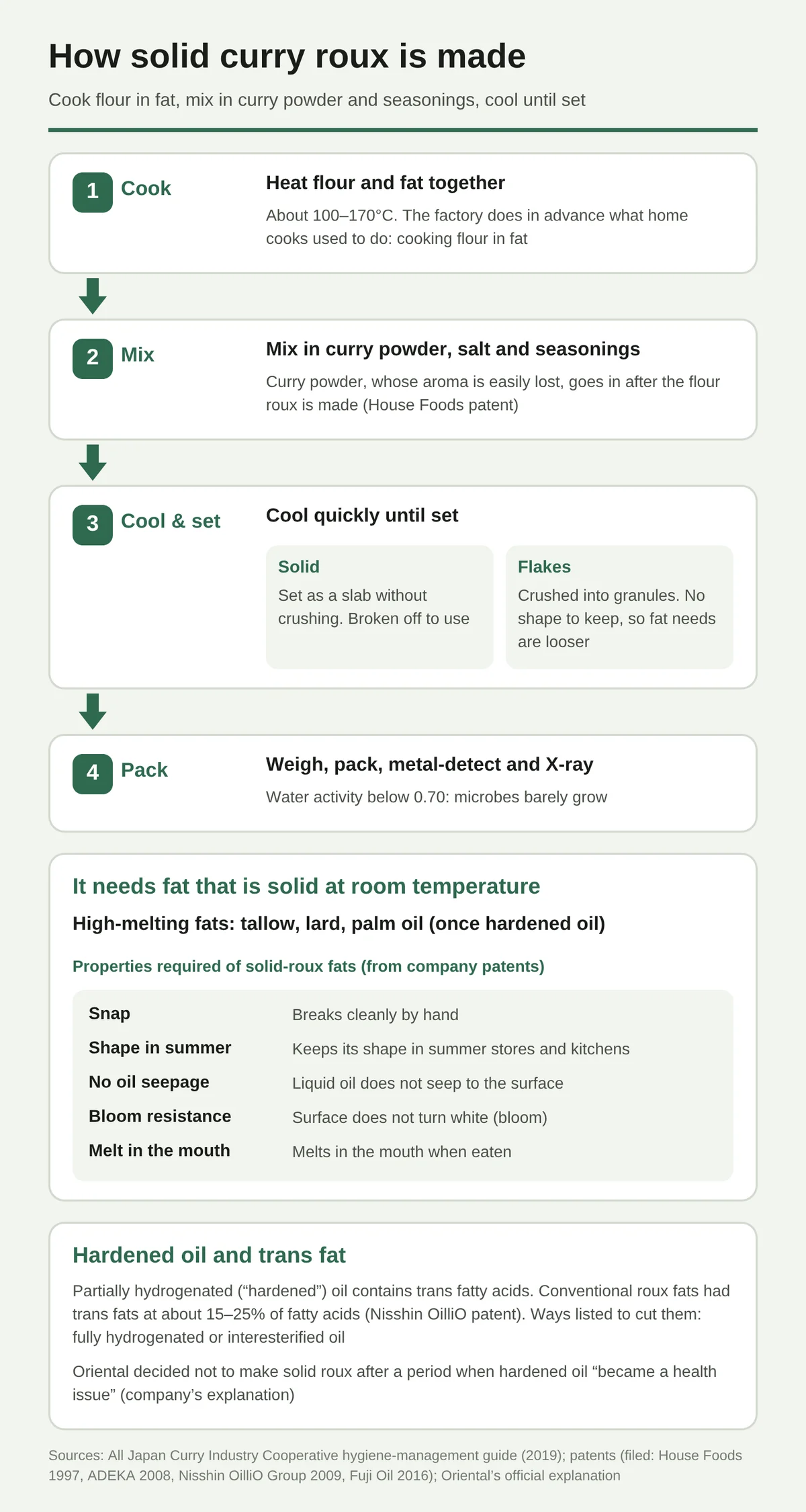
Solid roux is made by frying flour in fat, mixing in curry powder and seasonings, and cooling it until it sets. To set, it needs a fat that is solid at room temperature.
How it is made at the factory
A hygiene-management manual (2019) from the All Japan Curry Industry Cooperative, for small makers of curry powder and curry roux, describes the process like this:
- Weigh the raw materials (controlled so that raw materials that cause allergies do not get mixed in)
- Heat flour and other ingredients together with fat (blending and heating)
- Cool quickly to set (cooling)
- Crush to a suitable particle size (coarse crushing and pulverizing), weigh and pack
- Remove foreign matter with metal detectors and X-rays
Solid roux is cooled and set as a slab without crushing. A patent from ADEKA, a fat and oil maker, describes a process in which solid roux is set slowly while being cooled with air.
A House Foods patent (filed in 1997) describes the usual method as “after heating and mixing fat and flour at about 100–170°C to make a flour roux, adding curry powder and the like, whose flavor easily escapes or breaks down.” According to the manual, curry roux has a water activity (a measure of how much water in a food is available to microorganisms) below 0.70, so microorganisms hardly grow. The industry association gives a guideline best-before period of 1.5–2 years, unopened at room temperature.
Setting it takes “a fat that is solid at room temperature”
An ADEKA patent (filed in 2008) says: “As the fat used in solid roux, animal fats such as beef tallow, lard, hardened beef tallow and hardened lard have mainly been used, because their flavor and richness are good and they are solid at room temperature,” and “recently … solid roux using palm-based fats too.”
The qualities required of the fat in solid roux are also described in other patents.
| Required quality | Meaning | Source |
|---|---|---|
| Snap | It breaks crisply by hand | ADEKA patent (2008) |
| Shape retention in summer | It does not melt and lose its shape in a summer store or kitchen | Fuji Oil patent (filed 2016) |
| Resistance to liquid oil seeping out | Liquid oil does not bleed onto the surface | Same as above |
| Resistance to whitening | The surface does not turn white (bloom) | Same as above; ADEKA patent |
| Melt-in-the-mouth quality | It melts in the mouth when eaten | Fuji Oil patent |
To meet these needs, solid roux has used high-melting-point fats (beef tallow, lard, palm oil, and formerly hardened oil).
Hardened oil and trans fat: “hardened oil,” made by adding hydrogen to oil to make it firm (partially hydrogenated), forms trans fatty acids. A Nisshin OilliO patent (filed in 2009, priority date 2008) says that conventional fats for roux contained about 15–25% trans fatty acids in the fatty acids, and lists fully hydrogenated oil (extremely hardened oil) and interesterified oil (oil with rearranged fatty acids) as ways to reduce them.
Oriental still does not make solid roux. Its official explanation is that solid roux uses high-melting-point fat (hardened oil) to hold its shape, that there was “a time when this became a health problem,” and that this led it to decide not to make solid roux. It does not say when or what the problem was.
Difference between solid and flakes
| Solid | Flakes and powder | |
|---|---|---|
| Form | Cooled into a slab and broken to use | Crushed grains or powder. Measured to use |
| Requirements for the fat | Hard enough to break at room temperature, and not melting in summer | Looser, since it does not have to hold a shape |
| How fat is labeled in the 11 Urayomi products | The type is stated: “beef tallow and lard blend, palm oil” or “palm oil and rapeseed oil blend” | Many say only “edible fat” or “vegetable fat” (only Sokensha states the type: “organic safflower oil, palm oil”) |
The package of Sokensha’s flakes carries a note: “because it has little fat, it is a little slow to dissolve and lumps easily.”
Labeling rules for curry roux
Curry roux has no legal definition and no quality standard.
“Roux” does not appear in the Food Labeling Standards
The Food Labeling Standards, in use since 2015, include definitions for “curry” in “retort pouch foods” and for “canned and bottled curry.” But the word “roux” does not appear even once in the whole standard. The old Quality Labeling Standards (54 of them), abolished in 2015, did not include one for curry roux either.
We could not confirm a JAS (Japanese Agricultural Standard) for curry roux, including whether one ever existed. We could not find a fair competition code for the industry either.
The industry association’s hygiene-management manual describes curry roux as “flour and the like fried in butter and the like and mixed with curry powder, in flake or solid form.” This is an industry description, not a legal definition.
Since there is no fixed name, the “name” (名称) on the back differs by maker. Among the products on Urayomi, we found “curry roux” (カレールウ; House Kokumaro), “curry roux (flake type)” (Sokensha), and “curry roux (medium hot)” (カレールー(中辛); Cosmo rice flour).
There are rules for how curry powder is written
The roux itself has no definition, but there are rules for how the curry powder and spices in the ingredients are written. Details are in the ingredient dictionary entry Curry powder and spices.
What decides mild, medium hot and hot?
According to the industry association’s Q&A, “mild, medium hot and hot” are expressed by the amount of pungent spices such as chili pepper, pepper and ginger, not by the amount of salt. Each company sets its own heat ranking, and there is no unified industry standard. Even “medium hot” is not equally hot across makers. For the pungent compounds, see our article on chili peppers and capsaicin.
White or greenish surface?
The industry association explains that a white surface is “blooming,” where fat has come up and set, and a greenish look is the yellow component of turmeric dissolving into the fat and floating up, which looks that way depending on the light. It says neither means the quality has gone bad.
How to read the back label
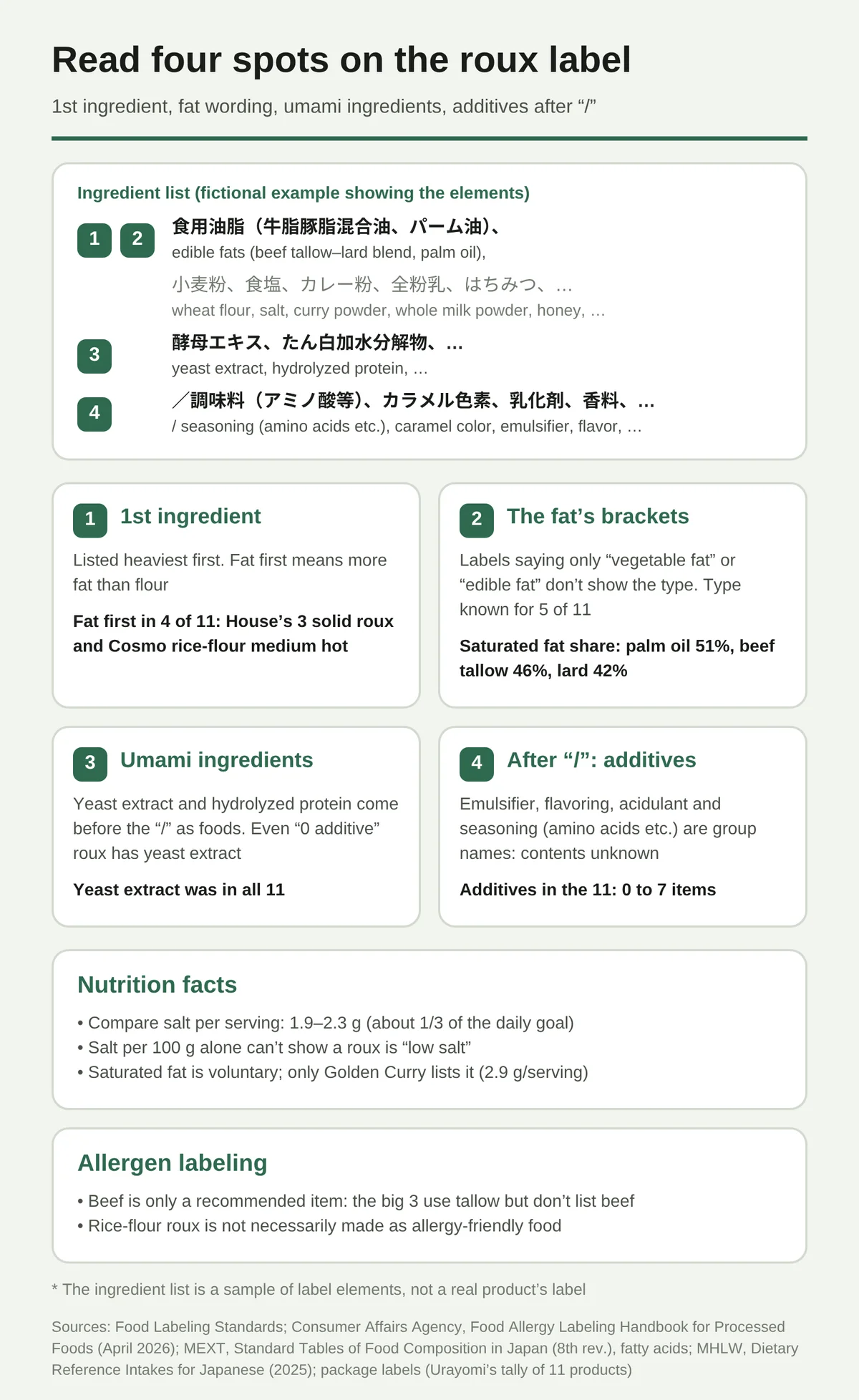
On the back of a roux, four places show the differences in content: the first ingredient, how the fat is written, the umami ingredients, and the additives after the “/”.
Look at the first ingredient
Ingredients must be listed in order of weight, heaviest first. If the first is “edible fat” (食用油脂), that roux has more fat than flour. Among the 11 products on Urayomi, House’s 3 solid roux (Vermont, Java and Kokumaro) and Cosmo’s rice-flour medium hot started with fat.
What is inside “edible fat” and “vegetable fat”
Fat may be written together as “vegetable fat” (植物油脂) or “edible fat” (食用油脂) without naming the type (details in our article on vegetable fats and oils). Of the 11 products, the type of oil could be read from the back in 5: House’s 3 (beef tallow and lard blend, palm oil), Golden (palm oil and rapeseed oil blend) and Sokensha (“vegetable fat (organic safflower oil, palm oil)”). For Cosmo’s 4 products and M to M, we could not tell the type.
In the “beef tallow and lard blend (made in Japan)” (牛脂豚脂混合油(国内製造)) on House’s 3 products, “made in Japan” means the blended oil was made in Japan, not where the cattle or pigs came from.
Yeast extract, hydrolyzed protein, and “seasoning (amino acids, etc.)”
| How it is written | How it is treated | Number of the 11 products that contain it |
|---|---|---|
| Yeast extract (酵母エキス) | Food (before the “/”) | All 11 |
| Hydrolyzed protein (たん白加水分解物) | Food (before the “/”) | 2 (Kokumaro, Golden) |
| Seasoning (amino acids, etc.) (調味料(アミノ酸等)) | Additive (after the “/”) | 5 (the 4 major curries and the stew) |
Yeast extract and hydrolyzed protein are umami ingredients, but under Japanese labeling they are treated as foods, not additives. That is why even a roux with “no additives” contains yeast extract. For the difference, see our article on yeast extract and our article on umami seasonings.
Group names: you cannot tell what is inside
“Emulsifier” (乳化剤), “flavoring” (香料), “acidulant” (酸味料) and “seasoning (amino acids, etc.)” may be written under the group name (一括名) no matter how many kinds are used. You cannot tell from the back label what is actually in there. See our article on emulsifiers, our article on flavorings and our article on acidulants and pH adjusters.
Also, if an additive used in an ingredient has no effect in the final food, it does not have to be labeled (carryover). That no additives are written on the back is not the same as no additives having been used at all (our article on carryover).
Comparing the 11 Urayomi products by the back label
Lining up the back labels of the 11 roux on Urayomi (10 curries and 1 stew) clearly separates the major solid roux from the flakes in number of ingredients, number of additives and first ingredient.
The first ingredient and the number of ingredients
| Name | Form | First ingredient | Number of ingredients (additives) | How the fat is written |
|---|---|---|---|---|
| Java Curry, medium hot | Solid | Fat | 34 (7) | Beef tallow and lard blend, palm oil |
| Vermont Curry, medium hot | Solid | Fat | 34 (6) | Beef tallow and lard blend, palm oil |
| Kokumaro Curry, medium hot | Solid | Fat | 33 (6) | Beef tallow and lard blend, palm oil |
| Golden Curry, medium hot | Solid | Flour | 15 (3) | Palm oil and rapeseed oil blend |
| Stew Mix Cream (reference) | Granules | Flour | 24 (5) | Vegetable fat |
| Cosmo Jikabiyaki Apple Curry Roux, mild | Flakes | Flour | 17 (1) | Edible fat |
| M to M Curry Roux, medium hot | Flakes | Flour | 16 (1) | Vegetable fat |
| Cosmo Jikabiyaki Curry Roux, medium hot | Flakes | Flour | 15 (1) | Edible fat |
| Cosmo Jikabiyaki Rice-Flour Curry Roux, medium hot | Flakes | Fat | 15 (0) | Edible fat |
| Cosmo Jikabiyaki Rice-Flour Curry Roux, mild | Flakes | Rice flour | 14 (0) | Edible fat |
| Sokensha Plant-Based Authentic Curry Roux, medium hot | Flakes | Flour | 11 (0) | Vegetable fat (organic safflower oil, palm oil) |
- In the 3 major solid roux, there is more fat than flour. Rather than “flour fried in oil,” fat is the main ingredient. Even among solid roux, Golden had flour first.
- The number of ingredients is 33–34 for the 3 major products and 11–17 for the flakes. The 3 major products contain many ingredients that layer flavor, such as whole milk powder, cheese powder, banana paste and honey.
- Animal-derived ingredients: the 3 major products have beef tallow and lard; Java has chicken extract and pork extract, Vermont has pork extract, and Cosmo’s two flour-based products and the rice-flour medium hot have “meat extract.” M to M, Sokensha and Cosmo rice-flour mild had no meat-derived ingredients.
Additives
| Name | Additives (as labeled) |
|---|---|
| Java | Seasoning (amino acids, etc.), caramel color, emulsifier, acidulant, sweetener (sucralose), flavoring, spice extract |
| Vermont | Coloring (caramel, paprika color), seasoning (amino acids, etc.), emulsifier, flavoring, acidulant, spice extract |
| Kokumaro | Seasoning (amino acids, etc.), caramel color, emulsifier, flavoring, acidulant, spice extract |
| Stew Mix (reference) | Seasoning (amino acids, etc.), flavoring, emulsifier, acidulant, antioxidant (vitamin E, vitamin C) |
| Golden | Seasoning (amino acids, etc.), caramel color, acidulant |
| Cosmo medium hot, Cosmo Apple mild, M to M | Caramel color |
| Cosmo rice-flour medium hot, Cosmo rice-flour mild, Sokensha | None |
- Caramel color was in 7 of the 11 products. The labels do not show which of the 4 types (our article on caramel color).
- The sweetener sucralose was only in Java (our article on sweeteners).
- The rules on when you can write “no additives” (無添加) are in our article on the rules for “no additives” labeling.
Nutrition (roux only)
| Name | Amount per serving | Fat per serving | Salt per serving | Salt per 100 g |
|---|---|---|---|---|
| Java | 20.6g | 8.2g | 2.3g | 11.2g |
| Vermont | 19.2g | 6.9g | 2.0g | 10.4g |
| Kokumaro | 18.1g | 6.2g | 2.3g | 12.7g |
| Golden | 18g | 5.3g (saturated fat 2.9g) | 2.3g | 12.8g |
| Sokensha | 22.5g | 5.9g | 1.9g | 8.4g |
| Stew Mix (reference) | 17g | 3.0g | 1.9g | 11.2g |
| Cosmo (4 products), M to M | Not shown | ― | ― | 6.1–8.9g |
For Java, Vermont, Kokumaro, Golden and the stew, the figures are the per-serving labels; for Sokensha, we converted the “per serving (22.5 g)” label to per 100 g. Cosmo and M to M give only per-100 g values, so we could not confirm how many grams make one serving. Ingredients such as meat and vegetables, and rice, are not included.
The makers’ “one serving made as directed” (using beef round and the like, rice excluded) was: Vermont 246 kcal and 2.1 g salt, Java 277 kcal and 2.3 g, Kokumaro 220 kcal and 2.4 g, Golden 261 kcal and 2.4 g.
For a roux with few additives
Of the 11 products, those with no additives in the ingredient list were Sokensha and Cosmo’s two rice-flour products (medium hot and mild). Sokensha uses no beef tallow, lard or meat extract, and states the type of oil on the back (organic safflower oil, palm oil), with the origins published on its official page. At about 393 yen per 100 g, it was the most expensive of the 11.
If you want fewer additives in a flour-based roux, Cosmo Jikabiyaki Curry Roux, medium hot, had just one additive: caramel color. The type of fat is not stated.
Checking the effects on the body, claim by claim
For curry roux as a food, what can be checked with numbers is salt and fat. For talk about spices, you need to separate what is said of supplements and powder from certain regions from what is said of roux.
One serving’s salt is a third of the target
The salt in one serving of roux was 1.9–2.3 g in the 6 products that give a serving size.
| Salt per serving | Men’s target (under 7.5 g) | Women’s target (under 6.5 g) | WHO target (under 5 g) |
|---|---|---|---|
| 1.9g (Sokensha, stew) | 25% | 29% | 38% |
| 2.0g (Vermont) | 27% | 31% | 40% |
| 2.3g (Java, Kokumaro, Golden) | 31% | 35% | 46% |
Source: MHLW “Dietary Reference Intakes for Japanese (2025)”; WHO. Percentages calculated by Urayomi.
- One serving is about a third of the daily target. A second helping (2 servings, 4.6 g) comes to over 70% of the women’s target and over 90% of the WHO target.
- The target for preventing worsening of high blood pressure and chronic kidney disease is under 6.0 g for both men and women.
- The targets for children are under 3.5 g at ages 3–5 and under 4.5 g at ages 6–7. Children eat smaller portions, so you cannot apply an adult serving as is, but salt goes in in proportion to the amount of roux.
Salt per 100 g alone does not tell you whether something is “low-salt.” The 6 flake products have 6.1–8.9 g per 100 g, which looks lower than the major solid roux (10.4–12.8 g). However, Sokensha has 8.4 g per 100 g but uses 22.5 g per serving, so a serving has 1.9 g. The difference from Vermont (2.0 g) was 0.1 g. For Cosmo and M to M, we do not know how many grams make a serving, so we cannot compare salt per serving.
The salt targets and the conditions for writing “low salt” (減塩) are in our article on salt intake. On curry days, cutting salt in the other side dishes and soups makes it easier to keep the day’s total down.
Fat and saturated fat: “plant-based” does not always mean less
The fat in one serving of roux was 5.3 g (Golden) to 8.2 g (Java). Only Golden, among the 11 products, shows saturated fat: 2.9 g per serving, 55% of the fat. On nutrition labels, writing saturated fat is optional (recommended), not required.
The Dietary Reference Intakes for Japanese (2025) set the saturated fat target for ages 18 and over at “7% or less of daily energy.” For 2,000 kcal a day, that is about 15.6 g. One serving of Golden roux (2.9 g) is about 19% of that.
Java, Vermont and Kokumaro do not publish saturated fat. If we suppose saturated fat is 43.5% of the fat (the 14.84 g of saturated fat for “curry roux” in the Standard Tables of Food Composition divided by 34.1 g of fat) to 57.6% (the median saturated fat of 19 g for the 20 roux in MAFF’s fiscal 2022–23 survey divided by the median fat of 33 g), then Java has 3.6–4.7 g per serving, Vermont 3.0–4.0 g, and Kokumaro 2.7–3.6 g. These are Urayomi’s estimates, not the makers’ figures.
Share of saturated fat by type of fat (Standard Tables of Food Composition in Japan, 2020 edition)
| Fat | Saturated fat per 100 g | Share of fatty acids |
|---|---|---|
| Palm oil | 47.08g | 51% |
| Beef tallow | 41.05g | 46% |
| Lard (pork fat) | 39.29g | 42% |
| Rapeseed oil | 7.06g | 8% |
| (Reference) Curry roux | 14.84g | 47% |
Source: MEXT “Standard Tables of Food Composition in Japan (8th revised edition),” fatty acid tables.
Palm oil has a higher share of saturated fat than beef tallow or lard. Using palm oil instead of beef tallow or lard does not necessarily lower saturated fat. Golden uses no animal fat, yet 55% of its fat was saturated. The difference between animal fats and vegetable oils is in our article on vegetable oils and animal fats.
Trans fat: the median fell, but some products are high
MAFF surveys trans fat in store-bought foods every few years.
| Survey | Subjects | Median (per 100 g) | Range |
|---|---|---|---|
| Fiscal 2006–07 | 5 curry roux | 0.88g | 0.78–1.5g |
| Fiscal 2014–15 | 20 roux (curry, hayashi, stew) | 0.52g | 0.07–6.4g |
| Fiscal 2022–23 | Same, 20 | 0.46g | 0.09–7.0g |
Source: MAFF “Survey on trans fatty acid content in foods.”
Meanwhile, the industry association (the All Japan Curry Industry Cooperative) reports in its voluntary survey that trans fat in home-use curry roux averaged 3.68 g per 100 g for products from 2007–2014 and 0.33 g in a September 2015 survey, a “reduction to one tenth.” It says it encouraged member companies to use fats low in trans fat.
The numbers from the two surveys do not agree. Against the industry’s “3.68 g before,” MAFF’s fiscal 2006–07 median was 0.88 g (5 products). The likely reasons are differences in the products surveyed, the number of products, and mean versus median, and we cannot say which is right. What is clear is that although the median fell, the fiscal 2022–23 survey still found a product with 7.0 g per 100 g (which product is not disclosed).
The Dietary Reference Intakes (2025 edition) say trans fat should “preferably be kept below 1% of daily energy.” For 2,000 kcal, that is about 2.2 g. If you use 20 g of roux with the median 0.46 g, that is about 0.09 g; with the 7.0 g product, about 1.4 g (Urayomi’s calculation). In Japan, trans fat labeling is not required, and none of the 11 products showed it.
Making it without roux
What is in roux is fried flour, fat, curry powder, salt and seasonings. If you make it at home from curry powder and flour, you decide the type and amount of oil and the amount of salt yourself. It is the same method as in the Meiji cookbooks, and as the one Oriental describes as “prewar home cooking.” S&B’s “Red Can Curry Powder” is a curry powder released in 1950.
Wheat and allergen labeling
Under the April 2026 revision of food allergy labeling, the mandatory “specified ingredients” became 9 items (shrimp, cashew nuts, crab, walnuts, wheat, buckwheat, egg, milk, peanuts). Cashew nuts have a 2-year transition period. The “items equivalent to specified ingredients,” for which labeling is recommended, number 20, with pistachio added.
The allergens that appeared on the labels of the 11 products were wheat, milk, soybeans, pork, chicken, apple, sesame (Java, Kokumaro), banana (Vermont) and gelatin (Golden).
Even when beef tallow is used, “beef” is not written. The Consumer Affairs Agency’s handbook explains that the scope of the beef and pork labeling includes “animal fat (lard, beef tallow).” But beef and pork are “recommended” items, not mandatory, so leaving them out is not a violation. In fact, none of the 3 major products that use the beef tallow and lard blend lists “beef” in its allergen labeling, and Kokumaro does not list “pork” either (the allergen information on the official page is also unmarked).
Japan versus overseas: Sesame is a recommended item in Japan, but in the US it became a major allergen with mandatory labeling in January 2023. Beef and pork are not among the US major allergens.
Even a roux without wheat is not necessarily meant for people with wheat allergy. Cosmo’s rice-flour roux uses rice flour and chickpea flour in place of wheat flour, but the package says “This product is not made as an allergy-friendly food.” The Consumer Affairs Agency has also issued an advisory titled “Be careful of wheat allergy from rice flour products” (introducing cases of wheat allergy accidents with rice-flour cookies and the like). For gluten, see our article on gluten and spelt.
Besides Cosmo, Oriental also has a rice-flour curry roux that does not use wheat flour. If you have an allergy, check on the package whether the product is made as an allergy-friendly product.
House Foods says its Vermont Curry in the “8 specified allergens free series” is made without the 8 specified ingredients of the time, on a dedicated line (in August 2024, it was renamed from “7 items” to match walnuts becoming mandatory). We could not confirm whether the name or contents changed after cashew nuts were added in April 2026. It is a powder type.
Does turmeric (curcumin) prevent dementia?
We cannot say that “eating curry makes dementia less likely.” We check, in order, the source of the often-heard “India has little Alzheimer’s disease” and the research since.
The source is the Indo-US study of the 1990s. It surveyed 5,126 people aged 55 and over in a rural area of northern India (Ballabgarh), and the prevalence of Alzheimer’s disease among those 65 and over was 1.07% (Chandra 1998). In a 2-year follow-up, the rate of new cases was about a quarter of that in a comparison area in the US (Chandra 2001). However:
- This study did not look at curcumin or curry.
- The authors themselves say it should be interpreted with caution because of factors such as short life expectancy, short survival after becoming ill, short follow-up, and cultural factors.
- In a 2024 survey of 4,096 people chosen from across India (LASI-DAD), the prevalence of dementia was 7.2%, and the authors write that this is “higher than previously thought” (Gross 2024). The methods and subjects differ, so the two numbers cannot be compared as an “increase.”
Curcumin is hardly absorbed by the body. In one study, taking 500–8,000 mg at a time was not detected in the blood, and 10,000–12,000 mg was detected only slightly (Lao 2006). A study reporting that taking piperine, a component of black pepper, along with it increased absorption (Shoba 1998) has a co-author who is the founder of a company that sells piperine products.
| Study | Type and number of people | Result |
|---|---|---|
| Ringman 2012 | RCT (randomized controlled trial), 36 people with mild-to-moderate Alzheimer’s disease, 2 g or 4 g a day for 24 weeks | No difference in symptoms or in blood and spinal fluid markers. Very little curcumin in the blood |
| Rainey-Smith 2016 | RCT, 96 older adults, 1,500 mg a day for 12 months | No difference, except that only the placebo group dropped on a cognitive test (MoCA) at 6 months |
| Small 2018 | RCT, 40 people without dementia, a formulation with improved absorption for 18 months | Memory and attention improved (40 people) |
| Yu 2025 | Meta-analysis (10 human studies, 531 people) | No significant difference in overall cognitive function. Adverse events were more common in the curcumin group |
| Wang 2025 | Meta-analysis (9 RCTs, 501 people) | Overall cognitive function significantly improved |
Two meta-analyses from the same year reached opposite conclusions. A 2017 review (Nelson, J Med Chem) says curcumin is unstable, poorly absorbed, and prone to appearing to react in assays, and writes that “no double-blind, placebo-controlled clinical trial of curcumin has succeeded.” Papers by a researcher well known for curcumin research, mainly test-tube and animal studies, have also been retracted.
In an observational study of older adults in Singapore, people who ate curry more often scored somewhat higher on cognitive tests (Ng 2006, 1,010 people). Because it is an observational study, we cannot tell whether curry was the cause.
The difference in amounts is also large: Curcumin in turmeric powder averages about 3% (analysis of 28 store-bought products, Tayyem 2006). Getting the 1,500 mg a day used in the trial from turmeric powder would take about 48 g. The curry powder in one serving of roux (18–22 g) is only part of that, and the share of curry powder in roux is not published.
Liver injury from ukon was reported with supplements
Almost all reports of liver injury from ukon (turmeric) involve supplements. In this survey we found no report of it occurring from spices used in cooking (that does not mean it never happens).
| Country | What is known | Source |
|---|---|---|
| Japan | In 89 cases of drug-induced liver injury from folk remedies and health foods (14 facilities, 1994–2003), the most common folk remedy or health food named as the cause was ukon (29 cases, 24.8%) | Onji et al., Kanzo (Liver) 2005 |
| US | In a liver injury registry, 10 cases were turmeric-related (all since 2011). One died of acute liver failure. 7 of the 10 carried a particular gene type (HLA-B*35:01) | Halegoua-DeMarzio 2023 |
| Italy | In the first half of 2019, 28 reports of acute hepatitis from turmeric products were collected, and regulatory measures were taken. They involved high doses or formulations with improved absorption | Menniti-Ippolito 2020, Lombardi 2021 |
We did not look into advertising claims such as “ukon is good for hangovers and the liver.”
Lead in turmeric
Overseas, adulteration of turmeric with a yellow pigment containing lead (lead chromate) has been a problem.
- In Bangladesh, mixing in the pigment to make the color look better had gone on for more than 30 years, and up to 1,152 µg/g of lead was found in the powder (Forsyth 2019).
- After enforcement through press coverage, education, and rapid testing by the food safety authority, the share of market turmeric in which lead was found went from 47% in 2019 to 0% in 2021 (Forsyth 2023).
- In 5 states in eastern India, 30% of 503 samples collected in 2021–23 exceeded India’s limit (10 µg/g) (Forsyth 2026).
In Japan, when we tallied MHLW’s violation cases for imported foods (fiscal 2024 to September 2026) for spices, there were 0 violations for lead. However, we could not confirm whether there is a standard value for lead in spices. Without a standard, nothing appears as a violation, so “0 violations” cannot be read as “no lead.”
Irradiation and mold toxins
Spices and dried vegetables can carry 100,000 to 10 million microorganisms per gram, mostly bacterial spores (Hayashi 2007). In Japan, fumigating food with ethylene oxide is prohibited, and sterilization is done with superheated steam. Sterilization methods differ by country.
| Japan | Overseas | |
|---|---|---|
| Irradiation | Irradiating food is prohibited in principle. The only actual use is to prevent potato sprouting. In 2000 the Japan Spice Association asked for permission to irradiate spices, but it has still not been allowed | The US allows up to 30 kGy for spices and requires labeling. The EU also allows irradiation of spices |
| Irradiated spices | In fiscal 2025, turmeric powder from Pakistan violated the Food Sanitation Act for “irradiation” | ― |
“Aflatoxin,” a toxin produced by mold, also turns up in violations in imported spices every year. Tallying MHLW’s violation cases for imported foods, there were 10 in fiscal 2024 (chili pepper, mixed spices, nutmeg) and 5 in fiscal 2025 (chili pepper, nutmeg) (the standard is 10 µg/kg total aflatoxin). Violations in nutmeg from Indonesia keep recurring. The aflatoxin standard is in our article on doubanjiang.
These are violations found in inspections at import. They do not mean they were found in domestic roux products.
Leftover curry and Clostridium perfringens
What to watch for in leftover curry is Clostridium perfringens, which forms heat-resistant “spores” (芽胞). How you cool it after cooking matters more than reheating.
Properties of the bacterium
According to the Food Safety Commission of Japan (FSCJ), Clostridium perfringens is a bacterium that dislikes air (oxygen) and forms heat-resistant spores.
- Some spores that cause food poisoning survive 1–6 hours of heating at 100°C.
- It grows at 12–50°C, and grows fastest at 43–45°C.
- Simmering kills other bacteria and drives the oxygen out of the pot. While it cools slowly, the spores wake up and multiply rapidly.
- Stomach pain and diarrhea come 6–18 hours after eating. It is a food poisoning that often clears up in 1–2 days.
Re-tallying the statistics
Urayomi re-tallied MHLW’s list of food poisoning cases.
| Year | Cases | Patients | Rank by patients among causative agents |
|---|---|---|---|
| 2023 | 28 | 1,097 | 3rd |
| 2024 | 43 | 1,889 | 2nd (after norovirus) |
| 2025 | 33 | 1,260 | 3rd |
| 2026 (preliminary, through September) | 14 | 382 | ― |
Source: MHLW “Food poisoning statistics,” food poisoning outbreak cases (tallied by Urayomi).
- The number of patients per case is high. In 2024 it was about 44 per case, more than norovirus (about 31) or Campylobacter (about 6).
- There were 8 cases in 2023–2025 where the implicated food was written as “curry,” “stew” or “hayashi.” In 2024 there was also a case (Mie Prefecture) in which 85 people fell ill from curry served on January 1. Many cases list the implicated food as “unknown.”
- The facilities named as the cause were restaurants (45 cases), meal-service facilities such as nursing homes (35), caterers (12), hospitals (6), inns (5), schools (7) and so on, and “home” was 0 (118 cases from 2023 to September 2026; plus 1 at a factory, 4 other, 3 unknown). This does not mean it does not happen at home. It happens more easily at facilities that cook in large amounts, and mild cases at home are thought to be less likely to be reported.
Divide into shallow containers to cool quickly
MAFF ran an experiment in which curry at about 80°C was divided between a pot (24 cm diameter, about 20 cm deep) and a shallow container (2.5 cm deep), left at room temperature for 1 hour, then chilled in the refrigerator for 2 hours.
- After 1 hour, the shallow container had fallen to 40°C or below, while the pot had only fallen to 62°C. The container cooled about 2.6 times as fast.
- The shallow container fell below 10°C in 2 hours 45 minutes in total. It spent 112 minutes in the 12–50°C range where bacteria grow.
- The pot was still at 38°C 2 hours after going into the refrigerator. It is estimated to take about 165 minutes to pass through 12–50°C and about 242 minutes to reach 20°C or below.
- Putting the pot in the refrigerator raised the temperature inside to 11°C. Other foods get warmed too.
The FSCJ recommends “prompt eating after cooking, dividing into portions, and storing at 10°C or below or 55°C or above,” and MAFF recommends “make an amount you can finish and eat it quickly” and “divide into shallow containers and cool quickly.” The basics are not to leave it overnight in the pot, and to cool it in shallow containers.
Reheat the whole thing, stirring
MAFF recommends that when reheating you “reheat the whole thing thoroughly while stirring well.” However, some spores survive long heating, so what matters more than reheating is the time from cooking until it has cooled. Cautions for reheating in a microwave are in our article on microwaves.
Is “retort has overtaken roux” true?
The claim that “retort curry has overtaken roux” gives different answers depending on whether you compare by weight, by amount of money, or by number of servings.
| Yardstick | What is known | Source |
|---|---|---|
| Weight (production) | Already in fiscal 2001, curry in retort pouches (103,263 t) exceeded curry roux (99,647 t) | MAFF survey |
| Money (store sales) | A trade paper reports that “it flipped in fiscal 2017” (no survey company named). In fiscal 2024, roux was 52.5 billion yen and retort 70.2 billion yen | Trade papers (fiscal 2024 from an INTAGE survey) |
| Number of servings | Dividing fiscal 2016 production (roux 91,485 t; retort 153,185 t for 2016) by the serving size (20 g of roux, 210 g of retort) gives about 4.57 billion servings of roux and about 730 million servings of retort. Roux is about 6 times larger | Urayomi’s calculation (production from the All Japan Curry Industry Cooperative and the Japan Canners, Bottlers and Retort Foods Association) |
- Production of curry roux was flat to slightly down at 90,000–105,000 tons a year in fiscal 2001–2016. We could not obtain figures for fiscal 2017 and later within what can be seen for free.
- Retort curry was about 150,000–164,000 tons a year in 2016–2023. From 2024 the scope of the tally widened to include tray-packed products and the like, so it cannot be compared directly with earlier years.
- With roux you add meat and vegetables at home, so the contents of one retort pouch and one plate are not the same amount. Even so, the number of plates of curry made at home is still thought to be far larger for roux.
- Exports of curry products were 134–454 tons a year (2002–2016), less than 0.5% of production. Overseas, local production rather than export is the main route.
Household survey: who buys the most is Niigata City
In the Ministry of Internal Affairs and Communications’ Family Income and Expenditure Survey (households of two or more people, 2023–2025 average), annual purchases of curry roux per household were 1,487 yen and 1,200 g on the national average.
| Rank | City | Amount |
|---|---|---|
| 1st | Niigata City | 1,895 yen |
| 2nd | Tottori City | 1,847 yen |
| 3rd | Yamagata City | 1,680 yen |
| 4th | Kochi City | 1,650 yen |
| Last | Kobe City | 1,231 yen |
Source: Statistics Bureau of Japan, MIC, “Family Income and Expenditure Survey (households of two or more people), ranking by item for prefectural capital cities and designated cities (2023–2025 average).”
The amount purchased peaked at 2,090 g in 1983 (series for households of two or more people excluding farm and fishing households), and today’s 1,200 g is about 60% of that (the series count households differently, so treat it as a guide). Note that the survey’s item name was “curry powder” until 1986 and changed to “curry roux” in 1987.
What households actually pay is half to 60% of list price
Calculated from the Family Income and Expenditure Survey’s amounts and quantities, the price households actually pay for curry roux is about 124 yen per 100 g (2023–2025 average). Meanwhile, the manufacturer’s suggested retail prices of the 4 major solid roux on Urayomi (converted to tax included) are 199–261 yen per 100 g.
That means households are buying at roughly half to 60% of list price (Urayomi’s calculation). It is thought to be a food often bought on sale. However, the survey amounts mix many brands and sizes, so this is not a comparison of identical products.
Points for choosing
With roux, the question is not “which is safe” but what to look at on the back when choosing. Here are the points that came out of the 11 products.
| What you care about | What to look at on the back | What the 11 products showed |
|---|---|---|
| Is there a lot of fat? | The first ingredient; fat per serving | In the 3 major solid roux, fat is first. Fat per serving is 5.3–8.2 g |
| Type of fat | Inside the parentheses of “edible fat (○○)” | The type was known for 5. Palm oil has a higher share of saturated fat than beef tallow or lard |
| Salt | Salt equivalent per serving | 1.9–2.3 g. Do not compare per 100 g |
| Additives | After the “/” | 0–7 items. What is inside group names is unknown |
| Umami | Yeast extract, hydrolyzed protein, seasoning (amino acids, etc.) | Yeast extract in all 11 |
| Allergy | Allergen labeling, and any “allergy-friendly” statement | “Beef” is not written even when beef tallow is used. Rice flour is not necessarily allergy-friendly |
For use, there are three basics: eat it soon after cooking, divide leftovers into shallow containers to cool, and reheat the whole thing while stirring.
What we introduced in this article (summary)
Here are the items we introduced in the article once more. The reasons and ingredients are in each section.
| What we introduced | Where to buy |
|---|---|
| Sokensha Plant-Based Authentic Curry Roux, Medium Hot (flakes) 135 g | See on Rakuten (楽天24) PR See on Amazon.co.jp PR See on Yahoo! Shopping PR |
| Cosmo Foods Cosmo Jikabiyaki Curry Roux, Medium Hot (flakes) 170 g | See on Rakuten (楽天24) PR See on Amazon.co.jp PR See on Yahoo! Shopping PR |
| Muen.com (online shop specializing in low-salt and salt-free foods) | 他では買えない減塩食品がたくさん!減塩専門店「無塩ドットコム」  PR PR |
| S&B Curry Powder, Red Can, 37 g | See on Rakuten (エスビー食品公式) PR See on Amazon.co.jp PR See on Yahoo! Shopping PR |
| Oriental Rice-Flour Curry Roux (6 servings) | See on Rakuten (オリエンタル公式) PR See on Amazon.co.jp PR See on Yahoo! Shopping PR |
| House Vermont Curry, Free of the 8 Specified Allergens, Medium Hot, 108 g | See on Rakuten (S-LIFE) PR See on Amazon.co.jp PR See on Yahoo! Shopping PR |
| Skater official shop (storage containers) | 【スケーター公式ショップ】  PR PR |
Summary
| What you care about | What we found |
|---|---|
| How did curry roux begin? | The 1872 Western cookbooks came first. Thickening and apples are in a British cookbook of 1861. “The Navy brought it” is wrong |
| Japan’s first instant curry or solid roux? | It cannot be pinned on one company. Oriental 1945 (powder), S&B 1954 (solid), Glico and House 1960, and so on; each company claims a “first” in its own words |
| What does the law say? | There is no definition or standard for curry roux. The word “roux” is not in the Food Labeling Standards, and we could not confirm a JAS |
| The back labels of the 11 products? | In the 3 major solid roux, fat is first, with 33–34 ingredients. Flakes have 11–17. Additives are 0–7. Yeast extract in all |
| Salt? | 1.9–2.3 g per serving, about a third of the daily target. Per-100 g numbers alone do not show “low salt” |
| Fat, saturated fat and trans fat? | Only Golden shows saturated fat (2.9 g per serving). Palm oil has a higher share of saturated fat than beef tallow or lard. The median trans fat fell, but a product with 7.0 g was found |
| Is turmeric good for you? | We cannot say it prevents dementia. It is poorly absorbed, and meta-analyses conflict. Liver injury is reported with supplements. Lead adulteration is a problem in certain regions |
| Leftovers? | Clostridium perfringens food poisoning: 43 cases and 1,889 patients in 2024. In the pot, 62°C after 1 hour; in a shallow container, 40°C or below |
| Did retort overtake roux? | Retort is ahead by weight and by money. By number of servings, roux is about 6 times larger (fiscal 2016) |
Sources
History and market
- Isabella Beeton, “The Book of Household Management” (1861), no. 941 “Curried Fowl” (Project Gutenberg #10136)
- Grace’s Guide, “Crosse and Blackwell”
- National Diet Library Search: “Seiyo Ryori Shinan” (1872), “Seiyo Ryori Tsu” (1872), “Guntai Ryoriho” (1910), “Kaigun Kappojutsu Sankosho” (reprints 2007 and 2011)
- Ministry of Defense, JGSDF Niigata Provincial Cooperation Office, “Shirakabe no Naka no Hito” (The People Inside the White Walls), part 7
- Osaka Prefectural Nakanoshima Library, “Research Guide 135: Curry” (March 2026)
- Hachi Foods “Company History,” S&B Foods “History,” House Foods Group “History,” business reports and news releases (February 9, 2023; February 2, 2024), Ezaki Glico “History of Products,” Oriental “History,” Otsuka Foods “History of Bon Curry,” Bell Foods “History”
- All Japan Curry Industry Cooperative, “What is Curry?,” “Curry in Numbers,” “Types of Curry,” “Q&A,” “Curry Figures,” “Production of Curry Products,” “Exports and Imports,” and school lunch materials
- Japan Canners, Bottlers and Retort Foods Association, “Production Volume of Retort Foods” (2016–2023, 2024–2025)
- Statistics Bureau of Japan, MIC, “Family Income and Expenditure Survey” item rankings (2023–2025 average), e-Stat long-term time series (1963–2007) and item classification (2015–2025)
- Shokuryo Jokai Shimbun (食料醸界新聞) (INTAGE SRI+ data, fiscal 2024), Nihon Shokuryo Shimbun (July 1, 2019)
Production and standards
- All Japan Curry Industry Cooperative, “Hygiene Management Manual Incorporating HACCP Principles (for small-scale curry powder and curry roux makers)” (May 2019), “On setting best-before dates for curry (curry powder, curry roux)”
- Patents: JP3276884B2 “Method for producing roux” (House Foods, filed 1997), JP2009201416A “Fat composition for solid roux” (ADEKA, filed 2008), JP4517043B1 “Fat composition for roux and roux” (Nisshin OilliO Group, filed 2009, priority 2008), WO2016/143530 (Fuji Oil, filed 2016, priority 2015)
- Food Labeling Standards (Cabinet Office Ordinance No. 10 of 2015), e-Gov Law Search
- Consumer Affairs Agency, “Food Labeling Standards Q&A,” Processing-64 and 65
Nutrition and fats
- MEXT, “Standard Tables of Food Composition in Japan (8th revised edition),” main tables and fatty acid tables
- MHLW, “Dietary Reference Intakes for Japanese (2025),” key points of the formulation
- WHO, “Salt reduction”
- MAFF, “Survey on trans fatty acid content in foods” (fiscal 2006–07, fiscal 2014–15, fiscal 2022–23)
- All Japan Curry Industry Cooperative, “On the curry cooperative’s trans fat reduction efforts” (2018)
Allergens
- Consumer Affairs Agency, “What is allergen labeling” (April 2026), administrative notice (April 1, 2026), “Handbook on Food Allergy Labeling of Processed Foods” (April 2026), “Be careful of wheat allergy from rice flour products” (Food Labeling Enforcement Office, Food Labeling Division)
- US FDA, “Food Allergies: What You Need to Know”
- House Foods news release (August 6, 2024)
Spices and health
- Chandra V, et al. Neurology 1998 (PMID 9781520) / Chandra V, et al. Neurology 2001 (PMID 11571321) / Gross AL, et al. PLoS One 2024 (PMID 38324518)
- Ng TP, et al. Am J Epidemiol 2006 (PMID 16870699)
- Lao CD, et al. BMC Complement Altern Med 2006 (PMID 16545122) / Shoba G, et al. Planta Med 1998 (PMID 9619120) / Tayyem RF, et al. Nutr Cancer 2006 (PMID 17044766)
- Ringman JM, et al. Alzheimers Res Ther 2012 (PMID 23107780) / Rainey-Smith SR, et al. Br J Nutr 2016 (PMID 27102361) / Small GW, et al. Am J Geriatr Psychiatry 2018 (PMID 29246725)
- Yu 2025 J Prev Alzheimers Dis (PMID 40579315) / Wang 2025 Front Nutr (PMID 40308636) / Nelson KM, et al. J Med Chem 2017 (PMID 28074653)
- Onji M, et al. “Survey of drug-induced liver injury from folk medicines and health foods,” Kanzo (Liver) 2005;46(3):142-148 / Halegoua-DeMarzio D, et al. Am J Med 2023 (PMID 36252717) / Menniti-Ippolito F, et al. 2020 (PMID 33346172) / Lombardi N, et al. 2021 (PMID 32656820)
- Forsyth JE, et al. Environ Res 2019 (PMID 31550596) / Forsyth JE, et al. Environ Res 2023 (PMID 37286126) / Forsyth JE, et al. NPJ Sci Food 2026 (PMID 42091913)
- MHLW, “Food Sanitation Act violation cases for imported foods” (fiscal 2024, fiscal 2025, fiscal 2026 April–September)
- Hayashi T, “Current status of food irradiation,” Journal of the Japanese Society for Food Science and Technology 2007;54(9):389; “Japan Spice Association’s request for permission to irradiate spices,” Shokuhin Shosha (Food Irradiation) 2001;36(1-2):49
- US Code of Federal Regulations 21 CFR 179.26; European Commission, “Food irradiation – legislation”
Food poisoning
- Food Safety Commission of Japan, “Clostridium perfringens food poisoning” fact sheet (updated April 11, 2025)
- MAFF, “Difference in cooling speed of curry by container”; Kinki Regional Agricultural Administration Office, “Beware of food poisoning from curry and stew”
- MHLW, “Food poisoning statistics,” food poisoning outbreak cases (fiscal 2023–2026)
Related articles and databases
- Is Yeast Extract Bad for You? Its History from Meat Extract, How It's Made, Glutamate Content, the “Hidden MSG” Claim, and Labeling Rules in Japan, the US and Germany
- What Is “植物油脂” (Vegetable Fat)? How True Is “Vegetable Oils Are Bad for You,” and What the Back Label Does and Does Not Tell You
- Where Does “Too Much Salt” Begin? Checking Japan’s Salt Intake Trend, Target Amounts, and the Links to High Blood Pressure and Stomach Cancer Against National Surveys and Studies
- Is Caramel Color Dangerous? The Carcinogen Claim About “4-MEI” and the Four Types, Checked Against Japan, EU, and US Assessments