
Are emulsifiers bad for you? The history that began with egg yolk lecithin, types and uses, gut microbiota research (mice and humans), and how Japan and the EU label them

PR This article contains affiliate links to Rakuten Ichiba, Amazon, Yahoo! Shopping and A8.net (“See on Rakuten”, etc.). What we write is based on public agency documents and papers, whether or not there is an ad. The “See on Amazon.co.jp” links are also affiliate links.
Bread, cakes, ice cream, chocolate, margarine, curry roux. Turn the package over and you will often see “乳化剤” (emulsifier) near the end of the ingredient list.
At the same time, you hear things like “emulsifiers punch holes in your gut,” “emulsifiers are the same as detergent,” “emulsifiers cause cancer and heart disease,” and “they are regulated overseas.” There are also questions such as “natural lecithin must be safe, right?” and “is the 乳 in 乳化剤 milk?”
In this article, we check the following against laws, public agency documents and papers:
- When and where did emulsifiers originate?
- What is inside the Japanese label “乳化剤” (emulsifier)? Which foods use it, and for what purpose?
- How do labeling rules differ in Japan, the EU and the US?
- Is the research saying “emulsifiers are bad for the gut” about mice or about humans? How much was used?
- Are the emulsifiers that caused concern in the research the same as the Japanese “emulsifier”?
- How do countries’ safety evaluations (acceptable daily intake) differ?
- How much are emulsifiers used in the ingredients of the 71 products listed on Urayomi?
For how surfactants themselves work, see the surfactants article. For the rules on additives that are not labeled, see the carryover article.
Conclusion
- The history of emulsifiers began with egg yolk. The French chemist Gobley, who studied the components of egg yolk, named “lecithin” in 1850 after the Greek word for egg yolk. Lecithin from soybeans was industrialized in Germany in the 1920s, and patents for synthetic emulsifiers were filed in the US in the 1930s and 40s, for purposes such as preventing margarine from splattering
- The Japanese “乳化剤” (emulsifier) is a “group name” (一括名) covering 24 substances (23 more for process cheese). However many you use, you can write just “乳化剤.” The EU requires a substance name or E number after “emulsifier,” and the US requires each substance to be named. Of the three regions, Japan’s labeling reveals the least about what is inside
- The starting point of “emulsifiers are bad for the gut” is a 2015 mouse experiment. The 1% mixed into drinking water is estimated to be about 175g a day when converted to a 70kg person. In the diets of about 95,000 people in France, the average for CMC, the star of the research, was 3.8mg a day
- Human trials have split results. In a trial where people took 15g of CMC a day for 11 days (16 people), the gut microbiota changed. On the other hand, in a trial giving 60 healthy people five kinds of emulsifiers for 4 weeks, markers of inflammation did not change. For people with Crohn’s disease, one trial found no difference, and there is a conference presentation saying symptoms improved
- The emulsifiers of concern in the research were mainly CMC, polysorbate 80 and carrageenan. Of these, CMC and carrageenan do not fall under “乳化剤” in Japanese labeling (they are treated as thickeners, etc.). The ones commonly used in Japan are glycerin fatty acid esters and lecithin, and in test-tube experiments some of them showed no clear effect
- The “emulsifiers” in the large French study cover a much wider range than the Japanese emulsifiers. They count even modified starch (33.5%) and baking soda (26.9%). An “association” with disease was reported, but because it is an observational study it cannot show cause, and the rise in risk was small
- “Japan is lenient on additives” is not always true. The ADI (acceptable daily intake) for polysorbates is stricter in Japan (10mg per kg of body weight) than in the EU (25mg), and Japan does not allow their use in bread
- Mayonnaise cannot use emulsifiers (additives) under its legal definition. Egg yolk plays the role of the emulsifier. Among Urayomi’s 71 products, 7 had an emulsifier or lecithin in the ingredients, and for 6 of them only the group name was given, so the substance was unknown
What we introduce in this article
| What we introduce | When it helps | Where in this article |
|---|---|---|
| SOIL CHOCOLATE (official online shop) | When you want chocolate made without emulsifiers | Chocolate and lecithin |
| SOIL CHOCOLATE Standard 3-Bar Set (Rakuten Ichiba) | Same as above, if you want to buy on Rakuten Ichiba | Chocolate and lecithin |
| Kewpie Mayonnaise | When you want to check the ingredients of mayonnaise emulsified with egg yolk | Mayonnaise cannot use emulsifiers |
| Yotsuba Fermented Butter for Bread | When you want butter made of only raw milk and salt instead of margarine | Margarine and butter |
How did emulsifiers come about?
Lecithin, found in egg yolk (France)
The first emulsifier was egg yolk.
The French chemist Gobley advanced the chemical study of egg yolk in the 1840s and isolated substances from it. Then in 1850 he named it “lecithin,” after the Greek word lekithos (egg yolk) (Zeisel 2012, Ann Nutr Metab).
- The year of discovery differs by source: 1845, 1846 or 1850. The most reliable statement is “named in 1850”
- The chemical identity of lecithin remained unknown for some time. An explanation from the French Academy of Agriculture says it was not understood until 1874, and then it was found to be a mixture of several substances
Egg yolk lecithin is still listed under the name “卵黄レシチン” (egg yolk lecithin) in Japan’s list of existing additives (natural-type additives that have long been in use).
Industrial production of soy lecithin (1920s, Germany)
The soy lecithin that is most common as a food emulsifier today is a component that comes out when soybean oil is made.
- Bollmann of Hamburg, Germany, obtained US patents for a method of recovering lecithin from soybean oil (1923 and 1928)
- In the late 1920s, Rewald showed that adding lecithin to chocolate lets you reduce the expensive cocoa butter (a history article by the American Oil Chemists’ Society, 2019)
The combination of chocolate and lecithin has continued since that time.
Synthetic emulsifiers: starting with margarine splatter prevention (1930s–40s, US)
Patents for synthetic emulsifiers line up in the US in the 1930s and 40s.
| Year | Event | Source |
|---|---|---|
| Filed 1931, granted 1933 | Patent for an emulsifier that prevents margarine from “splattering” when heated (B. R. Harris) | US Patent 1,917,256 |
| Filed 1935, granted 1939 | Patent for a shortening for cakes (the same Harris; the owner was Procter & Gamble) | US Patent 2,158,775 |
| Filed 1939, granted 1943 | Patent for sorbitan fatty acid esters (later the “Span” family) (Atlas Powder Company) | US Patent 2,322,820 |
| Filed 1941, granted 1945 | Patent for combining an oil-loving emulsifier with a water-loving one (the “Tween” family) (Griffin of the same company) | US Patent 2,380,166 |
| 1949 | Griffin published “HLB,” a scale that expresses an emulsifier’s affinity for water as a number | J Soc Cosmet Chem 1949 |
“Tween” is today’s “polysorbate.” MHLW documents also list Tween 20, 60, 65 and 80 as alternative names for polysorbates 20, 60, 65 and 80.
Sucrose fatty acid esters: Japan was first to approve them as a food additive (1959)
“Sucrose fatty acid esters,” made from sugar (sucrose) and fatty acids, are sometimes described as “an emulsifier developed in Japan.” When we checked, it was a little different.
- In 1952, the Sugar Research Foundation in the US encouraged Dr. Snell to research making detergents from sucrose. The patent for this method was granted in 1959
- In 1958, Dai-Nippon Sugar Manufacturing in Japan obtained a license for the method
- In 1959 it was approved as a food additive in Japan (Dai-ichi Kogyo Seiyaku materials). A University of Minnesota report cites Hass (1968) and says “the history of approval as a food additive began in Japan in 1959.” The journal of the Japan Society of Colour Material also says a Japanese company was the first in the world to industrialize it for food use
- Europe approved it in 1978 and the US in 1983 (Dai-ichi Kogyo Seiyaku company bulletin. Some sources say Europe “recommended its use in 1974”)
So the accurate statement, within what we could confirm, is not “developed in Japan” but “a technology born in the US, which Japan was the first in the world to approve as a food additive and industrialize.” However, we could not check the original text of the 1959 notification.
Polysorbates were designated in Japan in 2008
| Region | When polysorbates were approved for food |
|---|---|
| US | Early 1960s |
| EU | 1995 directive |
| Japan | 2008 (four kinds: 20, 60, 65 and 80) |
In Japan, after a request from the Minister of Health, Labour and Welfare (2003), the Food Safety Commission of Japan (FSCJ) evaluated them and set an acceptable daily intake (ADI) in 2007. We cover the details in Evaluations by country.
How emulsifiers work (in brief)
An emulsifier is a substance that has both a “water-loving part” and an “oil-loving part” within one molecule. It lines up at the boundary between water and oil and keeps the two, which would normally separate, mixed as fine droplets (emulsification). It belongs to the same family as the surfactants used in detergents and shampoos; the details of how it works are in the surfactants article.
But the job of a food “emulsifier” is not only mixing water and oil. Under Japanese labeling rules, an emulsifier is defined as an additive used for the following purposes (Consumer Affairs Agency, annex to “On the Food Labeling Standards”).
- Emulsification (mixing water and oil)
- Dispersion (spreading powders and the like evenly)
- Penetration and washing
- Foaming (making foam) and defoaming (removing foam)
- Release (making food come off a mold easily)
What is interesting is that emulsifiers are used both to “make” foam and to “remove” it.
On the other hand, CMC (carboxymethyl cellulose) and carrageenan, which often come up in research, are not surfactants. They are “thickeners” that make water thicker. The 2015 paper described emulsifiers as “detergent-like molecules,” which spread the saying “emulsifier = detergent,” but CMC, the star of the research, is not part of the detergent family.
What is inside the Japanese “emulsifier”?
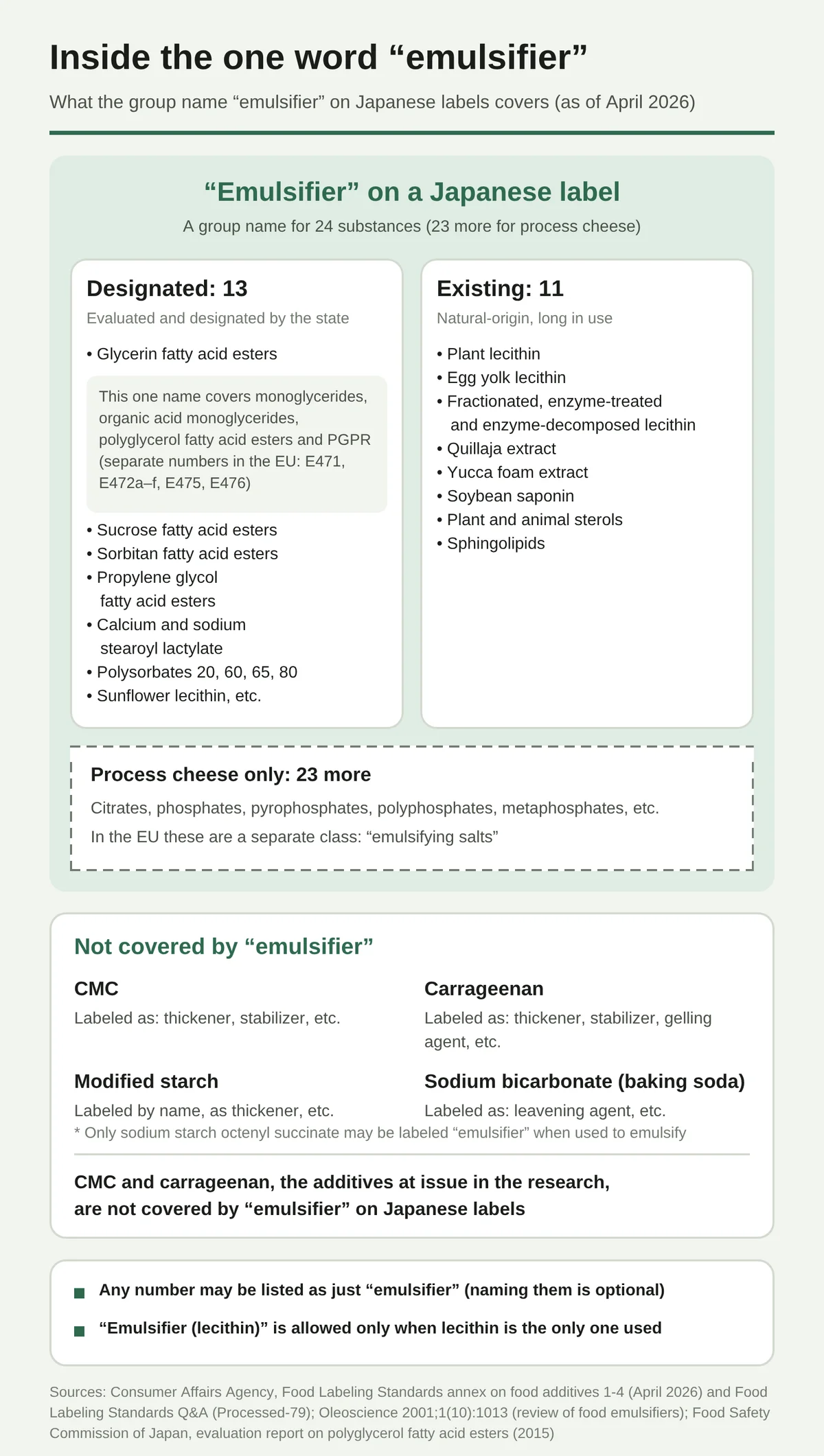
24 substances (23 more for process cheese)
As of April 2026, the additives that may be labeled “乳化剤” (emulsifier) in Japan are as follows (Consumer Affairs Agency, annex to “On the Food Labeling Standards,” Additives 1-4).
| Category | Number | Main substances |
|---|---|---|
| Designated additives (evaluated for safety and designated by the government) | 13 | Glycerin fatty acid esters, sucrose fatty acid esters, sorbitan fatty acid esters, propylene glycol fatty acid esters, calcium and sodium stearoyl lactylate, polysorbates 20, 60, 65 and 80, sunflower lecithin, etc. |
| Existing additives (natural-type additives that have long been in use) | 11 | Plant lecithin, egg yolk lecithin, fractionated lecithin, enzyme-treated lecithin, enzymatically decomposed lecithin, quillaja extract, yucca foam extract, soybean saponin, plant sterols, animal sterols, sphingolipids |
| Process cheese only | 23 | Citrates, phosphates, pyrophosphates, polyphosphates, metaphosphates, etc. |
A 2001 industry explanation listed “5 designated and 18 existing.” So the designated (synthetic-type) ones increased, while the existing (natural-type) ones decreased as they were removed from the list.
For process cheese, the phosphates and citrates that melt cheese smoothly can also be labeled “乳化剤.” In the EU, these fall under a separate category called “emulsifying salts.”
“Glycerin fatty acid esters” is a name that bundles four EU groups
The single Japanese name “グリセリン脂肪酸エステル” (glycerin fatty acid esters) includes:
- Monoglycerides (mono- and diglycerides of fatty acids)
- Organic acid monoglycerides (acetic, lactic, citric, succinic acid, diacetyl tartaric acid, etc.)
- Polyglycerol fatty acid esters
- Polyglycerol polyricinoleate (PGPR)
(From an industry explanation; the FSCJ also states that polyglycerol fatty acid esters are included.) In the EU these get separate numbers: E471, E472a–f, E475 and E476.
In other words, the “乳化剤” on a Japanese label is a double bundling: it bundles “any of the 24 substances” into one word, and then one of those substances bundles four EU groups.
CMC and carrageenan are not “emulsifiers”
CMC and carrageenan, which often appear in research, are not included in the group name “乳化剤” in Japan. They are labeled as “増粘剤” (thickener), “安定剤” (stabilizer) or “ゲル化剤” (gelling agent) (they can also be written together as “増粘多糖類,” thickening polysaccharides).
| Substance | Japanese label | EU number |
|---|---|---|
| Glycerin fatty acid esters | 乳化剤 (emulsifier) | E471, etc. |
| Lecithin | 乳化剤 (or “レシチン”) | E322 |
| Polysorbate 80 | 乳化剤 | E433 |
| CMC (sodium carboxymethyl cellulose) | 増粘剤, 安定剤, etc. (thickener, stabilizer) | E466 |
| Carrageenan | 増粘剤, 安定剤, ゲル化剤, etc. (thickener, stabilizer, gelling agent) | E407 |
This difference becomes important later when we read the research saying “emulsifiers are bad for the gut.”
Where are emulsifiers used?
From bread to ice cream to tofu
Emulsifiers are used for many purposes besides mixing (from industry explanations such as Oleoscience 2001).
| Food | What for | Main emulsifiers |
|---|---|---|
| Bread | Makes dough easier to handle. Binds with starch and delays the bread going stale | Monoglycerides, stearoyl lactylates |
| Cake | Helps with foaming | Monoglycerides, sucrose fatty acid esters |
| Ice cream | Deliberately breaks the emulsion a little so fat droplets cluster and support the air bubbles | Monoglycerides, polysorbate 80 |
| Chocolate | Lowers the thickness of the mass. Prevents “bloom,” the white film on the surface | Lecithin, PGPR |
| Margarine | Keeps water and oil together. Prevents splattering when heated | Monoglycerides, lecithin |
| Chewing gum | Keeps it soft. Makes it less sticky to teeth | Monoglycerides |
| Noodles and rice | Makes them loosen more easily and adds gloss | Monoglycerides, lecithin |
| Tofu | Removes the foam when soy milk is boiled | Monoglycerides |
| Canned and PET bottle drinks (sold warm) | Holds back the growth of bacterial spores that survive heating | Sucrose fatty acid esters |
How much is used in Japan?
| Year | Total (estimate) | Breakdown |
|---|---|---|
| 1998 | About 22,900 tons | Glycerin fatty acid ester group 11,600, lecithin 5,000, sucrose fatty acid esters 3,800, sorbitan 1,500, propylene glycol esters 1,000 |
| 2005 | About 24,000 tons | Glycerin fatty acid ester group 11,700, lecithin 5,600, sucrose fatty acid esters 4,200, sorbitan 1,500, propylene glycol esters 1,000 |
Sources: 1998 is from Oleoscience 2001 (based on an industry paper’s tally); 2005 is an estimate by the emulsifier maker Taiyo Kagaku (an FSCJ document also cites the same figure of 11,700 tons for glycerin fatty acid esters). Because different people did the tallies, this is not a strict trend. We could not find published statistics for 2006 onward.
The largest in Japan is glycerin fatty acid esters, at about half the total, followed by lecithin. By use in 1998, the order was Western-style confectionery at 3,500 tons, margarine and shortening at 3,450 tons, bread at 3,100 tons, and tofu at 1,450 tons.
Chocolate and lecithin
Chocolate often uses soy lecithin. This is because it lowers the thickness of the mass even when cocoa butter is reduced, making it easier to pour into molds. For coating chocolate, lecithin and PGPR are sometimes combined.
But chocolate can be made without lecithin. There is chocolate made without emulsifiers.
SOIL CHOCOLATE of Sapporo is a “Bean to Bar” specialist that makes everything from cocoa beans to chocolate bars in-house. Looking at the ingredients on the official online shop, the dark bar is made of only what is made from cocoa beans plus sugar, listed as “cacao mass (cacao beans), sugar,” and the milk bar is “cocoa butter, cacao mass, whole milk powder, sugar.” None of the products had an emulsifier or lecithin in the ingredients (checked October 3, 2026).
On Rakuten Ichiba, a set of the three standard kinds is available.
Margarine and butter
Margarine is a food in which water is finely dispersed in oil, and it is a food that often uses emulsifiers to keep that state and to prevent splattering when heated. The 1930s US patent was for this purpose too. In Japan in 1998 as well, margarine and shortening were the second-largest use of emulsifiers.
Butter is a food made by collecting the fat of milk and kneading it solid, and it takes shape without adding emulsifiers. For example, the ingredients of Yotsuba Fermented Butter for Bread are only two: raw milk (from Hokkaido) and salt, with no additives.
Note that if the emulsifier in an ingredient, such as the small amount of margarine in a cream puff, is present in an amount that does not work in the final food, labeling may be exempt (carryover). We cover this in the carryover article.
Tofu defoaming and “processing aids”
When making tofu, grinding and boiling soybeans produces a lot of foam. To remove this foam, an emulsifier (monoglycerides) is sometimes used. In the 1998 estimate, emulsifiers used for tofu were 1,450 tons, about 6% of the total.
Yet the back of a tofu package sometimes does not say “乳化剤” (emulsifier) or “消泡剤” (defoamer). Under national rules, an additive that remains in only a trace amount and leaves no effect on the food is exempt from labeling as a “加工助剤” (processing aid). A Sapporo City public health office document gives “silicone resin used to remove foam from the soybean liquid in tofu” as an example of a processing aid.
- However, we could not find a document that states clearly whether an emulsifier (glycerin fatty acid ester) used for defoaming counts as a processing aid under national rules
- On the other hand, Kyoto Prefecture, under its own rule (a prefectural notification), requires an additive used for defoaming in tofu to be labeled as “消泡剤” (defoamer), with the substance name too (Kyoto Prefecture “Quality Labeling Standards for Processed Foods,” notified in 1983, revised in 2019)
So even for the same tofu, a product sold within Kyoto Prefecture could carry a label such as “消泡剤 (glycerin fatty acid ester),” while one from another region says nothing.
The “emulsifier” in canned coffee is also there to hold back bacteria
In canned and PET bottle drinks sold warm, sucrose fatty acid esters are sometimes used to hold back the growth of bacterial spores that survive heat sterilization. It is a use that does not kill bacteria but keeps them from multiplying (Dai-ichi Kogyo Seiyaku company bulletin 2009, University of Minnesota report). The University of Minnesota report describes this as the largest use in Japan.
However, the group name “乳化剤” follows a rule that lets it be written “when used for the purpose of an emulsifier,” and we could not confirm from Consumer Affairs Agency documents whether “乳化剤” may be written when it is used to hold back bacteria.
Labeling rules: how Japan, the EU and the US differ
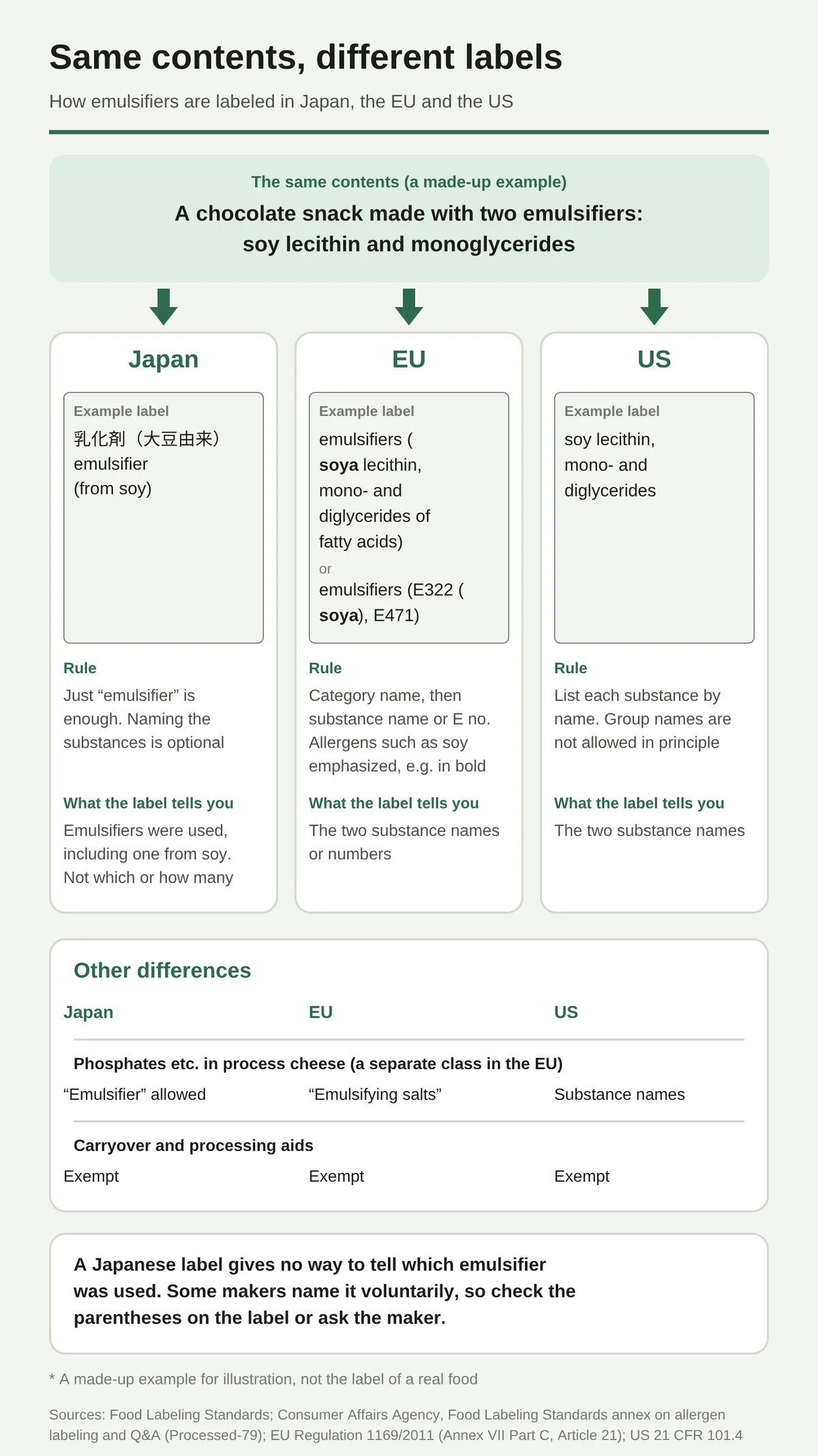
Japan: just writing “乳化剤” is enough
- However many kinds you use, the one word “乳化剤” is enough (group name). Adding a substance name is optional
- “乳化剤 (レシチン)” can be written only when lecithin alone was used. You cannot write only lecithin when other emulsifiers are also used (Consumer Affairs Agency, Food Labeling Standards Q&A, Processing-79)
- Labeling is exempt when the emulsifier in an ingredient does not work in the final food (carryover), or when it counts as a processing aid
“乳化剤(大豆由来)” and exceptions where no label is required
Emulsifiers made from soy or egg require allergen labeling. For the group name, it is written like “乳化剤(大豆由来)” (emulsifier, derived from soy) or “乳化剤(卵由来)” (emulsifier, derived from egg).
However, in the Consumer Affairs Agency’s list, the following need no “from soy” label even when made from soy. This is because it is considered that no protein that could cause allergy remains after refining.
| Emulsifier | “From soy” label |
|---|---|
| Plant lecithin, plant sterols | Required |
| Glycerin fatty acid esters (not distilled) | Required |
| Glycerin fatty acid esters (distilled) | Not required |
| Propylene glycol fatty acid esters | Not required |
| Calcium stearoyl lactylate | Not required |
| Sorbitan fatty acid esters | Not required |
| Soybean saponin | Not required (because the name contains “ダイズ,” soybean) |
Source: Consumer Affairs Agency, annex to “On the Food Labeling Standards,” labeling of foods containing allergens (October 2026 edition). Egg yolk lecithin and the like are written “レシチン(卵由来)” or “乳化剤(卵由来).”
The 乳 in “乳化剤” is not milk
When you see “乳化剤” on a label, someone with a milk allergy may think milk is in it. The 乳 in 乳化剤 does not mean milk.
The Consumer Affairs Agency writes the allergen label for milk only as “乳成分” (milk ingredients). One of its reasons is “to distinguish it from confusing words such as ‘乳化剤’” (Q&A on labeling of foods containing allergens).
If you have a milk allergy, look not at the characters “乳化剤” but at the allergen label, such as “(一部に乳成分を含む)” (contains milk ingredients in part).
EU: “Emulsifier” followed by a substance name or E number
In the EU, you cannot write just “emulsifier.” After the category name (Emulsifier), you write a substance name or an E number (EU Regulation 1169/2011, Annex VII Part C).
- Examples: “Emulsifier (soya lecithin)” and “Emulsifier: E322”
- Things that can cause allergy, such as soy, are made to stand out from the other ingredients, for example in bold (Article 21 of the same Regulation)
US: each substance by name
The US in principle does not allow ingredients to be written under a collective name (21 CFR 101.4(b)). The exceptions where they can be grouped are spices, flavors, colors, preservatives and the like; emulsifiers are not among them.
- Examples: “soy lecithin,” “mono- and diglycerides,” “polysorbate 80”
- A grouped form such as “dough conditioners (…, …)” for bread dough improvers also exists, but each substance must be written inside the parentheses
Same contents, different back labels by country
Even for a food using the same emulsifiers, the way it is written on the back changes by country. Taking a chocolate snack using two emulsifiers, soy lecithin and monoglycerides, we lined up the differences (this is a made-up example for explanation, not the label of a real food).
| Country/region | Example of how the emulsifier part is written | What you can read from it |
|---|---|---|
| Japan | 乳化剤(大豆由来) | That an emulsifier was used, and that some of it is from soy. Neither the kinds nor the number is known |
| EU | emulsifiers (soya lecithin, mono- and diglycerides of fatty acids) or emulsifiers (E322 (soya), E471) | You can tell the names or numbers of the two substances |
| US | soy lecithin, mono- and diglycerides | You can tell the names of the two substances |
From a Japanese back label there is no way to know “which emulsifier.” Some makers write the substance name voluntarily, so if you are curious, look inside the parentheses on the label or ask the maker.
| Japan | EU | US | |
|---|---|---|---|
| How it is written | The group name “乳化剤” alone is acceptable | Category name + substance name or E number | Each substance by name |
| Phosphates in process cheese, etc. | May be written “乳化剤” | A separate category, “emulsifying salts” | Substance name |
| Carryover and processing aids | Exempt from labeling | Exempt from labeling | Exempt from labeling |
Is “emulsifiers are bad for the gut” true? Checking the research one by one
Starting point: the 2015 mouse experiment
The starting point of “emulsifiers are bad for the gut” is a study published in the journal Nature in 2015 by Chassaing and colleagues at Georgia State University in the US.
- Mice were given drinking water mixed with 1% CMC or polysorbate 80 (P80) for 12 weeks
- Mild gut inflammation occurred, the mice gained weight easily, and their blood sugar was disturbed. In mice prone to colitis, clear colitis appeared
- It did not occur in germ-free mice, which have no gut microbiota, and transferring the gut microbiota of emulsifier-fed mice caused the same changes, so it was thought to occur “through the gut microbiota”
The study was funded by public money such as the US National Institutes of Health (NIH). A correction was issued in 2016, but it has not been retracted.
Since then, the same group and others have continued to report that tumors in a mouse model of colorectal cancer increased (2017) and that feeding mother mice changed the gut microbiota of their pups (2025). In a study that included researchers from Kyoto Prefectural University of Medicine in Japan, P80 worsened egg-white allergy symptoms in mice (Harusato 2022). All of these are animal experiments.
Experiment doses vs. doses at the table
The issue is the dose.
| Situation | Amount per day (70kg body weight) | Source |
|---|---|---|
| Mouse experiment (1% in drinking water) converted to a human | About 175g (estimate) | Fitzpatrick 2024, Nutrients (an estimate by researchers at Monash University, Australia) |
| Human trial FRESH (CMC) | 15g | Chassaing 2022 |
| Australian “high-emulsifier diet” (total of 41 substances) | 2.8g (the portion with known amounts) | Fitzpatrick 2024, Nutrients |
| ADI for polysorbates (EFSA and Japan) | 1.75g and 700mg | EFSA 2015, FSCJ 2007 |
| Japan: intake of 2 monoglycerides (measured in fiscal 2005) | About 73mg | MHLW survey |
| French average: CMC | 3.8mg (10.8% of people consumed it) | Sellem 2023 |
| French average: P80 | 0.3mg (1.1% of people consumed it) | Sellem 2023 |
- Australian researchers estimate the mouse dose as “about 2,500mg per kg of body weight a day, or 175g a day for a 70kg person, just under 9 tablespoons.” They write that it is closer to a drug dose than a food amount
- The 15g in the human trial is also about 4,000 times the French average CMC intake (3.8mg). The paper itself says it “would exceed the CMC intake of most people.” In the same sentence, however, it also says it “may be close to the total emulsifier amount taken by people who eat a lot of processed food”
- The mouse dose is about 250 times Japan’s ADI for P80 and about 100 times EFSA’s ADI
However, this kind of comparison has limits. The mouse dose is an estimate that assumes the mouse’s body weight and water intake, and it is not a conversion made by the researchers who ran the experiment.
Human trial 1: 15g of CMC a day (FRESH, 2022)
The trial that examined the effect of CMC in humans is Chassaing’s “FRESH” trial (Gastroenterology 2022).
- Healthy adults were admitted to a facility and their diets were completely controlled. People who took CMC and people who did not were assigned so that neither they nor the researchers knew which (a double-blind randomized controlled trial)
- 7 people took 15g of CMC a day and 9 did not, 16 people in total. The stay was 11 days. CMC was added 2.5g at a time to brownies and sorbet, eaten 6 times a day
- In those who took CMC, discomfort in the abdomen after meals increased a little, gut microbiota diversity fell, and short-chain fatty acids in stool (components that gut bacteria make from dietary fiber and that relate to gut health) decreased
- In 2 people, gut bacteria penetrated into the mucus layer that lines the inside of the gut
It was funded by public money such as the NIH, but one of the corresponding authors declared ties to health divisions of pharmaceutical and food companies.
Human trial 2: big individual differences
Even among those who took CMC in FRESH, only some were strongly affected. Later, when the participants’ stool bacteria were grown in a device and CMC was added, the difference between “people with bacteria vulnerable to CMC” and “people less affected” was reproduced, suggesting it may be possible to tell them apart beforehand (Rytter 2025, Gut). When the bacteria of CMC-vulnerable people were transferred into germ-free mice prone to colitis and the mice were given CMC, colitis occurred.
In other words, even at the same dose, the effect may differ greatly from person to person. However, this way of telling people apart is still at the research stage.
Human trial 3: 60 healthy people, 4 weeks (Belgium, 2026)
A trial at KU Leuven in Belgium (Wellens 2026, Clin Gastroenterol Hepatol) examined this in a form closer to real life.
- 60 healthy people. First they ate an emulsifier-free diet for 2 weeks
- Then, for 4 weeks, while continuing an emulsifier-free diet, they ate brownies containing one of five things (“CMC,” “P80,” “carrageenan,” “soy lecithin,” and “rice starch (unmodified)”) or “nothing added (placebo),” in a double-blind design
- Adding emulsifiers did not change markers of inflammation (fecal calprotectin, blood CRP, etc.) or metabolic markers compared with the placebo group
- On the other hand, short-chain fatty acids in stool were lower than in the placebo group (a statistically significant difference with CMC), and in the carrageenan group, one marker of gut permeability (whether substances leak easily out of the gut) rose from the start of the trial
It was also reported that cholesterol fell after 2 weeks on an emulsifier-free diet. We could not check the full text of the paper, so we could not confirm the amount of emulsifier per brownie.
In a trial of 22 healthy people in Australia (Fitzpatrick 2024, Aliment Pharmacol Ther), a “high-emulsifier diet” and a “low-emulsifier diet” made from store-bought products were compared, and the result was that under usual conditions, gut permeability was actually lower on the high-emulsifier diet. Permeability rose on the high-emulsifier diet only when a stress hormone was injected.
Comparing 20 kinds in test tubes, each emulsifier differed
What shows that emulsifiers cannot be lumped together is experiments in which human stool bacteria were grown in test-tube devices and emulsifiers were added.
| Study | Conditions | Result |
|---|---|---|
| Naimi 2021 (Microbiome) | Bacteria from one person’s stool, 20 kinds, all at 0.1% | CMC and P80 had long-lasting effects. Carrageenan and gums also had strong effects. Soy lecithin and mono- and diglycerides (one E471 product) showed no clear effect. However, even within E471, “glyceryl stearate” had a lasting effect |
| Miclotte 2020 (Front Microbiol, Ghent University, Belgium) | Bacteria from 10 people’s stool, concentrations 0.005–0.5%, 48 hours | Soy lecithin at 0.5% reduced live bacteria by 87%. Lecithin and microbially produced emulsifiers (such as rhamnolipids) had stronger effects than CMC and P80. The authors caution against thinking of them as “more natural alternatives” |
Putting the two studies side by side, soy lecithin had no clear effect at 0.1%, but at 0.5% it greatly reduced bacteria. The effect changes with the type and concentration of the emulsifier.
- You cannot say either “natural lecithin is safe” or “synthetic means dangerous”
- Both are test-tube experiments, and we do not know whether the same thing happens inside the human body
Crohn’s disease: results are split
In people with Crohn’s disease (a disease with persistent inflammation of the gut), trials that reduce emulsifiers in the diet have been run.
| Trial | Subjects and duration | Result |
|---|---|---|
| Australia (Fitzpatrick 2025, Aliment Pharmacol Ther) | 24 people with active Crohn’s disease, 4 weeks, double-blind | No difference between the high-emulsifier and low-emulsifier menus. The authors concluded “there is no basis to recommend avoiding emulsifiers in active Crohn’s disease.” One author declared speaker fees from a food company |
| UK ADDapt (King’s College London) | 154 people with Crohn’s disease with mild symptoms (active), 8 weeks, double-blind | More people improved in the group that ate a reduced-emulsifier diet plus emulsifier-free snacks (49% vs. 31%). It is only a 2025 conference presentation and a university announcement, and as of October 3, 2026 we could not find a peer-reviewed paper |
| US (Bhattacharyya 2017) | 12 people with ulcerative colitis in remission | More relapses in the carrageenan capsule group (3 of 5 vs. 0 of 7). A small trial stopped when a difference appeared, and the corresponding author is a researcher who has long argued that carrageenan is harmful |
The UK trial compares adding or not adding the three kinds that caused concern in research (carrageenan, CMC and P80) to snacks. We cannot yet confirm the amounts added from a paper, so it cannot be applied as is to emulsifiers on Japanese tables.
In 2020 the international inflammatory bowel disease research organization (IOIBD) said, as an expert opinion, that it is “prudent to reduce” CMC, P80, carrageenan and the like. The later Australian trial concluded “no basis to avoid,” and as of 2026 expert views are split. People with Crohn’s disease or ulcerative colitis should consult their doctor before changing their diet.
The large French study: an “association,” not a “cause”
France’s “NutriNet-Santé” is a large internet-based follow-up study in which volunteers take part. Participants recorded what they ate by brand, the amounts of additives were estimated, and later disease was followed. It was funded by public money such as the European Research Council, and the papers state there was no corporate funding.
| Paper | Subjects and follow-up | Main result |
|---|---|---|
| Sellem 2023 (BMJ) | 95,442 people, median follow-up 7.4 years | Cardiovascular disease: risk 1.03 times for each 1 standard deviation increase in CMC intake, and 1.07 times for the total of mono- and diglycerides. No association for lecithin, carrageenan and others |
| Sellem 2024 (PLoS Med) | 92,000 people, mean 6.7 years | Cancer: compared with the low group, the group eating more mono- and diglycerides (E471) had 1.15 times overall cancer, 1.24 times breast cancer and 1.46 times prostate cancer. Carrageenan: 1.32 times breast cancer. No emulsifier was associated with colorectal cancer |
| Salame 2024 (Lancet Diabetes Endocrinol) | 104,139 people, mean 6.8 years | Type 2 diabetes: associations with carrageenan (1.03 times for each 100mg/day increase), xanthan gum, guar gum and others |
Cautions when reading:
- It is an observational study, so it cannot say emulsifiers are the cause of disease. The paper itself says “because it is an observational study, we could not confirm that emulsifiers cause cardiovascular disease.” People who eat a lot of emulsifiers may differ in age, weight and overall diet
- The rise in risk is small. For example, CMC’s 1.03 times means “risk of cardiovascular disease is 3% higher when intake is 1 standard deviation higher.” The paper does not show the absolute difference in risk
- The amounts of very small quantities of additives are back-calculated from 3-day dietary records (repeated every six months). Regarding the diabetes paper, UK experts commented that “it cannot reach the precision the paper shows”
- The diabetes paper examined more than 60 kinds, and associations appeared for only some. When you examine many, chance associations also become more likely
- About 80% of participants were women, and they were volunteers
The “emulsifiers” in NutriNet are much broader than Japan’s emulsifiers
Another important point is that the range of “emulsifier” in this study is entirely different from the Japanese “emulsifier”.
This study adds up all 61 substances that have the function of “emulsifier” or “emulsifying salt” in the international food additive standard (Codex) and other sources, and calls them “emulsifiers.” The total intake averaged about 4.3g a day, and according to the text and figure of the paper, their shares of the total were:
- Modified starch 33.5%
- Sodium bicarbonate (baking soda) 26.9%
- Pectin 6.4%
- Diphosphates 5.1%
- Mono- and diglycerides (E471) 5.0%
Note that dividing the average intakes in Table 2 of the same paper gives baking soda about 35% and modified starch about 31%, so the order swaps (the values in the text appear to be calculated in a different way). Either way, these two make up about two-thirds of the total.
Of these, only some, such as mono- and diglycerides and lecithin, would be written “乳化剤” in Japan. Modified starch is labeled separately as “加工デンプン” (modified starch) or as a thickener, and baking soda as a leavening agent and the like (among modified starches, only sodium starch octenyl succinate can be written “乳化剤” if used for emulsification).
Also, one main source of mono- and diglycerides in this study was “fats and sauces (for example, store-bought mayonnaise).” As we show later, Japanese mayonnaise cannot use emulsifiers, so the contents of foods differ by country too.
“Emulsifiers punch holes in the gut” is at the hypothesis stage
You also often see the claim that “emulsifiers break the gut barrier and make holes in the gut (leaky gut).”
- The commonly cited source is a 2015 review (Lerner & Matthias, Autoimmun Rev), a hypothesis that “industrial food additives open the gaps between gut cells and could explain the rise in autoimmune diseases.” One of the coauthors was affiliated with a diagnostics company
- In test tubes and mice, there are studies in which permeability changed
- In humans, there is a trial in which permeability was actually lower under usual conditions (22 people in Australia), and a trial in which markers of inflammation did not change and only one marker of permeability rose in the carrageenan group (60 people in Belgium)
- A review says “leaky gut syndrome” is not a clearly defined diagnosis (Dey 2025, Nutrients)
Within what we checked, we did not find a study showing in humans that “emulsifiers make holes in the gut.”
Carrageenan’s “carcinogenicity” is about a different substance, poligeenan
The claim that “carrageenan is a carcinogen” is a mix-up with a different substance with a similar name.
- In 1987 the International Agency for Research on Cancer (IARC) classified “degraded carrageenan (poligeenan),” which is broken down by acid into small pieces, as “possibly carcinogenic (Group 2B),” and ordinary carrageenan as “not classifiable (Group 3)”
- In 2018 the European Food Safety Authority (EFSA) stated that “poligeenan is not permitted as a food additive and is not used”
- However, EFSA made the ADI for ordinary carrageenan (75mg per kg of body weight) “temporary” because of insufficient data, and asked for improved data within five years. A re-evaluation that includes infants continues
Soy lecithin and allergy
A very small amount of soy protein remains in soy lecithin.
- In a Japanese study (Awazuhara 1998), the protein in 100g of soy lecithin was 2.8mg. When blood from 30 patients sensitized to soy was tested, antibodies in 40% of them reacted to one protein in the lecithin, but of the 7 who had symptoms in an oral challenge, only 1 had antibodies reacting to the lecithin protein
- In a UK double-blind trial in which children with soy allergy (the delayed-symptom type) were given 1.5g of soy lecithin a day for one week (20 completed it), one child reacted to lecithin. In the week they ate a placebo, 5 children also reacted (Gholmie 2020)
The research result is that “few people react,” but it is not zero. Because “乳化剤(大豆由来)” labeling is mandatory in Japan, people with soy allergy should check the label and follow their doctor’s instructions.
Evaluations by country: Japan is stricter for some
The ADI (acceptable daily intake) is the amount considered to cause no harm to health if eaten every day for life. It is expressed in mg per kg of body weight.
Polysorbates are stricter in Japan
| ADI (per kg of body weight per day) | Basis | |
|---|---|---|
| Japan (FSCJ, 2007) | 10mg | The amount that did not cause diarrhea in a 13-week rat study of polysorbate 60 |
| EFSA (Europe, 2015) | 25mg | The amount that caused no adverse effect in a rat carcinogenicity study |
| JECFA (FAO/WHO, 1973) | 25mg | ― |
You sometimes hear that “Japan’s regulation of additives is lenient,” but polysorbates are an example where Japan is 2.5 times stricter. When it designated them in 2008, Japan judged that estimated intake from bread would be high, and did not allow their use in bread.
What EFSA said was “missing”
From 2013 to 2025, EFSA reviewed in turn the emulsifiers that can be used in the EU.
| Substance | EFSA’s conclusion |
|---|---|
| Lecithin (E322) | No numerical ADI needed. No concern up to the upper limit even in infant formula (2017, 2020) |
| Mono- and diglycerides (E471) | No numerical ADI needed. However, it should lower the limit for heavy metals and add limits for glycidyl esters and 3-MCPD (substances formed in oil refining) (2017, 2021) |
| Polysorbates (E432–436) | ADI 25mg. The estimate for toddlers who eat a lot is 24.5mg, close to the ADI (2015) |
| Sucrose fatty acid esters (E473) | ADI 40mg. Estimated intake exceeds the ADI in many age groups (2018, 2023; the estimate may be on the high side) |
| Stearoyl lactylates (E481, 482) | ADI 22mg. An estimate that even the average exceeds the ADI in age groups other than adults (2013) |
| CMC (E466) | No numerical ADI needed (2018) |
| Carrageenan (E407) | ADI 75mg made “temporary.” Asked for improved data (2018) |
What EFSA said was “missing” is mainly impurities (heavy metals, etc.), specifications, use in infants, and data on amounts used and amounts eaten. The effect on gut microbiota was not part of the basis of the ADIs.
Japan’s intake data are old
The national survey (market basket method) that measured how many mg of emulsifiers are actually eaten in Japan was, within what we checked, only for 2 monoglycerides in fiscal 2005 (stearic acid monoglyceride 46.58mg a day, palmitic acid monoglyceride 26.15mg a day).
In its 2007 evaluation of polysorbates, the FSCJ wrote that “intake should be determined after designation,” but we could not find a later measurement. We also could not find any document in which the FSCJ or the Consumer Affairs Agency stated a view on research about emulsifiers and gut microbiota.
Is “banned overseas” true?
- We could not confirm any move in the US to ban P80, CMC or carrageenan. What the US Food and Drug Administration (FDA) banned in 2024 was brominated vegetable oil (BVO), a beverage stabilizer, because of effects on the thyroid and elsewhere. P80, CMC, carrageenan and monoglycerides were also not on lists in state laws such as Texas’s
- In the EU, emulsifiers have not been banned; rather, specifications and permitted amounts are being reviewed (in January 2026 the conditions of use for carrageenan and others were amended)
The difference between countries lies less in “bans” than in which substances are permitted.
| Substance | Japan | EU |
|---|---|---|
| Polysorbate 40 | Not permitted | E434 |
| Ammonium phosphatides (for chocolate) | Not permitted | E442 |
| Yucca foam extract, soybean saponin, sphingolipids | Existing additives (emulsifiers) | Not additives |
| Use of polysorbates in bread | Not permitted | ― |
Reading “which emulsifier are we talking about” separately
Putting this together, the emulsifiers of concern in research and the “乳化剤” on Japanese back labels are quite far apart.
| Substance | Japanese label | What the research found | Share of UK processed foods | People who ate it in France |
|---|---|---|---|---|
| CMC (E466) | 増粘剤, 安定剤, etc. (thickener, stabilizer; not an emulsifier) | Gut microbiota changed in mice and in humans (15g a day) | 1.4% | 10.8% (average 3.8mg/day) |
| P80 (E433) | 乳化剤 (emulsifier) | Effects in mice and test tubes. We found no trial giving humans P80 alone | 0.06% (8 products) | 1.1% (0.3mg/day) |
| Carrageenan (E407) | 増粘剤, ゲル化剤, etc. (thickener, gelling agent; not an emulsifier) | Strong effects in test tubes. One marker of permeability rose in the Belgian trial. Associated with breast cancer and diabetes in observational studies | 4.4% | 77.9% (57.3mg/day) |
| Mono- and diglycerides (E471) | 乳化剤 (glycerin fatty acid esters) | In test tubes the results differ by product. Associated with cancer in an observational study | 14.5% | 81.6% (161.2mg/day) |
| Lecithin (E322) | 乳化剤, or “レシチン” | In test tubes, no clear effect at 0.1% and fewer bacteria at 0.5%. No association in the observational study | 23.4% | 88.4% (60.3mg/day) |
Sources: Sandall 2023 (12,844 UK processed foods), Sellem 2023 Table 2 (95,442 people in France)
- The most common in UK processed foods were lecithin (23.4%) and mono- and diglycerides (14.5%). CMC, the star of the research, was 1.4%, and P80 was only 0.06% (8 products)
- In dietary records of 367 people, both people with inflammatory bowel disease and healthy people in Australia, there was not a single record of eating P80 (Katsoudas 2024). The authors write that “the emulsifiers said to cause inflammation are not in foods as much as is often claimed”
- CMC and carrageenan are not in the Japanese back-label “乳化剤.” What is commonly used in Japan is glycerin fatty acid esters and lecithin
That does not mean we can say “Japanese emulsifiers are safe.” Mono- and diglycerides have been reported to be associated with cancer in the French observational study, and in Japan the group name means you cannot tell from the back label which emulsifier it is. The conclusion of this article is that you cannot judge good or bad from the word “emulsifier” alone.
Counting in Urayomi’s 71 products
We recounted the ingredients of the 71 products listed on Urayomi (as of October 3, 2026) for “乳化剤” and “レシチン” (lecithin).
| Category | Products | With emulsifier or lecithin | Label |
|---|---|---|---|
| Curry and stew roux | 11 | 4 | All “乳化剤” (group name) |
| Soup stock bases | 7 | 2 | All “乳化剤” (group name) |
| Powdered milk | 1 | 1 | “レシチン” |
| Mayonnaise and dressing | 4 | 0 | Emulsified with egg yolk or whole egg |
| Others | 48 | 0 | ― |
| Total | 71 | 7 (about 10%) |
The 7 products with an emulsifier or lecithin are the following.
- Roux: House Vermont Curry Medium Hot, House Java Curry Medium Hot, House Kokumaro Curry Medium Hot, House Stew Mix Cream
- Soup stock bases: Ajinomoto Marudori Gara Soup, Somi Shantan Soft Type
- Powdered milk: Glico Icreo Balance Milk (“レシチン”; the maker has not published the purpose of use)
For all 6 products labeled with the group name “乳化剤,” the substance name is unknown. From the back label we could not tell whether it is lecithin, glycerin fatty acid esters or polysorbates. On the other hand, 7 roux products, including those from Cosmo Foods, use no emulsifier. How to choose roux is covered in the curry roux article.
Mayonnaise cannot use emulsifiers
None of the 4 mayonnaise and dressing products on Urayomi used an emulsifier (additive). Egg yolk (the 2 Kewpie products) or whole egg (2 products) plays the role of emulsifier.
This is not a coincidence. Under the Food Labeling Standards, what may be called “mayonnaise” has fixed permitted ingredients and additives, and emulsifiers are not among them.
- Definition of mayonnaise: uses egg yolk or whole egg, with edible vegetable oil at 65% or more. The only additives allowed are seasonings (amino acids, etc.), acidulants and spice extracts
- “Salad cream dressing,” with less oil (10% to under 50%), may also use emulsifiers, thickeners and colors
For example, the ingredients of Kewpie Mayonnaise are seven: edible vegetable oil, egg yolk, brewed vinegar, salt, spices, seasoning (amino acids) and spice extract, and the additives are only the two after the “/” slash. The maker explains that 3.6 egg yolks are used in a 450g bottle.
Mayonnaise is a food in which the lecithin of egg yolk binds oil and vinegar. Remembering that the history of emulsifiers began with egg yolk, mayonnaise could also be called a food that still carries on “the oldest use of an emulsifier.”
Incidentally, mayonnaise went on sale in Japan in 1925 (Kewpie).
How to choose, and how to read the back label
Back-label checkpoints
- The single word “乳化剤” does not tell you what is inside. If a substance name is written in parentheses, that is a clue (“乳化剤(レシチン)” means lecithin only)
- “増粘剤(カラギーナン)” (thickener (carrageenan)), “増粘多糖類” (thickening polysaccharides) and “CMC” are written in a separate column from emulsifiers. If you are concerned about CMC and carrageenan, which drew attention in research, look there
- The 乳 in “乳化剤” is not milk. Check milk allergy from the “乳成分” label
- People with soy allergy should watch for “乳化剤(大豆由来)”. But some emulsifiers need no label
- A “乳化剤不使用” (no emulsifiers) claim may mean it was replaced by an ingredient with an emulsifying function. The Consumer Affairs Agency’s “Guidelines on Labeling That Additives Are Not Used” (2022) lists, as an example highly likely to be a prohibited labeling matter (Type 5, example 2), “labeling that no emulsifier was used on a food that uses a highly processed ingredient having an emulsifying action.” What it targets is the case of replacing it with something that, for example, has had only a specific component extracted and can no longer be called an ordinary food. We cover this in the article on the rules of “無添加” (additive-free) labeling
- Mayonnaise, butter and chocolate bars (made only of cocoa and sugar) are foods that can be made without emulsifiers
If you are concerned, what to cut back first
Within what we checked, there is no study showing that emulsifiers in a normal diet make people ill. With that in mind, we organized a guide from the content of the research for people who want to cut back.
| The concern | What the research says |
|---|---|
| Effect on gut microbiota | In humans, the effect appeared in a trial of 15g of CMC a day, an order of magnitude different from table amounts. There are individual differences in the effect |
| Which emulsifier | The ones of concern in research were CMC, P80 and carrageenan. CMC and carrageenan are not in the Japanese “乳化剤” |
| Natural or synthetic | In test tubes, soy lecithin also reduced bacteria at high concentration. It is not decided by natural vs. synthetic |
| Cancer, heart disease, diabetes | Associations were reported in French observational studies, but they cannot show cause and the rise in risk is small |
| Crohn’s disease | Trial results are split. Consult your doctor before changing your diet |
Foods that use many emulsifiers are processed foods such as sweet buns, cakes, ice cream, milk drinks and roux. Rather than avoiding only emulsifiers, reviewing the amount of processed food itself is thought to have a bigger effect on the diet as a whole. In fact, in the Belgian trial, people put on an emulsifier-free diet also ate 37.1% less (median) ultra-processed food (Wellens 2026, Clin Nutr ESPEN).
For other ingredients whose contents are hard to see from the label, such as yeast extract, see the yeast extract article, and for a list of additives, the additives database.
What we introduced in this article (summary)
Here is a recap of what we introduced in the article. The reasons and ingredients are written in each section.
| What we introduced | Where to buy |
|---|---|
| SOIL CHOCOLATE (official online shop of a Bean to Bar chocolate maker in Sapporo) | SOIL CHOCOLATE  PR PR |
| SOIL CHOCOLATE Standard 3-Bar Set (chocolate bars) | See on Rakuten (GELATERIA GELABO) PR See on Amazon.co.jp PR |
Summary
| The question | What we found |
|---|---|
| How did emulsifiers begin? | With egg yolk. Gobley named “lecithin” in 1850. Soy lecithin was industrialized in Germany in the 1920s, and synthetic emulsifiers began with US patents in the 1930s and 40s |
| Are sucrose fatty acid esters from Japan? | Developed in the US. Japan was the first in the world to approve them as a food additive and industrialize them, in 1959 |
| What is inside the Japanese “乳化剤”? | A group name for 24 substances (13 designated, 11 existing; 23 more for process cheese). However many kinds are used, “乳化剤” alone is enough |
| How is it labeled overseas? | The EU: “Emulsifier” + substance name or E number; the US: each substance by name. Japan shows the least about what is inside |
| Are emulsifiers bad for the gut? | The mouse dose converts to about 175g a day for a human, and the human trial used 15g of CMC. These are an order of magnitude different from table amounts (French average CMC 3.8mg). In the 4-week trial of 60 healthy people, markers of inflammation did not change |
| Which emulsifiers are we talking about? | The ones of concern in research were CMC, P80 and carrageenan. CMC and carrageenan are not in the Japanese “乳化剤.” In UK processed foods, P80 was 0.06% |
| What about cancer and other diseases? | Associations reported in French observational studies. They cannot show cause, and the rise in risk is small. The “emulsifiers” in the research cover a wide range, including modified starch and baking soda |
| How do countries evaluate them? | The ADI for polysorbates is 10 in Japan and 25 in the EU, so Japan is stricter. We could not confirm any move in the US to ban P80, CMC or carrageenan |
| Is the 乳 milk? | No. One reason the Consumer Affairs Agency made the allergen label “乳成分” is to distinguish it from “乳化剤” |
| What about mayonnaise? | Its legal definition does not allow emulsifiers. Egg yolk plays the role of emulsifier. Among Urayomi’s 71 products, 7 had an emulsifier or lecithin, and 6 of them used the group name, so the contents are unknown |
Sources
History
- Zeisel SH. A brief history of choline. Ann Nutr Metab 2012;61:254-258 (PMID 23183298)
- French Academy of Agriculture, “Les lécithines” (encyclopedia explanation)
- American Oil Chemists’ Society (AOCS), “Hermann Bollmann, Bruno Rewald …” (Gary R. List, 2019)
- US Patents US 1,917,256 (1933), US 2,158,775 (1939), US 2,322,820 (1943), US 2,380,166 (1945)
- Griffin WC. Classification of Surface-Active Agents by “HLB”. J Soc Cosmet Chem 1949;1:311
- Breene & Harrigan, “Sucrose esters: their impact on soybean oil utilization” (University of Minnesota); Dai-ichi Kogyo Seiyaku “DK Ester” catalog and company bulletin No. 550 (2009); Journal of the Japan Society of Colour Material 89(12):420 (2016)
- Kewpie, “History of Kewpie”
Types, uses and labeling
- Consumer Affairs Agency, “On the Food Labeling Standards,” annex Additives 1-4 and 2-1 (April 2026), annex on labeling of foods containing allergens (October 2026), Food Labeling Standards Q&A (Processing-78 and 79)
- Food Labeling Standards, Appended Table 3 (definitions of mayonnaise and salad cream dressing) and Appended Table 7 (e-Gov Law Search)
- Oleoscience 2001;1(10):1013 (explanation of food emulsifiers)
- Taiyo Kagaku (2005 estimate); FSCJ evaluation report on “polyglycerol fatty acid esters” (2015)
- Sapporo City Public Health Office, “Labeling of food additives”; Kyoto Prefecture, “Quality Labeling Standards for Processed Foods” (Kyoto Prefecture Notification No. 705 of 1983, revised in 2019)
- EU Regulation 1169/2011 (food information), EU Regulation 1333/2008 (food additives), EU Regulation 1129/2011
- US Code of Federal Regulations 21 CFR 101.4 and 101.100, 21 CFR Part 172 and 184
- Consumer Affairs Agency, “Guidelines on Labeling That Food Additives Are Not Used”
Health effects
- Chassaing et al. Nature 2015;519:92-96 (PMID 25731162)
- Chassaing et al. Gastroenterology 2022;162:743 (PMID 34774538, FRESH trial)
- Rytter et al. Gut 2025 (PMID 39870396)
- Wellens et al. Clin Gastroenterol Hepatol 2026;24:1092 (PMID 40816342, FOAM trial) / Clin Nutr ESPEN 2026;74:103321 (PMID 42105859, secondary analysis of FOAM)
- Fitzpatrick et al. Aliment Pharmacol Ther 2024;60:863 (PMID 39072856), Nutrients 2024;16:1922 (PMID 38931276), Aliment Pharmacol Ther 2025;61:1276 (PMID 39967287)
- Naimi et al. Microbiome 2021;9:66 (PMID 33752754) / Miclotte et al. Front Microbiol 2020 (PMID 33250870)
- Viennois et al. Cancer Res 2017 (PMID 27821485) / Harusato et al. Nutrients 2022 (PMID 36501013)
- King’s College London, “New research presented at ECCO congress on low emulsifier diet and Crohn’s disease” (2025, ADDapt trial)
- Levine et al. Clin Gastroenterol Hepatol 2020 (PMID 32068150, IOIBD)
- Bhattacharyya et al. Nutr Healthy Aging 2017 (PMID 28447072)
- Sellem et al. BMJ 2023;382:e076058 (PMID 37673430) / PLoS Med 2024;21:e1004338 (PMID 38349899) / Salame et al. Lancet Diabetes Endocrinol 2024;12:339 (PMID 38663950)
- Comments from the Science Media Centre (UK) (2016, 2023, 2024)
- Sandall et al. Public Health Nutr 2023 (PMID 37732384) / Katsoudas et al. Inflamm Bowel Dis 2024 (PMID 38244236)
- Lerner & Matthias. Autoimmun Rev 2015 / Dey et al. Nutrients 2025 (PMID 41097199)
- IARC Monographs Vol. 31 (1983) and Supplement 7 (1987), carrageenan
- Awazuhara et al. Clin Exp Allergy 1998 (PMID 10024228) / Gholmie et al. J Hum Nutr Diet 2020 (PMID 31603281)
Evaluations by country
- FSCJ, evaluation report on “polysorbates” (2007); MHLW Pharmaceutical Affairs and Food Sanitation Council committee report (2007); FSCJ, evaluation report (draft) on “sunflower lecithin” (2013)
- EFSA re-evaluations: E322 (2017, 2020), E471 (2017, 2021), E473 (2018, 2023), E481/482 (2013), E432–436 (2015), E466 (2018), E407 (2018), E491–495 (2017, 2025), E476 (2017, 2022)
- JECFA (FAO/WHO Joint Expert Committee on Food Additives) database
- Japan Food Chemical Research Foundation, “Fiscal 2005 survey of daily intake of food additives by the market basket method”
- US FDA, “Revocation of authorization for the use of brominated vegetable oil (BVO)” (2024)
- EU Regulation 2026/196 (January 2026)
Related articles and databases
- What are surfactants? Types, history, rules in Japan and abroad, effects on the body, and what the “strength rankings” really are
- What is carryover? How it differs from processing aids, and the additives that are not listed on labels even on “additive-free” foods
- Were “無添加” (Additive-Free) Labels Banned? Reading the Consumer Affairs Agency Guideline’s 10 Types from the Back Label
- Is Yeast Extract Bad for You? Its History from Meat Extract, How It's Made, Glutamate Content, the “Hidden MSG” Claim, and Labeling Rules in Japan, the US and Germany