
What Is Shortening? History, Ingredients, How It's Made, Whether “Bad for You” and “Carcinogenic” Claims Hold Up, Why Bread and Sweets Use It, and Alternative Fats

PR This article contains affiliate links to Rakuten Ichiba, Amazon and Yahoo! Shopping (“See on Rakuten”, etc.). What we write is based on public documents and studies, whether or not an ad is present. The “See on Amazon.co.jp” links are also affiliate links.
Bread, cookies, doughnuts, snack sweets. Turn the package over and the ingredient list sometimes says “ショートニング” (shortening). You hardly ever keep it in your own kitchen, yet you see it all the time on food labels. That is shortening.
There are also many things people say about it.
- What is shortening made from? Is it different from margarine?
- Why is it called “shortening”?
- Is it carcinogenic? Is it true that it is bad for you?
- Is it banned in the U.S.? What about Japan?
- Why do bread and sweets use it? Can you find bread that does not?
- Can lard or butter replace it? Can you buy it for home use?
On October 3, 2026, we checked Google search suggestions (autocomplete) and found about 600 Japanese suggestions containing “ショートニング”. The largest group was questions about finding products that do not use it (89), such as “ショートニング 不使用 食パン” (shortening-free sliced bread) and “ショートニング 不使用 お菓子市販” (shortening-free packaged sweets). Next came questions about differences and substitutes (79), such as “ショートニング ラード 違い” (shortening vs. lard) and “ショートニング 代用 サラダ油” (substituting salad oil for shortening). “ショートニング とは” (what is shortening) and “ショートニング 原料” (shortening ingredients) accounted for 47, and “ショートニング 発がん性” (carcinogenic) and “体に悪い 嘘” (bad for you, a lie) for 31 (a suggestion can be counted in more than one group). This is not a measure of search volume. It is a rough guide to the range of questions people actually type.
In this article, we check the following against laws, Ministry of Agriculture, Forestry and Fisheries (MAFF) materials and papers:
- When, where and why shortening was born (history in the world and in Japan)
- What it is made from and how, and how it differs from margarine, butter and lard
- Why it is used in bread, sweets and fried foods
- What the label terms “ショートニング”, “植物油脂” (vegetable fats and oils) and “加工油脂” (processed fats and oils) do and do not tell you
- How much trans fat today’s shortening contains
- Where the “carcinogenic” claim comes from, and measured values in Japan
- How far fully hydrogenated and interesterified shortening has been studied
- How U.S. and EU rules differ from Japan’s
- Shortening you can buy for home use, how to choose bread and sweets, and alternative fats
Series on shortening, margarine and trans fat (3 articles)
- Margarine article: history, how it is made, how it differs from butter and fat spreads, and a check of the “plastic” and “only in Japan” claims
- Shortening article: this article. Ingredients, how it is made, the carcinogenicity claim, why bread and sweets use it, and alternative fats
- Trans fat article: heart disease research, regulations around the world and why Japan has none, foods high in trans fat, and Japanese intake
Conclusions
- Shortening was born in the late-19th-century U.S. as a “substitute for lard”. The first products were a mix of cottonseed oil and beef tallow. In 1911, Crisco, made with hydrogenated oil, went on sale and spread through a cookbook giveaway with 615 recipes. In Japan it first appears in the 1951 statistics, and in 1959 its production overtook that of margarine
- Shortening is a solid (or liquid) fat for kneading into dough, almost 100% fat. It has 0.5% or less water, contains no milk ingredients, and has no taste or smell. In Japan most of it is for commercial use (bread, sweets, frying oil), and only a small part is for home use
- Palm oil is now the main ingredient. Among members of the Japan Margarine Association, raw material use in January–June 2026 (89,000 tons) was 39% refined palm oil, 24% interesterified oil and 8% hardened oil. The share of hardened oil in shortening fell from 14.2% (2016) to 7.9% (2025)
- In three MAFF surveys, the median trans fat fell from 12 to 1.0 to 0.61 g/100g (FY2006–07, FY2014–15, FY2022–23). Some FY2014–15 samples reached 24 g/100g, but the FY2022–23 maximum was 0.86. However, each survey sampled differently and used few samples, so these are “rough guides”
- The “carcinogenic” claim comes from mixing up two different stories. The International Agency for Research on Cancer (IARC) list contains neither trans fat, margarine nor shortening. What it does list are glycidol (2A) and 3-MCPD (2B), by-products of refining oils, and that is a story about refined oils in general, not just shortening. In Japan’s 2023 measurements, the median 3-MCPD fatty acid esters were 3.4 mg/kg in palm oil, 1.5 in shortening and 0.51 in margarine
- Cutting trans fat can raise saturated fat. The Food Safety Commission of Japan (FSCJ) surveyed commercial-use products in FY2006 and FY2010 (the purchase methods and brands were not the same), and the average saturated fat in commercial shortening went from 23.9 to 45.4 g/100g. MAFF’s FY2022–23 survey, however, says it “did not confirm a tendency to increase,” so the results are split
- The long-term effects of fully hydrogenated and interesterified shortening are not yet known. The main human trials involved a few dozen people for 4 to 8 weeks, and much of the funding came from a palm oil industry body
- Japan has no upper limit and no labeling requirement for trans fat. The U.S. has regulated partially hydrogenated oils since June 2018, and the EU caps trans fat at 2 g per 100 g of fat. The conditions for writing “zero” also differ: less than 0.3 g per 100 g in Japan, less than 0.5 g per serving in the U.S.
Items covered in this article
| Item | When it helps | Where in the article |
|---|---|---|
| Home-use shortening that does not use partially hydrogenated fats | When you bake sweets or bread at home and want to check the ingredient list before choosing | Shortening you can buy for home use |
| Fats that can replace shortening (lard, coconut oil, etc.) | When you want to choose an alternative fat by looking at its fatty acid composition | Compare alternative fats by fatty acids |
| Mail-order bread whose ingredients do not include shortening or margarine | When you want to check the fats on the label and choose bread | When choosing bread and sweets |
How was shortening born?
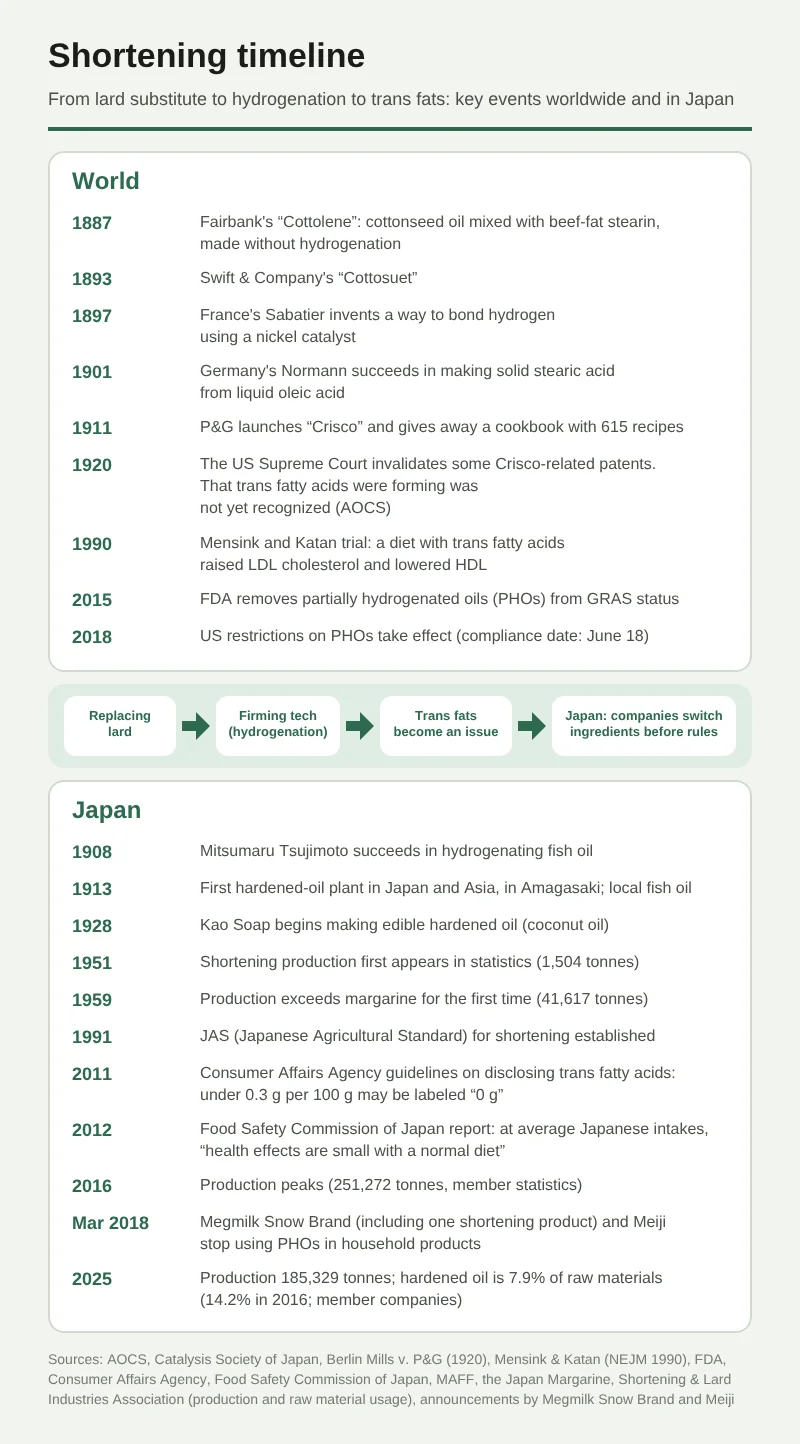
The history of shortening is a history of the search for substitutes for lard. The technology of “hydrogenation” was then added, making it possible to produce a fat that stays solid cheaply and in large quantities.
As a lard substitute: a mix of cottonseed oil and beef tallow (1880s–90s)
According to the Japan Margarine Association, shortening was born in the late-19th-century U.S. as a substitute for lard (pork fat), and was also called “lard compound.”
The first products did not use hydrogenation.
- 1887: N.K. Fairbank’s “Cottolene”
- 1893: Swift’s “Cottosuet”
- Both were a mix of 70–80% cottonseed oil (pressed from cotton seeds) and 20–25% beef tallow stearin (the hard fraction) (explanation by the American Oil Chemists’ Society, AOCS)
Cottonseed oil is pressed from the seeds left after the cotton fibers are removed. Hardening a liquid oil by mixing in firm beef tallow so that it behaves like lard was how shortening began. In other words, Crisco, which became famous later, was not “the first shortening.”
The invention of hydrogenation (1897–1903)
A way to harden a liquid oil without mixing in tallow is hydrogenation. Japan’s JAS (Japanese Agricultural Standard) defines hydrogenation as “a process of adding a catalyst such as nickel or copper, heating, and feeding in hydrogen so that part or all of the unsaturated portion is saturated.”
- 1897 (some sources say 1899): Sabatier of France invents a method of binding gaseous hydrogen to compounds using nickel as a catalyst (Nobel Prize in Chemistry, 1912)
- February 27, 1901: Normann of Germany succeeds in an experiment that turns liquid oleic acid into solid stearic acid by acting on it with nickel and hydrogen
- 1902–03: Normann’s patents (German Patent 141,029 took effect on August 14, 1902 and was granted in 1903; the British patent is from 1903)
- 1909: Crosfield of Britain industrializes it on a large scale. In September 1911, Procter & Gamble (P&G) of the U.S. obtains a U.S. patent on this method
When P&G first acquired hydrogenation, its aim was to harden oil for use as a soap ingredient. Using it in food came afterward.
1911: Crisco goes on sale, spread by giving away cookbooks
In June 1911, P&G launched “Crisco,” made from hydrogenated cottonseed oil. The name is said to be short for “crystallized cottonseed oil.”
The promotion looks like modern marketing (according to AOCS).
| Item | Figure |
|---|---|
| Advertising spend | $180,000 in 1911; about $400,000 a year in 1912–15 |
| Shipped to | About 15,000 retail stores nationwide |
| Cookbook | A book with 615 recipes was given away free |
| Sales volume | 2.6 million pounds in 1912 → 60 million pounds in 1916 |
| Price (1915) | Competitor Kream-Krisp at 16 cents a pound; good butter at 44 cents |
Crisco’s composition at the time was 20–25% saturated fatty acids, 65–75% oleic acid and 5–10% linoleic acid, with a melting point of 33–40°C (AOCS). A firm fat that was “cheaper than butter and easier to handle than lard” entered homes along with the cookbook.
Why is it called “shortening”?
According to the Japan Margarine Association, “shortening” is a word that means to make something crisp or crumbly. It comes from the English word (“shorten”) meaning that when used in bread or biscuits, it improves the mouthfeel and makes the dough tender and crumbly.
The same association’s page also says that “the ‘short’ in shortcake refers to shortening.” However, we could not find a primary source that confirms that etymology, so this article does not adopt it.
The 1920 lawsuit, and what was not known then
On December 6, 1920, the U.S. Supreme Court invalidated claims 1 and 2 of the Crisco-related patent (the Burchenal patent) held by P&G (Berlin Mills v. P&G). P&G had sued Berlin Mills, which was selling hydrogenated oil in the same way.
On this point AOCS writes that “there is no evidence that chemists at the time recognized that partial hydrogenation was producing elaidic acid (the trans form).”
Trans fat emerged as a health issue much later.
| Year | Event |
|---|---|
| 1976 | The U.S. scientific body FASEB says there is “no evidence of a hazard to the public” from hardened soybean oil (as quoted in a petition by the consumer group CSPI) |
| 1985 | FASEB says there is “little reason for concern” at current or projected intake levels (same source) |
| 1990 | Mensink and Katan show in a human trial that a trans fat diet raises LDL cholesterol and lowers HDL compared with an oleic acid diet |
| 1993 | In a study that followed 85,095 U.S. nurses for 8 years, the group with the most trans fat had 1.50 times the coronary heart disease risk of the group with the least |
| 2015 | The U.S. FDA decides to remove partially hydrogenated oils from “generally recognized as safe” status |
Both facts are on record: that “the problem was not visible then,” and that “it is different now.”
Rise and fall in the U.S.: supply per person
The USDA Economic Research Service (ERS) has published per-person supply of butter, margarine, lard and shortening since 1909 (in pounds, product weight; it is supply, not “amount eaten”).
| Year | Shortening | Lard | Butter | Margarine |
|---|---|---|---|---|
| 1909 | 8.0 | 6.9 | 17.9 | 1.2 |
| 1940 | 9.0 | 14.4 | 17.0 | 2.4 |
| 1965 | 14.2 | 6.2 | 6.6 | 9.8 |
| 1985 | 22.1 | 1.6 | 4.9 | 10.8 |
| 2000 | 31.5 | 0.8 | 4.5 | 8.2 |
| 2005 | 29.0 | 1.6 | 4.5 | 4.0 |
| 2010 | 15.3 | 1.5 | 4.9 | 3.5 |
Source: USDA ERS food availability statistics. ERS has not updated its fat and oil statistics other than butter since 2010.
- Lard fell from 14.4 pounds in 1940 to 0.8 pounds in 2000, and shortening appears to have taken its place
- Shortening rose about fourfold from 1909 to 2000. The jump around 2000 may reflect more companies reporting to the statistics
- From 2005 to 2010 it nearly halved, from 29.0 to 15.3 pounds. This overlaps with when trans fat in the nutrition label became mandatory in the U.S. (January 2006), but we have not verified any causal link
Japan: from hardened fish oil to oil for bread and sweets
Hydrogenation in Japan began with fish oil (Catalysis Society of Japan materials).
- 1908: Mitsumaru Tsujimoto of the Industrial Research Institute of the Ministry of Agriculture and Commerce succeeds in hydrogenating fish oil
- 1913 (Taisho 2): Lever Brothers begins making the first hardened oil in Japan and Asia, in Amagasaki (construction of the plant began in 1910). The raw material was fish oil from waters near Japan, and most of the product was exported to China. In the late Meiji period, large amounts of Japanese fish oil were exported to Europe as raw material for hardened oil
- 1928: Kao Soap begins making edible hardened oil (coconut oil)
Shortening production appears in the statistics after the war.
- 1951: statistics begin at 1,504 tons
- 1959: at 41,617 tons, it exceeds margarine (39,926 tons) for the first time
- 1991: the JAS for shortening is established (August 1, Heisei 3, MAFF Notice No. 989)
- 2016: the peak of 251,272 tons (member statistics). In 2025 it was 185,329 tons
From 2010, the figures cover only members of the Japan Margarine Association and are not continuous with earlier data. The graph separates them with a dotted line. MAFF’s 2013 material says shortening production is on a downward trend, but that the decline is gradual.
In Japan, shortening draws more attention than margarine
When we compared annual Wikipedia page views (public Wikimedia data) between the Japanese and English editions, there was a difference.
| Article | 2023 | 2024 | 2025 |
|---|---|---|---|
| Japanese edition “マーガリン” (margarine) | 79,494 | 62,102 | 56,354 |
| Japanese edition “ショートニング” (shortening) | 64,542 | 68,314 | 50,614 |
| English edition “Margarine” | 400,086 | 385,528 | 291,103 |
| English edition “Shortening” | 184,379 | 166,537 | 121,253 |
- In the Japanese edition, “ショートニング” overtook “マーガリン” in 2024 (68,314 vs. 62,102)
- In the English edition, margarine got about 2.2–2.4 times the views of shortening in all three years
All four articles fell from 2023 to 2025, so these are numbers that are only useful for comparing the articles with one another. One might think that “because people see it in the ingredient lists of bread in Japan, shortening has become a food people wonder about by itself,” but that has not been verified.
Search suggestions also differed. Of 3,176 English suggestions, 120 contained halal, haram, kosher, vegan or vegetarian, and 79 contained banned or illegal (in which country it is banned). Of 2,031 Japanese suggestions, only 5 concerned religion or vegetarian diets; instead, “school lunch” (給食), “baby” (赤ちゃん) and “bakery, not used” (パン屋 不使用) lined up. The data were collected in Japan, so there may be bias, but even for the same fat, what people ask about differs around the world.
Was it “invented as a submarine lubricant”?
There is a story that “shortening was made at the request of the German navy as a lubricant for submarines.” The fact-checking site Snopes rated this “Unfounded.”
- The source is said to be a YouTube video of December 10, 2019
- AOCS replied that “there is no record of the German navy using Crisco”
- Snopes explains that the German chemist Normann developed hydrogenation (a chemical technique for hardening liquid oil) in 1901 and Crisco went on sale about 10 years later in 1911, so there is no basis for the claim that Crisco was made for submarines
What the records confirm in the history so far is that shortening “was born in the late 19th century as a substitute for lard,” and that “when P&G first acquired hydrogenation, the aim was to make a soap ingredient (AOCS).”
What shortening is: definition, ingredients, how it is made
From here we look at today’s shortening in Japan through laws and statistics.
The JAS definition: how it differs from butter and margarine
Shortening has a Japanese Agricultural Standard (JAS). MAFF materials describe shortening as a solid or fluid product made from edible fats and oils, given workability such as plasticity (ease of changing shape) and emulsifying properties, and made up of almost 100% fat.
| Item | Shortening | Margarine | Butter |
|---|---|---|---|
| Basis | JAS (established Heisei 3 [1991], revised 2024) | JAS and Food Labeling Standards | Ministerial ordinance on milk and milk products |
| Main ingredients | Edible fats and oils (vegetable, animal) | Edible fats and oils emulsified with water, milk ingredients, salt, etc. | Raw milk (milk fat) |
| Fat content | Almost 100% | 80% or more (under 80% is a fat spread) | Milk fat 80.0% or more |
| Water | 0.5% or less (including volatile matter) | 17.0% or less | 17.0% or less |
| Process features | Types that are quick-chilled and worked with nitrogen gas mixed in, and types that are not worked | Emulsified, then quick-chilled and worked | (not checked) |
- The difference from margarine is that shortening contains no water and no milk ingredients. Margarine is emulsified with added water; details are in the margarine article
- Some commercial products use emulsifiers (lecithin, glycerin fatty acid esters) to improve workability, and the JAS sets a separate acid value standard (a measure of fat deterioration) only for those (see the emulsifiers article)
- Lard is pork fat. One that is 100% pork fat is “pure lard” (純製ラード), and one made mostly of pork fat mixed with beef tallow, palm oil and so on is “prepared lard” (調製ラード) (Japan Margarine Association)
- For shortening, no international standard such as a Codex standard had been established as of June 2012 (MAFF’s 2013 material; we have not checked since)
What “plasticity” means
The “plasticity” in the JAS definition is the property of changing shape when force is applied and keeping its shape when the force is removed. Think of how butter spreads when pressed, or how clay takes shape when kneaded. The Japan Margarine Association lists “good spreadability at room temperature and ease of mixing into dough” as characteristics of shortening.
The English word “plastic” is the same word, and U.S. federal regulations define margarine as a “plastic form.” You may see explanations that this word seeded the claim “margarine = plastic,” but that is a hypothesis with no supporting evidence. The reliable source is said to be a chain email that circulated in the English-speaking world from around 2003 (checked in the margarine article).
What is it made from? The ingredients
Looking at the raw materials (refined-oil basis) used by Japan Margarine Association members in January–June 2026, shortening was mostly palm oil.
| Raw material | Shortening (tons) | Share | Share in margarine products |
|---|---|---|---|
| Total | 89,000 | 100% | (72,153 tons) |
| Palm oil (refined only) | 35,040 | 39% | 19% |
| Interesterified oil | 21,026 | 24% | 39% |
| Hardened oil (hydrogenated oil) | 7,279 | 8% | 3% |
| Rapeseed oil (refined only) | 5,024 | 6% | 12% |
| Other (soybean oil, animal fats, etc.; breakdown not confirmed) | 20,631 | 23% | 27% |
Source: Japan Margarine Association, “Raw material use” (January–June 2026, refined-oil basis). “Other” is the remainder after subtracting from the total, calculated by Urayomi.
- Shortening uses twice the share of palm oil that margarine products do. This is thought to be because an oil that hardens easily suits a solid fat for kneading (we have not confirmed the reason in the association’s materials)
- Hardened oil includes fully hydrogenated oil (fully hardened oil). The figure is not only partially hydrogenated oil, which is high in trans fat
The share of hardened oil has fallen over the past 10 years (re-tallied by Urayomi from the association’s PDFs).
| Year | Shortening | Margarine products | All items |
|---|---|---|---|
| 2016 | 14.2% | 10.2% | 11.3% |
| 2018 | 12.8% | 8.0% | 8.8% |
| 2020 | 10.5% | 6.3% | 7.3% |
| 2022 | 9.7% | 4.2% | 6.6% |
| 2024 | 8.2% | 3.5% | 5.6% |
| 2025 | 7.9% | 3.2% | 5.5% |
This is the share of hardened oil in the total of “hardened oil (vegetable + animal),” “unprocessed vegetable and animal oils,” “fractionated oils” and “interesterified oils.” It covers only members of the association and includes fully hardened oil. Even without regulation in Japan, the shift in raw materials is under way. Hardened fish oil used in margarine products fell from 4,380 tons (2016) to 224 tons (2025).
According to MAFF’s 2013 material, over 99% of the shortening used in Japan is domestically made, and imports are about 0.8% (2011).
How it is made: refine, then adjust the firmness
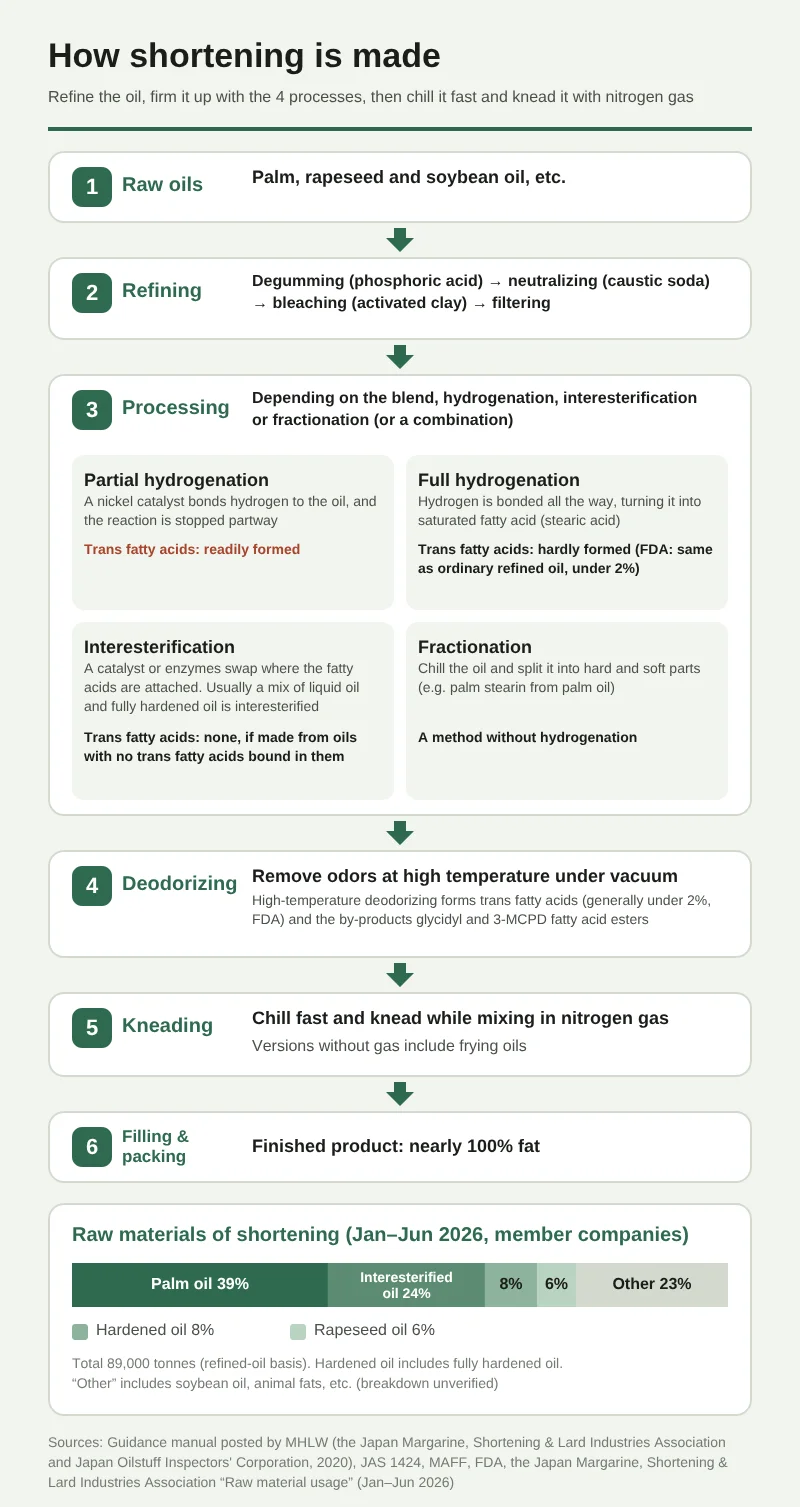
The “Manual for hygiene management incorporating HACCP concepts” posted by the Ministry of Health, Labour and Welfare (MHLW) (Japan Margarine Association and Japan Oil and Fat Inspection Association, 2020) describes the shortening process. “Edible refined processed fats and oils” that have been hydrogenated, interesterified or fractionated are accepted as raw materials.
- Refining: degumming (phosphoric acid) → deacidification (caustic soda) → bleaching (activated clay) → filtration
- Blending and deodorization: the oils are mixed and melted, and the odor is removed (with filtration in between)
- Working: the blended oil is kneaded while being quick-chilled. Some types are worked with nitrogen gas mixed in (MAFF’s 2013 material) and some are not
- Filling, packaging and aging: it is packed in containers, aged and shipped
Shortening is almost 100% fat (under 0.1% water in the manual), so microorganisms do not grow in it. The hazards the manual lists for shortening are cross-contact with allergens and foreign matter such as metal (strainer inspection in filtration and a metal detector). For hydrogenated oil (edible refined processed fats and oils), it is also checked every day that no nickel from the catalyst remains.
Four processes: hydrogenation, full hydrogenation, interesterification, fractionation
There are four ways to make fat firm. In the health discussion, it matters that “hydrogenation” and “full hydrogenation” are different things.
| Method | What it does | Trans fat | Notes |
|---|---|---|---|
| Partial hydrogenation | Binds hydrogen to the oil with a nickel catalyst and stops partway (example reaction conditions: catalyst 0.05–0.15%, hydrogen pressure from normal pressure to 0.5 MPa, 120–175°C) | Forms easily (average 25–45% trans fat in partially hydrogenated oil, WHO) | Under the U.S. FDA definition, an iodine value (a measure of the number of double bonds) above 4 |
| Full hydrogenation | Binds hydrogen all the way to make saturated fatty acid (stearic acid) | Almost none. The FDA says “about the same as ordinary refined oil (under 2%)” | MAFF explains that “unsaturated fatty acids, including trans fat, are not contained.” This differs slightly from the FDA’s explanation |
| Interesterification | Swaps the positions where fatty acids attach, using a catalyst (sodium methoxide, sodium hydroxide, or an enzyme) | None if made from oil with no trans fatty acids bound (MAFF) | Mixing liquid oil with fully hardened oil and swapping is the mainstream |
| Fractionation | Cools the oil and separates it into hard and soft portions | (a method without hydrogenation) | Hard palm stearin and the like are taken from palm oil |
MAFF explains why trans fat forms as follows.
- With hydrogenation (hardening) or the high-temperature heating of deodorization, some of the cis double bonds of unsaturated fatty acids in the oil can change to the trans form
- The same thing happens through microorganisms in the stomachs of ruminants such as cattle and sheep (which is why milk, beef and mutton contain natural trans fat)
- In frying (160–200°C, repeated heating), only a very small amount forms and its effect is negligible
According to the FDA, even refined vegetable oils that have not been hydrogenated generally contain less than 2% trans fat from the high-temperature deodorization step. In ruminant fat it is about 3%. So “not hydrogenated” does not mean “zero trans fat.”
Why it is used in bread, sweets and fried foods
Crisp, fluffy, light frying
Shortening has no taste. It is not eaten as it is; it is made as a fat to knead into other ingredients to bring out their flavor. The Japan Margarine Association explains its uses as follows.
- Cookies and biscuits: gives a light, crisp, crumbly texture. If you replace half the butter or margarine in a recipe with shortening, you can enjoy both butter flavor and a crisp texture
- Bread: bakes soft and fluffy
- Frying: it solidifies at room temperature, so the oil does not seep out and the food comes out light and crisp. Even freshly fried food does not leave oil on your hands. However, the association notes that what fast-food chains use differs slightly in composition from what is sold at retail
- It is also used in ice cream
This is an industry association’s explanation. The detailed mechanism of why it makes things crisp could not be confirmed in the public materials checked this time, so we do not write about it.
Keeps well
Shortening has almost no water (under 0.1% in the manual), so microorganisms do not grow. As a commercial example, product information for a Miyoshi Oil & Fat shortening (10 kg commercial) gives a best-before period of 120 days and 210 days after manufacture (unopened). The acid value, which shows the degree of fat deterioration, also has an upper limit in the JAS (0.2 or less; 2.0 or less for commercial products using emulsifiers).
How much is used? Mostly commercial
- Domestic consumption (shipments) in 2025 was 189,023 tons of shortening (Japan Margarine Association statistics). Margarine products were about 190,000 tons, and butter supply was about 84,000 tons (FY2024). The amount of shortening is about 2.3 times the butter supply. Because most of it is commercial, it is used in forms that are hard to see in stores (a rough estimate with different fiscal years and scopes)
- MAFF’s 2013 material also says that most shortening is commercial, used as an ingredient in sweets and bread or as frying oil, and only a small part is sold at retail for home use
- Types worked with nitrogen gas mixed in are used as ingredients in sweets such as cookies and biscuits and in bread, and types without gas are used as frying oil
For margarine, about 15% in 2025 was for home use and about 85% for commercial use. With shortening too, most of what we eat is in the form of sweets and bread.
How to read the label: “ショートニング”, “植物油脂”, “加工油脂”
How the name is written
Under the JAS for shortening (JAS 0989:2024), the name is written “ショートニング.” Unworked and fluid types add “未練り” (unworked) or “流動状” (fluid) in parentheses after the name. A product that has not been quick-chilled and worked is called unworked.
For the ingredient list (原材料名), the basic rule is to list the ingredients used in order of weight, using the most common names such as “大豆油” (soybean oil), “豚脂” (pork fat) and “硬化油” (hardened oil). They may also be grouped as “食用植物油脂” (edible vegetable fats and oils), “食用動物油脂” (edible animal fats and oils) or “食用精製加工油脂” (edible refined processed fats and oils).
Under the Food Labeling Standards, they are grouped as “植物油脂” or “加工油脂”
On the back of bread and sweets (Food Labeling Standards), edible fats and oils can be grouped as “植物油脂” (vegetable fats and oils), “動物油脂” (animal fats and oils), “加工油脂” (processed fats and oils) and so on (see the vegetable oils article).
- The words “ショートニング” (shortening), “硬化油” (hardened oil) and “トランス脂肪酸” (trans fat) do not appear in the text of the Food Labeling Standards (we searched the full text on e-Gov on October 3, 2026 and found 0 hits)
- Even when “加工油脂” is written, you do not have to state what is inside (hydrogenation, interesterification or fractionation). “加工油脂” does not necessarily mean hydrogenation
- Megmilk Snow Brand also explains that “食用精製加工油脂” includes hydrogenated, fractionated and interesterified processed fats and oils, and that trans fat forms in the hydrogenated portion. In other words, even if only “食用精製加工油脂” is written, you cannot tell whether it is partially hydrogenated unless there is a separate statement such as “partially hydrogenated fat not used”
Looking at the backs of Urayomi’s 78 products
We counted the ingredient lists of the 78 foods and daily goods featured on Urayomi (as of October 3, 2026, when the research notes were tallied).
| Words in the ingredient list | Number of products | Examples |
|---|---|---|
| Margarine, shortening, fat spread, hardened oil | 0 products | — |
| 加工油脂 (edible processed fats and oils) | 2 products | 味の素KKコンソメ(固形), クノール カップスープ コーンクリーム |
| 植物油脂 (including edible vegetable fats and oils and animal and vegetable fats and oils) | 9 products | ハウス シチューミクス クリーム, キユーピー マヨネーズ, 創味シャンタン, etc. |
| 食用油脂 (grouped name) | 8 products | コスモ直火焼のカレー・ルー, ハウス バーモント, etc. |
| Mixed fats and oils (palm oil, rapeseed oil) | 1 product | エスビー ゴールデンカレー |
| Beef tallow or lard is listed | 4 with beef tallow, 1 with lard | 3 from ハウス, 味覇, etc. |
20 of the 78 products list a fat.
- The reason that 0 products listed “ショートニング” or “マーガリン” is that Urayomi’s products are mainly seasonings such as roux, soups, dashi, sauces, tare and dressings, and there is almost no bread or sweets
- Even for foods like roux that need fat to set, what is inside “植物油脂” or “食用油脂” on the back is not known. In MAFF’s survey, the median trans fat in roux was 0.46 g/100g (FY2022–23), but the maximum was 7.0 (see the curry roux article)
In short, even if you avoid foods that say “ショートニング,” you cannot rule out that oil processed in the same way is inside a name such as “加工油脂” or “植物油脂.” Whether it is inside cannot be judged from the label alone.
Is it bad for you? Checking claim by claim
The phrase “shortening is bad for you” actually mixes together three separate stories.
- Trans fat formed by partial hydrogenation (its link to heart disease)
- Saturated fat, which increased in order to harden the fat
- By-products formed in refining (glycidol and 3-MCPD; covered in the next section)
Among the materials collected this time, there was no study that followed the health of people who ate shortening itself over a long period. What follows are studies by component.
Trans fat figures have fallen sharply over the past 15 years
MAFF has surveyed trans fat in the same food category three times (FY2006–07, FY2014–15, FY2022–23). The median for shortening went 12 → 1.0 → 0.61 g/100g.
| Survey | Samples | Median (g/100g) | Range |
|---|---|---|---|
| FY2006–07 | 10 | 12 | 1.2–31 |
| FY2014–15 | 24 | 1.0 | 0.46–24 |
| FY2022–23 | 12 | 0.61 | 0.52–0.86 |
- The 10 shortening samples that FSCJ surveyed in FY2006 had an average of 13.574 g/100g (maximum 31.210, minimum 1.150)
- When the same commission re-surveyed commercial margarine and shortening in FY2010, the average was less than one-tenth of the FY2006 figure (about 1 g/100g in most samples). However, commercial products were not purchased in the same way and the brands were not the same (only 11 household products were compared by the same brand), and it also writes that “there were products that had not been reduced and brands with high concentrations”
- The FY2022–23 maximum of 0.86 g/100g works out to 0.86 g per 100 g of fat, since shortening is 100% fat. This fits within the upper limit recommended by the EU and WHO (2 g per 100 g of fat). The FY2014–15 maximum of 24 does not. The analysis cannot distinguish naturally occurring trans fat
These three surveys cannot be read as simple increases or decreases.
- For FY2022–23, samples were chosen with sales volume in mind; for FY2014–15, they were not. FY2006–07 combines a survey by FSCJ and one commissioned by MAFF, with few samples, and MAFF itself writes “a rough guide”
- MAFF cautions that “differences between the results of each survey do not represent only increases or decreases”
- The shortening sample count is 12, which is not enough to see the distribution of what is on the market in Japan
Even so, we can tell that “shortening is high in trans fat, as it used to be” cannot be said. Companies have made fats low in trans fat using processing techniques such as interesterification and fractionation, even without regulation.
Even when it says “trans fat zero”
Even if the nutrition label on bread or sweets says “trans fat 0 g,” it is not necessarily truly zero. Japan has a guideline for how to write it.
- Under the Consumer Affairs Agency’s “Guideline on disclosure of trans fat information” (February 21, 2011), less than 0.3 g per 100 g of food may be written as “0 g.” An error of up to +20% is allowed
- To emphasize “contains none (zero, non, free),” saturated fat must also be under 1.5 g per 100 g (or under 10% of energy)
- In the U.S., less than 0.5 g per serving may be written as “0 g.” In South Korea it is under 0.2 g per serving (under 2 g per 100 g for edible fats and oils)
Applied to shortening, the 12 FY2022–23 samples from MAFF had a minimum of 0.52 g/100g. Under the Japanese guideline standard (under 0.3 g), none of the 12 samples tested is at a level that could be written “0 g.” Per 10 g, that is 0.052–0.086 g.
Please read “trans fat 0 g” or “trans fat free” as not meaning zero, but the lower limit of the amount a country’s rules allow you to write. The conditions for writing “zero” differ by country, so the same food may or may not qualify depending on the country (the trans fat article compares them by country).
Heart disease: blood lipid trials and follow-up studies
Research on trans fat and heart disease comes in two types: trials that look at blood lipids and observational studies that followed many people.
| Study | Type, size, duration | Result |
|---|---|---|
| Mensink and Katan (1990, NEJM) | Randomized crossover trial. 59 healthy people (34 women, 25 men), 3 diets for 3 weeks each, replacing 10% of energy | Compared with the oleic acid diet, the trans fat diet gave LDL 14 mg/dL higher and HDL 7 mg/dL lower. The saturated fat diet gave LDL 18 mg/dL higher but no change in HDL |
| Mensink et al. (2003, AJCN) | Meta-analysis of 60 controlled trials | The effect on the total cholesterol/HDL ratio was about twice as large for trans fat as for saturated fat |
| Willett et al. (1993, Lancet) | 85,095 U.S. nurses, 8 years, 431 coronary heart disease cases (observational study) | The group with the most trans fat had 1.50 times the risk of the group with the least (95% confidence interval 1.12–2.00) |
| Oh et al. (2005, AJE) | The same study extended to 20 years. 78,778 women (observational study) | The highest group had 1.33 times (1.07–1.66) the risk of the lowest |
| de Souza et al. (2015, BMJ) | Meta-analysis of observational studies | For total trans fat: all-cause death 1.34, coronary heart disease death 1.28, coronary heart disease 1.21. Industrial-origin trans fat: coronary heart disease 1.42 (1.05–1.92); ruminant-origin 0.93 (0.73–1.18). Stroke (1.07) and type 2 diabetes (1.10) were not significant |
- For blood lipids, human trials show a clear difference
- For the occurrence of heart disease, the results are from follow-up (observational) studies. Intake was estimated from diet questionnaires and other lifestyle factors are mixed in, so they do not prove cause. As of the FSCJ’s 2012 report, no intervention trial had been reported on whether reducing trans fat reduces heart disease. The WHO likewise separates blood lipids (trials) from disease (observational studies)
- de Souza’s “1.21, 1.28 and 1.34” are the figures cited in the WHO fact sheet, but they are totals that include naturally occurring trans fat. The values for industrial origin alone are in the table above
Japan’s public assessments are worded differently from the WHO’s view.
- Food Safety Commission of Japan (March 2012): Average Japanese intake is 0.3% of energy (about 0.67 g/day), and “in a normal diet the effect on health is small.” However, people whose diets are skewed toward fat need to take care. For the top 5% of consumers, intake was 0.70% (men) and 0.75% (women), and for boys aged 1–6 it was 1.02%, above the WHO target (under 1%). However, in an estimate using the commission’s FY2006 survey values, limited to hardened oil and edible vegetable oil sources, even the 99th percentile does not exceed 1%. Estimated with the upper bound of MAFF’s survey values, the 99th percentile for some age groups exceeds 1%
- Dietary Reference Intakes for Japanese (2025 edition): no target value is set for trans fat (because Japanese intake is lower than in Europe and the U.S., and reports of effects are not sufficient). But, saying “this does not mean the current situation is fine,” it gives as a reference value under 1% of energy, as low as possible. Comparing at average Japanese intake, it calculates the effect of trans fat at about 1/12 that of saturated fat
- WHO (2023): strongly recommends keeping trans fat to 1% of total energy. It does not distinguish industrial from natural. At 2,000 kcal, 1% is 2.2 g/day
Details of the research and the three intake estimates are in the trans fat article.
If trans fat was reduced, did saturated fat increase?
To cut the trans fat in shortening, firmness has to be produced another way. The ways are palm oil, fractionated hard oils, and fully hydrogenated oil (all of them oils high in saturated fat).
- FSCJ (commercial products surveyed in FY2006 and FY2010; purchase methods and brands not the same): average saturated fat went from 23.9 to 45.4 g/100g in commercial shortening (about 1.9 times) and from 29.9 to 40.9 in commercial margarine (about 1.4 times). The report writes that the saturated fat that increased along with the reduction needs continued attention
- MAFF (FY2022–23): it says no tendency was confirmed for saturated fat to increase by the amount trans fat decreased. The median saturated fat in shortening is 46 (range 38–54) g/100g, and in margarine 30 (17–45) g/100g
- The two results involve different samples, years and shares of commercial products, so we write both as a discrepancy. Just lining up the numbers, FY2022–23 shortening (46) is at about the same level as FY2010 commercial shortening (45.4), but they are different surveys, so we cannot say it increased or decreased
- In Denmark as well, among products surveyed twice after regulation, in more than two thirds of those whose trans fat had fallen it had been replaced mainly by saturated fat (often from coconut and palm oil) (MAFF’s summary)
So is saturated fat harmful? Researchers are divided (details in the article on vegetable oils and animal fats).
- American Heart Association (AHA, 2017): in trials that cut saturated fat and replaced it with polyunsaturated vegetable oil, cardiovascular disease fell by about 30%. But replacing it with refined carbohydrates or sugar does not lower it
- Cochrane review (2020): in 15 trials of 2 years or more that reduced saturated fat, cardiovascular events fell 17%. There was no difference in all-cause or cardiovascular death
- There are counterarguments: Chowdhury et al. (2014) reported no association, with a risk of coronary heart disease from saturated fat of 1.02 (0.97–1.07). Astrup et al. (2020) argue that for foods high in saturated fat, such as full-fat dairy, “there is no basis for restricting them further”
On the other hand, there is almost no debate about the harm of trans fat itself. Japan’s dietary reference intakes calculate that at the average Japanese intake, the effect of saturated fat is larger. “Reducing trans fat” and “not increasing saturated fat” are separate issues.
Is it “carcinogenic”?
The claim that shortening is “carcinogenic” also shows up in search suggestions (31 in Japanese). Here we first separate out the fact that two different stories are mixed together.
- Story A: Does trans fat cause cancer?
- Story B: Are the by-products formed in refined oils (glycidol and 3-MCPD) carcinogens?
What is and is not on the International Agency for Research on Cancer (IARC) list
IARC is an agency of the World Health Organization (WHO) that classifies the strength of evidence for carcinogenicity. Urayomi searched the 2018 list (Volumes 1–123) and checked.
| Substance | Classification | Volume, year |
|---|---|---|
| Glycidol | 2A (probably carcinogenic to humans) | Volume 77 (2000) |
| 3-MCPD (3-monochloro-1,2-propanediol) | 2B (possibly carcinogenic to humans) | Volume 101 (2013) |
| Trans fat, margarine, shortening, hardened oil, vegetable oil | Not on the list | — |
- Neither shortening nor trans fat is on the IARC list (we have not checked whether they were added in later volumes)
- This classification is “the strength of evidence for carcinogenicity (hazard),” and does not show how large the risk is at the amount eaten
- Glycidol and 3-MCPD are not in the oil directly. Edible oils contain them as by-products formed in the refining (high-temperature deodorization) step, bound to fatty acids (fatty acid esters). The European Food Safety Authority (EFSA) assumes that glycidyl fatty acid esters are almost entirely broken down in the body and absorbed as glycidol
Story B: it concerns refined oils in general, not shortening alone
MAFF buys and tests edible oils and margarine products (FY2012–13 and FY2023). The FY2023 (Reiwa 5) medians are as follows.
| Item | Samples | 3-MCPD esters (mg/kg) | Glycidyl esters (mg/kg) |
|---|---|---|---|
| Palm oil | 23 | 3.4 (1.3–5.4) | 1.1 (0.81–3.2) |
| Rice bran oil | 30 | 0.60 (0.15–7.3) | 1.1 (0.32–3.5) |
| Shortening | 12 | 1.50 (0.38–2.44) | 0.62 (0.12–1.08) |
| Margarine | 60 | 0.51 (0.09–1.42) | 0.33 (0.07–1.54) |
| Soybean oil | 24 | 0.095 | 0.29 |
| Olive oil | 5 | 0.28 | 0.15 |
| Lard | 20 | 0.15 | 0.07 |
- Palm oil is highest in 3-MCPD esters, and rice bran oil and palm oil are highest in glycidyl esters (both 1.1). The 3-MCPD esters in shortening are less than half those in palm oil
- Shortening uses palm oil as one of its main ingredients, so it is thought that the properties of the raw oil also show up in the product (we have not examined causation)
- MAFF explains that the reduction came from manufacturers’ efforts. But it also writes that glycidyl esters in margarine and shortening are “about the same” as in FY2012–13. Shortening had only 3 samples in FY2012–13, so that is a reference value
- As far as we checked, Japan has no maximum standard for refined oils, margarine and the like. The EU has limits: for edible vegetable fats and oils, 1 mg/kg for glycidyl esters, and for 3-MCPD esters 1.25 mg/kg (coconut, corn, rapeseed, sunflower, soybean, palm kernel, olive) or 2.5 mg/kg (palm and others) (EU regulation; from MAFF’s list)
- Lining up only the numbers, palm oil in the Japanese survey (3.4) is higher than the EU limit (2.5). Japan has no standard, so this does not mean “a violation,” and the analytical methods and sampling can also differ. They cannot be compared simply, but it is certain that oils sold in Japan also contain by-products at levels where the EU sets a limit
Calculate it yourself: the tolerable daily intake (TDI)
In 2018, EFSA set the tolerable daily intake (TDI) for the group of 3-MCPD and its fatty acid esters at 2 μg per kg of body weight per day (a value set using an index of excess growth of kidney cells, with an uncertainty factor of 100). A TDI is generally a guide to the amount estimated not to harm health even if eaten for a lifetime.
- EFSA concluded that adults, at both average and high intake, do not exceed the TDI
- However, it says that infants fed only infant formula, and high-intake children under 10, may exceed it
- Glycidyl fatty acid esters have no TDI. Because it is a genotoxic carcinogen, it is assessed by the “margin of exposure (MOE),” and 25,000 or more is considered low concern. For infants and children under 10, even the average may fall below 25,000, and high consumers aged 10 and over may too (EFSA’s estimated range: MOE 9,300–51,000 in the high-intake group aged 10 and over)
We apply Japan’s measured medians to the TDI (Urayomi’s calculation, not an official assessment).
| Food (median 3-MCPD esters) | Amount at which a 60 kg person reaches the TDI (120 μg) | Amount at which a 20 kg child reaches the TDI (40 μg) |
|---|---|---|
| Palm oil (3.4 mg/kg) | About 35 g | About 12 g |
| Shortening (1.5 mg/kg) | About 80 g | About 27 g |
| Margarine (0.51 mg/kg) | About 235 g | About 78 g |
- Formula: TDI (μg/day) ÷ median (μg/g). For 60 kg, 2 μg × 60 = 120 μg
- Nobody eats 80 g of shortening a day. It is in small amounts in many foods, such as bread, sweets and fried foods. Real assessments are made on the total across the whole diet, not one food (EFSA does the same)
- The calculation uses medians, so it does not include the spread between samples (0.38–2.44 for shortening)
What this calculation can say is that the by-products in shortening are at one level among refined oils, lower than palm oil and higher than rice bran oil, soybean oil and margarine; shortening alone is not especially high. We cannot say “so it is safe” or “so it is dangerous.” MAFF says that further reduction is needed for some foods.
Story A: trans fat and cancer
Research on trans fat and cancer is all observational.
| Study | Result |
|---|---|
| Michels et al. (2021, systematic review and meta-analysis of 46 observational studies) | Prostate cancer OR 1.49 (1.13–1.95) and colorectal cancer 1.26 (1.08–1.46) were significant. Breast cancer 1.12 (0.99–1.26) was not significant. Large variation between studies |
| Anjom-Shoae et al. (2020, 7 prospective studies on breast cancer) | Dietary trans fat 1.02 (0.95–1.10). Blood levels 1.37 only in postmenopausal women |
| Salemi et al. (2023, colorectal cancer) | 1.093 (1.017–1.176) overall, but using only cohort studies it was 1.027 (0.976–1.081), with no association visible |
- FSCJ (2012) says that for breast, colorectal and prostate cancer “there are many studies but the results are not consistent,” and that for other cancers “no conclusion can be drawn”
- Trans fat is not in the IARC classification of carcinogens, a public body’s classification
The answer to “carcinogenic”
- You cannot say that “trans fat is a carcinogen.” Observational results are not consistent, and it is not in the official classification
- You cannot say that “shortening is a carcinogen” either. Shortening is not on the IARC list. What is listed are by-products of refined oil (glycidol and 3-MCPD), and that is a story about refined oils in general, such as palm oil and rice bran oil
- In Japan’s measurements, shortening (1.5) was lower than palm oil (3.4) and higher than margarine (0.51)
- IARC’s 2A and 2B are classifications of the strength of evidence, not the size of risk at the amount eaten
In other words, the equation “shortening = carcinogenic” takes something that applies to many foods using refined oil and turns it into a story about shortening alone. Refined oil is also used in salad oil (soybean oil, rapeseed oil, etc.), and Japan’s measurements also detected small amounts in soybean oil (see the vegetable fats and oils article).
What about fully hydrogenated and interesterified shortening? Industry-funded studies
To harden fat without producing trans fat, fats made by interesterifying fully hydrogenated oil with liquid oil came into use. How far have their health effects been studied? We look at the main papers, lining up the funding sources.
| Study | Type, size, duration | Result | Funding and conflicts of interest |
|---|---|---|---|
| Sundram et al. (2007) | Randomized crossover. 30 healthy people, fully controlled diets, 4 weeks × 3. Palm olein / partially hydrogenated soybean oil / interesterified fat high in stearic acid | With both the partially hydrogenated soybean oil and the interesterified fat, the LDL/HDL ratio and fasting blood glucose rose. With interesterified fat, glucose was about 20% higher and insulin 22% lower | Funded by the Malaysian Palm Oil Board (MPOB). The first author is an MPOB employee and co-author Hayes is a member of the Palm Oil Advisory Council |
| Ng et al. (2018) | Parallel-group double-blind. 85 healthy overweight adults, 8 weeks | No difference in an index of insulin resistance between palmitic-type and stearic-type interesterified fats and natural palm oil | MPOB research funding |
| Hall et al. (2025) | Randomized crossover. 51 healthy people (47 completed), 6 weeks each. 10% of energy from muffins and margarine spread | No difference in total cholesterol/HDL ratio between palmitic-type and stearic-type interesterified fats (difference 0.05, −0.08 to 0.18). Only IL-10 decreased. Long-term effects unknown | MPOB research funding (the funder was not involved in planning or analysis). A co-author is an ADM employee and declared a relationship with Zoe |
| Mills et al. (2021) | Postprandial randomized trial (20 people) | Oils high in palmitic acid, with or without interesterification, increased atherosclerosis-related lipoproteins (small-particle LDL, remnants) more than rapeseed oil (an oil high in monounsaturated fat) (20 people). Interesterification itself did not change fat digestion or postprandial lipids | Funded by the UK BBSRC. The test fats were provided by ADM |
| Hayes and Pronczuk (2010) | Review of about 25 human trials | Trials containing small amounts of interesterified fat showed “no detectable abnormality.” Five or six trials that gave a high share of total energy as stearic-type fat showed adverse effects on lipoproteins, blood glucose, insulin and more. Adverse effects began from 7–8% of energy | Author Hayes declared membership of the Palm Oil Advisory Council in the 2007 paper |
- Trials at everyday amounts mostly showed “no difference.” However, they lasted 4–8 weeks and had a few dozen people
- The main trials were funded by a palm oil industry body (MPOB). This does not mean that bad results were hidden; it means the funding sources are skewed
- Full hydrogenation yields a fat of hard saturated fatty acid (stearic acid). According to the FDA, even nearly full hydrogenation can leave less than 2% trans fat
- We cannot say “safety has been confirmed” or “it is dangerous.” The most accurate statement is that there is little research and the long-term effects are not known.
Under Japanese labeling, both full hydrogenation and interesterification fall under the single term “加工油脂,” so consumers cannot choose between them (see the previous section).
Is it banned in the U.S.? And Japan? Regulations around the world
To start with the conclusion, Japan has no upper limit on trans fat content and no mandatory nutrition labeling for it. Businesses label voluntarily, following the Consumer Affairs Agency’s guideline.
The U.S.: what was banned is “partially hydrogenated oil”
It is sometimes reported that “shortening was banned in the U.S.,” but that is not accurate.
- June 17, 2015: the FDA made its final determination to remove partially hydrogenated oils (PHOs) from “generally recognized as safe” (GRAS) status
- June 18, 2018 was the compliance date. After later extensions, for uses without a petition, manufacture was allowed until June 18, 2018 and distribution until January 1, 2020. For uses with a petition, manufacture was allowed until June 18, 2019 and distribution until January 1, 2021
- What is covered is not trans fat but partially hydrogenated oil. Fully hydrogenated oil and naturally occurring (ruminant-origin) trans fat are not covered. If the FDA newly approves them, they can also be used
- Intake of industrial-origin trans fat in the U.S. fell from 4.6 g/day (2003) to 1.3 (2010) to 1.0 (2012) (FDA estimates)
Main regulations in the world
| Country or region | Regulation | Start |
|---|---|---|
| Denmark | Bans over 2 g per 100 g of fat in the final product (excluding natural origin). The world’s first | January 2004 (the rule began June 2003, with a transition period) |
| Switzerland | Bans over 2 g per 100 g in edible vegetable fats and oils | April 1, 2008 |
| U.S. | Removes partially hydrogenated oils (PHOs) from GRAS | June 18, 2018 (distribution 2020–21) |
| Canada | Bans the use of PHOs | September 17, 2018 |
| Taiwan | Bans the use of PHOs (iodine value over 4). Full hydrogenation allowed | July 1, 2018 |
| Thailand | Bans the manufacture, import and sale of PHOs and foods using PHOs | January 9, 2019 |
| EU | Trans fat other than natural up to 2 g per 100 g of fat (Regulation 2019/649) | Transition period until April 1, 2021 |
| India | Industrial-origin trans fat at 2% or less of fats and oils | January 1, 2022 |
| Hong Kong | Bans the use of PHOs and the import of fats and oils containing PHOs | December 1, 2023 |
| Malaysia | Bans the sale, etc., of foods with 2 g or more per 100 g of fat (excluding animal-fat origin) | September 1, 2025 |
| Japan | No upper limit; labeling is voluntary (guideline) | — |
- The “best policy” the WHO recommends is either an upper limit of 2 g per 100 g of fat or a ban on the manufacture and use of partially hydrogenated oils. The number of countries that implement it rose from 11 in 2018 (6% of the world’s population) to 53 countries by the end of 2023 (3.7 billion people, 46% of the population). Japan is not included
- Nine countries have received WHO “validation of elimination” (Denmark, Lithuania, Poland, Saudi Arabia, Thailand, and in 2025 Austria, Norway, Oman and Singapore). Japan is not among them
- On Japan’s position, MAFF (November 2024) explains it as “score 2 of the WHO’s four levels (countries taking other complementary measures),” while in the table of the WHO’s 2023 report it is in the “no data” column, so the two disagree
Japan is not “not regulating”; “for now, it is voluntary because of the numbers”
The summary of the Food Working Group of the Consumer Commission (May 2015) gave as its reason for not making trans fat labeling mandatory that “the estimated intake of the average Japanese person is under 1% of energy.” At the same time, it wrote that if a tendency for intake to increase is seen, regulation by an upper limit or mandatory labeling should be considered. The basis for having no regulation is “the numbers,” not a permanent conclusion.
- Companies moved first, without regulation. Megmilk Snow Brand, for 14 household margarine products and 1 shortening product, and Meiji, for 10 household products, stopped using partially hydrogenated oil in March 2018. Snow Brand explains that an image that margarine is high in trans fat had spread and was leading consumers to buy less (Nikkan Kogyo Shimbun)
- In the Consumer Affairs Agency’s 2020 survey (942 companies responded), of the businesses that said some of their own products contain trans fat, 14.3% provide information to consumers. The reasons for not providing it were “we do not know the content” 31.1%, “Japanese intake is said to be at a level with no effect on the body” 28.4%, and so on
- The view that Japan has not reached the WHO target and the FSCJ report’s “the effect is small in a normal diet” look at different units (the WHO report explains that for populous countries, even a low rate contributes to the number of deaths worldwide)
A detailed comparison of regulations by country and the reason Japan has none are summarized in the trans fat article.
How to choose and use it
From here, it is about what to actually do. Shortening is less a food you buy for home than a fat that is inside bread and sweets. So we divide it into three: “shortening for home use,” “when choosing bread and sweets,” and “alternative fats.”
Shortening you can buy for home use
In Japan, only a small part of shortening is sold for home use (Japan Margarine Association, MAFF).
- For Megmilk Snow Brand’s home-use shortening (in a tube), we could not find an official page and could not confirm it is sold
- MAFF’s 2013 material says that for home-use shortening, “almost no JAS-certified product is in circulation,” but about 80% of the consumers surveyed said a JAS standard is needed (there was a call for a household standard)
- The home shortening we could confirm on retailer pages this time was an imported product whose name includes “有機パーム油100%” (100% organic palm oil) and “トランスファットフリー” (trans fat free). We could not confirm the maker or the ingredient list
- Note that “trans fat free” means that under U.S. rules, less than 0.5 g per serving may be written as “0.” You cannot say “zero” from the name alone
Home-use shortening is in the food composition table (Standard Tables of Food Composition in Japan, 8th revised edition, 2023 supplement, per 100 g of edible portion).
| Food | Fat | Saturated fat | Monounsaturated | Polyunsaturated |
|---|---|---|---|---|
| Shortening (home use) | 99.9 g | 46.23 g | 35.54 g | 11.56 g |
There are three points to check.
- Whether the ingredient list is only one type of fat (palm oil, etc.). If it says only “加工油脂,” you cannot tell what is inside
- Whether the words “部分水素添加油脂” (partially hydrogenated fat) or “硬化油” (hardened oil) appear. If they do, trans fat may be high. Also look for a separate statement such as “部分水素添加油脂不使用” (partially hydrogenated fat not used)
- The amount of saturated fat. Shortening contains an amount of saturated fat close to butter’s (46.23 g per 100 g for home use)
We could not find individual published trans fat values for home-use shortening on companies’ official pages. A reference is MAFF’s survey values for 12 samples (median 0.61, range 0.52–0.86 g/100g).
Shortening is also used as an ingredient in spreads for bread. For example, the ingredients of a jam maker’s “パンにぬるホイップクリーム” (whipped cream to spread on bread; peanut and milk flavors) list “ショートニング” and “植物油脂.” Something you spread on bread in place of margarine may contain shortening, so check the ingredient list.
For home baking, the first rule of thumb is to choose one whose ingredient list is only fat and that you can confirm does not use partially hydrogenated fat.
When choosing bread and sweets
Most shortening is in bread and sweets. What does it come to converted to the amount you eat?
We multiplied MAFF’s FY2022–23 medians (per 100 g) by the amount eaten at one time (the range in the table of the FY2014–15 survey) and calculated the share of the WHO target (under 1% of total energy = 2.22 g/day at 2,000 kcal) (Urayomi’s calculation).
| Food | Median (g/100g) | Serving | Per serving (g) | Share of 2.22 g |
|---|---|---|---|---|
| Sliced white bread (1 slice of 6-slice loaf) | 0.03 | 56–69 g | 0.017–0.021 | 0.8–0.9% |
| Croissant (1) | 0.20 | 27–57 g | 0.054–0.114 | 2.4–5.1% |
| Doughnut (1) | 0.16 | 34–111 g | 0.054–0.178 | 2.4–8.0% |
| Shortcake (1 slice) | 0.12 | 70–143 g | 0.084–0.172 | 3.8–7.7% |
| Apple pie, etc. (1 piece or slice) | 0.13 | 79–181 g | 0.103–0.235 | 4.6–10.6% |
| Instant noodles (1 serving) | 0.10 | 71–160 g | 0.071–0.160 | 3.2–7.2% |
- Sliced bread is small at 0.8–0.9%, and even Western sweets and pies come to a few percent up to about 10% per serving. At one meal, this does not use up most of the WHO target. But it changes with how many times a day you eat them
- These values include not only trans fat from shortening but also naturally occurring trans fat from butter and dairy (the analysis cannot distinguish them)
- MAFF’s caution: the survey values are “a rough guide,” and the amount eaten also needs to be considered
- A “ranking of high-trans-fat foods” is a concentration per 100 g. It has to be considered separately from the amount you eat at one time. A detailed ranking is in the trans fat article
Let us also look at what is under a 0 g label. The nutrition tables of all 27 major breads at Seven-Eleven (as of December 22, 2025) show trans fat as “0 g.” The reason is the application of the guideline that “under 0.3 g per 100 g of product is labeled 0 g.” It does not mean the measured value is zero. In MAFF’s survey, the median for croissants was 0.20 with a range of 0.12–2.3 g/100g, and for sliced white bread 0.03 (0.03–0.16).
Restaurants and bread companies differ in how they disclose.
| Business | What it discloses | Numbers disclosed |
|---|---|---|
| Mister Donut (Duskin) | Has used a low-trans-fat frying oil in all stores since December 2007. The average per doughnut, pie or muffin went from about 1.44 g to about 0.25 g (about 83% reduction, calculated). The average for all current items is about 0.25 g (as of April 1, 2026, calculated from formulations) | Average only (per-product figures not found) |
| Seven-Eleven | Switched frying oil to an original low-trans-fat oil in 2007. All 27 major breads are labeled 0 g | “0 g” labeling only |
| Yamazaki Baking | Says it works to reduce trans fat and uses interesterification, fractionation and crystal-adjustment techniques. Says nutrition information is published on its website by product category | Says it is published on the website by product category. The table itself could not be confirmed |
| McDonald’s Japan | Says it changed its frying oil specification in 2007 and reduced trans fat in french fries | No figures confirmed on the official page (may not be visible because of dynamic display) |
| Lawson, FamilyMart | We could not confirm a disclosure page in this research | — |
All of these are the companies’ own explanations. Those that publish per-product values (g per 10 g, etc.) are Meiji, Megmilk Snow Brand and Sokensha for margarine; for bread and eating out, disclosure of only averages or “0 g” stood out (see the margarine article).
To look for bread that does not use shortening or margarine, do the following.
- Check whether the ingredient list on the back of the bread says “ショートニング,” “マーガリン” or “加工油脂”
- Instead, look for specific fat types such as “バター” (butter), “なたね油” (rapeseed oil) or “オリーブ油” (olive oil). However, butter also has natural trans fat, and in MAFF’s FY2006–07 survey (13 samples) the median was 1.9 g/100g
- When it says “植物油脂,” you cannot tell what is inside (see the vegetable fats and oils article)
- At an independent bakery, unpackaged bread may not have an ingredient label like the one on the back. In that case, asking the staff is the surest way (we have not checked the detailed labeling rules)
Whether shortening or margarine is written in the ingredient list is one of the few clues you can check yourself when choosing bread. When choosing bread by mail order, you can check the same way if the product page lists the ingredients.
Compare alternative fats by fatty acids
What can be used in place of shortening? It depends on the use (kneading in, frying), but first we compare fatty acid composition.
| Fat | Saturated | Monounsaturated | Polyunsaturated | Trans fat (source, year) |
|---|---|---|---|---|
| Salted butter | 50.45 g | 17.97 g | 2.14 g | 1.9 (MAFF FY2006–07, 13 samples. Natural origin) |
| Shortening (home use) | 46.23 g | 35.54 g | 11.56 g | 0.61 (MAFF FY2022–23, median of 12 shortening samples) |
| Lard | 39.29 g | 43.56 g | 9.81 g | 1.0 (MAFF FY2006–07, 3 samples) |
| Palm oil | 47.08 g | 36.70 g | 9.16 g | Individual value not checked |
| Coconut oil | 83.96 g | 6.59 g | 1.53 g | Individual value not checked |
| Olive oil (extra virgin) | 13.29 g | 74.04 g | 7.24 g | Under 0.1 (analysis examples from Nisshin OilliO, April 2023, and J-Oil Mills, March 2024) |
| Rapeseed oil | 7.06 g | 60.09 g | 26.10 g | 0.8 (Nisshin Canola Oil, April 2023) |
Fatty acids are in grams per 100 g of food (Table 1 of the food composition tables). The fatty acid tables of the Standard Tables of Food Composition in Japan have no trans fat values. The right-hand column is a MAFF survey value or a company-published value. The survey years and samples differ, so they cannot be compared on the same line.
- Fats high in saturated fat tend to be firm (firmness also varies with the type of fatty acid, so the order does not match exactly). Butter (71.5%), coconut oil (91.2%), palm oil (50.7%), shortening (home use 49.5%) and lard (42.4%) are the fats that are solid or semi-solid at room temperature (share per 100 g of fatty acids)
- Coconut oil has the highest share of saturated fat in this table (91.2%), higher even than butter
- Shortening made only from palm oil is not in the composition table. The composition of the raw palm oil (50.7% saturated) is a guide, but it can change with processing such as fractionation. Check the product’s nutrition label
- Butter has more saturated fat than home-use shortening (50.45 g vs. 46.23 g), but its trans fat includes natural ruminant-origin trans fat. Lining up MAFF’s values gives butter 1.9 and shortening 0.61 g/100g, but the years and surveys differ, so you cannot conclude that “butter has more”
- Lard is pork fat. The Japan Margarine Association describes lard’s characteristics as strong flavor and a low melting point that makes it liquefy quickly. It suits foods that use the flavor, such as fried foods and ramen
- The effect depends on what it replaces. In a researchers’ estimate (Mozaffarian and Clarke, 2009), replacing partially hydrogenated oil with 35% trans fat by butter for 7.5% of energy gives only a small reduction in coronary heart disease risk (−11.9% from trial data, −14.4% from follow-up studies). With canola oil it was −16.0% (trial data), and with soybean oil −33.4% (follow-up studies). All of these are estimates, and assume the high values of old shortening
Research on the health effects of fatty acids (LDL cholesterol, heart disease, dementia) is covered in the article on vegetable oils and animal fats and the article on oils, dementia and depression. Here we limit it to the points to look at when choosing a “substitute for shortening.”
- Whether you need firmness: shortening is made as a solid fat only for kneading in (Japan Margarine Association). Whether a liquid oil (rapeseed oil, olive oil) can substitute depends on the recipe. This article has not checked comparisons of the baked results
- The amount of saturated fat: firm fats tend to be high in saturated fat. As in the table, lard, butter and shortening are at about the same level, and coconut oil is higher still
- The amount of trans fat: in the range we checked, MAFF survey values or company-published values exist for each, but the survey years differ, so do not decide by lining them up
- Flavor: shortening has no taste or smell, while butter and lard have flavor and change the taste of the baked result
Storage, best-before dates and allergen labeling
- Best-before date: product information for commercial shortening (10 kg) gives 120 or 210 days after manufacture (unopened) (Miyoshi Oil & Fat). For home-use products, follow each product’s label
- When it hardens in the refrigerator: according to the Japan Margarine Association, lard and shortening are fats that are solid even at room temperature. If it hardens in the refrigerator, leave it at room temperature for a while before use and it will soften
- What “未練り” (unworked) means: not quick-chilled and worked. Types without nitrogen gas are used for frying oil and similar uses (MAFF materials). “ショートニング 未練り” is also a phrase that appears in search suggestions
- Allergen labeling: the handling of shortening itself could not be confirmed in this research. Check the “(一部に〜を含む)” (contains … in part) statement on the package. For example, the label of Megmilk Snow Brand’s Neosoft reads “(一部に乳成分・大豆を含む)” (contains milk ingredients and soybeans in part)
Items featured in this article (summary)
Here are the items featured in the article, collected again. The reasons and ingredients are in each section.
| Item featured | Where to buy |
|---|---|
| アリサン 有機ショートニング 680g (organic shortening, 680 g) | See on Rakuten (健康マイスター) PR See on Yahoo! Shopping PR |
| 丸和油脂 純製ラード 900g(国産) (pure lard, 900 g, domestic) | See on Rakuten (World NEXT) PR See on Amazon.co.jp PR See on Yahoo! Shopping PR |
| シェフズチョイス オーガニック エキストラバージン ココナッツオイル 500ml (organic extra virgin coconut oil, 500 ml) | See on Rakuten (シェフズチョイスジャパン) PR See on Amazon.co.jp PR See on Yahoo! Shopping PR |
| パンとピエルロ 冷凍食パン 2斤 (frozen sandwich bread, 2 loaves) | See on Rakuten (パンとピエルロ) PR |
Summary
| What you want to know | What we found |
|---|---|
| What is shortening? | A solid fat (also liquid) for kneading in, almost 100% fat. No water or milk ingredients. Has a JAS. In Japan, commercial use is the main one |
| When was it born? | In the late-19th-century U.S., as a lard substitute (cottonseed oil + beef tallow). Crisco with hydrogenation in 1911. In Japan it first appeared in the 1951 statistics and overtook margarine in 1959 |
| Origin of the name | “Shorten” (to make crumbly). It means to make crisp (the association’s explanation) |
| What is it made from? | Palm oil 39%, interesterified oil 24%, hardened oil 8% (January–June 2026, member companies). The share of hardened oil is 14.2% (2016) → 7.9% (2025) |
| Why bread and sweets? | Makes things crisp, fluffy and lightly fried (the association’s explanation). Almost no water, so it keeps well |
| What about trans fat? | MAFF medians 12 → 1.0 → 0.61 g/100g. Maximums 31 → 24 → 0.86. Each survey sampled differently |
| Is “0 g” really zero? | In Japan, under 0.3 g per 100 g may be written. The 12 shortening samples had a minimum of 0.52, a level that cannot be written “0 g” |
| Is it carcinogenic? | Trans fat, margarine and shortening are not on the IARC list. Glycidol (2A) and 3-MCPD (2B) are by-products of refined oils in general |
| What are Japan’s measurements? | Median 3-MCPD esters: palm oil 3.4, shortening 1.5, margarine 0.51 mg/kg (FY2023) |
| What about saturated fat? | Commercial shortening averages 23.9 → 45.4 (FY2006 → FY2010; brands not the same). MAFF (FY2022–23) found no tendency to increase, so the results are split |
| Full hydrogenation, interesterification? | Trials were a few dozen people for 4–8 weeks. Mainly funded by a palm oil industry body. Long-term effects unknown |
| Is it banned in the U.S.? | What was regulated is partially hydrogenated oil (from June 18, 2018). Full hydrogenation is not covered. Japan has no upper limit or labeling requirement |
| Can you buy it for home? Alternatives? | Few home-use products. Alternative fats differ in saturated fat, so check the composition table |
Sources
History, ingredients, how it is made
- Japan Margarine Association, “What is shortening?”, “What is lard?”, “Frequently asked questions (shortening and margarine)” https://j-margarine.com/kiso2/short/
- Japan Margarine Association statistics (production data04.xlsx and production-volume_r7.xlsx; raw material use 2016–2025 and January–June 2026; domestic consumption transition_r7_1.xlsx)
- AOCS, “The Battle Over Hydrogenation (1903–1920)” and “Wilhelm Normann (1870–1939)” https://www.aocs.org/resource/the-battle-over-hydrogenation-1903-1920/
- Google Patents “GB190301515A (Normann)”, Berlin Mills v. P&G, 254 U.S. 156 (1920)
- Snopes, “Was Crisco Invented as a Submarine Lubricant?”
- USDA ERS, “Butter and Margarine Availability Over the Last Century”, Food Availability Per Capita Data System
- Catalysis Society of Japan, Senior Forum News No. 77 (2015) and Industrial Catalysis Research Group News No. 73 (2012)
- “Manual for hygiene management incorporating HACCP concepts (margarine products, shortening, edible refined processed fats and oils)” posted by MHLW (Japan Margarine Association and Japan Oil and Fat Inspection Association, 2020)
- MAFF, “On the review of the Japanese Agricultural Standard for shortening (draft)” (2013), JAS 0989 and JAS 1424 (edible refined processed fats and oils), “How trans fat forms” and “Reducing trans fat”
- Miyoshi Oil & Fat, product information for “Pearl-in Shortening” and “Crone Shortening”
- Wikimedia REST API (page views), Google search suggestions (collected October 3, 2026; classified and tallied by Urayomi)
Health and research
- Mensink RP, Katan MB. N Engl J Med 1990 (PMID 2374566), Mensink RP, et al. Am J Clin Nutr 2003 (PMID 12716665)
- Willett WC, et al. Lancet 1993 (PMID 8094827), Oh K, et al. Am J Epidemiol 2005 (PMID 15781956)
- de Souza RJ, et al. BMJ 2015 (PMID 26268692)
- Michels N, et al. Nutr Rev 2021 (PMID 34104953), Anjom-Shoae J, et al. Clin Nutr 2020 (PMID 30954361), Salemi M, et al. Eur J Nutr 2023 (PMID 36322289)
- Sundram K, et al. Nutr Metab 2007 (PMID 17224066), Ng et al. Nutrients 2018 (PMID 30126103), Hall et al. Am J Clin Nutr 2025 (PMID 40975239), Mills et al. Am J Clin Nutr 2021 (PMID 33675343), Hayes KC, Pronczuk A. J Am Coll Nutr 2010 (PMID 20823487)
- Mozaffarian D, Clarke R. Eur J Clin Nutr 2009 (PMID 19424216)
- AHA Presidential Advisory. Circulation 2017 (PMID 28620111), Hooper L, et al. Cochrane 2020 (PMID 32827219), Chowdhury R, et al. Ann Intern Med 2014 (PMID 24723079), Astrup A, et al. J Am Coll Cardiol 2020 (PMID 32562735)
- Food Safety Commission of Japan, “Trans fatty acids in food” evaluation report (March 2012) and Q&A https://www.fsc.go.jp/sonota/trans_fat/iinkai422_trans-sibosan_hyoka.pdf
- MHLW, “Dietary Reference Intakes for Japanese (2025 edition)”
- WHO, “Saturated fatty acid and trans-fatty acid intake for adults and children: WHO guideline” (2023), WHO fact sheet “Trans fat” (January 2024)
- IARC, “Agents Classified by the IARC Monographs, Volumes 1–123” https://monographs.iarc.who.int/wp-content/uploads/2018/09/ClassificationsAlphaOrder.pdf
- EFSA. Risks for human health related to the presence of 3- and 2-monochloropropanediol (MCPD), and their fatty acid esters, and glycidyl fatty acid esters in food. EFSA Journal 2018 (PMC7009698)
- MAFF, “Survey of 3-MCPD fatty acid esters and glycidyl fatty acid esters in foods” (FY2023, FY2012–13), explanation of EFSA’s assessment
Regulation, labeling, content
- MAFF, “Survey of trans fatty acid content in foods” (FY2006–07, FY2014–15, FY2022–23), “International efforts on trans fat” and “Overseas regulations” (Denmark, the U.S., the EU, Canada, Taiwan and others)
- Consumer Affairs Agency, “Guideline on disclosure of trans fat information” (February 21, 2011), “On the dissemination and promotion of disclosure of trans fat information” (June 2020); Consumer Commission Food Working Group, “Summary on trans fat” (May 2015)
- Food Labeling Standards (Cabinet Office Order No. 10 of 2015, e-Gov law search, checked October 3, 2026)
- FDA, “Final Determination Regarding Partially Hydrogenated Oils” (Federal Register, June 17, 2015), EU Regulation 2019/649
- WHO, “Countdown to 2023” (2023), WHO announcements of January 29, 2024 and May 19, 2025
- MEXT, “Standard Tables of Food Composition in Japan (8th revised edition) 2023 supplement,” Fatty Acids, Tables 1 and 2
- Urayomi’s product data (October 3, 2026, 78 products)
Company disclosures
- Megmilk Snow Brand, “On trans fat and other lipid components” (updated September 2021), Meiji “Trans fat” page and February 8, 2018 release, published values from Nisshin OilliO and J-Oil Mills, official pages of Mister Donut (Duskin), Seven-Eleven, Yamazaki Baking and McDonald’s Japan
- Nikkan Kogyo Shimbun (February 2, 2018), FoodNavigator-Asia (June 11, 2018)
Related articles and databases
- Is Margarine Bad for You? History, How It's Made, How It Differs from Butter and Fat Spread, and Checking the “Plastic,” “Only in Japan” and “Banned Abroad” Claims
- Are Trans Fats Bad for You? Heart Disease Research, Global Regulation, Why Japan Has No Rules, High-Trans-Fat Foods and Japanese Intake
- What Is “植物油脂” (Vegetable Fat)? How True Is “Vegetable Oils Are Bad for You,” and What the Back Label Does and Does Not Tell You
- Are Lard and Butter Bad for You? 16 Plant Oils and Animal Fats (Beef Tallow, Fish Oil) Compared by Fatty Acids, and Which to Use Every Day
- Are emulsifiers bad for you? The history that began with egg yolk lecithin, types and uses, gut microbiota research (mice and humans), and how Japan and the EU label them
- Comparing Store-Bought Curry Roux by the Label: From Meiji-Era Cookbooks to Solid Roux, Fat, Salt and Additives in 11 Products, Lead in Turmeric, and Food Poisoning from Leftover Curry