
Is Margarine Bad for You? History, How It's Made, How It Differs from Butter and Fat Spread, and Checking the “Plastic,” “Only in Japan” and “Banned Abroad” Claims

PR This article contains affiliate links to Rakuten Ichiba, Amazon and Yahoo! Shopping (“See on Rakuten”, etc.). What it says is based on materials from public agencies and on research papers, whether or not ads are present. The “See on Amazon.co.jp” links are also affiliate links.
You hear all kinds of things about the margarine you spread on bread.
“Margarine is bad for you.” “It’s called edible plastic.” “Even bugs won’t go near it.” “It’s only sold in Japan.” “It’s banned overseas.” Yet there was also a time when people said it was “better for you than butter.”
Looking at Google’s search suggestions (tallied by Urayomi on October 3, 2026), the phrases people type about margarine fall roughly into the following groups.
| What readers wonder | Number of suggestion types | Examples |
|---|---|---|
| Bad for you, dangerous, cancer | 129 | “マーガリン 体に悪い” (“margarine bad for you”) / “マーガリン 危険性” (“margarine dangers”) |
| Difference from fat spread and shortening | 80 | “マーガリン ファットスプレッド 違い” (“margarine fat spread difference”) |
| Free of it, recommendations, rankings | 83 | “マーガリン おすすめ” (“margarine recommended”) / “パン屋 マーガリン 不使用” (“bakery margarine-free”) |
| Ingredients, how it is made, since when | 50 | “マーガリン 原料” (“margarine ingredients”) / “マーガリン なぜ作られた” (“why margarine was made”) |
| Difference from butter, which is better | 41 | “マーガリン バター どっち が体に悪い” (“margarine or butter, which is worse for you”) |
| Children, school lunches, babies, pregnancy | 37 | “マーガリン 給食” (“margarine school lunch”) / “マーガリン 妊娠中” (“margarine pregnancy”) |
| Only Japan, banned in the U.S., overseas | 32 | “マーガリン 日本だけ” (“margarine only Japan”) / “マーガリン アメリカ 禁止” (“margarine U.S. ban”) |
| Plastic, bugs, ants, never rots | 28 | “マーガリン プラスチック コピペ” (“margarine plastic copy-paste”) / “マーガリン 蟻 実験” (“margarine ants experiment”) |
These are not search counts. They show the range of questions people actually type. Many people want to know whether it is bad for them, but just as many want to know what it is made from and how, and what fat spread is.
In this article, we check the following against national statistics, laws, public-agency materials and papers:
- When, where and why margarine was born (Napoleon III, the war with the U.S. butter industry, hydrogenation, and “artificial butter” in Japan)
- How it is made, and how “partial hydrogenation,” “full hydrogenation,” “interesterification” and “fractionation” differ
- The legal differences between “margarine,” “fat spread” and “butter”
- How margarine of the past differs from margarine today (the government’s three surveys)
- How far we know about effects on the body, and which is better, margarine or butter
- Whether “one molecule away from plastic,” “even bugs won’t touch it,” “only in Japan” and “banned overseas” are true
- What to look at on the label, and how to think about children, school lunches, bread and sweets
Rather than deciding in one word that it is “bad” or “good,” we separate what has been confirmed from what has not.
The series on margarine, shortening and trans fat (3 articles)
- The margarine article: this article. History, how it is made, differences from butter and fat spread, and checking the myths
- The shortening article: ingredients, why it is used in bread and sweets, the “carcinogenic” claim, and alternative fats
- The trans fat article: heart disease research, regulation worldwide and why Japan has none, foods high in it and intake
Conclusion
- Margarine was patented in France in 1869 as a “butter substitute.” It is said that Napoleon III wanted a cheap replacement for butter. The first margarine was made from beef tallow and milk. The explanation that “butter shortages in the Franco-Prussian War were the trigger” does not fit the dates, because the patent application (July 1869) came before the outbreak of war (July 1870)
- “Margarine made from solidified vegetable oil” came after hydrogenation technology. And before the harm of trans fat, a by-product, was understood, U.S. reports of the 1970s and ’80s said there was “little reason for concern.” A 1990 Dutch trial (59 people) changed the course
- Margarine of the past and margarine today are different things. The median trans fat (per 100 g) in the same product category, as surveyed three times by MAFF, was 8.7 g (fiscal 2006–07) → 0.99 g (fiscal 2014–15) → 0.65 g (fiscal 2022–23) for margarine. However, the samples differ in each survey, so this is not a simple rise or fall
- What is in a home refrigerator is often legally “fat spread.” In 2025, of 28,787 tonnes of household margarine-type products, 23,987 tonnes (83%) were “fat spread” with less than 80% fat. Moreover, 85% of margarine-type products are for commercial use, not household use
- What has been confirmed about effects on the body is that blood LDL cholesterol goes up and HDL cholesterol goes down (trials in people), and an association with more heart disease (follow-up studies). The FSCJ (2012) assessed that at the average Japanese intake, “the health effect is small in a normal diet.” “Which is worse, butter or margarine” cannot be decided by a single number (per 10 g spread on bread, saturated fat is 5.05 g for butter and 2.30 g for margarine)
- “One molecule from plastic” and “bugs won’t come near it and it doesn’t rot” are not facts; they come from a chain email that circulated in the English-speaking world around 2003. “Only in Japan” is also wrong: world margarine production is about 9.38 million tonnes (2020), and Japan is 1.5% of it. What the U.S. banned was “partially hydrogenated oil,” not margarine itself
- Even without regulation, Japan’s raw materials have changed. The share of hydrogenated oil (硬化油) among raw materials for margarine-type products went from 10.2% (2016) to 3.2% (2025). In March 2018, Meiji and Megmilk Snow Brand switched their household products to “部分水素添加油脂不使用” (“no partially hydrogenated fats”)
- When choosing, look at the name (margarine or fat spread), the fat content, the “部分水素添加油脂不使用” statement, and saturated fat and trans fat per 10 g. “Trans fat 0 g” follows a guideline practice that allows it when the amount is under 0.3 g per 100 g; it is not a measured zero
Items featured in this article
| Item | When it helps | Where in the article |
|---|---|---|
| Margarine and fat spread made without partially hydrogenated fats | When you want to choose by checking trans fat against published figures | How to choose margarine and read the label |
| Butter | When you want to compare margarine and butter, or switch to butter | What to look at when choosing butter |
| Other fats to spread on bread (olive oil, etc.) | When you are looking for ways to spread or dip other than margarine or butter | Other options to spread on bread |
How was margarine born?
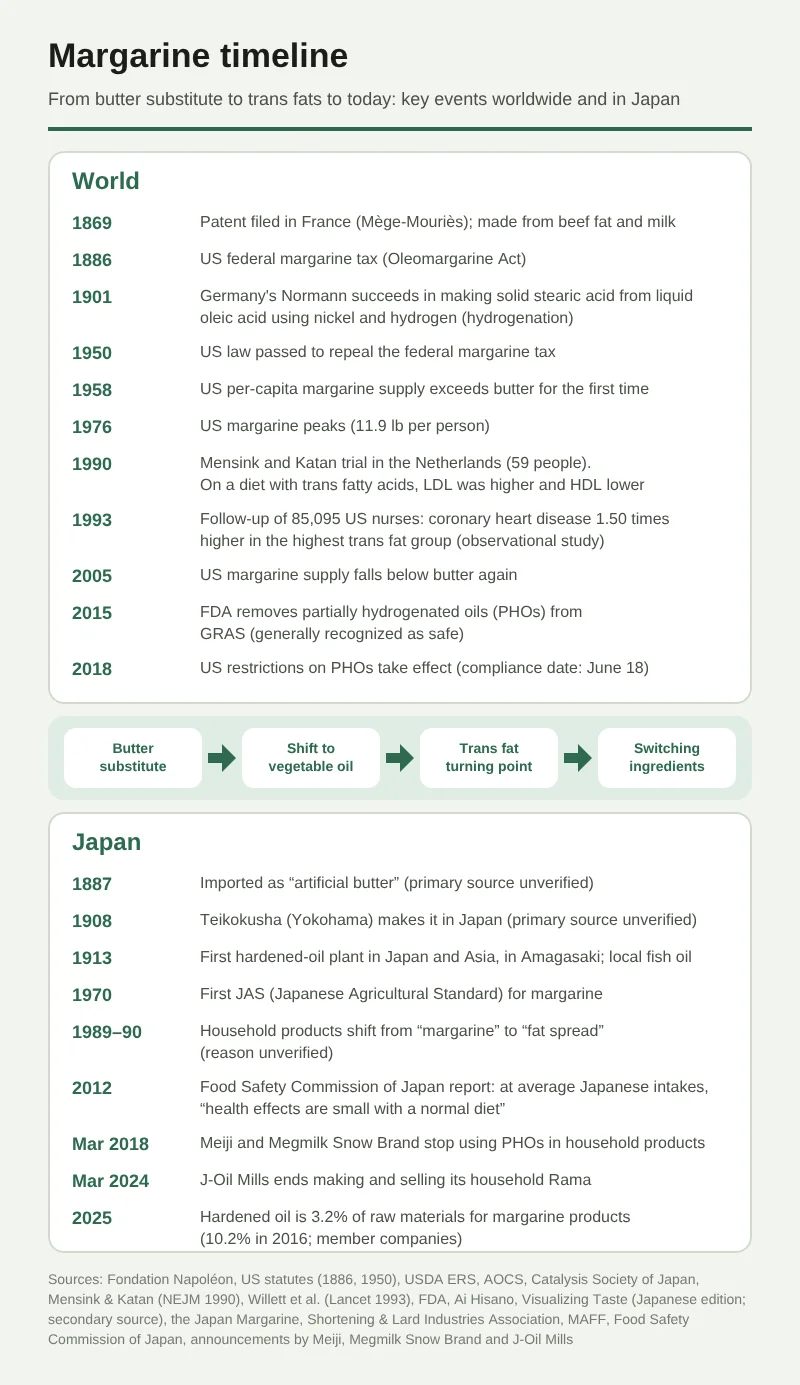
The history of margarine runs like this: it started with “butter is scarce and expensive,” passed through “better for you than butter,” and reached a turning point with “trans fat.” Here we lay out the events as a timeline, and where sources disagree, we give both.
1869: A patent is filed in France
- The French chemist Hippolyte Mège-Mouriès filed a patent in France on July 15, 1869, and in the U.K. on July 17 (French patent No. 86480, per Fondation Napoléon). A French lipid researcher’s site, however, gives the date of the same patent as “accepted on October 20, 1869.” It may be a difference between the filing date and the acceptance date, but we could not confirm it
- The first method was this: crush beef fat, wash it in water, treat it with a digestive enzyme to extract a liquid fat, and mix that with skim milk and tissue from cows’ mammary glands. There was no hydrogenation yet, and no vegetable oil was used
- The 1873 U.S. patent (US 146,012) says it artificially reproduces “the natural process by which a dairy cow reabsorbs her own fat and turns it into butter.” This has been judged a chemically mistaken understanding, but the discovery itself was real: treating beef fat at low temperature to take out a fat with little odor, and mixing it with milk, gives a butter-like flavor
Napoleon III is said to have “wanted a cheap substitute for butter.” However, the often-repeated story that he “held a contest and awarded a prize” could not be confirmed.
| Source | What it says |
|---|---|
| A French lipid researcher’s site | At the time of the 1866 Paris Exposition, the government sought a cheap fat source |
| Encyclopedia (English edition) | Received a prize from the government in 1870 |
| Explainer by a U.K. nonprofit | Says only that the government granted a patent in 1869 |
| A U.S. magazine (National Geographic) | Mentions a “huge prize” but gives no amount |
We found no primary source stating the prize amount, the year it was awarded, or the conditions. In this article we stop at “Napoleon III wanted a cheap substitute for butter.”
“The Franco-Prussian War was the trigger” does not fit the dates
Japanese food-industry newspapers and similar sources say that “butter ran short in the Franco-Prussian War, and Napoleon III offered a prize.” But the patent application (July 1869) came before the outbreak of the Franco-Prussian War (July 19, 1870). The order is reversed, so we cannot write that “the war was the trigger.” Sources do say it was used in 1870–71, when Paris was besieged.
The origin of the name: pearl
There are two explanations of the name “margarine,” and they are compatible.
- Japan Margarine Association: during manufacture, the fat droplets looked like pearls, so the name comes from the Greek “margarite” (pearl)
- A French lipid researcher’s site: Mège-Mouriès named it “oleo-margarine,” after the “margaric acid” named by Chevreul in 1813 (later found to be a mixture of palmitic and stearic acids)
The name of the acid itself comes from its pearl-like luster.
Spread across Europe
- In 1871 the method passed to the Dutch butter merchant Jurgens (the company that later became a source of Unilever). The Netherlands had no patent law at the time, so one study holds that what was sold was “knowledge of the method” rather than a “patent”
- Introduction by country: Germany 1872, Austria 1873, the U.S. 1874, Norway 1876, Sweden and Denmark 1884, the U.K. 1889 (a French lipid researcher’s site). The Association’s materials give 1895 for the U.K., so sources disagree
- In Denmark in 1900, per-person consumption per year is said to have been about 7 kg of butter and nearly 8 kg of margarine (an excerpt from Ai Kuno’s “視覚化する味覚” [“Visualized Taste”]; a secondary source). It is also written that in the Netherlands, Germany and Denmark margarine was on par with or above butter by 1900
- France itself: on April 6, 1897, the Senate passed a ban on coloring margarine and a ban on selling butter and margarine in the same place
In the U.S., it became a fight over “color”
In the U.S., margarine became the focus of a struggle with the butter industry, because it was cheaper than butter and could be colored yellow like butter.
| Year | Event |
|---|---|
| 1884–1891 | Vermont (1884), New Hampshire (1891) and South Dakota (1891) create “pink laws”: “a butter substitute may not be sold unless it is pink” |
| August 2, 1886 | The federal “Oleomargarine Act.” Special taxes of $600 a year for manufacturers, $480 for wholesalers and $48 for retailers, plus a tax of 2 cents per pound of product (it did not prohibit coloring itself) |
| 1894 | U.S. Supreme Court (Plumley v. Massachusetts): a state law banning the sale of margarine made to look like yellow butter is constitutional |
| 1898 | U.S. Supreme Court (Collins v. New Hampshire): a state law forcing margarine to be pink is unconstitutional |
| 1898 / 1902 | States banning coloring: 26 by 1898 (Smithsonian), 32 by 1902 (National Geographic). The numbers disagree |
| 1902 | Amendment of the federal law: 10 cents per pound for colored margarine and 1/4 cent for uncolored (Smithsonian) |
| March 16, 1950 | A law repealing the federal margarine tax is enacted (effective July 1). The encyclopedia says “1951,” but the text of the statute says 1950 |
| 1967 | Wisconsin ends the last remaining state restriction (encyclopedia and others) |
Selling white margarine with a small packet of yellow dye for people to mix at home also spread. For a long time there was a mismatched situation: “state laws banning making it yellow are constitutional, and state laws forcing it to be pink are unconstitutional.”
The result of this fight shows up in the numbers on American tables. In ERS statistics, annual supply per person moved as follows:
- 1909: butter 17.9 pounds, margarine 1.2 pounds (1 pound is about 454 g)
- 1958: margarine at 8.9 pounds exceeds butter for the first time (8.4 pounds)
- 1976: margarine peaks at 11.9 pounds (butter 4.3 pounds)
- 2005: margarine at 4.0 pounds falls below butter again (4.5 pounds)
- 2010: margarine 3.5 pounds (ERS ended its fats and oils statistics with this year)
In 1946 the price per pound was $0.23 for margarine and $0.71 for butter (ERS). On the rise in butter consumption, ERS writes that “concern about trans fat in margarine and the recent view that saturated fat is not so bad may be a factor.” This is only speculation, and the cause has not been confirmed. Note too that this is “supply,” calculated from what was on the market, not “amount eaten.”
Hydrogenation made the switch from beef tallow to vegetable oil possible
What was essential for margarine’s raw material to shift from beef tallow to vegetable oil was hydrogenation. It is a technique that bonds hydrogen to liquid vegetable oil and turns it into a fat that is solid at room temperature.
- In 1897 (some sources say 1899), Sabatier of France discovered a reaction that attaches hydrogen gas using nickel (Nobel Prize in 1912)
- On February 27, 1901, Normann of Germany succeeded in an experiment in which nickel and hydrogen acted on liquid oleic acid to give stearic acid (a solid fatty acid). The German patent is dated August 14, 1902, and the British patent 1903
- In 1914, butter ran short in Europe in World War I, and margarine production using partial hydrogenation of fats began, according to materials of the Catalysis Society of Japan
- In the U.S., by the 1930s partially hydrogenated domestic vegetable oil had become the mainstream (ERS), and by about 1950 manufacturers had almost entirely switched to vegetable oil
- The hardening of whale oil stopped being used after 1950 because of international whaling regulation, and fish oil replaced it (a French lipid researcher’s site)
From the same technology came “Crisco” in the U.S. in 1911. The history of shortening is covered in the shortening article.
Here is one thing that is easy to overlook. The chemists of the time are said not to have realized that “trans fat” forms during hydrogenation (explanation by the American Oil Chemists’ Society, AOCS; a secondary source). That was also the case around 1920, when the U.S. Supreme Court invalidated Crisco’s patent.
From “better for you than butter” to a turn
Margarine made from vegetable oil was long thought to be “better for you than butter.” We trace how that came about, as far as sources remain.
| Year | Event |
|---|---|
| 1961 | The American Heart Association (AHA) recommends replacing saturated fat with polyunsaturated fat (JAMA) |
| 1976 | Report of the Federation of American Societies for Experimental Biology (FASEB), requested by FDA: on hydrogenated soybean oil, “no evidence of hazard to the public” |
| August 1985 | FASEB report: on the safety of trans fatty acids, “little reason for concern at current or future expected intakes” |
| 1989 | FDA judges partially hydrogenated fish oil (menhaden oil), used in margarine in Europe, to be GRAS (generally recognized as safe) |
| August 16, 1990 | Mensink and Katan of the Netherlands (NEJM): 59 healthy people (34 women, 25 men) ate three diets for three weeks each, in random order. On the trans-fatty-acid diet, compared with the oleic acid diet, LDL was 14 mg/dL higher and HDL was 7 mg/dL lower |
| March 6, 1993 | Willett et al. of the U.S. (Lancet): following 85,095 nurses for 8 years, the group with the highest trans fat intake had 1.50 times the coronary heart disease of the lowest group (95% confidence interval 1.12–2.00). An observational study |
| October 1993 and February 1994 | A U.S. consumer group (CSPI) sends a letter and a petition to FDA asking for trans fat labeling |
| November 1999 | FDA publishes a labeling proposal. FDA wrote that “reports of the federal government and the National Academy of Sciences in the late 1980s found adverse effects unlikely” |
| January 2006 | Trans fat becomes mandatory on U.S. nutrition labels |
| June 17, 2015 | FDA’s final determination: partially hydrogenated oil (PHO) is not GRAS. Compliance deadline June 18, 2018. Fully hydrogenated oil and naturally occurring trans fat from cattle and others are excluded |
The quotations of the 1976 and 1985 reports are based on the CSPI petition (a group’s document). Because it is a document with the group’s own position, we could not confirm the original (the FASEB reports).
What this table shows is that both “it was considered safe at the time” and “now it is different” are facts. Science is updated. Until the 1990 trial appeared, the effect of trans fat on blood lipids was not weighed heavily in public reports. Conversely, what is called “certain” today may also be updated by new research.
Margarine in Japan: from “artificial butter”
Japan’s history is passed down as follows, mostly from secondary sources.
- It was imported as “artificial butter” (人造バター) in 1887, and Teikokusha (Yokohama) began domestic production in 1908 (an excerpt from Ai Kuno’s Iwanami Shinsho book and an encyclopedia agree, but we have not confirmed the original)
- Among usage examples in a dictionary (Nihon Kokugo Daijiten) is a 1926 text describing the “maagarin” served in milk halls as something with an unpleasant smell
- The change of name from “artificial butter” to “margarine” was November 1952 in one source and 1954 in another (we have not confirmed the original)
- The first JAS (Japanese Agricultural Standard) for margarine is the Ministry of Agriculture and Forestry notification of March 24, 1970 (Showa 45)
The “hydrogenated oil” industry that hardens the oil used in margarine began with fish oil.
- In 1908, Mitsumaru Tsujimoto of the Industrial Experiment Laboratory of the Ministry of Agriculture and Commerce succeeded in hydrogenating fish oil
- The British firm Lever Brothers built a soap, glycerin and hydrogenated oil factory in Japan in 1910 and in 1913 (Taisho 2) began Japan’s first hydrogenated oil production in Amagasaki (said to be the first hydrogenated oil factory in Japan and Asia). The raw material was fish oil from waters near Japan
- Kao Soap began producing edible hydrogenated oil (coconut oil) in 1928
- Fish oil as a raw material was exported in large quantities to Europe as hydrogenated oil for soap and margarine (Catalysis Society of Japan)
Hydrogenation in Japan began with fish oil. This comes up again later, in “the changeover of raw materials.”
Production can be traced from MAFF statistics reproduced by the Japan Margarine Association and from the Association’s member statistics.
| Year | Margarine (type) production | Shortening production | Note |
|---|---|---|---|
| 1926 | 618 tonnes | — | Whole industry |
| 1940 | 7,840 tonnes | — | Whole industry |
| 1945 | 826 tonnes | — | Wartime drop |
| 1950 | 20,060 tonnes | — | Whole industry |
| 1960 | 43,029 tonnes | 45,637 tonnes | Shortening first exceeded margarine in 1959 |
| 1970 | 108,440 tonnes | 77,038 tonnes | |
| 1980 | 222,289 tonnes | 136,816 tonnes | |
| 1990 | 249,715 tonnes | 175,833 tonnes | From 1986, “margarine-type products” including fat spread |
| 2009 | 233,833 tonnes | 207,643 tonnes | Last year for the whole industry |
| 2016 | 225,275 tonnes | 251,272 tonnes | Members only (the peak year for shortening) |
| 2025 | 192,749 tonnes | 185,329 tonnes | Members only |
From 2010, the Association’s statistics became a tally of member companies only, and are not continuous with 2009 and earlier (whole industry) (the Association’s note). 1945 was the year the war ended, and production fell to 826 tonnes. Three years later, in 1948, it was back to 22,422 tonnes, about 27 times as much.
How is margarine made?
Margarine is fat in which water is dispersed as fine droplets (a water-in-oil emulsion). It has the same form as butter, with a fat content of around 80% and moisture of a little over 10%. The manufacturing process has two parts: “turning liquid oil into a fat that is solid at room temperature,” and “mixing oil and water and solidifying it smoothly.”
The process: mix oil and water, chill quickly, and knead
In the manual by the Japan Margarine Association and the Japan Food Fat and Oil Inspection Association (posted on the MHLW website, 2020), the process for household margarine is as follows.
- Receiving and weighing raw materials (the raw fats / water, salt and milk powder / emulsifier, coloring and flavoring)
- Mixing and dissolving the oil side and the water side separately
- Emulsification: stirring at 50–60°C to mix oil and water
- Pasteurization: for example 63°C for 30 minutes (a critical control point)
- Filtration
- Rapid chilling and kneading: solidified by kneading while cooling
- Filling, forming and packaging, metal inspection
- Aging, storage and shipping
Salt and flavoring go into the water side. An emulsifier (such as lecithin from soybeans) is used for emulsification (details in the emulsifiers article). The manual states that the finished product has about 13–16% moisture and a water activity of 0.901–0.924.
In the 1940s, equipment that kneads while cooling (a scraped-surface heat exchanger, trade name “Votator”) made the process closed and continuous, and later became integrated with packaging machines (a French lipid researcher’s site; patent numbers and developers could not be confirmed).
The “reverse-phase type” of margarine was developed in Japan. Normally water is dispersed in oil, but in the reverse-phase type oil is dispersed in water, and it is said to spread easily without the whole becoming hard even when hard fats are used. The double-emulsion type wraps the outside of the reverse-phase type in oil again (Japan Margarine Association).
Four ways to make it firm
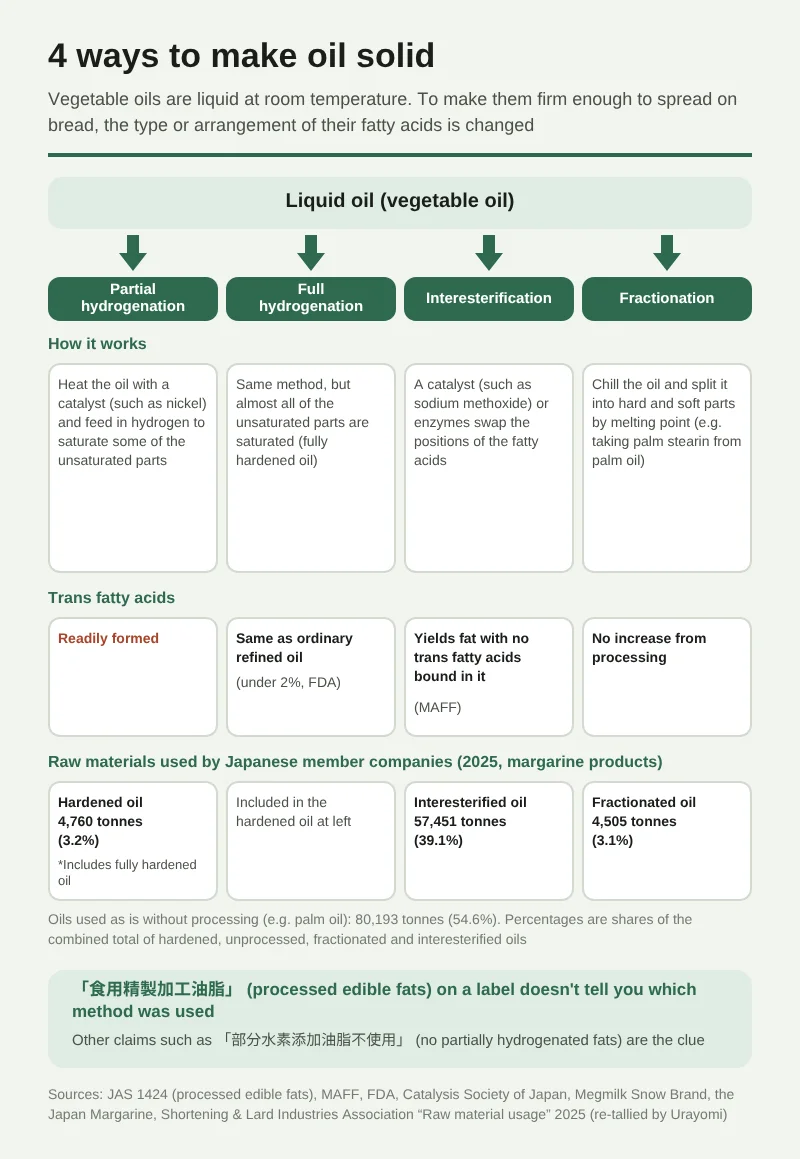
Vegetable oil is liquid at room temperature. To make it firm enough to spread on bread, the types and arrangement of the fatty acids in the oil are changed. There are broadly four methods.
| Method | How it works | Trans fat | Raw materials of Japanese member companies (2025, margarine-type products) |
|---|---|---|---|
| Partial hydrogenation | Add a catalyst (nickel, etc.), heat, and feed in hydrogen to saturate some of the unsaturated parts | Forms readily | Hydrogenated oil 4,760 tonnes (3.2%); includes fully hydrogenated oil |
| Full hydrogenation | The same method saturates almost all of the unsaturated parts | On par with ordinary refined oil (FDA: under 2% in the incompletely hydrogenated portion) | Included in the hydrogenated oil above |
| Interesterification | With a catalyst (sodium methoxide, etc.) or an enzyme, swaps the positions of fatty acids | Yields an oil in which no trans fatty acids are bound (MAFF) | 57,451 tonnes (39.1%) |
| Fractionation | Cool the oil and separate it into hard and soft parts by melting point (for example, taking palm stearin from palm oil) | No increase from processing | 4,505 tonnes (3.1%) |
In addition, oil that is not processed (palm oil and so on) is used as is, at 80,193 tonnes (54.6%).
Examples of hydrogenation reaction conditions are a nickel-based catalyst (0.05–0.15% of the oil by mass), hydrogen pressure from normal pressure to 0.5 MPa, and a temperature of 120–175°C (Catalysis Society of Japan). In this process, trans fat forms as a by-product.
MAFF explains why trans fat forms as follows.
- In hydrogenation (hardening) and in deodorization at high temperature, some of the cis double bonds in unsaturated fatty acids can change into the trans form
- The same thing happens through microbes in the stomachs of ruminants such as cattle
- It also happens in deep-frying (160–200°C, repeated heating), but in very small amounts whose effect is negligible
“Partial” and “full” are different things. By the U.S. FDA definition, an iodine value (a measure of the degree of unsaturation) above 4 makes it partially hydrogenated oil (PHO), and 4 or below fully hydrogenated oil (FHO). Even with FHO the reaction does not reach 100%, and trans fat remains at about the same level as in refined oil (under 2%). Ordinary refined vegetable oil also generally contains under 2% trans fat formed in high-temperature deodorization. Fat from cattle and others contains about 3% (FDA).
Japan’s raw materials have changed over the past decade
We re-tallied, year by year, the raw material usage published by the Japan Margarine Association. The changes in the oils used for margarine-type products (including fat spread) are as follows.
- Hydrogenated oil: 17,286 tonnes (2016) → 4,760 tonnes (2025). Its share of total raw materials went from 10.2% to 3.2%
- Interesterified oil: 53,067 tonnes (31.3%) → 57,451 tonnes (39.1%)
- Hydrogenated fish oil (the animal-derived part of hydrogenated oil): 4,380 tonnes (2016) → 224 tonnes (2025). The use of fish oil, the starting point of hydrogenation in Japan, has almost disappeared
- These are shares of the total of “hydrogenated oil (vegetable + animal),” “unprocessed oil,” “fractionated oil” and “interesterified oil”
There are three important cautions.
- “Hydrogenated oil” includes fully hydrogenated oil, so it is not a figure for partially hydrogenated oil, which is high in trans fat, alone
- The tally covers only the Association’s member companies
- “Hydrogenated oil decreased” does not mean trans fat became zero
Japan has no limit on trans fat and no labeling requirement (details in the trans fat article). Even so, in a market with no regulation, raw materials were replaced. According to the companies, one trigger was the 2018 U.S. regulation (described below).
For the half year from January to June 2026, of 72,153 tonnes of margarine-type products in raw material usage, interesterified oil was 28,247 tonnes, unprocessed palm oil 13,694 tonnes, unprocessed rapeseed oil 8,646 tonnes, and hydrogenated oil 2,232 tonnes (vegetable 2,160 tonnes, animal 72 tonnes). Other oils are also used.
When the label says “食用精製加工油脂,” the contents cannot be read
Here we return to the label. The Food Labeling Standards allow edible fats and oils to be written in the ingredient list under group names such as the following.
- Vegetable oil, vegetable fat, vegetable oils and fats (植物油, 植物脂, 植物油脂)
- Animal oil, animal fat, animal oils and fats (動物油, 動物脂, 動物油脂)
- Processed oil, processed fat, processed oils and fats (加工油, 加工脂, 加工油脂)
In other words, even if it says “食用植物油脂” (edible vegetable oils and fats) or “食用精製加工油脂” (edible refined processed fats and oils), you cannot tell whether the contents are partially hydrogenated, interesterified or fractionated. The words “shortening” (ショートニング), “hydrogenated oil” (硬化油) and “trans fat” (トランス脂肪酸) do not appear in the body text of the Food Labeling Standards (a search of the full text on e-Gov returned 0 hits; October 3, 2026). The words “trans fat” and “partial hydrogenation” do not appear in the JAS (Japanese Agricultural Standard) for margarine-type products and shortening either. However, the JAS for edible refined processed fats and oils themselves (commercial-use fats) requires “hydrogenated oil” and the like to be added alongside the name.
Megmilk Snow Brand explains that edible refined processed fats and oils include hydrogenated, fractionated and interesterified processed fats, and that trans fat forms in the process of making partially hydrogenated fats. That is why the label “食用精製加工油脂” alone cannot settle it, and a separate statement such as “部分水素添加油脂不使用” (no partially hydrogenated fats) becomes the clue.
The meaning of the wording “植物油脂” (vegetable oils and fats) itself is summarized in the vegetable oils and fats article.
Also, ways of reducing trans fat can increase other fatty acids. In its official Q&A, Sokensha explains that it uses fully hydrogenated fat (extremely hydrogenated oil) for part of the raw materials and does not use partially hydrogenated fats, which are high in trans fat. Full hydrogenation turns the fat into saturated fatty acids.
How do margarine, fat spread and butter differ under the law?
“Margarine” versus “fat spread” also had 80 suggestion types. The answer is the amount of fat.
| Item | Margarine | Fat spread | Butter |
|---|---|---|---|
| Basis | Food Labeling Standards, JAS 0932 | Same | The Ministerial Ordinance on Milk and Milk Products (乳等省令, the ordinance on standards for milk and milk products) |
| Amount of fat | Fat content 80% or more | Fat content under 80% (including those with added flavoring ingredients) | Milk fat 80.0% or more |
| Moisture | 17.0% or less | Fat content plus moisture of 85% or more (65% or more with sugar, honey or flavoring ingredients) | 17.0% or less |
| Milk fat | Under 40% | Under 40% and under 50% of the fat | Milk fat is the main ingredient |
| Labeling | Name “マーガリン” (margarine) | Name “ファットスプレッド” (fat spread). Required to show the fat content as a percentage | Name “バター” (butter) |
- Margarine-type products are defined as edible fat with water and other ingredients added, emulsified and rapidly chilled and kneaded, in a plastic (a property of changing shape under force and keeping it) or fluid form
- The upper limit for moisture in margarine was aligned to 17.0% or less in the 2008 revision of the JAS, from the old standard of “16.0% or less; but 17.0% or less for commercial-use products (except 25 g or less).” This is the same number as butter. MAFF explains that it unified the limit at 17.0% or less because products with 17% moisture classed as commercial-use were also sold to general consumers
- At the revision, the melting point standard (35°C or lower for household products) was also deleted. MAFF gives as the reason that products for baking and confectionery for general consumers have a wide melting point range, as commercial-use products do. At the time there were 26 domestic factories, and the JAS grading rate was 87% (fiscal 2006)
JAS is a voluntary standard. It is not the case that “anything that does not meet JAS cannot be called margarine” (the Food Labeling Standards have a separate definition).
More than 80% of the margarine in home refrigerators is fat spread
So which is actually sold? Here is the breakdown for household use from the statistics of the Japan Margarine Association (its members).
| Year | Household “margarine” | Household “fat spread” |
|---|---|---|
| 1986 | 86,524 tonnes | 1,887 tonnes |
| 1989 | 60,690 tonnes | 25,034 tonnes |
| 1990 | 23,847 tonnes | 54,798 tonnes |
| 2000 | 12,227 tonnes | 58,484 tonnes |
| 2010 | 11,348 tonnes | 43,037 tonnes |
| 2020 | 13,550 tonnes | 25,577 tonnes |
| 2025 | 4,801 tonnes | 23,987 tonnes (83%) |
In the single year from 1989 to 1990, household “margarine” and “fat spread” swapped places. The total was almost the same (85,724 tonnes → 78,645 tonnes), so it could be that products shifted to low-fat spread types or that the classification changed, but we could not confirm which.
- In 2025, household margarine-type products totaled 28,787 tonnes. Of these, “margarine” was 4,801 tonnes, and the remaining 23,987 tonnes (83%) are legally “fat spread”
- Household “margarine” fell sharply from 7,805 tonnes in 2023 to 4,952 tonnes in 2024. The Association explains this as the effect of a company that ended household margarine production in 2024 (the company is not named; Rama, described later, is an example of a withdrawal from household products). Household fat spread was nearly flat: 23,175 tonnes in 2023, 24,027 tonnes in 2024 and 23,987 tonnes in 2025
- 85% of margarine-type products are for commercial use, not household use. In 2025, commercial use was 163,419 tonnes, household 28,787 tonnes and school lunch use 543 tonnes (total 192,749 tonnes)
The story of “margarine at home” alone does not show the whole picture of margarine-type products. Most of it is what is used in bread, sweets and restaurants.
So if you turn over the package of the margarine in your refrigerator, the name field is often “ファットスプレッド” (fat spread), with a fat content of 60% or 66% written on it. For example, the official pages of each company state that Meiji “Corn Soft” has a fat content of 60%, Megmilk Snow Brand “Neo Soft” 66%, and the same company’s “Neo Soft Benibana” 39%.
Is today’s margarine different from margarine of the past?
Much of the basis for “margarine is bad for you” is figures for margarine of the past. Here we line up the results of three government surveys of the same product categories.
MAFF has chosen trans fat as one of the harmful chemical substances for which risk management should be given priority, and surveys its content in selected product categories each fiscal year.
| Product category | Fiscal 2006–07 | Fiscal 2014–15 | Fiscal 2022–23 |
|---|---|---|---|
| Margarine | 8.7 g (20 samples) | 0.99 g (46 samples) | 0.65 g (60 samples) |
| Fat spread | 6.1 g (14 samples) | 0.69 g (33 samples) | 0.48 g (60 samples) |
| Shortening | 12 g (10 samples) | 1.0 g (24 samples) | 0.61 g (12 samples) |
(Per 100 g of food, median)
- Looking at the lowest to highest values, margarine ranged 0.36–13 g in fiscal 2006–07, 0.44–16 g in fiscal 2014–15, and 0.33–1.3 g in fiscal 2022–23. Shortening reached a maximum of 24 g in fiscal 2014–15 but only 0.86 g in fiscal 2022–23
- MAFF cautions that “sampling and brands differ in each survey, and the differences do not represent increases and decreases alone.” In fiscal 2022–23 samples were chosen with sales volume in mind; in fiscal 2014–15 they were not, and both general-use and commercial-use products were surveyed. It also calls the number of samples “not enough to grasp the distribution in domestic distribution, and only a rough guide”
- Even so, MAFF sums up that “trans fat shows an overall downward trend compared with fiscal 2006–07 and 2014–15”
This is an example of our own calculation (not an official assessment). Margarine in fiscal 2022–23 had at most 1.3 g per 100 g, with a fat content of 81% or more. Converted per 100 g of fat, that is about 1.6 g at most. The upper limit recommended by the EU and WHO is 2 g per 100 g of fat (excluding natural trans fat), so in this survey, all 60 margarine samples come out within that level. However, the analysis cannot distinguish natural from industrial origin. For fat spread, the combination with fat content is unknown, so it cannot be calculated.
The FSCJ wrote that saturated fat increased. MAFF wrote that it did not
When trans fat is reduced, saturated fat may increase correspondingly to keep the product firm. On this, two Japanese surveys disagree.
| Survey | Result |
|---|---|
| FSCJ (the same brands compared between fiscal 2006 and fiscal 2010; 2012 risk assessment report) | Trans fat in general-use margarine went from an average of 5.28 g to 3.13 g (about 41% lower). Commercial-use margarine and shortening were below one tenth of fiscal 2006 (about 1 g in most samples). On the other hand, saturated fat rose from 29.9 g to 40.9 g (1.4 times) in commercial-use margarine and from 23.9 g to 45.4 g (1.9 times) in commercial-use shortening. The report wrote “note the increase in saturated fat” |
| MAFF (fiscal 2022–23) | Saturated fat showed “no major change.” “No tendency for saturated fat to increase along with the reduction in trans fat was confirmed” |
The samples, the years, and the proportions of general-use and commercial-use products all differ, so we can only report both. “Whether saturated fat increased” has different answers depending on how it was investigated. The health effects of saturated fat are themselves a matter on which researchers are divided (the vegetable and animal oils article).
Even without regulation, companies moved first
Japan has no limit on trans fat and no labeling requirement. Even so, the numbers went down. What happened?
- March 2018: For 10 target household margarine-type products, Meiji stopped using partially hydrogenated fats and put a “部分水素添加油脂不使用” (no partially hydrogenated fats) logo on the packaging. Megmilk Snow Brand stopped using partially hydrogenated fats in 14 products (and 1 shortening product). The change was timed to June 2018, when FDA regulation began in the U.S. (Meiji states this in its press release)
- Megmilk Snow Brand explained its reason for the change as: “the image has spread among consumers that margarine is a food high in trans fat, which has led them to buy less” (Nikkan Kogyo Shimbun, February 2018). Meiji wrote in its materials: “What the U.S. FDA excluded was ‘partially hydrogenated fats containing trans fat,’ but in Japan it was conveyed as if ‘trans fat’ were being banned”
- End of March 2024: J-Oil Mills ended production and sales of household margarine-type products (“Rama,” launched in 1966) (announced November 9, 2023). The reason was “aging manufacturing equipment and market trends,” and commercial-use products continue
The thing to hold on to here is that “the amount of trans fat” and “whether partially hydrogenated oil (PHO) is used” are separate matters. What FDA decided in 2015 was about the handling of PHO, not a ban on margarine. Note that the reasoning so far is the manufacturers’ own explanation. Whether amounts actually fell can be checked against the figures from the public surveys in the previous section.
The Japan Margarine Association (an industry group) explains in its November 2024 materials that many margarine-type packages state “we are working to reduce trans fat” and “the raw fats do not use edible hydrogenated oil (partially hydrogenated fats) high in trans fat.” Because it is an industry group’s material, it is safest to read its numbers together with materials from MAFF and the FSCJ.
Is margarine bad for you? What research tells us
First, the rules for how we write. Here we do not declare things “bad” or “safe.” We write only what has been confirmed, with the type of research (a trial in people or an observational follow-up study), the number of people, the duration and the source of funding.
Confirmed, part 1: blood lipids (trials in people)
The 1990 trial by Mensink and Katan (NEJM) is the starting point.
- 59 healthy people (34 women, 25 men) ate three diets, for three weeks each, in random order (a crossover trial)
- 10% of the diet’s energy was replaced with one of oleic acid (a fatty acid abundant in olive oil and others), trans oleic acid, or saturated fat
- Compared with the oleic acid diet, the trans diet gave LDL cholesterol 14 mg/dL higher and HDL cholesterol 7 mg/dL lower. The saturated fat diet gave LDL 18 mg/dL higher, but HDL did not change
The statement that “trans fat is worse than saturated fat in that it not only raises LDL but also lowers HDL” comes from here. In a study pooling 60 trials (Mensink et al., 2003), too, the effect on the ratio of total cholesterol to HDL was about twice as large for trans fat as for saturated fat.
Confirmed, part 2: heart disease (observational follow-up studies)
In studies that follow people for years, the result that people with more trans fat have more coronary heart disease has appeared repeatedly.
| Study | Content | Result |
|---|---|---|
| Nurses’ Health Study (Willett et al., 1993, Lancet) | 85,095 U.S. women followed for 8 years. 431 cases of coronary heart disease | The group with the highest intake had 1.50 times that of the lowest group (95% confidence interval 1.12–2.00). Among 69,181 who had steadily eaten margarine for 10 years, 1.67 times (1.05–2.66) |
| Same (Hu et al., 1997, NEJM) | 80,082 women followed for 14 years. 939 cases | For a 2% increase in energy, 1.93 times (1.43–2.61) |
| Same (Oh et al., 2005) | 78,778 women followed for 20 years. 1,766 cases | The highest group had 1.33 times (1.07–1.66) |
| Meta-analysis (de Souza et al., 2015, BMJ) | Summary of observational studies | Coronary heart disease 1.21 times (1.10–1.33). Industrial origin 1.42 times (1.05–1.92); ruminant (natural) origin 0.93 times (0.73–1.18). Certainty of evidence for coronary heart disease is “moderate” |
However, these are observational studies. They estimate intake from dietary questionnaires and cannot fully remove the influence of other lifestyle differences (people who eat a lot of margarine and sweets also differ in other ways). There is no trial that examined whether reducing trans fat actually reduces heart disease (the FSCJ and WHO, too, distinguish blood lipids as established by trials and disease as established by observational studies).
The 1993 study dates from a time when margarine’s trans fat was far higher than today. Whether “the results from margarine of the past can be applied as they are to margarine today” is a separate question.
Public assessments: the FSCJ, MHLW and WHO
| Agency | Content |
|---|---|
| FSCJ (March 2012) | The average Japanese intake is 0.3% of energy (about 0.67 g/day). “In a normal diet the health effect is small.” However, people whose diets are skewed toward fat need to be careful. For the 5% of people with the highest intake, it is 0.70% for men and 0.75% for women, and for boys aged 1–6 it is 1.02%, exceeding the WHO target (under 1%). However, this is estimated using the values from the FSCJ’s survey, and limited to hydrogenated oil and edible vegetable oil origins, even the 99th percentile does not exceed 1%. In estimates using the upper values of MAFF’s survey, the 99th percentile for males aged 1–14 and others exceeds 1% |
| MHLW, “Dietary Reference Intakes for Japanese (2025 edition)” | No target value is set for trans fat (because Japanese intake is lower than in Europe and the U.S.). However, saying “this does not mean the status quo is fine,” it gave as a reference value under 1% of energy, and as low as possible. Its effect compared with saturated fat, calculated at the average Japanese intake, is about one twelfth |
| WHO (2023) | Trans fat up to 1% of total energy (strong recommendation), and further to under 1% (conditional recommendation). It does not distinguish industrial from natural origin. For a 2,000 kcal diet, 1% is 2.2 g/day |
The FSCJ also writes that how much it is related to disease risk at Japanese intake levels is not clear. The backing for the assessment comes from studies in Europe and the U.S.
“Bad for you” and “the effect is small” are not contradictory. Hazard (when the amount is large) and risk (at the actual intake) are separate matters. We treat this in detail in the trans fat article.
Calculating it yourself: trans fat in the margarine on one slice of bread
The margarine spread on a slice of bread is 8–10 g (a guide from Megmilk Snow Brand’s materials). We calculate with 10 g (Urayomi’s calculation; the survey years and samples differ, so read it as a “guide”).
| Period | Median (per 100 g) | Per 10 g | Amount that reaches the WHO guide (2.2 g) |
|---|---|---|---|
| Fiscal 2006–07 | 8.7 g | 0.87 g | About 25 g of margarine alone |
| Fiscal 2022–23 | 0.65 g | 0.065 g | About 340 g of margarine alone |
- 2.2 g is the amount equal to 1% of a 2,000 kcal diet. In reality, trans fat also comes from foods other than margarine (bread, sweets, fried foods, dairy products, meat and so on)
- 0.065 g per 10 g is about 3% of 2.2 g. This is why we can say that margarine of the past and margarine today are different things
- On the other hand, this is not a calculation that says “so it is fine to eat” or “so it is bad.” Margarine alone is small, but adding up other foods, depending on how they eat, some people come close to 1% (for example, the FSCJ’s top 5% of people, and a dietary survey of female students with an average of 0.90% of energy [Yamada et al., 2009, 1,136 people, cross-sectional study])
“Less trans fat” alone does not settle it: saturated fat
Even if the trans fat in margarine has decreased, saturated fat is another matter. Compared per 10 g spread on bread, it is as follows (see the graph below).
- Salted butter: saturated fat 5.05 g
- Household shortening: 4.62 g
- Household margarine: 2.30 g
- Fat spread: 2.04 g
Saturated fat raises LDL cholesterol. But it is also a topic on which researchers are divided.
- The American Heart Association (2017) strongly recommends reducing saturated fat and replacing it with polyunsaturated vegetable oils, citing trials in which cardiovascular disease fell by about 30% (replacing saturated fat with refined carbohydrates or sugar does not reduce it)
- On the other hand, a 2014 meta-analysis (Chowdhury et al.) found no association between saturated fat and coronary heart disease (1.02 times, 0.97–1.07). A 2020 JACC review (Astrup et al.) says evidence is accumulating against recommendations to reduce saturated fat, and that there is no basis for further restricting foods high in saturated fat such as full-fat dairy, unprocessed meat and dark chocolate
Japanese people take in less saturated fat than people in the West, and some studies suggest that it cannot be said that “the less, the better” (details in the vegetable and animal oils article).
What about other diseases? Cancer, dementia and others
The claims that “margarine causes cancer” or “causes dementia” are at a stage where causation cannot be stated.
- Cancer: The FSCJ says for breast, colorectal and prostate cancer that “there is a lot of research but results are not consistent,” and for others “no conclusion can be drawn.” In a 2021 meta-analysis of 46 papers, prostate cancer (odds ratio 1.49) and colorectal cancer (1.26) were significant, and breast cancer (1.12) was not. The type of research is observational
- Dementia: In Japan’s Hisayama Study (1,628 people, median 10.3 years, 2019), people with higher blood elaidic acid (an indicator of industrial trans fat) had more dementia and Alzheimer’s disease, with no association with vascular dementia. It was an observational study, and blood was measured once. A 2022 systematic review says that “no fatty acid shows a robust association with dementia” (details in the oils and dementia/depression article)
- Pregnant women and fetuses: The FSCJ’s report writes that associations with decreased fetal weight, miscarriage and stillbirth have been reported. See the trans fat article for details
- Diabetes: In a summary of 7 trials in people, blood sugar and insulin did not change (2012). The FSCJ says “no conclusion can be drawn”
A large meta-analysis of long-term follow-up built around “margarine alone” was not found in this survey. Most studies look at “trans fat” as a whole and do not distinguish whether it comes from margarine.
There is also a trial of margarine containing almost no trans fat. In a trial (2001) in which 77 people with high cholesterol (aged 35–65; 72 completed) ate each for 23 days in alternation with butter, during the margarine period LDL cholesterol was 11.3% lower than with butter. However, the food company that developed the product was involved, and no record of the source of funding exists.
How to read the label
From here on is about choosing margarine in the store.
The name field: “margarine” or “fat spread”
As noted earlier, more than 80% of household products are fat spread. The name field tells you which it is.
- Margarine: fat content of 80% or more
- Fat spread: fat content under 80%. The fat content is written in %
The lower the fat content, the higher the proportion of water and of water-side ingredients (salt, milk powder and so on). Even for the same 10 g, the amount of fat differs. If you line up “fat” and “saturated fat” in the nutrition facts per 10 g and compare, the difference becomes visible.
The ingredient field: edible vegetable oils and fats, edible refined processed fats and oils
The ingredient list is written in descending order of amount used. For household products, the following ways of writing are common (each company’s official labeling; checked October 3, 2026).
- 食用植物油脂 (国内製造) (edible vegetable oils and fats, made in Japan), 食用精製加工油脂 (edible refined processed fats and oils), 脱脂粉乳 (skim milk powder), 食塩 (salt), 牛乳 (milk) / 乳化剤 (emulsifier; from soybeans), 香料 (flavoring), 着色料 (coloring; β-carotene) (Meiji Corn Soft)
- 食用植物油脂 (国内製造), 食用精製加工油脂, 食塩, 粉乳 (milk powder) / 乳化剤, 香料, 着色料 (carotene) (Megmilk Snow Brand Neo Soft)
- 食用植物油脂 (国内製造), 食用精製加工油脂, 発酵乳 (fermented milk), 全粉乳 (whole milk powder), クリーム (cream), 食塩 / レシチン (lecithin; from soybeans) (Sokensha Benibana High Plus Margarine)
As written above, the contents of “食用精製加工油脂” cannot be told from the label. Milk ingredients and soybeans can be told from the allergen labeling (“contains milk ingredients and soybeans”). What emulsifiers are is in the emulsifiers article.
The trans fat field: what “0 g” means
In Japan, trans fat labeling is not required (the words trans fat do not appear in the Food Labeling Standards). Companies write it voluntarily, based on the Consumer Affairs Agency’s “Guideline on Information Disclosure” (2011). The guideline’s rules are as follows.
- The unit is g. The allowed error is plus 20% (no lower limit)
- “0 g” may be written when the amount is under 0.3 g per 100 g of food
- To emphasize “does not contain (zero, non, free),” saturated fat must also be under 1.5 g per 100 g (or under 10% of calories)
In other words, even if “0 g” is written, it is not necessarily a measured zero. For example, spreading 10 g of margarine gives 0.065 g, which is 0.65 g per 100 g, so under Japan’s guideline it cannot be written as “0 g.” On the other hand, under the U.S. standard (under 0.5 g per serving) and the Korean one (under 0.2 g per serving), the same 10 g of margarine (taking 10 g as one serving) is at a level where “0 g” can be written (Urayomi’s calculation. Each country has separate rules for “0” in the nutrition facts and for the “free” claim, so how it is applied on actual labels needs to be checked country by country).
“部分水素添加油脂不使用” and companies’ published figures
For Japanese household margarine-type products, Meiji and Megmilk Snow Brand have already switched, in March 2018 (J-Oil Mills withdrew from household products in March 2024). The difference when choosing now has shifted from “whether it is free of them” to points like the following.
| Company / product | What is published | Figures |
|---|---|---|
| Meiji “Corn Soft” (fat spread, 60% fat) | Publishes trans fat for each product | 0.1 g per 10 g (as of March 2018). The company writes it is about one tenth of 2005 |
| Megmilk Snow Brand “Neo Soft” (fat spread, 66%) | Publishes trans fat and saturated fat per 10 g (updated September 2021) | Trans fat 0.05 g, saturated fat 2.3 g. In the same document’s table of household margarine-type products (9 rows), 0.02–0.1 g |
| Sokensha “Benibana High Plus Margarine” and “Fermented Soy Milk Margarine” | Published on the official product pages | About 0.03 g per 10 g |
| Seven-Eleven (bread) | Shows trans fat in nutrition tables | All 27 main breads are 0 g (as of December 22, 2025). The practice is to show 0 g for under 0.3 g per 100 g |
| Mister Donut | Publishes an average | About 0.25 g per piece on average across all items (as of April 1, 2026; a calculated value based on recipes). Switched to a low-trans-fat frying oil in December 2007, down about 83% from the previous average of about 1.44 g (calculated values) |
| McDonald’s Japan | Changed its frying oil specification in 2007 | We could not confirm figures on its official page |
We could not find published pages for Lawson or FamilyMart. The differences in disclosure are clear: “gives grams per product” (Meiji, Snow Brand, Sokensha), “0 g only” (Seven-Eleven), “only an average” (Mister Donut), “no figures” (McDonald’s, as far as we could confirm). Under the “0 g” on bread, how much is there actually? In MAFF’s fiscal 2022–23 survey, the median for sliced bread was 0.03 g per 100 g (range 0.03–0.16 g), and for croissants 0.20 g (0.12–2.3 g). We summarize this in the trans fat article.
How to choose margarine and read the label
Here is the above, in the order you see it in the store.
- Name: “margarine” or “fat spread.” Fat spread shows its fat content (60%, 66%, 39% and so on)
- Ingredients: besides “食用植物油脂” and “食用精製加工油脂,” whether butter, milk or fermented milk is included (these contain natural trans fat of dairy origin). Allergen labeling for milk ingredients and soybeans
- Statements such as “部分水素添加油脂不使用”: whether they are on the package. Even if not, it can sometimes be confirmed on the manufacturer’s official site
- Nutrition facts: line up fat and saturated fat per 10 g. Trans fat is voluntary, so it is often not written. Look for the figures published on the official site
- Price: compare per gram. For example, Meiji Corn Soft’s suggested retail price is 324 yen for 300 g (tax included, at launch on September 1, 2024), about 1.08 yen per gram. Sokensha’s “Benibana High Plus Margarine” is 443 yen for 180 g (tax included), about 2.46 yen per gram (checked October 3, 2026)
Price differences come from differences in fat content, raw materials and size. A higher price does not mean less trans fat (choose by looking at the published figures).
Whether partially hydrogenated fats are used can be confirmed from the package labeling and each company’s published materials. Here we introduce household margarine and fat spread that carry such statements.
Checking “one molecule from plastic,” “only in Japan” and “banned overseas”
From here on we check the myths. First, “only in Japan” and “banned overseas.”
Is “margarine is sold only in Japan” true?
To state the conclusion first, it is wrong.
World margarine production in 2020 was about 9.38 million tonnes (9,377 thousand tonnes). The top producers were Russia 1.365 million tonnes, Pakistan 915 thousand tonnes, Brazil 810 thousand tonnes, India 692 thousand tonnes, Turkey 640 thousand tonnes, the U.S. 460 thousand tonnes, China 440 thousand tonnes and Germany 353 thousand tonnes. Japan produced 143 thousand tonnes, 1.5% of the world. The figures for Pakistan, India and Turkey include “vanaspati,” a hydrogenated vegetable fat.
Japan’s figure (143 thousand tonnes) is smaller than the Association’s member statistics (about 210 thousand tonnes of margarine-type products in 2020). The scope of the tallies seems to differ, but we could not confirm the reason.
As noted earlier, U.S. consumption peaked in 1976 (11.9 pounds per person) and fell to or below butter in 2005. The European Margarine Association (IMACE) writes in its self-introduction that the EU has a market of about 2.3 million tonnes a year (the survey year is unknown).
Is “margarine is banned overseas” true?
We could not confirm any country that has banned margarine. What is banned or capped is “trans fat” or “partially hydrogenated oil (PHO).”
| Country / region | What is decided (effective date) |
|---|---|
| Denmark | Bans more than 2 g per 100 g of fat in the final product (January 2004; the first in the world) |
| U.S. | FDA removes PHO from GRAS (decided June 17, 2015; compliance deadline June 18, 2018) |
| Canada | Bans the use of PHO (September 17, 2018) |
| Taiwan | Bans the use of PHO in food (July 1, 2018) |
| Thailand | Bans the manufacture, import and sale of PHO and foods that use it (January 9, 2019) |
| EU | Trans fat other than natural, up to 2 g per 100 g of fat (Regulation 2019/649; transitional period until April 1, 2021) |
In every country, the target is not “margarine” but “oil high in trans fat.” It is said that the 2015 FDA news was reported as a “margarine ban,” and the misunderstanding spread (J-CAST 2015, Kazuki Matsunaga’s 2022 fact-check and others). Thailand’s Ministry of Public Health explains that “it does not prohibit trans fat from being detected in food.”
According to WHO, 53 countries (46% of the population) had implemented the “best-practice policy” on trans fat at the end of 2023. Japan is not among them (it is a fact that Japan has no regulation or labeling requirement; the reasons are written up in the trans fat article).
So the summary is: “only sold in Japan” is wrong, and “Japan has no regulation” is true.
Is “it is only one molecule different from plastic” true?
The origin of this claim is clearly known. It was an English-language chain email, “Butter vs. Margarine,” that circulated from around June 2003 (the U.S. fact-checking site Snopes and others).
- It came as a set of phrases: “margarine is only one molecule away from being plastic,” and “would you spread melted Tupperware on your toast?”
- Claims such as “flies won’t go near it,” “nothing grows on it” and “even bugs won’t eat it” are in the same chain email
- As recently as November 2024, it was shared more than 60,000 times on Facebook
The verdict is “false.”
- Margarine is a mixture of multiple compounds, centered on triglycerides (glycerin bound to three fatty acids). It is a different thing from plastic (a polymer, meaning the same structure linked in long chains)
- “One molecule different” can be rephrased like this: hydrogen peroxide (H₂O₂) and water (H₂O) differ by just one oxygen atom, but one is drinkable and the other is not. “One difference” is not evidence of similarity (as pointed out by Snopes and Lead Stories)
- The introduction that it “was made to fatten turkeys” is also false. In 1869, at the request of Napoleon III, it was made from beef fat and skim milk and other ingredients
In Japanese, the phrase “食べるプラスチック” (“edible plastic”) appears at least in a J-CAST article of September 5, 2015. The science journalist Kazuki Matsunaga fact-checked it on March 25, 2022, in “マーガリンは食べるプラスチックというのは事実ではない” (“It is not true that margarine is edible plastic”). The oldest use in Japanese has not been confirmed.
The claim that “‘plastic’ is a mistranslation of ‘可塑性’ (plasticity)” does not hold
The explanation that “it is a local Japanese superstition that mistranslated the English word plastic (meaning plasticity)” is also seen on social media. This too is wrong. The same story existed earlier in the English-speaking world, and the original names “Tupperware.”
There is, however, a curious coincidence. The U.S. federal regulation (21 CFR 166.110) defines margarine as a food in “plastic form” or liquid emulsion with a fat content of 80% or more. Japan’s JAS also says “plastic or fluid” (可塑性または流動状). The word “plastic” itself is in the definition of margarine. It is conceivable that this became the seed of a play on words, but that is a hypothesis with no supporting evidence.
Is “bugs won’t come near it, it won’t rot, it won’t mold” true?
The chain email’s “garage experiment” was one in which “flies don’t come, nothing grows, and it doesn’t rot.”
- “It doesn’t rot” cannot be said. In the manual of the Association and the Japan Food Fat and Oil Inspection Association, margarine’s moisture is about 13–16% and its water activity 0.901–0.924. The range allows only limited microbes to grow, but it states that it is kept at low temperature to suppress the growth of Staphylococcus aureus and others. An example of a best-before setting is 240 days
- Margarine is in a state where water is finely dispersed in oil (water-in-oil), so there is little water that microbes can use. Shortening has under 0.1% moisture, so even less
- We found no peer-reviewed paper that actually tested “flies don’t come.” The conditions of experiment accounts on blogs and the like are unknown
In other words, it is not “a food that nothing goes near,” but “a food with little water, kept in quality by low temperature and packaging.”
Butter or margarine: which is worse for you?
“Which is worse for you” is a topic with 41 suggestion types. In English too, comparison with butter is a prominent question. Here we do not name either and simply line up the numbers.
Comparing per 10 g
| Per 10 g | Saturated fat | Trans fat | Source of the trans fat |
|---|---|---|---|
| Salted butter | 5.05 g | 0.19 g | Natural (formed naturally in the stomachs of cattle and others). Fiscal 2006–07 survey (13 samples) |
| Shortening | 4.62 g | 0.061 g | Fiscal 2022–23 (12 samples) |
| Margarine | 2.30 g | 0.065 g | Fiscal 2022–23 (60 samples) |
| Fat spread | 2.04 g | 0.048 g | Fiscal 2022–23 (60 samples) |
(Note) Saturated fat is the “household” value in the food composition table, and trans fat is the value from MAFF’s survey of commercial products. This survey’s published materials do not state the distinction between general use and commercial use.
- Butter’s saturated fat is about 2.2 times that of margarine. This also matches the 2.3 g per 10 g for “Neo Soft” published by Megmilk Snow Brand
- For trans fat, the result is that today’s margarine has less than butter (butter, which includes natural trans fat, is 0.19 g)
- However, butter’s value is from the fiscal 2006–07 survey and has not been surveyed since. The survey year differs from margarine’s, so it is not a like-for-like comparison
- Butter’s value includes “natural” trans fat formed in the stomachs of cattle and others. WHO (2023) does not distinguish industrial from natural. Among researchers, on the other hand, opinions are divided over the effect of the natural kind (in a summary of trials there was no statistical difference in the power to raise the LDL-to-HDL ratio, and in follow-up studies no association between natural origin and coronary heart disease has been seen)
- “Saturated fat is double, trans fat is the opposite,” so it cannot be decided by one number
In research
- Studies following butter (Pimpin et al., 2016, a meta-analysis of 9 studies and 636,151 people): per 14 g a day (1 tablespoon), all-cause mortality 1.01 times, coronary heart disease 0.99 times, diabetes 0.96 times, a “small or neutral association.” There are no trials; they are observational studies
- Three U.S. follow-up studies (Zhang et al., 2025, JAMA Intern Med): 221,054 people followed for up to 33 years, with 50,932 deaths. The group with the most butter had 1.15 times (1.08–1.22) the all-cause mortality. The calculation is that replacing 10 g of butter with vegetable oil gives 17% lower all-cause mortality. It is an observational study
- Olive oil (Guasch-Ferré et al., 2020, about 93,000 people, 24 years): replacing 5 g a day of margarine, butter, mayonnaise or milk fat with olive oil gave 5–7% lower cardiovascular disease. Compared with other vegetable oils there was no difference. It is an observational study
- “Just going back to butter” is not the answer (Mozaffarian and Clarke, 2009): replacing a partially hydrogenated oil with 35% trans fat, at 7.5% of energy, with butter gives only a small reduction in coronary heart disease risk (an estimate of −11.9% from trial data and −14.4% from follow-up study data). With canola oil it is −16.0% (trials), and with soybean oil −33.4% (follow-up), so the effect changes with what you replace it with. This is an estimate that assumes an old type of partially hydrogenated oil, and is not about margarine today
A more detailed comparison of the fatty acids in butter, vegetable oils and animal oils is in the vegetable and animal oils article.
In Japanese households, margarine is still more common
In the Ministry of Internal Affairs and Communications’ Family Income and Expenditure Survey (households of two or more people), annual purchases per household have moved as follows.
| Year | Margarine | Butter | Purchase ratio, margarine : butter | Price per 100 g (margarine / butter) |
|---|---|---|---|---|
| 2011 | 1,255 g | 500 g | about 2.5 times | 70.0 yen / 173.6 yen |
| 2016 | 954 g | 471 g | about 2.0 times | 73.5 yen / 208.2 yen |
| 2020 | 911 g | 650 g | about 1.4 times | 74.4 yen / 215.2 yen |
- Margarine has declined and butter has risen, but even in 2020 the purchase amount of margarine is larger (we could not confirm values for 2021 and later)
- The price per 100 g in 2020 was about 74 yen for margarine and about 215 yen for butter. Butter’s price is about 2.9 times margarine’s
- In the Ministry’s Retail Price Survey, the surveyed margarine brand is “fat spread in a plastic container (300–320 g), Snow Brand ‘Neo Soft’ or Meiji ‘Corn Soft’,” and for butter “boxed 200 g (excluding unsalted).” These two are the representatives in Japan’s price statistics
In domestic production, the estimated amount of butter on the market in fiscal 2024 (Reiwa 6) was 83,521 tonnes (MAFF statistics, introduced by the Agriculture & Livestock Industries Corporation). Domestic consumption of margarine-type products (2025, members only, about 191 thousand tonnes) is about 2.3 times that of butter (a rough estimate, since the fiscal years and scope of the tallies differ).
What to look at when choosing butter
The legal definition of butter is “milk fat 80.0% or more, moisture 17.0% or less” (the ordinance on milk and milk products). The ingredient is just “生乳” (raw milk) (“生乳、食塩” [raw milk, salt] for the salted kind), and the official labeling of representative butters is as follows.
- Meiji Hokkaido Butter 200 g: 生乳, 食塩. Fat 81.5 g per 100 g
- Snow Brand Hokkaido Butter 200 g: 生乳 (from Hokkaido), 食塩. Fat 81.0 g, saturated fat 50.5 g
- Snow Brand Hokkaido Butter, unsalted, 200 g: 生乳 (from Hokkaido). Fat 83.0 g, saturated fat 52.4 g
In the food composition table, the saturated fat in salted butter is 71.5% of 100 g of fatty acids (salted fermented butter is also 71.5%). What you look at when choosing is whether it has salt (salted or unsalted), the amount of fat and saturated fat, whether it is fermented, and price.
Note that “ghee,” which is butter simmered down to remove the water and protein, is not listed in Japan’s food composition table. In U.S. statistics (USDA) the values are saturated fat 60.0 g/100 g and trans fat 0.0 g, but since it comes from cow’s milk it cannot have no natural trans fat at all, and “0.0” appears most likely to be a missing value that was not analyzed (salted butter in the same statistics is 3.28 g. The survey year and analytical method differ from Japan’s values, so we do not line them up and draw a conclusion).
Butter is a food whose only ingredient is “生乳” (raw milk), and by law it is defined as milk fat of 80% or more and moisture of 17% or less. We line up butter as a point of comparison with margarine-type products.
Is it all right to feed it to children? Margarine in school lunches
“マーガリン 給食” (“margarine school lunch”) had 13 suggestion types (including flavored school lunch items such as strawberry, honey, cocoa and jam). “マーガリン 妊娠中” (“margarine during pregnancy”) and “マーガリン いつから 赤ちゃん” (“margarine from when for babies”) also appear.
Margarine for school lunches has decreased greatly over the past 50-plus years.
| Year | Production of margarine for school lunches (members) |
|---|---|
| 1972 | 7,708 tonnes |
| 1980 | 4,790 tonnes |
| 1990 | 1,951 tonnes |
| 2000 | 1,925 tonnes |
| 2010 | 1,126 tonnes |
| 2020 | 639 tonnes |
| 2025 | 543 tonnes (93% down from 1972) |
School lunch products come in small packages of 6–10 g per meal, and are made with a melting point of 38°C or lower, about 3°C higher than household products (Japan Margarine Association). Some school and municipal materials say margarine appeared on a 1950 school lunch menu, but we could not confirm a primary MEXT source.
For children, it is worth knowing the figures in the public materials.
- In the FSCJ’s (2012) estimate, boys aged 1–6 in the top 5% of intake were at 1.02% of energy. That slightly exceeds the WHO target (under 1%). The averages are 0.47% for boys and 0.46% for girls
- However, estimated using the values from the FSCJ’s survey and limited to hydrogenated oil and edible vegetable oil origins, even the 99th percentile does not exceed 1%. In estimates using the upper values of MAFF’s survey, the 99th percentile for males aged 1–14 and others exceeds 1%. These are numbers whose reading changes depending on whether you look at the average or at those at the top, and on which survey you use
- In March 2022, an elementary school teacher posted on X (formerly Twitter) that a child had come forward saying “I won’t eat the margarine in today’s school lunch because it is poison,” and it sparked debate (Kobe Shimbun, March 2022). The teacher posted from a position of trusting the safety of school lunches. The word “poison” cannot be called factual. The FSCJ assesses that “the health effect is small in a normal diet.” At the same time, it is also true that anxiety remains widespread
From what age babies may eat it, and how it is during pregnancy, were not investigated in this article (we only note that the intent behind such searches is often about baby food). Please check with municipal baby food materials and your pediatrician or obstetrician.
Should you choose “margarine-free” bread and sweets?
The search suggestions include 83 types of phrases such as “パン屋 マーガリン 不使用” (“bakery margarine-free”) and “ショートニング マーガリン 不使用 パン” (“shortening margarine-free bread”). Many people seem to feel that even if they avoid margarine at home, the fats inside bread and sweets are not being avoided.
Let us confirm the facts.
- 85% of margarine-type products are for commercial use (2025). Most of it is what is used in bread, sweets and restaurants
- MAFF’s fiscal 2022–23 survey (median per 100 g): sliced bread 0.03 g (range 0.03–0.16 g), rolls 0.05 g, sweet buns 0.08 g, croissants 0.20 g (0.12–2.3 g), doughnuts 0.16 g
- Converted to a serving: one slice of sliced bread (6 slices per loaf; 56–69 g) has 0.017–0.021 g, one croissant (27–57 g) has 0.054–0.114 g, and 10 g of margarine has 0.052–0.065 g (calculated by Urayomi from the range of weights per piece and per serving in MAFF’s survey)
- In other words, 10 g of margarine spread on sliced bread and one croissant are about the same amount. However, the number of samples is small, and the croissant’s maximum of 2.3 g shows a wide range
Seven-Eleven labels all 27 of its main breads “trans fat 0 g” (as of December 22, 2025). Because the practice is to show 0 g for under 0.3 g per 100 g, it is not necessarily a measured zero.
The story of shortening and bread is in the shortening article, and differences by country in “0 g” labeling and foods high in trans fat are in the trans fat article.
Other options to spread on bread
If you give up margarine, what do you spread? We look at the options from the ingredient side.
Shortening is also in “spreads for bread”
Sonton’s “パンにぬるホイップクリーム” (“Whipped Cream to Spread on Bread”) is something you spread on bread, but it is not margarine. The ingredient lists are as follows (official site; checked October 3, 2026).
- Peanut: ピーナッツバター (peanut butter; made in China), 砂糖 (sugar), ショートニング, 植物油脂 (shortening, vegetable oils and fats), デキストリン (dextrin), 食塩 (salt), 澱粉 (starch), 全粉乳 (whole milk powder) / 乳化剤 (emulsifier)
- Milk: 砂糖, 植物油脂, ショートニング, 全粉乳, たん白質濃縮ホエイパウダー (protein-concentrated whey powder), 乳等を主要原料とする食品 (food made mainly from milk and similar ingredients), and others
Even though the product name says “peanut,” the first ingredient is “ピーナッツバター” (peanut butter), and it also contains shortening and vegetable oils and fats. For nut pastes, this article’s survey did not confirm the fatty acid composition or published trans fat values. Whether something is made from “nuts only” is told by the ingredient field.
Olive oil (extra virgin) and ghee
- Olive oil (extra virgin) has, in the food composition table, saturated fat at 14.1% of 100 g of fatty acids and monounsaturated fat at 78.3%. That is about one fifth of butter’s saturated fat (71.5%)
- Trans fat is, by manufacturers’ published figures, under 0.1 g per 100 g (J-Oil Mills “AJINOMOTO Olive Oil Extra Virgin,” a March 2024 analysis example. Nisshin OilliO’s “BOSCO Extra Virgin Olive Oil” is also under 0.1 g, as of April 2023). Incidentally, in the same table salad oil is 1.2 g and canola oil is 0.8 g
- In research, in the U.S. observational study mentioned earlier (about 93,000 people, 24 years), replacing 5 g of margarine, butter and the like with olive oil gave 5–7% lower cardiovascular disease
- Ghee is a kind of butter and is not listed in Japan’s food composition table. As noted earlier, the U.S. “trans fat 0.0 g” is most likely a missing value and has not been confirmed
Almost no food has zero trans fat. Even refined oil contains trace amounts from high-temperature deodorization (the 1.2 g in salad oil is said to have formed in the refining process, not in hydrogenation). Extra virgin olive oil is an unrefined oil, so its published value appears small, but we have not confirmed this in manufacturers’ explanations.
Olive oil (extra virgin) has saturated fat of 14.1% of 100 g of fatty acids in the food composition table, about one fifth of butter’s. Its trans fat is also under 0.1 g per 100 g in manufacturers’ published figures. We introduce it as an option for what to put on bread.
How differently Japanese and English speakers care
This is Urayomi’s own tally. Even for the same “margarine,” the questions searched differ between Japanese and English (Google search suggestions, October 3, 2026. The device that fetched them is in Japan, so bias is possible).
| Japanese (2,031 suggestion types) | English (3,176 suggestion types) | |
|---|---|---|
| Prominent questions | Bad for you, only Japan, school lunch, babies, “パン屋 不使用” (“bakery free of it”) | Questions comparing margarine and butter (suggestions containing words such as butter, better, worse), banned and illegal (79 types), halal, vegan, kosher (120 types) |
| Religion and dietary restrictions | Halal and others, 3 types | 120 types |
| Substitutes | “ショートニング 代用” (“shortening substitute”), “パン 不使用” (“bread free of it”) | substitute and alternative, 103 types |
| Product names | Store names such as “ミスド” (Mister Donut) and “マクドナルド バンズ” (McDonald’s buns) | Crisco-related alone, 104 types |
(The English counts are the number of the 3,176 suggestions obtained that contain the word. For example, banned and illegal is the number of suggestions containing banned or illegal. This is Urayomi’s way of counting, and numbers change depending on how it is tallied.)
In Japanese, people type not only “マーガリン” but also store and bread names, as in “ミスド ショートニング マーガリン” (“Mister Donut shortening margarine”), “マクドナルド バンズ マーガリン” (“McDonald’s buns margarine”) and “トランス脂肪酸 山崎パン” (“trans fat Yamazaki bread”). Suspicion is directed not only at home margarine but at the bread and fried food sold in stores.
The English margarine in japan and shortening in japan are most likely biased because the fetching device is in Japan, and we do not read them as worldwide interest. On the other hand, the fact that suggestions about halal appear is itself a clue that there are people (visitors to Japan and Muslims living in Japan) who check the ingredients of Japanese margarine from a religious standpoint. This article has not investigated whether margarine ingredients are of animal origin or the like.
Wikipedia page views also show a difference (annual views; used only for relative comparison between articles).
| Article | 2023 | 2024 | 2025 |
|---|---|---|---|
| Japanese edition “マーガリン” (Margarine) | 79,494 | 62,102 | 56,354 |
| Japanese edition “ショートニング” (Shortening) | 64,542 | 68,314 | 50,614 |
| Japanese edition “トランス脂肪酸” (Trans fat) | 43,551 | 40,316 | 29,272 |
| English edition Margarine | 400,086 | 385,528 | 291,103 |
| English edition Shortening | 184,379 | 166,537 | 121,253 |
- In 2024, views of shortening in the Japanese edition exceeded those of margarine. In the English edition, margarine is about 2.3 times shortening (2024)
- It suggests that in Japan, shortening has become a food of interest by itself as a label on the back of bread
- However, because Wikipedia views overall fell sharply in 2025–26, changes over time cannot be called a rise or fall in interest
Fat labeling in the foods Urayomi has read
As of October 3, 2026, Urayomi has read the backs of 78 foods and household goods. We reorganized how fats are written among them.
| How the back is written | Number of products | Examples |
|---|---|---|
| “マーガリン,” “ショートニング,” “ファットスプレッド,” “硬化油” (margarine, shortening, fat spread, hydrogenated oil) | 0 products | — |
| “食用加工油脂” (edible processed fats and oils) | 2 products | Ajinomoto KK Consommé, Knorr Cup Soup Corn Cream |
| “植物油脂,” “食用植物油脂,” “動植物油脂” (vegetable oils and fats, edible vegetable oils and fats, animal and vegetable oils and fats) | 9 products | House Stew Mix Cream, Kewpie Mayonnaise, M-to-M Curry Roux and others |
| “食用油脂” (edible oils and fats; beef tallow and lard blend, palm oil and others) | 8 products | Cosmo Naoyaki Curry Roux, House Vermont Curry and others |
| Mixed fats of palm oil and rapeseed oil | 1 product | S&B Golden Curry |
| Total of products with fat-type labeling | 20 products (of 78) |
- Not one product is labeled margarine or shortening. This is because most of Urayomi’s products are seasonings, with almost no bread or sweets
- However, the contents of “食用加工油脂” and “植物油脂” cannot be told from the back. This is because the Food Labeling Standards allow group names. “Processed fats and oils” (加工油脂) does not necessarily mean hydrogenation (it also includes interesterification and fractionation)
- Fats and trans fat in curry roux are summarized in the curry roux article
Items featured in this article (summary)
Here are the items featured in the article, once more. The reasons and ingredients are written in each section.
| Item featured | Where to buy |
|---|---|
| Sokensha Benibana High Plus Margarine 180 g (refrigerate) | See on Rakuten (お得に選べるフードショップ) PR See on Amazon.co.jp PR See on Yahoo! Shopping PR |
| Sokensha Fermented Soy Milk Margarine Made from Plant Ingredients 160 g (refrigerate) | See on Rakuten (ビーライフショップ) PR See on Amazon.co.jp PR |
| Megmilk Snow Brand Snow Brand Hokkaido Butter 200 g (refrigerate) | See on Rakuten (Smile Spoon) PR See on Amazon.co.jp PR See on Yahoo! Shopping PR |
| Nisshin OilliO BOSCO Extra Virgin Olive Oil 228 g | See on Rakuten (楽天24) PR See on Amazon.co.jp PR |
Summary
| What you wonder | What we found |
|---|---|
| When was margarine born? | Patented in France in 1869. A “butter substitute” made from beef tallow and milk. “The Franco-Prussian War was the trigger” does not fit the dates |
| How is it made? | Emulsify oil and water → pasteurize → rapidly chill and knead. Ways to make it firm: partial hydrogenation, full hydrogenation, interesterification, fractionation |
| What is the legal difference? | Margarine = 80% or more fat, fat spread = under 80%, butter = 80% or more milk fat. 83% of household products are fat spread (2025) |
| Are past and present the same? | Different. MAFF’s medians (per 100 g) are 8.7 g → 0.99 g → 0.65 g. However, the samples differ |
| Is it bad for you? | What is certain is LDL up and HDL down (trials) and an association with coronary heart disease (observational studies). The FSCJ says “the health effect is small in a normal diet.” For cancer and dementia, causation cannot be stated |
| Which is worse, butter or margarine? | Per 10 g, saturated fat is 5.05 g for butter and 2.30 g for margarine. Trans fat is 0.065 g for today’s margarine and 0.19 g for butter (natural; fiscal 2006–07). It cannot be decided by one number |
| Plastic, bugs, never rots | Comes from an English chain email of around 2003. False. The “mistranslation theory” does not hold either |
| Only Japan? Banned? | World production is about 9.38 million tonnes, Japan 1.5%. What is banned or capped is “partially hydrogenated oil” and “trans fat,” not margarine. It is true that Japan has no regulation |
| What did companies do? | Meiji and Snow Brand switched to being free of it in March 2018. Hydrogenated oil in raw materials went from 10.2% (2016) to 3.2% (2025). J-Oil Mills withdrew from household products in March 2024 |
| How to choose? | Name, fat content, “部分水素添加油脂不使用,” saturated fat and trans fat per 10 g. “0 g” follows a practice of under 0.3 g per 100 g |
Sources
History
- Fondation Napoléon, “L’invention de la margarine” (Gallica bibliographic record; the 1869 patent), U.S. Patent US 146,012 (1873), GB 190301515 (Normann, 1903)
- Cyberlipid, “Margarine” and “Mège-Mouriès”; American Oil Chemists’ Society (AOCS), “The Battle over Hydrogenation 1903–1920” and “Wilhelm Normann”
- U.S. statutes: Oleomargarine Act (24 Stat. 209, 1886), 64 Stat. 20 (1950), Plumley v. Massachusetts (155 U.S. 461, 1894), Collins v. New Hampshire (171 U.S. 30, 1898)
- Smithsonian Magazine, “How the government came to decide the color of your food”; National Geographic, “The Butter Wars” (2014)
- USDA Economic Research Service (ERS), “Butter and margarine availability over the last century” (2016), Food Availability (Per Capita) Data System
- U.S. FDA, Final Determination Regarding Partially Hydrogenated Oils, 80 FR 34650 (June 17, 2015)
- Catalysis Society of Japan, Senior Roundtable News No. 77 (2015); Industrial Catalysis Research Group News No. 73 (2012)
- Ai Kuno, “視覚化する味覚” (Iwanami Shinsho; excerpt, a secondary source); Nihon Kokugo Daijiten (Kotobank)
Manufacturing, definitions and labeling (Japan)
- MAFF, “Japanese Agricultural Standard for Margarine-type Products” (JAS 0932), “Japanese Agricultural Standard for Edible Refined Processed Fats and Oils” (JAS 1424:2024), “Japanese Agricultural Standard for Shortening” (JAS 0989), and materials on the JAS revision (March 2008)
- Food Labeling Standards (Cabinet Office Order No. 10 of 2015; e-Gov Laws Search, checked October 3, 2026); the ordinance on standards for milk and milk products
- Japan Margarine Association and Japan Food Fat and Oil Inspection Association, “Manual for Hygiene Management Incorporating the HACCP Approach” (posted by MHLW, March 2020); Japan Margarine Association, “Manufacturing Method,” “Types,” “Production” and “Raw Material Usage” 2016–2025, and “今どきのトランス脂肪酸の話し” (“Talking About Trans Fat Today,” November 2024)
- MAFF, “How trans fat forms” and “Efforts to reduce trans fat”; Ministry of Internal Affairs and Communications, “Family Income and Expenditure Survey” and “Retail Price Survey”; Agriculture & Livestock Industries Corporation (butter supply and demand)
- U.S. 21 CFR 166.110 (margarine)
Content, regulation and assessment
- MAFF, “Survey on the Content of Trans Fat in Food” (fiscal 2006–07, fiscal 2014–15, fiscal 2022–23) and “Overseas Efforts on Trans Fat”
- FSCJ, “Trans Fat in Food” risk assessment report (March 2012) and Q&A; the Consumer Affairs Agency, “Guideline on Disclosure of Information on Trans Fat” (February 2011); Consumer Commission, Food Working Group summary (May 2015)
- MHLW, “Dietary Reference Intakes for Japanese (2025 edition)”; MEXT, “Standard Tables of Food Composition in Japan 2023 (Eighth Revised Edition) Supplement,” Fatty Acids Tables
- WHO, “Saturated fatty acid and trans-fatty acid intake for adults and children: WHO guideline” (2023); WHO fact sheet “Trans fat” (January 24, 2024); WHO, “Countdown to 2023”
Research
- Mensink RP, Katan MB. N Engl J Med 1990 (PMID 2374566); Mensink RP et al. Am J Clin Nutr 2003 (PMID 12716665)
- Willett WC et al. Lancet 1993 (PMID 8094827); Hu FB et al. N Engl J Med 1997 (PMID 9366580); Oh K et al. Am J Epidemiol 2005 (PMID 15781956)
- de Souza RJ et al. BMJ 2015 (PMID 26268692); Chowdhury R et al. Ann Intern Med 2014 (PMID 24723079); Mozaffarian D, Clarke R. Eur J Clin Nutr 2009 (PMID 19424216); Astrup A et al. J Am Coll Cardiol 2020 (PMID 32562735)
- Tonstad S et al. Nutr Metab Cardiovasc Dis 2001 (PMID 11887429); Pimpin L et al. PLoS One 2016 (PMID 27355649); Zhang Y et al. JAMA Intern Med 2025 (PMID 40048719); Guasch-Ferré M et al. J Am Coll Cardiol 2020 (PMID 32147453)
- Michels N et al. Nutr Rev 2021 (PMID 34104953); Honda T et al. Neurology 2019 (PMID 31645469); Nwaru BI et al. Food Nutr Res 2022 (PMID 35950105); Yamada M et al. Asia Pac J Clin Nutr 2009 (PMID 19786384)
Checking the myths
- Snopes, “The Butter Truth” and “Crisco invented as submarine lubricant?”; Lead Stories (2019); Science Feedback; J-CAST News (September 5, 2015); Kazuki Matsunaga, “マーガリンは食べるプラスチックというのは事実ではない” (“It is not true that margarine is edible plastic”) (おいしい健康, March 25, 2022); Kobe Shimbun (March 2022)
Company disclosures and interest
- Official sites of Meiji, “トランス脂肪酸について” (“About Trans Fat”) and “Corn Soft,” and press releases (February 8, 2018 and August 23, 2024); Megmilk Snow Brand, “トランス脂肪酸やその他の脂質成分について” (“About Trans Fat and Other Lipid Components,” updated September 2021); Sokensha; J-Oil Mills (announcement of November 9, 2023 and others); Nisshin OilliO; Seven-Eleven; Mister Donut (Duskin); McDonald’s Japan; Sonton Food Industry
- Nikkan Kogyo Shimbun (February 2, 2018); FoodNavigator-Asia (June 11, 2018)
- Google search suggestions (obtained October 3, 2026; classified and tallied by Urayomi); Wikimedia REST API (page views)
Related articles and databases
- What Is Shortening? History, Ingredients, How It's Made, Whether “Bad for You” and “Carcinogenic” Claims Hold Up, Why Bread and Sweets Use It, and Alternative Fats
- Are Trans Fats Bad for You? Heart Disease Research, Global Regulation, Why Japan Has No Rules, High-Trans-Fat Foods and Japanese Intake
- Are Lard and Butter Bad for You? 16 Plant Oils and Animal Fats (Beef Tallow, Fish Oil) Compared by Fatty Acids, and Which to Use Every Day
- What Is “植物油脂” (Vegetable Fat)? How True Is “Vegetable Oils Are Bad for You,” and What the Back Label Does and Does Not Tell You
- Are emulsifiers bad for you? The history that began with egg yolk lecithin, types and uses, gut microbiota research (mice and humans), and how Japan and the EU label them
- Comparing Store-Bought Curry Roux by the Label: From Meiji-Era Cookbooks to Solid Roux, Fat, Salt and Additives in 11 Products, Lead in Turmeric, and Food Poisoning from Leftover Curry