
Which salt has fewer microplastics? Surveys of sea salt, rock salt and Guérande salt
What the salts “not detected” in an international survey actually were, and how results change with the particle size counted
In short
By weight, sea salt tends to have more, and rock salt and lake salt less. However, one study found more in rock salt when counting particles, so the ranking changes with how it is measured.
We found no study that can say a salt “contains no microplastics.” “Not detected” means that nothing was found within the range of sizes that survey counted.
Main surveys
| Survey | Samples | Size range counted, method | Result |
|---|---|---|---|
| Karami et al. (2017) | 17 brands from 8 countries (including Japan) | Particles larger than 0.149 mm | Only 1 brand, a French sea salt, had none found. Of the 6 French brands, the other 5 had particles |
| Kim et al. (2018) | 39 brands from 21 countries | — | None found in 3 brands (a refined sea salt from Taiwan, a rock salt from China, and a sun-dried sea salt from France). Higher in sea salts and lower in rock salts. Japanese salt was on the side where particles were detected |
| Fischer et al. (2019) | 17 salt samples from the Atlantic and the Mediterranean | Measured by weight | Fleur de sel 138–1993 μg per kg, ordinary sea salt 14–60 μg |
| Ercoşkun (2022) | Turkey, 18 types of unrefined salt | — (confirmed in the abstract) | Components of the nylon (polyamide) family from 2 types carrying the name “Guérande” |
| Thiele et al. (2023) | 13 European brands | Down to 0.005 mm | 74–1155 particles per kg in every brand |
| Özçifçi et al. (2023) | 36 samples from Turkey | FTIR (count) | Per kg: rock salt 44 particles, lake salt 38, sea salt 28 (by count, rock salt was highest) |
| Kwon et al. (2025) | Sea salt, rock salt and lake salt | Py-GC/MS (weight) | Per kg: sea salt 584.5 μg, rock salt 34.2 μg, lake salt 6.2 μg (by weight, sea salt was highest). Polystyrene thought to come from packaging in rock salt |
A study that pooled 150 reported values for table salt (Lee et al. 2021) found values ranging from 0 to 39,800 particles per kg, differing by 10 to 600 times depending on the identification method (visual inspection > FTIR > Raman).
The salts “not detected” in the international surveys
- In the 2018 international survey (39 brands from 21 countries), only 3 brands had none found: a refined sea salt from Taiwan, a rock salt from China, and a sun-dried sea salt from France. Japanese salt was on the side where particles were detected.
- In the 2017 survey (17 brands from 8 countries), too, only 1 brand, a French sea salt, had none found. But that survey included 6 French brands, and particles were found in the other 5.
What about Guérande salt?
- The French salt in which nothing was detected is sometimes presented as Guérande salt, but neither the 2018 nor the 2017 paper gives the brand name (the 2017 paper says only “French brand F, in a glass container”).
- One study found components of the nylon (polyamide) family in two salts analyzed under the name “Guérande” (Guérande Flake and Guérande Celtic) (Turkey, 2022; confirmed in the abstract, which gives no amounts).
- We could not confirm that the producers themselves publish test results. We also found no paper stating that “Guérande salt contains no microplastics.”
Fleur de sel (salt skimmed from the water surface)
- This is salt made by skimming the crystals that form on the surface of the water in salt pans, and it is also made in French salt pans such as Guérande.
- In a study that measured 17 salt samples from the Atlantic and the Mediterranean by weight, fleur de sel had 138–1993 μg per kg and ordinary sea salt 14–60 μg, so fleur de sel had considerably more (Germany, 2019). The analysis attributes this to differences in how the salt is harvested.
What “not detected” means
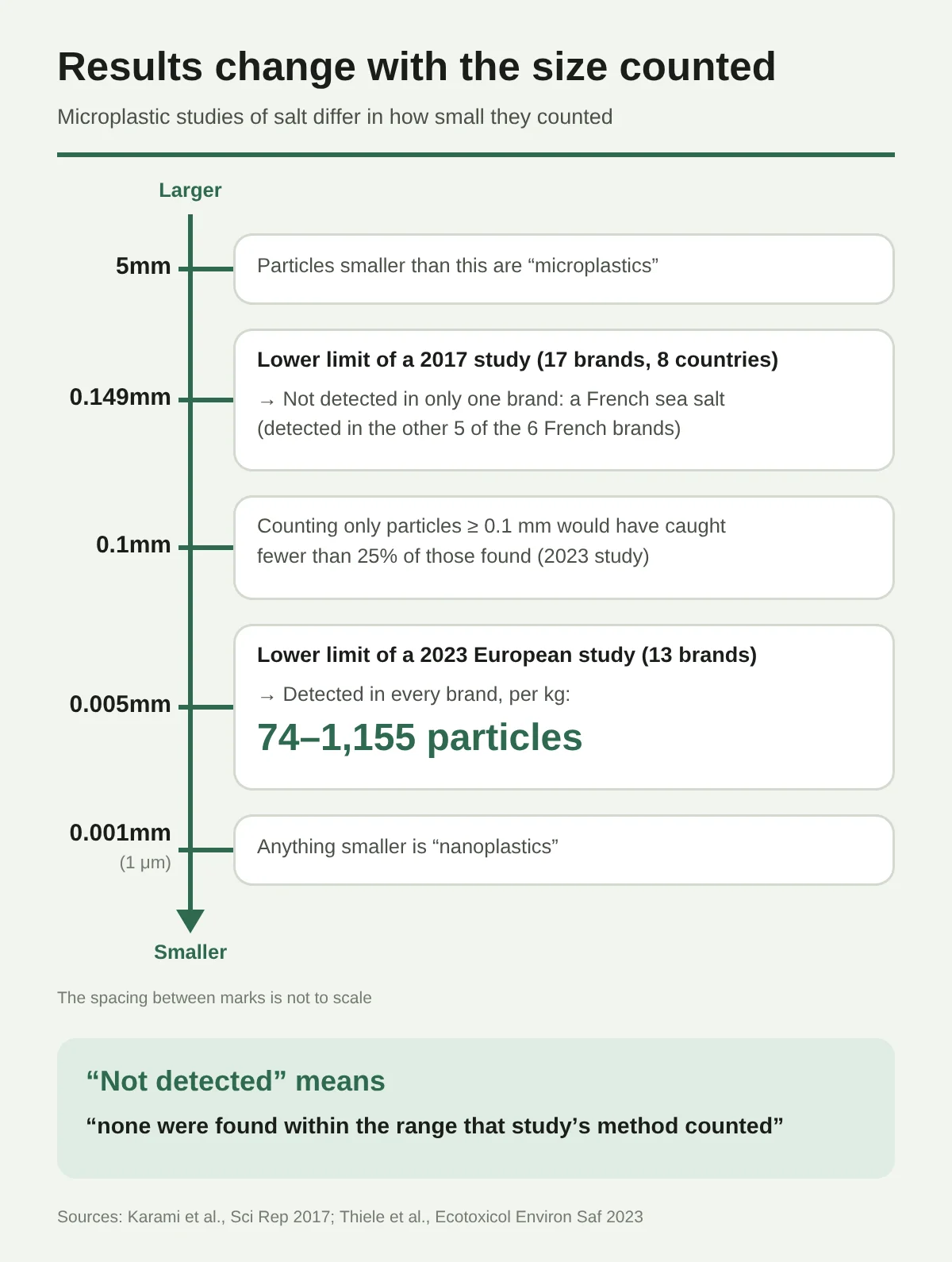
- The 2017 survey counted only particles larger than 0.149 mm.
- A European survey that counted down to 0.005 mm (13 brands, 2023) found particles in every brand. It says that counting only particles of 0.1 mm or larger would have captured less than 25% of the particles found. The same survey tended to find less in salts made the traditional sun-dried way than in many salts made industrially.
- One study found nanoplastics smaller than 0.001 mm in sea salt from 6 production areas, including the Seto Inland Sea (Ruan et al. 2024).
An example of a manufacturer publishing test results
- 真塩 and 海水塩 by 株式会社青い海 (sold through Seikatsu Club): published as not detected, with a limit of detection of 1 ppm, in a test by an outside laboratory (2019). The salt is made by filtering repeatedly through fine filters of 1–3 μm. This is a publication by the manufacturer itself, and details of the test method are not given.
Rules of thumb for choosing
- In studies that measured by weight, rock salt and lake salt tend to have less than sea salt.
- If you choose sea salt, one approach is to choose one whose test results are published.
- When you see a claim that a salt “contains no microplastics,” check which survey it comes from and down to what size particles were counted.
Salts whose labels this site has read
- セル マラン ド ゲランド ゲランドの塩(顆粒) (アクアメール)
- 雪塩(パウダータイプ) (宮古島の雪塩)
- 沖縄の海水塩 青い海 (青い海)
These are pages where we read the ingredient and process labeling; they are not microplastic test results. The rules for labeling salt are in “Salt and seawater” in the ingredient dictionary, and the topic of eating too much salt is in our article on excess salt intake.
Sources
- Karami A et al. Sci Rep 2017;7:46173
- Kim JS et al. Environ Sci Technol 2018
- Fischer M et al. J Anal Appl Pyrolysis 2019 (fleur de sel, confirmed in the abstract)
- Ercoşkun H. Food Addit Contam Part B 2022 (confirmed in the abstract)
- Thiele CJ et al. Ecotoxicol Environ Saf 2023
- Özçifçi et al. Food Chem Toxicol 2023;175:113698
- Kwon et al. Food Chem 2025;467:142193
- Lee HJ et al. J Hazard Mater 2021;402:123743
- Ruan X et al. Environ Sci Technol 2024;58:9091
- Seikatsu Club Consumers’ Co-operative Union, results of microplastic residue tests on its products 真塩 (Mashio) and 海水塩 (Kaisui-en) (2019) (Japanese)
Last checked 2026-10-01. Research and regulations change over time. This page is a translation of our Japanese page; if they differ, the Japanese page is the reference.