
Is Garlic Good for You? How Allicin Forms, the Smell, Research on Blood Pressure and Cancer, Drug Interactions, and the Cautions on Garlic in Oil

PR This article contains affiliate links to Rakuten Ichiba and A8.net (“See on Rakuten” and the link to a garlic mail-order shop). What is written here is based on documents from public agencies and on studies, regardless of whether there are ads. The “See on Amazon.co.jp” and “See on Yahoo! Shopping” links are also affiliate links.
“Garlic is good for you.” “Allicin works.” “It is pointless unless you eat it raw.” There are many such claims about garlic. On the other hand, you also hear that “it is dangerous with medicine” and that “garlic in oil causes food poisoning.”
In this article, we check the following against studies and documents from Japanese, U.S., and other public agencies:
- How is allicin formed? What changes when garlic is cut, crushed, or heated?
- Where does the smell after eating garlic come from?
- How much is known from research on blood pressure, cholesterol, and cancer (meta-analyses, Cochrane, WCRF assessments)?
- Drug interactions (the cautions from the U.S. NCCIH) and eating too much
- The botulism caution when making garlic in oil at home
- The amounts of domestic (Aomori) and imported (China) garlic, and import inspections
For health topics, we write in terms of the type of research (test tube, animal, human observational study, randomized controlled trial, meta-analysis) and the wording used by the assessing organizations.
Conclusions
- Allicin is not in garlic to begin with. When cells are broken by cutting or crushing, the enzyme alliinase acts on a compound called alliin, and allicin forms. The enzyme stops working with heat or strong acid (pH 3.5 or lower). In a study that measured human breath, with crushed raw garlic set at 100, boiled garlic was 16 and roasted garlic was 30
- The smell after eating comes first from the mouth. After about 3 hours, it comes mainly from a compound absorbed in the gut (allyl methyl sulfide) coming out through the lungs
- In meta-analyses pooling randomized controlled trials that used garlic supplements, many found that systolic blood pressure fell by an average of about 3 to 5 mmHg. Small drops in cholesterol have also been reported. However, Cochrane says there is not enough evidence on whether garlic reduces deaths or heart and blood vessel disease in people with high blood pressure. Also, in a trial in which people ate one raw garlic clove (about 4 g) for 6 months, LDL cholesterol did not change
- For cancer, the international assessing body (WCRF) changed its colorectal cancer wording from “probably decreases risk” to “limited evidence—no conclusion,” because newer studies were not consistent. For stomach cancer, studies comparing patients with healthy people show low numbers, but the difference disappeared when only studies that followed people forward in time were pooled. The U.S. NCCIH says garlic “does not appear to lower the risk of stomach cancer”
- The U.S. NCCIH calls attention to the fact that garlic supplements may increase the risk of bleeding, and urges people who use anticoagulants (drugs that make blood less likely to clot) or aspirin, and people having surgery, to tell their health care providers. One trial also found that garlic lowered the blood level of an HIV drug (saquinavir)
- Garlic in oil has caused botulism food poisoning overseas. The U.S. FDA classifies garlic in oil that has not been treated with acid or similar means as a “time/temperature control for safety food,” and Health Canada says a home refrigerator may not be enough
- In 2024, 17,600 tons of garlic were harvested in Japan (66.5% from Aomori), and fresh garlic imports were 24,238 tons (93.0% from China). In import inspections, garlic from China was found with pesticide levels above the standard in some cases, and the government has stepped up inspections
Products Featured in This Article
In the article, we introduce the following products to match each point (Rakuten Ichiba and A8.net links).
| For people who | Product featured | Where |
|---|---|---|
| want to try cooking with garlic “crushed first” | 貝印 SELECT100 ニンニクしぼり (薄皮むき付き) (Kai SELECT100 garlic press with skin peeler) | Crush it, then let it sit |
| want a garlic paste with no additives | Organic garlic paste (Me de Provence, made in France). Ingredients: organic garlic, organic sunflower oil, salt, organic lemon juice | Tube and paste garlic |
| want to use domestic garlic | Garlic from Takko Town, Aomori Prefecture (loose cloves, 200 g); raw Fukuchi White Rokuben garlic from Aomori Prefecture, 1 kg (Reitasu, れいたす) | If you use garlic from Aomori |
Allicin Forms When Garlic Is Cut or Crushed
In garlic, the ingredient and the enzyme are kept apart
Allicin, which gives garlic its smell and pungency, is hardly present in a whole garlic bulb.
- Garlic contains alliin (S-allylcysteine sulfoxide), a kind of sulfur-containing amino acid
- When cells are broken by cutting or crushing, the enzyme alliinase acts on alliin, and allicin forms (a 2014 review by Borlinghaus et al.)
- When water is added to garlic powder, allicin is formed in about 30 seconds (Lawson et al., 2018)
Allicin is a very unstable substance. As time passes or heat is applied, it changes into other sulfur compounds such as diallyl disulfide, ajoene, and vinyldithiin (Borlinghaus et al., 2014). The researchers say the effects of garlic cannot all be explained by allicin alone.
Allicin is thought to be a substance garlic makes to defend itself against insects and pathogens. That is why it forms only when the plant is damaged.
Heat, acid, and microwaves change it
Alliinase is an enzyme, so it stops working with heat or strong acid.
- Alliinase does not work at pH 3.5 or lower (Lawson et al., 2018. The stomach is about pH 2 before a meal)
- In an experiment boiling garlic with its skin on, for cloves under 5 g, the enzyme activity stopped completely in 2 minutes (Lawson et al., 2018)
Several studies look at how cooking changes things. All of them examined how allicin forms, or effects in test tubes and animals, not whether disease is reduced.
| Study | What was examined | Result |
|---|---|---|
| Song and Milner (2001, a review of rat experiments) | The ability of heated garlic to block a carcinogen from binding to DNA in mammary gland cells | Heating in a microwave for 60 seconds, or in an oven for 45 minutes, removed that ability. When garlic was crushed and left for 10 minutes before 60 seconds in the microwave, the ability was not completely lost |
| Cavagnaro et al. (2007, test tube) | The ability of heated garlic juice to block human platelets from clumping | In an oven (200°C) or in boiling water for up to 3 minutes, no different from raw. At 6 minutes, whole garlic lost the ability, but garlic crushed first kept it in weakened form. Beyond 10 minutes, both lost it. Microwaved garlic had no ability |
| Lawson et al. (2018, 13 people) | The amount of an allicin breakdown product (allyl methyl sulfide) in the breath after eating. Crushed raw garlic set at 100% | Boiled 16%, roasted 30%, pickled in vinegar 19%, minced with acid added 66%, black garlic 5% |
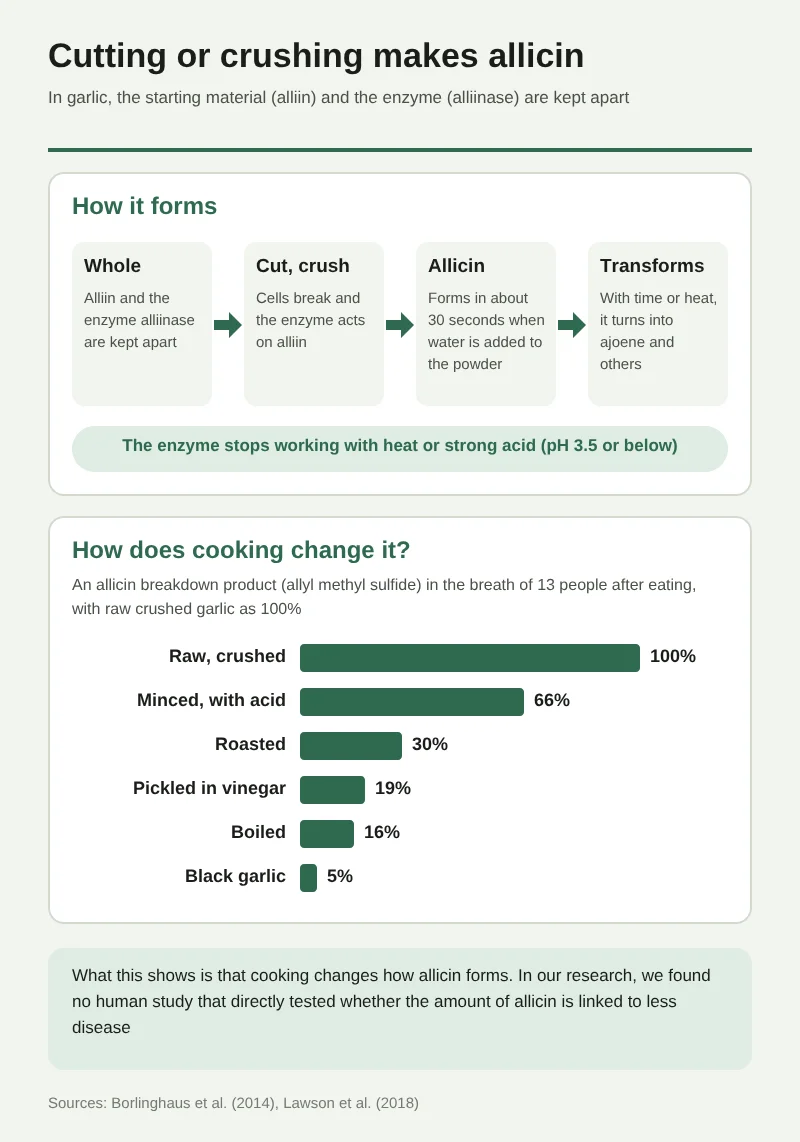
In the Lawson study, even foods in which heat or acid should have stopped the enzyme showed more breakdown product in the breath than expected. The researchers think this is partly because another component of garlic (such as S-allylcysteine) was converted in the body.
“More allicin” does not mean “better for your health” What this shows is that cooking changes how allicin forms. In the range we examined, we found no study that directly tested in humans whether the amount of allicin is related to a reduction in disease.
Crush it, then let it sit
The reason allicin-related activity was more likely to remain when garlic was “crushed and left to sit” or “crushed before heating” in studies is explained as allicin having time to form before heat stops the enzyme (Song and Milner 2001; Cavagnaro et al. 2007).
To crush garlic for cooking, besides pressing it with the flat of a knife, there are also garlic presses.
Tube and paste garlic
Commercial tube and paste garlic is made by adding salt, oil, sour ingredients, and the like to grated garlic. For example, the ingredient list (原材料名) of a common tube garlic (S&B “おろし生にんにく,” grated raw garlic) shows garlic (China), processed garlic, and salt, plus five food additives: sorbitol, cellulose, acidulant, thickener (xanthan), and flavoring (S&B Foods official page, checked September 30, 2026).
The ingredient list (原材料名) of the organic garlic paste (Me de Provence, made in France) is processed organic garlic (organic garlic, organic edible sunflower oil, salt, organic concentrated lemon juice), organic edible sunflower oil, and organic concentrated lemon juice, and no food additives are listed. Per 100 g, fat is 26.7 g and salt equivalent is 2.7 g.
For either one, the label does not tell you how much allicin remains. Other seasonings that use garlic include 焼肉ザパンチ 塩だれの素 (Yakiniku Za Punch salt sauce base, by Nitonya. Ingredients: sun-dried salt, fried garlic, pepper, chili pepper, roasted garlic) and tomato ketchup (by ユーサイド; garlic is in the ingredients).
The Smell: From the Mouth and From the Gut
The smell after eating garlic comes from two places.
- In a study of the breath of 5 people who ate 6 g of garlic (Suarez et al., 1999), right after eating, odor compounds such as methanethiol and allyl mercaptan were high in the mouth
- However, allyl methyl sulfide (AMS) alone was at about the same level in the mouth, in the deep air of the lungs, and in urine. This shows that AMS is absorbed in the gut, carried in the blood, and released from the lungs
- After 3 hours, AMS was the main odor compound in the breath. This is explained by AMS being hard for the body to break down
- Allicin is broken down in stomach acid into several sulfur compounds, which are thought to change into AMS in the body (Rosen et al., 2001). In the Lawson study, AMS was measured over 32 hours
In other words, what brushing your teeth or rinsing your mouth can reduce is mainly the smell in the mouth. The part absorbed from the gut has to wait until it leaves the body over time.
Foods that reduce the smell have also been studied. In a study in which people ate various foods right after eating raw garlic and then had their breath measured (Munch and Barringer, 2014), odor compounds decreased with raw apple, parsley, spinach, mint, and also lemon juice and green tea. In contrast, chlorophyllin (a compound made from chlorophyll) did not reduce them.
The U.S. NCCIH (National Center for Complementary and Integrative Health) lists bad breath and body odor first among the side effects of eating garlic.
Research on Blood Pressure
The most common topics in garlic health research are blood pressure and cholesterol. However, most trials used garlic supplements (tablets made from powder, aged garlic extract, and so on), not garlic used in cooking.
These are the results of meta-analyses pooling randomized controlled trials (trials that divide people by lottery into those who take garlic and those who take a look-alike dummy).
| Study | Trials pooled | Upper (systolic) blood pressure | Lower (diastolic) blood pressure |
|---|---|---|---|
| Wang et al. (2015) | 17 trials | Down 3.75 mmHg | Down 3.39 mmHg |
| Ried (2016) | 20 trials, 970 people | Down 5.1 mmHg (8.7 mmHg in people with high blood pressure only) | Down 2.5 mmHg (6.1 mmHg in people with high blood pressure only) |
| Tang et al. (2025) | 10 trials in people with high blood pressure | Down 4.21 | Down 3.13 |
| Behrouz et al. (2026) | 108 trials, 7,137 people (including outcomes other than blood pressure) | Down 3.71 mmHg | Down 1.97 mmHg |
- Tang et al. (2025) say, “It has a blood-pressure-lowering effect in some people, but its effect on high blood pressure overall may be limited,” and write that stomach upset and bad breath were the most common side effects
- The review by Cochrane (an international organization that pools medical research) (Stabler et al., 2012) asked not “does it lower blood pressure?” but “does it reduce deaths and heart and blood vessel disease in people with high blood pressure?” Only two trials (87 people) met the conditions, and neither reported deaths or onset of disease, so it concluded that “there is not enough evidence to judge whether it reduces them.” Blood pressure itself seemed to fall by 10 to 12 mmHg (upper) and 6 to 9 mmHg (lower) in the two trials, but the estimates had wide ranges and fell within the variation due to how blood pressure is measured, so it says the true effect is hard to judge
- The U.S. NCCIH says, “Limited evidence suggests that garlic supplements may slightly lower blood pressure in people with high blood pressure” (updated February 2025)
Supplement ingredient page For S-allylcysteine, which is abundant in aged garlic extract, the supplement ingredient page summarizes what has been notified to the government.
Research on Cholesterol
| Study | Type | Result |
|---|---|---|
| Ried et al. (2013) | Meta-analysis of 39 trials | In people with total cholesterol above 200 mg/dL, use for longer than 2 months lowered total cholesterol by about 17 mg/dL and LDL cholesterol by about 9 mg/dL. Triglycerides did not change |
| Behrouz et al. (2026) | Meta-analysis of 108 trials | Total cholesterol down 10.21 mg/dL, LDL down 5.90 mg/dL, triglycerides down 5.82 mg/dL, HDL up 2.18 mg/dL |
| Gardner et al. (2007) | Randomized controlled trial, 192 adults with LDL of 130 to 190 mg/dL | Raw garlic (the equivalent of an average clove, about 4 g), a powder supplement, or aged garlic extract, 6 days a week for 6 months. None of them changed LDL cholesterol |
- The Gardner trial was funded by the U.S. National Institutes of Health (NIH), and the garlic components used were measured throughout the trial. In the group that ate raw garlic, LDL changed by an average of +0.4 mg/dL at 6 months
- The U.S. NCCIH says, “Garlic supplements may lower total cholesterol and LDL slightly in people with high cholesterol”
- For the disease in which leg blood vessels narrow (peripheral arterial disease), the Cochrane review (Jepson et al., 2013) says only one trial (78 people, 12 weeks) met the conditions, and there was no difference in walking distance
The relationship between oils and cholesterol is summarized, together with Standard Tables of Food Composition figures, in the article on plant oils and animal fats.
Research on Cancer
Colorectal cancer
| Study | Type | Result |
|---|---|---|
| Fleischauer et al. (2000) | Meta-analysis (mainly studies comparing the diets of people with cancer and people without) | Among people who ate more raw or cooked garlic, the relative risk of colorectal cancer was 0.69. However, because of differences between studies, publication bias (studies with good results are more likely to be published), and the effect of eating more vegetables overall, “the pooled figure alone cannot be relied on” |
| Hu et al. (2014) | Meta-analysis of 5 prospective cohort studies (studies that follow healthy people for years) | Relative risk 1.06 for raw or cooked garlic and 1.12 for supplements. No association was seen |
Studies that compare people with cancer and people without ask them to recall “how much they ate in the past,” so they are said to be prone to errors in recall. In studies that followed people forward in time, the low figures no longer appeared.
Stomach cancer
| Study | Type | Result |
|---|---|---|
| Kodali and Eslick (2015) | Meta-analysis (14 case-control studies, 2 randomized controlled trials, 1 cohort study) | Odds ratio for stomach cancer 0.49 among people who ate more |
| Li et al. (2018) | Meta-analysis of 18 studies | Odds ratio 0.51 overall. When only prospective studies were pooled, it was 0.95, and the difference disappeared |
| Shandong Intervention Trial (Ma et al. 2012, Li et al. 2019) | Randomized controlled trial, 3,365 people in Shandong Province, China. A garlic supplement (2 capsules of 200 mg aged garlic extract plus 1 mg garlic oil, twice a day) for 7.3 years | Over 22 years of follow-up, the number of people who developed stomach cancer showed no statistically significant difference (odds ratio 0.81). For people who died of stomach cancer, the hazard ratio was 0.66 (95% confidence interval 0.43 to 1.00), which the researchers describe as a statistically significant reduction |
In the Shandong trial, the garlic capsules were provided by a U.S. maker of aged garlic extract (Wakunaga of America). The paper states that the maker attended planning meetings but was not involved in data collection (except for the measurement of S-allylcysteine), interpretation, or writing the paper.
How the assessing organizations put it
| Organization | Assessment |
|---|---|
| WCRF and AICR (World Cancer Research Fund and American Institute for Cancer Research) colorectal cancer report (2017, revised 2018) | In the earlier report (2011), garlic was “probably decreases risk” of colorectal cancer, but because newer studies were no longer consistent, it was changed to “limited - no conclusion” |
| WCRF and AICR stomach cancer report (2016, revised 2018) | Garlic is not listed in the assessment table |
| U.S. NCCIH (updated February 2025) | “Eating garlic does not appear to lower the risk of stomach cancer. It is not known whether it affects the risk of colorectal cancer” |
In test-tube and animal experiments, there are many reports that components of garlic act on cancer cells. However, when studies in humans are pooled, the assessing organizations’ wording as of 2026 is “not clear,” as above.
Research on Colds
The Cochrane review (Lissiman et al., 2014) says that among trials testing whether garlic supplements prevent colds, only one (146 people, 12 weeks) met the conditions, and “the evidence is insufficient.” The U.S. NCCIH also says that its 2022 review found only two small trials, both with weaknesses.
Drug Interactions and Eating Too Much
Drugs that make blood less likely to clot, and before surgery
The U.S. NCCIH writes the following about the safety of garlic (updated February 2025).
- Garlic taken by mouth has been used safely in studies lasting up to 7 years
- Garlic supplements may increase the risk of bleeding. If you use a supplement, tell your health care provider. This applies especially to people who plan to have surgery, and people who use anticoagulants (drugs that make blood less likely to clot), aspirin, or other drugs that affect bleeding
- People who use anticoagulants, aspirin, and the like should talk with a health care provider before using herbal products such as garlic
- During pregnancy and breastfeeding, taking more than the amount found in food by mouth may not be safe
These are the studies in humans.
| Study | Type | Result |
|---|---|---|
| Scharbert et al. (2007) | Randomized controlled trial, 18 healthy people | Eating a yogurt salad (tzatziki) with 4.2 g of raw garlic did not change platelet function. The same was true for 5 people who ate it every day for a week |
| Mohammed Abdul et al. (2008) | Randomized crossover trial, 12 healthy men | Taking a garlic supplement for 2 weeks did not greatly change how the anticoagulant warfarin worked |
| Macan et al. (2006) | Randomized controlled trial, 48 people taking warfarin | Aged garlic extract for 12 weeks. There was no sign of increased bleeding (under conditions of close monitoring by physicians) |
| Woodbury et al. (2016) | Case report (1 person) | Heavy bleeding of unknown cause in neck surgery. In the days before surgery, the person had been taking the equivalent of 12 g of garlic a day |
| Borrelli et al. (2007) | Review of adverse effects and drug interactions | Case reports of bleeding, and a possibility of strengthening the effect of anticoagulants (warfarin, fluindione) |
Many trials found no large effect, but there are also case reports. The NCCIH caution is about supplements; it does not set any special limit on the amount used in cooking. People taking medicine are better off asking a doctor or pharmacist rather than deciding on their own.
HIV drugs
In a trial in which 10 healthy people took the HIV drug saquinavir (Piscitelli et al., 2002), after taking a garlic supplement for 3 weeks, the blood level (AUC) of saquinavir fell by an average of 51%. Even 10 days after stopping the supplement, it came back only to 60 to 70% of the original level.
Eating too much, and raw garlic on the skin
- The NCCIH lists, as side effects when taken by mouth, bad breath and body odor, stomach pain, gas, and nausea. Some people have allergic reactions
- Putting raw garlic on the skin can cause burns (chemical burns). A study pooling reports (Hitl et al., 2021) found 39 people in 32 papers, most with second-degree burns. The researchers write that people should avoid applying or taping it to the skin as a folk remedy
- In the range we examined, we found no document in which a government or international organization set an upper limit such as “up to X cloves of garlic a day”
Garlic in Oil and Botulism
What is Clostridium botulinum?
Clostridium botulinum is a bacterium that lives in soil. It multiplies where there is little oxygen and makes a powerful toxin (MAFF).
- Symptoms appear 8 to 36 hours after eating: nausea, double vision, difficulty speaking, and difficulty swallowing. It can make breathing impossible and can cause death
- The bacteria (spores) are heat resistant and are not killed unless heated at 120°C for 4 minutes, or at 100°C for 360 minutes or more
- The foods most likely to be the cause are home-made foods stored for a long time, such as izushi (fermented fish with rice), bottled foods, and canned foods
Clostridium botulinum is widespread in the environment, including soil (Health Canada), and MAFF says, “Wash ingredients thoroughly.” When garlic is submerged in oil, the surrounding oil blocks air (oxygen), making it easier for the bacteria to multiply (Health Canada). Garlic in oil is a low-acid product (Morse et al., 1990).
Food poisoning overseas
| Year | Place | What happened |
|---|---|---|
| 1985 | A restaurant in Vancouver, Canada | From commercial “chopped garlic in soybean oil” that had not been kept at a proper temperature, at least 36 people got botulism. Because symptoms were mild and progressed slowly, it was misdiagnosed as myasthenia gravis, stroke, and the like, and discovery was delayed (St. Louis et al., 1988; Health Canada) |
| 1989 | United States | From garlic toast made with “garlic in oil” that had not been kept at a proper temperature, 3 people got botulism. The remaining garlic in oil had a pH of 5.7 and contained many bacteria and much toxin. It was a low-acid product that had to be kept refrigerated (Morse et al., 1990) |
| 1999 | United States | Two people, from home-made garlic in oil (Health Canada list) |
After the 1989 incident, the U.S. FDA (Food and Drug Administration) required commercial garlic in oil to contain a substance or acid that inhibits bacterial growth (Morse et al., 1990).
Documents from governments and the FDA
| Organization | What the document says |
|---|---|
| U.S. FDA (Food Code 2022) | A model code for retail and food service. It classifies “garlic-in-oil mixtures that have not been modified to prevent the growth of bacteria or the production of toxin” as foods requiring time and temperature control (TCS foods), alongside cut melons and heat-treated plant foods |
| Health Canada (2019 guidance) | Gives the basis for keeping uncontrolled vegetables and mushrooms in oil at 4°C or below for a maximum of 7 days. Because a home refrigerator cannot always hold 4°C or below, it does not recommend relying on refrigeration alone |
| MHLW | For low-acid foods in containers and packaging (pH above 4.6, water activity above 0.94, sterilized at less than 120°C for 4 minutes), it asks businesses to “heat at 120°C for 4 minutes, or manage at 10°C or below from production to consumption and label them ‘refrigeration required,’” and so on. It also urges proper management at home, such as refrigerating sealed foods |
| MAFF | Be careful with home-made bottled and canned foods. Do not eat vacuum packs or cans that are bulging or have an unusual smell |
What the documents say about making it at home
We found no caution in Japanese government documents that addresses garlic in oil alone. Putting the documents above together gives the following.
- Do not leave it at room temperature. Put it in the refrigerator once made (the FDA classifies it as a food that needs temperature control)
- Do not keep it long, even refrigerated. Health Canada gives a guideline of 4°C or below and up to 7 days for uncontrolled foods in oil
- If a sealed container is bulging or smells strange, do not eat it (MAFF)
- For commercial products, the maker controls the manufacturing method. Follow the storage method on the label (such as “refrigerate after opening”)
Domestic (Aomori) and Imported (China)
How much is produced, and how much is imported?
- The 2024 garlic harvest was 17,600 tons, down 12.9% from the previous year. Low temperatures and drought during growth are given as the reasons (MAFF, Agriculture & Livestock Industries Corporation)
- Aomori Prefecture produced 11,700 tons, 66.5% of the national total. Garlic needs to be exposed to low temperatures for a certain period while growing, and varieties for cold regions such as “White Rokuben” are the main ones, so production is concentrated in northern Japan such as Aomori and Hokkaido
- Imports of fresh garlic were 24,238 tons (up 1.9% from the previous year), and 93.0% came from China. Imports account for 57.9% of the combined domestic and imported amount
- Imported garlic is used mainly for processing and commercial use, such as restaurants and food factories, and most of it is distributed without passing through wholesale markets
- At the Tokyo central wholesale markets, the average price from 2020 to 2024 was around 1,500 yen per kg for domestic garlic and around 370 yen for garlic from China
- Garlic exported from China to Japan, counting fresh as well as dried, frozen, brined, and vinegar-pickled, was 34,423 tons in 2024 (Chinese customs statistics). There are also processed products such as garlic powder, garlic slices, and sweet vinegar-pickled garlic
Inspections at import
Imported foods must be notified to the government (quarantine stations) under the Food Sanitation Act. In fiscal 2025, there were about 2.53 million notifications; 8.5% of them were inspected, and 791 cases (0.03% of notifications) were found in violation and sent back or destroyed (MHLW “Imported Food Monitoring Statistics, Fiscal 2025”).
For pesticide residues, the government sets standards for each crop. For pesticides with no standard, the limit is a uniform 0.01 ppm (0.01 mg per kg) (the positive list system).
From the list of violations published by the MHLW, we pulled out those related to garlic.
| Date published | Product | Country of origin | Nature of violation | Type of inspection |
|---|---|---|---|---|
| November 2024 | Fresh leaf garlic | China | Residue of the pesticide procymidone above the uniform standard (0.19 ppm) | Monitoring inspection |
| November 2024 | Frozen garlic | China | Residue of the pesticide thiamethoxam above the uniform standard (0.02 ppm) | Monitoring inspection |
| February 2025 | Frozen garlic (peeled garlic, to be eaten cooked) | China | Bacterial count exceeded the standard | Voluntary inspection |
| April 2025 | Frozen garlic (to be eaten cooked) | China | Bacterial count exceeded the standard | Voluntary inspection |
| August 2025 | Dried garlic (garlic slices) | China | Had been irradiated (violation of manufacturing and processing standards) | Monitoring inspection |
| December 2025 | Fresh garlic | China | Residue of the pesticide benfuracarb above the uniform standard (0.03 ppm) | Monitoring inspection |
| December 2025 | Frozen garlic sprouts (to be eaten cooked) | China | E. coli positive | Voluntary inspection |
(Cases published from April 2024 to March 2026. There was also one case of a violation of the use standard for an additive in a South Korean food (garlic-and-shellfish-flavored filling). Products in violation were destroyed, sent back, or otherwise dealt with.)
After the thiamethoxam violation in frozen garlic, in December 2024 the MHLW raised the frequency of monitoring inspections for thiamethoxam in garlic from China and simple processed products to 30%, and made products of the company in violation subject to voluntary inspection by the importer at each import.
Monitoring inspections and inspection orders “Monitoring inspections” are inspections carried out by quarantine stations under the national annual plan (the Imported Food Monitoring Plan). For foods in which violations are found, an “inspection order” may be issued under the law (Article 26 of the Food Sanitation Act). In that case, the importer must pay for an inspection at a designated laboratory and cannot proceed with import procedures until the food is shown to have no problems (an EIC Net article reporting the MHLW’s 2006 announcement). The inspection order at that time was issued because the pesticide pyrimethanil above the standard (0.01 ppm) was found twice in garlic stems (garlic sprouts) from China. The total number of inspection orders in fiscal 2025 was 72,575.
If you use garlic from Aomori
Aomori Prefecture accounts for about two-thirds of domestic garlic. The first shop lists its garlic as “Fukuchi White Rokuben” (a variety for cold regions) from Takko Town, Aomori Prefecture. The second shop (Reitasu, れいたす) sells raw Fukuchi White Rokuben garlic from Aomori Prefecture in 1 kg units (the town is not stated).
Summary
| Point | What is known |
|---|---|
| How allicin forms | Forms when alliin is acted on by the enzyme alliinase after cutting or crushing. The enzyme stops with heat and strong acid. In the human breath study, boiling gave 16% and roasting 30% (crushed raw garlic = 100%) |
| Smell | At first from the mouth, then mainly AMS absorbed from the gut after about 3 hours. One study found it decreased with apple, parsley, mint, lemon juice, and green tea |
| Blood pressure | In meta-analyses of supplement trials, systolic blood pressure fell by an average of about 3 to 5 mmHg. Cochrane says the evidence is insufficient on whether it reduces deaths or heart and blood vessel disease |
| Cholesterol | Small drops reported with supplements. In a trial of one raw garlic clove eaten for 6 months, LDL did not change |
| Cancer | For colorectal cancer, WCRF changed from “probably decreases risk” to “no conclusion.” For stomach cancer, unclear in prospective studies, and NCCIH says it “does not appear to lower” the risk |
| Drug interactions | NCCIH says supplements may increase the risk of bleeding, and urges people using anticoagulants or aspirin, and people before surgery, to tell health care providers. One trial found it lowered the blood level of the HIV drug saquinavir |
| Garlic in oil | Botulism has occurred overseas. The FDA classifies it as a food needing temperature control. Health Canada gives the basis for 4°C or below and up to 7 days, and cautions against relying on refrigeration alone |
| Domestic and imported | In 2024, domestic 17,600 tons (Aomori 66.5%) and fresh imports 24,238 tons (China 93.0%). Violations were found in import inspections, and pesticide inspections of garlic from China were strengthened |
Products featured in this article (Rakuten Ichiba):
- A tool for crushing garlic → 貝印 SELECT100 ニンニクしぼり (Kai SELECT100 garlic press) (Crush it, then let it sit)
- A garlic paste with no additives listed → メ・ド・プロヴァンス 有機ガーリックペースト (Me de Provence Organic Garlic Paste) (Tube and paste garlic)
- Garlic from Takko Town, Aomori Prefecture → 田子にんにく バラ (Takko garlic, loose cloves) (If you use garlic from Aomori)
Please note This article does not show that garlic or the products introduced prevent or cure disease. If you take medicine or have surgery coming up, consult a doctor or pharmacist before using garlic supplements. Prices and shipping fees may change.
Sources
- Borlinghaus J, et al. Allicin: chemistry and biological properties. Molecules. 2014;19(8):12591-618. https://pubmed.ncbi.nlm.nih.gov/25153873/
- Lawson LD, Hunsaker SM. Allicin Bioavailability and Bioequivalence from Garlic Supplements and Garlic Foods. Nutrients. 2018;10(7):812. https://pubmed.ncbi.nlm.nih.gov/29937536/
- Song K, Milner JA. The influence of heating on the anticancer properties of garlic. J Nutr. 2001;131(3s):1054S-7S. https://pubmed.ncbi.nlm.nih.gov/11238815/
- Cavagnaro PF, et al. Effect of cooking on garlic (Allium sativum L.) antiplatelet activity and thiosulfinates content. J Agric Food Chem. 2007;55(4):1280-8. https://pubmed.ncbi.nlm.nih.gov/17256959/
- Suarez F, et al. Differentiation of mouth versus gut as site of origin of odoriferous breath gases after garlic ingestion. Am J Physiol. 1999;276(2):G425-30. https://pubmed.ncbi.nlm.nih.gov/9950816/
- Rosen RT, et al. Determination of allicin, S-allylcysteine and volatile metabolites of garlic in breath, plasma or simulated gastric fluids. J Nutr. 2001;131(3s):968S-71S. https://pubmed.ncbi.nlm.nih.gov/11238798/
- Munch R, Barringer SA. Deodorization of garlic breath volatiles by food and food components. J Food Sci. 2014;79(4):C526-33. https://pubmed.ncbi.nlm.nih.gov/24592995/
- Wang HP, et al. Effect of garlic on blood pressure: a meta-analysis. J Clin Hypertens. 2015;17(3):223-31. https://pubmed.ncbi.nlm.nih.gov/25557383/
- Ried K. Garlic Lowers Blood Pressure in Hypertensive Individuals, Regulates Serum Cholesterol, and Stimulates Immunity: An Updated Meta-analysis and Review. J Nutr. 2016;146(2):389S-396S. https://pubmed.ncbi.nlm.nih.gov/26764326/
- Tang Y, et al. Meta-analysis on the safety and efficacy of long-term garlic consumption as an adjunctive treatment for hypertension. 2025. https://pubmed.ncbi.nlm.nih.gov/41393949/
- Behrouz V, et al. Effects of Garlic Supplementation on Cardiovascular Risk Factors in Adults: A Comprehensive Updated Systematic Review and Meta-Analysis of Randomized Controlled Trials. Nutr Rev. 2026. https://pubmed.ncbi.nlm.nih.gov/40580481/
- Stabler SN, et al. Garlic for the prevention of cardiovascular morbidity and mortality in hypertensive patients. Cochrane Database Syst Rev. 2012. https://pubmed.ncbi.nlm.nih.gov/22895963/
- Ried K, et al. Effect of garlic on serum lipids: an updated meta-analysis. Nutr Rev. 2013;71(5):282-99. https://pubmed.ncbi.nlm.nih.gov/23590705/
- Gardner CD, et al. Effect of raw garlic vs commercial garlic supplements on plasma lipid concentrations in adults with moderate hypercholesterolemia: a randomized clinical trial. Arch Intern Med. 2007;167(4):346-53. https://pubmed.ncbi.nlm.nih.gov/17325296/
- Jepson RG, et al. Garlic for peripheral arterial occlusive disease. Cochrane Database Syst Rev. 2013. https://pubmed.ncbi.nlm.nih.gov/23633303/
- Fleischauer AT, et al. Garlic consumption and cancer prevention: meta-analyses of colorectal and stomach cancers. Am J Clin Nutr. 2000;72(4):1047-52. https://pubmed.ncbi.nlm.nih.gov/11010950/
- Hu JY, et al. Consumption of garlic and risk of colorectal cancer: an updated meta-analysis of prospective studies. World J Gastroenterol. 2014;20(41):15413-22. https://pubmed.ncbi.nlm.nih.gov/25386091/
- Kodali RT, Eslick GD. Meta-analysis: Does garlic intake reduce risk of gastric cancer? Nutr Cancer. 2015;67(1):1-11. https://pubmed.ncbi.nlm.nih.gov/25411831/
- Li Z, et al. The association of garlic with Helicobacter pylori infection and gastric cancer risk: A systematic review and meta-analysis. Helicobacter. 2018;23(5):e12532. https://pubmed.ncbi.nlm.nih.gov/30155945/
- Ma JL, et al. Fifteen-year effects of Helicobacter pylori, garlic, and vitamin treatments on gastric cancer incidence and mortality. J Natl Cancer Inst. 2012;104(6):488-92. https://pubmed.ncbi.nlm.nih.gov/22271764/
- Li WQ, et al. Effects of Helicobacter pylori treatment and vitamin and garlic supplementation on gastric cancer incidence and mortality: follow-up of a randomized intervention trial. BMJ. 2019;366:l5016. https://pubmed.ncbi.nlm.nih.gov/31511230/
- Lissiman E, et al. Garlic for the common cold. Cochrane Database Syst Rev. 2014. https://pubmed.ncbi.nlm.nih.gov/25386977/
- World Cancer Research Fund / American Institute for Cancer Research. Diet, nutrition, physical activity and colorectal cancer (2017, revised 2018). https://www.wcrf.org/wp-content/uploads/2021/02/Colorectal-cancer-report.pdf / stomach cancer (2016, revised 2018). https://www.wcrf.org/wp-content/uploads/2021/02/stomach-cancer-report.pdf
- National Center for Complementary and Integrative Health (NCCIH). Garlic (updated February 2025). https://www.nccih.nih.gov/health/garlic
- Borrelli F, et al. Garlic (Allium sativum L.): adverse effects and drug interactions in humans. Mol Nutr Food Res. 2007;51(11):1386-97. https://pubmed.ncbi.nlm.nih.gov/17918162/
- Scharbert G, et al. Garlic at dietary doses does not impair platelet function. Anesth Analg. 2007;105(5):1214-8. https://pubmed.ncbi.nlm.nih.gov/17959943/
- Mohammed Abdul MI, et al. Pharmacodynamic interaction of warfarin with cranberry but not with garlic in healthy subjects. Br J Pharmacol. 2008;154(8):1691-700. https://pubmed.ncbi.nlm.nih.gov/18516070/
- Macan H, et al. Aged garlic extract may be safe for patients on warfarin therapy. J Nutr. 2006;136(3 Suppl):793S-795S. https://pubmed.ncbi.nlm.nih.gov/16484565/
- Woodbury A, et al. Garlic-Induced Surgical Bleeding: How Much Is Too Much? A A Case Rep. 2016. https://pubmed.ncbi.nlm.nih.gov/27782907/
- Piscitelli SC, et al. The effect of garlic supplements on the pharmacokinetics of saquinavir. Clin Infect Dis. 2002;34(2):234-8. https://pubmed.ncbi.nlm.nih.gov/11740713/
- Hitl M, et al. Garlic burn injuries - a systematic review of reported cases. Am J Emerg Med. 2021. https://pubmed.ncbi.nlm.nih.gov/33571752/
- St Louis ME, et al. Botulism from chopped garlic: delayed recognition of a major outbreak. Ann Intern Med. 1988;108(3):363-8. https://pubmed.ncbi.nlm.nih.gov/3341673/
- Morse DL, et al. Garlic-in-oil associated botulism: episode leads to product modification. Am J Public Health. 1990;80(11):1372-3. https://pubmed.ncbi.nlm.nih.gov/2240308/
- U.S. Food and Drug Administration. Food Code 2022 (Chapter 1, Time/temperature control for safety food). https://www.fda.gov/media/164194/download
- Health Canada. Guidance on Mitigating the Health Risk Associated with Clostridium botulinum in Plant and Mushroom Products Stored in Oil (2019). https://www.canada.ca/en/health-canada/services/food-nutrition/legislation-guidelines/guidance-documents/plant-mushroom-oil-profile/plant-mushroom-oil.html
- MHLW, “Measures against botulism food poisoning from vacuum-packed foods (low-acid foods in containers and packaging)” (真空パック詰食品(容器包装詰低酸性食品)のボツリヌス食中毒対策). https://www.mhlw.go.jp/seisakunitsuite/bunya/kenkou_iryou/shokuhin/syokuchu/03-4.html
- MAFF, “Clostridium botulinum (bacterium)” (ボツリヌス菌(細菌)) (updated October 17, 2025). https://www.maff.go.jp/j/syouan/seisaku/foodpoisoning/f_encyclopedia/clostridium.botulinum.html
- MAFF, “Vegetable Production and Shipment Statistics, 2024 crop,” Table 3: planted area, yield per 10 a, harvest, and shipments by prefecture (garlic) (e-Stat, published December 23, 2025). https://www.e-stat.go.jp/stat-search/files?page=1&layout=datalist&lid=000001473711
- Agriculture & Livestock Industries Corporation (ALIC), “Garlic production and processing in China as production costs rise,” Vegetable Information, February 2026 (original data: Ministry of Finance “Trade Statistics” and others). https://www.alic.go.jp/content/001279441.pdf
- MHLW, “Imported Food Monitoring Statistics, Fiscal 2025” (August 2026). https://www.mhlw.go.jp/content/001743296.pdf
- MHLW, “Cases of Food Sanitation Act violations in imported foods,” fiscal 2024 and 2025. https://www.mhlw.go.jp/stf/seisakunitsuite/bunya/kenkou_iryou/shokuhin/yunyu_kanshi/ihan/index.html
- MHLW, Notice Kenseishoku-yu-hatsu 1202 No. 1, “Implementation of the ‘Fiscal 2024 Imported Food Monitoring Plan’” (December 2, 2024). https://www.mhlw.go.jp/content/11135200/001343766.pdf / Notice Kenseishoku-yu-hatsu 1127 No. 1 (November 27, 2024). https://www.mhlw.go.jp/content/11135200/001342052.pdf
- MHLW, “Enforcement of the positive list system for agricultural chemicals and other residues in foods.” https://www.mhlw.go.jp/topics/2006/bukyoku/iyaku/a6.html
- MHLW, “Implementation of inspection orders for imported foods (Chinese garlic stems and eel)” (August 22, 2006). https://www.mhlw.go.jp/houdou/2006/08/h0822-1.html / EIC Net, “Pesticides and insecticides above residue standards found in Chinese garlic stems and eel” (2006). https://www.eic.or.jp/news/?act=view&serial=13941
- Ingredient lists (原材料名) of the organic garlic paste (Nichifutsu Boeki online shop) and S&B おろし生にんにく (S&B Foods) (checked September 30, 2026)
Related articles and databases
- Are Lard and Butter Bad for You? 16 Plant Oils and Animal Fats (Beef Tallow, Fish Oil) Compared by Fatty Acids, and Which to Use Every Day
- What Is “植物油脂” (Vegetable Fat)? How True Is “Vegetable Oils Are Bad for You,” and What the Back Label Does and Does Not Tell You
- Is Caramel Color Dangerous? The Carcinogen Claim About “4-MEI” and the Four Types, Checked Against Japan, EU, and US Assessments