
What does “無農薬” (pesticide-free) mean? Why it cannot be labeled, and organic JAS vs. specially cultivated
Why vegetables cannot be labeled “pesticide-free” in Japan, and how to read the labels used instead
In short
Since the guidelines were revised in 2003, vegetables and fruit in Japan are not to be labeled “無農薬” (pesticide-free).
The reason is that consumers took the word to mean “zero pesticide residue,” which led to misunderstanding. Today you tell them apart by “農薬:栽培期間中不使用” (pesticides: not used during the growing period) (specially cultivated produce) or by the organic JAS mark.
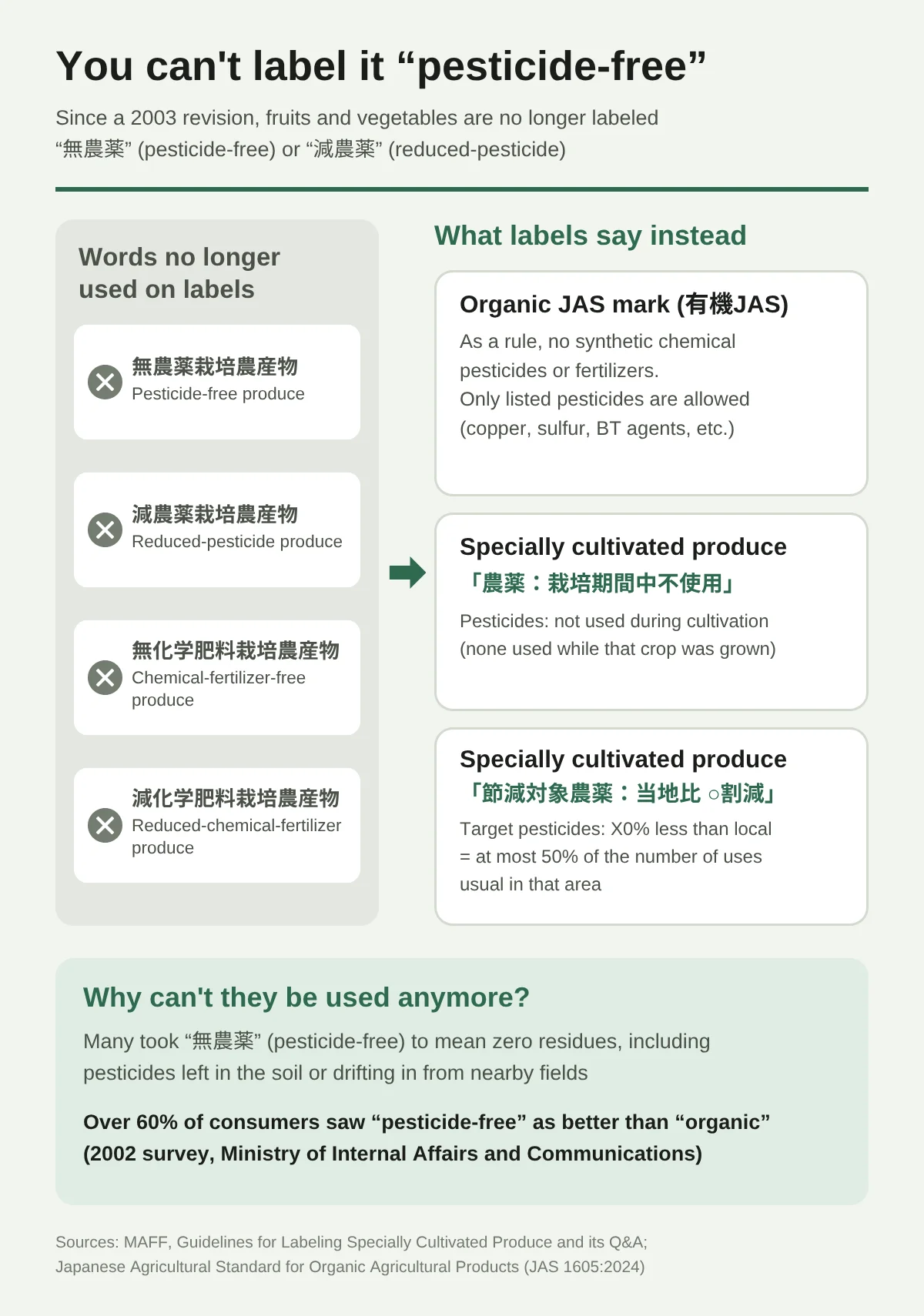
Why “無農薬” can no longer be written
MAFF’s “Labeling guidelines for specially cultivated produce” list the terms that are not to be used, including “無農薬栽培農産物” (pesticide-free produce), “無化学肥料栽培農産物” (chemical-fertilizer-free produce), “減農薬栽培農産物” (reduced-pesticide produce) and “減化学肥料栽培農産物” (reduced-chemical-fertilizer produce).
- For growers, “無農薬” meant “no pesticides were used while growing the crop.” Consumers, however, took it to mean no residue at all, including pesticide left in the soil or drifting in from neighboring fields (Guidelines Q&A, Q6).
- More than 60% of consumers wrongly believed “無農薬” was better than “organic” (2002 questionnaire survey on food labeling by the Ministry of Internal Affairs and Communications, same Q6).
- With “減農薬” (reduced pesticide), it was unclear what it was compared with, by how much, and what was reduced (the number of applications or the amount left) (same Q6).
The revision of May 26, 2003 merged the earlier categories, such as “pesticide-free produce” and “reduced-pesticide produce,” into “specially cultivated produce,” and set the period up to March 31, 2004 for the new labels to spread and settle.
For processed foods, too, “made with pesticide-free tomatoes” is not appropriate; wording such as “made with tomatoes grown without pesticides during the growing period” is considered appropriate (Q&A Q50).
How to read the labels used instead
| Label in the store | What it means for pesticides |
|---|---|
| Organic JAS mark | In principle, no chemically synthesized pesticides or fertilizers. The field must also have been free of prohibited materials for at least 3 years before the first harvest for perennial crops, and for at least 2 years before sowing or planting for other crops. Only when a pest or disease outbreak is likely to spread suddenly and cannot be prevented by other means can designated pesticides (table below) be used |
| “農薬:栽培期間中不使用” (pesticides: not used during the growing period) | Specially cultivated produce for which no pesticides were used while the crop was growing |
| “節減対象農薬:栽培期間中不使用” (pesticides subject to reduction: not used during the growing period) | Pesticides allowed under organic JAS and the like were used, but none of the other pesticides (the “pesticides subject to reduction”) were |
| “節減対象農薬:当地比 ○割減” (pesticides subject to reduction: ○% less than local practice) | The number of applications of pesticides subject to reduction is at least 50% lower than the number usually used in that region (the conventional level). The names, purposes and number of applications of the pesticides used are also shown → How reduced pesticide works |
Because the wording is “during the growing period,” it does not cover earlier pesticide in the soil or pesticide drifting in from neighboring fields. Like “無農薬,” it does not mean “no pesticide remains.”
Some pesticides can be used even under organic JAS
Annex B, Table B.1 of the organic JAS standard (JAS 1605:2024) designates pesticides that can be used even in organic farming. Examples include pyrethrum emulsion, rapeseed oil emulsion, machine oil emulsion, sulfur agents, sodium bicarbonate (baking soda), copper wettable powder, natural-enemy biological pesticides (those that use microorganisms themselves, such as BT agents), spinosad, milbemectin, kasugamycin and vinegar.
Active ingredients in this database that FAMIC’s list of registered active ingredients marks as usable under organic JAS:
- Spinosad
- Milbemectin
- Bacillus thuringiensis (Bt)
- Pyrethrins (conditional)
- Paraffin oil/(CAS 64741-88-4) / Paraffin oil/(CAS 64741-89-5) / Paraffin oil/(CAS 64741-97-5) / Paraffin oil/(CAS 64742-46-7) / Paraffin oil/(CAS 64742-54-7) / Paraffin oil/(CAS 64742-55-8) / Paraffin oil/(CAS 64742-65-0) / Paraffin oil/(CAS 72623-86-0) / Paraffin oil/(CAS 8012-95-1) / Paraffin oil/(CAS 8042-47-5) / Paraffin oil/(CAS 97862-82-3)
- Rape seed oil
- starch
- Copper hydroxide / Copper oxychloride / Copper sulfate / Cuprous oxide (conditional)
- Sulphur
- Potassium hydrogen carbonate
- Kasugamycin
Table B.1 sets conditions by type of formulated product (for example, pyrethrum emulsion is limited to products that do not contain piperonyl butoxide, which strengthens the effect). Even with the same active ingredient, not every formulated product can be used.
Choosing vegetables grown without pesticides
In stores, look for the “organic JAS mark” and “農薬:栽培期間中不使用.” Some vegetable delivery services mainly handle vegetables grown without or with fewer pesticides and publish their production standards.
A detailed comparison of each company’s growing standards is in Comparison of food delivery services and Oisix subscriptions and vegetable standards.
Sources
- MAFF, “Labeling guidelines for specially cultivated produce” (revised March 23, 2007) (Japanese)
- MAFF, “Labeling guidelines for specially cultivated produce: Q&A” (June 2008), Q6, Q50, Q51 (Japanese)
- MAFF, “On the revision of the labeling guidelines for specially cultivated produce” (May 26, 2003) (Japanese)
- Japanese Agricultural Standard for organic plants, JAS 1605:2024, Annex B, Table B.1 (Japanese)
- MAFF, “Q&A on the JAS for organic plants, organic processed foods, organic livestock products and organic feed” (as of October 2025), Q17-2 (Japanese)
- FAMIC, list of registered active ingredients (as of September 30, 2026), “Organic JAS” column (Japanese)
Last checked 2026-10-01. Systems and figures change over time. This page is a translation of our Japanese page; if they differ, the Japanese page is the reference.