
Supplement ingredient database
Supplement ingredients, grouped by the functions they are claimed to have. For each ingredient we show how it is notified under Japan's government systems, whether the EU authorised the claim, and how the US NIH summarizes the research. We do not judge whether anything works.

Claim not authorised in the EUMany notifications in Japan, but the claim is not authorised in the EU
- GABA (gamma-aminobutyric acid) (920 notifications in Japan)
- Lactic acid bacteria and bifidobacteria (693 notifications in Japan)
- Lutein and zeaxanthin (344 notifications in Japan)
- Ellagic acid (224 notifications in Japan)
- Indigestible dextrin (resistant maltodextrin) (203 notifications in Japan)
- Tea catechins (174 notifications in Japan)
- Astaxanthin (145 notifications in Japan)
- Coenzyme Q10 (112 notifications in Japan)
- Hesperidin (79 notifications in Japan)
- Bilberry (anthocyanins) (74 notifications in Japan)
EU-authorised claimIngredients with an authorised health claim in the EU
- Inulin
- DHA and EPA
- Barley beta-glucan
- Hydroxytyrosol (olive oil only)
- Oligosaccharides (such as lactulose)
- Alpha-linolenic acid
- Chitosan
- Xylitol (FOSHU for teeth)
- Plant sterols
- Green tea fluoride
- Polydextrose
- Melatonin (a medicinal ingredient in Japan)
- Vitamins and minerals (Nutrient supplementation)
In the EU, health claims on food may be used only after the European Food Safety Authority (EFSA) has assessed the scientific evidence and the claim has been authorised. Many plant-based claims (about 2,000) are still on hold. “No claim in the EU register” does not mean the ingredient has no effect.
Japan's three systems and the EU
How foods can carry “function” claims
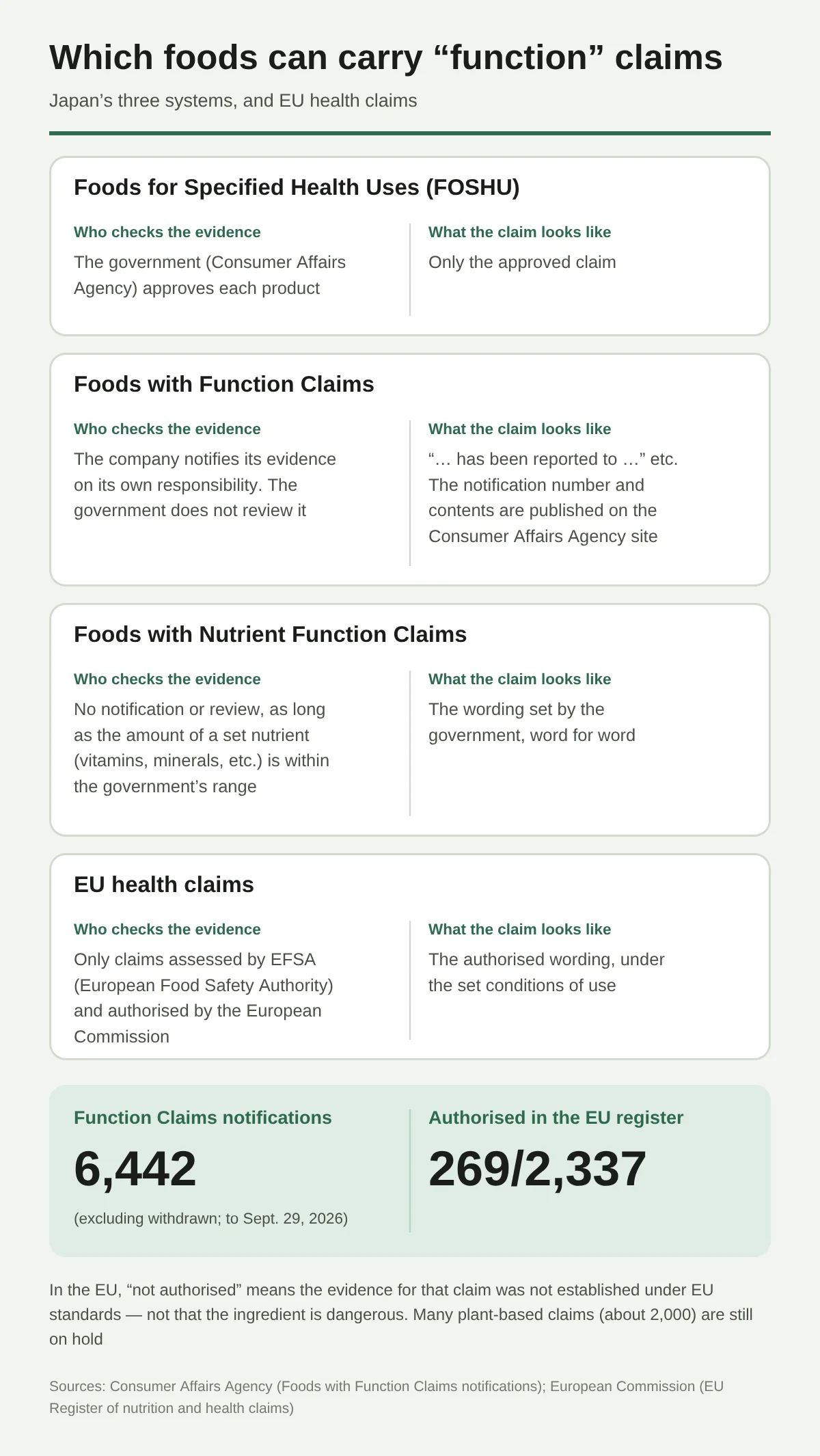
| System | Who checks the evidence | What the claim looks like |
|---|---|---|
| Foods for Specified Health Uses (FOSHU, トクホ) | The government (Consumer Affairs Agency) reviews and approves each product | Only the approved claim |
| Foods with Function Claims (機能性表示食品) | The company notifies its evidence on its own responsibility. The government does not review it | “… has been reported to …” and similar. The notification number and contents are published on the Consumer Affairs Agency site |
| Foods with Nutrient Function Claims (栄養機能食品) | No notification or review, as long as the amount of a nutrient set by the government (vitamins, minerals, etc.) is within the range | The government's wording, word for word (e.g. “Vitamin D is a nutrient that promotes calcium absorption in the intestine and helps bone formation.”) |
| EU health claims | Only claims assessed by the European Food Safety Authority (EFSA) and authorised by the European Commission | The authorised wording, under the set conditions (e.g. “DHA contributes to the maintenance of normal brain function” requires 250 mg per day) |
There are 1,025 approved FOSHU products (as of Sept. 1, 2026) and 6,442 Foods with Function Claims notifications (excluding withdrawn, to Sept. 29, 2026). The counts in this database are those notifications counted by ingredient. They are numbers of notifications, not a measure of effect or sales.
Body fat and weight
Body fat / Weight and BMI
Body fat24
- Ellagic acidClaim not authorised in the EU
- Indigestible dextrin (resistant maltodextrin)Claim not authorised in the EU
- Black ginger (polymethoxyflavones)No claim in the EU register
- Tea catechinsClaim not authorised in the EU
- HMPANo claim in the EU register
- Kudzu flower isoflavonesNo claim in the EU register
- Rose hip (tiliroside)No claim in the EU register
- Medium-chain fatty acidsClaim not authorised in the EU
- Gallic acidNo claim in the EU register
- Acetic acid (vinegar)Claim not authorised in the EU
- Lactic acid bacteria and bifidobacteriaClaim not authorised in the EU
- Apple procyanidinsClaim not authorised in the EU
- Globin peptide (VVYP)No claim in the EU register
- Tea flower saponins (chakasaponin)No claim in the EU register
- AlluloseNo claim in the EU register
- Hydroxycitric acid (HCA)No claim in the EU register
- Chlorogenic acidsClaim not authorised in the EU
- Alanine, arginine, and phenylalanineNo claim in the EU register
- IsomaltodextrinNo claim in the EU register
- GarcinolNo claim in the EU register
- Alpha-linolenic acidEU-authorised claim
- Oligosaccharides (such as lactulose)EU-authorised claim
- Quercetin glycosidesClaim not authorised in the EU
- Oolong tea polymerized polyphenolsNo claim in the EU register
Weight and BMI17
- Ellagic acidClaim not authorised in the EU
- Black ginger (polymethoxyflavones)No claim in the EU register
- HMPANo claim in the EU register
- Kudzu flower isoflavonesNo claim in the EU register
- Tea catechinsClaim not authorised in the EU
- Rose hip (tiliroside)No claim in the EU register
- Medium-chain fatty acidsClaim not authorised in the EU
- Gallic acidNo claim in the EU register
- Tea flower saponins (chakasaponin)No claim in the EU register
- Lactic acid bacteria and bifidobacteriaClaim not authorised in the EU
- Apple procyanidinsClaim not authorised in the EU
- Chlorogenic acidsClaim not authorised in the EU
- Alanine, arginine, and phenylalanineNo claim in the EU register
- GarcinolNo claim in the EU register
- Alpha-linolenic acidEU-authorised claim
- Indigestible dextrin (resistant maltodextrin)Claim not authorised in the EU
- Acetic acid (vinegar)Claim not authorised in the EU
Blood sugar, blood pressure, and blood lipids
Post-meal blood sugar / Fasting blood sugar / Blood pressure / Triglycerides / Cholesterol / Uric acid / Liver function
Post-meal blood sugar18
- Indigestible dextrin (resistant maltodextrin)Claim not authorised in the EU
- InulinEU-authorised claim
- Gallic acidNo claim in the EU register
- IsomaltodextrinNo claim in the EU register
- Salacia (salacinol)No claim in the EU register
- HMPANo claim in the EU register
- Barley beta-glucanEU-authorised claim
- Chlorogenic acidsClaim not authorised in the EU
- Mulberry leaf (iminosugars)No claim in the EU register
- Tea catechinsClaim not authorised in the EU
- AlluloseNo claim in the EU register
- Partially hydrolyzed guar gumClaim not authorised in the EU
- Alginic acid (sodium and calcium)No claim in the EU register
- 5-Aminolevulinic acid (ALA)No claim in the EU register
- Psyllium (seed husk dietary fiber)Claim not authorised in the EU
- GABA (gamma-aminobutyric acid)Claim not authorised in the EU
- Dietary fiber from young barley leavesNo claim in the EU register
- Wheat albuminNo claim in the EU register
Fasting blood sugar3
Blood pressure14
- GABA (gamma-aminobutyric acid)Claim not authorised in the EU
- Alpha-linolenic acidEU-authorised claim
- Acetic acid (vinegar)Claim not authorised in the EU
- NattokinaseNo claim in the EU register
- Indigestible dextrin (resistant maltodextrin)Claim not authorised in the EU
- Psyllium (seed husk dietary fiber)Claim not authorised in the EU
- HesperidinClaim not authorised in the EU
- Citric acidNo claim in the EU register
- Sardine peptideNo claim in the EU register
- Chlorogenic acidsClaim not authorised in the EU
- Lactotripeptides (VPP and IPP)Claim not authorised in the EU
- Enryucha flavonoidsNo claim in the EU register
- Eucommia leaf glycosidesNo claim in the EU register
- Sesame peptideNo claim in the EU register
Triglycerides17
- Ellagic acidClaim not authorised in the EU
- DHA and EPAEU-authorised claim
- Indigestible dextrin (resistant maltodextrin)Claim not authorised in the EU
- Gallic acidNo claim in the EU register
- IsomaltodextrinNo claim in the EU register
- InulinEU-authorised claim
- Globin peptide (VVYP)No claim in the EU register
- Tea flower saponins (chakasaponin)No claim in the EU register
- Tea catechinsClaim not authorised in the EU
- GABA (gamma-aminobutyric acid)Claim not authorised in the EU
- Quercetin glycosidesClaim not authorised in the EU
- Psyllium (seed husk dietary fiber)Claim not authorised in the EU
- HesperidinClaim not authorised in the EU
- Oligosaccharides (such as lactulose)EU-authorised claim
- Alpha-linolenic acidEU-authorised claim
- Beta-conglycininNo claim in the EU register
- Oolong tea polymerized polyphenolsNo claim in the EU register
Cholesterol13
- HMPANo claim in the EU register
- HydroxytyrosolEU-authorised claim
- Alpha-linolenic acidEU-authorised claim
- Pine bark procyanidinsClaim not authorised in the EU
- LycopeneClaim not authorised in the EU
- Ellagic acidClaim not authorised in the EU
- Barley beta-glucanEU-authorised claim
- Tea catechinsClaim not authorised in the EU
- ChitosanEU-authorised claim
- Psyllium (seed husk dietary fiber)Claim not authorised in the EU
- Soy proteinClaim not authorised in the EU
- Alginic acid (sodium and calcium)No claim in the EU register
- Plant sterolsEU-authorised claim
Uric acid3
Liver function3
Circulation, cold sensitivity, and swelling
Circulation and cold sensitivity / Swelling
Circulation and cold sensitivity8
- Hihatsu (long pepper) (piperines)No claim in the EU register
- HesperidinClaim not authorised in the EU
- Ginkgo leaf (flavonoid glycosides and terpene lactones)No claim in the EU register
- Elastin peptidesNo claim in the EU register
- Pine bark procyanidinsClaim not authorised in the EU
- NattokinaseNo claim in the EU register
- Lactic acid bacteria and bifidobacteriaClaim not authorised in the EU
- Ellagic acidClaim not authorised in the EU
Swelling2
Eyes
Focusing and eye fatigue / Sharp vision and light stimulation / Dry eyes
Focusing and eye fatigue4
Sharp vision and light stimulation1
Dry eyes2
Brain, mind, and sleep
Memory and cognitive function / Sleep quality / Stress and tension / Fatigue
Memory and cognitive function17
- Ginkgo leaf (flavonoid glycosides and terpene lactones)No claim in the EU register
- DHA and EPAEU-authorised claim
- Lutein and zeaxanthinClaim not authorised in the EU
- GABA (gamma-aminobutyric acid)Claim not authorised in the EU
- PlasmalogenNo claim in the EU register
- S-allylcysteine (garlic)No claim in the EU register
- Lactic acid bacteria and bifidobacteriaClaim not authorised in the EU
- AstaxanthinClaim not authorised in the EU
- ErgothioneineNo claim in the EU register
- BacopaNo claim in the EU register
- PQQ (pyrroloquinoline quinone)No claim in the EU register
- PhosphatidylserineClaim not authorised in the EU
- Imidazole dipeptidesClaim not authorised in the EU
- CurcuminClaim not authorised in the EU
- Coenzyme Q10Claim not authorised in the EU
- HMPANo claim in the EU register
- L-theanineClaim not authorised in the EU
Sleep quality19
- GABA (gamma-aminobutyric acid)Claim not authorised in the EU
- Rafuma (luobuma) (hyperoside and isoquercitrin)No claim in the EU register
- Lactic acid bacteria and bifidobacteriaClaim not authorised in the EU
- ProteoglycanNo claim in the EU register
- Coenzyme Q10Claim not authorised in the EU
- L-theanineClaim not authorised in the EU
- Lutein and zeaxanthinClaim not authorised in the EU
- CrocetinNo claim in the EU register
- GarcinolNo claim in the EU register
- Saffron (crocin and safranal)Claim not authorised in the EU
- GlycineNo claim in the EU register
- Undenatured type II collagenNo claim in the EU register
- Barley beta-glucanEU-authorised claim
- DHA and EPAEU-authorised claim
- CurcuminClaim not authorised in the EU
- HesperidinClaim not authorised in the EU
- Chlorogenic acidsClaim not authorised in the EU
- Pine bark procyanidinsClaim not authorised in the EU
- S-allylcysteine (garlic)No claim in the EU register
Stress and tension15
- GABA (gamma-aminobutyric acid)Claim not authorised in the EU
- Coenzyme Q10Claim not authorised in the EU
- Lactic acid bacteria and bifidobacteriaClaim not authorised in the EU
- L-theanineClaim not authorised in the EU
- Lutein and zeaxanthinClaim not authorised in the EU
- Rafuma (luobuma) (hyperoside and isoquercitrin)No claim in the EU register
- Rhodantenone BNo claim in the EU register
- Citric acidNo claim in the EU register
- BacopaNo claim in the EU register
- Barley beta-glucanEU-authorised claim
- Saffron (crocin and safranal)Claim not authorised in the EU
- GarcinolNo claim in the EU register
- 5-Aminolevulinic acid (ALA)No claim in the EU register
- Quercetin glycosidesClaim not authorised in the EU
- DHA and EPAEU-authorised claim
Fatigue20
- GABA (gamma-aminobutyric acid)Claim not authorised in the EU
- Coenzyme Q10Claim not authorised in the EU
- Citric acidNo claim in the EU register
- L-theanineClaim not authorised in the EU
- Acetic acid (vinegar)Claim not authorised in the EU
- S-allylcysteine (garlic)No claim in the EU register
- Imidazole dipeptidesClaim not authorised in the EU
- CrocetinNo claim in the EU register
- Barley beta-glucanEU-authorised claim
- Moringa (glucomoringin)No claim in the EU register
- GarcinolNo claim in the EU register
- Lactic acid bacteria and bifidobacteriaClaim not authorised in the EU
- AstaxanthinClaim not authorised in the EU
- CurcuminClaim not authorised in the EU
- DHA and EPAEU-authorised claim
- Saffron (crocin and safranal)Claim not authorised in the EU
- HesperidinClaim not authorised in the EU
- Chlorogenic acidsClaim not authorised in the EU
- Pine bark procyanidinsClaim not authorised in the EU
- GlycineNo claim in the EU register
Bones, joints, and muscles
Bones / Knees, lower back, and joints / Muscles / Walking ability and exercise
Bones6
Knees, lower back, and joints11
- N-acetylglucosamineNo claim in the EU register
- ProteoglycanNo claim in the EU register
- GlucosamineClaim not authorised in the EU
- Undenatured type II collagenNo claim in the EU register
- AstaxanthinClaim not authorised in the EU
- Collagen peptidesClaim not authorised in the EU
- Elastin peptidesNo claim in the EU register
- Moringa (glucomoringin)No claim in the EU register
- DHA and EPAEU-authorised claim
- Banaba (corosolic acid)No claim in the EU register
- CurcuminClaim not authorised in the EU
Muscles6
- GABA (gamma-aminobutyric acid)Claim not authorised in the EU
- HMB (beta-hydroxy-beta-methylbutyrate)Claim not authorised in the EU
- Black ginger (polymethoxyflavones)No claim in the EU register
- Banaba (corosolic acid)No claim in the EU register
- Lactic acid bacteria and bifidobacteriaClaim not authorised in the EU
- Medium-chain fatty acidsClaim not authorised in the EU
Walking ability and exercise11
- N-acetylglucosamineNo claim in the EU register
- ProteoglycanNo claim in the EU register
- Black ginger (polymethoxyflavones)No claim in the EU register
- Undenatured type II collagenNo claim in the EU register
- HMB (beta-hydroxy-beta-methylbutyrate)Claim not authorised in the EU
- Collagen peptidesClaim not authorised in the EU
- Banaba (corosolic acid)No claim in the EU register
- CurcuminClaim not authorised in the EU
- GlucosamineClaim not authorised in the EU
- Quercetin glycosidesClaim not authorised in the EU
- Alanine, arginine, and phenylalanineNo claim in the EU register
Digestive health
Bowel movements / Gut condition / Stomach
Bowel movements12
- Lactic acid bacteria and bifidobacteriaClaim not authorised in the EU
- InulinEU-authorised claim
- Oligosaccharides (such as lactulose)EU-authorised claim
- Indigestible dextrin (resistant maltodextrin)Claim not authorised in the EU
- Maltobionic acidNo claim in the EU register
- Partially hydrolyzed guar gumClaim not authorised in the EU
- IsomaltodextrinNo claim in the EU register
- Apple procyanidinsClaim not authorised in the EU
- Psyllium (seed husk dietary fiber)Claim not authorised in the EU
- Gallic acidNo claim in the EU register
- Dietary fiber from young barley leavesNo claim in the EU register
- DHNA (propionibacteria-fermented whey)No claim in the EU register
Gut condition13
- Lactic acid bacteria and bifidobacteriaClaim not authorised in the EU
- InulinEU-authorised claim
- Indigestible dextrin (resistant maltodextrin)Claim not authorised in the EU
- Oligosaccharides (such as lactulose)EU-authorised claim
- IsomaltodextrinNo claim in the EU register
- Partially hydrolyzed guar gumClaim not authorised in the EU
- Maltobionic acidNo claim in the EU register
- Barley beta-glucanEU-authorised claim
- Dietary fiber from young barley leavesNo claim in the EU register
- Psyllium (seed husk dietary fiber)Claim not authorised in the EU
- Alginic acid (sodium and calcium)No claim in the EU register
- PolydextroseEU-authorised claim
- DHNA (propionibacteria-fermented whey)No claim in the EU register
Stomach2
Skin and mouth
Skin moisture / Skin elasticity and wrinkles / UV exposure / Teeth and mouth
Skin moisture14
- GlucosylceramideNo claim in the EU register
- AstaxanthinClaim not authorised in the EU
- Coenzyme Q10Claim not authorised in the EU
- Lactic acid bacteria and bifidobacteriaClaim not authorised in the EU
- Collagen peptidesClaim not authorised in the EU
- InulinEU-authorised claim
- N-acetylglucosamineNo claim in the EU register
- Rhodantenone BNo claim in the EU register
- Hyaluronic acidClaim not authorised in the EU
- Elastin peptidesNo claim in the EU register
- SulforaphaneClaim not authorised in the EU
- Alpha-linolenic acidEU-authorised claim
- Dietary fiber from young barley leavesNo claim in the EU register
- Soy isoflavonesClaim not authorised in the EU
Skin elasticity and wrinkles10
- GABA (gamma-aminobutyric acid)Claim not authorised in the EU
- Collagen peptidesClaim not authorised in the EU
- ProteoglycanNo claim in the EU register
- InulinEU-authorised claim
- Elastin peptidesNo claim in the EU register
- AstaxanthinClaim not authorised in the EU
- Soy isoflavonesClaim not authorised in the EU
- Partially hydrolyzed guar gumClaim not authorised in the EU
- Pine bark procyanidinsClaim not authorised in the EU
- Lactic acid bacteria and bifidobacteriaClaim not authorised in the EU
UV exposure4
Teeth and mouth8
- Coenzyme Q10Claim not authorised in the EU
- Tea catechinsClaim not authorised in the EU
- Lactic acid bacteria and bifidobacteriaClaim not authorised in the EU
- Oligosaccharides (such as lactulose)EU-authorised claim
- CPP-ACP (casein phosphopeptide-amorphous calcium phosphate, a milk protein derivative)No claim in the EU register
- Xylitol (FOSHU for teeth)EU-authorised claim
- Green tea fluorideEU-authorised claim
- Eucalyptus extractNo claim in the EU register
Immunity and nose or eye discomfort
Immunity / Nasal discomfort / Itchy eyes
Immunity4
Nasal discomfort6
Itchy eyes2
Women's health concerns and urination
Menstruation and menopause / Urination
Menstruation and menopause2
Urination0
No ingredients in this database yet.
Nutrient supplementation
Vitamins / Minerals / Omega-3 fatty acids
Vitamins6
Minerals4
Omega-3 fatty acids2
Items requiring caution
Ingredients classed as drugs in Japan / Reported cases of health harm / Interactions with medications
Ingredients classed as drugs in Japan1
Reported cases of health harm1
Interactions with medications12
- Ellagic acidClaim not authorised in the EU
- DHA and EPAEU-authorised claim
- Ginkgo leaf (flavonoid glycosides and terpene lactones)No claim in the EU register
- Salacia (salacinol)No claim in the EU register
- GlucosamineClaim not authorised in the EU
- CurcuminClaim not authorised in the EU
- LuteolinNo claim in the EU register
- SulforaphaneClaim not authorised in the EU
- Mulberry leaf (iminosugars)No claim in the EU register
- Hydroxycitric acid (HCA)No claim in the EU register
- Saffron (crocin and safranal)Claim not authorised in the EU
- St. John's wortCautionNo claim in the EU register
Sources
- Consumer Affairs Agency, Foods with Function Claims notification database: full export of all notifications (CSV, retrieved Sept. 30, 2026) (Japanese)
- European Commission, EU Register of nutrition and health claims (retrieved Sept. 30, 2026); Regulations (EU) No 432/2012 and (EC) No 1924/2006
- Consumer Affairs Agency: list of approved FOSHU products (as of Sept. 1, 2026); Food Labeling Standards, Appended Table 11 (Foods with Nutrient Function Claims); report of the review panel on Foods with Nutrient Function Claims and the referral to the Consumer Commission (July 17, 2026); 2024 revision of the Foods with Function Claims system (Japanese)
- MHLW: Dietary Reference Intakes for Japanese (2025), food–drug classification, and working group documents on health damage linked to red yeast rice products (Japanese)
- US NIH: NCCIH and ODS fact sheets (Japanese translations on MHLW's eJIM)
Last checked 2026-09-30. Systems and notifications change over time. These pages are translations of our Japanese supplement database; claims quoted from notifications are our translations.